
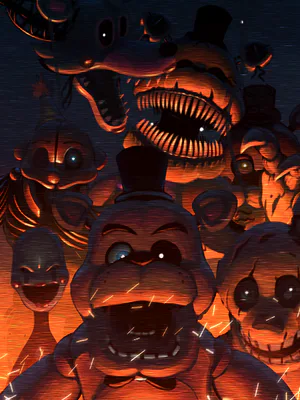
After the fire at Freddy Fazbear’s Pizzeria Simulator (FNAF 6), it seems like William Afton is finally destroyed along with the remaining animatronics, but the story gives us clues that he doesn’t truly die. The HandUnit says that “the gates of hell have opened,” which could be taken literally as a supernatural punishment or as a symbolic reference to Afton being sent somewhere torturous. One compelling theory is that this “hell” is the nightmare world depicted in FNAF 4. In that game, Nightmare Freddy, Nightmare Bonnie, Nightmare Chica, Nightmare Foxy, and Nightmare Fredbear appear in a twisted, dark version of the previous restaurants. While these nightmarish animatronics are officially tied to the fears of the crying child, they could also represent William Afton’s eternal punishment, with each animatronic symbolizing either one of the children he murdered or the guilt and trauma of his past crimes. Nightmare Fredbear, in particular, seems directly connected to the Bite of ’83, which was one of the earliest events that set Afton on his path of murder and obsession with animatronics.
This interpretation also helps explain the emergence of Burntrap in Security Breach. Burntrap’s burnt, decayed appearance and aggressive behavior could indicate that Afton eventually escapes the nightmare world, but is permanently scarred and twisted by the torment he endured there. His return suggests that even though he is freed from the hellish nightmare, the consequences of his actions continue to follow him, forcing him into a new cycle of violence and survival. This theory creates a timeline connecting FNAF 6, FNAF 4, and Security Breach: Afton survives the fire in FNAF 6, is sent into the nightmare world as punishment, experiences repeated torment from the Nightmare animatronics, and eventually escapes as Burntrap, carrying both his trauma and guilt into the next chapter of the story. This cycle aligns with other FNAF games, including Ultimate Custom Night, where Afton repeatedly faces punishment and attacks from the spirits of the children he killed, reinforcing the idea that William Afton can never truly escape the consequences of his actions.
By connecting these events, the theory not only explains the existence of the FNAF 4 nightmare animatronics in a new light but also gives a deeper purpose to Burntrap’s terrifying return, framing him as the survivor of a personal hell rather than just another animatronic villain. It paints a picture of a character trapped in an endless cycle of his own making: a brilliant but monstrous mind, haunted by the very consequences of his obsession with life, death, and the animatronics that blur the line between both





0 comments