
In the last blog post, we discussed techniques that you could use to think of new game ideas. Once you have that idea, you want to begin working on the design. The best way to begin developing your idea into a design is to understand the different design methodologies. There are numerous methodologies to the software development process but to keep things concise I will only discuss the waterfall and iterative methods.
The design of a game project would move in one steadily, downward direction following the Waterfall Method:
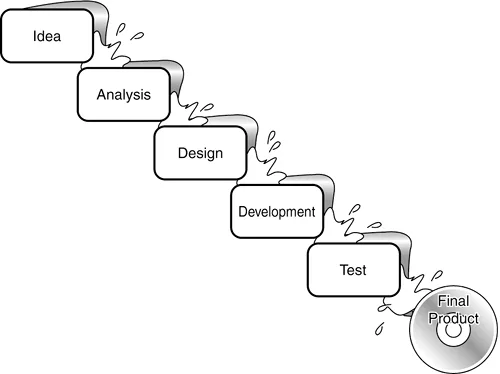
In a nutshell, the process of the waterfall method is to brainstorm an idea, analyze and design the idea into a game, develop and test the game with a prototype, and finally add the graphical polish along with other necessities, and ship the game. As the video game industry matured, publishers and developers came to understand that testing and adjusting game software requires time and money. It is also known that the time and money required increases the further you are into the development phase. This initially made developers want to test and adjust as little as possible which only hurt the game projects in the end.
Developers eventually encountered what is known as the Rule of the Loop: the more times you test and improve your design, the better your game will be. So, the idea to add the option of being able to backtrack and redesign things in earlier steps came along. This created what is known as the Iterative Approach:
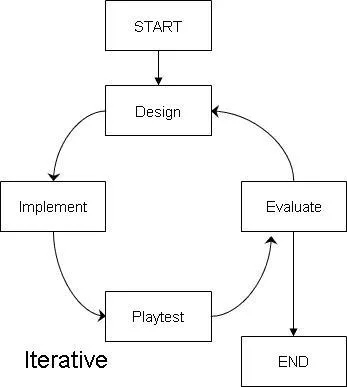
Similar to the waterfall method, you first come up with an idea, design the game, implement the game with a playable prototype, and then you test to see if the core mechanics work. However, after the testing comes an evaluation step. While evaluating the prototype of the game, you playtest the idea to decide what part of the design fits, and what needs to change. During this step, you are able to make the decision of whether the game is complete and ready to be shipped, or if you need to go back to the design step, and make some changes.
The problem with the waterfall method is that it is too linear for both designing and programming. It violates the rule of the loop because it leaves no room for iteration, which is needed in the creation process. If you should decide while using the iterative method that the rules, for example, need to change then you are able to go back to the design step, address the identified problem, implement the changes, and evaluate again. The iterative approach allows you to continue doing this until the game is ready. The iterative approach is inspired by the scientific method which involves making an observation, making a hypothesis, creating an experiment to prove or disprove the hypothesis, performing the experiment, evaluating the results of the experiment while forming a new set of observations, and repeating the first step until you reach desired results.
Since game design and development is an iterative approach, it should be obvious which method would help more with the game creation process. However, there are times when the waterfall method can be useful, like in games where the mechanics are largely lifted from another successful game, or with sequels and expansion sets to popular games. But for new and innovative ideas, the iterative approach is the road to take. Once you decide which methodology would work best, you can proceed with the next step in the game creation process which is the Implementation of the Game Prototype.
The Game Creation Process Part 1


0 comments