
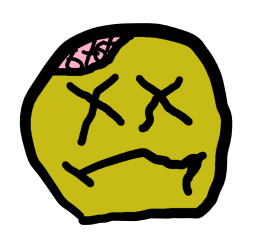
From the moment the pen—or stylus—touched the canvas, the act of drawing this face was more than just doodling; it was a release, a statement, and a mirror of inner emotion. To the artist, this yellow, sickly figure with X-shaped eyes, a crooked mouth, and a partially exposed brain is not just a character—it’s a reflection of their own mental landscape.
Choosing Color and Form
The choice of the yellow-green hue likely didn’t come from a rulebook or formal color theory. Instead, it emerged organically, capturing a sense of discomfort, unease, or queasiness. For the drawer, this is a color of mood, not accuracy—an instinctual way to translate inner feelings into a visible form. The rough, irregular outline of the head mirrors a sense of instability or imperfection that the artist may have been feeling. It’s as if the figure itself is breathing, trembling, or struggling to hold together, echoing the artist’s own vulnerability.
Expressing Emotion Through Simplicity
The X-shaped eyes are bold and deliberate. They aren’t meant to be subtle; they are a universal shorthand for extreme states—death, exhaustion, or mental shutdown. For the drawer, marking the eyes this way could have been a cathartic act: visually acknowledging a mental or emotional “exit” that words fail to convey.
The crooked, drooping mouth reinforces this raw honesty. The artist isn’t striving for perfection—they are communicating fatigue, resignation, or frustration. In every uneven line, the drawer leaves traces of their hand and their state of mind, creating a kind of map of internal tension.
The Exposed Brain: Vulnerability Made Visible
One of the most striking choices is the partially exposed brain. This isn’t just a horror trope—it is intimate and symbolic. From the artist’s perspective, revealing the brain is like revealing a part of themselves that they usually keep hidden: fears, anxieties, overthinking, or cognitive overwhelm. The drawer may have felt mentally “raw” while creating this, and this detail becomes a visual confession, a glimpse into their private world.
The Act of Drawing as Therapy
For the artist, this image is more than representation—it is a process. Each line and color choice allows for expression of feelings that might be difficult to articulate verbally. The roughness, asymmetry, and exaggerated features all signal a need to externalize internal chaos, perhaps as a form of self-soothing or emotional processing. Drawing becomes a dialogue with oneself: the canvas listens, reflects, and never judges.
Humor and Catharsis
Even in its grim elements, the figure’s cartoonish exaggeration introduces a subtle layer of humor. For the drawer, creating this face might have been a way to laugh at their own struggles—acknowledging stress, exhaustion, or overthinking while keeping it light enough to survive emotionally. It’s a mix of honesty and play, a coping mechanism expressed through art.
Conclusion: A Mirror and a Messenger
From the drawer’s perspective, this sketch is both a mirror and a messenger. It mirrors the state of mind that inspired it—fragile, tired, maybe overwhelmed—but it also communicates to the world (or to themselves) that it’s okay to feel this way. Each X in the eyes, each jagged line of the mouth, and each exposed portion of the brain is a deliberate choice, revealing vulnerability, humor, and resilience simultaneously.
In short, this isn’t just a doodle—it’s a snapshot of the drawer’s inner life. It’s messy, imperfect, and raw, yet it conveys an honesty that polished art rarely achieves. For the artist, creating it is a small act of survival, a way to face chaos with a pen in hand and turn feelings into something tangible, shareable, and ultimately human.






0 comments