
When you've played my "Secrets of Dyrt" game, you must have met him. Aldarus.
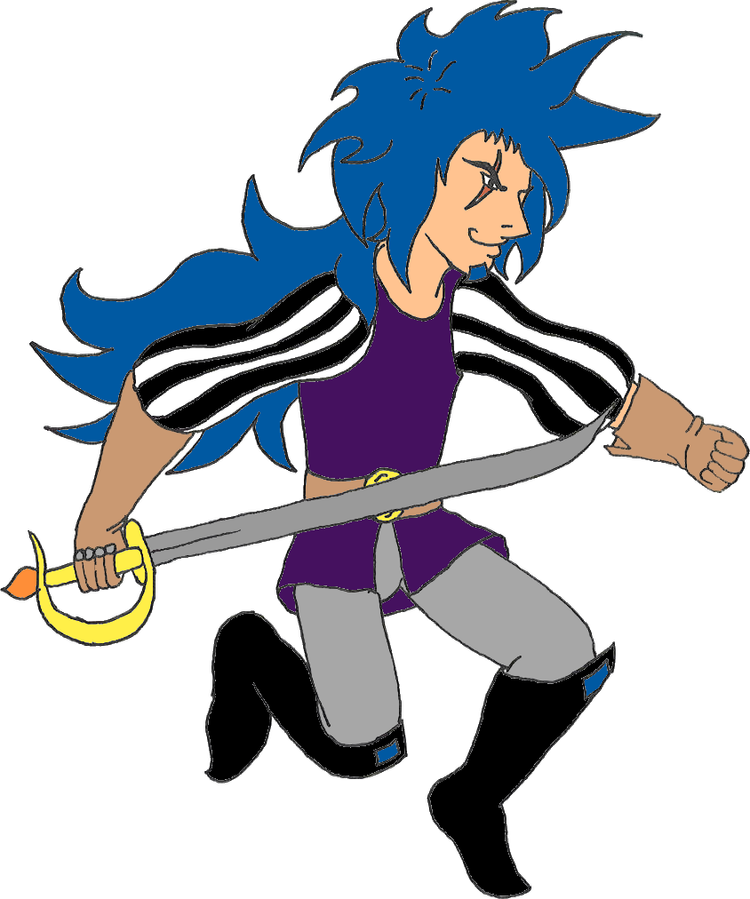
Aldarus was a hard character to put in the game. No, not working out his AI settings as a boss, but as a character in the story line.
SPOILER ALERT! From this point onward this blog may contain spoilers, so don't read on if you still want to play the game! I'll try to keep it as spoiler-free as possible, though.
Aldarus is a very honorable man, and a man of his word. Then why did he fight for the side of evil? In Aldarus' case it was because he had sworn some very heavy vows and he intends to uphold every vow he took on, no matter where it takes him. He didn't know his vows would eventually force him into the "dark side" and to support the evil Lord Dzgjymza.
In Dyrt, Aldarus' role is relatively small. Aldarus also makes his appearance in two novels of mine. The novel "Weniaria" and the novel "De waanzin die 'liefde' heet", the latter could be translated as "The madness called 'love'". Near the end of the story line of the Secrets of Dyrt it is revealed how some important events in the Phantasar Lore intertwine with the story line of Dyrt. The novel "Weniaria" focuses most of all on Weniaria, and the kind of girl she was as a mortal and how her actions eventually got her killed yet revived as the Goddess of Healing in the Elfish religion. "De Waanzin die 'Liefde' heet" takes place in the time right after Weniaria's death as a mortal and her ascension into godhood, and in that novel in particular Aldarus will play a keyrole and show the reader why his honor as a warrior "forced" him onto the road to evil.
Aldarus really hates himself for having to uphold these vows, but he does still care for his honor, and that's why he never breaks his vows no matter what they force him to do. In Dyrt this even causes Rondomo to call him a hypocrite and to state that Shalaga (for the humans and Befindos the Goddess of Justice) will damn his soul anyway. And no matter how repulsive Rondomo may be, I must say that he has a point, as far as Aldarus is concerned.
Aldarus' presence could therefore in these three stories be seen as a kind of a philosophical move from my side as a writer. Are promises and vows always the right excuse to do a bad thing? In the real world, it's not that uncommon that a judge/jury has to acquit a murderer while it is absolutely clear that murderer is guilty as can be, but that there is still no way in the law allows to punish him for that, or even worse, that people who walked the path of evil even are rewarded by such courts just because the law happens to be the way it is. Aldarus is in a similar situation in which his vows obligate him to walk the path of evil, but his judgment as a person tells him today otherwise, still he chooses to go against his personal (and honestly better) judgment and keeps following his vows. One must always be able to look further than vows and rules to come to true judgment. "Just following orders" has brought a lot of misery upon us over the years. Basically many wars were only possible because the soldiers did follow their leader's will, regardless of their own opinions about these matters.
Perhaps you should decide how to judge Aldarus. I definitely do not deem him an evil person. Far from that actually. But was upholding his vows, even when it came to the point he had to aid Lord Dzgjymza into his evil plans the right thing to do, or did have have to break his vows, breaking his honorable code as a warrior, standing up against Lord Dzgjymza, losing his honor in the process, but able to be content he did the right thing.
Of course, the term "evil" is always very subjective, as even when it comes to Lord Dzgjymza himself some nuances must be made before we call him "evil". In fact, was he actually evil, or just another victim? As far as this blog in concerned I'll use the term "evil" to make things more understandable in the short run, but in the longer, more objective run, one should never use that term lightly.









1 comment