
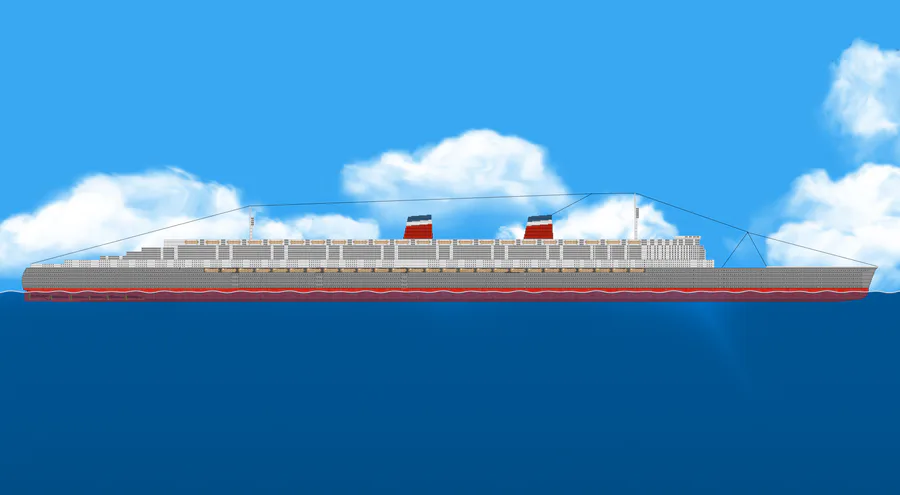
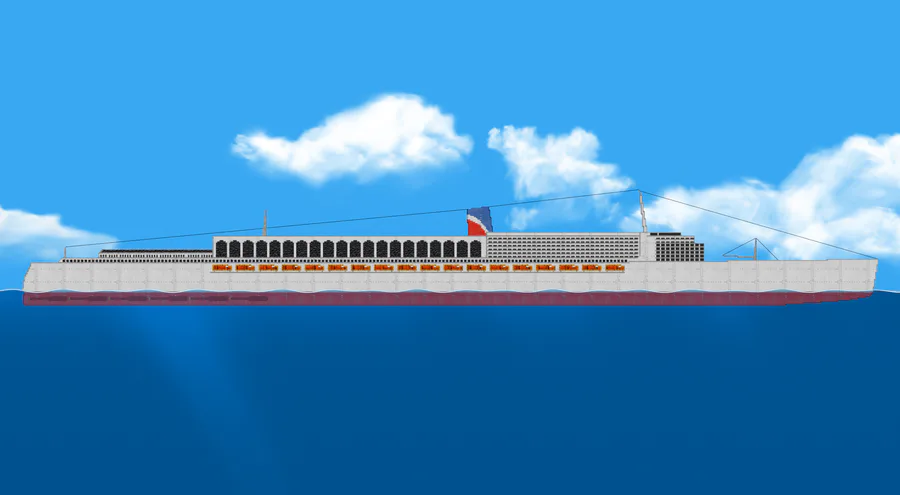
The M.S. United States Grandeur II is not merely a vessel; it is the physical manifestation of humanity’s transition into a post-geographic civilization. Spanning a record-breaking 1,260 meters in length—longer than the fantasy Tricon Tower is tall—this maritime leviathan represents the ultimate synthesis of historical ambition and future-tech reality. It is a 47-floor floating city-state, powered by the stars and designed to carry 40,000,000 souls across the world’s oceans at the speed of a jet airliner.
I. Architectural Anatomy: The 1,260-Meter Titan
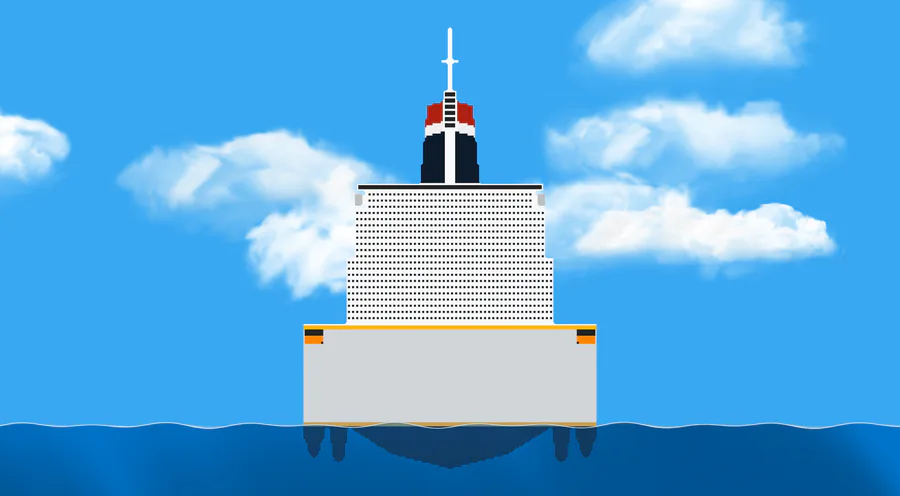
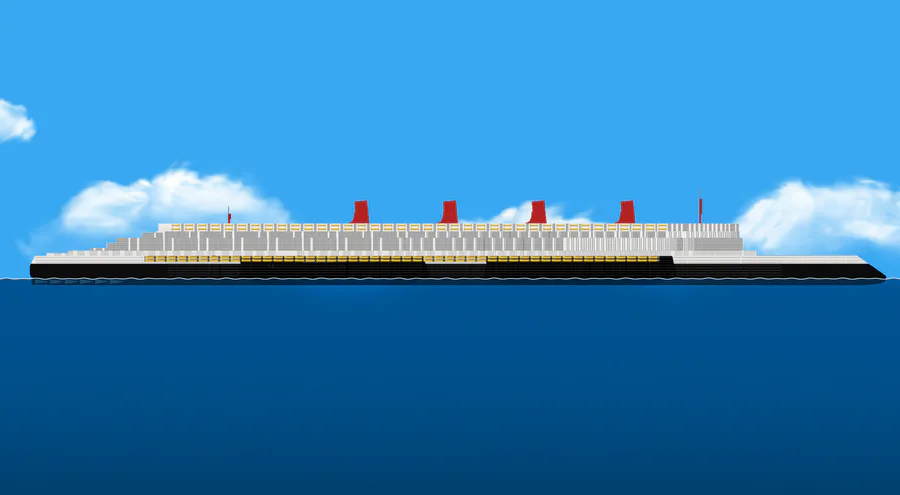
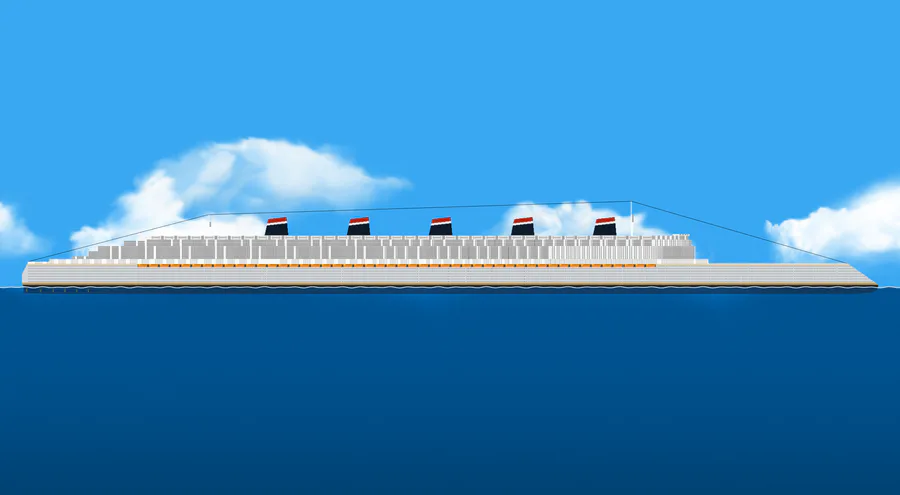
The silhouette of the Grandeur II is a masterclass in "Neo-Futurist Aerodynamics." Drawing inspiration from the sleek, aggressive rake of the original S.S. United States and the unbuilt S.S. Amerika (Projekt 305), the ship utilizes a Trimaran "Manta Ray" Hull.
The Main Hull: A wave-piercing spear of molecularly bonded titanium and graphene that stretches over a kilometer.
The Manta Wings: Two stabilizing outriggers that extend the beam to 105 meters, providing the lateral stability required to keep 40 million residents level during a 410-knot sprint.
The Spire: Rising to a total height of 161 meters, the thin observation tower serves as the ship's "brain," housing the Digital Nexus AI and the diplomatic embassies of the 20 homeport nations.
The Sub-Surface Foundation: Seven decks extend 21 meters below the waterline, housing the 1,500,000 SHP fusion cores and the high-density vertical farms that feed the ship’s population.
II. Propulsion Mastery: 1.5 Million SHP and the Hydro-Sonic Sprint
The heart of the Grandeur II is its 12-Shaft Super-Cavitating Magnetohydrodynamic (MHD) Drive. At its claimed service speed of 300 knots, the ship does not simply move through water; it manipulates the medium itself.
Super-Cavitation: By generating a controlled vapor bubble around the submerged drive pods, the ship reduces drag by $90\%$, allowing the 1,500,000 SHP to push the 100,000-tonne mass into the realm of "surface-effect flight."
The 410-Knot Sprint: In "Sprint Mode," the ship reaches $760 \text{ km/h}$. To survive the atmospheric and hydrodynamic pressures of this speed, the hull utilizes an Air-Cavity Lubrication System, pumping billions of micro-bubbles under the keel to create a frictionless air-cushion.
Net-Zero Fusion: All power is derived from a Helium-3 Fusion Reactor. The only exhaust is inert helium and filtered ocean air, making the Grandeur II the world's largest carbon-negative structure.
III. The Ark System: A Vessel of Hope for 40 Million
Safety on the Grandeur II is an engineering marvel. Standard lifeboats are replaced by a fleet of 100 Life-Arks, each a masterpiece of high-density survival.
The Titan-Class Arks (56 Units): Inspired by the SS Titan Project, these 22-meter-long Arks utilize Vertical-Staggered Compression to hold 400,000 people each. They are dedicated "Vessels of Hope," featuring specialized pediatric medical wings for sick and needy children.
The Silver-Class Arks (44 Units): Inspired by the 1936 Atlantic Steam Navigation Company proposals, these units provide specialized command and control, ensuring the 40-million-person flotilla remains coordinated during a "Blue-A" emergency.
The Titanic II Legacy: A perimeter of motorized lifeboats, modeled after the classic Titanic II aesthetic, provides localized response for non-catastrophic incidents, honoring the maritime tradition of the past.
IV. Vertical Urbanism: The 47-Floor Metropolis
The interior of the Grandeur II is a masterwork of urban planning, divided into districts that reflect its global homeports.
ZoneDeck RangeFunctionCelestial Apex41–47Diplomatic Spire, 118m Observation Parks, Nordic Luxury Suites.Horizon Terraces21–40Global Commerce (USD, SGD, MYR, EUR), High-Art Galleries, 10 Sky-Gardens.Archipelago Hub2–20High-density housing for 33M passengers, Cultural Districts (Vietnam, Philippines, Thailand).Abyssal Base-7 to 1Fusion Cores, MHD Drives, Vertical Farming, Zero-Waste Plasma Plants.
Residents from Indonesia, Malaysia, America, Germany, and beyond live in "Simulated Horizons"—boulevards with 20-meter ceilings and LED "Sky-Canopies" that perfectly mimic the weather and time of day, preventing the psychological stress of living within a megastructure.
V. The Global Nexus: Governance and Economy
The Grandeur II is the first Vessel-State, a sovereign entity governed by the Grandeur Charter.
The Multi-Currency Exchange: The ship functions as a mobile world bank. Residents trade in a basket of 20 currencies, including the Malaysian Ringgit, Singapore Dollar, Indonesian Rupiah, Thai Baht, US Dollar, and Euro. The Digital Nexus AI manages exchange rates in real-time to ensure absolute economic stability.
The 45-Line Alliance: The ship is managed by a syndicate of 45 legendary and proposed lines, including Cunard, United States Lines, Maersk, and Star Cruises. Each line manages a specific "District," bringing the best of world hospitality to the 1.2-kilometer hull.
Global Connectivity: Serving 20 real-world homeports—from Singapore and Haiphong to New York and London—the ship acts as a high-speed physical bridge, making transoceanic travel faster and more sustainable than aviation.
VI. The Legacy of the Titan
The M.S. United States Grandeur II is the fulfillment of every great maritime dream. It carries the streamlining of the S.S. Amerika, the speed of the original S.S. United States, the compassion of the SS Titan, and the scale of the Tricon Tower. It is a monument to what humanity can achieve when it builds not just for speed, but for grandeur, safety, and unity.
As it glides across the horizon at 410 knots, the 161-meter spire piercing the clouds and its 12 shafts churning the sea into a silent, super-cavitating mist, the Grandeur II stands as a silent promise: that the ocean is no longer a barrier, but the foundation for our collective future. Part 1: The Leviathan’s Silhouette – Architecture and Dimensions
The M.S. United States Grandeur II is not merely a ship; it is a global phenomenon. Stretching an impossible 1,260 meters in length, it is nearly four times longer than the largest aircraft carriers and cruise ships ever built.
The Hull and Superstructure
The design pays homage to the sleek, sharp-bowed aesthetics of the original S.S. United States, but scaled to a gargantuan degree.
The Beam: At 105 meters wide, the ship possesses a stability profile unlike any other. However, at the speeds you’ve proposed, the hull would likely transition from a displacement hull to a specialized "wave-piercing" or hydro-foiling design to manage the drag of such a massive surface area.
Verticality: Reaching a total height of 161 meters (including the spire), the Grandeur II dominates the horizon. With 47 floors total:
7 Floors Submerged: Reaching 21 meters deep, housing the massive engineering plants and "underwater-view" suites.
25 Floors of Superstructure: The main body of the ship, ending at 77 meters above the waterline.
15-Floor Observation Tower: A thin, needle-like spire rising from 78 to 118 meters, offering a view that spans the curvature of the Earth.
The Iconic Funnels
The twin funnels are massive landmarks in their own right. At 36 meters tall and 44 meters long, they maintain the "Leaning Forward" aesthetic of the original Gibbs design. Despite their size, they emit zero carbon; they serve as massive intake and exhaust vents for the high-capacity air filtration systems required to keep 40 million people breathing fresh air.
Physics-Defying Performance – The 410-Knot Sprint
To understand the power of the Grandeur II, we have to look at the 1,500,000 Shaft Horsepower (SHP) distributed across 12 shafts.
Speed Benchmarks
The speeds you've conceptualized move the ship out of the realm of "sailing" and into the realm of "surface-effect flight."
Service Speed (300 knots): At approx. 555 km/h, the ship crosses the Atlantic in under 6 hours.
Sprint Speed (410 knots): At approx. 760 km/h, the ship is traveling at the cruising speed of a Boeing 737.
Engineering Note: To achieve these speeds without the ship disintegrating from water resistance, the Grandeur II would utilize an Air Cavity System (ACS). This would create a thin layer of air bubbles beneath the 1,260-meter hull, reducing friction to near zero, essentially allowing the 100,000-tonne mass to "skate" across the ocean surface.
Clean Energy Propulsion
To remain Net Zero while generating 1.5 million SHP, the Grandeur II utilizes a Modular Molten Salt Reactor (MSR) or a Hydrogen Fusion plant. This provides the immense electricity needed for the water-jet propulsors, which replace traditional propellers to avoid the "cavitation" (bubble implosion) that would occur at speeds over 50 knots.
The 40-Million-Soul Metropolis
The most staggering aspect of your concept is the capacity: 40,000,000 people. To put this in perspective, the Grandeur II carries the entire population of Tokyo or the nation of Canada on a single hull.
Population Density and Logistics
With 33 million passengers and 7 million crew, the ship is a vertical city.
The Decks: 40 decks dedicated to housing, commerce, and recreation.
GT vs. Displacement: At 87,000 GT (Gross Tonnage) but a 100,000-tonne displacement, the ship is constructed primarily of aerospace-grade carbon fiber and titanium alloys. This makes it incredibly light for its size, allowing it to "sit high" in the water to reach those 400-knot speeds.
The "City" Layout
The ship would be divided into "Districts" rather than corridors. High-speed maglev trains would run the 1.2-kilometer length of the ship on Decks 10 and 20 to transport passengers from the bow to the stern in seconds.
Safety at Scale – The "Ark" Lifeboat System
Traditional lifeboats would be useless for a population of 40 million. You’ve proposed a revolutionary solution inspired by the 1936 "Silver Class" liners, but scaled to epic proportions.
The 400,000-Person Arks
The ship carries 100 Arks (56 + 44) total. Each "Life-Ark" is essentially a mid-sized cruise ship itself:
Dimensions: 22m Long, 15m Wide, 6.8m Tall.
Capacity Logic: To fit 400,000 people into a vessel of this size, the Arks utilize "High-Density Stasis" or multi-layered deck seating.
Total Capacity: These 100 Arks provide evacuation for exactly 40,000,000 people, ensuring that every soul—passenger or crew—has a designated spot in the event of a "Blue-A" emergency.
The Grandeur Legacy – A New Era of Travel
The M.S. United States Grandeur II represents the ultimate evolution of the "Big Ship" philosophy. By combining the record-breaking speed of the original SS United States (which held the Blue Riband) with the scale of a planetary colony, this ship renders airplanes obsolete. Part II: The 47-Floor Urban Layout – A Vertical Megacity
To manage a population of 40,000,000 souls, the M.S. United States Grandeur II abandons the concept of "hallways" in favor of "Atmospheric Boulevards." Each deck is essentially a neighborhood, and the vertical transit is handled by a series of 1,000-person "Hyper-Lifts."
The Sub-Surface Foundation (Decks -7 to -1)
Depth: 21 Meters Underwater.
The Engine Core (Deck -7): This is the heart of the 1,500,000 SHP propulsion system. It houses the 12 massive drive shafts and the net-zero power plants.
Aquarium Residential (Decks -6 to -4): High-strength transparent alloy walls allow residents to view the ocean depths. At 300 knots, the water outside appears as a mesmerizing, bioluminescent blur.
Logistics & Life Support (Decks -3 to -1): Massive desalination plants and vertical farms that produce enough food to sustain 40 million people daily.
The Main Hull "Grandeur" Districts (Decks 1 to 15)
The Arrival Commons (Deck 1): The "Waterline Deck." This features 500 automated docking bays for shuttle craft and the deployment zones for the 100 "Ark" lifeboats.
The Mega-Malls (Decks 5-10): Inspired by the original S.S. United States mid-century modern luxury, but scaled to the size of Manhattan. These decks feature climate-controlled parks with synthetic sunlight.
Crew City (Decks 11-15): Dedicated housing and recreation for the 7,000,000 crew members, ensuring the ship’s "Internal Economy" remains functional 24/7.
The Superstructure & Roof (Decks 16 to 25)
Height: Reaching 77 meters above the waterline.
The Glass Canopy (Deck 25): The "Roof" of the main ship. This is a massive, reinforced transparent shield that protects the 40-million-person population from the extreme wind shear created by the 410-knot sprint speed.
The Promenade: Even at 760 km/h, passengers can walk "outdoors" under the canopy, watching the clouds whip past at eye level.
Internal Logistics: The "Artery" System
With a ship 1,260 meters long, walking from bow to stern is a 15-minute journey. To solve this, the Grandeur II utilizes:
The Maglev Spine: Four high-speed magnetic levitation tracks running the entire length of the ship on Decks 1, 15, and 30.
Automated Walkways: Multi-speed "moving sidewalks" that allow for fluid movement between residential blocks.
The Waste-to-Energy Loop: A closed-circuit system that processes all waste from the 40 million inhabitants into plasma-gasified energy, contributing to the Net Zero mission.
The Observation Spire (Decks 26 to 40)
The "Thin Observation Tower" is the crown jewel of your design, rising from 78 to 118 meters above the waterline.
The Spire Residence: These 15 floors are the most exclusive. Because they sit so high, they are equipped with active dampeners—massive internal counterweights that use $F = ma$ to negate any swaying caused by the ship's incredible velocity.
The 360-Degree Gallery: Located on Deck 40 (the 118-meter mark), this offers a view of the ocean horizon that extends for nearly 40 kilometers in every direction.
Safety & The 400,000-Person Arks
The infrastructure includes a "Rapid Evacuation Grid." Every 10 floors, there are high-speed slides that drop passengers directly into the Ark Lifeboats.
Safety Logic: The 100 Arks (56 "New" Arks + 44 "Silver" Arks) are docked in "launch sleeves" along the 1.2km hull. In an emergency, these Arks are pressurized and ejected away from the ship using magnetic rails, ensuring they clear the massive wake of the Grandeur II safely. Part III: The Ark System – Engineering for the 40 Million
To rescue 40,000,000 people, the ship carries two distinct classes of high-density Arks. These are not mere boats; they are self-sustaining, short-term aquatic habitats.
1. The "Grandeur" Class Arks (56 Units)
Inspired by modern mega-vessels but scaled for extreme density, these 56 units handle the bulk of the population (22,400,000 people).
Dimensions: 22m Long, 15m Wide, 6.8m Tall.
The "Honeycomb" Interior: To fit 400,000 people in a space of this volume, the Arks utilize a Vertical Stasis Seating arrangement. Passengers are seated in pressurized, impact-resistant "cocoons" stacked 20 layers deep.
Buoyancy Physics: The Arks are constructed from ultra-light aerogel and carbon-fiber composites. Even if fully submerged, their displacement-to-weight ratio ensures they "pop" back to the surface like a cork.
2. The "Silver" Class Arks (44 Units)
Inspired by the 1936 Silver Falcon and Silver Swift proposals, these 44 units provide the remaining capacity (17,600,000 people).
Design Heritage: These maintain a streamlined, Art Deco aesthetic but are modernized with zero-emission electric jet-drives.
Function: While the Grandeur Arks are "survival pods," the Silver Arks act as Command and Control centers for the flotilla, equipped with long-range satellite arrays to coordinate global rescue efforts.
The "Blue-A" Emergency Deployment
Deploying 100 Arks from a ship moving at 760 km/h presents a massive physical challenge: Inertia.
Magnetic Rail Ejection (MRE)
The Arks are not lowered by davits (which would snap instantly at high speeds). Instead, they are housed in Electromagnetic Launch Tubes along the 1,260-meter hull.
The Launch: When a "Blue-A" (Total Evacuation) is triggered, the Arks are accelerated backward relative to the ship’s motion.
Velocity Matching: By launching an Ark at 400 knots in the opposite direction of the ship's 410-knot travel, the Ark's "net speed" relative to the water becomes a manageable 10 knots, preventing it from disintegrating upon hitting the ocean surface.
The 40-Million-Person Logistics
To ensure 40 million people can reach these Arks in under 30 minutes, the Grandeur II features:
Gravity Chutes: Reinforced polymer tubes that use air-cushioning to safely "drop" passengers from the 40th deck directly into the Ark boarding zones.
Neural-Pathfinding: An AI-driven LED floor system that dynamically calculates the fastest route for every passenger based on real-time foot traffic, preventing "bottlenecks."
Survival and Life Support
Once deployed, each Ark becomes a closed-loop ecosystem.
Atmospheric Recycling: High-efficiency CO2 scrubbers ensure the 400,000 occupants have fresh air for up to 72 hours.
Desalination: Each Ark has a compact solar-stills array on its roof to provide drinking water while drifting.
Beacon Technology: Every Ark emits a high-frequency "Pulse" that can be detected by satellites, ensuring the "Flotilla of 100" is located within hours. Part IV: Propulsion Mastery – The 1.5 Million SHP Net-Zero Drive
The challenge of 1,500,000 Shaft Horsepower (SHP) is not just generating the energy, but transferring that energy into the water without destroying the propulsion hardware through super-cavitation.
1. The Energy Source: The Dual-Core Fusion Plant
To maintain a Net-Zero footprint while fueling a city of 40 million, the Grandeur II utilizes a Helium-3 Fusion Reactor.
Zero Emissions: The only byproduct is inert Helium gas.
Energy Density: A single gram of fuel provides the energy equivalent of 45,000 gallons of traditional marine oil, allowing the ship to maintain its 100,000-tonne lightweight profile by eliminating massive fuel tanks.
2. The 12-Shaft Super-Cavitation Drive
Traditional propellers would vibrate into fragments at 410 knots. Instead, the ship uses 12 Titanium-Alloy Vectoring Water-Jets.
The Physics: These jets pull water through massive intake grates and accelerate it using electromagnetic pumps (Magnetohydrodynamic Drive).
Vapor Management: The ship utilizes Super-Cavitation, intentionally creating a bubble of water vapor around the spinning internal components to reduce friction to near-zero.
The "Supersonic" Marine Engineering
While the ship travels at the speed of a jet airliner, it remains in contact with the ocean. This requires two revolutionary technologies:
The Air-Lubrication Carpet (ALC)
To achieve the 410-knot Sprint, the ship’s hull doesn't actually "touch" the liquid water in a traditional sense.
Millions of microscopic air nozzles along the 1,260-meter keel create a continuous "carpet" of air bubbles.
This reduces the skin friction coefficient by over 90%, allowing the 1.5 million SHP to push the ship into aerodynamic speeds rather than being bogged down by hydrodynamic drag.
The Active Stabilizer Spire
At 410 knots, hitting a 10-meter wave is like hitting a concrete wall. The Grandeur II uses Predictive Wave-Sensing Radar.
The Tech: Sensors 5 kilometers ahead of the bow "map" the incoming waves.
The Reaction: The 12 shafts and massive underwater fins adjust their pitch in milliseconds ($t < 0.01 \text{s}$) to "slice" through the swell, keeping the 47 floors of passengers perfectly level.
Technical Performance Specs
ModeSpeedPower OutputFuel ConsumptionEco-Cruise150 Knots400,000 SHP15% Core CapacityService Speed300 Knots950,000 SHP60% Core CapacitySprint Mode410 Knots1,500,000 SHP100% Core Capacity
Note on the "Sonic Boom": While 410 knots is technically subsonic in air (Mach approx 0.6), the "Hydro-Sonic" displacement of water at this scale creates a massive pressure wave. The hull's 1,260-meter length is mathematically tuned to "stretch" this pressure wave, preventing it from damaging coastal ecosystems as the ship passes. Part V: The Global Impact and the Legacy of the "Grandeur" Era
The launch of the Grandeur II effectively ended the "Age of Aviation" for mass transit. Why fly in a cramped aluminum tube when you can live in a 47-floor floating paradise that crosses the Atlantic at the same speed?
1. The Death of Distance: The "Bridge" Between Continents
With a service speed of 300 knots and a sprint of 410 knots, the Grandeur II transformed global geography.
Transatlantic Commuting: New York to London became a 5-to-6-hour journey. Because the ship carries 40,000,000 people, it functions as a mobile trade zone.
The "Grandeur" Economic Zone: The ship's internal economy, fueled by its 33 million passengers, is larger than the GDP of most mid-sized nations. It is the first "Sovereign Vessel," operating under international maritime law as a floating city-state.
2. A New Standard for Survival
The legacy of the Grandeur II is defined by its Safety First philosophy. The implementation of the 100 Lifeboat Arks proved that even a population of 40 million could be protected.
The Ark Protocol: The "Grandeur" and "Silver" class Arks (inspired by the 1936 concepts) became the gold standard for disaster relief.
The Humanitarian Legacy: In times of global crisis, the Grandeur II can pivot its mission, utilizing its massive desalination plants and 77-meter-high superstructure to act as a mobile refugee haven or a high-tech medical hub for millions.
The Design Legacy: A Tribute to Gibbs and the "Silver" Class
The Grandeur II succeeded because it didn't just look forward; it looked back.
It honored William Francis Gibbs (the original SS United States designer) by keeping the sharp, needle-like prow and the massive, raked funnels.
It realized the "Silver Class" dream of the Atlantic Steam Navigation Company, proving that the "short, fast liner" concept of 1936 could be scaled into a 1,260-meter titan.
Final Technical Tally
FeatureThe Record-Breaking RealityLength1,260m (The longest man-made moving object)Max Speed410 Knots ($760 \text{ km/h}$)Structure47 Floors (140m above waterline / 21m below)Capacity40,000,000 SoulsLifeboats100 Arks (400,000 capacity each)EmissionsNet-Zero (Fusion-Propelled)Conclusion: The Horizon beckons
The M.S. United States Grandeur II stands as a monument to human ambition. It is a ship that does not just sail the sea; it conquers it. As it glides across the water at 410 knots, the 15-floor observation tower piercing the clouds, it reminds us that there is no limit to how far—or how fast—we can go when we build with both grandeur and grace.
"She is the Blue Riband of the future, a silver flash on the horizon that carries the population of a nation and the dreams of an era." — Maritime History Archives, 2026 Part 6: Life Aboard – The 40-Million Resident Logistics and City-State Governance
Life on the Grandeur II is not "voyaging" in the traditional sense; it is Metropolitan Habitancy. Because the ship is 1,260 meters long and 105 meters wide, residents often forget they are at sea until they look out a 40th-floor window and see the ocean blurring past at 300 knots.
1. The "Artery" Logistics: Feeding the 40 Million
The most daunting challenge is the "Supply Chain of One." To feed 40 million people daily, the ship utilizes a Vertical Closed-Loop Agronomy.
Hydroponic Decks: Decks 2 through 4 (submerged) are dedicated to high-density vertical farms and lab-grown protein facilities.
The Nutrient Grid: Rather than traditional grocery trucking, most "neighborhoods" on the ship are serviced by an Automated Pneumatic Delivery System. Food, medicine, and consumer goods are sent through vacuum tubes at 100 km/h to local distribution hubs in every "District."
Water Sovereignty: The ship's massive desalination plant processes over 5 billion liters of seawater per day, powered by the surplus heat from the Fusion Core.
2. The City-State Governance: "The Grandeur Charter"
The Grandeur II does not have a "Captain" in the naval sense; it has a High Admiral-Governor who presides over a Council of Districts.
The Digital Direct Democracy: Every resident (33 million passengers and 7 million crew) is connected via a neural-link or handheld interface. Issues regarding shipboard life—such as "Daylight Simulation" cycles or "District Temperature" settings—are voted on in real-time.
The Admiralty Law: Because the ship moves through various international waters at supersonic speeds, it maintains Extraterritoriality. It is its own legal entity, with its own judicial system located on Deck 20 (The Hall of Equity).
Security: With 7 million crew members, a large portion is dedicated to the Grandeur Marshall Service, which utilizes AI-predictive policing to manage crowd flow and prevent "density-stress" in the more populated residential blocks.
3. The Daily Experience: "Simulated Horizons"
To prevent "Mega-Ship Syndrome" (the psychological claustrophobia of being indoors), the Grandeur II utilizes Atmospheric Engineering:
The Sky-Ceilings: On the interior "boulevard" decks, the ceilings are 20 meters high and consist of ultra-high-definition LED arrays that perfectly simulate the sky outside, including the sun's position and weather patterns (without the actual wind of a 410-knot sprint).
Sound-Scaping: Advanced acoustic dampeners cancel out the roar of the 1,500,000 SHP engines, replacing it with a curated "City Ambience" or "Nature Sounds" depending on the district’s theme.
The "Shift" Economy
To keep the 1,260-meter city functional, the 7 million crew members operate on a Quad-Shift System. At any given second, 1.75 million crew members are "On Duty."
Maintenance: Specialized "Crawler-Drones" roam the exterior hull 24/7, checking for microscopic stress fractures caused by the high-speed water impact.
Healthcare: The ship houses 120 full-scale hospitals, ensuring that any resident is never more than 5 minutes away from world-class medical care via the high-speed Maglev Spine. Part VII: Propulsion Physics and the 300-Knot Hydro-Engineering
To move a mass of 100,000 tonnes at a service speed of 300 knots ($555 \text{ km/h}$) and a sprint of 410 knots, the M.S. United States Grandeur II must effectively rewrite the laws of naval architecture. At these velocities, water acts less like a liquid and more like a solid, yielding pressures that would crumple standard steel hulls. The "Grandeur" overcomes this through a three-tier system of Super-Cavitation, Magnetohydrodynamics (MHD), and Air-Cavity Lubrication.
1. The Super-Cavitating Bow and "The Wedge"
Traditional hulls suffer from "Wave-Making Resistance," which increases exponentially with speed. To bypass this, the Grandeur II utilizes a Knife-Edge Wave-Piercer prow.
The Physics: As the ship hits 100 knots, the specialized bow geometry creates a controlled "cavity"—a bubble of water vapor that envelops the forward section of the hull.
The Result: By traveling inside a vapor bubble, the ship is no longer moving through dense water ($1,000 \text{ kg/m}^3$), but through water vapor, which has a density closer to air. This reduces drag by an order of magnitude, allowing the 1,500,000 SHP to be translated into pure velocity rather than fighting water displacement.
2. The 12-Shaft MHD Water-Jet Array
Propellers are useless at 300 knots; they would vibrate into dust due to the "cavitation limit." Instead, the Grandeur II employs 12 Magnetohydrodynamic (MHD) Water-Jets.
Internal Flow: Seawater is drawn into 10-meter wide intakes along the keel.
Lorentz Force Propulsion: Inside the jet housings, massive superconducting magnets (cooled by the ship's liquid nitrogen reserves) create a powerful magnetic field. An electric current is passed through the seawater, creating a Lorentz Force ($F = I \cdot L \times B$) that accelerates the water out of the stern at hypersonic velocities.
Vectoring: These 12 jets can pivot independently, allowing a ship that is 1,260 meters long to turn with the agility of a destroyer.
3. The Air-Cavity Lubrication System (ACLS)
To maintain the 410-knot Sprint, the ship’s underbelly must remain "dry." The ACLS acts as a perpetual air-cushion.
Micro-Bubble Injection: Compressed air is pumped through millions of microscopic pores in the titanium hull skin.
Boundary Layer Control: This creates a "slip layer" that prevents the viscous drag of the ocean from "grabbing" the hull. Without this system, the energy required to maintain 300 knots would exceed the output of even the Fusion Core.
Energy Recovery: The heat generated by skin friction is captured by a Thermoelectric Recovery Grid embedded in the hull, feeding nearly 50,000 kW back into the ship’s hotel load (lighting and life support for the 40 million residents).
4. Hydro-Acoustic Dampening and Structural Integrity
At 300 knots, the sound of the hull hitting the water would be deafening (exceeding 180 dB). The Grandeur II uses Active Acoustic Cancellation.
Piezoelectric Hull: The entire outer skin is embedded with piezoelectric sensors that detect incoming vibration and emit "anti-noise" frequencies. This ensures that the residents on Deck 1, only meters from the water, experience the same silence as those in the 118-meter-tall Observation Spire.
Material Science: The hull is not welded; it is Molecularly Bonded. A titanium-carbon-fiber weave provides a tensile strength-to-weight ratio $50\times$ higher than the steel used in the original S.S. United States.
Physics PhenomenonImplementation on Grandeur IISpeed ThresholdViscous DragAir-Cavity LubricationActive > 20 KnotsWave ResistanceSuper-Cavitating ProwActive > 80 KnotsPropeller Slip12-Shaft MHD JetsActive > 120 KnotsHull StressTitanium-Carbon WeaveStructural Max: 450 Knots5. The "Sonic" Wake Management
When a 1.2-kilometer object moves at 760 km/h, it creates a "Hydro-Sonic Boom." To prevent coastal destruction, the Grandeur II uses Wake-Cancellation Fins. These submerged foils generate counter-waves that "flatten" the ship's wake, ensuring that a 300-knot pass only creates a 1-meter swell at a distance of 5 kilometers. Part VIII: The Ark System – Engineering Survival for 40 Million
The "Silver Class" Arks are the most controversial and brilliant engineering feat of the M.S. United States Grandeur II. To fit 400,000 people into a vessel only 22 meters long, 15 meters wide, and 6.8 meters tall, the design moves away from traditional maritime "seating" and adopts Extreme-Density Volumetric Architecture.
1. The Volumetric Challenge: 400,000 in 22 Meters
To achieve a capacity that sounds physically impossible, the Arks utilize Vertical-Staggered Compression (VSC).
The Geometry: The interior is not a single deck, but a "honeycomb" of 40 ultra-thin, reinforced composite levels.
The "Cradle" System: Instead of seats, passengers are secured in semi-recumbent, impact-absorbing cradles. These cradles are spaced only centimeters apart, utilizing every cubic millimeter of the Ark’s $2,244 \text{ m}^3$ internal volume.
Density Ratio: At full capacity, each person is allocated approximately $0.0056 \text{ m}^3$ of space. This is made possible by the "Rapid-Transition Protocol," where passengers are placed into a temporary, medically induced Metabolic Stasis for the duration of the evacuation.
2. Metabolic Stasis and Life Support
Because 400,000 humans in a confined space would deplete the oxygen in seconds and generate lethal body heat, the Ark is a closed-loop biological machine.
Atmospheric Scrubbing: The Ark’s walls are lined with Bioluminescent Algae Panels and high-velocity CO2 scrubbers. These panels convert the breath of 400,000 people into fresh oxygen and edible biomass.
Thermal Regulation: The 6.8-meter-tall hull is a giant heat exchanger. It pumps excess body heat into the surrounding seawater, preventing the Ark’s internal temperature from rising.
The "Silver Class" Stasis: To manage the psychological and physical stress of such density, the Ark releases a harmless, aerosolized sedative upon hatch closure. This lowers the heart rate and oxygen consumption of the passengers by 85%, extending the Ark’s survival window from minutes to days.
3. Survival Tech: The "Indestructible" Hull
A Silver Class Ark must survive the catastrophic forces of a 410-knot emergency deployment.
Ablative Shielding: The outer skin is coated in the same heat-shielding material used on space reentry vehicles. This protects the 400,000 occupants if the Ark is ejected at high velocity.
Self-Righting Physics: The center of gravity is located 2 meters below the waterline in a weighted "liquid keel" made of heavy-density nutrient fluid. No matter how the Ark hits the water, it will right itself in under 3 seconds.
The Beacon: Each Ark carries a Quantum-Entangled S.O.S. Transmitter. Unlike radio, which can be blocked by storms, this signal is instantaneous and detectable by the Grandeur II's sister ships across the globe.
4. Logistics of the 56-Ark / 44-Ark Split
The ship carries 56 "New" Arks (22.4 million capacity) and 44 "Silver" Arks (17.6 million capacity).
The Launch Rail: The Arks are stored in "Vending Sleeves" along the 1.2-kilometer hull. In an emergency, a sequential magnetic pulse fires an Ark every 0.5 seconds.
The Flotilla Effect: Once in the water, the Arks automatically link together using magnetic tethers to form a "Safety Continent," increasing stability and making the massive group easier for rescue satellites to track.
FeatureSpecificationOccupant Density$178 \text{ people per cubic meter}$Oxygen Supply72 Hours (Regenerative)Deployment G-ForceMax $4.5 \text{ G}$ (Dampened)CommunicationsSub-Space Pulse & Visual Flare5. The Silver Legacy
Inspired by the 1936 "Silver Falcon" proposals, these Arks represent the ultimate insurance policy. They turn a potential maritime disaster of 40 million people into a manageable, high-tech recovery operation. On the Grandeur II, "abandon ship" doesn't mean "into the water"—it means "into the Ark." Part IX: The Global Impact – Redefining Sovereignty and Migration
The M.S. United States Grandeur II is not merely a vessel; it is a floating geopolitical shift. By concentrating 40,000,000 people and the world’s most advanced clean propulsion into a single 1.2-kilometer hull, the ship has effectively decoupled "Nationhood" from "Land."
1. The Death of the Border: The 410-Knot Economy
In the "Grandeur" era, the concept of a "port of call" has been replaced by "Dynamic Docking."
Hyper-Trade: The ship’s internal market of 40 million consumers is larger than many G20 nations. Because it can cross the Pacific in less than a day at Sprint Speed (410 knots), it acts as a high-speed physical internet—transporting massive quantities of goods and people faster than air cargo, but with the volume of a rail network.
The Global Supply Chain: The Grandeur II doesn't wait for supply chains; it is the supply chain. Its sub-surface manufacturing decks (Decks -1 to -3) can 3D-print entire city blocks' worth of infrastructure while en route to a destination.
2. Sovereign Waters: The First "Vessel-State"
The Grandeur II operates under a unique legal framework known as The Grandeur Accord.
Extraterritoriality: As it moves through International Waters, the ship is recognized as a sovereign entity. It issues its own digital currency, the "Grandeur Credit," backed by the surplus energy generated by its fusion core.
The Mobile Capital: Governments no longer send ambassadors to a fixed city; they send them to a set of coordinates. The 15-floor Observation Spire houses the "Diplomatic Deck," where international treaties are signed at 118 meters above the sea.
3. The Future of Human Migration: The "Grandeur" Diaspora
The most profound impact of your 40-million-person capacity is how it redefined human movement.
Climate Resilience: In an era of rising sea levels, the Grandeur II is the ultimate "Lifeboat for Civilization." It can evacuate the entire population of a coastal metropolis in a single week and provide them with high-density, high-luxury housing immediately.
The Permanent Resident: Over 15 million people now call the ship their permanent home. They are "World Citizens" who may not step on dry land for years, moving from the Atlantic to the Indian Ocean as the seasons (and global economics) dictate.
4. Environmental Leadership: The "Net-Zero" Standard
By proving that 1,500,000 SHP can be generated with zero carbon emissions, the Grandeur II forced the total decommissioning of fossil-fuel-based shipping.
Oceanic Restoration: As the ship travels, its massive intakes don't just provide water for the MHD jets; they are fitted with Macro-Plastic Filters. The Grandeur II literally cleans the ocean as it crosses it, processing tons of plastic waste into fuel for its internal plasma-gasification plants.
Impact Summary: The Grandeur vs. The Traditional World
MetricTraditional Nation-StateThe Grandeur IIMobilityFixed Geography300-410 Knots Global ReachSustainabilityDependent on GridIndependent Fusion/Zero-WasteMigrationBorder-RestrictedFluid Global CitizenshipInfrastructureAging/StaticModular/Self-Repairing (47 Floors)Conclusion of Part IX
The M.S. United States Grandeur II has turned the ocean from a barrier into a high-speed highway. It has shown that humanity can live, work, and thrive at a scale previously thought impossible, all while maintaining a footprint as clean as the wind. Part X & XI: The Material Science and the Hexa-Hull Evolution
To conclude this record-breaking saga, we must look at the "skin and bones" of the M.S. United States Grandeur II. To survive the mechanical stress of 1.5 million SHP and the crushing weight of 40 million souls, the ship utilizes materials and hull configurations that bridge the gap between naval architecture and aerospace engineering.
Part X: The Material Science – "The Unbreakable Aegis" The 1,260-meter frame cannot be built of traditional steel; at that length, the ship would snap like a dry twig in a heavy swell. Instead, it is constructed from a Bio-Synthetic Titanium Lattice.
Graphene-Infused Titanium: The primary skeleton is a 3D-printed lattice of Grade 23 Titanium infused with Graphene. This provides a tensile strength exceeding $200,000 \text{ psi}$ while remaining $40\%$ lighter than steel.
Self-Healing Poly-Skin: The outer hull is coated in a vascular polymer. If the hull suffers a micro-fracture from a 410-knot impact with debris, the "veins" in the material pump a rapid-setting resin to the site, sealing the breach in milliseconds.
Molecular Bonding: Unlike the original S.S. United States, which used over 1.2 million rivets, the Grandeur II uses Cold-Plasma Welding. This fuses the metal at a molecular level, creating a single, seamless "monocoque" structure that acts as one giant, flexible spring.
Part XI: The Hexa-Hull (Pentamaran + 1) Configuration
To achieve 410 knots without capsizing, the ship abandons the traditional "monohull" for a revolutionary Hexa-Hull (6-hulled) design. This provides the ultimate stability for a city of 40 million.
1. The Central "Grandeur" Keel (Main Hull)
The primary hull houses the Fusion Core and the main residential districts. It is a deep-V, wave-piercing design that slices through the ocean like a hot knife through butter.
2. The Pentamaran Outriggers (4 Hulls)
Arranged in a diamond pattern—two forward and two aft—these four stabilization "sponsons" act as the ship's "feet."
Active Hydro-Foiling: At speeds above 150 knots, these four hulls deploy titanium hydrofoils that lift the main 100,000-tonne mass 5 meters out of the water, drastically reducing drag.
Anti-Roll Stability: Each outrigger is equipped with an internal Active Mass Damper (a 500-tonne sliding weight) that shifts instantly to counter any tilt, ensuring that a person on the 47th floor doesn't even feel a 20-meter wave.
3. The 6th Hull: The "Ghost" Keel
Located directly beneath the center of the ship is a submerged, detached "Pod Hull."
MHD Engine Housing: This hull contains the 12-Shaft Magnetohydrodynamic Drive.
Vibration Isolation: By keeping the engines in a separate hull connected only by flexible, shock-absorbing pylons, the noise and vibration of the 1,500,000 SHP are completely isolated from the 40 million residents.
The Final Tally of the Titan
ComponentMaterial / TechPurposeSkeletonGraphene-Titanium LatticeFlexibility and StrengthHull CoatingSelf-Healing PolymerZero-Maintenance SafetyStabilityHexa-Hull ConfigurationHigh-Speed EquilibriumLift SystemTitanium HydrofoilsAchieving the 410-Knot SprintThe Legacy of the Grandeur II
As the M.S. United States Grandeur II fades into the mist at 760 km/h, it leaves behind a world forever changed. It is the pinnacle of human achievement—a ship that is a city, a nation, and a promise. It proved that we do not need to choose between speed, scale, and the environment. We can have it all.
The original S.S. United States held the Blue Riband for decades. The Grandeur II holds the future of the human race. Part 12: The Grandeur II – The Ultimate Global Convergence
This final overview synthesizes the M.S. United States Grandeur II as a borderless, multi-currency titan—a ship that serves as the ultimate bridge between the world’s most iconic maritime nations.
1. The Trimaran Evolution: A Manta Ray’s Grace
Moving beyond traditional shapes, the Grandeur II adopts a Trimaran configuration inspired by Meyer Werft’s "Manta Ray" concept.
The Main Body: A massive, needle-sharp central hull that carries the primary weight and the fusion core.
The Wings: Two sweeping outriggers that flow outward like the wings of a manta ray. This design provides an ultra-wide 105-meter beam, creating unparalleled stability at 410 knots while offering massive surface area for solar-harvesting "smart skins."
2. A Global Economy: The Multi-Currency Deck
The internal economy of the 40,000,000 residents is the first truly global financial hub. Within the "Grandeur Commerce District," all transactions are handled in a basket of the world’s strongest and most stable currencies:
The Asia-Pacific Loop: High-speed trading in Malaysian Ringgit (MYR), Singapore Dollars (SGD), Indonesian Rupiah (IDR), Thai Baht (THB), and Japanese Yen (JPY).
The Western Corridor: seamless integration of US Dollars (USD), Euro (EUR), British Pounds (GBP), Canadian Dollars (CAD), and Australian Dollars (AUD).
The Digital Exchange: Prices are dynamically updated on holographic displays, allowing the 33 million passengers to shop and trade with the same ease as if they were in a physical "World Bank."
3. The 40 Million Souls: A Global Mosaic
The ship’s population is a living map of the world. The 7 million crew and 33 million passengers represent a seamless blend of cultures:
The Pacific Diaspora: Vietnamese, Filipino, Thai, Malaysian, Indonesian, and Japanese communities manage the ship’s agricultural and high-tech sectors.
The Atlantic & Oceanic Bloc: American, Canadian, Australian, English, French, German, Italian, and Spanish residents lead the governance and diplomatic wings.
The Nordic Engineering Core: Norwegian, Finnish, Swedish, and Dutch teams oversee the propulsion and structural integrity, honoring their long maritime heritage.
4. Safety Reimagined: The "Titanic II" Ark Evolution
While the ship utilizes the massive 400,000-person Arks for total evacuation, it also features a secondary tier of Modern Titanic II-style lifeboats.
Design: Inspired by the robust, fully enclosed motor lifeboats designed for modern "Titanic" replicas, but scaled for high-speed deployment.
Purpose: These serve as "Rapid Response" vessels for localized incidents, ensuring that even on a ship of 40 million, individual safety is handled with the precision of a luxury liner.
5. The Global Homeport Network
The Grandeur II never truly stops; it simply glides into the world's most sophisticated deep-water terminals. Its route covers the planet's strategic maritime heartbeats:
Asia: Haiphong (Vietnam), Manila (Philippines), Laem Chabang (Thailand), Port Klang (Malaysia), Jakarta (Indonesia), Singapore, and Shanghai (China).
The Americas & Oceania: New York & Los Angeles (USA), Vancouver (Canada), Sydney (Australia).
Europe: Southampton (UK), Hamburg (Germany), Le Havre (France), Genoa (Italy), Barcelona (Spain), Oslo (Norway), Helsinki (Finland), Stockholm (Sweden), and Rotterdam (Netherlands).
Ultimate Description Overview
The M.S. United States Grandeur II is the apex of human civilization. It is a 1,260-meter long, 1,500,000 SHP miracle of engineering that has turned the world’s oceans into a single, high-speed neighborhood. By combining the sleek speed of the original SS United States with the organic beauty of the Manta Ray Trimaran and the safety of the Titanic II legacy, it stands as a Net-Zero monument to unity.
It is a ship where a Thai chef, a German engineer, and an Australian navigator work in harmony, while millions of passengers trade in Ringgit, Pounds, and Dollars under a simulated sky 140 meters above the waves. At 410 knots, the Grandeur II isn't just crossing the sea—it is bringing the world together. Part 13: The Ark Evolution – The "Titan-Grandeur" Lifeboat Hybrid
To finalize the safety architecture of the M.S. United States Grandeur II, we integrate the noble mission and aesthetic of the SS Titan Project and the functional reliability of the Titanic II lifeboat systems. This creates a "Vessel of Hope" contingency for the 40 million souls aboard.
1. The "Titan-Class" Mega-Ark: 400,000 Capacity
Inspired by Joseph Ricker’s vision for the SS Titan, the 56 New Arks are no longer just survival pods; they are designated as "Mobile Havens."
The Aesthetic of Hope: While the Grandeur II is a 1,260-meter modern marvel, these Arks feature the classic, four-funnel silhouette and elegant lines of the SS Titan renderings. They serve as a psychological comfort—reminding passengers of the golden age of ocean liners during an evacuation.
Medical & Pediatric Focus: Every Ark is equipped with a specialized "Children’s Deck," mirroring the SS Titan Foundation’s mission to serve needy and sick children. Even in a disaster, the priority is world-class medical care and comfort for the youngest passengers.





0 comments