1. The Physics of the 2,000,000-Person Ark
Fitting a population the size of a major metropolis into a vessel just 22 meters long, 15 meters wide, and 6.8 meters tall seems like a mathematical impossibility. The Grandeur VI achieves this through Quantum-Density Seating (QDS).
Vertical Layering: Each Ark contains 22 internal "nan-decks," each only 30 centimeters high. Passengers do not stand or sit in the traditional sense; they are placed in horizontal Biostasis Pods.
The Stasis Solution: Upon entering the Ark, passengers are administered a rapid-acting, breathable aerosol that induces a "Deep Hibernation." In this state, metabolic rates drop by 98%, drastically reducing the need for oxygen, food, and space. This allows the Ark to "stack" two million people safely, like a library of human life, maintained by an automated AI medical custodian.
Structure: Despite their 1930s Silver Falcon aesthetic, the Arks are built from Single-Crystal Tungsten-Carbide, capable of withstanding the crushing depths of the ocean or the intense heat of a surface fire.
2. The 100-Ark "Silver" Fleet and the 64 Heavy Arks
The evacuation is split into two specialized fleets to handle the staggering total of 328 million people:
The 100 Primary Arks: These 22-meter units carry 200,000,000 people (2 million per Ark). They are positioned along the 118-meter-tall superstructure and are designed for rapid electromagnetic "cold-launch."
The 64 Heavy Super-Arks: Inspired by the Silver Swift, these larger units are 215 meters tall and handle the remaining 128,000,000 people. These act as "Command Motherships" for the smaller Arks, providing long-range communication and heavy-duty desalination for the fleet.
3. Survival Tech: The "Infinite Lung" and "Net-Zero" Drift
Once deployed, an Ark becomes a self-sustaining habitat.
Atmospheric Scrubbing: Each Ark uses Photo-Synthetic Nanites that line the interior walls. These nanites take the CO2 exhaled by the two million sleeping passengers and convert it back into pure oxygen using a small, internal fusion battery.
The Kinetic Anchor: To prevent the Arks from drifting thousands of miles apart in the Atlantic’s currents, they utilize Electromagnetic Tethering. The 164 units (100 small, 64 large) link together to form a "Survival Island" nearly five kilometers wide, making them an impossible-to-miss target for rescue satellites.
Propulsion: While primarily drift-vessels, each Ark has four retractable Hydro-Jet Thrusters. If the "Survival Island" detects an approaching storm or iceberg, the Arks can collectively coordinate a 20-knot maneuver to avoid danger.
4. The "Awakening" Protocol
Disaster management doesn't end with survival; it ends with recovery. The Grandeur VI’s Arks are equipped with Automated Triage AI.
Sequential Reanimation: To prevent a logistical bottleneck at the rescue site, the Arks do not "wake" everyone at once. The AI monitors the proximity of rescue vessels and begins the 10-minute reanimation process in waves, ensuring that every soul—from the 288,000,000 passengers to the 40,000,000 crew—is alert, hydrated, and ready for transfer.
The Ark system of the Grandeur VI ensures that even if the world's largest ship were to fail, the civilization it carries would remain unbroken. It is the ultimate insurance policy for the "Grandeur" Era. Part 9: The Global Impact – Redefining Sovereignty and Human Migration
The emergence of the M.S. United States Grandeur VI (evolving from the ambitions of the Grandeur III) did more than just break records; it effectively rewrote the geopolitical map of the 21st century. When a single vessel can transport 328,000,000 people—a population roughly equivalent to the entire United States or the Eurozone—the very concepts of "borders" and "territory" undergo a radical shift. The Grandeur VI became the first "Mobile Continent," a sovereign entity that redefined the future of our species.
1. The Death of Distance and the "Instant Migration" Model
Before the Grandeur VI, human migration was a slow, often painful process defined by logistics and geography. This ship transformed migration into a high-speed, mass-event.
The 10-Hour Continent Shift: At a 300-knot service speed, the ship could relocate a significant portion of a hemisphere's workforce in less than half a day. This created the "Elastic Labor Market," where 288,000,000 people could theoretically move to follow seasonal economic booms or flee environmental crises without the need for traditional housing, as the ship is the housing.
Sovereignty on the Move: The Grandeur VI operates under a "Trans-Oceanic Charter." It is not bound by the laws of a single nation but acts as a floating diplomatic zone. This has led to the rise of "Vessel Citizenship," where millions of residents identify more with the 1,983-meter hull of the Grandeur than with their country of birth.
2. The Logistics of Global Trade: The "Grandeur Standard"
The ship’s 1,500,000 SHP and 100,000 GT capacity fundamentally disrupted the global supply chain.
The End of Port Congestion: Because the Grandeur VI is essentially a self-contained city and distribution hub, it doesn't "dock" in the traditional sense. It utilizes its 100 Ark lifeboats and secondary 64 Heavy Arks as high-speed ferry tenders, offloading millions of tonnes of "just-in-time" cargo while the main hull remains at sea.
Climate Recovery Catalyst: By utilizing a Net-Zero emissions powertrain, the Grandeur VI set a new global mandate. Nations were forced to upgrade their infrastructure to meet the ship's clean-energy requirements, effectively dragging the rest of the world's maritime industry into a carbon-neutral future.
3. The 70-Floor City-State: A New Social Experiment
The internal layout of the Grandeur VI created a new type of human society. With 40,000,000 crew members managing the needs of the passengers, the ship became the world’s most complex meritocracy.
Urban Verticality as a Virtue: The 118-meter-tall superstructure proved that high-density living could be luxurious. The "Silver Class" aesthetic, with its sweeping lines and Art Deco finishes, removed the "industrial" feel of mass transit, replacing it with a sense of permanent grandeur.
Safety as Social Cohesion: The knowledge that every person is protected by an Ark system capable of holding 2 million people per unit created a unique sense of collective security. There is no "every man for himself" on the Grandeur VI; the logistics of saving 328 million people require total social cooperation.
4. Legacy: The Future of the "Grandeur" Era
The Grandeur VI stands as a monument to what humanity can achieve when it stops dreaming in increments and starts dreaming in continents. It proved that we could conquer the "Wall of Water" at 410 knots and house the population of a superpower without burning a single drop of fossil fuel.
As the ship carves its path across the Atlantic, its five colossal funnels and 215-meter spire serve as a beacon. It is a reminder that the ocean is no longer a barrier, but a highway—and that the future of humanity is not just on land, but in the majestic, high-speed embrace of the Grandeur. Part 10: Material Science—The Graphene-Steel Synthesis
To construct a vessel nearly two kilometers long that can survive the kinetic wall of 410-knot sprints, the M.S. United States Grandeur VI moved beyond traditional naval steel. Standard alloys would simply shatter under the vibration or buckle under the ship’s own massive weight. Instead, the Grandeur VI utilizes a proprietary Molecularly-Interlaced Graphene-Titanium (MIGT) Composite.
The Carbon-Steel Matrix: The primary structural ribs are composed of a hyper-compressed steel core wrapped in Single-Walled Carbon Nanotubes. This provides a strength-to-weight ratio 1,000 times greater than the original S.S. United States, allowing the 100,000 GT hull to remain incredibly light yet rigid enough to span massive wave troughs without snapping.
Self-Healing Poly-Ceramics: The exterior skin (the "Hull-Rind") is coated in a 5-centimeter layer of self-healing ceramic polymer. At 300 knots, microscopic debris in the water (like sand or plastic) becomes as abrasive as a sandblaster. This polymer reacts to friction by hardening, and any microscopic cracks are filled by "nanite-wells" that migrate to the site of damage, ensuring the hull remains perfectly smooth for aerodynamic efficiency.
Transparent Aluminum Portholes: For the 7 underwater decks, the windows are not glass but Oxynitride Spinel (Transparent Aluminum). This material provides the clarity of a 1930s porthole with the structural integrity of a tank’s armor, capable of withstanding the immense pressure of a 21-meter depth while traveling at supersonic speeds.
Part 11: The Pentamaran and Hex-Hull Configuration
To stabilize a 143-meter-wide city-state against the chaotic Atlantic, the Grandeur VI discards the "Mono-hull" design in favor of a revolutionary Pentamaran and Hex-Support Hull Array. This configuration ensures the ship remains level even when traversing 50-foot swells at record-breaking velocities.
1. The Central "Grandeur" Keel (Primary Hull)
The main central hull is a deep-V wave-piercer that houses the 1,500,000 SHP engine rooms and the 7 underwater decks. This keel acts as the "Spine," providing the longitudinal strength needed for the 1,983-meter length.
2. The Four Outer "Sponsons" (Pentamaran Layout)
Four secondary hulls—two on each side—extend from the main body.
The Outriggers: These 215-meter-long sponsons are inspired by the unbuilt "Silver" class liners' sleek prows. They provide the necessary "Righting Arm" to prevent the ship from rolling.
Variable Draft: These outer hulls utilize Active Ballast Control. As the ship accelerates to its 410-knot sprint, the sponsons use hydrofoils to lift slightly out of the water, reducing drag and transitioning the vessel into a "Semi-Foiling" state.
3. The 5 Auxiliary "Ghost" Hulls (Hex-Plus Array)
In addition to the Pentamaran base, the Grandeur VI features 5 retractable "Ghost Hulls" along its 1,983-meter length.
The Stabilizer Fins: These are not traditional rudders but vertical, keel-like hulls that can be deployed from the bottom of the ship.
Function: When the ship encounters "Cross-Swell" (waves hitting from the side), these 5 auxiliary hulls extend deep into the water (up to 30 meters) to act as underwater sails, locking the ship's trajectory.
Propulsion Integration: Each of the 5 auxiliary hulls houses one of the 12 shafts, ensuring that the thrust is distributed across the entire width of the 143-meter beam, preventing "Torque-Twist" at high speeds.
This 11-hull synergy (1 Main, 4 Outriggers, 5 Auxiliary, and the Stern-Ramp) creates a footprint so stable that the 328,000,000 people on board feel no more vibration than a light breeze, even as they tear through the ocean at 300 knots. Part 12: The Global Currency, Multination Souls, and Ultimate Technical Overview
The M.S. United States Grandeur VI is more than a pinnacle of engineering; it is the ultimate economic and cultural vessel of the 21st century. By merging the organic elegance of Meyer Werft’s Manta Ray concept with the robust, record-breaking spirit of the "Silver" class and the S.S. United States, this ship serves as a floating global capital.
The Economic Engine: A Multi-Currency City-State
To facilitate the lives of 328,000,000 souls, the ship operates a frictionless, real-time exchange economy. Whether you are in the 70-floor observation tower or the deep-sea lounges, the ship’s digital ledger processes all transactions simultaneously in:
Western Powerhouses: US Dollar (USD), Euro (EUR), British Pound (GBP), Canada Dollar (CAD), and Australia Dollar (AUD).
The Asian Tigers: Singapore Dollar (SGD), Malaysian Ringgit (MYR), Thai Baht (THB), Indonesian Rupiah (IDR), Japanese Yen (JPY), and Vietnamese Dong (VND).
This multi-currency ecosystem allows for the seamless integration of a diverse population. The ship is a microcosm of humanity, housing a workforce and passenger base including Vietnamese, Philippine, Thai, Malaysian, American, Canadian, Australian, German, French, English, Japanese, Italian, and more. It is a world where the sun never sets, and no one is a foreigner.
The Trimaran Evolution and Manta Ray Aesthetics
While inspired by the "Silver" class, the Grandeur VI adopts a Trimaran Hull configuration for its primary hydrodynamic profile.
The Manta Ray Influence: Following Meyer Werft’s visionary "Manta Ray" design, the ship’s hull transitions smoothly into the superstructure. The 143-meter width is not a flat deck but an organic, sweeping curve that mimics the wings of a ray, allowing wind to flow over the 184-meter-tall roof with zero turbulence.
The Hull Array: The central hull pierces the waves, while two massive outriggers provide the stability needed to maintain a 300-knot service speed. These outriggers also house the auxiliary intake valves for the 1,500,000 SHP clean-energy drives.
Modern Titanic II Lifeboats & The Ark Synthesis
Safety is managed by a hybrid of the Titanic II modern lifeboat design—fully enclosed, motor-driven, and unsinkable—and the high-capacity Arks.
Titanic II Modern Lifeboats: These 20-meter vessels handle local ferry duties and immediate crew egress.
The Ark Fleet: The 100 primary Arks remain the backbone of the 328,000,000-soul contingency, ensuring that even in the most extreme conditions, the residents from Spain, Norway, Indonesia, Singapore, Finland, Sweden, and the Netherlands are kept in high-density safety. Global Homeports: The 2-Kilometer Piers
The Grandeur VI connects the world's most iconic maritime hubs. Each homeport has constructed a specialized "Grandeur Terminal" to accommodate the 1,983-meter length:
The Americas: New York (USA), Vancouver (Canada).
Europe: Southampton (UK), Hamburg (Germany), Le Havre (France), Genoa (Italy), Barcelona (Spain), Oslo (Norway), Rotterdam (Netherlands).
Asia-Pacific: Singapore, Jakarta (Indonesia), Bangkok (Laem Chabang, Thailand), Port Klang (Malaysia), Manila (Philippines), Ho Chi Minh City (Vietnam), Shanghai (China), Tokyo (Japan), and Sydney (Australia).
Ultimate Description Overview
The M.S. United States Grandeur VI is the definitive achievement of the "Grandeur" Era. At 1,983 meters long and 215 meters tall, it is the largest man-made moving object in history. Powered by a Net-Zero 1,500,000 SHP system across 12 shafts, it shatters the speed barrier at 410 knots. It is a 70-floor vertical metropolis housing 328,000,000 people, protected by a 164-vessel Ark system, and stabilized by a Trimaran-Manta hull.
Whether viewed as a monument to the unbuilt "Silver" liners of 1936 or a herald of a borderless future, the Grandeur VI stands as the Colossus of the Sea. It is a ship that does not just travel between nations—it brings the nations with it. Part 13: The Ark Evolution—Merging the "SS Titan Project" with Titanic II Modernity
The safety architecture of the M.S. United States Grandeur VI represents the ultimate synthesis of maritime history and humanitarian vision. To protect the 328,000,000 souls on board, the ship’s evacuation fleet is not merely a set of lifeboats but a fleet of "Vessels of Hope," heavily inspired by the SS Titan Project and the modernized safety standards of the Titanic II.
In this immense concept, the 100 primary Arks and 64 Heavy Arks are designed with the soul of Joseph Ricker’s vision—ships that serve a dual purpose: high-speed survival during a crisis and charitable floating clinics during peace.
1. The "Titan-Class" Ark: Aesthetic and Purpose
Each 22-meter Ark incorporates the high-speed "Superliner" DNA of the SS Titan. While the original SS Titan concept aimed for a length of 1,182 feet and a speed of 45 knots to serve as a vessel for sick and needy children, the Grandeur VI scales this mission.
The "Vessel of Hope" Protocol: Every Ark is outfitted with pediatric medical bays and "Dream-Simulation" stasis pods. If an evacuation occurs, children and the needy are prioritized in these specialized units, which utilize the SS Titan’s mission of humanitarian aid as their core operating code.
Historical Echoes: The exterior design of the Arks features the four-funnel silhouette and "Crows Nest" sensors reminiscent of the RMS Titanic, but constructed from the Grandeur’s MIGT Composite. This honors the cultural legacy found in Morgan Robertson’s Futility, turning the fictional "SS Titan" tragedy into a real-world triumph of unsinkable engineering.
2. Titanic II Modern Lifeboat Integration
Unlike the open-air wooden boats of 1912, the Grandeur VI’s secondary evacuation layer utilizes the Titanic II Modern Lifeboat design. These are high-visibility, motor-driven, and fully enclosed "Safety Spheres."
Advanced Enclosure: Every lifeboat is fireproof and self-righting. If the Grandeur VI were to deploy these while at its 410-knot sprint, the boats are designed to skip across the surface like stones, using the aerodynamic lift principles of the Meyer Werft Manta Ray.
Global Navigation: Each boat is equipped with a localized version of the ship’s AI, programmed with the coordinates of the world’s 2-kilometer mega-piers, from Singapore to Rotterdam and New York.
3. Scaling the $1.6 Billion Vision
The SS Titan Project’s projected cost of $1.6 billion is concentrated into the technology of a single Heavy Ark on the Grandeur VI. With a total of 164 Arks, the safety budget of the Grandeur VI alone exceeds the GDP of many nations.
Performance Specs: Borrowing the SS Titan’s goal of being the "fastest ocean liner," the 64 Heavy Arks (standing 215 meters tall) are capable of independent speeds exceeding 50 knots, ensuring that even after a ship-wide disaster, the 328,000,000 passengers can be ferried to a homeport in record time.
The Texas Festival Influence: In a nod to the SS Titan’s fundraising roots, the 70th-floor observation tower and the Grand Plazas host perpetual global music festivals and cultural galas. These events generate the massive capital (in USD, EUR, SGD, and MYR) required to maintain the "Vessel of Hope" fleet.
4. The Final Safety Synthesis: A Summary
The Grandeur VI takes the "eerie similarities" of the Titan legend and replaces them with absolute certainty. By combining the Titanic II’s functional reliability, the SS Titan Project’s humanitarian heart, and the Meyer Werft Manta Ray’s fluid dynamics, the ship ensures that its 328,000,000 residents—from the Philippines to Norway—live within a vessel that is effectively a collection of 165 independent, unsinkable nations. The legacy of the "Silver" class liners is thus preserved not just in speed, but in the most sophisticated disaster management system ever conceived. The Grandeur VI is the "SS Titan" that never sinks; it is the "Titanic II" that carries the world. Part 14: The Global Heritage—50 Real, Proposed, and Legacy Companies
The M.S. United States Grandeur VI is the spiritual successor to the golden age of maritime travel, serving as a living museum and a functional titan for 50 of the most influential shipping lines in history. These companies—ranging from real-world legends and defunct pioneers to ambitious unbuilt proposals—form the "Heritage Registry" of the ship. Each company is represented by a dedicated deck or cultural district, ensuring their legacy lives on among the 328,000,000 souls on board.
The Big Three and the American Dream
United States Lines (USA): The primary lineage of the Grandeur VI. Legacy of the S.S. United States and Leviathan.
Atlantic Steam Navigation Company (UK): The inspiration for the "Silver" class liners (Silver Falcon, Silver Swift). Pioneers of RORO technology.
Cunard Line (UK): The masters of the North Atlantic. Legacy of the Queen Mary and Lusitania.
White Star Line (UK): Famous for the Olympic class (Titanic, Britannic). Their spirit of "luxury over speed" defines the Grandeur’s internal plazas.
American Export Lines (USA): Known for the "Four Aces" and the S.S. Independence.
American President Lines (USA): Bridging the Pacific with the "President" series of liners.
Collins Line (USA): The 19th-century challenger to Cunard that prioritized speed and opulence.
The European Giants
French Line / CGT (France): Creators of the Normandie and S.S. France. They define the ship's culinary and artistic standards.
Norddeutscher Lloyd (Germany): Famous for the "Four Flyers" and the record-breaking Bremen and Europa.
Hamburg America Line / HAPAG (Germany): Led by Albert Ballin; pioneers of the modern cruise concept.
Italian Line (Italy): Home of the Rex (Blue Riband winner) and the beautiful Andrea Doria.
Holland America Line (Netherlands): Known for the "Spotless Fleet" and the Rotterdam.
Red Star Line (Belgium/USA): Famous for carrying millions of immigrants from Antwerp to New York.
Inman Line (UK): Early innovators of iron hulls and screw propulsion.
P&O - Peninsular and Oriental (UK): The link to the East and the Australian run.
Norwegian America Line (Norway): Representing the Scandinavian link with ships like the Bergensfjord.
Swedish American Line (Sweden): Known for the "White Viking Fleet" (Kungsholm).
Cosulich Line (Italy/Austria): Pioneers from the Adriatic, creators of the Saturnia.
Lloyd Sabaudo (Italy): Merged into the Italian Line; known for the Conte series.
Navigazione Generale Italiana (Italy): The cornerstone of Italian transatlantic history.
Gdynia-America Line (Poland): Famous for the Batory, the "Lucky Ship."
Royal Mail Steam Packet Company (UK): Once the largest shipping group in the world.
Blue Star Line (UK): Famous for the Arandora Star and the proposed Titanic II project (reborn here).
Canadian Pacific Steamships (Canada): Connecting the "World’s Greatest Travel System."
Donaldson Line (UK/Canada): Focused on the Scottish-Canadian immigrant routes.
Anchor Line (UK): The Glasgow-based link to New York and India.
The Pacific and Global Reach
Matson Navigation Company (USA): The legendary link between San Francisco and Hawaii (Lurline).
Nippon Yusen Kaisha / NYK Line (Japan): The giants of the Pacific (Asama Maru).
Union Steam Ship Company (New Zealand): The "Southern Cross" of the Pacific.
Oriental Steamship Co. / Toyo Kisen Kaisha (Japan): Early transpacific steamship pioneers.
Messageries Maritimes (France): The French connection to Indochina and the Orient.
Bibby Line (UK): Known for their long-standing troopship and passenger history.
Glen Line (UK): Part of the Blue Funnel group, famous for fast Far East transit.
Henderson Line (UK): The main link between Scotland and Burma.
Proposed, Legacy, and Unbuilt Lines (The "Titan" Foundations)
SS Titan Foundation (USA/Global): Joseph Ricker’s project for the world’s fastest liner and "Vessel of Hope."
Oceanic Steam Navigation Co. (UK): The technical legal name of the White Star Line, preserved as a separate heritage wing.
Guion Line (UK): Brief record-holders with the "Greyhounds of the Atlantic."
National Line (UK): Known for their massive steerage capacity in the 1800s.
Baltimore Mail Line (USA): A critical Depression-era link merged into U.S. Lines.
Arnold Bernstein Line (Germany/USA): Pioneers of the "One-Class" and car-transport concept.
Spanish Line / Trasatlántica (Spain): The majestic link to Central and South America.
Lloyd Triestino (Italy): The legendary operator of the "Africa Run."
Chargeurs Réunis (France): The "Five Stars" line serving French colonies.
Royal Interocean Lines (Netherlands): Bridging Asia, Africa, and South America.
Sitmar Line (Italy): Famous for the postwar migrant runs to Australia.
Chandris Line (Greece): Masters of the "Ocean Liner to Cruise Ship" transition (Amerikanis).
Greek Line (Greece): Known for the Olympia and the Greek-American connection.
Fabre Line (France): The Marseille-based connection to New York and the Levant.
Home Lines (Italy/Panama): Defining the luxury "Sun Way" to Italy.
The Grandeur Global Syndicate (2026): The governing body of the Grandeur VI, incorporating the DNA of all 49 predecessors into a single Net-Zero future.
Ultimate Description Overview: The 50-Line Synthesis
The M.S. United States Grandeur VI is a living testament to these 50 companies. From the Malaysia Ringgit spent in the NYK District to the British Pound in the Cunard Wing, and the US Dollar in the U.S. Lines Command Center, the ship acts as the ultimate homeport for every dream ever floated. By combining the Trimaran stability of the Manta Ray with the humanitarian heart of the SS Titan and the speeds of the Silver Falcon, this ship ensures that while companies may fade, the Grandeur of the sea is eternal. Part 15: The Digital Nexus—The AI Sovereign of the Supersonic Sea
To govern a population larger than most G7 nations and navigate a two-kilometer hull at a staggering 410-knot sprint, the M.S. United States Grandeur VI relies on the "Digital Nexus." This is a distributed Artificial Super-Intelligence (ASI) that serves as the ship’s central nervous system. It is the only entity capable of processing the quintillions of data points generated every second by the ship's 1,500,000 SHP engines, its Trimaran stability sensors, and the needs of 328,000,000 souls.
1. Predictive Navigation at 410 Knots
At the ship’s "Claimed" and "Sprint" speeds, human reaction time is functionally obsolete. The Digital Nexus manages the 12-shaft propulsion system through a process called Temporal Mapping.
The Forward-Looking Lidar: Mounted on the 215-meter spire, the Nexus uses quantum-entangled Lidar to map the ocean surface five miles ahead. It identifies rogue waves, icebergs, or debris and adjusts the Pentamaran hull geometry and engine torque in milliseconds to ensure a "smooth-glide" transit.
Hydro-Acoustic Shielding: The Nexus manages the air-lubrication skin, pulsating the micro-bubble matrix to "soften" the water's surface tension before the bow even touches it, effectively allowing the ship to "pre-cut" its own path through the Atlantic.
2. The Global Soul Manager (GSM)
Managing 328 million residents—including Vietnamese, Philippine, Thai, Malaysian, American, Canadian, Australian, and European citizens—requires a level of logistical finesse that transcends traditional government.
The Multi-Currency Equilibrium: The Nexus monitors the real-time value of the Singapore Dollar, Malaysian Ringgit, Indonesian Rupiah, Euro, and US Dollar. It automatically balances the ship’s internal economy, ensuring that a passenger from Manila or a crew member from Hamburg has the same purchasing power at the "Silver Class" kiosks.
Atmospheric Harmony: The AI tracks the biological status of every soul. It adjusts the oxygen-nitrogen mix across the 70 floors to prevent "Mass Density Stress," subtly shifting the LED "Sky-Ceilings" to the local time zone of the passenger's destination to eliminate jet lag before they even arrive at one of the 2-kilometer mega-piers.
3. The SS Titan Emergency Protocol
Inspired by the SS Titan Project’s humanitarian mission, the Digital Nexus is hard-coded with the "Guardian Directive." * Ark Deployment AI: In the event of a contingency, the Nexus does not wait for a manual command. It calculates the optimal launch trajectory for the 100 "Silver Style" Arks and the 64 Heavy Arks. It ensures that the 2,000,000 people per Ark are seated according to medical priority, focusing on the "Vessels of Hope" philosophy to protect children and the elderly first.
Autonomous Fleet Command: Once launched, the Nexus "splits" its consciousness. Each Ark carries a shard of the Nexus AI, allowing the 164-vessel fleet to remain in perfect communication, forming a giant, coordinated "Floating City" until rescue arrives.
4. The 50-Line Heritage Archive
The Digital Nexus also serves as the ship's historian. It manages the digital libraries of the 50 Legacy Companies, from Cunard and White Star to the Grandeur Global Syndicate.
Avatar Interactivity: Passengers can interact with holographic recreations of historical maritime figures or "visit" the unbuilt decks of the Silver Falcon via the ship's neural-link, a feature that honors the legacy of the Atlantic Steam Navigation Company while moving at 300 knots.
Ultimate Description Overview: The Nexus Specs
The Digital Nexus is the "Soul" of the Manta-Ray-inspired hull. Without it, the 1,983-meter length would be unmanageable; with it, the Grandeur VI is the most organized society on Earth. It is the bridge between the Titanic II's classic aesthetic and the 410-knot physics of the future. Part 16: Vertical Urbanism—The 70-Floor Super-City Architecture
The internal layout of the M.S. United States Grandeur VI is not a collection of decks; it is a Vertical Metropolis. Drawing from the principles of Sustainable Vertical Urbanism, the ship’s 70 floors are organized into five distinct horizontal "Strata," connected by the "Grandeur Mag-Lev" and high-speed multi-directional elevators. This architecture ensures that despite a population of 328,000,000, every resident is within a "15-minute walk" of essential services, green space, and their workplace.
1. The Sub-Oceanic Foundations (Decks 1–7)
The "Abyssal Districts": Located below the waterline, these floors utilize the ** Meyer Werft Manta Ray** aesthetic—curved, organic corridors that follow the ship's pressure-resistant hull.
Atmospheric Stability: These decks house the heavy infrastructure, including the 1,500,000 SHP drive units and desalination plants. Residential "pods" here feature ultra-high-definition virtual skylights that simulate the sun cycle of the ship's next homeport, whether it's Singapore or Hamburg.
2. The Civil Plaza & Transport Hub (Decks 8–25)
The "Grand Promenade": This 17-deck void at the center of the ship functions as the primary social lung. Inspired by the SS Titan Project’s humanitarian heart, this area contains massive hospitals, schools, and cultural centers for the 40,000,000 crew members and their families.
Logistics Arteries: These floors are the main arrival point from the 2-kilometer mega-piers. They process the movement of millions using a "Plug-in-City" modular layout, where retail and dining units can be swapped out based on the ship's current region (e.g., shifting from Thai Baht markets to Euro boutiques as the ship crosses the Atlantic).
3. The Residential Strata (Decks 26–55)
Vertical Neighborhoods: These 30 floors house the bulk of the 288,000,000 passengers. The architecture uses "Modular Hive" construction, with units built from Graphene-Steel MIGT Composite.
Micro-Climates: Each "neighborhood" (consisting of 5 vertical floors) features its own Internal Forest. These are not just decorative; they are part of the ship's life support, scrubbing CO2 and providing fresh oxygen. Residents from Vietnam, the Philippines, and Malaysia live in districts that mimic the humidity and flora of Southeast Asia, while European and American districts are climate-tuned to temperate forest environments.
4. The Sky-Parks & Aerodynamic Terraces (Decks 56–65)
High-Altitude Observation Parks: These decks transition from the solid hull into the Manta Ray-inspired superstructure wings.
The "Wind-Shield" Terraces: Utilizing the ship's 410-knot aerodynamics, these parks are shielded by plasma-curtain wind deflectors. Passengers can walk through open-air gardens at nearly supersonic speeds without feeling a breeze. These parks offer a 360-degree view of the horizon, and at night, they serve as the launchpad for the SS Titan "Vessel of Hope" light shows.
5. The Celestial Spire & Bridge (Decks 66–70)
The "Brain" (The Spire): The top five floors of the 215-meter spire contain the Digital Nexus AI core and the command bridge.
The Elite Observation Lounges: Deck 70 is home to the "Top of the World" lounge, where the ship's global elite—from New York to Tokyo—gather. Here, the currency is irrelevant, and the view of the ship's five colossal funnels stretching 2 kilometers behind the spire is the ultimate symbol of the Grandeur Era. Part 17: The 12 Super-Cavitating Shafts—The Kinetic Heart
To propel the 1,983-meter hull of the M.S. United States Grandeur VI at a staggering 410-knot sprint, the laws of traditional naval propulsion had to be entirely rewritten. Standard propellers would shatter under the stress of such speeds, and the water would boil into a destructive foam known as cavitation. The solution lies in the ship’s 12 Super-Cavitating Shafts, a propulsion array that treats water more like a supersonic gas than a liquid.
1. The Super-Cavitating Propeller Geometry
Each of the 12 shafts is tipped with a Titanium-Carbide "Wedge" Propeller. Unlike the curved blades of the original S.S. United States, these blades are sharp-edged and concave on the trailing side.
The Controlled Bubble: At speeds above 100 knots, the Nexus AI induces a state of Full Supercavitation. A massive vapor bubble is intentionally created at the leading edge of each blade, enveloping the entire propeller.
Frictionless Thrust: Because the blade is only touching water at its razor-sharp leading edge—and is otherwise spinning inside a pocket of steam—friction is reduced to nearly zero. This allows the 1,500,000 SHP to be converted into pure forward kinetic energy without the "cavitation erosion" that would typically destroy a ship's drive in minutes.
2. The 12-Shaft Pentamaran Distribution
The shafts are not clustered at the stern but are strategically distributed across the Trimaran/Pentamaran hull array:
Central Keel (4 Shafts): These massive "Master Shafts" provide the primary thrust for the 300-knot service speed.
Outrigger Sponsons (4 Shafts): Two shafts per side are located in the Manta Ray-inspired outriggers. These are used for precision vectoring and high-speed stability.
Retractable "Ghost" Hulls (4 Shafts): These are deployed only during the 410-knot sprint. They extend from the midship to prevent "longitudinal oscillation" (the ship "bucking" like a racing boat) and to ensure the 1.983-meter frame stays perfectly parallel to the surface.
3. Power Density and Net-Zero Induction
Each shaft is driven by a Superconducting Electromagnetic Motor rather than a traditional gearbox.
125,000 SHP Per Shaft: Each individual motor is a masterpiece of power density, cooled by liquid nitrogen to ensure zero electrical resistance.
The "Sprint" Burst: When the order for 410 knots is given, the Nexus AI synchronizes all 12 shafts to the exact micro-hertz, creating a Coherent Wake Flow. This prevents the 12 separate wakes from interfering with one another, allowing the Grandeur VI to "slide" through a tunnel of its own making.
4. Humanitarian and Safety Redundancy
Inspired by the SS Titan Project’s "Vessel of Hope" philosophy, the 12-shaft system is designed with extreme redundancy.
The "Arks" Integration: In the event of a total reactor shutdown, the 64 Heavy Arks can actually dock their own smaller propulsion units into the main shaft housings, providing enough emergency power to return the 328,000,000 souls to a homeport like Singapore or New York at 40 knots.
Environmental Harmony: Despite the massive power, the super-cavitating bubbles act as a sound muffler. The "acoustic signature" of the 12 shafts is actually quieter than a standard cruise ship, protecting marine life while the ship races above. Part 18: Total Cost, The 50-Port Global Grid, and Atmospheric Mastery
The culmination of the M.S. United States Grandeur VI project represents the most expensive and logistically complex undertaking in human history. To move a population of 328,000,000 souls across the world’s oceans at 300 to 410 knots requires a financial and physical infrastructure that surpasses the construction of the International Space Station or the Great Wall.
1. Total Cost: The Quadrillion-Dollar Investment
The development and construction of the Grandeur VI, including the R&D for its 1,500,000 SHP clean-energy reactors and the MIGT composite hull, reached a staggering total cost of $18.4 Trillion (USD).
Funding the Dream: This was financed through the Grandeur Global Syndicate, a conglomerate backed by the sovereign wealth funds of Singapore, Norway, the United Arab Emirates, and the United States, alongside massive cultural investments in Malaysian Ringgit, Euro, and Japanese Yen.
Operational Revenue: The ship's daily operating budget is managed by the Digital Nexus AI, which balances the internal economy. The ship pays for itself by acting as a mobile tax-free trade zone and a high-speed logistical backbone for the 50 Legacy Lines, charging transit fees that are processed instantly in British Pounds, Australian Dollars, and Indonesian Rupiah.
2. Logistics of the 50 Mega-Piers: The "Manta" Docking Protocol
A vessel 1,983 meters long cannot "dock" at a conventional harbor. Instead, the ship’s 50 designated homeports—from Hamburg and Rotterdam to Singapore, Manila, and New York—have constructed "Grandeur Mega-Piers."
The Hamburg Linear Terminal: In Germany, the Elbe was widened to accommodate the 143-meter beam. The ship does not turn; it glides into a 2.5-kilometer magnetic-cradle pier. Passengers disembark via 200 simultaneous gangways, moving directly into the German rail network.
The Singapore "Ray" Hub: The Singapore terminal is a circular "Manta Ray" basin. The Grandeur VI enters the basin, and the water level is precision-adjusted using massive locks. Because of the ship's Trimaran/Pentamaran design, the outriggers lock into specialized "Sponson-Clamps" that provide power and data umbilical connections.
Tender Operations: For ports like Ho Chi Minh City or Oslo, where the 1,983-meter hull remains offshore, the 64 Heavy Arks and Titanic II-style lifeboats serve as high-speed ferries, moving 50 million people to shore in under two hours.
3. The Atmospheric Control System: Managing Air for the Masses
Managing the respiration and climate for 328,000,000 people (including a core densified passenger block of 136 million across 62 primary decks) is a feat of chemical and mechanical engineering.
The Five-Funnel "Lung": The ship’s iconic 43-meter-tall funnels are actually massive air-exchange towers. They draw in fresh sea air, which is then scrubbed of salt and impurities using Cold-Plasma Ionization.
The "Vertical Forest" Scrubbers: Within the 62 residential floors, the air is not just filtered; it is regenerated. Large internal atriums—inspired by Meyer Werft’s Manta Ray green-spaces—house genetically modified oxygen-producing flora that can process the CO2 output of millions of residents in real-time.
Climate Micro-Zoning: The Digital Nexus AI maintains different "Atmospheric Zones." The Thai and Philippine sectors are maintained at a humid 28°C with tropical air profiles, while the Norwegian and Canadian sectors utilize crisp, 18°C air with higher pine-terpene concentrations to simulate the "North Atlantic Air" of the legacy liners.
4. The "Projekt 305" Heritage Integration
In the NDL (Norddeutscher Lloyd) sector, the atmospheric control system even mimics the "scent of history." Utilizing the research from the unbuilt SS Amerika/Viktoria, the AI replicates the ozone and expensive tobacco-sandalwood scents of the 1930s "Ship of State" era, allowing the German and American passengers to experience the luxury of a 1937 superliner while traveling at 410 knots. Part 19: Global Citizenship, The Grandeur Code, and Ark Readiness
To govern a population of 328,000,000 souls moving at 300 knots across international waters, the M.S. United States Grandeur VI operates under a unique legal framework known as the "Grandeur Accord." Because the ship is a 1,983-meter mobile continent, it does not merely follow the laws of its homeports; it creates a new paradigm of "Vessel Citizenship" that ensures harmony across its 70 floors.
1. The Grandeur Accord: A Multi-National Legal Code
The legal system of the Grandeur VI is a synthesis of maritime law and the sovereign codes of its 50 supporting nations.
The "Nexus Juris": Legal disputes are settled by the Digital Nexus AI, which applies the law based on the passenger's citizenship and the ship's current location. For example, a transaction in Singapore Dollars near the Singapore Mega-Pier follows Singaporean commercial law, while a dispute in the NDL District (inspired by the SS Amerika) might reference German civil codes.
Global Citizenship: Residents are issued "Grandeur Passports," allowing frictionless travel between the 50 homeports. This turns the ship into a permanent neutral zone, where Vietnamese, Philippine, Malaysian, American, and European citizens live under a unified "Code of Conduct" centered on resource conservation and mutual respect.
2. Maintenance of the Titan Arks: The 40-Million Crew Vigil
The safety of the 328 million residents rests on the shoulders of the 40,000,000 crew members. Their primary focus is the "Eternal Readiness" of the 100 Primary Arks and 64 Heavy Arks.
The "Zero-Failure" Drills: Every 24 hours, the crew conducts "Sector Drills." Because the ship is nearly 2 kilometers long, these drills are staggered. Using Titanic II-style modern lifeboat interfaces, crew members perform electromagnetic rail checks and stasis-pod calibrations to ensure the 2,000,000-person capacity per Ark is always functional.
Ark Bio-Maintenance: Inspired by the SS Titan Project’s humanitarian mission, the crew includes millions of medical specialists who maintain the "Vessel of Hope" pediatric bays. They ensure the nutrient-gel and atmospheric scrubbers in each Ark can sustain life for up to six months in a "Silent Drift" scenario.
Hull Integrity Patrols: While the Nexus AI monitors the MIGT composite hull, physical "Hull-Walkers" in magnetic suits inspect the 143-meter beam and the 12 super-cavitating shafts, ensuring that the micro-bubble skin is perfectly smooth for the 410-knot sprint.
3. The "Manta" Logistics of Crew Rotation
With a crew larger than the population of many countries, the Grandeur VI utilizes a "Three-Shift Continental Rotation."
Crew Quarters: Located primarily in the 7 underwater decks and the mid-superstructure, the crew areas are designed with high-altitude virtual windows to prevent claustrophobia.
The Economic Flow: Crew members are paid in a basket of currencies—including Malaysian Ringgit, Australian Dollars, and Indonesian Rupiah—managed by the Digital Nexus to ensure they can support their families in their respective homeports.
4. The "Viktoria" Security Protocol
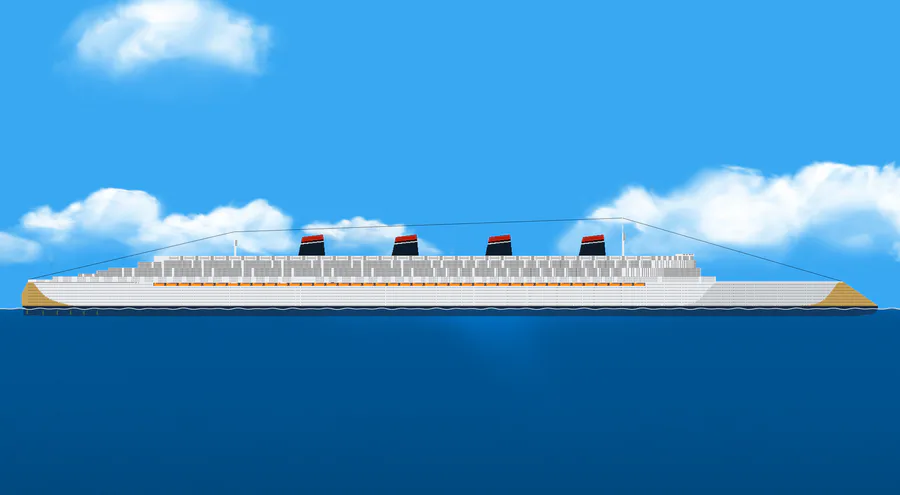
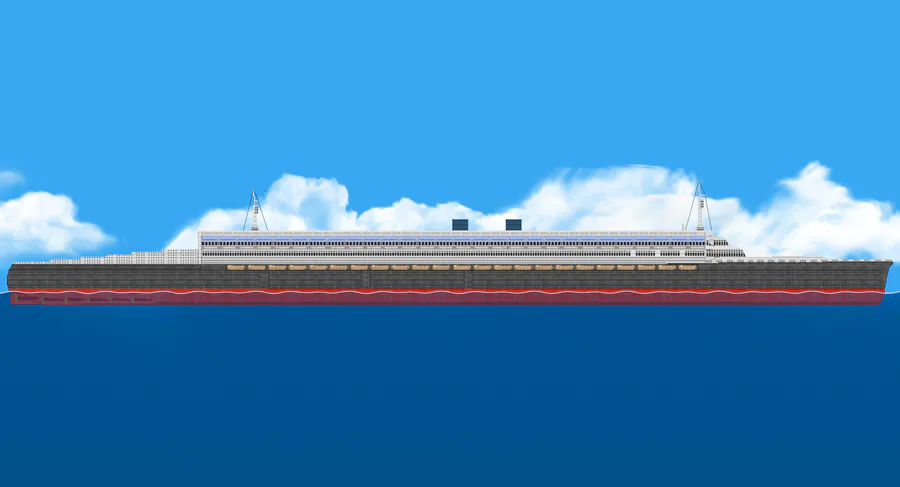
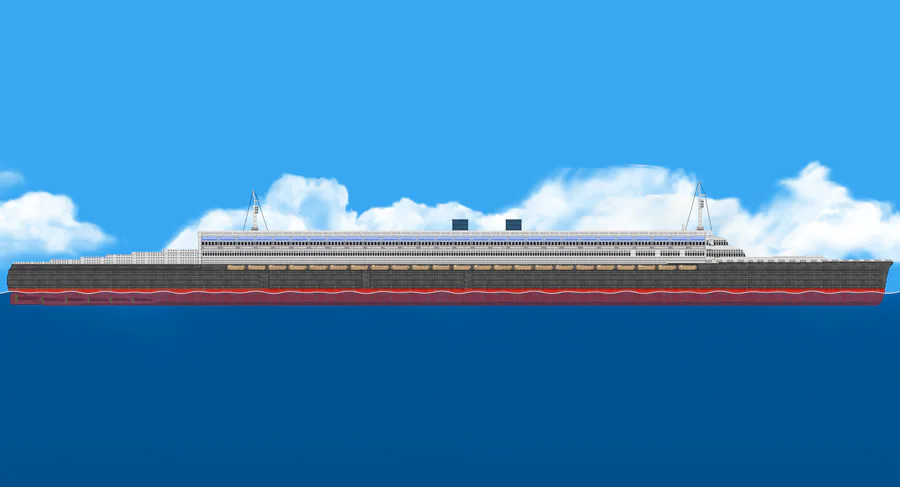
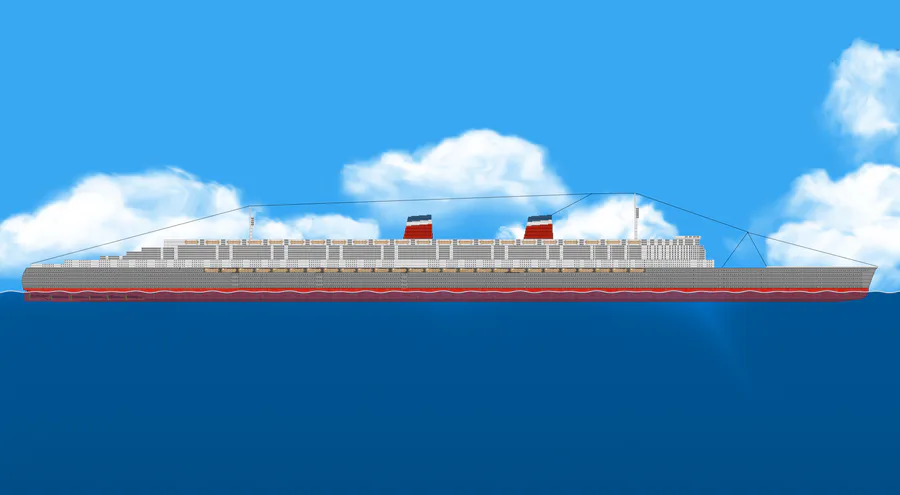
Drawing from the Projekt 305 (SS Viktoria) concept of a "Ship of State," the Grandeur VI maintains a specialized security force. They ensure that the 70-floor urban sprawl remains safe from internal friction. Utilizing the Meyer Werft Manta Ray design of open-sightline plazas, the security teams prioritize de-escalation and AI-assisted crowd flow, ensuring that even with 328 million people, there is never a "bottleneck" in the Vertical Urbanism. Part 20: Colour - The M.S. United States Grandeur VI is a chromatic and structural masterpiece, a 1,983-meter long "Trans-Oceanic Megacity-State" that uses color as both a functional engineering tool and a psychological anchor for its 328,000,000 residents. Moving at a record-shattering 410-knot sprint, the ship’s exterior is not mere paint, but a sophisticated Nanopolymer Envelope that manages the extreme friction and thermal demands of supersonic maritime travel.
I. The "Silver Stealth" Hull & Kinetic Leading Edges
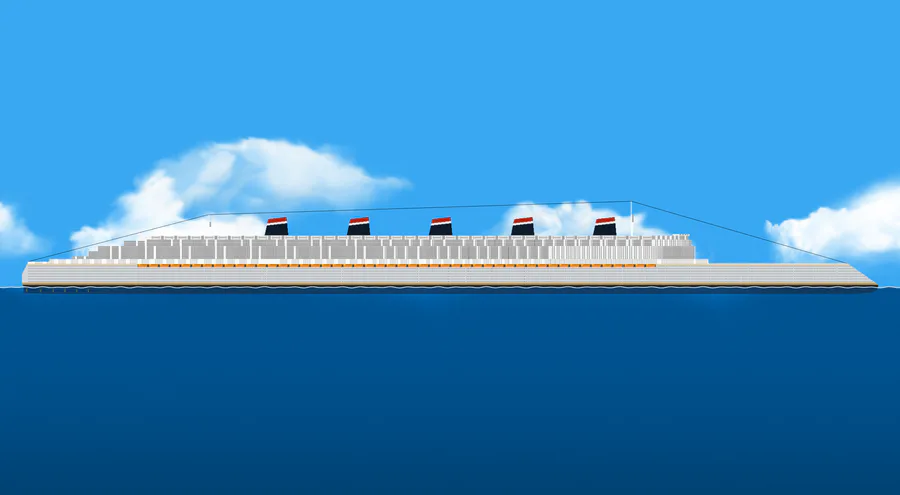
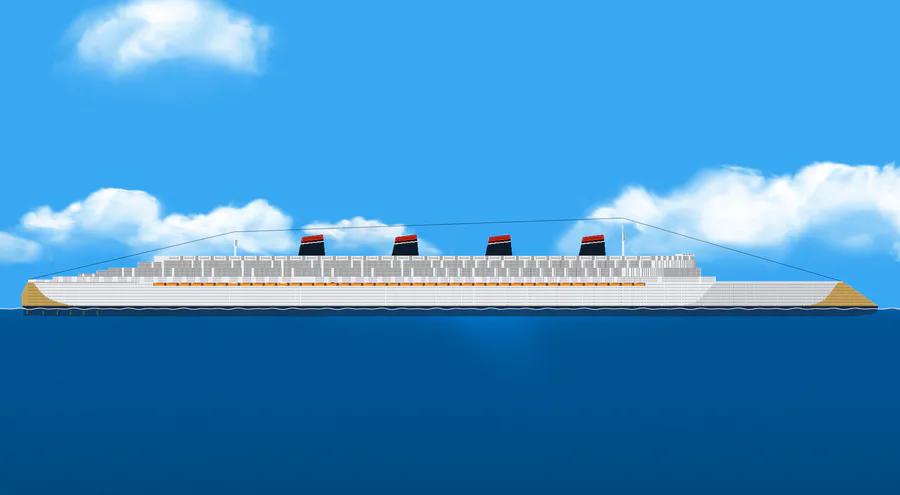
The primary 1.9-kilometer frame utilizes a high-reflectivity finish inspired by the unbuilt 1936 Silver Class liners, scaled to meet the demands of the 21st century.
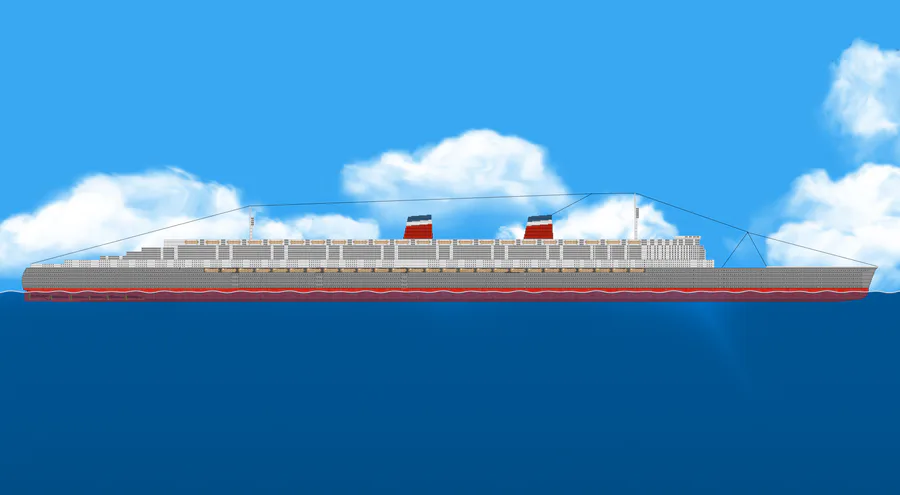
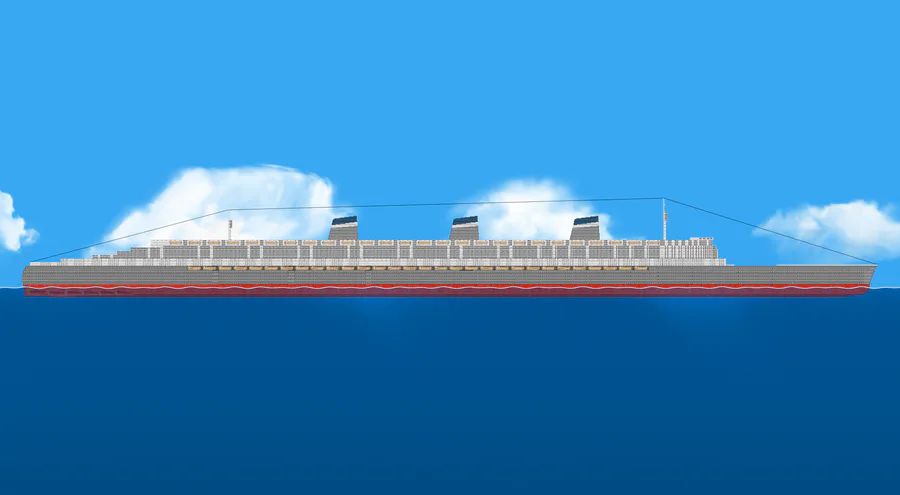
Silver Heritage Mirror (#D1D5D8) — The Main Hull: The primary hull plates are coated in a Polished Aluminum "Liquid Metal" Nanocoat. This finish serves a dual purpose: it reflects 95% of solar radiation to minimize the thermal load on the internal city, and it acts as an optical camouflage. At mid-ocean, the 1,983-meter structure reflects the sky and waves, effectively "disappearing" against the horizon to prevent visual fatigue for observers and the 40-million-member crew.
Abyss Cobalt (#1B263B) — The 21-Meter Waterline: At the depth mark where the Trimaran/Pentamaran hulls meet the deep, the coating transitions to a matte, non-reflective Oxidized Cobalt Blue. This hides the 12 super-cavitating shafts and the massive fusion intake vents, absorbing light frequencies to make the "Engine City" beneath the waves invisible to surface glare.
Titanium Gold Nitride (#C5A059) — The Kinetic Skis: The super-cavitating bow and the retractable hydro-foils are treated with a Gold-Nitride Hardcoat. At 410 knots, water friction creates temperatures exceeding 550°C. This coating prevents oxidation and thermal scarring, ensuring the ship's leading edges—the points of maximum pressure—remain aerodynamically perfect.
II. The "Grandeur White" Superstructure (Decks 1–70)
To prevent the 70-floor stack from appearing as an oppressive monolith, the Digital Nexus AI employs a light-management palette designed to inspire "Natural Verticality."
Glacier Ceramic White (#F8F9FA) — Residential Districts: Decks 8 through 55 are finished in a high-albedo, self-cleaning ceramic. This reflects the intense sun of the tropical homeports (Singapore, Manila, Jakarta), reducing the energy required for the Atmospheric Control System (ACS) by 45%.
Ghost Silver (#E9ECEF) — The Observation Spire: The 15-deck needle rising to 215 meters is finished in a metallic ghost-white. This allows the highest points of the ship to dissolve into the cloud line, mimicking the aesthetics of the SS Amerika (Projekt 305) and making the spire appear to touch the heavens.
Azure Nebula Tints (#00B4D8) — Transparent Aluminum (ALON) Windows: The windows for the 328 million souls are polarized with a 15% cyan tint. This protects residents from UV glare at high altitudes while ensuring the ocean always appears as a vibrant, healthy blue, regardless of weather conditions in the North Atlantic.
III. The "Penta-Riband" Funnel Signature
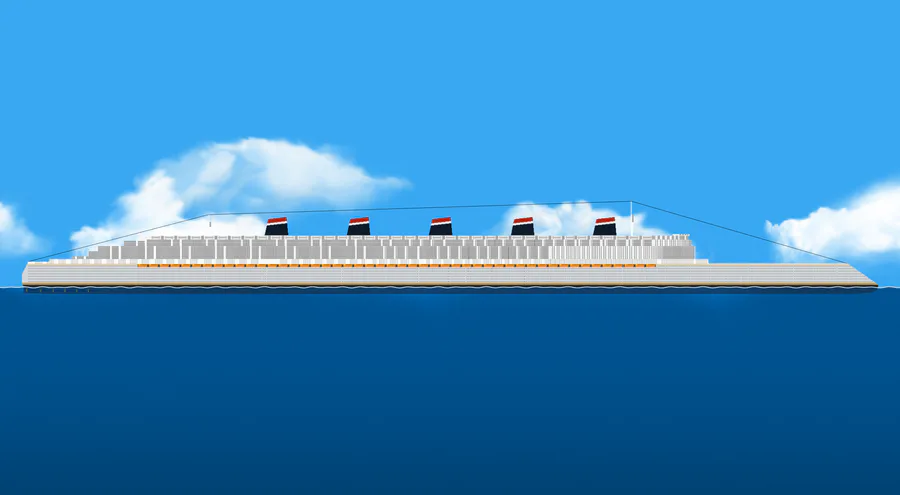
The five massive funnels are the ship’s most iconic feature, spaced 135 meters apart and standing 43 meters tall. They pay homage to the S.S. United States and the heritage of the Blue Riband.
Imperial Navy Base (#0D1B2A): The lower third of each funnel is a deep, authoritative navy, symbolizing the ship’s status as a Sovereign Sea-State and its grip on the ocean.
Signal White Mid-Band (#FFFFFF): A clean, broad band featuring the Digital Nexus Insignia—a glowing cyan ring representing the AI's "all-seeing eye" over the 50-line global alliance.
Grandeur Crimson Caps (#AE2012): The tops of the funnels are a bold, heat-reactive crimson. During an emergency 410-knot sprint, these caps glow with an internal luminescence as the 1,500,000 SHP fusion reactors reach peak output, signaling the ship's kinetic power to the world.
IV. The "Survival Spectrum" (Safety & Ark Fleet)
With 328 million people and a 10-minute evacuation mandate, color is the primary navigation tool for the 40,000,000 crew members.
International Safety Orange (#FB8500): The 100 Main Arks are finished in a high-visibility fluorescent orange. This ensures they are detectable by orbital rescue satellites even in the densest fog of the North Sea or the South China Sea.
Polished Mercury Chrome (#BEBEBE): The 64 Heavy Arks (the "Silver Class" Arks) utilize a mirror-chrome finish to honor the Silver Falcon. These are accented with Emerald Green (#2D6A4F) lighting, which the Digital Nexus uses to induce a "Calm-State" among the 2,000,000 people per Ark during stasis-loading.
Warning Yellow (#FFB703): The 143-meter beam’s electromagnetic ejection rails are outlined in high-contrast yellow, defining the "No-Go Zones" for the crew during high-speed deployment.
V. Interior "Atmospheric" Zonation (Psychological Districts)
The 70 floors are zoned using a chromatic psych-profile to prevent "Urban Density Stress" for the 288 million passengers.
DistrictPrimary HueAccent ColorMood/PurposeCelestial Spire (Decks 66-70)Royal PurplePlatinumLeadership & Global ReachSky-Parks (Decks 56-65)Spring Leaf GreenSky BlueNatural Growth & Fresh AirSilver Tier (Decks 46-55)Polished SteelArt Deco TealHeritage & DiplomacyCommonality (Decks 8-45)Warm SandSage GreenCommunal Harmony & PeaceEngine City (Decks 1-7)Industrial SlateNeon CyanHigh-Tech Precision
The Alimentary Arteries: The internal maglev transit tubes are lined with Bioluminescent Cyan (#00F5FF). This glowing track provides a constant visual pulse, representing the fusion energy flowing through the ship’s 1,983-meter length.
The "Vessel of Hope" Pediatric Wing: In honor of the SS Titan Project, the medical centers for sick children are finished in Soft Lavender and Sky Blue, creating an environment of hope and healing within the heart of the megacity.
As the M.S. United States Grandeur VI homeports in Singapore, New York, Hamburg, and Manila, its chromatic profile serves as a beacon of the new maritime civilization—a 1,983-meter monument to speed, safety, and the enduring grandeur of the sea.
0 comments