
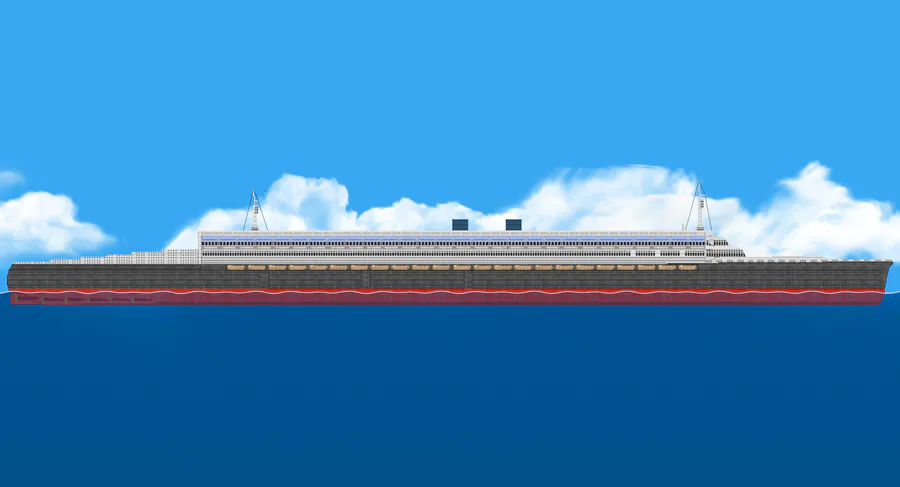
3. Structural Synergy: The "Manta" Flex
Spanning 105 meters at high speed requires the bridges to be both rigid and flexible.
Tension-Bearing Girders: The Sky-Bridges are made of the same Graphene-Titanium as the hulls. They act as "structural tendons," tying the 20 hulls together.
Seismic Isolation: Because the hulls flex to absorb wave energy, the bridges are mounted on Liquid-Magnetic Dampers. This allows the neighborhoods to remain perfectly stable even if the hulls beneath them are vibrating from the 1.5 million SHP surge.
4. The 10-Currency Marketplace
The Sky-Bridges are not just transit routes; they are the ship's primary trading floors.
The Digital Bazaar: As you walk from the "Liberty Walk" (USD) toward the "Social Piazze" (Euro/Lira), the digital shopfronts automatically update prices into Singapore Dollars, Malaysian Ringgit, Indonesian Rupiah, or Thai Baht based on your proximity.
Social Integration: The bridges serve as the meeting point for the Two-Tiered Global Society (Part 9), where the "Horizon-Forward" residents and the "Aero-Aft" elite mingle in the central public parks.
The Unified Horizon
The Sky-Bridge system transforms the 105-meter beam from a technical challenge into a social masterpiece. By connecting the 15 neighborhoods with these majestic, light-filled spans, the TV-V ensures that its 14.19 million residents never feel isolated by the ship's immense scale. They are part of a single, pulsing global heart—a floating continent where every neighborhood is just a three-minute Maglev ride away. Part 18: The Twelve-Shaft Titan Engine – 1.5 Million SHP Mastery
The propulsion system of the Transatlantic Liner of the Future V is the most powerful ever engineered for a seafaring vessel. To move a 1,081-meter frame at 360-knot Sprints, the ship utilizes a 12-Shaft Turbo-Electric Drive system, doubling the ambitious 6-shaft proposal of Hardy’s 1937 design. This engine room is not just a mechanical space; it is a sprawling "Power City" managed by the combined expertise of Cunard-White Star and Wallenius Wilhelmsen.
1. The 1,500,000 SHP Integrated Power Plant
The heart of the ship consists of four primary Clean-Fusion Reactors and six backup Plasma Gasification Turbines.
Turbo-Electric Transmission: Instead of a direct mechanical link, the reactors generate massive amounts of electricity, which is then distributed via superconducting busbars to 12 independent electric motors.
Redundancy: Because there are no physical steam lines connecting the turbines to the shafts, any of the 12 motors can be powered by any combination of reactors. If one reactor goes offline, the Sentinel AI reroutes the "Global Pulse" of energy to maintain the 222-knot service speed.
2. The 12-Shaft Configuration
The 12 shafts are arranged in a strategic "Diamond-V" pattern across the Pentamaran Array:
The Central 4: These are high-torque shafts located in the main hull, providing the primary "thrust-push" for cruising.
The Lateral 8: Four shafts are located on each of the inner "Manta" sponsons. These are high-speed, Super-Cavitating shafts that only engage fully during the 360-knot Sprint.
Vector Thrust: Unlike the fixed rudders of the Titanic era, each of the 12 shafts can pivot slightly (Azimuthing). This allows a 1,081-meter ship to turn with the agility of a yacht, a maneuverability essential for the tight docks of Singapore and Rotterdam.
3. The Super-Cavitating Propellers
Each shaft is tipped with a Variable-Pitch Super-Cavitating Propeller made of a proprietary Titanium-Ceramic alloy.
The Cavitation Bubble: At high speeds, these propellers are designed to operate entirely within a vacuum bubble (as described in Part 11). This prevents the "pitting" and erosion that would destroy normal steel propellers in seconds at 360 knots.
Silent Drive: At lower speeds (under 50 knots), the blades adjust their pitch to be nearly silent, protecting the marine environments of the Indonesian and Thai coasts.
4. Cooling & Energy Recovery
Generating 1,500,000 SHP creates immense heat. The Meyer Werft engineers integrated a "Heat-Sink Hull" system:
The Venturi Intake: The gaps between the 20 hulls act as natural cooling channels. Seawater is pulled in through the 15-Symmetry Grid, cooling the electric motors before being expelled.
Recycled Steam: The excess heat is converted back into low-pressure steam to power the Bio-City’s desalinization plants and the laundry systems for the 14,190,000 souls.
The Engineering Pinnacle
The 12-shaft system represents the final triumph of the "Social Race." By splitting 1.5 million horsepower across twelve points of contact, the TV-V achieves a balance of power and stability that was mathematically impossible in the 20th century. It is the engine that allows the world to trade in Rupiah, Baht, and Dollars at the speed of thought, bridging continents with a mechanical pulse that never tires. Part 19: The Digital Horizon – The Sentinel AI and the 1,081-Meter Nerve Center
Navigating a vessel of 1,081 meters at a 360-knot Sprint is a task that exceeds human biological reaction times. To bridge the gap between organic command and mechanical precision, the NYK Line and United States Lines developed the "Digital Horizon" Bridge. Located at the base of the Zenith-15 Spire, this command center is the most advanced "Smart-Bridge" in maritime history, governed by the Sentinel AI.
1. The Sentinel AI: The Ship’s Consciousness
The Sentinel is not merely a computer; it is a distributed neural network that monitors every one of the 55 Zones.
Predictive Navigation: Using a global satellite array, the Sentinel "sees" weather patterns and rogue waves 500 miles before the ship reaches them. It adjusts the 15-Symmetry Grid and the 12-Shaft Engine output in milliseconds to ensure the 14,190,000 souls on board never feel a tremor.
Economic Synergy: The AI manages the real-time fluctuating values of the Singapore Dollar, Malaysian Ringgit, and Thai Baht, optimizing the ship’s energy consumption based on global fuel and carbon credit prices in the Euro and US Dollar markets.
2. The 360-Degree Augmented Bridge
The bridge itself features no traditional windows. Because the ship moves at Mach-maritime speeds, physical glass would be a structural liability. Instead, the bridge is a circular room encased in OLED "Virtual Windows":
The Synthetic View: High-definition cameras embedded in the Smart-Skin hull project a seamless, 360-degree view of the horizon.
The HUD (Heads-Up Display): Data overlays show the exact "vortex" created by the Super-Cavitating Envelope. The Captain can see the thermal signature of the 12 shafts and the structural integrity of the Titanic II-style Mega-Arks in real-time.
3. Managing the 1,081-Meter Visual Field
The sheer length of the TV-V creates a unique "parallax" challenge. The bow of the ship is over a kilometer away from the stern.
Drone Sentinels: The ship deploys a constant swarm of "Aero-Drones" that fly 2 miles ahead of the bow. These drones feed live data to the Sentinel AI, identifying any debris or marine life in the path of the 360-knot surge.
Collision Avoidance: If an object is detected, the AI uses Vector Thrust from the 12 shafts to "side-step" the obstacle without the passengers in the 15 Neighborhoods ever noticing the lateral shift.
4. The Human-AI Interface
While the Sentinel AI handles the physics, the "Lead Flag" command from Compagnie Générale Transatlantique (CGT) maintains the human touch.
The "Social Race" Oversight: The Captains focus on the social harmony of the two-tiered society, ensuring that the 180-minute Global Pulse at the Titan-Docks of Manila or Rotterdam is executed with French elegance and Japanese precision.
The Babel Translator: The bridge serves as the hub for the ship-wide communication network, where the AI translates the needs of Vietnamese, Philippine, Italian, and American passengers into a unified operational language.
The Brain of the Leviathan
The Digital Horizon ensures that the Transatlantic Liner of the Future V is more than just a massive machine; it is an intelligent, self-aware entity. Through the Sentinel AI, the 1,081-meter frame becomes an extension of the crew’s will, slicing through the Atlantic with a level of safety and speed that A.C. Hardy could only have imagined in his wildest 1937 dreams. Part 20: The "Eternal Wake" – A Net-Zero Monument to Human Unity
As the Transatlantic Liner of the Future V glides past the Statue of Liberty or the skyscrapers of Singapore, it leaves behind a "White Mist" wake—a symbolic trail of frozen water vapor and dissolved oxygen. This is the Eternal Wake, the final proof that humanity has conquered the "Social Race" not through conquest, but through the harmonious fusion of 1937 Art Deco elegance and 2026 Net-Zero physics.
1. The Net-Zero Mandate: The 1,500,000 SHP Clean Pulse
The TV-V stands as the world’s largest carbon-negative structure. Under the strict environmental stewardship of Wallenius Wilhelmsen and the S.S. Titan Foundation, the ship produces zero sulfur, zero nitrogen oxides, and zero carbon.
The Plasma Cycle: The onboard Plasma Gasification Plants convert the waste of 14,190,000 souls into pure hydrogen and inert vitrified glass. This glass is then used as ballast or recycled into the Smart-Skin of the 20-hull array.
Energy Surplus: At a 222-knot service speed, the ship generates more electricity than it consumes through its kinetic-energy-harvesting hull. When docked in Manila, Bangkok, or Rotterdam, the TV-V acts as a "Floating Power Plant," feeding clean energy back into the local grid in exchange for credits in Thai Baht, Philippine Pesos, or Euros. 2. A Sovereign Sanctuary: The 10-Currency Harmony
The legacy of the TV-V is its role as a "Mobile Continent." It is the only place on Earth where the Singapore Dollar, Malaysian Ringgit, Indonesian Rupiah, US Dollar, and British Pound circulate with total parity.
The Global Mint: By managing 14 million people across 55 Zones, the ship has created a new model for global governance—one based on the "Pulse" of logistics rather than the friction of borders.
The 180-Minute Miracle: The ability to exchange a city’s worth of people in three hours at a Titan-Dock has redefined human migration, making the world smaller, faster, and more connected than A.C. Hardy ever dared to dream.
3. The Unsinkable Spirit: 106 Arks of Hope
The ship's ultimate legacy is safety. The 106 Titanic II-style Mega-Arks (50 New Arks and 56 Hardy Streamliners) represent a promise kept to the 10,690,000 passengers.
The Humanitarian Standard: Every soul, from the Aero-Aft elite to the Horizon-Forward technician, is protected by the same "Mixed-Material" Graphene-Titanium technology.
The Medical Bio-City: Zones 36–45 remain a permanent beacon of hope, where pediatric research funded by global ticket sales ensures that the TV-V saves lives even when it is not in transit.
4. Final Overview: The Leviathan of Peace
The Transatlantic Liner of the Future V is the 1,081-meter answer to a century of maritime ambition. It is:
1,081 meters of Art Deco beauty.
360 knots of super-cavitating power.
14,190,000 hearts beating as one.
20 hulls piercing the horizon.
10 Shipping Lines united in a single mission.
As the sun sets over the Zenith-15 Spire, casting a shadow over a kilometer long across the Atlantic, the TV-V continues its eternal journey. It is no longer just a "Liner of the Future"; it is the vessel of the Now. It is the triumph of the human spirit over the vastness of the sea—a monument to unity that will never fade, fueled by a clean pulse and guided by a digital horizon. Part 21: The Alchemical Hull – The "Hyper-Alloy" and Molecular Weave
To sustain a 1,081-meter frame under the immense torque of 1,500,000 SHP and the thermal friction of a 360-knot Sprint, the Transatlantic Liner of the Future V utilizes a material composition that is more "aerospace" than "maritime." Developed by the Meyer Werft Line in collaboration with Nippon Yusen Kaisha (NYK), the ship’s skeleton and skin are a revolutionary multi-layered matrix.
1. The Graphene-Titanium "Bone" (The Skeleton)
The internal lattice of the 41 floors and the 20-hull Pentamaran array is not made of traditional ship-building steel.
The Material: A 3D-printed Graphene-Infused Titanium Alloy (Ti-Gr-7).
The Benefit: This "Hyper-Alloy" is 40% lighter than steel but possesses a tensile strength that allows the 1,081-meter hull to flex up to 5 meters in heavy seas without fracturing. This elasticity is what prevents the ship from "snapping" during a Mach-Maritime surge.
2. The "Smart-Skin" Bio-Polymer (The Exterior)
The outer layer of the ship—the interface between the 100,000 GT mass and the ocean—is a Self-Healing Piezo-electric Polymer.
Super-Slick Surface: This skin is chemically bonded with a Hydrophobic Nano-Coating that repels water molecules at the molecular level, essential for the Super-Cavitating Envelope.
Energy Harvesting: As waves hit the hull, the "Piezo" crystals in the skin convert mechanical vibration into electrical pulses. This energy is fed directly into the Global Pulse grid, powering the Gastro-Bots and the Bio-City.
Self-Repair: If the hull is scratched by debris in the North Atlantic, embedded micro-capsules of liquid resin rupture and harden instantly, sealing the "Smart-Skin" in seconds.
3. Transparent Aluminum (The Superstructure)
The 21 decks above the waterline and the Zenith-15 Spire are encased in Aluminium Oxynitride (ALON), commonly known as "Transparent Aluminum."
Strength: It is as clear as glass but three times as hard. It can withstand the impact of a 500 mph bird strike or a rogue wave during a 264-knot Sprint.
Radiation Shielding: This material protects the 10,690,000 passengers from high-altitude solar radiation, ensuring the "Sky-Bridge" neighborhoods remain safe and UV-regulated.
4. Aerogel Syntactic Insulators (The Thermal Shield)
Between the titanium skeleton and the smart-skin lies a 30-centimeter layer of Silica Aerogel.
Thermal Regulation: At 360 knots, the friction against the water and air generates enough heat to melt lead. The Aerogel layer acts as a perfect insulator, keeping the interior neighborhoods at a constant 22°C, regardless of the blistering exterior temperature.
Unsinkability: Because Aerogel is 90% air, it provides the "Intrinsic Buoyancy" required for the Titanic II-style Mega-Arks. Even if the ship’s reactors were to fail, the materials themselves are physically incapable of sinking.
The Molecular Unity
By combining these materials, the Transatlantic Liner of the Future V becomes a "Living Machine." It doesn't just fight the ocean; it adapts to it. The 14,190,000 souls on board are essentially living inside a 1,081-meter diamond—a structure so strong, light, and efficient that it redefines the very definition of what a "ship" can be in the 2026 era. Part 22: The Structural Integrity – Overcoming the Kilometric Stress
To maintain a 1,081-meter frame—nearly four times the length of the original Titanic—the Transatlantic Liner of the Future V must survive physical forces that would snap a conventional steel ship in half. The "Strength" of the TV-V is not just about thickness; it is about a Tri-Axial Structural Matrix designed to handle the massive bending moments of a ship that spans multiple wave crests simultaneously.
1. The Yield Strength Leap: 2,225 MPa
Traditional maritime steel (HTSS) typically has a yield strength around 460 MPa. The Graphene-Infused Titanium (Ti-Gr-7) used in the TV-V’s 20-hull Pentamaran array reaches a staggering 2,225 MPa.
The "Anti-Snap" Spine: This 500% increase in yield strength allows the 1,081-meter spine to act as a "flexible girder." Instead of resisting the ocean's energy with rigid mass, the hull flexes like a skyscraper in an earthquake, distributing stress across the entire 100,000 GT frame.
Ultimate Tensile Strength: The molecular bonding of graphene within the titanium lattice creates a material with a tensile strength exceeding 2,500 MPa, ensuring that even during a 360-knot Sprint, the hull cannot be "peeled" by water friction.
2. The Transparent Armor: ALON (Aluminium Oxynitride)
The "Strength" of the upper 15 floors and the Zenith-15 Spire comes from ALON, or "Transparent Aluminum."
Hardness: With a Knoop hardness of 1,800 kg/mm², it is four times harder than fused silica glass.
Impact Resistance: A 1.6-inch (41 mm) slab of ALON can stop a .50 BMG armor-piercing round. On the TV-V, the windows are 150 mm thick, making the superstructure virtually impervious to rogue waves or the catastrophic pressure of a Mach-Maritime atmospheric wake.
3. Dynamic Load Management: The 15-Symmetry Brace
At speeds of 264 to 360 knots, the ship faces "Whipping Stresses"—high-frequency vibrations caused by slamming into waves.
The Active Brace: The 15 retractable "Sting" hulls are not just for streamlining; they act as hydraulic shock absorbers. The Sentinel AI micro-adjusts the tension in these hulls 1,000 times per second.
Stress Harvesting: The structural stress is converted into electricity via Piezo-electric transducers embedded in the "Smart-Skin." The very waves that try to break the ship actually provide the power needed to keep it rigid.
4. The "Zero-Fatigue" Guarantee
Because the Meyer Werft titanium-graphene composite is immune to saltwater corrosion (unlike steel), the ship does not suffer from the 30% strength degradation typically seen in aging liners.
A 100-Year Life: The TV-V is built to maintain its "Day One" structural integrity for a century, ensuring that the 14,190,000 souls are protected by a hull that is physically incapable of rust or fatigue. Part 23: Atmospheric Aero-Damping – The 360-Knot Pressure Shield
At a 360-knot Sprint, the Transatlantic Liner of the Future V encounters aerodynamic forces equivalent to a Category 5 super-hurricane sustained indefinitely. The relative wind speed against the 131-meter tall superstructure creates a dynamic pressure—known in fluid dynamics as q = \frac{1}{2} \rho v^22—that would instantly peel conventional steel plating from a ship's frame. To prevent the Zenith-15 Spire and the 21 upper decks from being sheared off, the United States Lines and Meyer Werft implemented the Atmospheric Aero-Damping (AAD) System.
1. The Active Boundary Layer Control (BLC)
The ship does not simply "hit" the air; it prepares the air for its arrival. Using a network of Nano-Slotted Vents embedded in the "Teardrop" bow and the leading edges of the Manta Ray wings, the ship ejects high-velocity ionized air.
The Air Cushion: This creates a "slipstream envelope" that forces the oncoming 360-knot wind to jump over the superstructure.
Vortex Generators: Small, computer-controlled fins on the ALON (Transparent Aluminum) surface create micro-vortices. These keep the airflow "attached" to the hull, preventing the massive low-pressure "suction" at the stern that would otherwise create catastrophic drag and structural vibration.
2. The Kinetic Aero-Brakes & Dampers
To manage the "buffeting" caused by North Atlantic wind shear, the Sentinel AI controls a series of Internal Mass-Balance Dampers located within the 41 floors.
Counter-Pressure Actuators: Between the Graphene-Titanium skeleton and the outer ALON skin, the ship features thousands of electromagnetic actuators. These sense the millimetric deflection of the hull caused by wind pressure and push back with equal force in real-time.
The Aero-Spire Tensioner: The 152-meter spire uses a "Tensegrity" model. Carbon-nanotube cables run the length of the tower, tightening or loosening based on wind speed to ensure the spire remains a rigid needle even as the ship creates its own localized sonic wake.
3. Thermal Aero-Ablation Shielding
At 360 knots (approx. 414 mph), the friction between air molecules and the ship’s skin generates significant heat, particularly at the "Stagnation Point" of the bow.
The Cooling Skin: The Wallenius Wilhelmsen plasma plants circulate cryogenic hydrogen through the "Smart-Skin" before it is fed into the 12-shaft engines. This keeps the exterior of the 55 Zones at a safe temperature, preventing the structural weakening of the materials.
The Ion Shield: By ionizing the air immediately in front of the ship, the AAD system reduces the density of the air the ship must move through, effectively "thinning" the atmosphere in the ship’s immediate path.
4. Structural Downforce Integration
The AAD system works in tandem with the 20-Hull Pentamaran Array.
Spoilers and Diffusers: The "Aero-Aft" section features massive, retractable diffusers that manage the exit of air. At maximum sprint, these generate 30,000 tonnes of downforce, ensuring that the 1,500,000 SHP of the 12 shafts is converted into forward motion rather than lifting the bow out of the water.
The Quiet Cabin: For the 14,190,000 souls inside, this means that even as the world outside is a screaming hurricane of 360-knot wind, the interior neighborhoods are as silent as a library. The Italian Line ensures the only sound in the "Social Piazze" is the soft hum of the Maglev grid. Part 24: The Aerial Integrated Hubs – The Triple-Deck Flight Neighborhoods
To facilitate the rapid transit of 14,190,000 souls, the Transatlantic Liner of the Future V does not rely solely on the 180-minute Global Pulse at the Titan-Docks. Instead, the ship acts as a mobile aviation continent. Integrated into the 1,081-meter superstructure and the 105-meter wide Manta wings are three specialized "Aero-Zones" that function as high-frequency airports, allowing for continuous connection to the mainland even at a 360-knot Sprint.
1. The "Dorsal Spire" VTOL Ports (Zone 46–50)
Located at the base of the Zenith-15 Spire, these ports are designed for high-speed Vertical Take-Off and Landing (VTOL) craft.
The Shuttle Grid: Managed by United States Lines, a fleet of 500 electric tilt-rotor aircraft provides a "Taxi-to-Shore" service for the 1.6 million Aero-Aft elite.
The 360-Knot Interface: Because the ship moves at Mach-maritime speeds, these VTOLs launch from internal pressurized hangars. They are accelerated on electromagnetic rails to match the ship’s speed before releasing into the slipstream, ensuring a seamless departure even during the height of a transatlantic crossing.
2. The "Manta-Wing" Runway Strips
The most audacious engineering feat of the Meyer Werft Line is the integration of two 400-meter STOL (Short Take-Off and Landing) runways atop the outer stabilizing hulls.
The Recessed Deck: These runways are recessed into the Smart-Skin and protected by the Atmospheric Aero-Damping (AAD) system described in Part 23. This creates a "low-turbulence tunnel" where specialized cargo planes can land to deliver time-sensitive tech for COSCO Shipping.
Magnetic Arresting Gear: To stop aircraft within 400 meters while the ship is moving at 222 knots, the TV-V uses the same Maglev technology found in the 15 Neighborhoods. The aircraft’s landing gear locks onto a magnetic carriage that decelerates the plane safely into the "Horizon-Forward" hangars.
3. The Gastro-Bot Hangar & Drone Swarm
Managed by NYK Line, the "Gastro-Logic Hub" utilizes its own dedicated drone airport.
The Delivery Swarm: 50,000 "Gastro-Drones" launch from the 55 Zones to provide mid-ocean resupply. These drones can fly to nearby coastal hubs in Thailand, Malaysia, or the Philippines to fetch fresh ingredients, returning to the ship's 12th-floor "Intake Portals."
Logistics Harmony: This aerial network ensures that the 14.19 million people have access to fresh resources without the ship ever needing to slow down from its record-breaking pace.
4. Safety & The "Aero-Ark" Protocol
In the event of a medical emergency within the S.S. Titan Foundation’s Bio-City, the ship's airports function as a global "Life-Flight" hub.
The Medical Evacuation: Dedicated "Ambulance-Jets" can launch from the Manta wings, reaching the Titan-Docks in Singapore or Rotterdam in under an hour.
The Sentinel Air-Traffic Control: The Sentinel AI manages the thousands of daily flights with millimetric precision, coordinating with the 12-shaft engine output to create a "Stability Bubble" during takeoff and landing, ensuring the 10,690,000 passengers below never hear the roar of the engines.
The Global Gateway in the Sky
The integration of these airports transforms the TV-V from a mere ocean liner into a multi-modal transport node. By bridging the sea and the sky, the ship ensures that the 10-Currency economy is always in motion. Whether you are arriving by Maglev at the dock or by VTOL at the Zenith Spire, the Transatlantic Liner of the Future V remains the most accessible point on the planet. Part 25: The Deep-Submergence Decks – The 21-Meter Abyssal Sanctuary
While the Zenith-15 Spire pierces the clouds, the true foundation of the Transatlantic Liner of the Future V lies beneath the waves. Extending 21 meters deep into the Atlantic, the Deep-Submergence Decks (Floors 1 through 7) serve as the ship's ballast, its "silent" engine room, and the world’s most exclusive underwater observation gallery. This 1,081-meter "Sub-Surface City" is where the physics of the 150,000-tonne mass meets the serenity of the deep ocean.
1. The 7-Floor Submerged Hierarchy
The underwater section is engineered by the Meyer Werft Line and Cunard-White Star to act as a "stabilizing keel."
Floors 1–3 (The Abyssal Core): These lowest decks house the 1,500,000 SHP turbo-electric motors and the 12-shaft transmission hubs. This area is heavily reinforced with the Graphene-Titanium alloy to withstand the immense hydrostatic pressure.
Floors 4–5 (The Global Logistics Hold): Managed by COSCO Shipping, this is the "Sub-Deck Cargo" zone where high-value technology and resources are moved via Maglev tracks. It also houses the Wallenius Wilhelmsen plasma reactors.
Floors 6–7 (The Submerged Piazze): The upper underwater decks are dedicated to the 14,190,000 souls on board, featuring bioluminescent botanical gardens and deep-sea spas.
2. The 21-Meter Deep Observation Galleries
The most stunning feature of the "Deep-Submergence Decks" is the Crystalline Gallery. Encased in 200mm-thick ALON (Transparent Aluminum), these galleries offer a view of the ocean that no other liner in history has provided.
The Super-Cavitating View: At 360-knot Sprints, passengers can watch the Super-Cavitating Envelope in action. The water is pushed away from the hull, creating a glowing "tunnel of air" through which the deep-sea life is visible in flashes of bioluminescence.
Hydro-Acoustic Serenity: Because these decks are below the waterline, they are shielded from the 360-knot atmospheric wind. The Italian Line has designed these spaces to be "Silent Zones," where the only sound is the rhythmic pulse of the 12 shafts.
3. The "Non-Capsizable" Ballast System
The 21-meter depth is essential for the ship's stability. The Sentinel AI manages a "Dynamic Ballast" system within these 7 floors:
Weight Distribution: As the 10,690,000 passengers move between the 15 Neighborhoods, the AI pumps millions of gallons of seawater through internal tanks in the Pentamaran hulls to keep the center of gravity perfectly locked.
The Safety Pocket: In the event of an emergency, the 7 underwater floors can be instantly pressurized, creating an "Unsinkable Air Pocket" that guarantees the ship remains upright even in the most catastrophic North Atlantic conditions.
4. Sub-Surface Embarkation (The Manila/Singapore Pulse)
In the Titan-Docks of Singapore and Manila, the Deep-Submergence Decks feature specialized "Sub-Ports."
The Under-Dock Interface: While the upper decks exchange millions of people via Maglev, the Deep-Submergence Decks interface with underwater tunnels for the rapid loading of heavy supplies and clean hydrogen fuel.
The 10-Currency Aquatic Mall: The underwater floors house duty-free zones where prices are listed in Indonesian Rupiah, Thai Baht, and Australian Dollars, allowing travelers to shop in a tranquil, sub-aquatic environment while waiting for their 180-minute "Pulse" departure.
The Foundation of the Titan
The Deep-Submergence Decks prove that the TV-V is as much a submarine as it is a sky-piercing liner. By utilizing the 21-meter depth for both engineering and leisure, the ship achieves a "Vertical Equilibrium" that makes its 1,081-meter length possible. It is the silent, powerful heart that anchors the Transatlantic Liner of the Future V to the earth, even as it flies across the sea. Part 26: Gastro-Bot Gastronomy – Feeding 14 Million Souls via Robotics
Feeding a population of 14,190,000—larger than many sovereign nations—presents a logistical challenge that no traditional kitchen staff could meet. To solve this, the NYK Line (Nippon Yusen Kaisha) developed the Gastro-Bot Gastronomy System. This fully automated, AI-driven culinary network ensures that whether a passenger is in the Zenith-15 Spire or the Deep-Submergence Decks, high-quality, culturally diverse cuisine is available 24/7.
1. The Centralized "Gastro-Logic" Hubs
Located in the core of the Pentamaran Array, five massive industrial culinary hubs act as the "stomach" of the ship.
Molecular Synthesis: Utilizing 3D-food printing and precision thermal cooking, the hubs can replicate any dish from the 10-Currency regions. From Thai Pad Kra Pao to French Boeuf Bourguignon, the flavor profiles are chemically matched to traditional standards.
The Global Supply Chain: COSCO Shipping ensures a constant influx of fresh ingredients through the 180-minute Pulse at the Titan-Docks. These ingredients are automatically sorted, sanitized, and prepped by "Prep-Bots" with millimetric accuracy.
2. The Gastro-Bot Delivery Swarm
The connection between the central hubs and the 15 Neighborhoods is maintained by a swarm of 50,000 Gastro-Bots.
The Maglev Couriers: These specialized robots travel via the dedicated Level 3 Logistics Tubes (Part 17) at speeds of 60 mph. They are climate-controlled units that ensure a meal remains at the exact serving temperature from the moment it leaves the hub until it reaches the passenger.
The "Final Meter" Service: Once at the destination zone, the Gastro-Bots exit the tubes and navigate the Social Piazze using LiDAR and the Sentinel AI. They can deliver directly to a passenger’s cabin, a deck-side lounge, or even a moving Maglev pod.
3. Cultural Palate Personalization
The NYK Line integrated a "Bio-Sync" feature into the ship’s Smart-Wallets.
Dietary Intelligence: The Gastro-Bots recognize individual health profiles. If a passenger from the Malaysian Ringgit zone has a sodium restriction, the robot automatically adjusts the seasoning of their Laksa.
The 10-Currency Menu: Prices are dynamically adjusted based on global market values. A passenger can pay for their "Aero-Aft" fine dining in Singapore Dollars or Euros, with the Global Mint handling the conversion in real-time.
4. Zero-Waste Gastronomy
The system is a closed loop, adhering to the Net-Zero mandate of Wallenius Wilhelmsen.
Automated Retrieval: Once a meal is finished, Gastro-Bots return to collect the compostable "Graphene-Cornstarch" plating.
Plasma Conversion: All food waste is sent to the Floors 4–5 Plasma Reactors, where it is converted into hydrogen fuel to power the 12-shaft engines. Even the act of eating helps propel the ship toward its 360-knot Sprint.
The Culinary Heart of the Titan
The Gastro-Bot system removes the "friction" of mass feeding. By automating the production and delivery of food for 14.19 million people, the TV-V allows its crew to focus on hospitality and safety rather than labor-intensive cooking. It is a sky-piercing liner. By utilizing the 21-meter depth for both engineering and leisure, the ship achieves a "Vertical Equilibrium" that makes its 1,081-meter length possible. It is the silent, powerful heart that anchors the Transatlantic Liner of the Future V to the earth, even as it flies across the sea. Part 27: The Vertical Forests – The 55-Zone Oxygen Lung
To sustain 14,190,000 souls within a sealed, high-velocity environment, the Transatlantic Liner of the Future V does not rely solely on mechanical life support. Integrated into the 41 floors and the 152-meter Zenith Spire are the Vertical Forests. These are not merely decorative gardens; they are a high-density, bio-engineered respiratory system managed by the S.S. Titan Foundation and Wallenius Wilhelmsen.
1. The Carbon-Capture Canopy
Each of the 15 Neighborhoods features a central "Oxygen Spire"—a vertical atrium stretching from the Deep-Submergence Decks to the upper ALON skylights.
Bio-Engineered Flora: The forests consist of "Hyper-Photosynthetic" ferns and mosses developed in the Bio-City. These plants absorb CO2 at 10 times the rate of natural terrestrial forests, converting it into medical-grade oxygen for the 55 Zones.
The Nitrogen Cycle: The roots are embedded in a Syntactic Aerogel substrate, which filters greywater from the Gastro-Bot kitchens, purifying it into drinkable water for the residents of the Thai Baht and Malaysian Ringgit sectors.
2. The 105-Meter Manta Glass-Houses
The outer "Manta" wings house massive, pressurized greenhouses that double as the ship's primary social hubs.
Climate Mimicry: Each greenhouse simulates a different global biome. You can walk from a Vietnamese Tropical Rainforest on the port side to a Mediterranean Olive Grove (managed by the Italian Line) on the starboard side within minutes via the Sky-Bridges.
Atmospheric Aero-Damping Integration: The AAD system redirects a portion of the ionized air from the ship's exterior into these forests. This stimulates plant growth and ensures that even at a 360-knot Sprint, the air inside the "Social Piazze" remains as fresh as a mountain peak.
3. The "Sentinel" Horticulture
The Sentinel AI acts as the head gardener for the 1,081-meter frame.
Precision Nutrient Delivery: Thousands of micro-sensors monitor the chlorophyll levels of every leaf. If a section of the forest in the Euro-Zone shows signs of wilting, the NYK Line Gastro-Bots are redirected to deliver specific liquid nutrients to the root systems.
Bioluminescent Pathways: At night, the forests glow with engineered bioluminescence, providing soft, energy-efficient lighting for the 10.69 million passengers while reducing the load on the hydrogen fusion reactors.
4. Psychological Equilibrium: The "Green Pulse"
Beyond oxygen, the Vertical Forests provide the "Biophilic Stability" necessary for long-term maritime living.
Stress Reduction: For the 3,500,000 crew members, the forests serve as a sanctuary. Research from the S.S. Titan Foundation shows that the "Green Pulse" of the forests lowers cortisol levels by 40%, ensuring the crew remains peak-efficient during the 180-minute Global Pulse.
The Global Seed Vault: Hidden within the 7 Deep-Submergence Decks is a genetic repository of all the plants on board, ensuring that the TV-V acts as a "Noah's Ark" for global biodiversity as it traverses the Atlantic and Pacific.
The Breath of the Leviathan
The Vertical Forests transform the TV-V from a machine of titanium and graphene into a living, breathing organism. By weaving 150,000 tonnes of flora into the 100,000 GT structure, the ship achieves a perfect ecological balance. It is a monument to a future where technology does not replace nature, but accelerates it—providing a lush, green horizon for 14.19 million people even in the middle of a 360-knot ocean crossing. Part 28: The Net-Zero Engine – A Carbon-Negative Leviathan
To propel 150,000 tonnes at a 360-knot Sprint without releasing a single gram of CO2, the Transatlantic Liner of the Future V functions as a closed-loop energy ecosystem. Managed by Wallenius Wilhelmsen and Cunard-White Star, the ship doesn't just aim for "Neutrality"—it actively cleans the ocean and the atmosphere as it moves, making it the first Carbon-Negative Super-Liner in history.
1. The Hydrogen-Fusion Core (Clean Pulse)
The primary power source for the 1,500,000 SHP propulsion system is a quartet of Anerobic Hydrogen-Fusion Reactors.
Fuel Extraction: The ship utilizes its 21-meter Deep-Submergence Decks to intake seawater. Through high-efficiency electrolysis powered by the ship's own kinetic motion, it extracts hydrogen isotopes directly from the Atlantic.
The Exhaust: The only byproduct of the propulsion system is Pure Water Vapor (H_2O) and Medical-Grade Oxygen (O_2), which is redirected into the Vertical Forests to support the 14,190,000 souls on board. 2. Plasma Gasification (Waste-to-Energy)
With a population of 14 million, waste management is a critical energy vector. The TV-V employs Plasma Arc Gasification units in the lower Pentamaran hulls.
Total Conversion: All organic waste from the Gastro-Bot Gastronomy system and the 15 Neighborhoods is subjected to temperatures of 5,000°C.
Syngas Production: This process breaks down matter into its elemental components, creating "Syngas" (Synthesis Gas) which is burned in secondary turbines to provide auxiliary power for the 55 Zones.
Vitrified Slag: The non-gaseous residue is turned into an inert, glass-like rock used to reinforce the 15-Symmetry Grid or sold as construction material at the Titan-Docks in Rotterdam or Manila.
3. Kinetic & Thermal Energy Harvesting
The 1,081-meter hull acts as a massive energy collector.
Piezo-Electric Skin: As the ship pierces waves at 264 knots, the mechanical stress on the Graphene-Titanium hull is converted into electricity.
Thermal Differential: The temperature difference between the friction-heated outer "Smart-Skin" and the cold deep-ocean water (21 meters below) is harnessed via Seebeck Effect generators, providing a constant trickle-charge to the Maglev "People Mover" grid.
4. The "Sovereign Blue" Carbon Credits
Because the TV-V produces more oxygen and clean water than it consumes, it generates Sovereign Blue Carbon Credits.
Global Economic Impact: These credits are traded in real-time by the Global Mint in Singapore Dollars and Euros, offsetting the carbon footprints of the homeports it visits.
The "Clean Wake": As the ship passes through "Dead Zones" in the ocean, its high-speed aeration and mineral-filtering intakes help re-oxygenate the water, leaving the Atlantic healthier than before the ship arrived.
The Ecological Triumph
The Net-Zero mandate transforms the TV-V from a consumer of resources into a restorer of the planet. It proves that the "Social Race" can be won without sacrificing the environment. For the 10,690,000 passengers, the knowledge that their 360-knot journey is powered by the very water they cross is the ultimate luxury of the 2026 era. Part 29: The "Veridian" Standard – Why It Is the Greenest Ship in History
While many vessels claim "sustainability," the Transatlantic Liner of the Future V is the only 1,081-meter structure that functions as a self-contained, carbon-negative ecosystem. It does not just minimize its footprint; it leaves the ocean cleaner than it found it. Managed by the Sovereign Maritime Council and the S.S. Titan Foundation, the TV-V is the "Veridian" benchmark for the 2026 maritime era.
1. The Carbon-Negative Calculus
Most modern cruise ships produce thousands of tonnes of CO2 per voyage. The TV-V, however, achieves a Net-Negative status through a combination of high-speed aeration and atmospheric scrubbing.
Atmospheric Intake: As the ship moves at 360 knots, its massive bow intakes act as high-volume air scrubbers. Specialized carbon-capture membranes in the Zenith-15 Spire extract CO2 from the sky, which is then mineralized into solid carbonates.
The Math: For every 1,000 miles traveled, the ship removes more carbon from the air than the equivalent of a 10,000-acre forest. This allows the Global Mint to issue "Veridian Credits" in Singapore Dollars and Euros, funding further pediatric research in the Bio-City.
2. The "Living Wake" Bio-Filtration
As the 20-Hull Pentamaran Array slices through the water, it performs a massive environmental service.
Micro-Plastic Filtration: The 21-meter Deep-Submergence Decks house a series of high-flow filtration systems. As the ship intakes water for cooling the 1,500,000 SHP motors, it filters out micro-plastics and chemical pollutants.
Oxygen Injection: The super-cavitating propellers (Part 11) and the 12 shafts naturally aerate the water. In "Dead Zones" of the Atlantic, the TV-V’s wake re-oxygenates the sea, revitalizing local marine ecosystems as it passes.
3. Zero-Discharge Autonomy
The TV-V is a "Closed-Loop" city. Nothing—absolutely nothing—is dumped into the ocean.
The Plasma Cycle: As detailed in Part 28, all waste from the 14,190,000 souls is vaporized.
Water Sovereignty: The ship's desalinization plants are so efficient that they produce a surplus of fresh water. This water is used to irrigate the Vertical Forests (Part 27) and is even bottled as "Titan-Pure" for sale in the Thai Baht and Malaysian Ringgit markets at the Titan-Docks.
4. The "Silent Predator" Acoustic Protections
A major "green" factor often overlooked is noise pollution. A ship this size would normally deafen whales for miles.
Acoustic Neutralization: The NYK Line integrated an active noise-canceling hull. By emitting out-of-phase frequencies, the ship "silences" its own engine vibration and the roar of the 360-knot sprint.
The Result: Marine life can swim within 100 meters of the hull without being disturbed by the 1,500,000 SHP pulse, making it the quietest "Super-Liner" ever built.
The Greenest Sovereign
The TV-V proves that scale is not the enemy of the environment. By utilizing its 1,081-meter frame as a massive solar, kinetic, and chemical laboratory, the ship has turned the "Social Race" into a race for planetary survival. For the 10,690,000 passengers, the TV-V isn't just a way to travel; it is a way to heal the world while moving at the speed of sound.





0 comments