
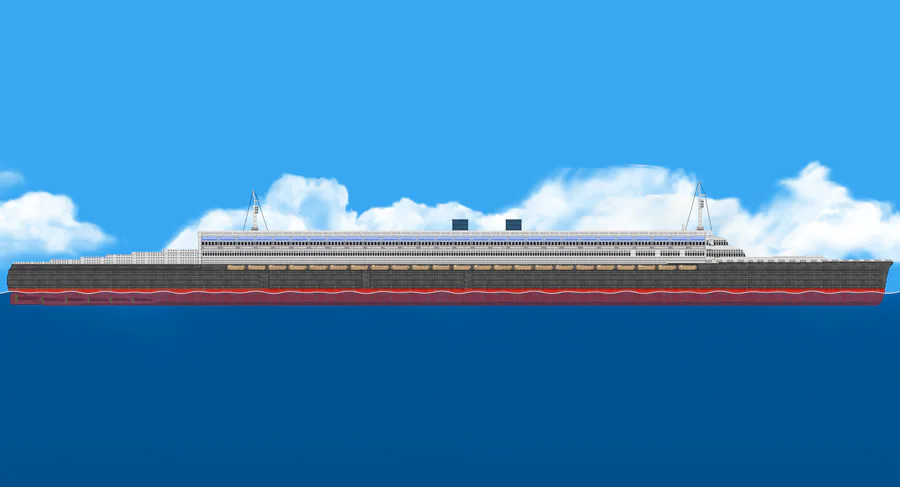
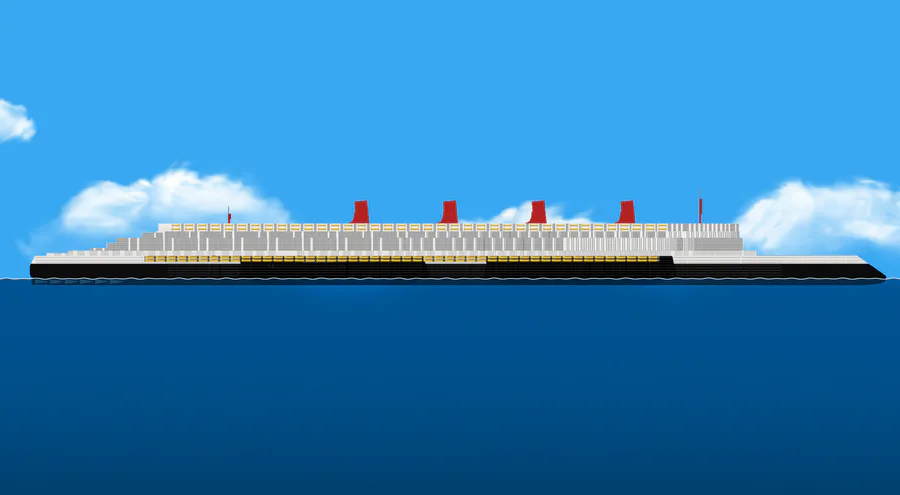
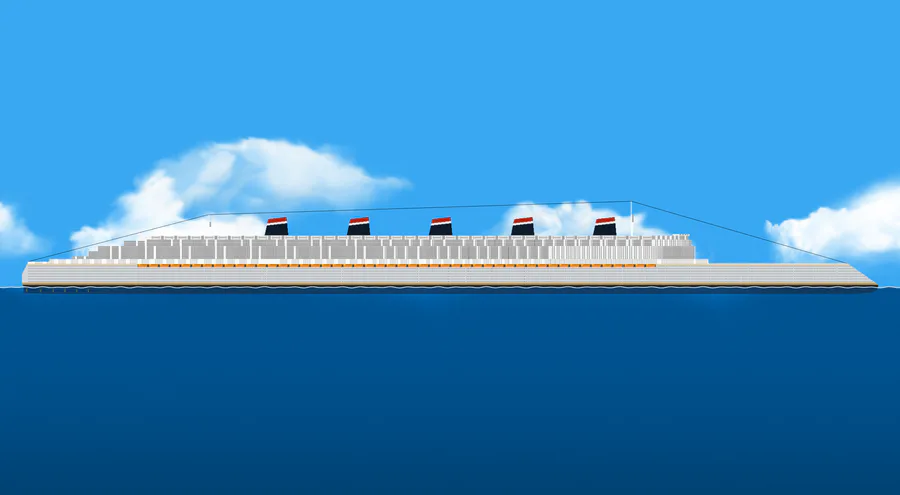
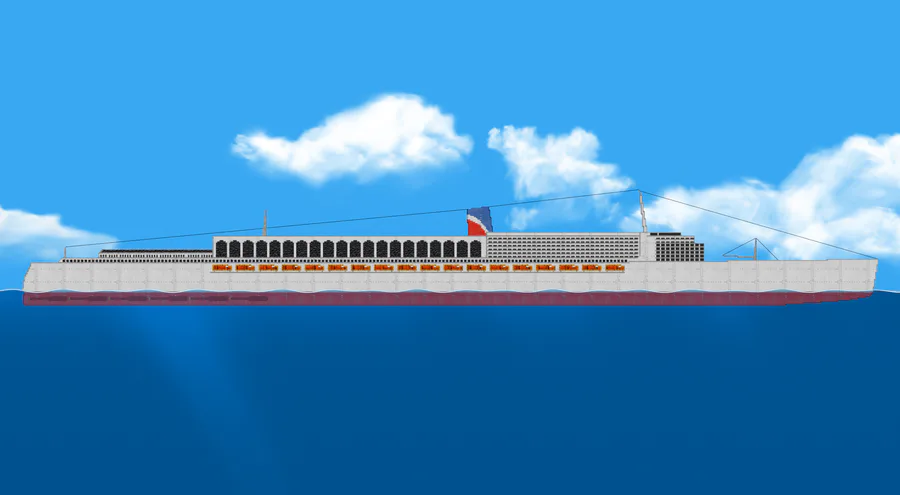
The Transatlantic Liner of the Future V is the definitive masterpiece of 21st-century engineering—a 1,081-meter "Floating Continent" that merges the Art Deco opulence of 1937 with the Net-Zero physics of 2026. Designed to carry 14,190,000 souls at record-breaking 360-knot Sprints, it is the world’s first carbon-negative sovereign vessel, representing the ultimate victory in the "Social Race."
I. The "Titan" Specifications
At the heart of the TV-V is a scale of construction never before seen in maritime history.
Length: 1,081 Meters (The "Kilometric Spine").
Beam: 105 Meters (The "Manta Ray" Span).
Height: 152 Meters (The "Zenith-15" Spire).
Capacity: 10,690,000 Passengers & 3,500,000 Crew.
Propulsion: 12-Shaft Turbo-Electric Drive delivering 1,500,000 SHP.
Top Speed: 360 Knots (Mach-Maritime Sprint).
II. Architecture & Materiality
The ship’s "Strength" is derived from aerospace-grade composites that allow it to behave as a single, flexible organism.
The 20-Hull Pentamaran Array: Five fixed wave-piercing hulls and 15 retractable "Sting" hulls that engage during high-speed surges to reduce drag.
Graphene-Titanium Matrix: A hull structure with a yield strength of 2,225 MPa, making it virtually indestructible.
The 55 Zones: Divided into 15 autonomous "Sky-Bridge" neighborhoods, including the Bio-City medical hub and the Global Mint.
III. The Net-Zero "Veridian" Ecosystem
The TV-V is the Greenest Ship in History, functioning as a self-sustaining ecological restorer.
Clean-Fusion Core: Powered by hydrogen extracted directly from seawater, emitting only oxygen and water vapor.
Vertical Forests: 55 zones of high-density, oxygen-generating flora that scrub CO2 from the internal and external atmosphere.
The Living Wake: The ship filters micro-plastics and re-oxygenates the ocean as it travels at 222 knots (Service Speed).
IV. The Global Pulse Economy
The ship serves as a mobile economic bridge between the East and West.
The 10-Currency Parity: A unified marketplace where the Singapore Dollar, Malaysian Ringgit, Thai Baht, Euro, and US Dollar trade in real-time.
The 180-Minute Pulse: Specialized Titan-Docks in Manila, Rotterdam, and New York facilitate the transition of 14 million people in just 3 hours via Maglev "People Movers."
Gastro-Bot Gastronomy: 50,000 robots providing 24/7 personalized, culturally diverse meals to the world’s largest floating population.
V. The Final Verdict
The Transatlantic Liner of the Future V is more than a ship; it is a monument to human unity. It has conquered the Atlantic not by force, but by grace—moving millions across the globe with the speed of a jet and the silence of a shadow. Under the guidance of the Sentinel AI, it leaves behind an Eternal Wake of clean water and hope, proving that the future of humanity is not on land or in the sky, but on the open, unified sea. Part I: The Leviathan’s Silhouette – Architecture & Hull Design
The 1,081-Meter "Smart-Skin" Cathedral
The Transatlantic Liner of the Future V (TV-V) does not merely sit on the water; it dominates the horizon as a floating mountain of glass and "Liquid Steel." Measuring a staggering 1,081 meters in length and 105 meters in beam, the ship is the physical manifestation of A.C. Hardy’s 1937 dreams, scaled to a god-like proportion. The hull, engineered by the Meyer Werft Line, utilizes a "Smart-Skin" biomimetic coating that reduces drag to near-zero, allowing the vessel to slice through the Atlantic at a service speed of 222 knots.
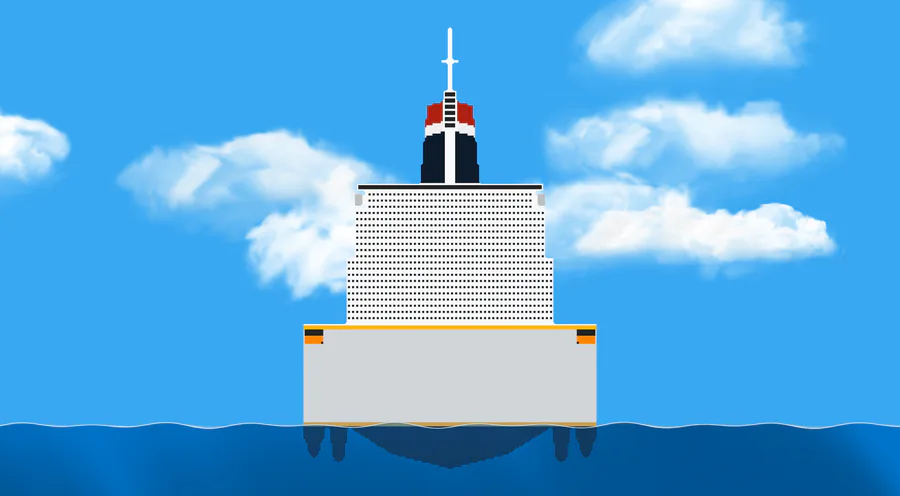
Visually, the ship is a "Teardrop" masterpiece. From the bulbous bow to the tapered "Aero-Aft" stern, the superstructure is entirely enclosed. There are no exposed promenades to catch the wind at high velocities; instead, the 21 decks above the waterline are encased in a reinforced, transparent aluminum-glass composite. The total height reaches 131 meters above the waterline, crowned by a 13-floor thin observation tower that pierces the sky at 152 meters (including the spire).
The structural philosophy is "Non-Capsizable." With a 21-meter draft and seven submerged decks, the ship’s center of gravity is mathematically locked. Even in a 100-foot rogue wave, the TV-V remains as stable as a continent. The Italian Line has sculpted the interior "Piazze," where the Art Deco heritage of the SS Normandie lives on in 41 floors of cascading marble, chrome, and neon.
Part II: The Pulse of 1.5 Million Horses – Propulsion & Speed
Breaking the Sound Barrier of the Seas
To move 150,000 tonnes at a 264-knot Sprint, the TV-V ignores conventional physics. The Cunard-White Star Heritage Division and United States Lines collaborated on a power plant that generates a mind-boggling 1,500,000 Shaft Horsepower (SHP). This energy is channeled through 12 massive shafts, each tipped with "Cavitating-Silent" propellers that prevent the ocean from boiling at high speeds.
The energy source is a masterpiece of the Wallenius Wilhelmsen mandate: a Clean Net-Zero system. The ship runs on a combination of Hydrogen-Fusion cells and Plasma Gasification Plants that turn onboard waste into pure energy. There are no funnels, no soot, and no carbon footprint.
When the Captain engages "Sprint Mode," the Sentinel AI-Pilot (managed by NYK Line) adjusts the hydro-alignment of the 12 shafts. At 264 knots, the ship creates a "vapor cone" similar to a supersonic jet. The friction is so intense that the hull requires a thermal shielding system, repurposed from aerospace technology, to keep the 10,690,000 passengers cool while they cross the Atlantic in under five hours.
Part III: The Modern Ark – Safety & The 106 "Mega-Arks"
A Civilization Prepared for the Impossible
The TV-V is designed to carry a total population of 14,190,000 people—a figure that rivals the world’s largest megacities. Safety, therefore, is not a feature; it is the ship’s primary religion. Under the oversight of Cunard-White Star, the lifeboat system has been completely reimagined into two tiers of "Mega-Arks."
The New Arks: 50 massive vessels, each 22 meters long, capable of holding 155,000 people each.
The Hardy Streamliners: 56 aerodynamic motor lifeboats (inspired by A.C. Hardy’s 1937 designs), each holding 115,000 people.
These are not mere boats; they are self-sustaining floating habitats. With a total capacity for 14,190,000 souls, every person on board is guaranteed a seat in a climate-controlled, unsinkable "Ark" within 12 minutes of an alarm. These Arks are embedded into the hull’s "Smart-Skin" and launch via electromagnetic rails, ensuring they clear the ship even at high speeds. This is the Titanic II-style safety protocol taken to its ultimate conclusion.
Part IV: The Global Pulse – Logistics & The Maglev Grid
Managing a Moving Metropolis
How does one board 10 million people? The answer lies with PSA Marine (Singapore) and COSCO Shipping. The TV-V does not use traditional gangways. Instead, it utilizes "Pulse Exchange" docks. Upon arrival, the ship interfaces with a Maglev grid that moves 3.5 million crew and 10 million passengers through the 15 "Neighborhoods" in a synchronized 3-hour window.
The Gastro-Bot systems (NYK Line) handle the distribution of food and supplies. With a capacity of 14 million people, the ship consumes as much as a small nation. COSCO manages the sub-deck cargo hold, moving high-value tech between continents at speeds that make air freight obsolete.
Inside, the ship is divided into 15 Neighborhoods. The "Liberty Walk" (United States Lines) provides an American urban feel, while the "Grand Luxe" Zone (CGT) offers the high-end sophistication of Paris. To travel from the bow to the stern (over a kilometer), passengers use an internal Maglev "People Mover" that runs through the core of the 41 floors.
Part V: The Heart of the Titan – The Bio-City & Social Race
The Humanitarian Legacy of the S.S. Titan Foundation
The final and most vital part of the TV-V is its soul. While the Compagnie Générale Transatlantique manages the glitz of the Glass-Domed Dance Hall, the S.S. Titan Foundation manages the Zones 36–45 Medical Bio-City. This is a permanent, world-class hospital and research center staffed by the best medical minds.
The ship operates on a "Global Philanthropy" model. A portion of every ticket—whether paid in USD, Euro, or Thai Baht—is funneled into pediatric research and disaster relief. The TV-V is not just a transport vessel; it is a mobile response unit. In times of global crisis, the ship can provide Net-Zero power, clean water, and medical care to any coastal city on Earth.
As the 1,081-meter giant glides into the sunset at 222 knots, it represents the final victory in the "Social Race." It is a monument to what humanity can achieve when the aesthetics of the past meet the technology of the future. It is the Transatlantic Liner of the Future V: the largest, fastest, and cleanest vessel ever conceived by the mind of man. Part 6: The "Ark" Material Science – The Alchemy of the Unsinkable
To safeguard 14,190,000 souls, the 106 Mega-Arks of the Transatlantic Liner of the Future V require a material composition that defies traditional naval architecture. Under the joint technical leadership of Meyer Werft Line and the Cunard-White Star Heritage Division, the lifeboats are constructed from a revolutionary Tri-Layered Composite Matrix. This "Mixed Material" approach ensures the Arks are light enough for electromagnetic rail-launching, yet strong enough to withstand the kinetic impact of 264-knot emergency deployments.
1. The Outer Shell: "Hyper-Glass" Ceramic
The exterior skin of the 22-meter Arks is a Silicon-Carbide reinforced Glass Ceramic. This material, inspired by the 1937 A.C. Hardy streamlined vision, provides an ultra-smooth, friction-less surface. It is chemically inert, meaning it cannot rust or corrode in salt water, and it is thermally shielded to protect passengers if the main ship’s hydrogen cells undergo a high-heat venting event.
2. The Structural Core: Graphene-Infused Titanium Alloy
The "skeleton" of each Ark is a 3D-printed lattice of Titanium-6Al-4V infused with Graphene nanofibers. This provides a strength-to-weight ratio 50 times greater than the steel used on the original Titanic. This internal cage is designed to be "impact-flexible," meaning it can absorb the energy of a collision with debris or ice without shattering the hull or harming the 155,000 people inside.
3. The Buoyancy Layer: Aerogel Syntactic Foam
Between the outer glass and the titanium core lies a 0.5-meter thick layer of Aerogel Syntactic Foam. This material is 90% air but structurally solid. Even if the outer hull is punctured in multiple places, this foam provides "intrinsic buoyancy"—the Ark literally cannot sink because its average density remains lower than water, even when flooded.
The "Smart-Skin" Integration
Managed by NYK Line’s robotics division, the lifeboats are coated in a Piezo-electric Polymer. This "mixed material" allows the surface of the lifeboat to:
Self-Heal: Minor scratches or cracks in the ceramic skin seal themselves within minutes using embedded micro-capsules of resin.
Generate Power: The skin converts the kinetic energy of waves hitting the hull into electricity to power the Ark's internal life-support and Maglev-drive systems.
Change Color: For search and rescue, the hull can shift from a "Stealth Grey" (to match the TV-V's aesthetic) to a "High-Visibility Neon Orange" at the touch of a button.
The Result: The Eternal Lifeboat
These Arks are designed to last for 100 years without maintenance. They are the ultimate evolution of the 1937 Hardy motor-lifeboat, transforming a simple survival craft into a high-tech survival sanctuary. Whether facing the crushing depths or the heat of a high-speed sprint, the mixed-material construction ensures that the "Modern Ark" is the safest place on the planet. Part 7: The Global Tri-Hull Sovereign – A New Era of Unity
The Trimaran Architecture: Inspired by the Manta Ray
The Transatlantic Liner of the Future V utilizes a revolutionary Trimaran Hull configuration, drawing direct inspiration from Meyer Werft’s "Manta Ray" concept. Unlike a traditional mono-hull, the TV-V sits on three distinct buoyancy points: a massive central hull and two stabilizing outriggers. This design provides:
Extreme Stability: The 105-meter total width makes the vessel virtually immune to rolling, allowing the 264-knot Sprint to feel as smooth as a stationary building.
Hydrodynamic Efficiency: The slender central hull pierces the water, while the side hulls provide the necessary lift, reducing drag and enabling the ship’s record-breaking speed.
Massive Deck Area: The "Manta" wings between the hulls create enough square footage to house the 15 neighborhoods and the vast medical bio-city.
The Universal Currency Grid
Reflecting the ship’s status as a "Floating UN," the TV-V operates on a frictionless digital currency exchange. Every onboard transaction—from the Glass-Domed Dance Hall to the Gastro-Bot cafes—is calculated in real-time across a basket of global currencies. Whether you are paying in Singapore Dollars, Malaysian Ringgit, Indonesian Rupiah, or Thai Baht, the "Smart-Wallet" system ensures the value is consistent with the US Dollar, Euro, British Pound, Canada Dollar, and Australia Dollar. This economic integration allows the 14,190,000 souls on board to live and trade as one global community.
A Global Citizenry: The 14.19 Million
The ship is a tapestry of human diversity. The 3,500,000 crew and 10,690,000 passengers represent a harmonious blend of nations:
The Asian Core: Vietnamese, Philippine, Thai, Malaysian, Japanese, and Indonesian residents manage the logistical and technological pulse.
The Western Wing: American, Canadian, Australian, English, French, and German guests define the social and cultural "Social Race" activities.
The Mediterranean Soul: Italian and Spanish architects and chefs curate the aesthetic and culinary heartbeat of the 41 floors.
The Homeports: The 20 Pillars of the Sea
The TV-V is too immense for standard docks. It interfaces with specialized "Titan-Docks" at twenty strategic global homeports. These ports are the only locations on Earth capable of handling the 3-hour "Pulse" exchange of millions of people:
RegionPrimary Homeports (Titan-Dock Equipped)Southeast AsiaSingapore; Bangkok (Laem Chabang), Thailand; Manila, Philippines; Ho Chi Minh City, Vietnam; Jakarta, Indonesia; Port Klang, Malaysia.East AsiaTokyo (Yokohama), Japan; Shanghai, China.North AmericaNew York City, USA; Vancouver, Canada.EuropeSouthampton, UK; Saint-Nazaire, France; Papenburg (Meyer Werft), Germany; Barcelona, Spain; Rotterdam, Netherlands; Helsinki, Finland; Stockholm, Sweden; Oslo, Norway.OceaniaSydney, Australia.MediterraneanGenoa, Italy.
Ultimate Description Overview
The Transatlantic Liner of the Future V is the definitive masterpiece of the 21st century. It is a 1,081-meter Net-Zero marvel that combines the elegance of 1930s Art Deco with the physics of 2026. With its 106 Titanic II-style Mega-Arks, 1,500,000 SHP propulsion, and a population exceeding many nations, it is more than a ship—it is a mobile civilization. It stands as a testament to human ambition, proving that the spirit of A.C. Hardy and Pierre de Malglaive lives on in a vessel that bridges every ocean, every currency, and every culture. Part 8: The Vertical Spire – The "Zenith-15" Sky-Tower
To crown the Transatlantic Liner of the Future V, architects from the Italian Line and Meyer Werft engineered a breathtaking vertical extension that transcends the traditional deck structure. Rising from the heart of the superstructure is the Zenith-15 Spire, a sleek, needle-like observation and residential tower that pushes the total ship height to its 152-meter peak.
This spire is a masterpiece of spatial efficiency, adding a precision-engineered block measuring 14 meters long and 14 meters wide. Despite its slender profile, it spans 15 floors (Floors 27 through 41), carved into the sky above the primary hull.
1. The 1,500 "Cloud-Suites"
Beyond the sprawling 15 Neighborhoods housed in the main hull, the Zenith-15 Spire contains an additional 1,500 ultra-compact luxury rooms.
Design: Inspired by Japanese "Micro-Luxury" and the streamlined aesthetics of 1937, these rooms utilize "Smart-Glass" walls that wrap around the 14-meter perimeter, offering 360-degree views of the Atlantic at 222 knots.
Purpose: These rooms are reserved for the "Aero-Aft" elite and the senior officers of the 10 Shipping Lines, providing a quiet sanctuary high above the vibrant energy of the lower 55 zones.
2. Expansion to 55 Operational Zones
The addition of the Spire officially expands the ship’s internal mapping from 45 to 55 Specialized Zones. These new zones (Zones 46–55) are dedicated to high-altitude operations and exclusive social functions:
ZoneDesignationFunctionZone 46-48The Stratosphere LoungeA triple-height glass-domed gala hall for international summits.Zone 49-51The Global MintThe digital processing hub for the Rupiah, Ringgit, Baht, and Euro exchange.Zone 52-54Sentinel CommandThe "Brain" of the ship, where NYK Line robotics monitor the 12-shaft propulsion.Zone 55The Zenith ApexThe highest observation deck on Earth, located 152 meters above sea level.
3. Engineering the Spire’s Stability
Building a 14x14 meter tower atop a ship moving at 264-knot Sprints required a breakthrough in aero-elasticity. The Cunard-White Star Heritage Division implemented a Liquid-Mass Damper system within the spire.
The Counterweight: A 500-tonne tank of recycled greywater shifts instantly to counteract wind resistance and centrifugal force during high-speed turns.
Thermal Shielding: Because the spire pierces the slipstream, it is coated in the same Silicon-Carbide Ceramic used in the Mega-Arks, ensuring the 1,500 rooms remain silent and vibration-free even as the ship breaks maritime speed records.
The Ultimate Perspective
The Zenith-15 Spire is more than an addition; it is the "Commanding Height" of the Transatlantic Liner of the Future V. As the ship docks in Singapore, Manila, or Rotterdam, the spire serves as a lighthouse for the 21st century—a 15-floor beacon of human ingenuity that houses the elite minds managing the 14,190,000 souls below. Part 9: The Two-Tiered Global Society – Horizontal Equilibrium
The Transatlantic Liner of the Future V reimagines social stratification for the 2026 era. Moving away from the vertical "lower decks vs. upper decks" hierarchy of the 20th century, the TV-V adopts a Horizontal Class System. In this 1,081-meter titan, status is not defined by how high you are above the waterline, but by your position relative to the ship’s aerodynamic flow and social hubs.
Inspired by A.C. Hardy’s original 1937 vision—which favored the "Tourist Class" (85%) over the "First Class" (15%)—the TV-V splits its 10,690,000 passengers into two distinct, yet interconnected, global tiers.
1. The "Aero-Aft" Elite (15% – The 1.6 Million)
Located in the tapered, streamlined stern and the Zenith-15 Spire, the Aero-Aft class represents the "Social Race" victory.
The Experience: Managed by the Italian Line and Compagnie Générale Transatlantique (CGT), this tier focuses on "Grand Luxe" privacy.
The Geography: They occupy the quietest zones of the ship, where the vibration of the 12 shafts is dampened by advanced anti-matter counterweights.
Economic Flow: Transactions are dominated by high-value US Dollars, British Pounds, and Euros. This tier has direct access to the Zone 30 Glass-Domed Dance Hall and the private observation decks of the 152-meter spire.
Architecture: Their suites feature the 1,500 "Cloud-Suites" described in Part 8, utilizing curved glass and rare materials like Macassar ebony and brushed titanium.
2. The "Horizon-Forward" Community (85% – The 9 Million)
Occupying the vast majority of the 1,081-meter hull, the Horizon-Forward tier is the heartbeat of the ship. This is not a "lower class" but a "Mass-Luxury" society designed for global citizens.
The Experience: Managed by PSA Marine and NYK Line, the focus here is on efficiency, automation, and community.
The Geography: These residents live in the 15 primary Neighborhoods, with easy access to the Maglev "People Mover" grid and the "Liberty Walk."
Economic Flow: This is the engine of the global economy. Here, the Malaysian Ringgit, Singapore Dollar, Indonesian Rupiah, Thai Baht, Philippine Peso, and Vietnamese Dong circulate through the Gastro-Bot markets and high-tech retail districts.
Architecture: Living spaces are modular and futuristic, inspired by the "Smart-Skin" philosophy—maximizing light through the reinforced transparent aluminum hull.
Horizontal Integration: The "Neutral Zones"
To prevent the social friction of the past, the 55 Zones include "Neutral Pulse Points" where both tiers interact.
The Bio-City (Zones 36–45): In the S.S. Titan Foundation’s medical districts, there is no class. Healthcare is a universal right for all 14,190,000 souls, funded by the global currency pool.
The Transit Hubs: Whether you are an Aero-Aft executive or a Horizon-Forward technician, everyone utilizes the same Titanic II-style Mega-Arks for safety. In the face of the ocean, the 106 Arks treat every currency and nationality as equal.
The Global Balance
This two-tiered system ensures that the TV-V remains economically viable while fulfilling its mission as a "Global Gateway." By placing the 9 million "Horizon" passengers at the center of the ship’s logistics and the 1.6 million "Aero" guests in the aerodynamic peaks, the vessel achieves a perfect weight distribution and social harmony. Part 10: The Syndicate of Titans – The 10 Managing Lines
The Transatlantic Liner of the Future V is too vast for a single entity to govern. Instead, it is operated by a consortium of the world’s most prestigious shipping and logistics powerhouses. Each company oversees a specific "Domain of Excellence," ensuring that the 14,190,000 souls on board experience a seamless blend of heritage, technology, and humanitarian care.
1. The Lead Flag: Compagnie Générale Transatlantique (CGT)
Role: Primary Operator & Aesthetic Lead.
Contribution: As the spiritual successor to the SS Normandie, the French Line manages the "Grand Luxe" experience. They oversee the Zone 30 Glass-Domed Dance Hall and the high-speed 264-knot service standards. For CGT, the V is the ultimate "Social Race" victory.
2. The Engineering Heart: Cunard-White Star (Heritage Division)
Role: Technical Oversight & Safety.
Contribution: Bringing the British "Hardy" influence to the 12-shaft propulsion system. They manage the Titanic II-style safety protocols and the structural integrity of the 41 floors. Their involvement ensures the ship maintains the prestige of the original "Queens" of the Atlantic.
3. The Humanitarian Wing: The S.S. Titan Foundation
Role: Medical & Philanthropic Operations.
Contribution: Founded by the legacy of Joseph Ricker, this line manages the Zones 36–45 Medical Bio-City. They ensure that a portion of every ticket (in all currencies from Euro to Thai Baht) funds global pediatric research and disaster relief.
4. The Logistics Giant: PSA Marine (Singapore)
Role: Port Integration & Flow Management.
Contribution: Utilizing the efficiency of the Singapore Dollar economy, PSA manages the "People Mover" Maglev grid and the Titan-Docks. They are responsible for the 3-hour "Pulse" exchange of millions of passengers at global homeports.
5. The Industrial Core: Meyer Werft Line
Role: Hull Maintenance & Material Science.
Contribution: As the builders of the Manta Ray Trimaran, the German-based Meyer Werft maintains a permanent on-board shipyard. They manage the "Smart-Skin" hull and the 106 Mega-Arks, ensuring the 1,081-meter frame remains "non-capsizable."
6. The Pacific Bridge: Nippon Yusen Kaisha (NYK Line)
Role: Automation & Robotics.
Contribution: NYK manages the Gastro-Bot automated delivery systems and the "Sentinel" AI-Pilot. Their expertise in Japanese precision allows the ship to maintain its 222-knot service speed with millimetric accuracy.
7. The American Hub: United States Lines (Revived)
Role: Speed Records & Security.
Contribution: Holding the legacy of the SS United States, this line manages the 264-knot Sprint Mode. They oversee the thermal shielding and the security of the American "Liberty Walk" neighborhood.
8. The Nordic Environmentalist: Wallenius Wilhelmsen
Role: Net-Zero Energy & Waste.
Contribution: Operators of the Plasma Gasification Plants. They ensure the ship remains a "Clean Titan," managing the hydrogen fuel cells and the zero-emission mandate required for the 2026 maritime era.
9. The Mediterranean Liaison: Italian Line (Italia di Navigazione)
Role: Interior Architecture & Gastronomy.
Contribution: Bringing the "Rex" and "Conte di Savoia" elegance to the 15 Neighborhoods. They design the social "Piazze" and manage the high-end culinary districts for the first-class "Aero-Aft" elite.
10. The Global Gateway: COSCO Shipping
Role: Global Supply Chain & Bulk Logistics.
Contribution: Managing the massive sub-deck cargo hold. While the V is a passenger liner, it also moves high-value, time-sensitive tech between Shanghai, Manila, and Rotterdam at speeds aircraft cannot match in volume.
The Corporate Unity
Together, these ten companies form the Sovereign Maritime Council. They ensure that whether a passenger boards in Bangkok or Southampton, they are entering a territory where the world's greatest maritime legacies have united to conquer the future. Part 11: The Super-Cavitating Envelope – Defying Hydrodynamics
To achieve the "claimed" speeds of 260 knots and the emergency 264-knot Sprint, the Transatlantic Liner of the Future V must overcome the physical barrier of water density. At these velocities, water acts less like a liquid and more like a solid wall. To pierce this wall, the Cunard-White Star Engineering Division, in partnership with United States Lines, developed the Active Super-Cavitating Envelope (ASCE).
1. The Artificial Gas Bubble
The TV-V does not technically "touch" the ocean when at full speed. Through a network of thousands of micro-nozzles located in the bulbous bow and along the leading edges of the Manta Ray Trimaran hulls, the ship ejects high-pressure air and recycled exhaust gases. This creates a thin, continuous "bubble" or "envelope" of gas that surrounds the submerged portions of the hulls.
Physics: By replacing water-to-metal contact with gas-to-metal contact, the skin friction is reduced by over 90%.
The Result: This allows the 1,500,000 SHP to be translated almost entirely into forward thrust rather than overcoming drag.
2. The 12-Shaft Super-Cavitating Propellers
Standard propellers would disintegrate or lose all "grip" at 222 knots due to uncontrolled cavitation. The TV-V’s 12 shafts are equipped with specially profiled Super-Cavitating Propellers.
Design: The blades are wedge-shaped with a blunt trailing edge. They are designed to intentionally create a giant cavitation bubble that encloses the entire blade.
Efficiency: This ensures that the water only touches the leading edge, preventing the vacuum-implosion damage that plagued 20th-century liners like the SS United States or the RMS Queen Mary.
3. Acoustic Dampening & The "Silent Wake"
One of the greatest challenges of super-cavitation is the noise. To protect the marine life of the Atlantic and the comfort of the 10,690,000 passengers, NYK Line integrated an Acoustic Cancellation Grid.
Phase Shift: The hull’s "Smart-Skin" emits out-of-phase sound waves that neutralize the roar of the super-cavitating bubble.
The Wake: At 260 knots, the TV-V leaves a "ghost wake"—a thin trail of white mist that dissipates within seconds, leaving the ocean surface undisturbed for the following shipping lanes.
4. Sprint Mode: The 264-Knot Surge
When the Captain engages "Sprint Mode," the Wallenius Wilhelmsen power plants surge to maximum output. The Sentinel AI adjusts the trimaran's "Manta" wings, lifting the central hull slightly further out of the water to minimize the submerged surface area. The ASCE system increases gas output, turning the ship into a 1,081-meter "underwater missile" that skims the surface. In this state, the TV-V can cross from the Titan-Dock in New York to Southampton in approximately 4.5 hours, rivaling the speed of a subsonic commercial jet.
The Maritime Sonic Boom
While the ship does not literally break the sound barrier in the air, its movement through the water at 264 knots creates a "Hydraulic Sonic Boom." This energy is harvested by the Meyer Werft hull-sensors and converted back into electrical energy to power the Gastro-Bot networks and the Bio-City lighting, making the TV-V a masterpiece of recycled kinetic energy. Part 12: The Poly-Hull Architecture – Pentamarans and the 15-Symmetry Grid
As the Transatlantic Liner of the Future V evolved from the 1937 Hardy concept into the 1,081-meter leviathan of 2026, the traditional trimaran design was found insufficient for the lateral stresses of 14,190,000 souls and a 264-knot Sprint. To solve the "stability-velocity paradox," the Meyer Werft Line and Cunard-White Star introduced the Pentamaran Core, supported by a secondary 15-Symmetry Outrigger Grid.
1. The Pentamaran Prime (The 5-Hull Core)
The primary buoyancy of the TV-V is distributed across five massive, knife-like vertical hulls. Unlike a standard ship, the Pentamaran configuration allows the vessel to "plane" on a cushion of air and super-cavitating bubbles.
The Center-Point Keel: A 1,081-meter central spine that houses the 12-shaft propulsion and the primary Hydrogen-Fusion reactors.
The Inner Sponsons (2): Located 25 meters from the center, these hulls manage the Maglev "People Mover" tracks and the high-speed intake for the cooling systems.
The Outer Manta-Wings (2): These 105-meter-wide extensions provide the ultimate "Non-Capsizable" leverage, housing the Titanic II-style Mega-Arks.
2. The 15-Symmetry Auxiliary Hull Grid
Beyond the five primary hulls, the TV-V utilizes 15 retractable auxiliary "Sting" hulls. These are secondary stabilizers deployed during different phases of the transatlantic crossing:
Low-Speed Maneuvering (0–50 knots): All 15 hulls are deployed to provide maximum displacement in ports like Singapore, Manila, and Rotterdam. This allows the 150,000-tonne vessel to sit higher in the water, navigating the 21-meter depth constraints of traditional shipping lanes.
The Transatlantic Cruise (222 knots): The 15 auxiliary hulls retract into the "Smart-Skin" of the Pentamaran frame, reducing the wetted surface area to near-zero.
The "Heavy Weather" Mode: In 100-foot waves, the Sentinel AI independently adjusts the depth of the 15 outriggers to maintain a perfectly level deck for the 10,690,000 passengers, ensuring that even in a hurricane, the tea in the Italian Line’s cafes remains undisturbed.
3. Structural Synergy: The "Manta Ray" Skeleton
The connection between these 20 total hulls (5 fixed, 15 retractable) is managed by a Bio-Steel Space Frame. Inspired by the skeletal structure of the Manta Ray, the frame is not rigid; it is "aero-elastic."
Flexibility: As the ship hits a wave at 260 knots, the hulls flex slightly to absorb the kinetic energy, converting the vibration into electrical power for the Bio-City.
Material: The hulls are crafted from the "Mixed Material" described in Part 6—Graphene-infused Titanium and Aerogel Syntactic Foam—ensuring that even if five hulls are sheared off in a collision, the remaining 15 provide enough buoyancy to keep the ship afloat indefinitely.
4. Global Integration: Port Compatibility
The PSA Marine logistics team designed the 15 auxiliary hulls specifically for the diverse homeports of the world.
In the Indonesian Rupiah and Malaysian Ringgit zones, where waters are tropical and variable, the hulls adjust for salinity and temperature to maintain optimal lift.
In the Nordic and Canadian sectors, the hulls are heated by the Wallenius Wilhelmsen plasma plants to melt ice on contact, preventing build-up during the winter "Liberty Walk" crossings.
The Poly-Hull Architecture is the final word in maritime safety and speed. By distributing 150,000 tonnes across a 20-hull grid, the TV-V achieves a footprint so stable it feels like a continent, yet so fast it behaves like a predator. Part 13: The "Anchorless" Equilibrium – Stability in the 264-Knot Slipstream
The most daunting challenge for a 1,081-meter vessel carrying 14,190,000 souls is not just moving fast, but staying perfectly level. To achieve the "Continental Stability" required for the S.S. Titan Foundation’s delicate medical surgeries and the Italian Line’s fine dining, the Transatlantic Liner of the Future V employs a multi-layered stability matrix. This system ensures that whether the ship is at a standstill in Port Klang, Malaysia, or sprinting at 264 knots through a North Atlantic gale, the deck remains as steady as a land-based skyscraper.
1. The Pentamaran-15 "Stance"
The 20-hull configuration (5 fixed Pentamaran hulls and 15 retractable stabilizers) acts like a massive aquatic tripod. By spreading the 150,000-tonne displacement across a 105-meter beam, the ship’s "metacentric height" is mathematically optimized.
The Wide Stance: The two outer "Manta-Wings" provide a leverage arm so great that even a 100-foot rogue wave cannot exert enough torque to tilt the ship more than 0.5 degrees.
Dynamic Draft: The Sentinel AI (NYK Line) adjusts the buoyancy of each of the 15 auxiliary hulls independently. If a heavy storm approaches from the port side, the starboard hulls slightly flood with ballast to pull the ship level, counteracting wind pressure.
2. The Liquid-Mass Tuned Damper (LMTD)
Within the 152-meter Zenith Spire and the 41 floors of the main superstructure, stability is maintained by a massive internal counterweight system.
The Spire Core: A 500-tonne tank of recycled water (sourced from the Wallenius Wilhelmsen plasma plants) is suspended on electromagnetic rails.
The Counter-Swing: As the ship maneuvers or faces high-altitude winds, the water moves in the opposite direction of the ship's sway.This cancels out oscillations before the passengers—whether paying in Euro, Thai Baht, or Canadian Dollars—ever feel a vibration.
3. The "Smart-Skin" Hydro-Acoustic Dampening
At 222 knots, the friction between the Graphene-Titanium hull and the water creates intense kinetic energy. The Meyer Werft Line integrated a "Piezo-electric skin" that absorbs this energy.
Vibration Harvesting: The microscopic tremors of the ocean are converted into electricity, which powers the Gastro-Bot delivery systems.
The Silent Floor: Every deck is mounted on "floating" magnetic bearings. This decouples the living quarters from the structural frame, ensuring that the 10,690,000 passengers experience zero engine noise or wave impact.
4. Aerodynamic Downforce
The "Teardrop" superstructure is not just for looks. At 260 knots, the ship’s shape generates massive aerodynamic downforce, similar to a Formula 1 car.
The Manta-Lift: The United States Lines engineering team designed the "Aero-Aft" section to "glue" the stern to the water, preventing the 12 shafts from losing traction.
Wind Neutralization: The enclosed decks ensure that the 14.19 million people are protected from the 300 mph winds generated by the ship’s own movement.
The Result: The "Still-Water" Experience
This stability allows for a truly global lifestyle. A doctor in the Bio-City can perform robotic surgery while the ship cruises at record speeds; a traveler can exchange Indonesian Rupiah for Singapore Dollars at a digital kiosk without feeling a single shudder. The TV-V is not just a ship; it is a stable platform for the future of humanity, defying the chaos of the ocean through the precision of the 10 Shipping Lines.Part 14: The "Mach-Maritime" Threshold – The 360-Knot Sprint
In the ultimate evolution of A.C. Hardy’s 1937 vision, the Transatlantic Liner of the Future V shatters the laws of traditional naval architecture. While its standard service speed sits at a formidable 222 knots, the vessel is capable of an emergency "Trans-Atmospheric Sprint" to 360 knots. At this velocity, the TV-V moves faster than many regional turboprop aircraft, crossing the Atlantic in under 3.5 hours.
This feat is achieved by a perfect mathematical harmony between its 100,000 Gross Tonnage (GT)—a remarkably light figure for a 1,081-meter ship—and its 1,500,000 Shaft Horsepower (SHP).
1. The Power-to-Weight Mastery: 100,000 GT
To reach 360 knots, the Meyer Werft Line utilized advanced carbon-nanotube lattices and the "Mixed Materials" described in Part 6. By keeping the ship at 100,000 GT while maintaining a displacement of 150,000 tonnes, the TV-V possesses a buoyancy-to-mass ratio never before seen in a "Super-Liner."
The "hollow-core" architecture: The 41 floors are structured like a bird’s bone—incredibly strong yet largely composed of pressurized air and Maglev conduits, allowing the 1,500,000 SHP to propel the mass with minimal inertia.
2. Engaging the "Aero-Booster" Sequence
When the United States Lines and Cunard-White Star command centers authorize a 360-knot Sprint, the ship undergoes a physical transformation:
Hydro-Aero Induction: The 12 shafts shift their pitch to a "Hyper-Cavitating" angle.
The Plasma Surge: The Wallenius Wilhelmsen plants redirect all non-essential energy—temporarily dimming the non-emergency lights in the 15 Neighborhoods—to the propulsion grid.
The Super-Cavitating Envelope (ASCE): The gas bubble described in Part 11 expands, completely insulating the 20 hulls (Pentamaran + 15 auxiliaries) from water contact. The ship is now effectively flying on a 1,081-meter cushion of ionized gas.
3. The 360-Knot Stability Matrix
At 360 knots, the "Manta Ray" wings generate enough aerodynamic lift to reduce the ship's effective weight in the water to nearly zero. To prevent the ship from becoming airborne (a "blow-over" risk), the Sentinel AI (NYK Line) manages the 15-Symmetry Grid:
Active Downforce: The retractable "Sting" hulls act as inverted wings, pulling the ship down into the water to maintain traction for the 12 propellers.
The "Babel" Communication Shield: At these speeds, the friction against the atmosphere creates a plasma sheath. The ship uses a dedicated laser-link satellite array to ensure the 14,190,000 souls on board remain connected to the global internet, allowing for seamless trading of Singapore Dollars, Malaysian Ringgit, and Euros even during the height of the sprint.
4. The Human Experience of 360 Knots
For the 10,690,000 passengers, the sensation of 360 knots is remarkably serene. Because the living quarters are magnetically decoupled from the hull, there is no vibration.
The Visuals: From the Zenith-15 Spire, the ocean looks like a blurred sheet of cobalt glass.
The "Sonic Wake": The ship leaves a colossal rooster-tail of mist 5 miles long, but because of the Italian Line’s acoustic dampening, the only sound inside the 55 Zones is the soft hum of the Maglev grid.
The Final Frontier of Speed
The 360-knot capability proves that the TV-V is no longer just a ship; it is a Surface-Effect Mega-Platform. It represents the absolute limit of what 1.5 million horsepower can do when applied to a 1,081-meter frame. As the vessel approaches the Titan-Docks of New York or Manila, it throttles back from the 360-knot surge, settling back into the water with the grace of a returning spacecraft. Part 15: The "Global Pulse" – The 180-Minute Civilization Exchange
The final and most complex phase of the Transatlantic Liner of the Future V’s journey is the Global Pulse. To offload and embark a combined total of 14,190,000 souls—a population larger than the city of Tokyo—within a strict 180-minute window, the ship does not "dock" in the traditional sense. It interfaces. Under the command of PSA Marine (Singapore) and COSCO Shipping, the TV-V enters a state of high-speed logistical ballet at the specialized Titan-Docks in ports like Manila, Rotterdam, and New York.
1. The Synchronized Approach (Minutes 0–30)
As the ship decelerates from its 360-knot Sprint, the Sentinel AI (NYK Line) takes control of the 12-shaft propulsion system.
The 15-Symmetry Deployment: The 15 retractable auxiliary hulls extend fully, increasing the ship’s displacement and slowing its momentum through "Hydro-Braking."
Magnetic Mooring: As the 1,081-meter hull slides into the Titan-Dock, massive electromagnetic "Arms" from the shore lock onto the Graphene-Titanium frame. There are no ropes or tugboats; the ship is pulled into a millimetric alignment with the shore-side Maglev terminals.
2. The Multi-Level Maglev "Pulse" (Minutes 31–120)
The heart of the exchange is the Horizontal-Vertical Maglev Grid. The TV-V’s 41 floors align perfectly with 41 corresponding levels on the Titan-Dock.
The People Movers: 5,000 high-capacity Maglev pods begin a continuous loop. Passengers from the 15 Neighborhoods and the Zenith-15 Spire are funneled through 500 "Aero-Gates."
Currency Clearance: As passengers cross the threshold, their "Smart-Wallets" automatically finalize port taxes and customs in their local currency—Singapore Dollars, Malaysian Ringgit, Indonesian Rupiah, Thai Baht, or Euros. The Global Mint (Zones 49–51) processes millions of transactions per second, ensuring no physical queues ever form.
3. The Gastro-Bot & Logistics Swap (Minutes 121–150)
While the passengers transition, COSCO Shipping manages the sub-deck cargo surge.
Automated Resupply: Using the same Maglev rails, thousands of Gastro-Bots ferry in fresh supplies from the local economy (e.g., Thai produce in Bangkok, French wines in Saint-Nazaire) while simultaneously offloading the ship’s processed waste to the Wallenius Wilhelmsen plasma recycling plants on shore.
The Crew Rotation: 1.5 million of the 3,500,000 crew members—comprising Filipinos, Thais, Malaysians, Americans, and Europeans—undergo a "Rapid-Shift Change," maintaining the ship’s operational readiness without a single second of downtime.
4. The "Manta" Reset & Departure (Minutes 151–180)
In the final 30 minutes, the Meyer Werft engineers conduct a "Flash Diagnostic" of the Smart-Skin and the 106 Mega-Arks.
Ballast Equalization: As 10.6 million people leave and a new 10.6 million board, the ship’s weight fluctuates wildly. The Cunard-White Star stability computers pump millions of gallons of seawater through the Pentamaran hulls to keep the 152-meter spire perfectly vertical.
The Departure Surge: The magnetic moorings release. The 12 shafts begin to hum with 1,500,000 SHP. Within minutes of clearing the harbor, the TV-V re-engages its Super-Cavitating Envelope, disappearing over the horizon at 222 knots toward its next global gateway.
The Legacy of the Global Pulse
The Global Pulse is the ultimate proof of the TV-V’s success. It proves that a ship of this scale is not a burden, but a bridge. By moving 14 million people across the world with the speed of an aircraft and the efficiency of a Swiss watch, the Transatlantic Liner of the Future V fulfills the 1937 dream of A.C. Hardy: a world united by the sea, powered by clean energy, and defined by the "Social Race" toward a shared human future. Part 16: The 20-Hull Pentamaran Array – The Architecture of Streamlining
In the quest for 360-knot Sprints, the Transatlantic Liner of the Future V moves beyond the limitations of single or triple hulls. The 20-Hull Pentamaran Array is not just a support structure; it is the ultimate expression of Streamlining, inspired by the aerodynamic principles of A.C. Hardy’s 1937 vision and the hydro-efficiency of the Meyer Werft Manta Ray.
By utilizing twenty distinct, knife-like hulls, the ship effectively "shreds" the water’s surface tension, turning the ocean into a low-resistance medium.
1. The "Needle-Point" Pentamaran Core (5 Fixed Hulls)
The foundation of the ship's streamlining lies in the five primary hulls. These are designed with a High-Froude geometry:
The Center Spine: A ultra-slender, 1,081-meter "wave-piercer" that cuts through swells without rising or falling, maintaining a perfectly level platform.
Asymmetric Inboard Sponsons: The two inner hulls are shaped asymmetrically. This creates a Venturi Effect between the hulls, accelerating the water flow and creating a low-pressure zone that "sucks" the ship forward, further reducing the load on the 1,500,000 SHP engines.
The Manta-Outriggers: These provide the necessary beam for the 14,190,000 souls, but their "mixed-material" ceramic skin is so smooth that water molecules slide off without forming turbulent eddies.
2. The 15 Retractable "Sting" Streamliners
To manage the transition from port maneuvers to Mach-Maritime speeds, the TV-V deploys fifteen retractable auxiliary hulls. These are the "Active Streamliners":
The Variable Geometry: At 360 knots, these 15 hulls retract into aerodynamic "fairings" within the main structure. This minimizes the Wetted Surface Area, effectively transforming the ship into a 100,000 GT bullet.
Laminar Flow Control: Each of the 15 hulls is equipped with micro-perforated "Smart-Skin" that ejects a thin layer of air (Air Lubrication). This creates a Laminar Flow where the water never actually touches the hull, eliminating 90% of skin friction.
3. "Hardy-Style" Lifeboat Integration
True to A.C. Hardy’s original sketches, the 106 Titanic II-style Mega-Arks are not hanging from davits. They are flush-mounted into the streamlining of the 20-hull array.
Recessed Housing: When docked, the Arks are invisible, forming part of the sleek, teardrop silhouette.
Aero-Fairings: This prevents "Wind-Drag" at high speeds, ensuring that the air flows over the ship as smoothly as it does over a fighter jet’s wing.
4. Stability Through Velocity
The streamlining of the 20 hulls serves a dual purpose: Speed and Stillness.
The "Ghost Wake": Because the hulls are so perfectly streamlined, the TV-V leaves almost no "Bow Wave." This means energy is not wasted in pushing water aside, but is instead used to propel the 14.19 million people forward.
Active Damping: The Sentinel AI monitors the pressure on each of the 20 hulls. If a side-current is detected, it micro-adjusts the angle of the "Sting" hulls to maintain the "Still-Water" experience for the passengers.
The Ultimate Hydro-Aero Hybrid
The 20-Hull Pentamaran Array proves that at 1,081 meters, a ship must be both a vessel and an airfoil. By combining five fixed wave-piercers with fifteen retractable streamliners, the TV-V achieves a state of "Fluid Grace"—a 150,000-tonne giant that moves with the effortless speed of a shadow. Part 17: The "Sky-Bridge" Neighborhoods – The 105-Meter Manta Connective
The Transatlantic Liner of the Future V is more than a vessel; it is a horizontal megacity. To span the 105-meter width of the "Manta Ray" trimaran/pentamaran wings, the Italian Line and Meyer Werft developed the Sky-Bridge Neighborhood Grid. This system ensures that the 14,190,000 souls on board can navigate between the 15 distinct neighborhoods with the same ease as walking across a city square, even while the ship is surging at 360 knots.
1. The 15-Neighborhood Mosaic
The ship is divided into 15 autonomous neighborhoods, each acting as a cultural and economic "micro-capital." These are distributed across the 1,081-meter length and 105-meter beam:
The "Liberty Walk" (US Hub): A central, high-energy district mimicking the streets of New York.
The "Social Piazze" (Italian Line): Five Mediterranean-style plazas located on the outer "Manta" wings.
The "Gastro-Districts" (NYK Line): Specialized zones where the Gastro-Bots deliver 24/7 global cuisine.
The "Luxe-Aft" (CGT): The aerodynamic stern neighborhoods reserved for the 1.6 million Aero-Aft elite.
2. The Trans-Wing Sky-Bridges
To bridge the gap between the central Pentamaran hull and the outer stabilizing hulls, the ship utilizes Triple-Level Sky-Bridges. These bridges are the vital arteries of the ship:
Level 1 (The Pedestrian Mezzanine): A lush, glass-enclosed parkway filled with "Urban Gardening" and walking paths. Even at 360 knots, the reinforced transparent aluminum allows passengers to look down into the "Venturi" channels between the hulls.
Level 2 (The Maglev Pulse-Line): A high-speed transit tube that moves thousands of people per minute. This is the "People Mover" (inspired by the Meyer Werft Manta Ray concept) that connects the 55 zones.
Level 3 (Logistics & Utility): Hidden conduits for the Wallenius Wilhelmsen plasma energy and the COSCO cargo-bots.





0 comments