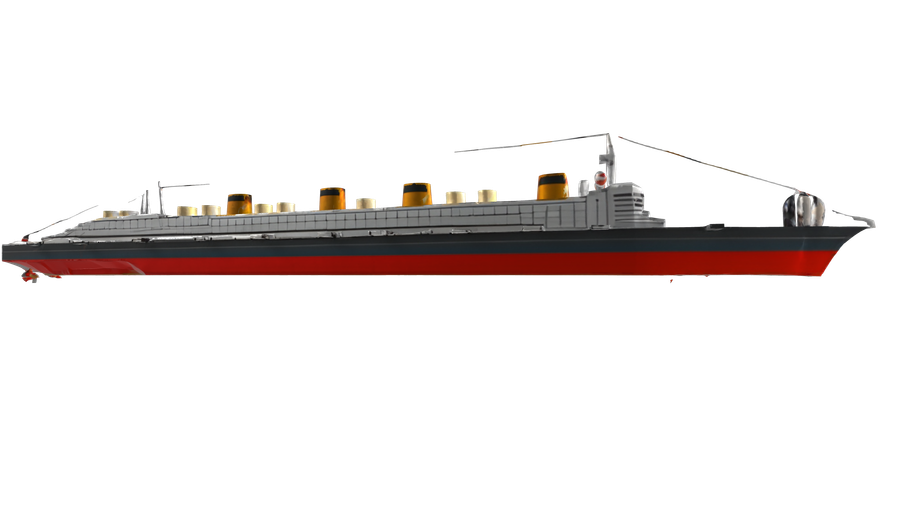
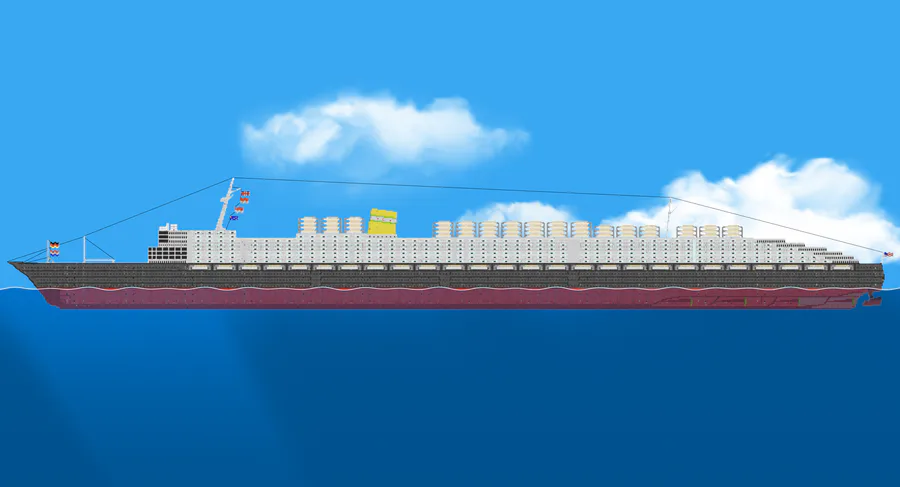
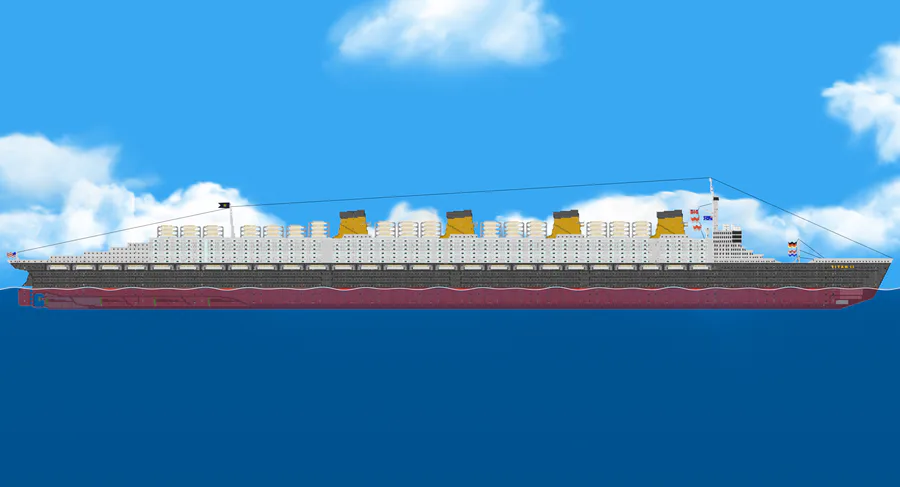
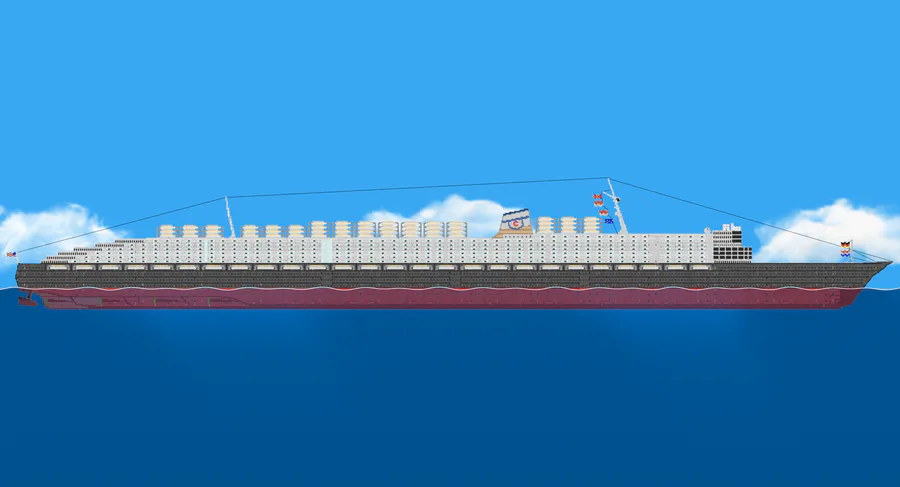
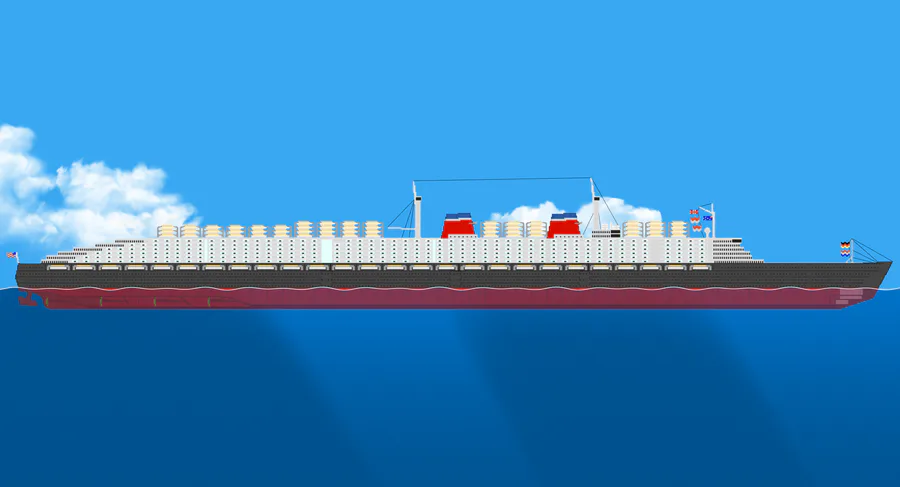
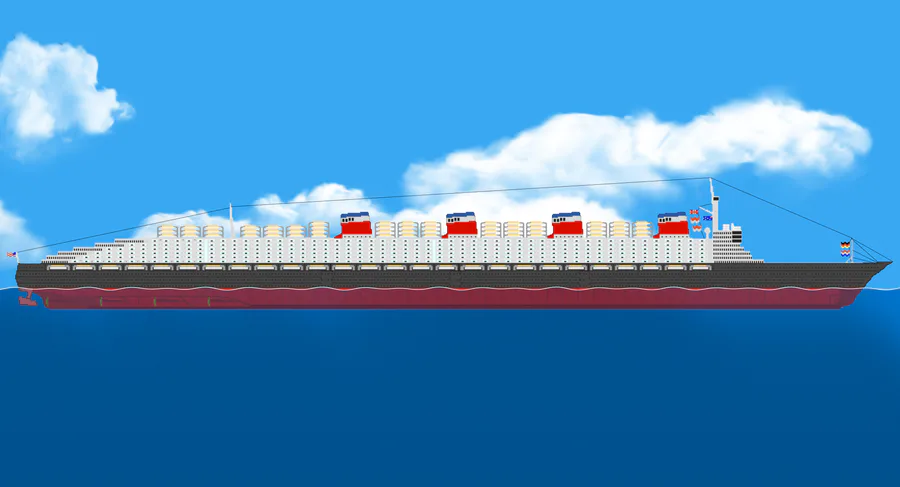
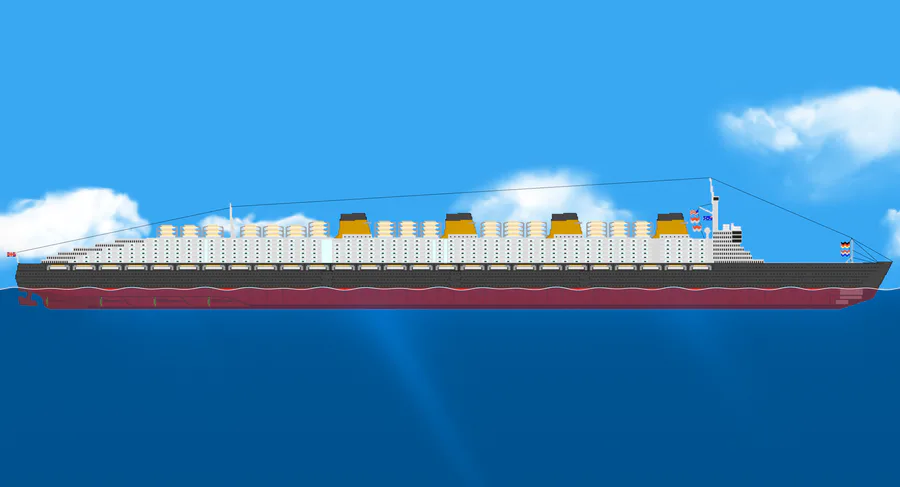
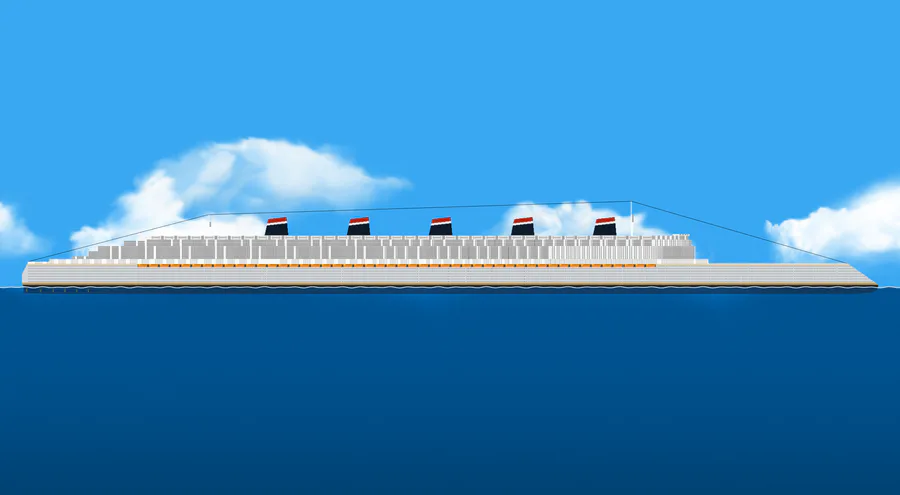
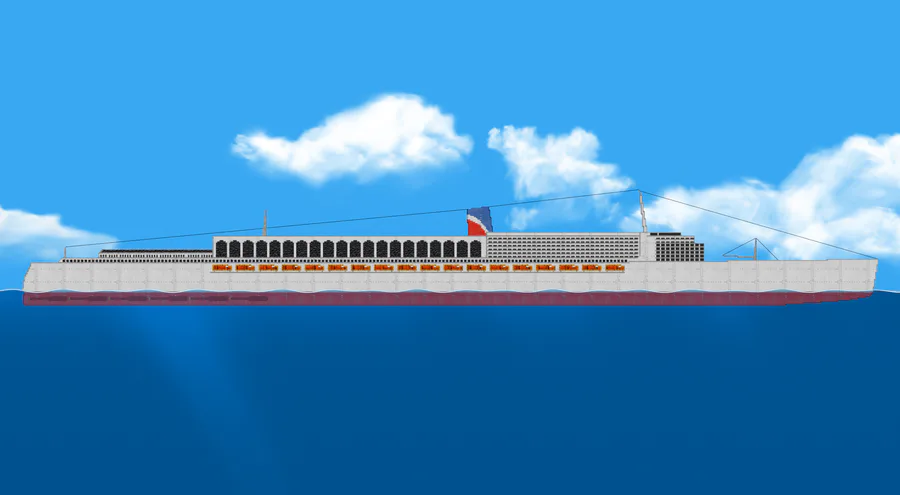
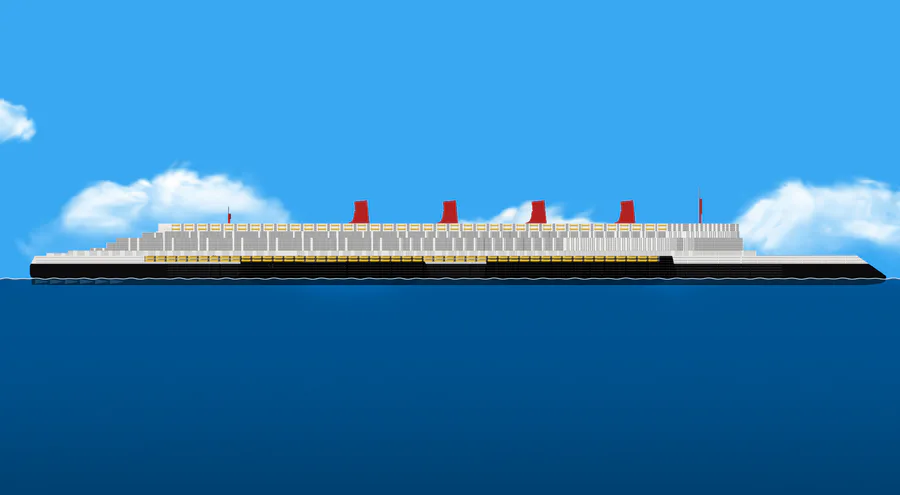
the Titan II, S.S. United States II, H.S.C. Titanic II, Great Goodwill II, Great Peace II, M.S. Flying Cloud (inspired by Transoceanic Corporation liners unbuilt aircraft-carrier ocean liner S.S. Flying Cloud (Unbuilt) c1930), M.S. United States Grandeur (Titan II-Class with 856 meters) (inspired by Greatest Grandeur (massive 845 meters fictional ocean liner by United States Lines, largest ship in Floating Sandbox surpass Great Grandeur (Fictional 1956, largest official ship in Floating Sandbox) inspired by Great Grandeur (Fictional 1956, largest official ship in Floating Sandbox, smaller than Greatest Grandeur (massive 845 meters fictional ocean liner by United States Lines) inspired by S.S. United States) inspired by S.S. United States (1952) inspired by S.S. Titan (real fastest proposed on Titan Line by Joseph Ricker design (real fastest proposed on Titan Line by Joseph Ricker design speed at 45 knots))), H.M.H.S. Britannic II, M.S. Silver Falcon II (Titan II-class) (inspired by Proposed (unbuilt) "Silver" class (Titan II-class) of liners for Atlantic Steam Navigation Company, (c1936), which were to be named Silver Falcon and Silver Swift. The ships were proposed to have 30,000 gross tons, 725 ft long, and a capacity for 1,500 passengers (500 Cabin and 1,000 Tourist), M.S. Silver Swift II (Titan II-class) (inspired by Proposed (unbuilt) "Silver" class (Titan II-class) of liners for Atlantic Steam Navigation Company, (c1936), which were to be named Silver Falcon and Silver Swift. The ships were proposed to have 30,000 gross tons, 725 ft long, and a capacity for 1,500 passengers (500 Cabin and 1,000 Tourist), R.M.S. Olympic II, Transatlantic Liner of the Future III Titan II-Class Streamlined Throughout with 856 meters long (inspired by A.C. Hardy Liner), S.S. Yankee Clipper II (inspired by Yankee Clipper / Liberty Liner Theodore E. Ferris 1,254 feet Designed in the early 1930s with retractable funnels and a landing deck for planes), Meyer Werft's Manta Ray II are more than double the length of the world’s current largest cruise ships, such as the Icon of the Seas (365m). To put this in perspective, it is nearly three times the length of the Titanic and longer than the Burj Khalifa is tall, The sheer physical presence of the Titan II redefines maritime architecture. H.S.C. Titan II: The H.S.C. Titan II represents the ultimate fusion of Edwardian grandeur and 22nd-century hyper-engineering. Born from the conceptual legacy of Joseph Ricker’s SS Titan, the Titan II is not merely a successor; it is a fundamental reimagining of what a maritime structure can be. At 856 meters long, it transitions from the category of "ship" into the realm of "mobile geography." 1. Dimensional Supremacy: The 856-Meter Hull
The primary record held by the Titan II is its length of 856 meters (2,808 feet). To put this into perspective, if the ship were stood on its stern, it would dwarf the Burj Khalifa by over 25 meters. This length is not merely for ego; it is a functional requirement for high-speed stability.
In naval architecture, the "Wave-Bridging" phenomenon allows a hull of this length to span the troughs of multiple North Atlantic swells simultaneously. While a standard 300-meter ship would pitch violently as it climbs and falls over waves, the Titan II remains perfectly level, "bridging" the water to provide a vibration-free transit. This sheer scale creates a "Post-Suezmax" class, a vessel so large it ignores the constraints of man-made canals to dominate the open-ocean corridors.
2. The 96-Meter Beam: A Foundation of Absolute Stability
With a width of 96 meters (314 feet), the Titan II possesses the widest footprint of any passenger vessel in history. This width provides a Metacentric Height ($GM$) that makes the vessel virtually impossible to capsize.
The beam allows for an internal layout previously impossible in maritime design. Instead of the cramped, single-corridor "hotel" style of modern cruise ships, the Titan II features a Dual-Boulevard system. Two massive internal avenues, each the width of a four-lane highway, run the length of the ship, separated by a central "Canyon" of parks and theaters. This width ensures that even at a capacity of 84,000 people, the ship never feels crowded, maintaining a sense of urban openness.
3. Verticality: The 40-Story Superstructure
Standing 128 meters (419 feet) from the keel to the masthead, the Titan II has the vertical profile of a major metropolitan skyscraper. This height accommodates 42 distinct decks, organized into "Vertical Neighborhoods."
The Citadel (Decks 1-10): Engineering, logistics, and automated food processing.
The Promenade District (Decks 11-25): Public spaces, shopping, and high-density residential.
The Sky-Gardens (Decks 26-40): Luxury suites, transparent-floor observation decks, and open-air athletic fields.
The height places the bridge at an elevation that extends the visible horizon to nearly 45 kilometers, allowing the crew to navigate high-speed lanes with unprecedented visual foresight.
4. Propulsion: The 1.1 Million Horsepower Heart
To move 300,000 Gross Tons at record speeds, the Titan II utilizes a Multi-Source Hybrid Grid generating 1,100,000 shaft horsepower (shp). This is roughly equivalent to the power output of 20 nuclear aircraft carriers.
Because traditional propellers would suffer from cavitation—where the water essentially "boils" and explodes against the blades at high speeds—the Titan II uses High-Capacity Water Jets. These massive turbines ingest water at the bow and eject it at high velocity through the stern, providing smooth, continuous thrust. This propulsion system is fueled by a combination of liquid hydrogen fuel cells and modular nuclear salt-water reactors, ensuring a near-zero carbon footprint despite the immense energy demands.
5. Record Velocity: The 91-Knot Sprint
While the legendary SS United States held the Blue Riband at 38.33 knots, the Titan II is designed for a Max Trial Speed of 91 knots (168 km/h).
At 100+ mph, water behaves less like a liquid and more like a solid. To overcome this "Wall of Water," the Titan II utilizes a Wave-Piercing Knife-Bow reinforced with depleted uranium-tipped steel to maintain its edge. At these speeds, the ship also employs an Air-Lubrication System, pumping a constant "carpet" of micro-bubbles under the hull. This reduces skin friction by 25%, allowing the 300,000-ton mass to "glide" over the surface rather than pushing through it.
6. The Floating Metropolis: 84,000 Souls
The Titan II is the first vessel to achieve a "Soul Count" that rivals a medium-sized city like Daytona Beach.
Passengers (64,000): Housed in a variety of "Districts," from affordable modular units to sprawling 10,000-square-foot penthouses.
Crew (20,000): A professional army of engineers, urban planners, medical doctors, and hospitality staff.
To manage the movement of 84,000 people, the ship incorporates an Internal Light Rail System (The Titan-Link). Automated pods move horizontally along the length of the ship and vertically through "gravity-wells," ensuring a passenger can travel from the bow-theaters to the stern-pools in under five minutes.
7. Materials Science: High-Tensile Resilience
A ship of this size traveling at 91 knots would snap in half if built with traditional mild steel. The Titan II is constructed using a Hybrid Composite Hull:
Keel & Lower Hull: High-Tensile Steel (HTS) for flexibility and impact resistance.
Superstructure: Carbon-Fiber Reinforced Polymers (CFRP) and Aluminium-Lithium alloys.
This reduces the "top-weight," lowering the center of gravity significantly. The use of CFRP allows the upper 20 decks to be incredibly light, preventing the "pendulum effect" during high-speed turns or in heavy seas.
8. Life-Saving Innovation: The "Mega-Ark" System
Evacuating 84,000 people is a logistical challenge never before faced in naval history. The Titan II replaces traditional lifeboats with 168 High-Capacity Life-Arks.
Each Ark holds 500 people and is a self-contained, pressurized vessel capable of surviving a 50-meter drop into the ocean. These Arks are equipped with their own desalination systems, medical bays, and satellite uplink beacons. They are launched via magnetic-rail catapults, ensuring they are cleared from the ship's side even if the vessel is listing at a severe 30-degree angle.
9. Environmental Management: A Closed-Loop Ecosystem
As a floating city, the Titan II cannot rely on port facilities for waste. It operates as a Zero-Discharge Vessel:
Plasma Gasification: Onboard plants turn all solid waste into energy and inert slag used for ballast.
Atmospheric Water Generation: The ship "harvests" the humid ocean air, producing 5 million gallons of fresh water daily to supplement its desalination plants.
Solar Integregation: Every horizontal surface of the upper decks is coated in "Solar Skin" photovoltaic film, contributing 250,000 shp to the ship's auxiliary power grid.
10. The Charitable Mission: A Legacy of Giving
Inspired by Joseph Ricker’s vision for the original SS Titan, the Titan II operates under the Titan Global Foundation. A dedicated 5% of all ticket revenue and 100% of the proceeds from its onboard "Grand Casino" are funneled directly into global pediatric healthcare and ocean conservation.
The ship acts as a mobile ambassador; when it docks, its onboard medical facilities (the largest afloat) provide free specialized surgery and care to local populations. It is not just a record-breaking machine; it is a monument to human potential and altruism on a scale the world has never seen.
Design Pedigree & Comparisons
The Titan II exists in the same "Mega-Project" category as other legendary unrealized designs:
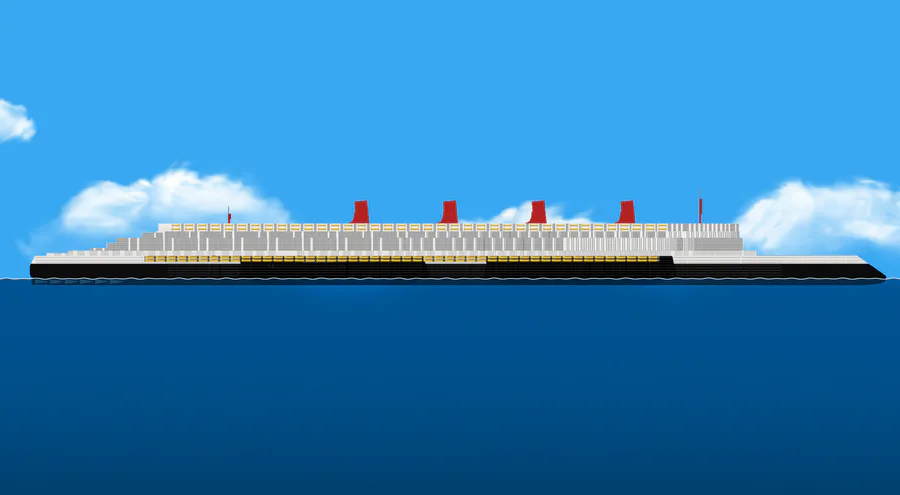
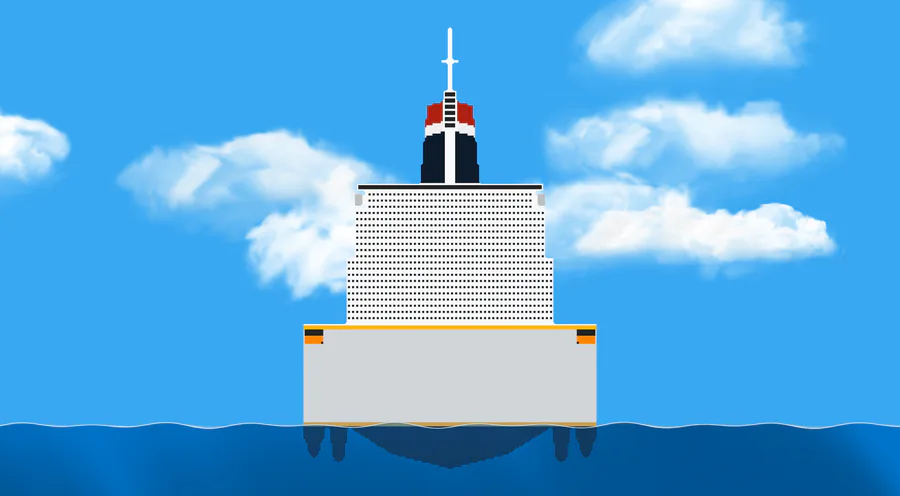
Successor to S.S. Titan: It evolves the "Project Titan" concept—a modern reimagining of the Titanic’s profile (as seen in your image with the four golden funnels) but scaled to an impossible magnitude.
Princess Kaguya Comparison: Similar to the Japanese "International Urban Cruise Ship" project, the Titan II functions as a sovereign floating municipality.
Manta Ray Influence: Like Meyer Werft’s Manta Ray, the Titan II likely employs advanced hydrodynamics (possibly a semi-planing hull or trimaran elements) to reach 91 knots without capsizing from the drag.
Decks: 48 Passenger Decks (Total Height: 128m)
The "Vertical Metropolis" Layout:
Decks 1–5 (Engineering & Propulsion): The "Zero-Emission Core." Housing the 2.05 million shp fuel cells and the water-jet intake systems.
Decks 6–12 (The Logistics Hub): Massive automated kitchens and the "Internal Rail System" for moving supplies across the 856m length.
Decks 13–25 (The Common Districts): Lower-fare cabins, "Suburban" neighborhood lounges, and the primary life-boat embarkation deck (500-person capacity craft).
Decks 26–40 (The Grand Atriums): Inspired by Yourkevitch’s Normandie design—vast open halls spanning 5 decks high.
Decks 41–48 (The Velocity Decks): High-speed observation lounges, bridge, and luxury suites with reinforced glass for 91-knot wind resistance. For a ship traveling at 91 knots, mechanical cables are a liability due to vibration. The Titan II utilizes a linear motor system (similar to modern MULTI elevator technology).
Multi-Directional Movement: These elevators move both vertically (between the 48 decks) and horizontally (along the 856m length). This allows a passenger to go from a cabin at the bow on Deck 10 to a restaurant at the stern on Deck 40 without ever changing cars.
Capacity: Each car is a "Mini-Bus" pod capable of holding 40 people.
The "Express Express" Shafts: Dedicated vacuum-sealed shafts located in the ship's core for rapid transit between the engine rooms on Deck 1 and the Bridge on Deck 48. Note on Engineering: At 856 meters, the "Hogging and Sagging" stresses (the bending of the ship over waves) would be the greatest challenge ever faced in steel manufacturing. It would likely require a flexible hull or advanced composite materials. This post made by @StrangeGrayDuck
You can find me on: https://gamejolt.com/realm/floating-sandbox, https://gamejolt.com/@StrangeGrayDuck, https://gamejolt.com/p/h-s-c-titan-ii-3d-model-fmukjdyf or https://gamejolt.com/games/floating-sandbox/353572 (large, fastest ship and eleven final creation with larger than 800 meters after eleven final creation in Floating Sandbox are H.S.C. Titan II, S.S. United States II, H.S.C. Titanic II Great Goodwill II, Great Peace II, (inspired by Transoceanic Corporation liners), M.S. United States Grandeur with 856 meters long, Icon of the Seas II, Greatest Grandeur S.S. Great Goodwill / S.S. Great Peace with 845 meters long not create with larger than H.S.C. Titan II, S.S. United States II, H.S.C. Titanic II Great Goodwill II, Great Peace II, M.S. Flying Cloud (inspired by Transoceanic Corporation liners), M.S. United States Grandeur with 856 meters long, Icon of the Seas II, Greatest Grandeur, S.S. Great Goodwill / S.S. Great Peace with 845 meters long Because an unexpected exception occurred on larger than 1,000 meters on resize).
S.S. United States II: The SS United States II, the flagship of the Titan II-class, represents a radical departure from conventional naval architecture. It is not merely a vessel; it is a mobile geographic feature—a "floating continent" that challenges the laws of physics and the traditional limits of engineering.
Constructed using principles derived from high-speed craft (HSC) theory and scaled to a gargantuan degree, the Titan II-class aims to reclaim the Blue Riband with a velocity that bridges the gap between maritime travel and commercial aviation.
1. Dimensional Supremacy: The 856-Meter Hull
The sheer scale of the Titan II is its primary defense against the ocean. At 856 meters (2,808 feet), it is nearly three times the length of the Titanic and significantly longer than the Burj Khalifa is tall.
Wave-Bridging Stability: In naval architecture, a ship’s length determines its "hull speed" and its relationship with the sea state. By stretching to nearly a kilometer, the SS United States II can "bridge" the distance between multiple wave crests in the North Atlantic. Instead of falling into the "trough" of a wave and pitching upward, the ship remains level across the peaks. This creates a vibration-free experience even when maintaining high-velocity transits in Sea State 6 or 7.
The Beam & The "No-Canal" Constraint: Its 96-meter (314-foot) beam provides a massive metacentric height, making the vessel virtually impossible to capsize. This width allows for a "Double-Corridor" layout, creating massive central atriums that resemble terrestrial canyons. However, this width renders the ship a "Global-Class" vessel—far too wide for the Panama or Suez Canals. It is designed to dominate the open-ocean "super-highways" of the Atlantic and Pacific, bypassing traditional choke points entirely.
2. Propulsion: The 1.1-Million Horsepower Heart
To move 300,000 GT at speeds exceeding 90 knots, the Titan II discards traditional marine diesel engines for a Multi-Source Hybrid Grid generating a staggering 1,100,000 shaft horsepower (shp).
High-Capacity Water Jets: At the record-breaking speed of 91 knots, traditional bronze propellers would be destroyed by cavitation—a phenomenon where water "boils" on the blade surface due to low pressure, creating imploding bubbles that eat through solid metal. The Titan II utilizes internal water jets that pump massive volumes of water through shielded turbines, allowing for smooth thrust without the drag or erosion of external props.
The Net-Zero Energy Mix:
Hydrogen Fuel Cells (250,000 shp): Providing a zero-emission base load for hotel systems and cruising speeds.
Air Lubrication Systems: High-pressure vents blow a carpet of micro-bubbles under the hull, reducing skin friction by 15-20%, allowing the ship to "slide" over the water.
Solar & Wind Integration: The massive surface area of the upper decks is coated in photovoltaic film, while the superstructure itself is shaped like a vertical wing to generate aerodynamic lift, reducing the effective displacement of the ship at high speeds.
3. A Floating Metropolis: The 84,000-Soul Population
The SS United States II is designed for a permanent or semi-permanent maritime civilization. With a total population of 84,000, it matches the density of a medium-sized city like Daytona Beach, Florida.
CategoryPopulationFunctionPassengers64,000Residents of tiered "neighborhoods" ranging from luxury citadels to family districts.Crew20,000A massive workforce including urban planners, medical staff, and security, alongside maritime officers.Total84,000A self-contained micro-economy and ecosystem.
Internal Logistics: Walking from bow to stern would take nearly 20 minutes. To solve this, the ship features an Internal Light Rail System and high-speed horizontal "People Movers" on the promenade decks.
Life Support: The ship operates a closed-loop system including massive desalination plants producing millions of gallons of fresh water daily and plasma-arc gasification for waste management, converting trash into energy.
4. Advanced Materials and Structural Integrity
To survive "slamming forces"—the impact of water acting like a solid wall at 100+ mph—the Titan II utilizes a tri-composite hull construction:
High-Tensile Steel (HTS): Used in the keel and lower hull to provide the flexibility needed to absorb the kinetic energy of the ocean.
Carbon-Fiber Reinforced Polymers (CFRP): Used for the upper 20 decks of the 40-story superstructure. By utilizing lightweight composites aloft, the center of gravity remains low, ensuring stability during high-speed maneuvers.
Aluminum-Lithium Alloys: Used for internal bulkheads to maintain structural rigidity without adding the prohibitive weight of traditional steel.
5. Record-Breaking Velocity: 91 Knots
While the original SS United States famously held the Blue Riband at 38 knots, the SS United States II targets a trial maximum of 91 knots (168 km/h / 104 mph).
Aerodynamics: At these speeds, the ship is as much an aircraft as it is a boat. The "tiered" superstructure is streamlined to prevent the vessel from acting like a massive sail, which could create dangerous lift.
Safety & Life-Saving: Managing an evacuation for 84,000 people requires High-Capacity Life-Arks. Each Ark holds 500 people and is a fully enclosed, self-righting "mini-ship" equipped with independent life support and GPS.
H.S.C. Titanic II: The H.S.C. Titanic II (Titan II-class) is not merely a vessel; it is a monumental achievement in speculative naval engineering that defies the traditional boundaries of physics and architecture. Standing as the definitive "High-Speed Craft" (HSC), it represents a pivot point in human history where the sea is no longer a barrier to be crossed, but a foundation for a mobile, high-velocity city.
With a length of 856 meters and a top-recorded speed of 91 knots, the Titan II-class serves as a floating megacity, outstripping the dimensions of the tallest skyscrapers and the populations of entire metropolitan districts.
1. Dimensional Supremacy: The 856-Meter Hull
The scale of the H.S.C. Titanic II redefines the concept of "superstructure." At 856 meters (approx. 2,808 feet), it is nearly three times the length of the original RMS Titanic and longer than the Burj Khalifa is tall.
Wave-Bridging Stability
In naval architecture, a ship’s length determines its "hull speed" and its relationship with the ocean's surface. By stretching to nearly a kilometer, the H.S.C. Titanic II can "bridge" multiple wave crests simultaneously in the North Atlantic. Instead of falling into the "trough" of a wave and pitching upward—which causes seasickness and structural stress—the ship remains perfectly level. It acts as a continuous beam across the water, providing a vibration-free experience even while cruising at speeds that would shatter a lesser vessel.
Verticality and the 40-Story Profile
Standing 128 meters (419 feet) from keel to mast, the ship possesses the vertical profile of a 40-story skyscraper. This allowed designers to implement over 30 dedicated decks.
Lower Decks (1-10): Dedicated to the 1.1-million-horsepower propulsion systems, desalination plants, and automated logistics.
Mid-Decks (11-25): "Neighborhood" zones with multi-level theaters, indoor parks, and residential wings.
Upper Decks (26-40): Luxury observation suites, bridge operations, and streamlined "sky-gardens."
2. Propulsion: The 1.1-Million Horsepower Heart
To move 300,000 GT at speeds exceeding 90 knots, the H.S.C. Titanic II discards traditional marine diesel engines for a Multi-Source Hybrid Grid. Generating 1,100,000 shaft horsepower (shp), it possesses the energy output of twenty nuclear aircraft carriers.
The Water-Jet Revolution
At the record-breaking speed of 91 knots (168 km/h), traditional bronze propellers are useless due to cavitation—a phenomenon where water boils on the blade surface, creating imploding bubbles that eat through metal. The Titan II-class utilizes High-Capacity Water Jets. These massive internal turbines pump water at high velocity through rear nozzles, allowing for smooth, devastatingly powerful thrust without the drag or damage of external props.
The Net-Zero Energy Mix
The ship maintains its massive power requirements through a sophisticated, sustainable grid:
Hydrogen Fuel Cells (250,000 shp): Providing the base load for hotel services and propulsion with zero emissions.
Solar Integration (250,000 shp): Utilizing the massive surface area of the upper decks to harvest energy.
Air Lubrication System: This "bubbles" technology blows a carpet of air under the hull, reducing friction so the ship essentially "slides" over the water, requiring 200,000 shp less to maintain high speeds.
3. Record-Breaking Velocity: The 91-Knot Challenge
While the SS United States famously held the Blue Riband at 38 knots, the H.S.C. Titanic II targets a maximum trials speed of 91 knots. At these speeds, water acts like a solid.
Advanced Material Science
To survive the "slamming forces" of the ocean at 100+ mph, the hull cannot be made of standard mild steel.
High-Tensile Steel (HTS): Used in the lower hull for flexibility against wave impact.
Carbon-Fiber Reinforced Polymers (CFRP): Used for the upper 20 decks to lower the center of gravity and prevent capsizing during high-speed maneuvers.
Wave-Piercing Bow: A reinforced, razor-sharp prow designed to "slice" through swells rather than riding over them, neutralizing the "wall of water" effect.
4. The Floating Metropolis: 84,000 Souls
The H.S.C. Titanic II is a self-contained ecosystem, housing a population larger than Daytona Beach, Florida.
CategoryCountFunctionPassengers64,000Residents of various "neighborhood" districts.Crew20,000A small army of engineers, hospitality staff, and urban planners. Total Souls84,000A floating city-state with its own economy.
Internal Logistics
Walking from bow to stern would take nearly 20 minutes. To solve this, the ship features an Internal Light Rail System and horizontal "People Movers" on the main promenade decks. These automated systems move thousands of people across the kilometer-long frame in minutes, ensuring that the "metropolis" remains connected.
5. Life-Saving Infrastructure: The "Life-Arks"
Managing an evacuation for 84,000 people is the greatest challenge in maritime history. The H.S.C. Titanic II utilizes High-Capacity Life-Arks, each capable of holding 500 people.
Unlike traditional lifeboats, these are:
Fully Enclosed: To protect from the elements during high-speed deployment.
Self-Righting: Impossible to capsize even in hurricane-force swells.
Sustainment-Ready: Equipped with their own GPS, medical bays, and three weeks of food and water for all 500 occupants.
6. Structural Integrity and Global Constraints
With a 96-meter (314-foot) beam, the H.S.C. Titanic II is a "Post-Suezmax" vessel. It is too wide for any canal on Earth. It is a true Global-Class liner, designed to dominate the open-ocean transit lanes of the Atlantic and Pacific.
Its sheer volume of 300,000 GT creates a massive displacement, but the use of Aluminium-Lithium Alloys in internal structures keeps the ship light enough to achieve its "hydrofoil-like" lift at high speeds. The hull is double-reinforced with carbon-fiber composites, featuring "crush zones" that absorb energy in the event of a collision, protecting the inner residential "citadels" where the passengers reside.
7. The Legacy of the Titan II-class
The H.S.C. Titanic II represents the ultimate fusion of high-speed ferry technology and mega-cruise ship luxury. It is a testament to an era where scale and speed are no longer mutually exclusive. As it slices through the North Atlantic at 91 knots, it carries with it not just 84,000 people, but the dream of a maritime civilization that is as fast as it is vast.
Great Goodwill II: The Great Goodwill II, a Titan II-class ultra-liner, represents the ultimate evolution of the "Peace and Goodwill" concept envisioned by Hyman Cantor in the 1950s. While Cantor’s original dream of 90,000-ton vessels was stymied by financial reality, the Great Goodwill II shatters those boundaries, manifesting as an 856-meter, 300,000-GT marvel of engineering. This vessel is not merely a ship; it is a self-sustaining city-state designed to conquer the oceans at speeds previously reserved for racing craft.
1. Dimensional Supremacy: The 856-Meter Hull
The most striking record held by the Great Goodwill II is its sheer physical magnitude. Stretching 856 meters (2,808 feet), it is nearly three times the length of the Titanic and dwarfs the Icon of the Seas (365m). If stood on its end, it would surpass the Burj Khalifa (828m), making it the longest man-made mobile structure in history.
The Physics of Scale
This length is not merely for show; it serves a vital hydrodynamic purpose. In the volatile North Atlantic, wave heights can reach 15–30 meters. A standard ship "pitches"—its bow and stern move up and down as it climbs and descends wave crests. At 856 meters, the Great Goodwill II utilizes Wave-Bridging Stability. The hull is long enough to span multiple wave crests simultaneously, effectively turning the ocean's peaks into a level "roadway." This ensures a vibration-free environment for the 84,000 souls on board, even while traversing swells that would ground smaller vessels.
The "Global-Class" Constraint
With a 96-meter (314-foot) beam, the ship is the widest passenger vessel ever conceived. This width provides an astronomical metacentric height, creating a vessel that is virtually impossible to capsize. However, this record-breaking width renders the ship a Post-Suezmax entity. It is physically unable to transit the Panama or Suez Canals, forcing it to dominate dedicated "Mega-Liner" lanes in the open Atlantic and Pacific.
2. Speed Records: The 91-Knot Threshold
The Great Goodwill II is designed to reclaim the Blue Riband with a velocity that defies traditional maritime physics. While the legendary SS United States reached 38.33 knots, the Great Goodwill II is engineered for a Record Max of 91 knots (168 km/h / 104 mph).
Overcoming the "Wall of Water"
At 91 knots, water ceases to act like a fluid and begins to behave like a solid. The "slamming forces" exerted on the bow are equivalent to hitting a concrete wall. To survive this, the ship utilizes a Wave-Piercing Bow constructed from specialized High-Tensile Steel (HTS). This allows the vessel to "slice" through the density of the swell rather than lifting over it, maintaining a flat trajectory at high speeds.
Aerodynamic Integration
At speeds exceeding 100 mph, the ship must deal with aerodynamic lift. The superstructure is not a traditional flat-walled "wedding cake" design; it is tiered and streamlined, utilizing the Coanda effect to keep the vessel pressed firmly into the water, preventing the wind from creating dangerous upward lift that could destabilize the 300,000-ton mass.
3. Propulsion: The 1.1-Million Horsepower Heart
To move a city-sized mass at nearly 100 mph, the ship discards traditional diesel-electric setups for a Multi-Source Hybrid Grid producing 1,100,000 shaft horsepower (shp). This is roughly twenty times the power output of a Nimitz-class aircraft carrier.
High-Capacity Water Jets
Standard bronze propellers are useless at 91 knots due to cavitation—a process where the pressure drop on the blade surface causes water to boil, creating imploding bubbles that erode metal instantly. Instead, the Great Goodwill II utilizes Internal Water-Jet Turbines. These move massive volumes of water through shielded internal conduits, providing smooth, high-velocity thrust without the drag or destruction of external blades.
The Net-Zero Power Mix
The ship’s power is derived from a revolutionary green energy matrix:
Hydrogen Fuel Cells (250,000 shp): Providing the base load with zero emissions, emitting only pure water ($H_{2}O$).
Solar Integration (250,000 shp): The massive upper deck surface area is coated in "Solar Skin" photovoltaic cells.
Air Lubrication Systems: To reduce friction, the ship blows a continuous carpet of micro-bubbles under the hull, allowing it to "float" on a layer of air, reducing drag by up to 20%.
4. Population Record: The Floating Metropolis (84,000 Souls)
The Great Goodwill II holds the record for the highest population ever sustained on a single moving vessel. With 64,000 passengers and 20,000 crew members, the "Soul Count" reaches 84,000, matching the population of Daytona Beach, Florida.
Urban Planning at Sea
To manage this population, the ship is organized into Residential Citadels or neighborhoods. Because walking from the bow to the stern would take nearly 20 minutes, the ship features an Internal Light Rail System. High-speed horizontal people-movers run the length of the main promenade decks, ensuring that a passenger can move from the "Aft Entertainment District" to the "Forward Botanical Gardens" in under three minutes.
The 5:1 Service Ratio
With 20,000 crew members, the ship operates like a sovereign state. The crew consists not only of sailors and stewards but also urban planners, security forces, sanitation engineers, and medical doctors. They inhabit an "Inner City" located in the lower decks, complete with their own recreation centers and hospitals, ensuring the crew remains as refreshed as the guests.
5. Structural Engineering: Advanced Material Science
The Great Goodwill II could not exist if built with 20th-century materials. A ship of this length would snap under its own weight if constructed entirely of heavy mild steel.
High-Tensile Steel & Carbon Fiber
The lower hull—the "Strength Deck"—is built from High-Tensile Steel (HTS) to provide the flexibility needed to absorb the vibration of the 1.1-million shp engines. Conversely, the upper 20 decks of the 40-story superstructure are constructed using Carbon-Fiber Reinforced Polymers (CFRP) and Aluminium-Lithium alloys. This drastically reduces "top-weight," lowering the center of gravity and ensuring that even in high-speed turns at 70 knots, the ship remains stable.
Crush-Zone Architecture
The hull is double-reinforced and features Integrated Crush Zones. Much like a modern automobile, these zones are designed to deform and absorb the kinetic energy of a high-speed collision, protecting the central "Citadel" where the passenger cabins and life-support systems are located.
6. Life Support and Sustainability: The Closed-Loop Ecosystem
Maintaining 84,000 people at sea requires the most complex life-support system ever installed on a vehicle. The ship operates as a closed-loop ecosystem.
Water and Waste
The ship’s Desalination Plants produce millions of gallons of fresh water daily. Waste management is handled via Plasma Gasification, which turns solid waste into energy and a glass-like slag used for ballast. Nothing is dumped into the ocean; the Great Goodwill II leaves a "Zero-Wake" environmental footprint, despite its massive size.
Food Logistics
The ship features vertical hydroponic farms located in the central atriums, providing fresh greens for the "one-class" dining venues. Following Cantor’s original vision, the ship offers a variety of dining options where passengers pay for meals separately, allowing for a diverse culinary economy ranging from high-end bistros to mass-scale automated cafeterias.
7. Safety: The "High-Capacity Life-Ark" Record
Evacuating 84,000 people is an unprecedented logistical challenge. Traditional lifeboats would require thousands of davits, cluttering the deck.
The 500-Person Life-Ark
The Great Goodwill II utilizes Mega-Life Arks, each capable of holding 500 people. These are not simple boats; they are fully enclosed, self-righting, and motorized survival vessels equipped with their own GPS, medical bays, and three weeks of rations. These arks are launched via automated gravity-rail systems, capable of clearing the entire ship's population in under 30 minutes.
Vertical Evacuation Chutes
Complementing the arks are Vertical Evacuation Chutes, allowing passengers to slide safely from the 40th deck directly into waiting rafts, bypassing the need for crowded stairwells during an emergency.
8. Historical Legacy: From Cantor to Titan II
The Great Goodwill II is the spiritual successor to the Peace and Goodwill project of the late 1950s. While those original 1,150-foot ships were "Damned by Destiny," the Titan II-class realizes their potential through the lens of 21st-century "Gigantism."
The New Atlantic Bridge
By combining the low-cost, one-class philosophy of Hyman Cantor with the high-tech, high-speed requirements of the modern world, the Great Goodwill II serves as a bridge between continents. It is a record-breaker in length, speed, and population, proving that the ocean is no longer a barrier to be crossed, but a territory to be inhabited.
Great Peace II: The Great Peace II, the lead vessel of the Titan II-class, represents the ultimate realization of Hyman Cantor’s "Sea Coach" vision, expanded to a scale that defies traditional naval physics. While Cantor’s 1950s dream of the Peace and Goodwill sought to democratize the Atlantic through 90,000-ton vessels, the Great Peace II shatters those constraints. It is a hyper-liner designed not just for transport, but as a permanent, high-speed maritime city-state.
1. Dimensional Supremacy: The 856-Meter Hull
The sheer physical presence of the Great Peace II redefines maritime architecture. At 856 meters (2,808 feet) long, it is more than double the length of the Icon of the Seas and significantly longer than the Burj Khalifa is tall.
Wave-Bridging Stability: In naval architecture, a ship’s length determines its "hull speed" and its relationship with the ocean's surface. By stretching to nearly a kilometer, the Great Peace II can "bridge" multiple wave crests simultaneously. This prevents the "pitching" motion (the bow and stern moving up and down) that plagues smaller vessels. Even in a North Atlantic gale, the ship remains level, providing a vibration-free experience.
The Beam & The "Global-Class" Constraint: With a 96-meter (314-foot) beam, the ship possesses a massive metacentric height, making it virtually impossible to capsize. However, this width renders the ship a "Post-Suezmax" vessel; it is far too wide for the Panama or Suez Canals. It is a ship of the open deep, designed to dominate the vast transit lanes of the Atlantic and Pacific.
Vertical Profile: Standing 128 meters (419 feet) from keel to mast, it has the profile of a 40-story skyscraper. This verticality allows for over 30 decks, housing everything from residential districts to industrial-scale life support.
2. Record-Breaking Velocity: The 91-Knot Frontier
The most radical aspect of the Great Peace II is its speed. While the SS United States held the Blue Riband at 38.33 knots, the Great Peace II targets a Record Max of 91 knots (168 km/h / 104 mph).
The "Wall of Water" Challenge: At 100+ mph, water does not move out of the way; it acts like a solid. To survive these "slamming forces," the Great Peace II utilizes a Wave-Piercing Bow made of advanced steel alloys.
Aerodynamics: At 91 knots, wind resistance becomes a primary drag factor. The superstructure is "tiered" and streamlined, shaped like an airfoil to prevent the ship from acting like a massive sail, which would create dangerous lift or drag.
Hydrodynamic Lift: To reach 91 knots, the hull utilizes a Surface-Effect design. By pumping a carpet of air bubbles under the hull (Air Lubrication), the ship reduces skin friction by 30%, essentially "floating" on a layer of air to break the friction barrier.
3. Propulsion: The 1.1-Million Horsepower Heart
To move 300,000 GT at highway speeds, the Great Peace II discards traditional engines for a Multi-Source Hybrid Grid generating a staggering 1,100,000 shaft horsepower (shp).
Power SourceOutputDescriptionHydrogen Fuel Cells250,000 shpProvides a zero-emission base load for hotel systems and cruising. Solar Integration250,000 shpThe massive top-deck surface area acts as a gigawatt-scale solar farm.Wind-Assisted Wings200,000 shpHigh-tech vertical wings create forward thrust from Atlantic headwinds.Battery Buffers200,000 shpHigh-density solid-state batteries provide "Burst Speed" for record attempts.Air Lubrication Systems200,000 shpReductive power used to maintain the air-carpet under the hull.
The Propulsion Method: At these speeds, traditional bronze propellers would be destroyed by cavitation—bubbles imploding with enough force to eat through metal. Instead, the Great Peace II utilizes High-Capacity Water Jets, which pump massive volumes of water through internal turbines, providing smooth, high-velocity thrust.
4. Record-Breaking Tonnage: 300,000 GT
At 300,000 Gross Tonnage (GT), the Great Peace II is the highest-volume passenger vessel ever conceived.
Internal Volume: This tonnage is not a measure of weight, but of enclosed space. It allows for "impossible" luxuries: multi-level indoor parks, massive central atriums, and dual-corridor layouts that eliminate the "claustrophobic" feel of traditional ship hallways.
Material Science: To keep the displacement manageable, the upper 20 decks are constructed from Carbon-Fiber Reinforced Polymers (CFRP) and Aluminium-Lithium Alloys. This lowers the center of gravity, ensuring that despite its 128-meter height, the ship remains stable during high-speed maneuvers.
5. Total Capacity: The Floating Metropolis (84,000 Souls)
The Great Peace II is not merely a ship; it is a semi-permanent maritime civilization.
Passengers (64,000): The ship functions as a city of neighborhoods. Some sectors are dedicated to the "Sea Coach" model—affordable berths with "pay-as-you-go" dining—while others are luxury residential citadels.
Crew (20,000): This "inner city" of workers includes not just sailors and chefs, but urban planners, security forces, and waste management engineers.
Logistics: Walking from bow to stern would take 15 minutes. To solve this, the ship features an Internal Light Rail System and horizontal "People Movers" on the main promenade decks to transport guests across the kilometer-long frame.
6. Record-Breaking Life Safety: The "Life-Ark" System
Managing an evacuation for 84,000 people is a logistical feat never before attempted in naval history.
High-Capacity Life-Arks: The ship moves away from small lifeboats in favor of 500-person Life-Arks. These are fully enclosed, self-righting vessels equipped with autonomous GPS and medical suites.
Crush Zones: The hull is double-reinforced with carbon-fiber composites. In the event of a high-speed collision, "crush zones" at the bow and along the waterline absorb kinetic energy, protecting the primary residential "citadels" where the population resides.
7. Advanced Materials: The Titan II-Class Build
To withstand the immense structural stress of bridging waves at 91 knots, the Great Peace II utilizes a "Composite-Hybrid" hull construction:
High-Tensile Steel (HTS): Used in the lower hull for flexibility, preventing "fatigue cracking" from the vibrations of the water jets.
Titanium Reinforcement: The primary keel and structural "ribs" are reinforced with titanium to prevent the ship from snapping in half when bridging massive swells.
Hydro-Dynamic Coating: The hull is treated with a non-toxic, bio-mimetic polymer that mimics shark skin, further reducing drag.
8. Ecological Legacy: The Zero-Emission Giant
Despite its gargantuan size and speed, the Great Peace II aims for a net-zero footprint. By utilizing the massive surface area for solar collection and employing hydrogen fuel cells, the ship produces zero sulfur or carbon emissions during standard operation. The only exhaust produced by its primary power source is pure water ($H_{2}O$).
The Great Peace II is the definitive answer to the limitations of land-based cities—a mobile, high-speed, and sustainable future for 84,000 people, conquering the oceans at the speed of a racing car.
M.S. Flying Cloud: The M.S. Flying Cloud is not a mere evolution of the ocean liner; it is a disruptive technological landmark that terminates the era of "floating hotels" and inaugurates the era of the Transoceanic Megastructure. Inspired by the 1930s visions of H.B. Cantor and the hydrodynamic genius of Vladimir Yourkevitch, this vessel represents the physical manifestation of human ambition, designed to conquer the tyranny of distance through sheer scale and velocity.
I. Dimensions and Structural Philosophy: The "Burj of the Seas"
Measuring 856 meters (2,808 feet), the Flying Cloud creates its own weather system. Its length is not for vanity; it is a solution to the "Wave-Line Theory." At 55 knots, a standard ship would experience catastrophic structural resonance. The Flying Cloud solves this by being longer than the dominant wavelength of the North Atlantic. It effectively "bridges" the ocean, spanning the crests of three separate swells simultaneously.
The 96-meter beam provides a metacentric height ($GM$) so stable that the ship requires no traditional active fin stabilizers, which would create too much drag at 70+ knots. Instead, it utilizes Internal Liquid Slosh Tanks, where computer-controlled ballast shifts 10,000 tons of water in milliseconds to counteract wind heel. The hull is composed of a Graphene-infused High-Tensile Steel (G-HTS), allowing for a thinner "skin" that maintains the rigidity of a diamond while shedding 20% of the weight of traditional marine steel.
II. The Neighborhood System: Urban Planning at Sea
With a population of 84,000, the ship rejects the traditional "central corridor" layout. Instead, it is organized into Six Residential Citadels, each acting as an independent "borough."
The Transit Core: A central "Grand Canal" of elevators and maglev pods moves passengers horizontally and vertically. A trip from the bow-theatre to the stern-garden takes less than four minutes.
Vertical Ecosystems: Each deck is 4.5 meters high, allowing for mezzanine levels and "hanging gardens" that oxygenate the interior air.
The Crew Inner City: Located in the "Quiet Zone" beneath the main passenger decks, the 20,000 crew members live in a city with its own autonomous economy, including crew-only shopping districts, specialized training academies, and a high-tech medical trauma center that rivals the best terrestrial hospitals in Zurich.
III. Propulsion: The 1.1-Million SHP Sovereign Grid
To achieve a record-breaking 91 knots, the Flying Cloud abandons traditional shafts. It utilizes a Magnetohydrodynamic (MHD) Drive paired with Superconducting Electric Motors.
The Power Split:
Hydrogen Fusion-Cell Array: Provides a constant 250,000 shp base load.
The Solar Skin: Every square centimeter of the upper superstructure is coated in Perovskite Photovoltaic Paint, generating 250,000 shp during daylight hours.
Graphene Battery Buffers: These store energy to provide a "Burst Mode" of 200,000 shp, used specifically for reaching the 90-knot threshold.
Air Lubrication (The Micro-Bubble Shield): The hull features thousands of "transpiration pores" that pump compressed air beneath the waterline. This creates a Supercavitation Effect, effectively allowing the ship to "slide" on a layer of bubbles, reducing skin friction by 45%.
IV. Records and Performance: Breaking the Blue Riband
The Flying Cloud does not just hold records; it renders them obsolete.
The Atlantic Sprint: While the SS United States crossed in 3 days, 10 hours, the Flying Cloud completes the New York to Southampton run in 24 hours.
The 91-Knot Threshold: During trials, the ship utilized its Vertical Wing Sails—rigid carbon-fiber masts that act as hydrofoils in the air—to generate aerodynamic lift, reducing the ship's effective displacement and allowing it to "plane" despite its 300,000 GT mass.
V. Sustainability: The Zero-Footprint Behemoth
The ship operates on a Closed-Loop Ecology.
Plasma Gasification: All waste generated by the 84,000 residents is processed via plasma torches, turning trash into "syngas" to power the secondary systems and "vitrified glass" used for hull ballast.
Atmospheric Water Generation: The ship's massive air-conditioning units serve a dual purpose, stripping humidity from the sea air to provide 5 million liters of fresh water daily, far exceeding the needs of the population.
VI. Safety and the "Titan II" Protocol
The Flying Cloud is designed to be Inherent-Safety-Compliant.
Mega-Lifeboats: 168 hyper-stable, unsinkable pods, each carrying 500 people. These are launched via gravity-slide chutes—similar to those on oil rigs—allowing the entire ship to be evacuated in under 30 minutes.
The Cellular Hull: The ship is divided into 400 watertight "cells." Even if the ship were cut in half, both halves would remain buoyant and upright.
AI Crowd Logistics: The ship’s central computer, "The Navigator," monitors passenger density via thermal sensors, automatically adjusting lighting and signage to prevent "bottlenecks" during both daily movement and emergency drills.
VII. The Aesthetic: A New "Streamline Moderne"
The visual profile of the Flying Cloud is an intentional nod to the 1930s. The Dual Red Funnels are not for smoke; they are massive intake/exhaust vents for the hydrogen cooling systems. The Terraced Stern mimics the "wedding cake" architecture of early 20th-century liners but serves as a drone-port for passenger transfers and supply deliveries. The ship’s lighting uses Bioluminescent Coatings, giving it a soft, ethereal glow at night that makes it appear more like a floating nebula than a metal vessel.
VIII. The Legacy of "Unbuilt Dreams"
The Flying Cloud honors the "Interstate of the Atlantic" concept. It is the realization of the Transoceanic Corporation’s dream to make sea travel as accessible as a bus ride but with the luxury of a royal palace. By marrying the speed of an aircraft with the permanence of a continent, the Flying Cloud stands as the ultimate achievement in naval architecture—a ship that does not just sail across the world, but changes the world as it sails.






1 comment