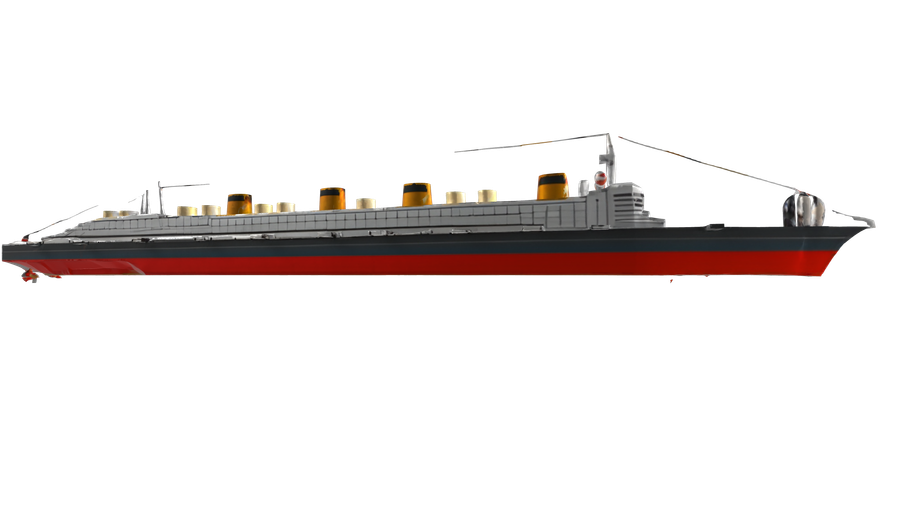
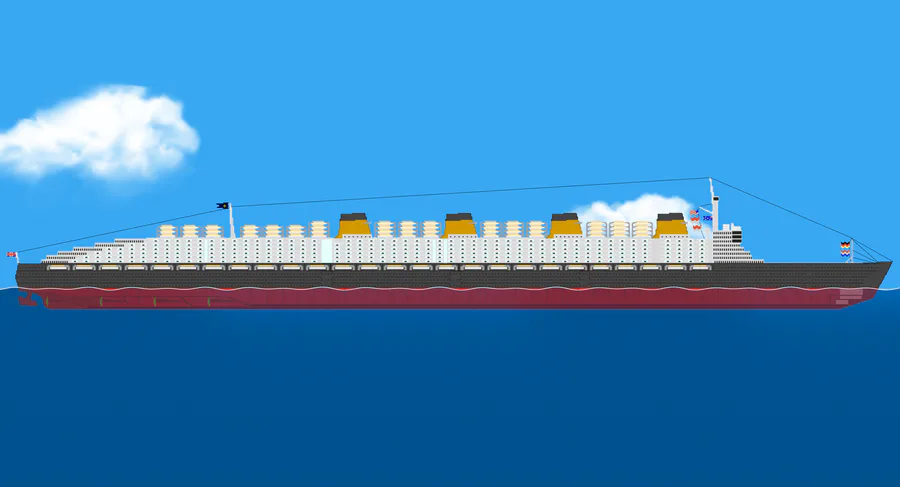
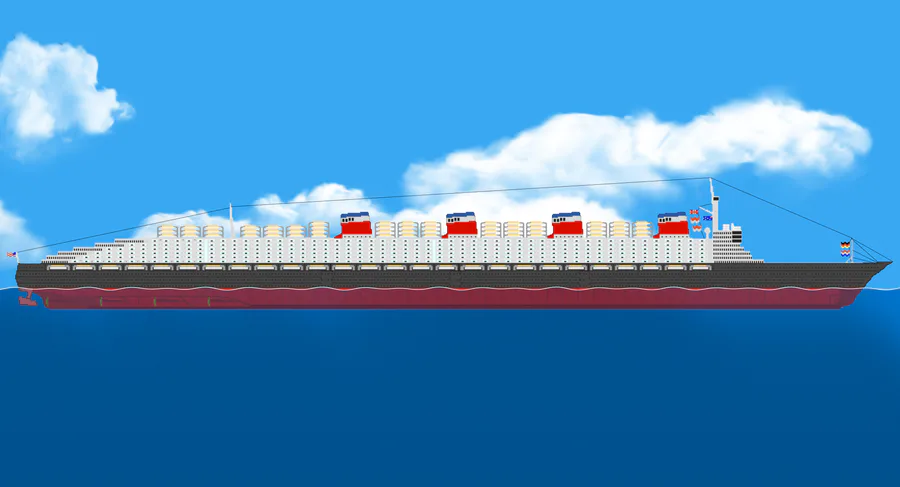
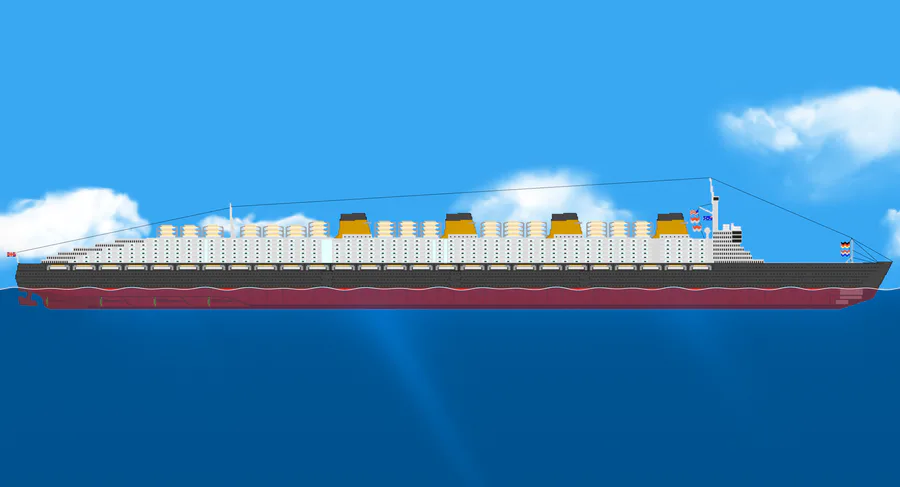
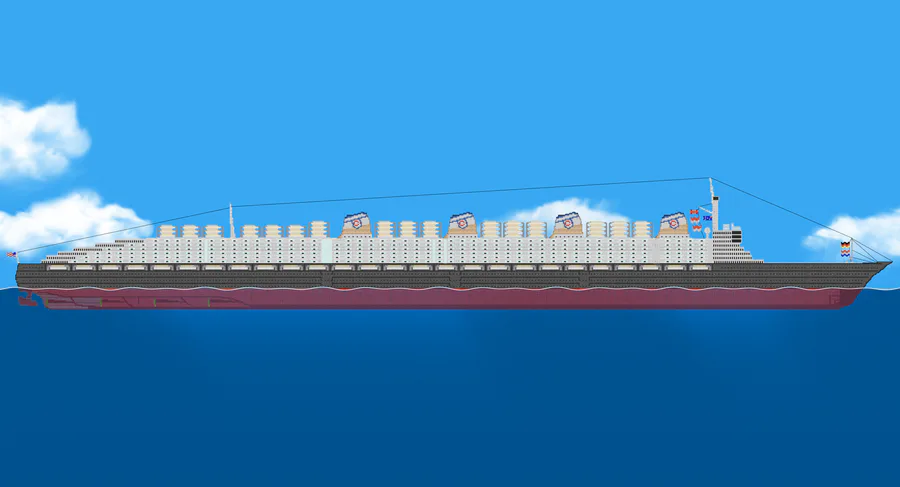
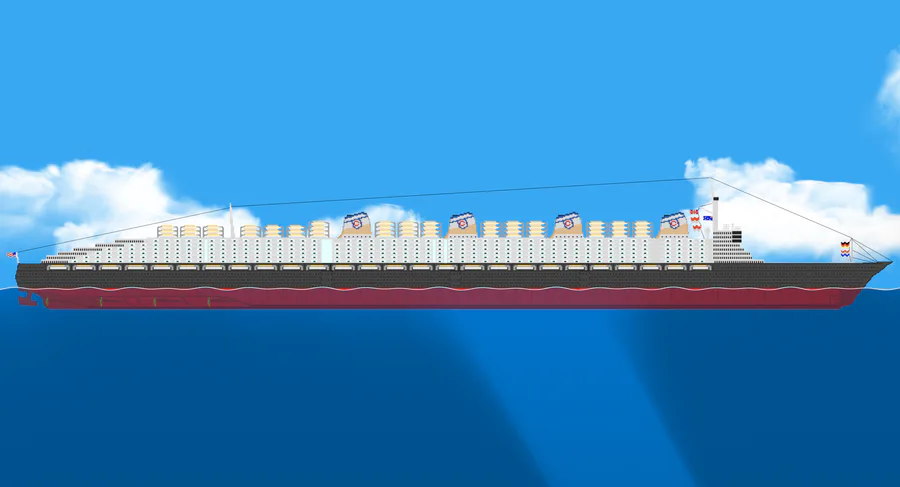
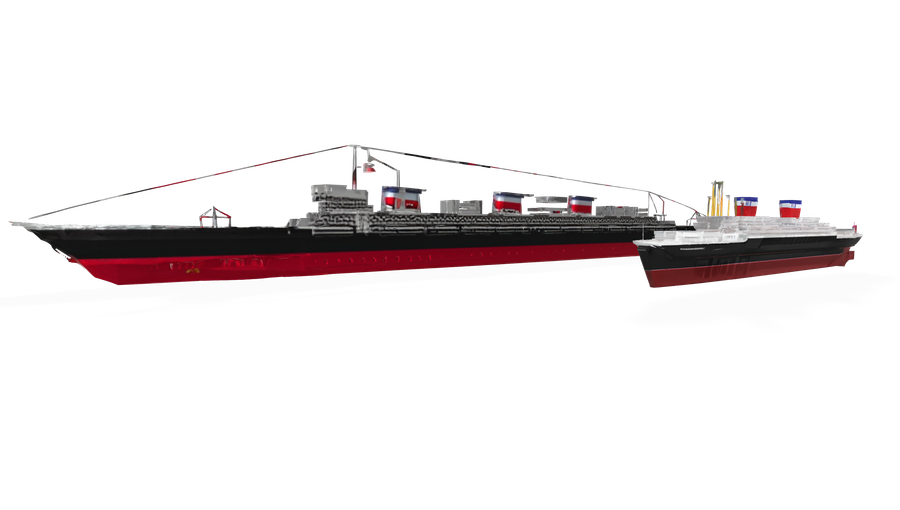
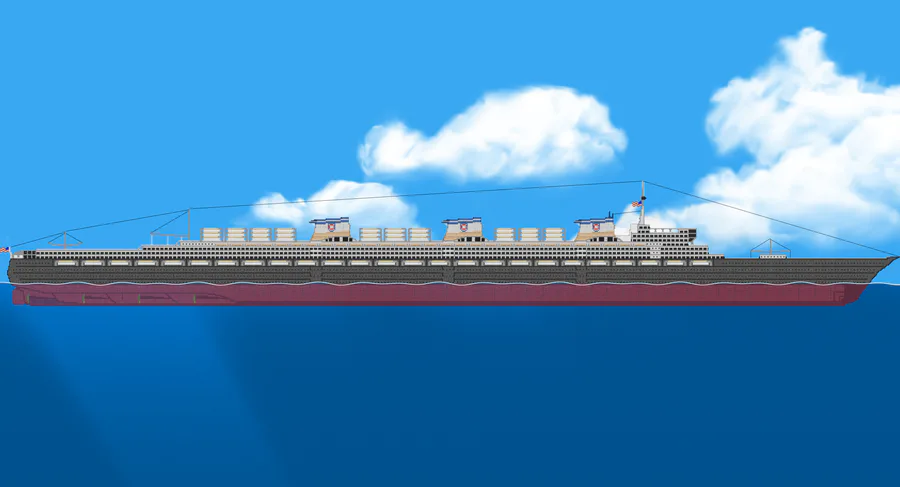
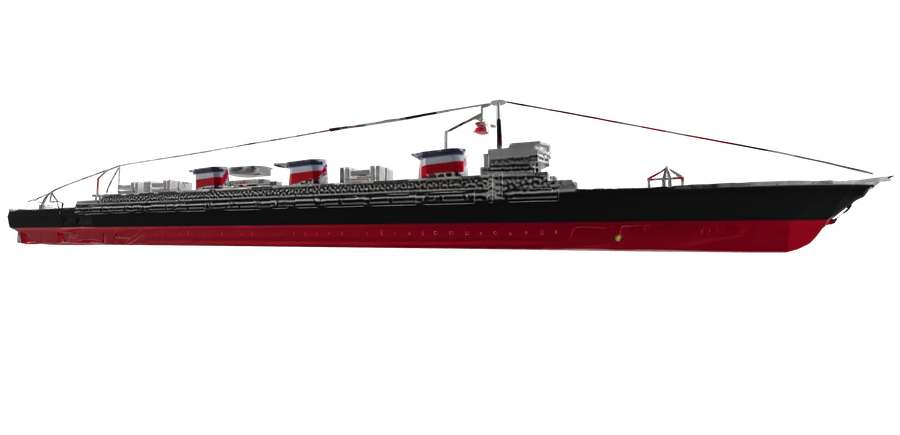
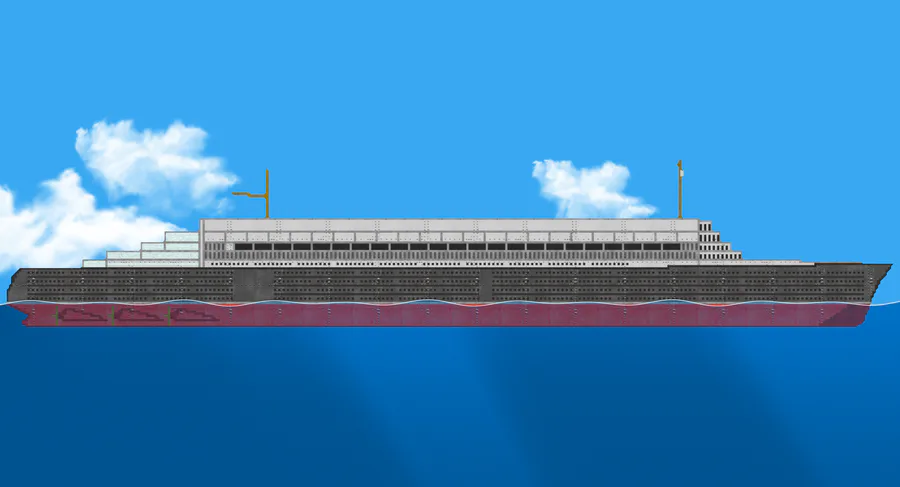
At 856 meters (approximately 2,808 feet), the Titan II, S.S. United States II, H.S.C. Titanic II, Great Goodwill II, Great Peace II are more than double the length of the world’s current largest cruise ships, such as the Icon of the Seas (365m). To put this in perspective, it is nearly three times the length of the Titanic and longer than the Burj Khalifa is tall, The sheer physical presence of the Titan II redefines maritime architecture. At 856 meters (approx. 2,808 feet) long, it is more than double the length of the Icon of the Seas (the current world's largest cruise ship) and longer than the Burj Khalifa is tall.
Beam (Width): At 96 meters (314 feet), it is wide enough to provide incredible stability at high speeds, though it would be unable to pass through the Panama or Suez Canals.
Height: Standing 128 meters (419 feet) from keel to mast, it possesses the vertical profile of a 40-story skyscraper, allowing for dozens of decks to house its massive population.
Tonnage: With a volume of 349,000 GRT, it displaces a massive amount of water, yet its hull design must be incredibly efficient to achieve its projected speeds. This immense length is necessary to provide the longitudinal stability required for such high speeds, allowing the hull to "bridge" multiple wave crests simultaneously, which creates a remarkably smooth ride even in rough Atlantic or Pacific swells, Standing 128 meters (419 feet) from the keel to the highest point of its superstructure, the Titan II is roughly equivalent to a 40-story skyscraper. This verticality allows for an unprecedented number of decks, likely exceeding 30 to 40 levels. Such height provides a massive internal volume for luxury amenities, including multi-level theaters, indoor parks, and extensive residential wings. The height also places the bridge in a commanding position, offering the crew a horizon line spanning dozens of miles, Record-Breaking Beam (96 Meters)
The 96-meter (314-foot) beam (width) provides the vessel with an incredibly wide footprint, essential for preventing the ship from rolling. This width is nearly double that of most Panamax vessels, meaning the Titan II would be unable to pass through the Panama Canal, instead operating as a "Post-Suezmax" or dedicated open-ocean "Mega-Liner." The wide beam allows for massive central atriums and dual-corridor layouts that prevent the "claustrophobic" feel of traditional ship hallways, Passenger Capacity (60,000 People)
The Titan II is designed to carry a staggering 60,000 passengers. This is not merely a ship; it is a floating metropolis. To accommodate this many people, the ship would function like a city, with various "neighborhoods" catering to different demographics and interests. Managing the flow of 60,000 people requires revolutionary logistics, likely involving high-speed internal transit systems (like horizontal elevators or light rail) to move guests across its nearly kilometer-long decks, Crew Capacity (12,000 People)
To maintain a luxury standard for 64,000 guests, the ship requires a small army of 20,000 crew members. This creates a passenger-to-crew ratio of 5:1. The crew would have their own dedicated "inner city" within the ship, including their own gyms, dining halls, and medical facilities. Their roles would range from traditional maritime officers and engineers to urban planners, security forces, and thousands of hospitality professionals, Total Capacity (84,000 People)
With a total population of 84,000 souls, the Titan II matches the population of a medium-sized city (like Daytona Beach, Florida). The environmental and life-support systems required to sustain 84,000 people—including fresh water generation The Titan II is essentially a floating city-state. Its capacity requirements necessitate logistics never before seen in naval history.
Passengers: 64,000 people can be accommodated, requiring massive dining halls, theaters, and internal transit systems (likely light rail or high-speed elevators) to move people across its nearly kilometer-long frame.
Crew: To service such a population, a crew of 20,000 is required, including engineers, hospitality staff, and maritime officers.
Total Soul Count: At 84,000 people, the ship holds a population larger than many mid-sized terrestrial cities, creating a unique micro-economy on board., waste management, and food supply—would be the most complex ever installed on a moving vehicle. The ship essentially serves as a self-contained ecosystem capable of remaining at sea for weeks at a time, each 500 people per lifeboats, Record-Breaking Speed (45 to 81 Knots)
Speed is the "Titan" in its name. While most cruise ships lumber at 20–22 knots, the Titan II The most revolutionary aspect of the Titan II is its power-to-weight ratio. Achieving "High-Speed Craft" status at this scale requires astronomical energy output, Service Speed 55 Knots (102 km/h) Standard cruising speed. Trial Speed 70 Knots (130 km/h)Achieved during sea trials. Record Speed 91 Knots (168 km/h) Faster than most modern speedboats. Such power would likely be generated by a series of Fuel Cells (600,000 shp), battery energy (500,000 shp), solar energy (350,000 shp), driving advanced water-jet propulsion systems (600,000 shp) rather than traditional propellers to avoid the "cavitation" (bubble implosion) that occurs at high speeds, The "H.S.C." designation (High-Speed Craft) is earned through its staggering propulsion system. While traditional ocean liners cruise at 20–30 knots, the Titan II is designed for "interstate speeds" on the open ocean.
Installed Power: Trials: 900,000 shp (1,118,550 kW)
Max Potential: Up to 2,050,000 shp (1,528,685 kW)
Speed Capability:
Standard Service: 55 knots (102 km/h / 63 mph)
Trials Max: 70 knots (130 km/h / 80 mph)
Record Claim: 91 knots (168 km/h / 104 mph)
Note: For comparison, the current Blue Riband holder (fastest Atlantic crossing) is the SS United States, which reached 38.33 knots. The Titan II's claimed 91 knots would make it faster than most professional racing boats and some high-speed ferries.
At 349,000 Gross Register Tons (GRT), the Titan II is the heaviest passenger vessel ever conceived. Tonnage in shipping is a measure of internal volume, not weight; this figure indicates that the Titan II has an internal capacity nearly double that of the current record-holder. This massive volume allows for the "impossible" luxuries described above, ensuring the ship remains a stable, comfortable environment despite the immense forces exerted on the hull at high speed, Since this model was conceptualized in Floating Sandbox and Tripo AI, it pushes the boundaries of physics. In a real-world scenario, a ship of 856 meters traveling at 91 knots would face "hull stress" challenges; the force of the water against the bow at 100+ mph would be equivalent to hitting a solid wall. This model is a "successor" to the SS Titan Project, a popular community-driven concept for a modern, gigantified Titanic.
The design likely utilizes a wave-piercing hull or a hydrofoil/surface-effect hybrid to lift that 349,000-ton mass partially out of the water to reduce drag and reach those record-breaking velocities, Design Pedigree & Comparisons.
Design Pedigree & Comparisons
The Titan II exists in the same "Mega-Project" category as other legendary unrealized designs:
Successor to S.S. Titan: It evolves the "Project Titan" concept—a modern reimagining of the Titanic’s profile (as seen in your image with the four golden funnels) but scaled to an impossible magnitude.
Princess Kaguya Comparison: Similar to the Japanese "International Urban Cruise Ship" project, the Titan II functions as a sovereign floating municipality.
Manta Ray Influence: Like Meyer Werft’s Manta Ray, the Titan II likely employs advanced hydrodynamics (possibly a semi-planing hull or trimaran elements) to reach 91 knots without capsizing from the drag.
Decks: 48 Passenger Decks (Total Height: 128m)
The "Vertical Metropolis" Layout:
Decks 1–5 (Engineering & Propulsion): The "Zero-Emission Core." Housing the 2.05 million shp fuel cells and the water-jet intake systems.
Decks 6–12 (The Logistics Hub): Massive automated kitchens and the "Internal Rail System" for moving supplies across the 856m length.
Decks 13–25 (The Common Districts): Lower-fare cabins, "Suburban" neighborhood lounges, and the primary life-boat embarkation deck (500-person capacity craft).
Decks 26–40 (The Grand Atriums): Inspired by Yourkevitch’s Normandie design—vast open halls spanning 5 decks high.
Decks 41–48 (The Velocity Decks): High-speed observation lounges, bridge, and luxury suites with reinforced glass for 91-knot wind resistance. For a ship traveling at 91 knots, mechanical cables are a liability due to vibration. The Titan II utilizes a linear motor system (similar to modern MULTI elevator technology).
Multi-Directional Movement: These elevators move both vertically (between the 48 decks) and horizontally (along the 856m length). This allows a passenger to go from a cabin at the bow on Deck 10 to a restaurant at the stern on Deck 40 without ever changing cars.
Capacity: Each car is a "Mini-Bus" pod capable of holding 40 people.
The "Express Express" Shafts: Dedicated vacuum-sealed shafts located in the ship's core for rapid transit between the engine rooms on Deck 1 and the Bridge on Deck 48. Note on Engineering: At 856 meters, the "Hogging and Sagging" stresses (the bending of the ship over waves) would be the greatest challenge ever faced in steel manufacturing. It would likely require a flexible hull or advanced composite materials. This post made by @StrangeGrayDuck
You can find me on: https://gamejolt.com/realm/floating-sandbox, https://gamejolt.com/@StrangeGrayDuck, https://gamejolt.com/p/h-s-c-titan-ii-3d-model-fmukjdyf or https://gamejolt.com/games/floating-sandbox/353572 (large, fastest ship and nine final creation with larger than 800 meters after nine final creation in Floating Sandbox are H.S.C. Titan II, S.S. United States II, H.S.C. Titanic II Great Goodwill II, Great Peace II with 856 meters long, Icon of the Seas II, Greatest Grandeur S.S. Great Goodwill / S.S. Great Peace with 845 meters long not create with larger than H.S.C. Titan II, S.S. United States II, H.S.C. Titanic II Great Goodwill II, Great Peace II with 856 meters long, Icon of the Seas II, Greatest Grandeur, S.S. Great Goodwill / S.S. Great Peace with 845 meters long Because an unexpected exception occurred on larger than 1,000 meters on resize).













0 comments