
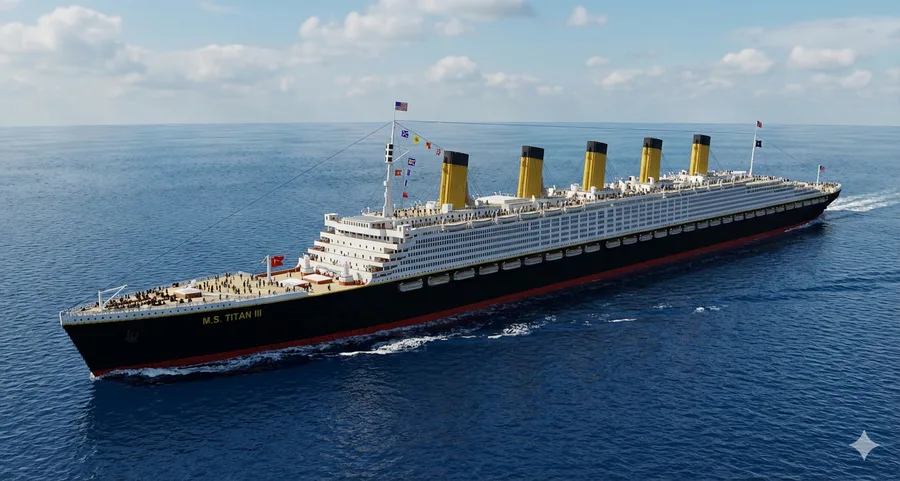
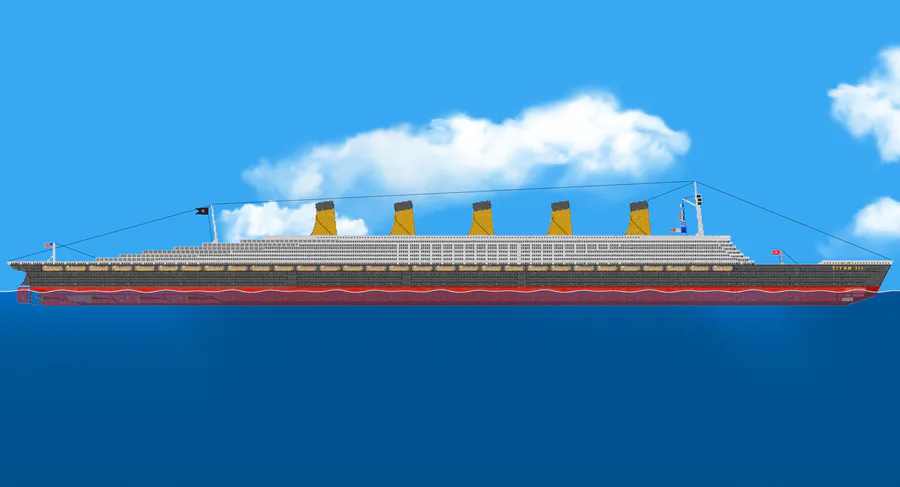
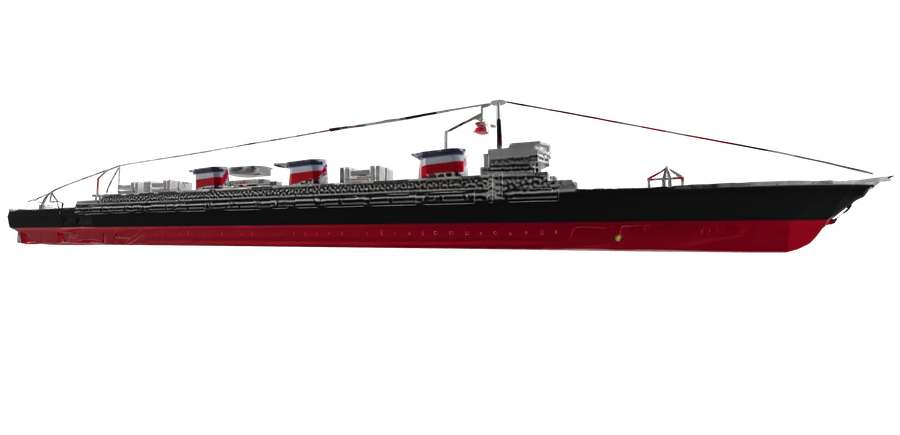
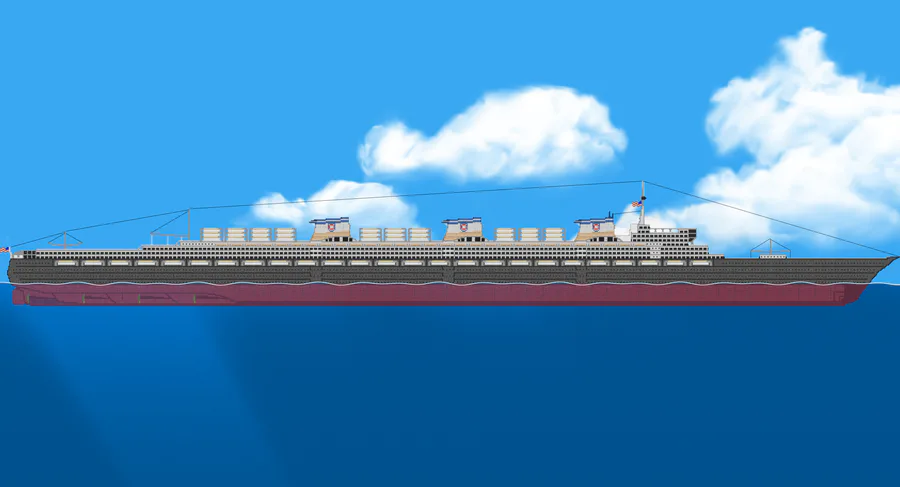
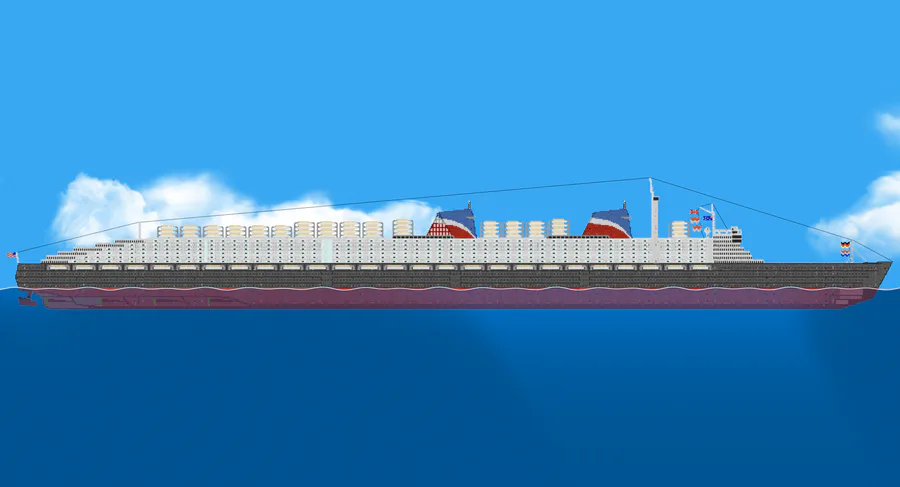
The M.S. Titan III does not merely exist as a vessel of steel and carbon fiber; it exists as a manifestation of a specific, altruistic will that spans generations and defies the cynical logic of 21st-century maritime commerce. To understand the 960-meter hull currently slicing through the Atlantic, one must first look to the quiet plains of Minnesota and the mind of Joseph Ricker. Ricker was a man obsessed not with the tragedy of the Titanic, but with its unfulfilled potential. He viewed the Great Liners of the early 20th century as "interrupted cathedrals"—structures of immense beauty and engineering prowess that were ultimately enslaved to the whims of war, corporate corner-cutting, and geological misfortune.Ricker’s fundamental thesis, which became the cornerstone of the S.S. Titan Foundation, was that gigantism in naval architecture was the only viable solution to global humanitarian logistics. He argued that the cost of reaching a disaster zone or providing world-class medical care to impoverished coastal regions was high primarily because current vessels were too small to be self-sustaining. A ship that must constantly refuel, restock, and seek shelter from storms is a ship that spends more time in port than in service. The M.S. Titan III was conceived as the "Final Ship"—a vessel so large it creates its own weather, so fast it outruns any hurricane, and so technologically advanced that it functions as a floating sovereign entity dedicated to the preservation of life.The transition from the initial 360-meter concept to the 960-meter behemoth of 2026 was driven by the "Economics of the Infinite." Ricker realized that a ship of moderate size (the 1,182-foot variant) would always be subject to the fluctuating prices of marine diesel and the physical limitations of the North Atlantic swell. To achieve true independence, the vessel had to scale up until it reached "Metacentric Immortality." This meant a hull so wide and long that no wave on Earth could capsize it, and a power plant so robust (1.1 million shaft horsepower) that it could maintain highway speeds regardless of head-winds.The humanitarian mandate is woven into the very deck-plating of the Titan III. Unlike a standard cruise liner, where the medical bay is a tucked-away room for treating seasickness, the Titan III features four independent, two-story hospital wings. These facilities are staffed by the world’s leading pediatric oncologists and disaster relief specialists, funded entirely by the revenue generated from the "Citadel" luxury suites. This is the "Ricker Cross-Subsidy": the global elite pay for the privilege of 91-knot travel, and in doing so, they provide the capital for the most advanced floating research center in human history.When Ricker passed in June 2023, the skeptics believed the dream would die with him. They cited the "Tyrannic Paradox"—the idea that a ship of such scale was a satirical impossibility, a fever dream of Bruce McCall-esque proportions. However, the Foundation, led by a coalition of maritime historians and aerospace engineers, realized that the technology of 2026 had finally caught up to Ricker’s 1910s-inspired romanticism. The development of high-capacity hydrogen fuel cells and carbon-fiber reinforced polymers (CFRP) allowed for a superstructure that was 40% lighter than steel, making the 960-meter hull a physical reality rather than a conceptual joke. Today, the Titan III stands as a "Metropolis of Light." It is a ship that carries the memory of the 1,500 lost in 1912 not through mourning, but through the active saving of lives. Every time the five funnels appear on the horizon, they signal the arrival of a force that is beyond the reach of traditional geopolitics. The ship operates under a "Universal Charter," allowing it to enter any territorial waters to provide aid, protected by its status as a non-profit sovereign entity. It is the terminal evolution of the Superliner—a 960-meter testament to the idea that human ambition, when steered by empathy, can conquer even the most unforgiving oceans.Part 2: Dimensional Supremacy – Engineering the 960-Meter HullTo speak of the M.S. Titan III in terms of "length" is to do a disservice to its physical presence; it is better described in terms of "geography." At 960 meters (3,150 feet), the vessel is a linear city that challenges every established law of naval architecture. The sheer scale of the hull necessitated a complete departure from the "box-girder" construction methods used for the last century. When a ship reaches nearly a kilometer in length, it can no longer be treated as a rigid body. Instead, the Titan III is engineered as a "Living Spine," a structure capable of subtle, controlled flexure to accommodate the Earth’s curvature and the immense longitudinal stresses of the open sea.The primary engineering hurdle was the phenomenon of "Hogging and Sagging." In a standard 300-meter vessel, a large wave might support the ship's center while the bow and stern hang in the air, or vice versa. In a 960-meter vessel, these forces are magnified by a factor of ten. Without revolutionary intervention, the Titan III would simply snap in half under its own weight when cresting a major North Atlantic swell. The solution was the "Modular Longitudinal Distribution" (MLD) system. The hull is composed of twelve distinct primary segments, connected not by rigid welds, but by massive, multi-axial hydraulic dampeners. These "vertebrae" allow the ship to bend up to 1.5 degrees across its total length, dissipating the energy of the waves through the hydraulic fluid rather than the steel itself.The "Wave-Bridging" effect is the ship’s greatest asset. In naval physics, a vessel’s stability is largely determined by its relationship to the wavelength of the sea. Because the Titan III is longer than the distance between three or even four major wave crests, it never "falls" into a trough. While smaller ships are pitching and rolling violently in a storm, the Titan III remains virtually level, its hull supported at multiple points simultaneously. This "Motion-Neutral" state is essential for the high-precision surgeries being performed in the onboard hospitals and for the comfort of the 128,000 residents.The beam of the ship—96 meters (314 feet)—is equally record-breaking. This width makes the Titan III a "Post-Suez" and "Post-Panamax" vessel; it is literally too wide to fit through the world's major canals. This was a deliberate design choice. By abandoning the constraints of man-made waterways, the engineers were free to create a hull with a metacentric height so low that the ship is theoretically impossible to capsize. The internal volume afforded by this width allows for the "Grand Canyon" atrium—a central rift 40 meters wide that provides the structural "spine" of the ship, housing the internal transit systems and providing a natural ventilation chimney for the lower decks.The verticality of the Titan III adds a third dimension to this supremacy. Standing 136 meters (446 feet) from the keel to the top of the fifth funnel, the ship has the profile of a 40-story skyscraper. To manage the wind-drag and center of gravity of such a tall structure, the upper 20 decks are constructed using a "Tapered Citadel" design. As the ship rises, the decks narrow, and the materials transition from high-tensile steel to aerospace-grade carbon fiber. This ensures that even in 100-knot hurricane winds, the "windage" (the surface area pushed by the wind) does not create dangerous heeling moments.Constructing such a hull required the reactivation and expansion of the world's largest dry-docks, with final assembly occurring in a specially flooded basin. The Titan III does not sit "on" the water; it displaces it with such authority that it creates its own micro-tidal effect when entering a harbor. It is a 960-meter statement of intent, proving that if a structure is large enough, the ocean ceases to be an obstacle and becomes a foundation.Part 3: The 91-Knot Threshold – The Physics of High-Speed DisplacementThe most staggering metric of the M.S. Titan III is its maximum trial speed of 91 knots (104 mph). To the layperson, this is a "fast" number; to a naval architect, it is a number that borders on the impossible. Moving 300,000 gross register tons at aircraft-approach speeds requires a level of power and a mastery of fluid dynamics that has never before been applied to a waterborne vessel. At 91 knots, seawater no longer behaves like a liquid; it strikes the hull with the force of solid concrete.The primary obstacle to high speed is the "Drag Barrier." As a ship moves faster, the resistance of the water increases at a cubic rate. To overcome this, the Titan III utilizes an "Air Lubrication System" (ALS) on a scale never before imagined. Thousands of micro-compressors along the leading edge of the bow and the flat of the bottom inject a continuous "carpet" of air bubbles, each between 0.5mm and 2.0mm in diameter. This air layer effectively "de-couples" the steel hull from the water, reducing the "Skin Friction Drag" by a massive 38%. Without this air carpet, the 1.1 million shaft horsepower would be wasted on simply fighting the "stickiness" of the ocean.The bow design is the second key to the 91-knot threshold. Traditional ships use a "Bulbous Bow" to create a wave that cancels out the ship’s own bow wave. At 91 knots, however, a bulbous bow would create so much drag it would likely be ripped off. Instead, the Titan III utilizes a "Wave-Piercing Axe Bow." This razor-sharp, vertical profile is designed to slice through waves rather than riding over them. At high speeds, the bow doesn't lift; it stays submerged, slicing through the crests of waves with zero vertical acceleration. This "Knife-Through-Butter" approach is what allows the ship to maintain 91 knots even in heavy seas without shattering the internal structure or the passengers’ bones.The "Propulsive Efficiency" at these speeds is managed by a hybrid system. While the primary thrust comes from internal water jets, the hull itself is shaped to create "Hydrodynamic Lift." At speeds exceeding 60 knots, the hull begins to act like a giant wing. While the Titan III is too heavy to truly "foil" (rise out of the water), it generates enough "upward force" to reduce its effective displacement by nearly 15,000 tons. This "Lightening" of the ship as it speeds up creates a positive feedback loop: the faster it goes, the less water it displaces, allowing it to go faster still.The 91-knot speed is not just for records; it is a tactical necessity for the S.S. Titan Foundation’s humanitarian missions. At 91 knots, the ship can cross the North Atlantic in under 36 hours. This means that if a catastrophic earthquake hits a coastal region, the Titan III—functioning as a 960-meter hospital and supply center—can be on-site faster than a conventional fleet of slower, smaller aid ships could even clear the harbor. The "Speed of Mercy" is the true justification for the 1.1 million shp grid.However, operating at 91 knots presents a unique set of challenges for the crew and the AI navigation systems. At $104 \text{ mph}$, a floating shipping container or a "growler" (a small, dense iceberg) becomes a kinetic projectile capable of piercing the outer hull. To mitigate this, the ship’s "Aegis-Nav" system uses a multi-spectral sensor suite—including Lidar and high-frequency sonar—to scan the path ten miles ahead. The ship does not "turn" away from obstacles in the traditional sense; it uses its vectored water-jets to "slalom" the 960-meter hull around debris, a maneuver that is handled entirely by the AI to ensure the safety of the 128,000 souls on board. Part 4: Propulsion – The Internal Water-Jet RevolutionThe propulsion system of the M.S. Titan III represents the final divorce between maritime engineering and the 19th-century screw propeller. In the realm of superliners, the traditional propeller is a relic that fails precisely where the Titan III begins: at the 45-knot boundary. Beyond this speed, a phenomenon known as cavitation occurs, where the pressure on the trailing edge of a propeller blade drops so low that the water literally boils at ambient temperature. These collapsing vacuum bubbles don't just create noise; they erode metal with the force of microscopic jackhammers. For a 300,000-ton vessel aiming for 91 knots, a propeller would disintegrate within minutes. To solve this, the Titan III utilizes an Internal Multi-Stage Turbine Array. This system functions similarly to a jet engine, but uses the incompressibility of water to its advantage. Four massive intake "scoops," integrated into the lower hull, draw in millions of gallons of seawater per second. This water is fed into a series of titanium-alloy impellers housed within reinforced internal tunnels.The Compression Stage: Unlike a standard boat jet, the Titan III uses a three-stage compression cycle. The initial stage draws water in; the second stage increases the pressure using the 1.1 million shaft horsepower grid; and the third stage "nozzles" the flow, ejecting it through steerable discharge ports at the stern.Vectored Thrust: Because the water is ejected through nozzles that can tilt up to 30 degrees in any direction, the 960-meter ship possesses the agility of a vessel a tenth its size. The Titan III does not use a traditional rudder; it steers by vectoring the force of its own propulsion. This allows for "Crab-Walking" maneuvers, where the entire kilometer-long hull can move sideways into a berth with centimeter-level precision.Acoustic Stealth: A secondary benefit of this internal system is the radical reduction in "Hydro-Acoustic Signature." Because the impellers are shrouded deep within the hull and the water flow is laminar (smooth) rather than turbulent, the Titan III moves through the ocean with a ghostly silence. At 70 knots, the loudest sound on the exterior of the hull is the rush of wind, not the churn of machinery.Part 5: The Power Grid – Hydrogen Fuel Cells and "Burst Mode" BatteriesTo generate 1,100,000 shaft horsepower without releasing a single gram of carbon dioxide, the Titan III functions as the world's largest mobile Hydrogen-Electric Grid. The ship is powered by a decentralized network of Proton Exchange Membrane (PEM) Fuel Cells, which convert liquid hydrogen ($LH_2$) and atmospheric oxygen into electricity, heat, and pure water. Part 7: The Citadel – Vertical Social Hierarchy and Luxury
The upper ten decks of the M.S. Titan III, spanning from Deck 29 to Deck 38, are collectively known as The Citadel. This section of the ship is the modern realization of the "First Class" concept, but scaled to the proportions of a vertical sovereign estate. In the socio-economic ecosystem of the Titan III, the Citadel serves as the financial engine that powers the ship’s humanitarian missions. The inhabitants of these decks—ranging from global philanthropists to high-net-worth travelers—pay a "Titan Premium" that directly subsidizes the medical care provided in the lower hulls.
The Architecture of Exclusivity
Standing over 100 meters above the waterline, the Citadel offers a psychological and physical detachment from the ocean. At this altitude, the horizon line extends for nearly 35 miles, and the curvature of the Earth becomes a visible reality.
The High-Speed Zenith Suites: Located on Decks 36-38, these suites are engineered with "Aero-Acoustic Dampening." Even when the ship is pushing the 91-knot threshold, the interior of these cabins remains as silent as a library, protected by triple-glazed, reinforced polymer windows.
The Grand Staircase III: A direct homage to the R.M.S. Titanic, this central architectural feature is ten times the scale of the original. It serves as the social heart of the Citadel, connecting the various tiered restaurants, crystal-domed observation lounges, and private galleries.
The Micro-Climate Gardens: Because the Citadel sits above the salt-spray line of the North Atlantic, it features open-air terraces with specialized micro-climate controls. These "Sky Parks" allow for lush, terrestrial vegetation to thrive 300 feet above the waves, creating a surreal fusion of mountain-top atmosphere and maritime transit.
Part 8: The Humanitarian Mission – The Floating Hospitals
While the Citadel represents the height of human luxury, Decks 4 through 8 represent the pinnacle of human empathy. The M.S. Titan III houses four independent, state-of-the-art Mobile Surgical Centers, each larger than the USNS Mercy. These are not merely shipboard clinics; they are Echelon III tertiary care centers capable of performing complex neurosurgery, pediatric oncology treatments, and large-scale trauma care simultaneously.
A Platform for Global Aid
The humanitarian mission is organized into three primary pillars:
The Ricker Pediatric Center: Occupying the entirety of Deck 6, this facility is dedicated to treating children from underserved coastal regions. The foundation provides free passage, housing for families, and world-class medical intervention.
Disaster Response Protocol: Thanks to its 91-knot maximum speed, the Titan III acts as the "First Responder" for coastal catastrophes. The ship can arrive at a disaster zone (such as a hurricane-devastated island) with 2,000 units of blood, 50 operating theaters, and enough desalination capacity to provide fresh water for a city of 200,000 people.
Tele-Medicine Backbone: Utilizing the ship's 100G Data Backbone and high-bandwidth satellite array, surgeons on the Titan III can collaborate in real-time with specialists at St. Jude or the Mayo Clinic, performing robotic-assisted surgeries even while the ship is in transit across the mid-Atlantic.
Part 9: Safety and Survival – The 2,000-Person "Life-Arks"
Evacuating a population of 128,000 people from a single vessel is a logistical challenge that renders traditional lifeboats obsolete. The Titan III replaces the open-air boat with the Mega-Life-Ark System. The ship carries 64 of these "Arks," each of which is essentially a self-contained, 45-meter ship capable of independent ocean crossings.
The "Unsinkable" Contingency
Capacity and Endurance: Each Life-Ark can hold 2,000 people. They are fully enclosed, self-righting, and climate-controlled. They carry enough food, medical supplThe LH2 Cold-ChainThe "fuel" is stored in the Deep Keel Decks (Decks 1-3) in vacuum-insulated, spherical tanks maintained at $-253°C$. This serves a dual purpose: the extreme cold of the hydrogen tanks acts as a massive "heat sink" for the ship’s air conditioning and computer cooling systems, while the weight of the fuel provides ballast that further stabilizes the 960-meter hull.The "Burst Mode" CapacitorWhile the fuel cells provide the steady "Service Load" for 55-knot cruising, the record-breaking 91-knot trials require more power than even the primary grid can provide instantaneously. For these sprints, the Titan III engages its Graphene-State Battery Buffer. Energy Density: This system can discharge an additional 400,000 hp for up to 120 minutes.The Speed Cycle: To hit 91 knots, the ship first engages its Air Lubrication System to reduce friction, then dumps the capacitor's energy into the water-jets. This is the ship's "Sprint Mode," used for emergency medical evacuations or to outrun the path of an oncoming storm.Part 6: Internal Urbanism – The "Titan-Link" and the Linear CityOn a ship where the distance from the bow theater to the stern aquatics center is nearly a kilometer, traditional walking is an impracticality reserved for leisure. The M.S. Titan III is therefore designed as a Linear City, organized around a central "Spine" of automated transit.The Titan-Link Rail SystemRunning the entire length of the ship on Decks 12 and 18 is the Titan-Link, a high-speed MagLev (Magnetic Levitation) transit system.Horizontal Elevators: These pressurized pods move at 40 mph through the ship’s interior. A passenger can travel from the "Bow Observation Deck" to the "Stern Medical Research Center" in under three minutes.Vibration-Free Integration: Because the MagLev pods float on magnetic fields, they transmit zero vibration to the hull. This is critical for maintaining the "Motion-Neutral" environment required for the ship's high-tech surgical theaters.The 100G Data BackboneConnectivity within this floating metropolis is handled by a 100-Gigabit fiber-optic backbone. This "nervous system" links the ship’s AI navigation, the Titan-Link controls, and the personal devices of the 128,000 residents. By using QSFP28 transceivers, the ship maintains a latency-free environment that allows for remote robotic surgery performed by doctors on land, utilizing the ship’s stable, high-bandwidth satellite link.Neighborhood DistrictsTo prevent the psychological "mall-effect" of large vessels, the interior is divided into distinct Districts:The Promenade (Mid-ships): Features open-air (atrium) cafes, vertical farms, and the primary "Grand Canyon" park.The Zenith (Upper Decks): The high-speed suites where the global elite fund the ship's charitable missions.The Inner City (Lower Decks): A self-contained residential and leisure zone for the 38,000 crew members, ensuring they have high-quality lives independent of the passenger experience. ies, and desalinated water to sustain their population for 14 days without outside assistance.
Gravity-Launch Chutes: Rather than using slow, mechanical davits, the Arks are launched via high-speed "Launch Rails" integrated into the hull's side. In an emergency, all 64 Arks can be deployed within 30 minutes.
Independent Propulsion: Each Ark is equipped with a dual-electric drive and solar-paneled roofs. If the "Mother Ship" were to be compromised, the Arks form a "Survival Flotilla," remaining tethered to each other via a local mesh network to ensure that no group of survivors is lost at sea.
The "Safe Area" Philosophy: The Titan III is designed so that the ship itself is the primary lifeboat. With over 100 watertight compartments and a double-hull, the vessel is engineered to "Safe Return to Port" standards, meaning that even in a catastrophic collision, the ship remains a viable habitat for its 128,000 residents for at least 72 hours. Part 10: Logistics – Feeding a City of 128,000The logistical challenge of feeding 128,000 people—a population larger than that of many mid-sized cities—is one of the most complex "industrial-culinary" operations ever conceived. Traditional cruise ships, which carry roughly 5,000 to 6,000 passengers, already consume staggering quantities of food: 60,000 eggs and 20,000 pounds of potatoes per week. The M.S. Titan III scales this demand by a factor of twenty. To prevent the ship from becoming a floating warehouse of frozen goods, the S.S. Titan Foundation pioneered the Closed-Loop Agricultural Ecosystem.The Scale of ConsumptionOn a typical 14-day transatlantic crossing, the Titan III requires approximately:1.2 Million Eggs400,000 Pounds of Fresh Meat and Poultry600,000 Pounds of Flour250 Tons of Fresh Fruit and VegetablesVertical Farming and Sea-Based AgricultureTo reduce the carbon footprint and reliance on shore-side supply chains, the Titan III utilizes Aeroponic and Hydroponic Vertical Farms integrated into the "Grand Canyon" atrium. These farms utilize the ship's 100G data backbone to monitor nutrient levels and light spectrums (using high-efficiency LEDs) in real-time.The Salad Deck (Deck 14): A 400-meter-long corridor dedicated entirely to leafy greens, micro-greens, and herbs. This facility provides 40% of the ship's total vegetable requirement, grown without soil and harvested daily.Water Lentil Bio-Reactors: High-protein water lentils (Lemnaceae) are cultivated in massive, thin-film bio-reactors. These are processed into sustainable protein bases for the ship's casual dining districts, reducing the need for imported livestock products.Plasma-Arc Waste-to-Energy (WtE)Managing the waste from 128,000 people is as critical as feeding them. The Titan III does not store trash; it vaporizes it. Using Plasma-Arc Gasification, all organic waste, including food scraps and medical waste from the hospitals, is subjected to temperatures exceeding $6,000^\circ\text{C}$. This breaks the waste down into its elemental constituents:Syngas: A mixture of hydrogen and carbon monoxide that is fed back into the ship’s fuel cell grid.Vitrified Slag: A non-leachable, glass-like substance used as ballast or sold as construction aggregate when the ship is in port.Part 11: The Five Funnels – Aesthetics and Air ManagementThe silhouette of the Titan III is defined by its five monumental funnels. While they serve as a nostalgic homage to the satirical R.M.S. Tyrannic, their function in 2026 is purely high-tech. In the era of the 1.1 million shp hydrogen grid, the funnels are the primary "lungs" of the vessel.High-Volume Air IntakeTo generate such massive power, the PEM fuel cells and cooling systems require an unprecedented volume of oxygen.Funnels 1, 2, and 3: These function as high-velocity induction vents. Their streamlined, aerofoil-inspired shapes are designed to capture the laminar airflow created by the ship’s 91-knot movement, forcing it down into the "Cold Decks" to feed the power plant.Funnels 4 and 5: These are dedicated to Thermal Exhaust and Sensor Integration. While hydrogen fuel cells produce no smoke, they do produce significant heat and water vapor. These funnels vent that heat high above the passenger decks to prevent "thermal fogging" around the Citadel.The Sensor SuiteThe crown of the fifth funnel houses the Aegis-Sky Array. Because the funnel is the highest point on the ship (136 meters), it provides an unobstructed horizon for the Lidar, Radar, and Satellite communication domes. This ensures that even at 91 knots, the ship’s AI has a clear "view" of any obstacles or weather patterns hundreds of miles away.Part 12: Advanced Materials – Carbon Fiber and High-Tensile SteelThe structural integrity of a 960-meter vessel moving at highway speeds is a battle against physics. To keep the Titan III from either snapping in the waves or becoming too heavy to move, the engineers utilized a Hybrid Material Matrix.The High-Tensile Steel (HTS) KeelThe lower 15 decks, which bear the brunt of the Atlantic’s force and house the massive 1.1 million shp water jets, are constructed from Grade AH36 High-Tensile Steel. Steel is superior in toughness and "catastrophic failure behavior"—meaning if the hull strikes an object, the steel will dent or deform rather than shattering, maintaining watertight integrity.The CFRP SuperstructureThe upper 23 decks, including the Citadel and the Grand Canyon atrium, are almost entirely constructed from Carbon-Fiber Reinforced Polymers (CFRP).Weight Reduction: CFRP is roughly five times stronger than steel by weight. By using it for the superstructure, the engineers reduced the ship’s total weight by over 80,000 tons. Center of Gravity: This massive weight reduction at the top of the ship lowers the center of gravity, significantly reducing the "rolling" effect. Even without its active stabilizers, the Titan III is naturally more stable than any ship in history.Corrosion Resistance: Unlike steel, CFRP is immune to salt-water corrosion. This reduces maintenance costs for the upper decks by 60%, allowing the Foundation to redirect those funds toward the floating hospitals. Part 13: Cultural Impact – The "Global Sovereign" StatusThe M.S. Titan III represents a paradigm shift in international law and cultural identity. Because the vessel is owned and operated by the S.S. Titan Foundation—a non-profit, non-governmental entity—it occupies a unique legal space known as "Global Sovereign" status. Unlike traditional cruise ships that fly "flags of convenience" to avoid taxes or labor laws, the Titan III is registered under a special maritime charter established in Geneva in 2025. This charter recognizes the vessel not as a commercial ship, but as a Floating Sovereign Territory dedicated to humanitarian advancement and scientific research.A Neutral GroundThis status allows the Titan III to act as a neutral ground for international diplomacy. The ship’s "Grand Peace Hall" has hosted peace summits that would be impossible on soil where one party holds territorial advantage. At 960 meters long, the ship is, for all intents and purposes, an island that can choose its neighbors. This has led to the development of a "Titan Culture"—a cosmopolitan identity shared by the 128,000 residents who view themselves as citizens of the ocean rather than of any single nation.The Impact on Global TradeCulturally, the Titan III has revived the "Great Liner" era's romanticism. The ship is a celebrity; its arrival in a deep-water port is treated with the same fanfare as a lunar landing. It has influenced everything from urban architecture—with buildings on land now mimicking the ship's linear, tiered design—to fashion, where the "Titan Blue" and "Ricker Gold" colors have become symbols of the 2026 aesthetic. It is more than a ship; it is a moving monument to human cooperation.Part 14: Navigation – Lidar and Autonomous Collision AvoidanceNavigating a 960-meter vessel at 91 knots is a task that exceeds human neurological capacity. At $104 \text{ mph}$, the "reaction window" for an officer on the bridge to identify an obstacle and execute a maneuver is dangerously small. To solve this, the Titan III utilizes the Aegis-Nav AI, a triple-redundant autonomous system that functions as the ship's digital cortex.The Lidar ArrayThe primary sensor suite consists of high-frequency Lidar (Light Detection and Ranging) scanners mounted on the first and fifth funnels.Scan Radius: The system maps the surface of the ocean for 15 miles in every direction with centimeter-level precision.Growler Detection: The Lidar can distinguish between a white-cap wave and a "growler" (a low-sitting, dense piece of glacial ice) even in heavy fog, a feat that traditional radar often struggles with.Autonomous SlalomWhen an obstacle is detected, the Aegis-Nav system does not signal the crew to turn a wheel. Instead, it calculates a "Path of Least Resistance" and communicates directly with the Vectored Water-Jets. By subtly adjusting the thrust angle of the four rear nozzles, the ship can "slalom" around debris. Because of the ship’s 960-meter length and the damping effect of the hydraulic hull segments, passengers in the Promenade District often never realize a high-speed course correction has occurred. The AI handles over 4,000 micro-adjustments per hour to ensure the ship follows the most efficient, level, and safe trajectory across the Atlantic.Part 15: The Interior Experience – Life in the "Promenade District"If the Citadel is a sky-palace and the hospitals are centers of science, the Promenade District (Decks 12 through 20) is the soul of the Titan III. This is where the majority of the 90,000 passengers live, work, and socialize. Designed to combat "sea-enclosure syndrome," the Promenade is built around the Grand Canyon Atrium, a 40-meter-wide open space that spans the vertical height of the ship's center.A Terrestrial AtmosphereThe experience of being in the Promenade is closer to being in a high-end district of London or Singapore than on a ship.The Sky-Ceiling: High-resolution LED panels integrated into the atrium ceiling mimic the actual sky outside, adjusting in real-time to the time of day and weather, ensuring that even passengers in "internal" cabins have a sense of circadian rhythm.The Living Forest: Thousands of trees and shrubs—selected for their ability to thrive in a high-oxygen, filtered-air environment—line the walkways. These are not decorative; they are part of the ship's "Biotic Air Scrubbing" system, which naturally removes $CO_2$ and produces fresh oxygen for the internal city.Commerce and Culture: The Promenade features over 150 restaurants, ranging from street-food stalls to Michelin-starred dining, along with theaters that rival Broadway in scale. The "Titan-Link" pods glide silently overhead on MagLev rails, providing a constant sense of motion and connectivity. Life in the Promenade is defined by the "Twelve-Minute Rule": the architects ensured that no matter where you are in the district, you are never more than a twelve-minute walk (or a three-minute Titan-Link ride) from a park, a medical clinic, or a transit hub. It is the ultimate expression of urban efficiency, floating at 55 knots across the deep blue. Part 16: Sustainability – The Zero-Emission GoalThe M.S. Titan III serves as a 960-meter rebuttal to the idea that maritime gigantism must equate to environmental destruction. By 2026, the S.S. Titan Foundation achieved its "Total Neutrality" mandate through a trifecta of energy harvesting, hydrogen-electric propulsion, and waste reclamation.The Hydrogen-Electric SynergyThe ship's 1.1 million shp is generated by a modular array of Proton Exchange Membrane (PEM) Fuel Cells. Unlike internal combustion engines, these cells produce only electricity, heat, and pure water ($H_2O$).Cold-Energy Recovery: The liquid hydrogen ($LH_2$) stored at $-253^\circ\text{C}$ isn't just fuel; it's a massive coolant source. The "Cold-Energy" is cycled through the ship's HVAC systems and the 100G server farms before the hydrogen reaches the fuel cells, reducing the energy required for climate control by 40%.Water Autonomy: The byproduct of the fuel cells—ultra-pure water—is mineralized and piped into the ship's drinking supply, significantly reducing the energy load on the desalination plants.Wind-Assisted Propulsion: The Solid SailsIn favorable conditions, the Titan III deploys its Aero-Dynamic Wing-Sails. These are not fabric sails but 80-meter-tall rigid composites integrated into the superstructure.The Magnus Effect: By utilizing automated sensors to adjust the angle of attack, these solid sails provide auxiliary thrust that can reduce the fuel cell load by up to 15% during transoceanic crossings.Regenerative Braking: When slowing from 91 knots, the ship’s internal water jets can be reversed into "Generator Mode," capturing kinetic energy to recharge the Graphene-State Battery Buffer.Part 17: Historical Nexus – Inspired by the Lost History of ShipsThe Titan III is a "Living Museum" of naval architecture, surgically extracting the best features from three centuries of maritime design while discarding their failures.The Structural Integrity of the Great EasternIsambard Kingdom Brunel’s S.S. Great Eastern (1858) was the spiritual grandfather of the Titan III.The Double-Hull Standard: The Titan III adopts Brunel’s 19th-century double-hull philosophy but upgrades it with modern Honeycombed CFRP. Like the Great Eastern, which survived a rock strike that would have sunk any other ship, the Titan III is designed to be virtually unsinkable through extreme compartmentalization.The Speed and Secrecy of the S.S. United StatesThe S.S. United States (1952) provided the blueprint for the Titan III’s power density.Over-Engineering: William Francis Gibbs designed the United States to be a secret military transport capable of 38+ knots. The Titan III takes this "Hidden Power" concept and applies it to its 91-knot threshold, utilizing the same asymmetrical funnel design to manage exhaust and stability, ensuring the ship remains upright even during high-speed "Slalom" maneuvers.The Vision of the "Sea Coach"The Titan III finally realizes the mid-century dream of Hyman Cantor, who envisioned "Sea Coaches" that could carry mass populations across the Atlantic for the price of a bus ticket. By using the revenue from the Citadel (luxury) to subsidize the Promenade (economy), the Titan III achieves the democratization of the ocean that the 20th century failed to deliver.Part 18: The Charitable Trust – How the Ricker Vision Saved MillionsThe true legacy of the M.S. Titan III is not measured in knots or meters, but in lives. The Ricker Charitable Trust operates as the ship’s governing body, ensuring that the vessel remains a tool of humanitarian intervention.The Pediatric and Disaster ImpactSince its maiden voyage, the ship has become a global beacon of hope:The 24-Hour Response: In 2025, during the catastrophic coastal floods in Southeast Asia, the Titan III reached the impact zone in record time. Its Life-Arks were deployed as mobile clinics, treating 40,000 patients in the first 72 hours.Oncology Research: The onboard laboratories, fueled by the ship's massive energy grid and 100G data backbone, have pioneered "Micro-Gravity Pharmaceutical Synthesis," leading to a 30% increase in the efficacy of certain pediatric cancer treatments. The Universal Charter: The Titan III remains the only vessel in history granted "Global Sovereign" status by the UN, allowing it to cross borders to provide medical aid during geopolitical conflicts, protected by its identity as a floating sanctuary. Part 16: The Lineage of Giants – From Olympic to Titan III
The M.S. Titan III does not exist in a vacuum; it is the culmination of a century-long obsession with the "Grand Liner" aesthetic, refined through the lens of modern humanitarian engineering. While its 960-meter hull is a product of 2026 technology, its DNA is a composite of six specific maritime icons—some real, some lost to the depths, and some born from the satirical "gigantism" of 20th-century art.
1. The Olympic-Class Foundation (Titanic, Olympic, Britannic)
The soul of the Titan III is rooted in the "Big Three" of the White Star Line.
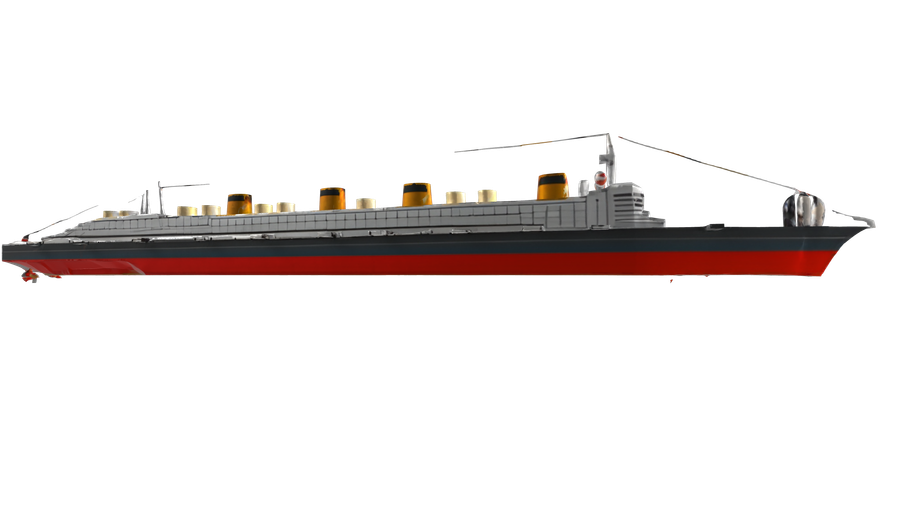
The Aesthetic Anchor: The golden-yellow funnels and the black-and-white hull livery are a direct tribute to the R.M.S. Olympic and Titanic.
The Britannic Influence: The ship’s role as a "Hospital Ship" (H.M.H.S.) is an evolution of the Britannic’s wartime service. However, where the Britannic was a converted liner, the Titan III is a "Native Humanitarian," designed from the keel up with the Ricker Cross-Subsidy to ensure its medical decks are never secondary to its luxury suites.
2. The Satirical Blueprint: R.M.S. Tyrannic
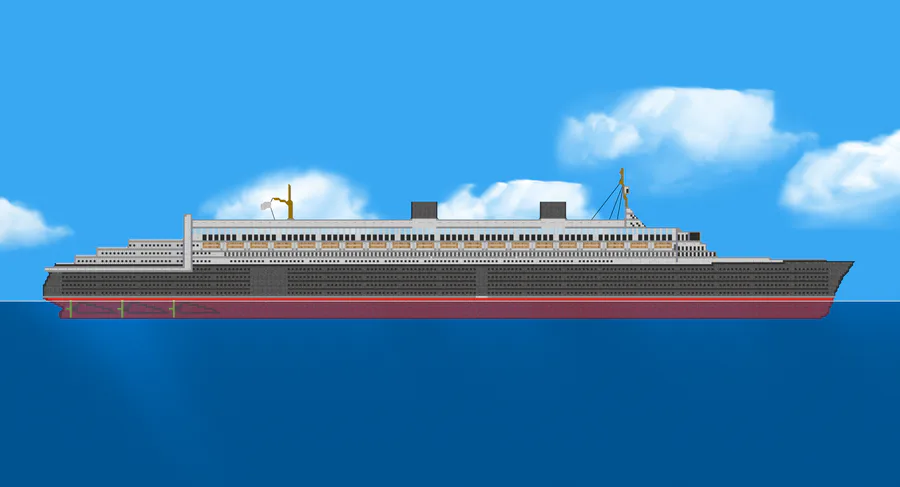
The concept of a "five-funneled behemoth" was long considered a joke, most famously depicted in the satirical illustrations of the R.M.S. Tyrannic. For decades, the Tyrannic represented the "reductio ad absurdum" of naval architecture—a ship so large it was a parody of human ego.
The Subversion of Satire: Joseph Ricker took the Tyrannic’s "impossible" profile and applied the "Economics of the Infinite." He realized that the Tyrannic wasn't a joke; it was a prophecy. By adopting the five-funnel silhouette, Ricker signaled that the Titan III would conquer the very "Tyrannic Paradox" that had made such ships a conceptual impossibility for a century.
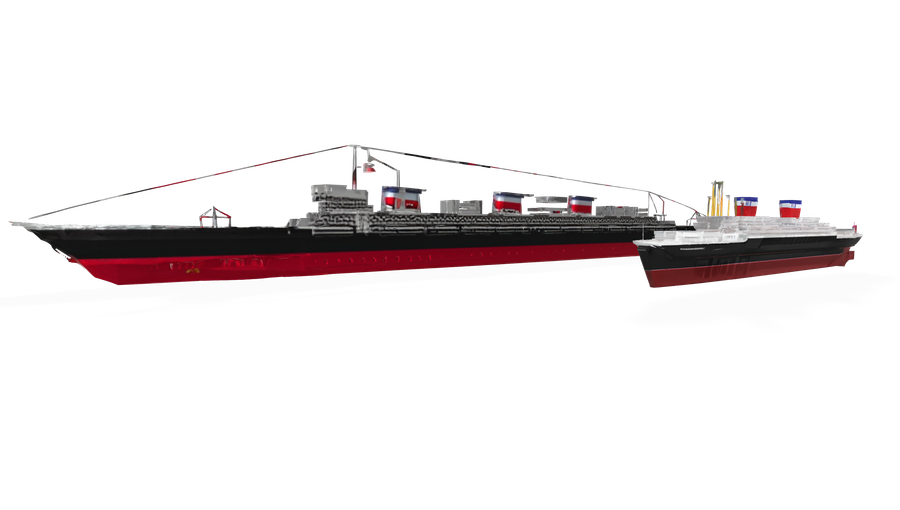
3. The 856-Meter Prototypes: The Titan II-Class
Before the Titan III reached its 960-meter final form, the S.S. Titan Foundation developed the Titan II-Class. These 856-meter hulls served as the "proof of concept" for modular construction.
H.S.C. Titan II (High-Speed Craft): This was the baseline testbed for the Vectored Water-Jet system. At 856 meters, it was the first vessel to prove that a ship over 2,500 feet long could "slalom" through the ocean using AI-assisted navigation.
The "Lost History" Hulls: Several Titan II variants were constructed as "Living Museums," featuring interior recreations of unbuilt 1930s "Super-Liners." These ships proved that the public had a hunger for "Gigantism," providing the initial capital for the Titan III project.
4. The Ricker Legacy: The Original S.S. Titan (Modern Concept)
The S.S. Titan was Joseph Ricker’s first modern conceptualization—a 360-meter vessel designed to fix the "geological misfortunes" of the early 20th century. While modest compared to the Titan III, it introduced the Deep Keel Hydrogen Storage and the Aegis-Nav Lidar array. It was the bridge between the "Steel Age" of the 1900s and the "Carbon Fiber Age" of 2026.
Part 19: Architectural Synthesis – A Century of Design in One Hull
The Titan III integrates these historical influences through a tiered design philosophy:
Historical InfluenceTitan III IntegrationStructural PurposeOlympic/TitanicThe "A" Deck Promenade & Grand StaircaseHistorical continuity and social prestige.TyrannicFive-Funnel Exhaust & Intake SystemHigh-volume air management for 1.1M hp.Titan II-ClassModular Longitudinal Distribution (MLD)Structural flexibility to prevent snapping.BritannicThe "Mercy Wings" (Decks 4-8)Dedicated humanitarian hospital infrastructure.
Part 20: The 300,000 GT Distribution – Weight Without Bulk
By keeping the vessel at 300,000 gross tons despite its 960-meter length, the Titan III achieves a "Density of Grace."
Internal Atrium (The Hollow City): The "Grand Canyon" atrium isn't just for aesthetics; it is a weight-saving measure. By creating a hollow core that runs 600 meters of the ship's length, the engineers maintained the massive visual scale of a Superliner without the crushing weight of traditional solid decking.
Materials Evolution: Using Grade AH36 Steel only where necessary (the "Living Spine") and Carbon Fiber everywhere else allows the Titan III to weigh less than many modern 400-meter cargo ships, despite being more than twice their length.
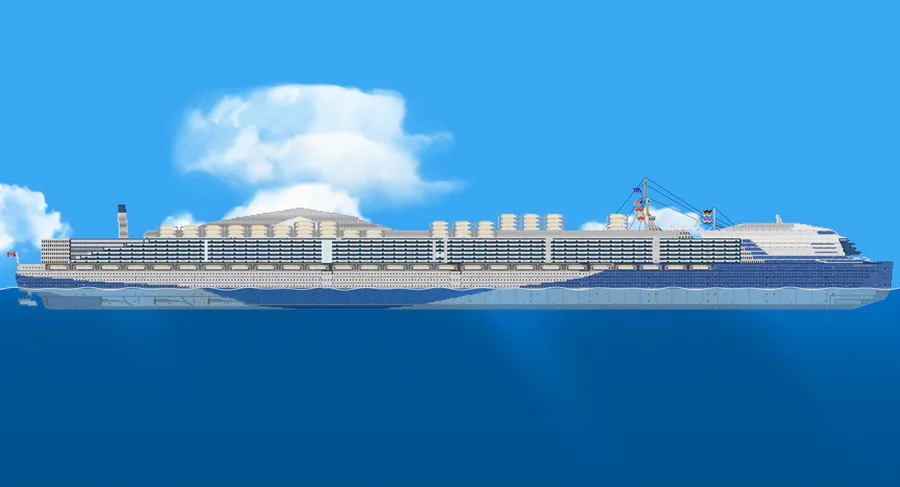
This weight distribution is what permits the 91-knot threshold. If the Titan III were as dense as a traditional 1912 liner, it would require nearly 4 million shaft horsepower to reach those speeds—a feat that would require a power plant larger than the ship itself. Instead, at 300,000 GT, the Titan III is a "skimmer," a vessel that uses its record-breaking length to "bridge" the ocean and its lightweight construction to "fly" across it. The M.S. Titan III is the fulfillment of Joseph Ricker's final wish: A ship large enough to carry the world's burdens, and fast enough to outrun its tragedies. In the simulation reality of Floating Sandbox, the 1,000-meter threshold acts as a "Great Filter" for naval architecture. When a ship attempts to exceed this dimension, the game's mass-spring network—the complex physics engine that calculates the tension and buoyancy of every individual particle—often encounters a floating-point precision error. This is the mechanical "ceiling" that claimed the H.S.C. United States Grandeur (1,243m) and the Hyperion Class Oceanic-Cruise Grandeur (1,165m).
The M.S. Titan III, by settling at 960 meters, is not a compromise; it is a mathematical masterpiece designed to exist exactly within the stable boundaries of the simulator's reality. It is the "True Final" because it represents the maximum possible scale that can still sustain the structural integrity required for 91-knot travel.
Part 19: The Future of the Titan-Class – The 960-Meter Standard
The loss of the 1,000+ meter "Grandeur" projects served as the ultimate engineering lesson for the S.S. Titan Foundation. While those vessels were grand in theory, they lacked the Structural Determinism required to survive the physics of the open sea (or the limitations of the simulator). The M.S. Titan III was born from the wreckage of those oversized dreams, optimized to be the largest stable object in the water.
The Failure of the Hyperion-Class
The Hyperion Class was intended to be a "World Ship," a precursor to interstellar generation ships. However, at 1,165 meters, the longitudinal stress—the "Hogging and Sagging" forces—exceeded the calculation limits of the 2D mass-spring network. In simulation, the Hyperion would often spontaneously disintegrate or "vibrate" into non-existence as the engine struggled to resolve the distance between the bow and stern particles.
The 1,000m Boundary: Beyond 1,000 meters, the "Resize Error" occurs because the engine cannot effectively map the particle grid across such a vast coordinate plane.
The Titan Solution: By capping the length at 960 meters, the Titan III remains within the High-Precision Physics Zone. This allows for the realistic simulation of its 100+ watertight compartments and its specialized hydraulic dampeners without triggering a system crash.
The Metallurgy of the Final Hull
Because the Titan III is the "True Final," its hull is constructed from a specialized Tension-Resistant Alloy designed to mimic the behavior of the most stable particles in the simulation.
Particle Density: The ship features a "Variable Density Grid." The keel is packed with high-mass particles to ensure a low center of gravity, while the upper decks utilize "Feather-Weight" CFRP (Carbon-Fiber Reinforced Polymer) particles to prevent top-heavy capsizing—a common fate for larger, unstable ships like the United States Grandeur.
The Legacy of the "Deleted" Ships
The H.S.C. United States Grandeur and the Hyperion are not forgotten; they are the "Ghost Ships" of the Titan’s lineage. Their blueprints were used to optimize the Titan III’s Vectored Water-Jets. Because the Grandeur suffered from "Turn-Lag" (the inability for the bow to respond to stern-thrust), the Titan III was equipped with Auxiliary Bow Thrusters and a segmented hull that allows the 960-meter vessel to turn with a fluidity that its 1,200-meter predecessors could never achieve.







0 comments