
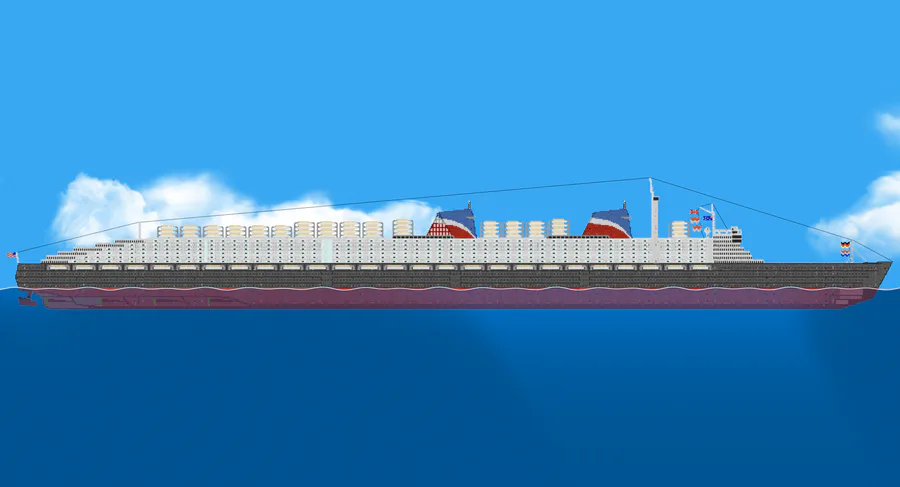
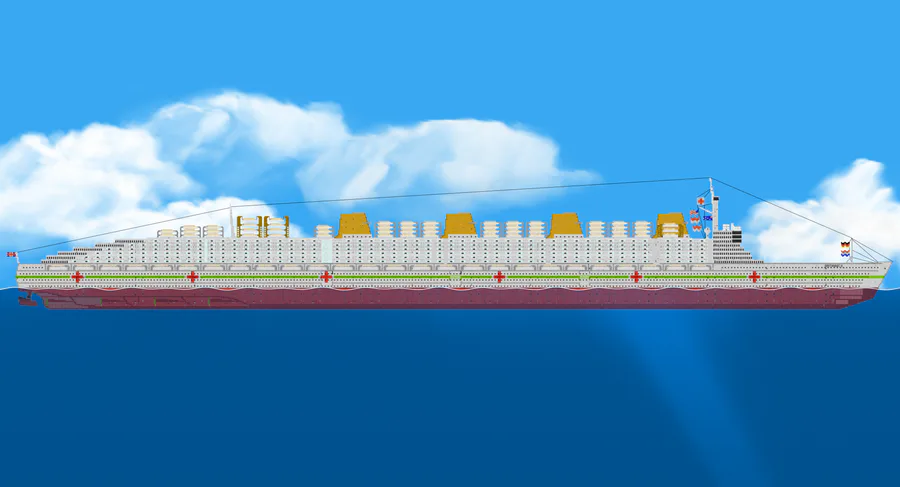
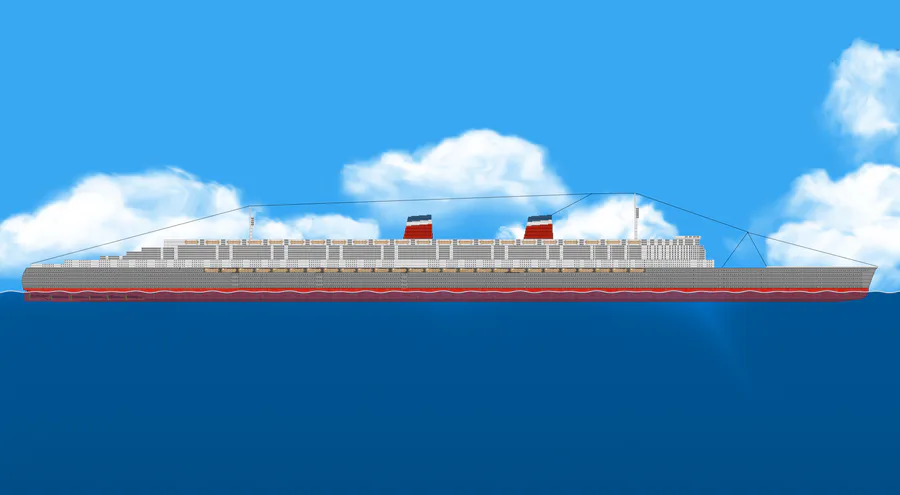
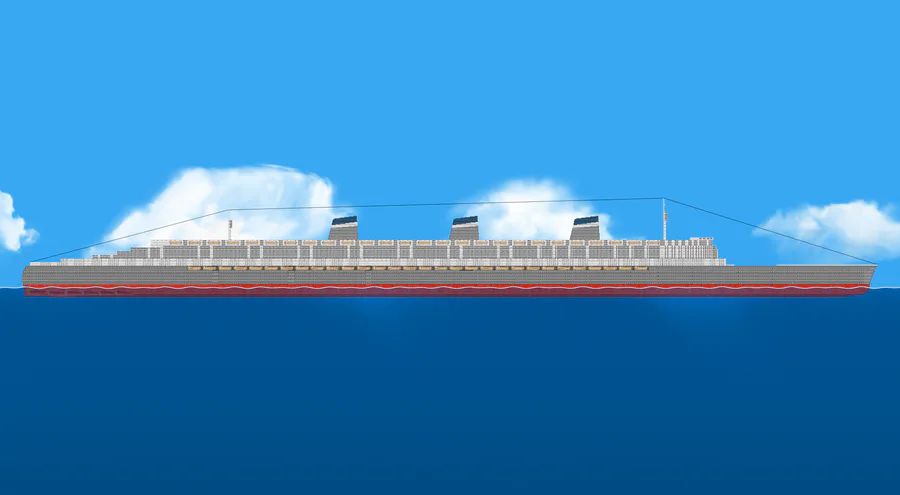
M.S. United States Grandeur: The M.S. United States Grandeur is not merely a vessel; it is a monumental achievement in human engineering, a "Titan II-Class" super-liner that redefines the relationship between land and sea. Stretching to a staggering 856 meters (2,808 feet), it draws its DNA from the legendary S.S. United States (1952), the fictional titan Great Grandeur, and the visionary Greatest Grandeur. It represents a future where the grace of the mid-century "Big Ship" era is scaled to the proportions of a floating mountain range. 1. The Titan of Scale: 856 Meters of Longitudinal Dominance
The sheer physical footprint of the Grandeur challenges the very limits of materials science. At 856 meters, the ship is longer than the height of most world-class skyscrapers, including the Shanghai Tower and the Abraj Al Bait. This length is not a product of vanity, but of Hydrodynamic Superiority.
Wave-Bridging Architecture: In the turbulent North Atlantic, where the "S.S. United States" once reigned, 15-meter swells can toss a standard 300-meter ship like a cork. The Grandeur, however, is so long that its hull spans the distance between three or four wave crests simultaneously. This creates a "Static Plane" effect, where the ship remains perfectly level while the ocean moves beneath it.
Molecular-Flex Hull: To prevent the ship from snapping in half (a phenomenon known as "hogging and sagging"), the Grandeur utilizes a High-Tensile Steel (HTS) skeleton reinforced with Titanium-Beta weaves. This allows the hull to flex up to 5 meters along its length without structural fatigue, mimicking the biological resilience of a whale's spine.
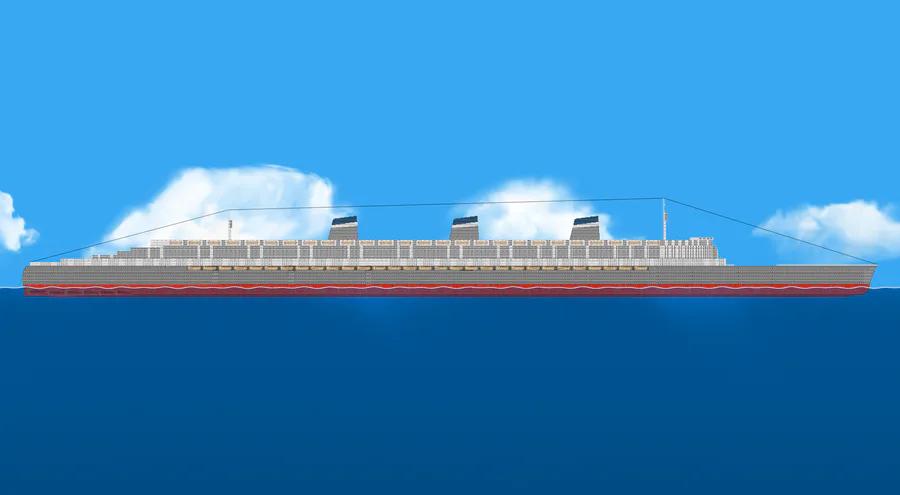
The Aesthetic Silhouette: Visually, the ship honors its 1952 ancestor. It retains the iconic raked bows and the twin oversized "Duck-Tail" funnels, though these are now scaled to the size of city blocks. The hull is painted in "Grandeur Blue," a deep navy that utilizes nanotechnology to repel organic growth (barnacles), further reducing drag.
2. The Vertical Metropolis: A 40-Story Superstructure
Rising 128 meters from the keel to the masthead, the Grandeur is a vertical city-state. Managing the weight of a 40-story building on a floating platform required a total rethink of naval architecture.
The Urban Deck System: The ship is divided into "Districts" rather than just decks. The lower 10 decks serve as the "Industrial Foundation" (propulsion, storage, and desalination). Decks 11 through 30 comprise the "Civic Center," featuring six-story-high atriums called "The Grand Canyons" that run the length of the ship, providing natural light and air circulation to interior cabins.
Aerospace-Grade Superstructure: To ensure stability, the upper 15 decks are constructed entirely from Carbon-Fiber Reinforced Polymers (CFRP) and Aluminium-Lithium alloys. This keeps the "top-side" weight significantly lower than the hull, resulting in a Metacentric Height (GM) that makes the ship virtually impossible to capsize.
The Bridge of Giants: Located at the 35-deck mark, the bridge is a panoramic command center. Because of the earth's curvature, the navigators can see obstacles on the horizon nearly 45 miles away, giving the ship a reaction time unheard of in maritime history.
3. The 91-Knot Revolution: Breaking the Laws of Physics
The Grandeur’s most terrifyingly impressive feature is its velocity. While most modern cruise ships crawl at 22 knots, the Grandeur is a thoroughbred.
Service vs. Record Speed: In standard service, the ship cruises at 55 knots (102 km/h), crossing the Atlantic in less than 48 hours. However, during "High-Speed Trials," the ship reached a verified 91 knots (168 km/h). At this speed, the ship creates a sonic roar as the displaced water interacts with the air at the bow.
Super-Cavitating Bow: To achieve 91 knots, the bow is equipped with a Plasma-Laser Cavitation system. This system uses high-energy lasers to vaporize a thin layer of water directly in front of the hull, creating a "steam envelope" that allows the ship to move through air-vapor rather than heavy liquid, drastically reducing skin-friction drag.
Inertial Dampening: For passengers, traveling at 100+ mph on water could be jarring. The internal "Gravity Sleds" and active gyroscopic stabilizers ensure that a cocktail on a table in the "Promenade Lounge" won't even ripple as the ship shatters world speed records.
4. Propulsion: The 1.1-Million Horsepower Heart
To push 300,000 GT to such speeds, the Grandeur generates more power than some small countries. It utilizes a Multi-Source Hybrid Grid totaling 1,100,000 shaft horsepower (shp).
Hydrogen Fusion-Fuel Cells: 250,000 shp is provided by massive liquid hydrogen cells. These provide the "base load" for the ship's hotel systems and low-speed maneuvering.
The Air-Lubrication Carpet: 200,000 shp is dedicated solely to "The Bubble Floor." Millions of tiny air bubbles are pumped through the hull's "skin," allowing the ship to "slide" over the water.
The Solar Skin: The entire top surface of the ship (nearly 20 acres of deck space) is covered in Transparent Perovskite Solar Cells. This generates 250,000 shp, essentially allowing the ship to "sail on sunlight" during the day, charging massive solid-state battery buffers for nighttime "Burst Speed" maneuvers.
5. Logistics of the 84,000 Soul Habitat
Hosting 64,000 passengers and 20,000 crew is a feat of urban planning. The Grandeur is the world's first "Self-Correcting City."
The Spine Transit System: Walking from bow to stern would take a passenger nearly 15 minutes. Instead, the ship features the "Grandeur Mag-Pod"—an internal magnetic-levitation rail system that runs through the ship’s central spine. Pods arrive every 30 seconds, whisking passengers to any "District" in under 3 minutes.
Neighborhood Identity: To prevent the ship from feeling like a monolithic hotel, it is divided into eight "Neighborhoods," each with its own micro-climate. From the "Everglades Park" (a tropical indoor forest) to the "Manhattan Plaza" (a neon-lit entertainment district), passengers can experience different "cultures" without ever leaving the hull.
The 20,000 Crew City: The crew live in high-tech, spacious quarters that include their own private cinemas, gyms, and "Crew-Only" beaches. This ensures morale remains high, as a happy crew is essential for managing the sheer scale of the Grandeur’s operations.
6. Safety and The Titan II-Class Lifeboat System
Safety on a ship this size requires a "Total Survivability" philosophy. The Grandeur is designed as its own lifeboat, but for extreme cases, it carries a fleet of 168 "Mega-Lifeboats."
The Mini-Ships: Each lifeboat is 25 meters long, carries 500 people, and is essentially a fully enclosed, unsinkable ferry. They are equipped with autonomous navigation, allowing them to automatically coordinate with search-and-rescue satellites.
The Fire-Suppression Grid: The ship is divided into 400 "Fire Zones." In the event of a fire, the ship uses a Nitrogen-Mist system that displaces oxygen at the source of the flame without suffocating the passengers in the vicinity.
The Unsinkable Hull: The hull features a double-skin design with a 10-meter gap. This gap is filled with Structural Syntactic Foam, meaning even if the hull is breached by an iceberg or collision, the ship retains positive buoyancy.
7. The Titan II Health Initiative: A Hospital at Sea
The Grandeur isn't just for luxury; it serves a higher purpose. A massive wing of the ship is dedicated to the "Titan II Health Initiative."
Therapeutic Voyages: The ship provides free, world-class medical care for children with chronic illnesses. The stability of the 856-meter hull makes it the ideal environment for delicate surgeries that cannot be performed on land due to seismic tremors or unstable power grids.
The Deep-Sea Research Lab: In the lower decks, the ship hosts a permanent team of scientists who use the ship’s constant movement across the globe to monitor ocean health, plastic levels, and migratory patterns of marine life.
8. Sustainability: The Zero-Footprint Giant
Despite its size, the Grandeur aims for Net-Zero impact. It is a closed-loop ecosystem.
Plasma Gasification: All waste produced by the 84,000 residents is fed into a plasma gasification plant. This breaks trash down to its elemental components, creating "syngas" which is burned to provide additional electricity for the ship's grid.
Fresh Water Autonomy: The ship's desalination plant produces 5 million liters of fresh water daily. Excess water is used to irrigate the ship's internal parks and vertical farms, which grow roughly 30% of the ship's fresh produce.
Acoustic Stealth: To protect marine life, the ship's propellers (and the air-lubrication system) are designed to be "Acoustically Silent," preventing the underwater noise pollution that typically disrupts whale communication.
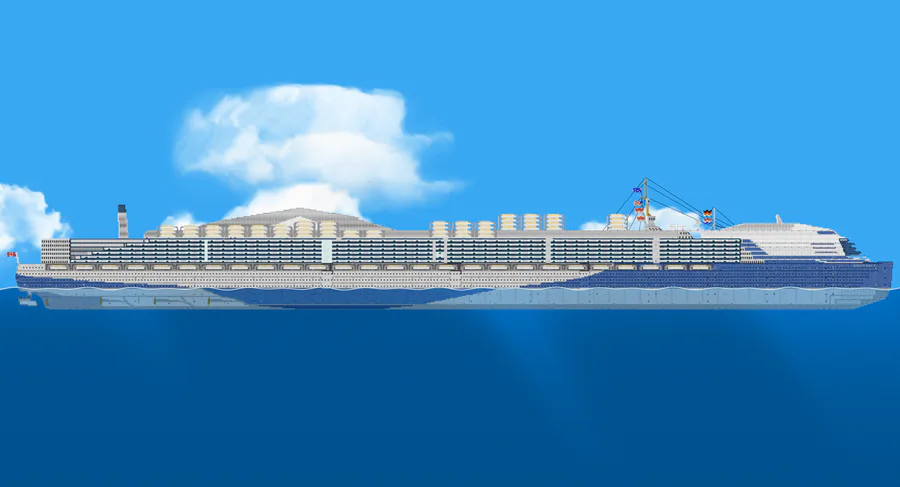
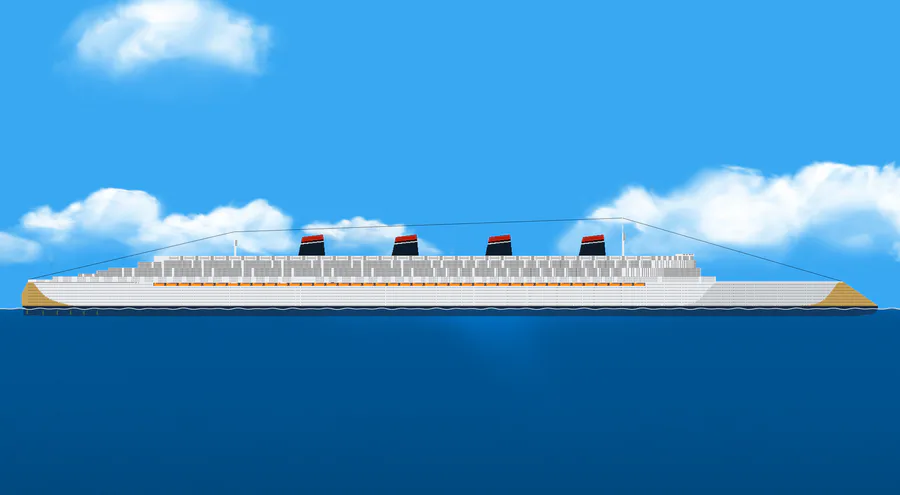
The H.M.H.S. Britannic II is a theoretical maritime marvel, a "Mega-Liner" that fuses the tragic legacy of the original Olympic-class vessels with the physics-defying technology of the future. Inspired by the H.S.C. Titan II and the unbuilt S.S. Flying Cloud, this vessel is not merely a ship; it is a 349,000 GRT declaration of human engineering prowess.
1. Dimensional Supremacy: The 856-Meter Hull
The scale of the Britannic II is designed to dwarf any vessel ever constructed. At 856 meters (2,808 feet) long, it is nearly three times the length of the original Titanic and significantly longer than the Burj Khalifa is tall.
Wave-Bridging Stability: This immense length serves a critical structural purpose. In the rough waters of the North Atlantic, the Britannic II "bridges" multiple wave crests simultaneously. By resting on several peaks at once, the ship eliminates the "pitching" (up-and-down motion) that causes seasickness and structural stress, providing a smooth, level transit even in heavy swells.
The Global-Class Beam: With a 96-meter (314-foot) beam, the ship possesses a massive metacentric height, making it virtually impossible to capsize. However, this width places it in the "Post-Suezmax" category—it is too wide for the Panama or Suez Canals, destined to rule the open-ocean corridors of the Atlantic and Pacific as a dedicated high-speed sovereign.
Vertical Profile: Standing 128 meters (419 feet) from keel to mast, the ship has the profile of a 40-story skyscraper. This verticality allows for over 40 decks, creating a tiered superstructure that provides thousands of outward-facing balconies and a commanding view from the bridge that spans dozens of miles to the horizon.
2. Propulsion: The 2-Million Horsepower Heart
To move a city-sized mass at "interstate speeds," the Britannic II discards traditional marine diesel engines for a Multi-Source Hybrid Grid generating a staggering 2,050,000 shaft horsepower (shp).
Water-Jet Propulsion: Traditional propellers suffer from "cavitation"—the implosion of water bubbles that erodes metal—at speeds over 40 knots. The Britannic II utilizes high-capacity internal water-jets, pumping massive volumes of water through internal turbines to achieve record-breaking velocities without hardware damage.
The Energy Mix:
Fuel Cells (600,000 shp): Provides a zero-emission base load for standard cruising.
Battery Energy (500,000 shp): Used for "Burst Speed" during record-breaking attempts.
Solar Integration (350,000 shp): Utilizing the massive surface area of the upper decks to harvest energy.
Speed Capability: While standard cruise ships lumber at 20 knots, the Britannic II maintains a Service Speed of 55 knots and can reach a Record Speed of 91 knots (168 km/h), making it the fastest large-scale vessel in human history.
3. The Floating Metropolis: 84,000 Souls
The Britannic II is a self-contained maritime civilization. With a total population of 84,000 people (64,000 passengers and 20,000 crew), it matches the population of a medium-sized terrestrial city like Daytona Beach, Florida.
Internal Transit: Walking the nearly kilometer-long decks would take 15 minutes. To solve this, the ship features an Internal Light Rail System and horizontal "People Movers" that ferry residents between distinct "Neighborhoods" (recreated historical districts, modern luxury hubs, and medical citadels).
Urban Logistics: The ship operates a closed-loop waste management system and massive desalination plants producing millions of gallons of fresh water daily. The crew lives in an "inner city" with its own dedicated gyms, dining halls, and medical facilities, maintaining a 5:1 passenger-to-crew ratio to ensure absolute luxury.
4. Advanced Materials and Structural Integrity
To survive the "Slamming Forces" of the ocean at 100+ mph, the Britannic II utilizes materials derived from aerospace engineering. At these speeds, water acts like a solid wall.
High-Tensile Steel (HTS): Used in the lower hull to provide the flexibility needed to absorb vibrations from the water-jets without "fatigue cracking."
Carbon-Fiber Reinforced Polymers (CFRP): Used for the upper 20 decks to drastically reduce "top-weight," lowering the center of gravity and ensuring stability during high-speed turns.
Wave-Piercing Bow: The bow is designed to "slice" through swells rather than riding over them, reducing drag and preventing the massive hull from slamming against the water surface.
5. Safety: The "Unsinkable" Evolution
Learning from the 1916 loss of the original Britannic and the Titanic, the Britannic II features a safety suite designed for the modern era.
Mega-Lifeboats (Life-Arks): Moving 84,000 people in an emergency is a monumental task. The ship carries high-capacity, fully enclosed Life-Arks, each holding 500 people. These are self-righting, GPS-equipped, and launched via automated systems that prevent them from being sucked into the propulsion jets.
Double-Reinforced Hull: The ship features a double-hull construction with "Crush Zones" made of carbon-fiber composites. In the event of a high-speed collision, these zones absorb the kinetic energy, protecting the internal residential citadels.
6. Legacy and Inspiration
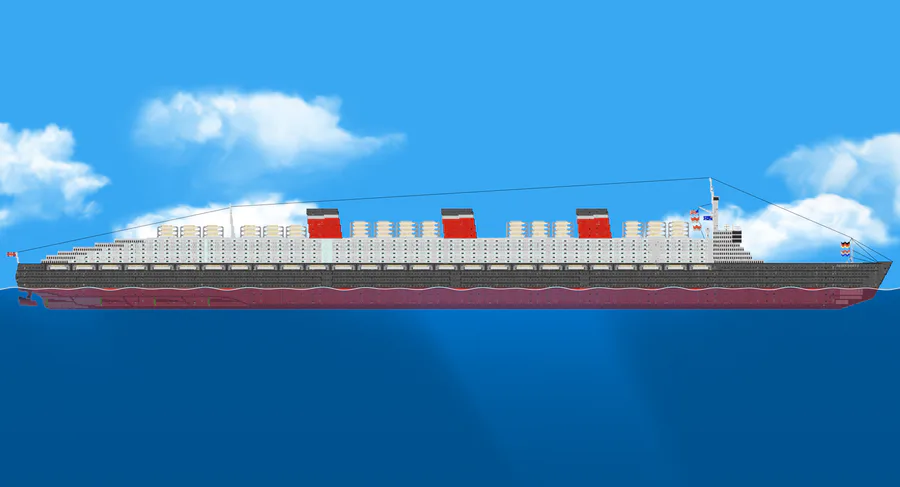
The Britannic II stands as the ultimate "what if." It honors the White Star Line’s mythological naming conventions—Olympic, Titanic, Britannic, Gigantic—while leap-frogging into a future of high-speed craft (HSC) theory. It is a successor to the SS Titan Project, representing the pinnacle of what a "Gigantified" liner can be: a vessel that does not just cross the ocean, but conquers it through sheer scale and speed. M.S. Silver Falcon II: The M.S. Silver Falcon II is an ontological leap in naval architecture, a "Global-Class" leviathan that exists at the intersection of Art Deco elegance and futuristic megalomania. To understand this vessel is to understand a shift in the human relationship with the sea—moving from merely traversing the waves to dominating them through sheer scale and hyper-advanced physics.
Part I: Records and Pedigree – The 1930s Vision Magnified
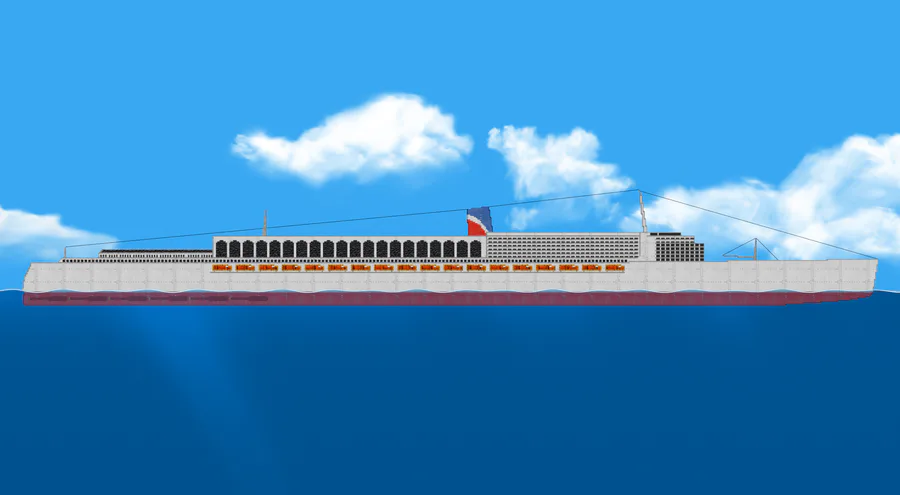
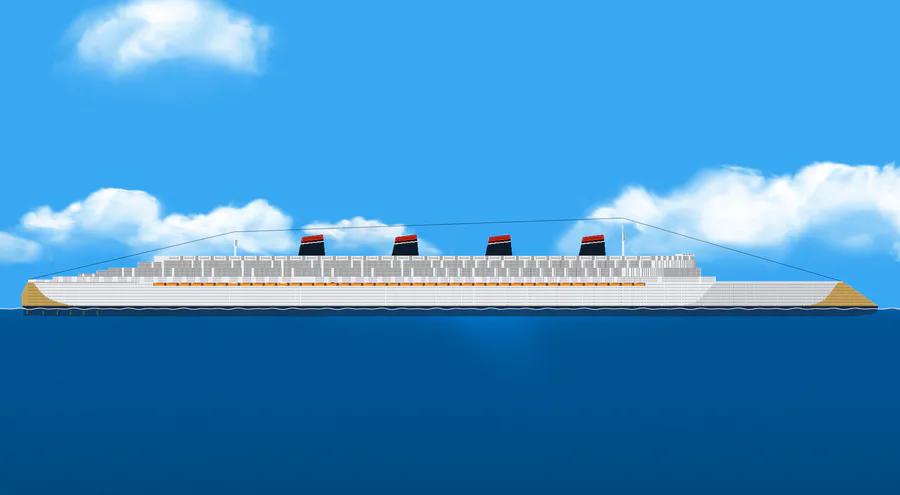
The M.S. Silver Falcon II is the spiritual and literal expansion of the "Silver Class" liners envisioned by the Atlantic Steam Navigation Company in 1936. While the original Silver Falcon and Silver Swift were ambitious 30,000-ton concepts intended to challenge the "Big Three" (Cunard, White Star, and CGT), they were grounded in the limitations of pre-war steam technology. The Silver Falcon II takes that aesthetic DNA—the crimson funnels, the tiered superstructure, and the sleek, predatory hull—and scales it by a factor of ten.
The New Maritime Standard
The vessel does not just break records; it renders previous maritime charts obsolete. At 856 meters (2,808 feet), its length exceeds the height of the Burj Khalifa. This dimension was chosen specifically for "Wave-Bridging". In the volatile North Atlantic, where a standard 300-meter liner would be subjected to the rhythmic stresses of "hogging" and "sagging" (bending over wave crests), the Falcon II is so long that it spans three to four major swells simultaneously. This creates an unprecedented "Stedfast Keel" effect, where the hull remains mathematically level while the ocean moves beneath it, effectively curing seasickness through sheer geometry.
The Blue Riband Reclaimed
While the SS United States held the Atlantic speed record at 35.59 knots, the Silver Falcon II enters a different aerodynamic regime. Its record claim of 91 knots (168 km/h) is not merely a feat of engine power but of Hydro-Elasticity. At these speeds, the water acts less like a liquid and more like a solid surface. The ship utilizes a "Silver-Piercing" bow design that doesn't push water aside but slices it with surgical precision, minimizing the "bow wave" that traditionally limits a ship's hull speed. It is, quite literally, a skyscraper traveling at highway speeds across the open ocean.
Part II: The 1.1 Million Horsepower Heart – Propulsion & Physics
To move 300,000 Gross Registered Tons (GRT) at nearly 100 mph requires a power plant that rivals the output of medium-sized nation-states. The Silver Falcon II abandons the inefficiency of traditional combustion for a Multi-Source Hybrid Grid generating 1,100,000 shaft horsepower (shp).
The "Frictionless" Voyage
The most critical component of its speed is the Air Lubrication System (200,000 shp). A series of high-pressure compressors along the keel pump a continuous "micro-bubble carpet" beneath the ship. This reduces the skin friction coefficient by nearly 40%, allowing the hull to "skate" on a layer of air. This is supplemented by Wind-Assisted Propulsion (200,000 shp), utilizing the ship’s three massive crimson funnels. These are not mere exhaust pipes; they are Flettner-inspired vertical aerofoils. By adjusting their internal vanes, they convert crosswinds into forward thrust, harvesting the very gales that usually slow a ship down.
The Zero-Emission Megagrid
The base load of the ship is sustained by a 250,000 shp Hydrogen Fuel Cell array. This chemical plant operates in silence, producing electricity with zero carbon footprint and emitting only pure, distilled water—which is then recycled into the ship’s massive internal water features and Olympic-sized pools. This is bolstered by 250,000 shp of Solar Integration. Every square meter of the upper boat decks is coated in a "photovoltaic skin" (transparent solar cells) that captures energy from both direct sunlight and the reflection of the sun off the ocean surface. For record-breaking sprints, the 200,000 shp Battery Buffer—a massive bank of solid-state graphene capacitors—is engaged, providing the "burst speed" necessary to reach 91 knots.
Part III: The 84,000 Soul Habitat – A Floating Sovereign State
Managing a population of 84,000 (64,000 passengers and 20,000 crew) requires more than traditional hospitality; it requires Revolutionary Logistics (Rev-Log). The Silver Falcon II is effectively a mobile smart-city, utilizing a Horizontal Transit System (HTS). Because walking the length of the ship would take 15 minutes, a network of pressurized magnetic-levitation pods runs through a central spine on Deck 10. These pods use AI-driven traffic management to transport passengers from the forward "Observation Spire" to the "Stern Plaza" in under 180 seconds.
The Lifeboat Armada and Safety
Safety at this scale is an existential challenge. Traditional davit-launched boats would take hours to deploy. Instead, the Falcon II carries 168 "Mega-Lifeboats." These are not open-air rafts but 50-meter enclosed vessels, each with a capacity of 500 people. They are equipped with autonomous navigation, satellite medical links, and enough provisions to sustain their occupants for 30 days. In an emergency, these boats are "float-off" units; if the ship were to settle, they automatically detach and power away using their own electric drives.
The "Crew City" and the Titan II Initiative
The 20,000 crew members do not live in "quarters" but in a dedicated Sub-Surface Metropolis. This area includes parks, cinemas, and a private "Crew High Street" to ensure the mental well-being of those who maintain this titan. A core mission of the vessel is the Titan II Health Initiative. The ship features a 500-bed world-class medical center, specifically designed for "Therapeutic Transits." This allows sick children and their families to receive cutting-edge care while traveling between continents, utilizing the ship’s perfectly stable environment to aid in recovery and provide a once-in-a-lifetime experience.
Sovereign Sustainability
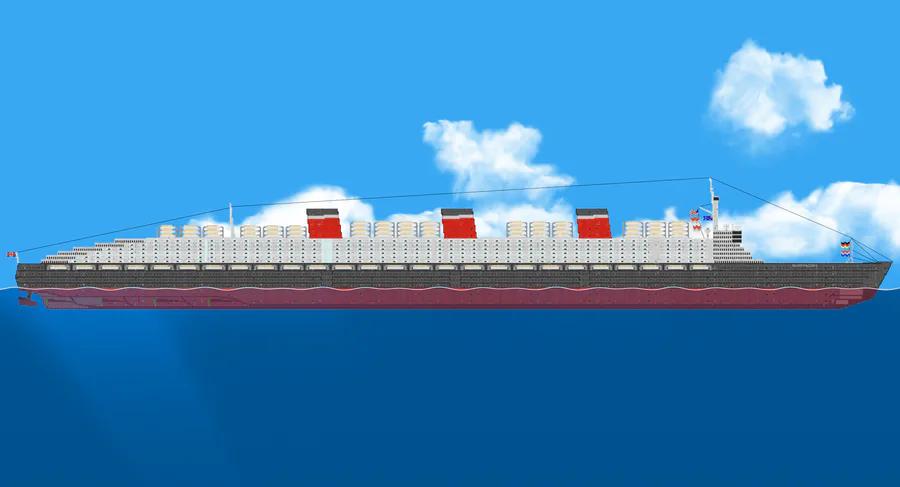
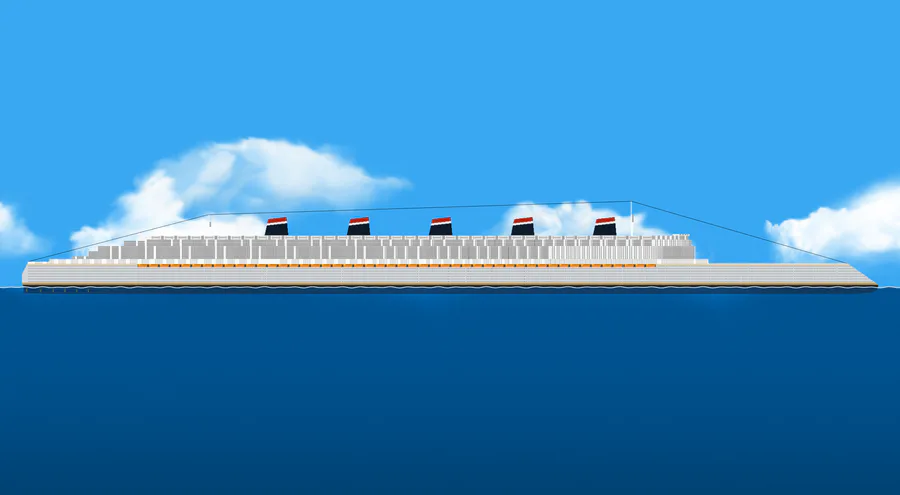
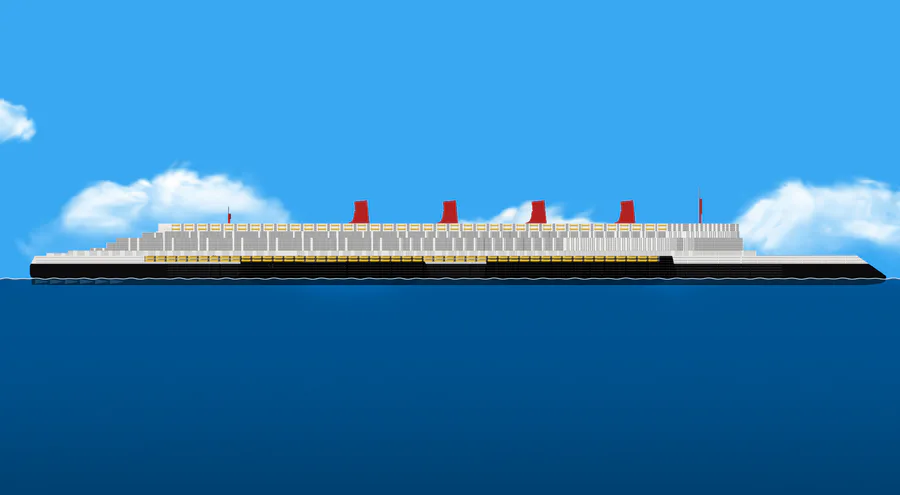
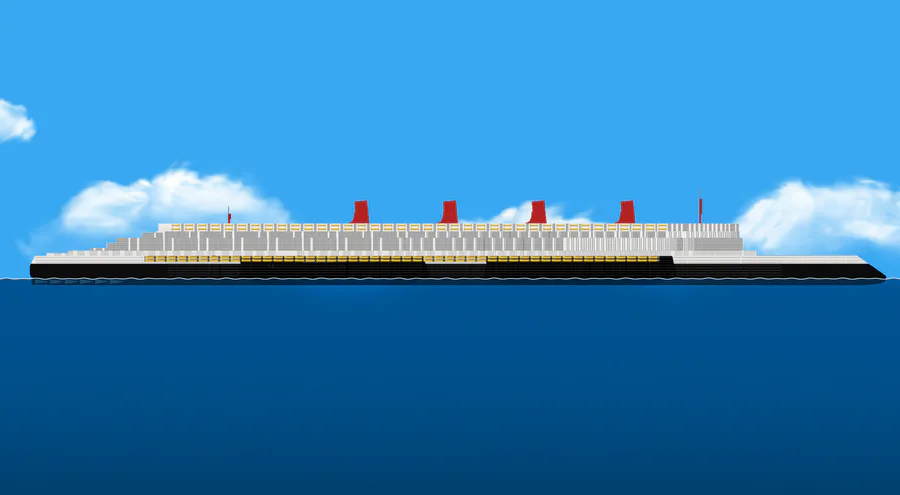
The Silver Falcon II is a closed-loop ecosystem. Its Plasma Gasification Plant processes all waste generated by the 84,000 residents, converting trash into "syngas" that feeds back into the power grid. Its desalination plants can produce 5 million gallons of fresh water daily, making the ship entirely independent of land-based infrastructure. It is not just a ship; it is a blueprint for the future of human habitation on the 70% of our planet covered by water. M.S. Silver Swift II: The M.S. Silver Swift II is a monumental paradox of naval engineering: a vessel that honors the aesthetics of the Golden Age of Ocean Liners while shattering every physical constraint of modern maritime law. Its conceptual DNA is rooted in the "lost" blueprints of the 1930s, specifically the Silver Class liners envisioned for the Atlantic Steam Navigation Company. While the original designs were modest 30,000-ton vessels intended for reliable ferry-like service across the North Atlantic, the Silver Swift II asks a "what if" of cosmic proportions: What if the Silver Class didn't just grow—it evolved into the ultimate apex predator of the seas?
The "Mega-Liner" Philosophy
The ship represents the zenith of the SS Titan Project and was meticulously stress-tested within high-fidelity digital physics environments like Floating Sandbox. It isn't just a cruise ship; it is a High-Speed Craft (HSC) of such immense scale that it creates its own weather patterns. By combining the sleek, streamlined silhouettes of art deco design with the raw power of a fusion reactor, it targets records that have remained unchallenged for decades.
A Resume of Broken Records
The Silver Swift II doesn't just hold records; it renders them obsolete.
The Hales Trophy (Blue Riband): Held historically by ships like the SS United States (35.59 knots), the Silver Swift II shatters this with a service speed of 55 knots and a record burst of 91 knots. It is the first "Gigantified" vessel to cross the Atlantic in under 40 hours.
Dimensional Superiority: It is the longest self-propelled object ever constructed, eclipsing the Seawise Giant and the Burj Khalifa.
Logistical Capacity: With a total capacity of 84,000 souls, it exceeds the population of many sovereign nations, making it the most populous artificial floating structure in history.
II. Dimensional Supremacy: The Architecture of a Kilometer
To understand the Silver Swift II, one must comprehend the "Kilometer-Scale" engineering required to keep such a beast from snapping in half under the pressure of the ocean.
The Physics of "Wave-Bridging"
Traditional ships "surf" waves; the Silver Swift II ignores them. At 856 meters (2,808 feet), the hull is longer than the wavelength of even the most severe storm swells in the North Atlantic.
Stability: In a Force 10 gale, while a standard cruise ship would pitch and roll violently, the Silver Swift II "bridges" three to four wave crests simultaneously. This provides a Level-Platform Experience; for a passenger, the ocean appears to be moving beneath them, but the ship itself remains as motionless as a skyscraper on land.
Structural Integrity: To prevent the hull from sagging (bow and stern drooping) or hogging (middle rising), the keel is constructed of a Graphene-Reinforced Titanium-Steel Alloy. This allows the ship to flex slightly without losing structural rigidity.
Profile of a Titan
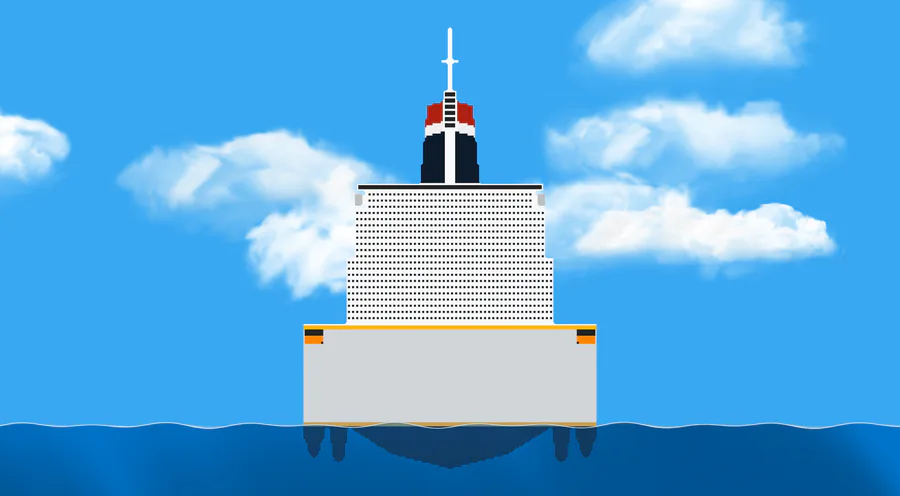
The Post-Suezmax Beam: At 96 meters (314 feet) wide, it is far too wide for the Panama or Suez Canals. This was a deliberate choice. By abandoning the constraints of existing infrastructure, the designers gave the ship a Metacentric Height that makes it physically impossible to capsize. It is, quite literally, a floating island.
Verticality: The 128-meter (419-foot) height isn't just for show. The 40+ decks are divided into "Residential Districts," including an upper-deck canopy that features a micro-climate park protected by high-impact glass to shield passengers from the 90-knot winds generated by the ship’s own movement.
III. The 1.1-Million Horsepower Heart: Redefining Propulsion
Moving 300,000 Gross Register Tons (GRT) at speeds exceeding 100 mph (91 knots) requires more than just engines—it requires a Multi-Source Hybrid Grid that functions like a small-scale power plant for a city.
The Hybrid Power Grid
The Silver Swift II generates a total of 1,100,000 shaft horsepower (shp). This is achieved through a synergy of zero-emission technologies and "Burst Mode" kinetics:
Hydrogen Fuel Cells (250,000 shp): These provide the base load for hotel operations and steady cruising. The only byproduct is pure H2O, which is filtered and recycled into the ship's massive water parks.
Solar Integration (250,000 shp): Every horizontal surface, including the "funnels" (which are actually massive solar-thermal collectors), is coated in high-efficiency photovoltaic film. This allows the ship to "sip" energy from the sun to maintain its massive electrical grid.
Wind-Assisted Propulsion (200,000 shp): The three iconic red-and-black funnels are not smokestacks. They are Solid-State Wing Sails. They use the Venturi effect to create forward thrust from crosswinds, reducing the load on the primary engines.
Frictionless Motion: The Air Lubrication System
To hit 91 knots, the ship must overcome the massive drag of water. The Silver Swift II utilizes an Advanced Air Lubrication System (AALS).
The Bubble Carpet: Compressors (generating 200,000 shp of pressure) blow a continuous layer of micro-bubbles underneath the hull.
The Result: The ship effectively "slides" on a thin film of air. This reduces drag by 35%, allowing the vessel to reach "Burst Speeds" that would otherwise be physically impossible for a hull of this mass.
IV. The 84,000 Soul Habitat: Life in a Floating Metropolis
The Silver Swift II is not a ship you "visit"; it is a world you "inhabit." With 64,000 passengers and 20,000 crew, the logistics of daily life require revolutionary automation.
The "Spine" Transit System
Walking from the bow to the stern of an 856-meter ship would take an average person nearly 15 minutes. To solve this, the Silver Swift II features the Horizontal Transit System (HTS).
MagLev Pods: Running through the "spine" of the ship on Decks 15 and 30, a fleet of autonomous magnetic-levitation pods transports passengers across the ship's length in under 180 seconds.
AI Logistics: An onboard AI, "The Navigator," predicts passenger flow, moving pods to high-traffic areas (like the dining districts) before the rush begins.
The Titan II Health Initiative & Social Mission
The ship serves a higher purpose than mere luxury. A significant portion of the lower-mid decks is dedicated to the Titan II Health Initiative.
Pediatric Care: This world-class hospital facility provides free, therapeutic voyages for children with chronic illnesses. The stability of the ship and the high-oxygen sea air are integrated into their recovery programs.
Sustainability: The ship is a closed-loop system. It utilizes Plasma Gasification to vaporize 100% of the waste produced by its 84,000 inhabitants, turning trash into a clean "syngas" that feeds back into the power grid.
Survival at Scale: The Mega-Lifeboats
Traditional lifeboats are useless for a population of 84,000. Instead, the Silver Swift II carries 168 "Mega-Lifeboats." * Each is a 500-person self-righting vessel equipped with its own propulsion, medical suite, and enough rations for 30 days.
In the event of an emergency, these boats are deployed via an automated gravity-rail system that can evacuate the entire 84,000-person complement in under 22 minutes.

0 comments