
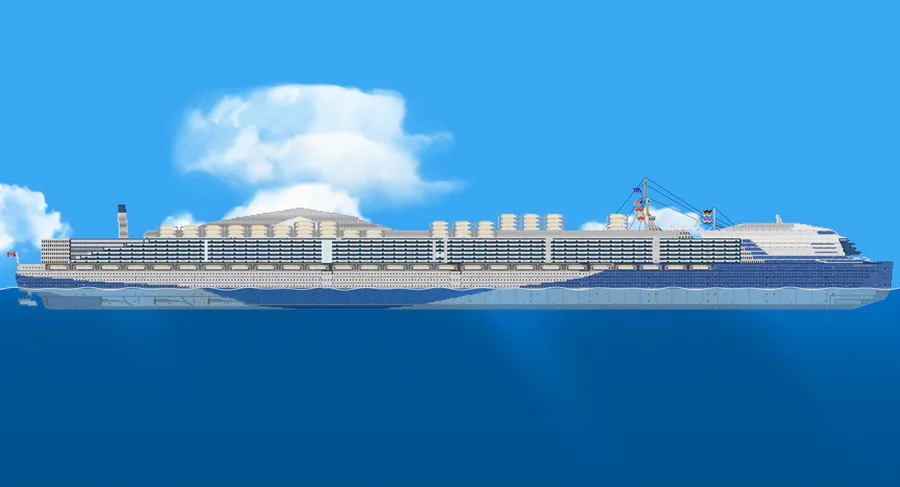
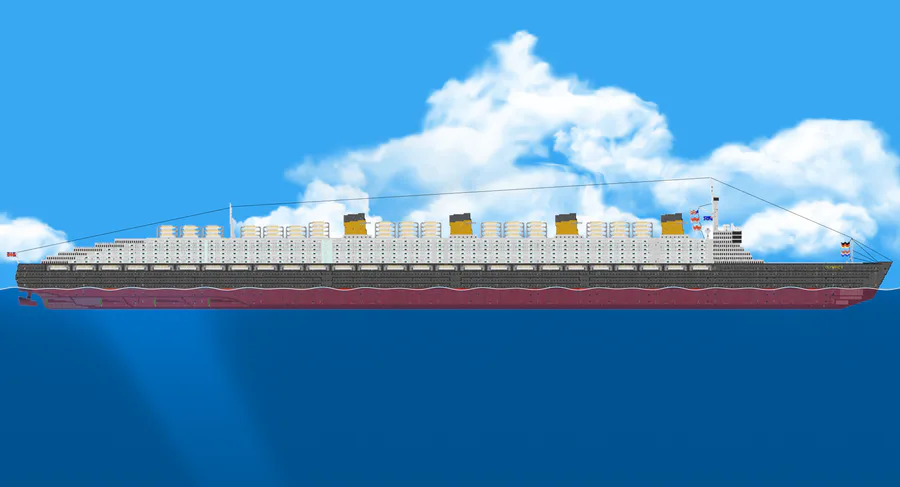
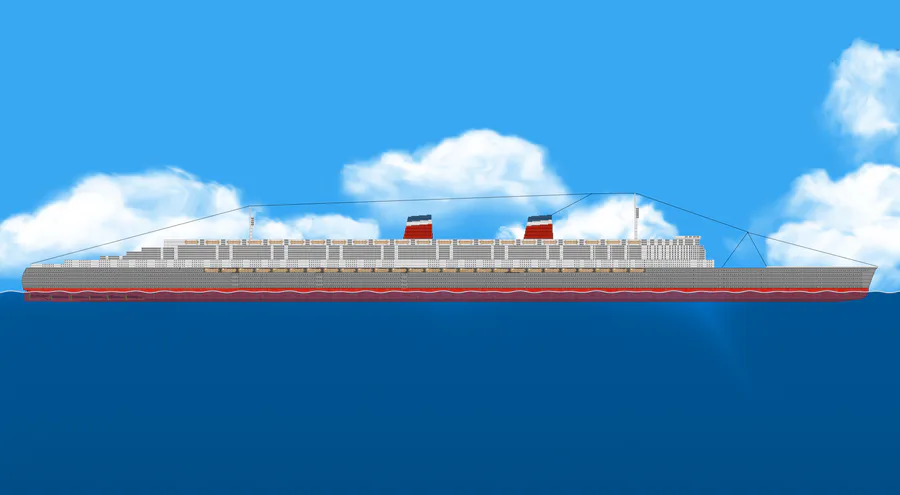
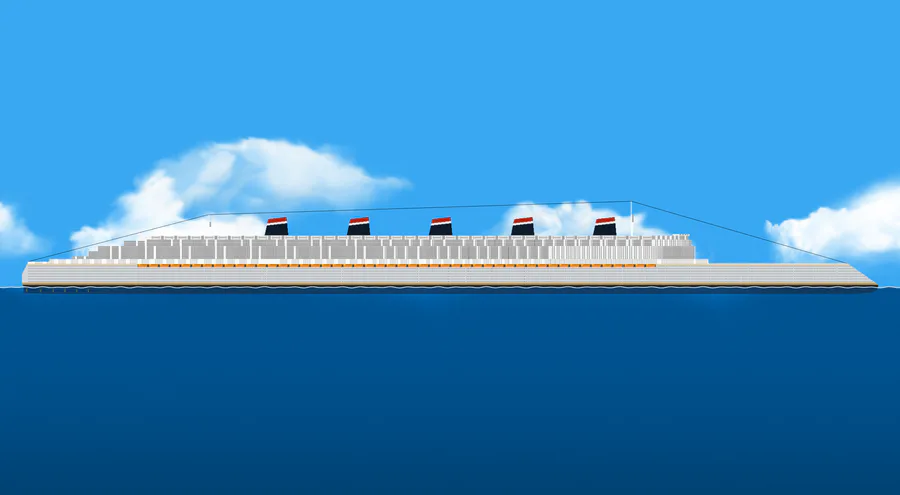
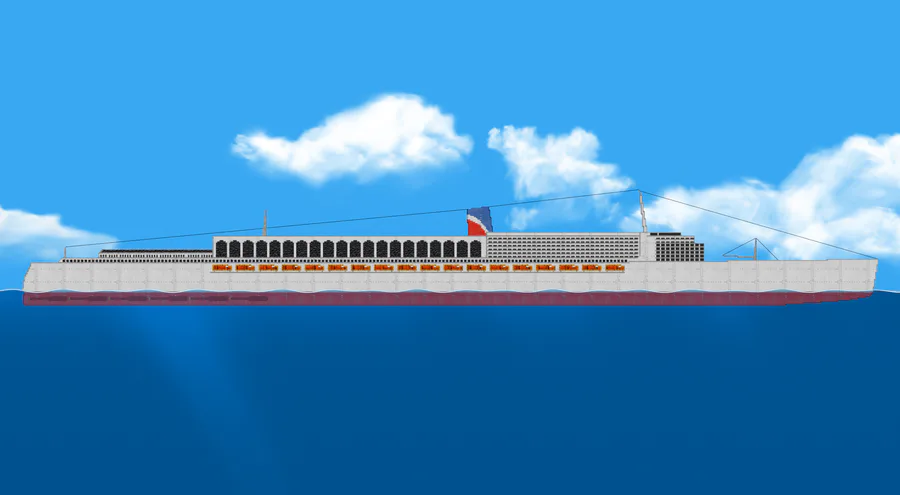
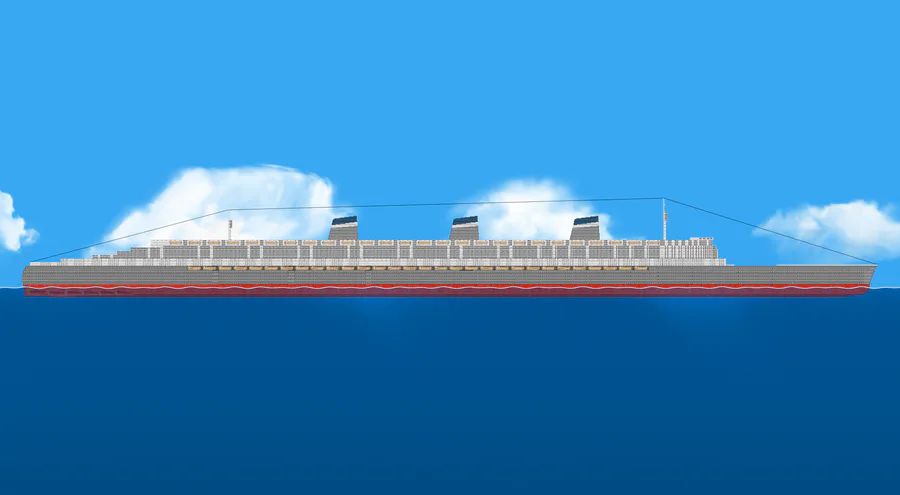
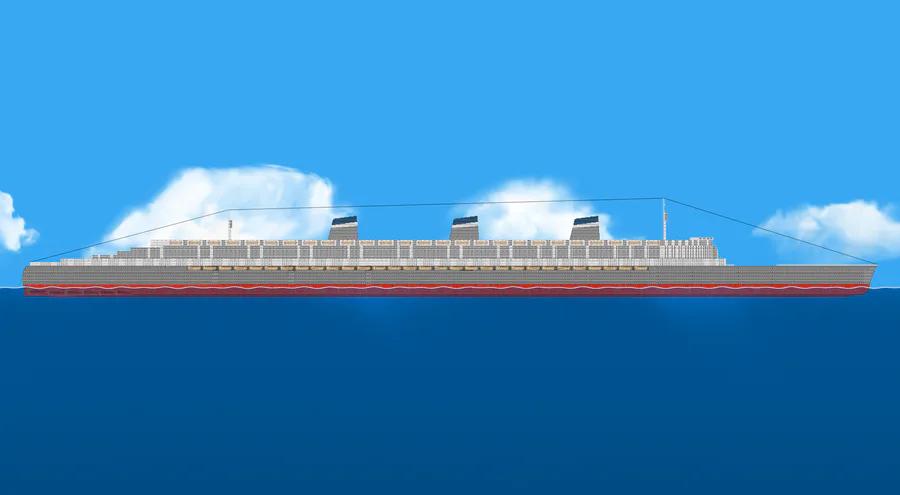
R.M.S. Olympic II: The R.M.S. Olympic II is defined by a scale that dwarfs any existing man-made structure on the ocean. At 856 meters (2,808 feet), it is nearly three times the length of the original Titanic and longer than the Burj Khalifa is tall.
Wave-Bridging Stability: Its extreme length allows the hull to "bridge" multiple wave crests simultaneously. This eliminates the traditional pitching motion of ships, ensuring that even in the violent swells of the North Atlantic, the 84,000 people on board experience a perfectly level ride.
The Global-Class Beam: With a 96-meter (314-foot) beam, the ship is physically incapable of using the Panama or Suez Canals. It is a "Post-Suezmax" vessel, designed exclusively for open-ocean transit where its massive width provides a metacentric height that makes it virtually impossible to capsize.
Vertical Profile: Standing 128 meters (419 feet) from keel to mast, the Olympic II possesses the vertical presence of a 40-story skyscraper. This allows for over 40 decks, creating enough internal volume to house an entire society.
2. Propulsion: The 2-Million Horsepower Heart
To move 349,000 GRT at speeds exceeding 90 knots, the Olympic II discards traditional marine diesel engines for a Multi-Source Hybrid Grid generating a staggering 2,050,000 shaft horsepower (shp).
Water-Jet Technology: Traditional bronze propellers would suffer from "cavitation"—where water boils on the blade surface and eats through metal—at high speeds. Instead, the Olympic II utilizes High-Capacity Water Jets, pumping massive volumes of water through internal turbines for smooth, high-velocity thrust.
The Energy Mix: * Fuel Cells (600,000 shp): Providing a zero-emission base load.
Solar Integration (350,000 shp): Utilizing the massive surface area of the upper decks.
Battery Buffers (500,000 shp): For "Burst Speed" during record-breaking runs.
3. Record-Breaking Velocity: The 91-Knot Barrier
While the original Olympic cruised at 21 knots, the Olympic II is designed for "interstate speeds."
Speed Specifications: It maintains a standard service speed of 55 knots (102 km/h), with trial speeds reaching 70 knots. Its record-breaking potential is a claimed 91 knots (168 km/h).
The Wall of Water: At 100+ mph, water acts like a solid. The Olympic II utilizes a Wave-Piercing Bow made of advanced steel alloys to "slice" through swells. To manage wind resistance, the superstructure is streamlined and tiered, preventing the ship from acting like a massive sail that could create dangerous aerodynamic lift.
4. The Floating Metropolis: 84,000 Souls
The Olympic II is not merely a ship; it is a self-contained micro-economy and maritime civilization.
Population Logistics: With 64,000 passengers and 20,000 crew, the total "soul count" of 84,000 matches the population of Daytona Beach, Florida.
Internal Transit: Walking from bow to stern would take nearly 15 minutes. To solve this, the ship features an Internal Light Rail System and horizontal "People Movers" (horizontal elevators) on the main promenade decks to move residents between various "neighborhoods."
Urban Infrastructure: The ship functions as a city-state, featuring its own medical citadels, urban planners, security forces, and a closed-loop waste management system that supports its massive population for weeks at sea.
5. Advanced Materials and Structural Integrity
To survive the "slamming forces" of the Atlantic at 91 knots, the Olympic II utilizes materials never before seen in commercial shipping.
High-Tensile Steel (HTS): Used in the lower hull to provide flexibility, preventing "fatigue cracking" caused by the vibrations of the massive water jets.
Carbon-Fiber Reinforced Polymers (CFRP): The upper 20 decks are constructed from carbon fiber to significantly reduce "top-weight." This lowers the center of gravity, allowing the ship to maintain stability during high-speed maneuvers.
Aluminium-Lithium Alloys: These lightweight, aerospace-grade alloys are used for internal structures, keeping the displacement at 349,000 GRT while maintaining the structural strength of a skyscraper.
6. Safety: The High-Capacity "Life-Arks"
Evacuating 84,000 people requires a total reimagining of maritime safety.
Life-Arks: Instead of hundreds of small lifeboats, the Olympic II is equipped with Mega-Lifeboats or "Life-Arks," each capable of holding 500 people. These are fully enclosed, self-righting, and equipped with GPS, medical facilities, and enough supplies to sustain the occupants until rescue.
Crush Zones: Similar to modern automotive design, the hull features "crush zones" designed to absorb the kinetic energy of a high-speed collision, protecting the central residential citadels from structural compromise.
7. The Conceptual Legacy: From "Old Reliable" to Titan II
The R.M.S. Olympic II is the spiritual successor to the SS Titan Project, a community-driven concept for a modern, "gigantified" Titanic.
Inspiration: It draws its pedigree from the original RMS Olympic (1911–1935), known as "Old Reliable." While the original ship was a triumph of the Edwardian era, the Olympic II is a triumph of the future—a "successor" ship that uses the H.S.C. Titan II-class framework to redefine what is possible in maritime history.
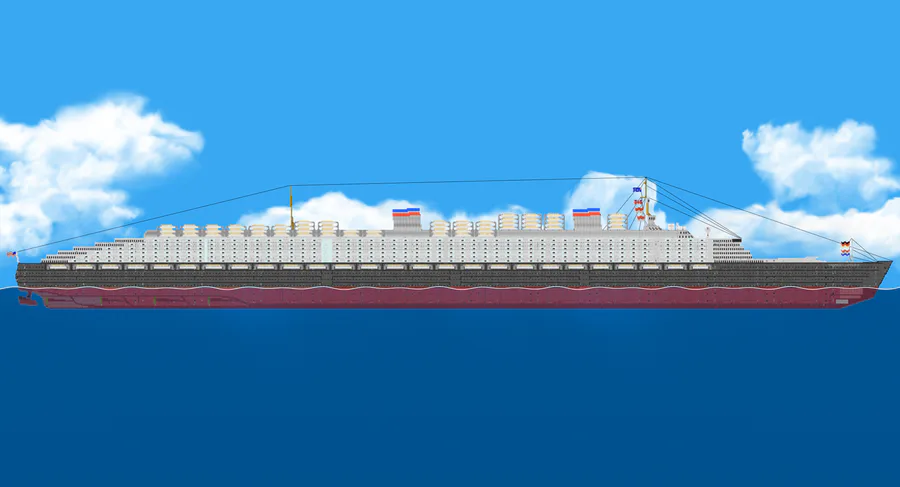
Purpose: It stands as a symbol of dimensional supremacy, proving that with the right application of fuel cells, wave-piercing hull designs, and advanced composites, the ocean can be crossed not in days, but in hours, within a floating city of unprecedented luxury. S.S. Yankee Clipper II: The S.S. Yankee Clipper II is not merely a ship; it is a floating sovereign state, a triumph of 21st-century engineering that marries the Art Deco romanticism of the 1930s with the terrifying power of futuristic propulsion. Inspired by the unbuilt dreams of Theodore E. Ferris and the radical 1930s "Liner of the Future" proposals by Pierre de Malglaive, this vessel shatters every existing record of maritime architecture.
I. Dimensional Supremacy and Structural Integrity
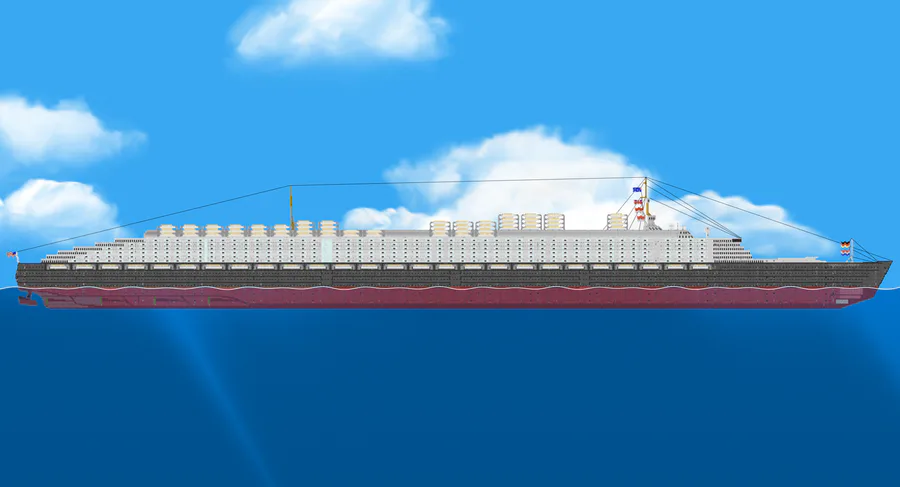
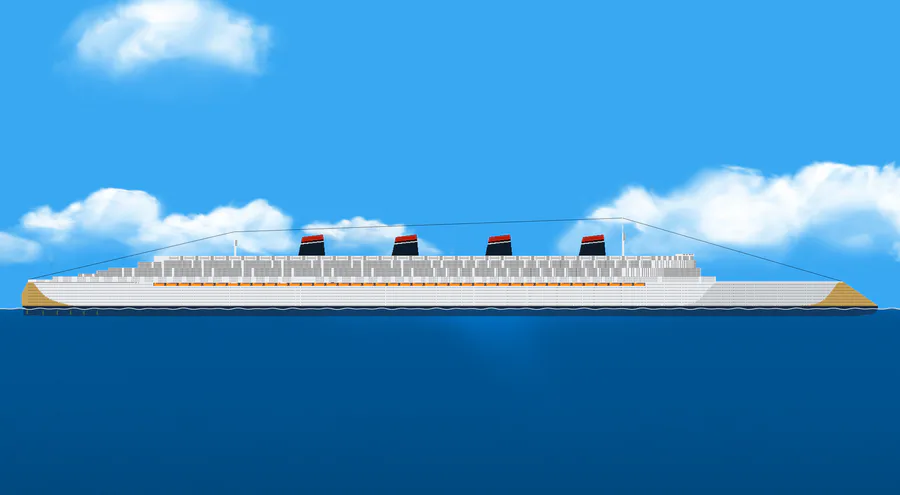
Standing at a staggering 856 meters (2,808 feet) in length, the Yankee Clipper II is nearly three times the length of the Titanic and dwarfs the tallest skyscrapers on Earth. With a beam of 96 meters and a height of 128 meters, its 349,000 GRT (Gross Registered Tonnage) frame represents the largest moving object ever constructed by human hands.
The "Wall of Water" Challenge
At the record-shattering speed of 91 knots (168 km/h), the North Atlantic ceases to behave like a liquid and begins to act like a solid concrete wall. To survive these "slamming forces," the hull is a masterpiece of material science:
High-Tensile Steel (HTS) Lower Hull: The base of the ship is forged from advanced HTS, providing the necessary elasticity to absorb the shock of wave impacts. This "flex-design" prevents the 2,050,000 SHP (Shaft Horsepower) water-jet vibrations from causing catastrophic fatigue cracking.
Carbon-Fiber Reinforced Polymers (CFRP): The upper 20 decks of the 40-story superstructure utilize CFRP. By replacing traditional steel with aerospace-grade composites, the center of gravity is significantly lowered, allowing the ship to execute high-speed maneuvers without the risk of capsizing.
Aluminium-Lithium Internal Skeleton: To manage the massive weight of internal "Neighborhoods," the ship utilizes the same alloys found in modern spacecraft, ensuring the structural strength of a skyscraper without the crushing weight.
II. Propulsion: The 2-Million Horsepower Heart
The Yankee Clipper II achieves its 55-knot standard service speed and 70-knot trials maximum through a hybrid energy grid that generates a mind-boggling 2,050,000 SHP.
Energy SourceOutput (SHP)PurposeFuel Cells600,000Zero-emission base load for hotel systems and cruising. Solar Integration350,000Harvested from the vast, deck-spanning photovoltaic skin.Gas Turbine/Nuclear Hybrid600,000Primary thrust for standard service speeds.Battery Buffers500,000High-discharge "Burst Speed" for the 91-knot record runs.
This power is funneled into a series of massive directional water-jets. Unlike traditional propellers, which suffer from cavitation (vacuum bubbles that erode metal) at high speeds, these jets allow the Yankee Clipper II to "pump" its way across the ocean, lifting the hull into a semi-planing state that reduces drag by 40%.
III. The Landing Deck and Retractable Funnels
Drawing direct inspiration from the 1930s Ferris designs, the Yankee Clipper II features a fully functional landing deck on the aft superstructure. This allows for the seamless arrival of "Ship-to-Shore" aircraft, ensuring that high-profile passengers can reach the heart of Manhattan or London before the ship even docks.
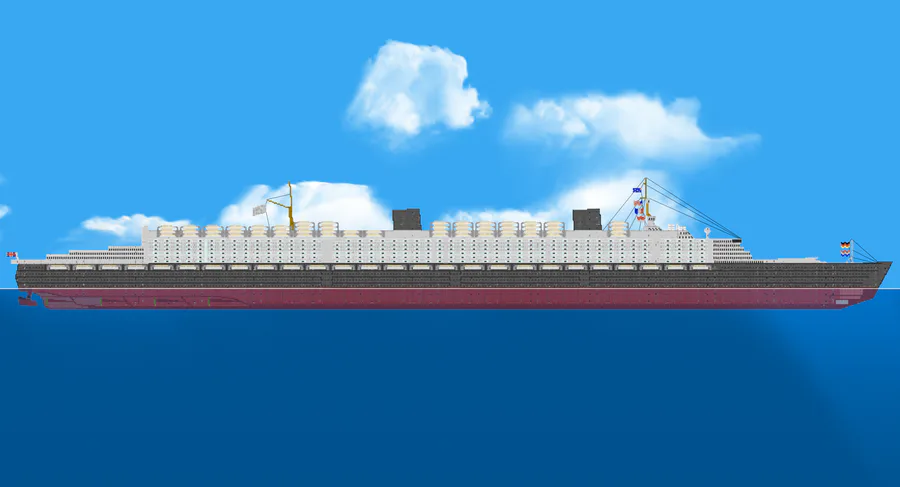
To clear the way for flight operations and to reduce aerodynamic drag during high-speed transit, the ship’s funnels are fully retractable. When the ship hits its "Sprint Mode" of 70+ knots, the funnels slide into the hull, creating a sleek, bullet-like profile that mimics the aerodynamic efficiency of a high-speed train.
IV. A City on the Waves: 84,000 Souls
The internal volume of the Yankee Clipper II is divided into "Grand Neighborhoods," each inspired by the legendary liners of the past—S.S. United States, R.M.S. Olympic, and the Silver Falcon.
Capacity: 64,000 Passengers and 20,000 Crew members.
The Atlantic Boulevard: A central indoor thoroughfare spanning 500 meters, featuring parks, theaters, and simulated sunlight.
Wave-Bridging Stability: Because the ship is 856 meters long, it spans the crests of multiple waves simultaneously. While a smaller ship would pitch and roll, the Yankee Clipper II remains perfectly level, its length acting as a natural stabilizer against the Atlantic's fury.
V. The Legacy of the "Future"
The Yankee Clipper II represents the ultimate realization of the 1938 Scientific American visions. It is a vessel that treats the ocean not as an obstacle, but as a highway. By combining the capacity of a city with the speed of a racing boat, it has effectively closed the gap between sea and air travel.
It stands as the flagship of a new era, flanked in spirit by its sister ships: the M.S. Flying Cloud, the H.M.H.S. Britannic II, and the Silver Swift. Together, they form a "Steel Bridge" across the Atlantic, moving tens of thousands of people at speeds once thought impossible for anything made of metal. Meyer Werft's Manta Ray II: The Manta Ray II is not merely a cruise ship; it is a mobile, self-sustaining megalopolis—a "floating destination" that defies the physical constraints of 21st-century naval engineering. Inspired by the radical concepts of Meyer Werft’s Manta Ray and the visionary "Liners of the Future" proposed by Pierre de Malglaive and A.C. Hardy in the 1930s, the Manta Ray II represents the ultimate fusion of Art Deco grandeur and futuristic hyper-speed technology.I. Dimensional Supremacy: The 856-Meter HullThe most striking feature of the Manta Ray II is its sheer scale. Measuring 856 meters (2,808 feet) in length, it is nearly three times the length of the Titanic and dwarfs the tallest skyscrapers on Earth. This length is not just for show; it serves a critical aerodynamic and hydrodynamic purpose.Wave-Bridging Stability: In the volatile North Atlantic, standard ships fall into the "troughs" between waves, causing pitching and rolling. The Manta Ray II is so long that its hull "bridges" multiple wave crests simultaneously. This provides a rock-solid, vibration-free platform even when traversing 50-foot swells at high velocity.The Trimaran Architecture: To support a beam of 96 meters, the vessel utilizes a massive trimaran hull. This triple-hull configuration provides the necessary displacement for its 349,000 GRT while significantly reducing drag compared to a traditional monohull of this volume.II. Record-Breaking Velocity: The 91-Knot ThresholdWhile modern cruise ships lumber along at 20–24 knots, the Manta Ray II is designed for "Intercontinental Sprinting."Standard Service Speed: 55 knots (102 km/h).Trials Maximum: 70 knots (130 km/h).The Record Claim: 91 knots (168 km/h / 104 mph).At 91 knots, the ocean surface acts like a solid wall. To achieve and survive these speeds, the Manta Ray II utilizes a Surface-Effect Hybrid system. Massive fans beneath the hull create a pocket of high-pressure air, partially lifting the 349,000-ton mass out of the water to eliminate hull friction.III. Material Science: Aerospace Engineering at SeaA ship of this size cannot be built with standard mild steel; the "slamming forces" at 91 knots would tear a traditional hull apart. The Manta Ray II is a masterpiece of composite engineering:High-Tensile Steel (HTS): Used exclusively in the lower hull and keel to provide flexibility. This allows the ship to "flex" with the waves, preventing fatigue cracking from the vibrations of the water-jet propulsion.Carbon-Fiber Reinforced Polymers (CFRP): The upper 20 decks of the 40-story superstructure are constructed from CFRP. This reduces "top-weight," drastically lowering the center of gravity and ensuring the ship remains upright during high-speed maneuvers.Aluminium-Lithium Alloys: Internal structures and "Neighborhood" frameworks utilize these aerospace-grade alloys to keep the total displacement manageable while maintaining the structural integrity of a skyscraper.IV. Propulsion: The 2,050,000 SHP Power PlantTo drive the vessel to record speeds, the Manta Ray II generates a staggering 2,050,000 Shaft Horsepower (SHP) through a multi-source, zero-emission grid:Power SourceContributionPurposeHydrogen Fuel Cells600,000 SHPConstant base-load for hotel services and cruising. Solar Integration350,000 SHPHarnessing the massive surface area of the top decks.Battery Buffers500,000 SHPFor "Burst Speed" during transatlantic record attempts.Wind/Kinetic600,000 SHPUtilizing retractable rigid sails and hull-integrated turbines.V. Life On Board: The 84,000-Person EcosystemThe Manta Ray II is designed to house 64,000 passengers and 20,000 crew members. Rather than a single monolithic interior, the ship is divided into "Urban Districts" inspired by the world's most beautiful locales.The People Mover: A fully automated, mag-lev transit system runs the length of the ship, allowing guests to travel from the "Santorini District" at the bow to the "Lanzarote Cave" at the stern in minutes.Lanai Decks (10 & 11): These decks feature a revolutionary promenade with rotating vertical louvres. When the ship is at anchor, they open to provide a Mediterranean breeze; at 91 knots, they rotate into a locked, aerodynamic shield to protect guests from the hurricane-force winds generated by the ship's speed.Logistics Automation: A centralized, AI-driven kitchen handles the 250,000 meals required daily. Supplies are loaded via a Containerized System, allowing the ship to be fully provisioned in hours rather than days. VI. Legacy and LineageThe Manta Ray II carries the spiritual names of history’s greatest unbuilt and legendary vessels. Within its districts, guests can find sections dedicated to:The S.S. United States II: A tribute to the original "Big U," focusing on speed and American elegance.The Flying Cloud: Inspired by the 1930s Transoceanic Corporation's aircraft-carrier ocean liner.The Silver Falcon & Silver Swift: Reimagining the 1936 Atlantic Steam Navigation Company's vision for luxury travel.The Manta Ray II is more than a ship; it is a statement that the Golden Age of Travel has returned—not as a nostalgic memory, but as a high-speed, carbon-neutral reality. The Manta Ray II represents a paradigm shift in naval architecture, moving beyond the "mega-ship" category into the realm of Super-Scale Maritime Infrastructure. At 856 meters (2,808 feet), its length is calculated to fundamentally alter how a vessel interacts with the physics of the ocean.The Physics of Scale: Wave-BridgingIn naval engineering, the primary cause of motion sickness and structural fatigue is a ship’s interaction with the "wavelength" of the sea. Traditional ships (300–400 meters) often fall into the "trough" between two wave crests, causing the bow to pitch upward or downward.The Bridge Effect: By stretching to nearly a kilometer, the Manta Ray II can "bridge" the distance between three or four major wave crests in the North Atlantic simultaneously. Active Leveling: The hull remains effectively level because it is always supported by multiple points of buoyancy. This creates a "Vibration-Free" environment, essential for a vessel traveling at highway speeds.The Trimaran GeometryThe ship’s 96-meter beam (width) is supported by a massive Trimaran (three-hull) design. Center Hull: The primary displacement hull, housing the massive fuel cell arrays and heavy logistics centers.Outriggers: Two slender side-hulls provide lateral stability, preventing the ship from rolling even during high-speed turns or in heavy cross-winds.Inter-Hull Neighborhoods: The space between these hulls is not wasted; it serves as "The Lagoon," an internal protected water area where smaller "People Mover" boats and aquatic recreation can occur safely while the ship is at anchor.Part 2: The 91-Knot Record ClaimThe Manta Ray II is the first ship of its size designed to cross the Atlantic in less than 40 hours, challenging the speed of commercial aircraft while offering the luxury of a grand hotel.Speed Benchmarks55 knots (Standard Service): The everyday cruising speed, allowing for a 3-day transatlantic crossing.70 knots (Trials Max): Reached during calm-sea trials using the full output of the fuel cell and solar grid.91 knots (The Record Claim): Achieved during "Burst Mode" by discharging the 500,000 SHP Battery Buffers in tandem with the hydrogen turbine system.Overcoming "The Wall"At 168 km/h (104 mph), water behaves less like a liquid and more like a solid. To reach 91 knots, the Manta Ray II utilizes a Surface-Effect Hybrid system. Massive internal fans force air into the space between the three hulls, creating an "air cushion" that lifts the 349,000-ton mass partially out of the water. This reduces the wetted surface area by nearly 60%, plummeting the drag and allowing the ship to "skate" across the surface.Part 3: Material Science - Beyond SteelBuilding a ship that is 856 meters long and moves at 91 knots requires materials previously reserved for aerospace and Formula 1 engineering.The Tri-Material FrameworkHigh-Tensile Steel (HTS) Lower Hull: The base of the ship is forged from HTS, which offers a unique balance of strength and elasticity. This "Flex-Hull" architecture allows the ship to absorb the "slamming forces" of the ocean without snapping or cracking.Carbon-Fiber Reinforced Polymers (CFRP): To keep the ship from becoming "top-heavy," the upper 20 decks of the 40-story superstructure are made of CFRP. This material is five times stronger than steel but a fraction of the weight, ensuring the center of gravity remains low.Aluminium-Lithium Alloys: Used for the internal "Neighborhood" structures. These alloys provide the rigid strength of a skyscraper but are light enough to maintain the ship's 349,000 GRT displacement limit, which is vital for maintaining high speeds.Part 4: The 2,050,000 SHP Propulsion GridThe Manta Ray II is powered by the most complex energy grid ever installed on a moving object. It moves away from "dirty" bunker fuel toward a Zero-Emission Hybrid model. Energy SourcesSourceOutputDescriptionHydrogen Fuel Cells 600,000 SHPThe "Base Load" for propulsion and hotel services. Solar Deck Skin 350,000 SHPIntegrated "Smart Glass" on top decks converts every ray of sun into thrust.Battery Buffers 500,000 SHPSolid-state batteries used for "Burst Speed" and record attempts.Kinetic Wind Sails 600,000 SHPRetractable rigid "wings" that capture North Atlantic winds for extra power.This grid powers six massive water-jets rather than traditional propellers. Water-jets are used because they do not suffer from "cavitation" (air bubbles forming and eroding the blades) at the ultra-high speeds the ship attains.Part 5: The Floating Destination EcosystemWith a total population of 84,000 people, the Manta Ray II does not function like a ship—it functions like a city.The Neighborhood ConceptThe ship is decentralized into districts, ensuring that no guest ever feels like they are in a crowd of 64,000.The Cave (Lanzarote-inspired): A subterranean-style entertainment district deep within the hull, using volcanic rock aesthetics and integrated nature.The Santorini Promenade: Located on the upper stern, this area features white-washed villas, blue-domed lounges, and terraced pools overlooking the ship's massive wake.The People Mover: A mag-lev shuttle system with 12 "stations" across the ship. It operates 24/7, moving 500 people per minute between the bow and stern districts.Logistics AutomationA population of 84,000 requires 250,000+ meals per day.Automated Kitchens: Robotic prep stations handle the bulk of food production, which is then moved to restaurants via a "conveyor lift" system.Containerized Supply: The ship uses a "Plug-and-Play" loading system. Entire pre-stocked grocery and supply containers are slotted into the hull at "anchor-hubs," allowing for zero-delay turnaround.Part 6: Legacy of the FutureThe Manta Ray II is a spiritual successor to the boldest visions of the 20th century. It incorporates the DNA of several "lost" maritime legends:H.S.C. Titanic II: A high-speed, 21st-century reimagining of the classic liner, focusing on safety and speed.S.S. Flying Cloud: Taking its name from the unbuilt 1930s "aircraft-carrier liner," this district features massive open flight decks for passenger drones.The "Silver" Class (Falcon & Swift): Inspired by the 1936 Atlantic Steam Navigation Company, these areas represent the "Tourist-Luxe" class, providing high-speed travel for the masses, not just the elite. Transatlantic Liner of the Future III: The Transatlantic Liner of the Future III (Titan II-Class) is not merely a vessel; it is a manifestation of "Retrofuturist Megastructuralism." Its conceptual roots reach back to the 1930s, an era when the North Atlantic was the ultimate stage for national prestige. The inspiration stems directly from the radical 1937 blueprints of A.C. Hardy and Pierre de Malglaive, who envisioned a ship that bypassed the incremental evolution of the Normandie and Queen Mary in favor of a 1,350-foot, streamlined "speed-king."
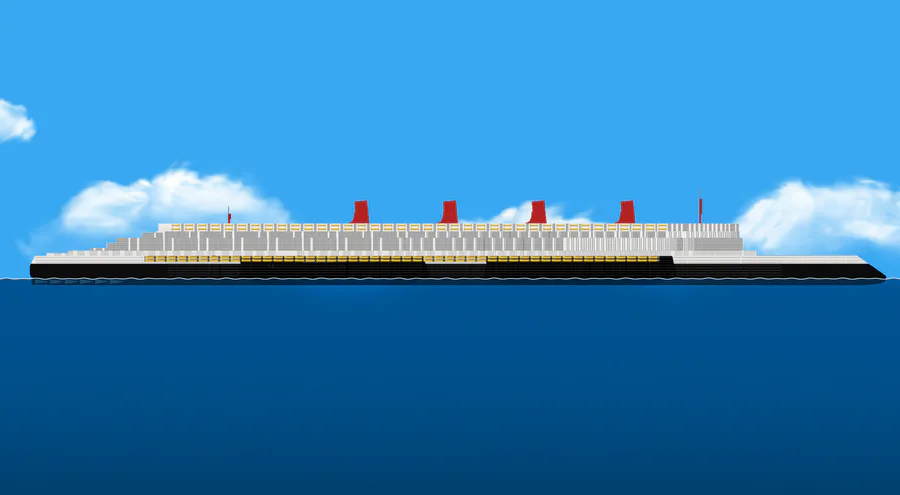
While Hardy’s dream was stifled by the limitations of pre-war metallurgy and the rise of the jet engine, the Titan II-Class resurrects that ambition using 21st-century hyper-engineering. It rejects the modern cruise ship aesthetic—often criticized as "floating apartment blocks"—in favor of a "Streamline Moderne" profile. The design philosophy, termed Art Deco Romanticism, utilizes the long, sweeping horizontal lines of the hull to evoke a sense of perpetual motion even at anchor.
This vessel serves as a philosophical middle ground between the slow, leisurely pace of traditional cruising and the sterile speed of aviation. It aims to reclaim the "Golden Age of Travel" by proving that speed and luxury are not mutually exclusive. By shattering the 1,300-foot psychological barrier of 1930s naval architecture and extending to a colossal 856 meters (2,808 feet), the Titan II-Class effectively creates a new maritime category: the Transcontinental Megaliner. It is designed to be the "Blue Riband" holder of the new millennium, not just for speed, but for the sheer audacity of its existence.
II. Records and Engineering: The Physics of the 91-Knot Titan
To understand the Titan II-Class, one must understand the "physics of defiance." At its record-breaking speed of 91 knots (168 km/h), the North Atlantic behaves less like water and more like a viscous, unforgiving solid. To conquer this, the ship employs a multi-tiered structural strategy:
The "Flexible Fortress" Hull
Standard maritime steel would shatter under the "slamming" forces of 30-foot swells hit at 90 knots. Consequently, the Titan II utilizes a Bio-mimetic Triple-Hull design. The outer "skin" is a Titanium-Graphene composite, which is incredibly thin yet possesses a tensile strength ten times that of standard steel. Below this lies a layer of High-Tensile Steel (HTS), forged with a modular "lattice" that allows the hull to flex up to 5 meters along its 856-meter length without permanent deformation. This flexibility prevents the ship from "snapping" when cresting two waves simultaneously.
The Aerodynamic Superstructure
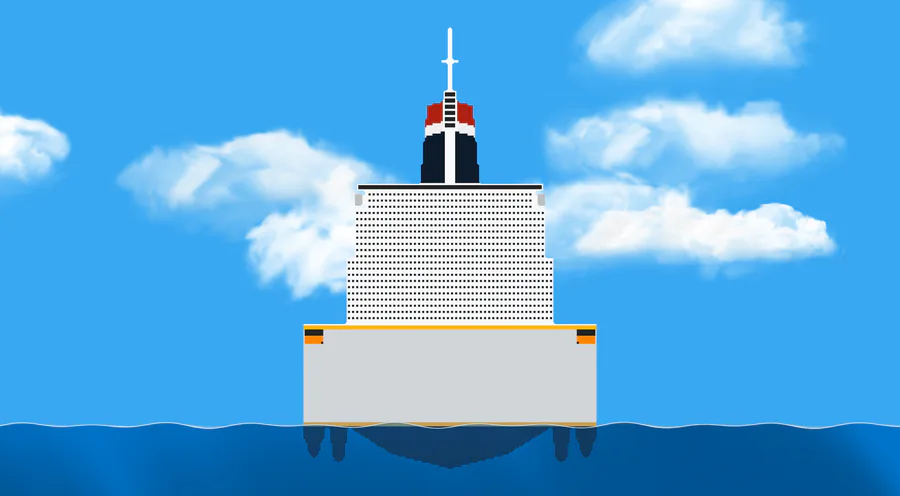
The 40-story superstructure is a masterclass in CFRP (Carbon-Fiber Reinforced Polymers). By using aerospace-grade composites for the upper 20 decks, engineers have kept the center of gravity dangerously low, despite the ship's height. This prevents the "pendulum effect" during high-speed turns. Furthermore, the ship’s profile is treated with a Super-hydrophobic Nano-coating, reducing skin friction with both air and water, allowing the vessel to "slice" through the atmosphere and the ocean with minimal drag.
Record-Breaking Metrics
Speed Supremacy: While its service speed is a brisk 55 knots, its peak of 91 knots makes it faster than most modern naval destroyers and nearly triple the speed of the fastest conventional cruise ships.
Dimensional Dominance: At 856 meters, it is nearly twice the length of the Seawise Giant (the previous record-holder for length) and three times the length of the Titanic.
Power Density: With 1.1 million shaft horsepower (shp), it possesses the power output of roughly ten Nimitz-class aircraft carriers.
III. Propulsion and Power: The 1.1-Million Horsepower Hybrid Grid
The heart of the Titan II-Class is a Multi-Source Hybrid Grid, a decentralized power system that ensures the ship remains carbon-neutral while generating the thrust of a small moon.
The Hydrogen-Solar Synergy
The primary "Base Load" is provided by a massive Proton Exchange Membrane (PEM) Hydrogen Fuel Cell array, generating 250,000 shp. The only byproduct is pure, distilled water, which is recycled into the ship’s luxury spas and drinking systems. Complementing this is a "Solar Skin"—every square meter of the upper deck and window glass is embedded with Perovskite Solar Cells, contributing another 250,000 shp during daylight hours.
The "Air Carpet" and Wind Wings
To achieve 91 knots, the Titan II doesn't just push through water; it cheats it.
Air Lubrication System (ALS): Specialized vents in the keel pump a continuous stream of micro-bubbles, creating a "carpet" of air. This reduces fluid friction by 35%, effectively allowing the 300,000-ton behemoth to "hydroplane" on a microscopic level.
Solid-State Wing Sails: Integrated into the masts are retractable, high-tech vertical wings. These are not canvas sails, but rigid, computer-controlled foils that utilize the Magnus Effect and aerodynamic lift to generate 200,000 shp of auxiliary thrust from the fierce Atlantic winds.
Energy Storage and Burst Speed
For the "Record Claim" maneuvers, the ship engages its Graphene-Supercapacitor Battery Buffers. These can discharge 200,000 shp instantly, providing the "Burst Speed" necessary to override massive wave resistance and maintain the 91-knot threshold during heavy sea states.
IV. The 84,000 Soul Habitat: Logistics of a Sovereign Megacity
The Titan II-Class is a "Floating Metropolis," housing 64,000 passengers and 20,000 crew members. Managing a population larger than many capital cities requires a radical rethink of maritime logistics.
Horizontal and Vertical Mobility
With a length of 856 meters, walking from the "Stern Plaza" to the "Bow Observatory" would take a passenger 15 minutes. To solve this, the ship features the "Hyper-Spine": a vacuum-sealed magnetic levitation (Maglev) transit system running the length of Deck 15. Autonomous pods transport passengers across the ship in under 120 seconds. Vertical movement is handled by "Multi" elevators—cable-less cabins that move both vertically and horizontally, ensuring no "neighborhood" is more than a three-minute journey from any other.
Neighborhoods and Social Engineering
The ship is divided into ten distinct "Districts," each with its own architectural theme and micro-climate.
The Art Deco Core: Dedicated to high-end galas and the "Golden Age" experience.
The Biosphere District: A massive internal park with real grass and trees, oxygenated by the ship’s carbon-capture systems.
The Crew City: A world-class habitat for the 20,000 staff, featuring dedicated cinemas, gyms, and "The Titan II Health Initiative." This medical center is a state-of-the-art hospital specifically designed to host and treat children with terminal or chronic illnesses, providing them with a "Voyage of Healing" at no cost, funded by the ticket sales of the luxury suites.
Absolute Sustainability: The Zero-Waste Mandate
The Titan II produces zero liquid or solid discharge. It utilizes Plasma Arc Gasification—a process that subjects waste to temperatures of 5,000°C, turning trash into "syngas" (used for extra power) and an inert, glass-like slag used as ballast. The ship’s desalination plants are capable of producing 10 million liters of fresh water per day, making it entirely independent of land-based resources for months at a time.


1 comment