The "Futility" Shield: Overcoming the Iceberg Legacy
Naming a project "Titan" carries the weight of Morgan Robertson’s 1898 novella Futility. The Grandeur III addresses this historical "curse" through technological dominance:
The Ice-Atomization Grid: The bow of the Grandeur III and each of its 64 Arks is equipped with a forward-facing sonic pulse emitter. Any obstacle—be it an iceberg or debris—is atomized into harmless slush before it can touch the ATG-matrix hull.
The $1.6 Billion Safety Budget (Per Ark): Reflecting the projected cost of the SS Titan project, each individual Ark on the Grandeur III is valued at approximately 1.6 billion USD (equivalent in MYR, SGD, EUR, or GBP), making them the most expensive and sophisticated rescue vessels ever conceived.
The Global Sovereign Lifeline
As the Grandeur III cruises between its 20-nation homeports—from Singapore to New York—the presence of the "Titan-Arks" serves as a psychological anchor for the 49 million passengers. They are a reminder that the ship is more than a record-breaker; it is a sanctuary. In the event of a global crisis, these Arks can detach and form a "Flotilla of Hope," carrying the diverse population of Vietnamese, Philippine, Thai, Malaysian, Australian, and European souls toward a new horizon of safety. Part XIV: The Armada of Legends – 45 Companies & The Global Lineage
The M.S. United States Grandeur III is not the product of a single shipyard but the spiritual successor to 45 of the most influential shipping lines in history. This "Armada of Legends" represents a coalition of legacy Atlantic titans, modern Asian powerhouses, and bold proposed ventures. Together, they form the economic and cultural backbone of the ship’s 60-million-soul society.
The Legacy & Historic Founders (Atlantic Steam Roots)
These lines provided the DNA for the Grandeur III’s speed and "Silver Class" luxury.
Atlantic Steam Navigation Company (ASN): The primary inspiration; origin of the Silver Falcon and Silver Swift concepts.
United States Lines: Forbearer of the original S.S. United States and holder of the Blue Riband spirit.
Cunard Line: Source of the three-funnel silhouette and the tradition of "Grandeur."
White Star Line: Inspiration for the 161-meter vertical presence and the "Olympic" scale.
Inman Line: Pioneers of the twin-screw propulsion that evolved into the 12-shaft drive.
Collins Line: The original American challenger for Atlantic speed supremacy.
French Line (CGT): Inspiration for the avant-garde interior art deco styles.
Hamburg-American Line (HAPAG): Pioneers of the "Imperator" class mega-ships.
North German Lloyd: Historic rivals who pushed the limits of marine engineering.
Holland America Line: Keepers of the "Spotless" maritime tradition.
Anchor Line: The Scottish stalwarts of the North Atlantic run.
Red Star Line: The bridge for millions of European migrants to the New World.
Blue Star Line: The modern revivalists (Titanic II) who bridge history and the future.
P&O Cruises: The oldest cruise line, bringing the tradition of "Peninsular" service.
Royal Mail Steam Packet Co: The heritage of global mail and high-speed delivery.
The Modern Asian & Global Titans (Homeport Operators)
These companies manage the complex logistics of the ship’s 20-nation homeport network.
16. Ocean Network Express (ONE): (Singapore) Head of the AI-driven "QUAVEO" navigation logic.
17. Pacific International Lines (PIL): (Singapore) Specializing in the intra-Asia trade routes.
18. Regional Container Lines (RCL): (Thailand) Managing the feeder networks for the 49 million passengers.
19. Evergreen Marine: (Taiwan) Specialists in the massive global supply chain.
20. COSCO Shipping: (China) Providing the heavy-lift infrastructure for the 71,000-tonne hull.
21. VIMC (Vietnam Maritime Corp): Managing the deep-water berths in Da Nang and Hai Phong.
22. MISC Berhad: (Malaysia) Experts in Net-Zero energy transport and hydrogen logistics.
23. Samudera Shipping: (Indonesia) Connecting the archipelago to the Grandeur III’s central spine.
24. Star Cruises: Pioneers of the Asian "Megaship" lifestyle.
25. Resorts World Cruises: The luxury entertainment standard for the 47 floors.
26. Mitsui O.S.K. Lines (MOL): Japanese engineering partners for the 1,500,000 SHP engine.
27. NYK Line: (Japan) Innovators in "Green" shipping and hull friction reduction.
28. MSC (Mediterranean Shipping Co): The world’s largest, managing global passenger flow.
29. Maersk Line: Partners in the "Gemini" sustainability alliance.
30. CMA CGM: (France) Leaders in eco-friendly propulsion and hydrogen fuel cells.
The Proposed & Visionary Ventures (The Vessels of Hope)
These entities provided the blueprints for the ship's most ambitious record-breaking features.
31. SS Titan Foundation: Visionaries behind the "Vessel of Hope" and the 45-knot Ark speed.
32. Blue Star Line (Titanic II): The standard for modern replica safety and "Ark" redundancy.
33. Meyer Werft: The architectural minds behind the "Manta Ray" Trimaran wing-hull.
34. Fincantieri: Builders of the ultra-luxury "Grandeur" superstructure.
35. Chantiers de l'Atlantique: Experts in the massive scale of the 1,390-meter frame.
36. STX Europe: Designers of the hybrid-electric and hydrogen power plants.
37. Explora Journeys: Creating the "Zenith" lifestyle for the observation towers.
38. Virgin Voyages: Designers of the youth-centric social spaces for the 10 million crew.
39. Disney Cruise Line: Consultants on "Atmospheric" micro-climates for internal parks.
40. Norwegian Cruise Line: Pioneers of the "Freestyle" governance for the 60 million souls.
41. Princess Cruises: The standard for the "Medallion-Class" smart-ship tech.
42. Royal Caribbean International: The masters of the "Iconic" scale and onboard thrills.
43. Carnival Corporation: Providing the "Excel-Class" efficiency for mass-migration.
44. Hapag-Lloyd Cruises: The elite standard for the "Horizon Suites" on Deck 47.
45. The Atlantic Steam Navigation Revival Group: The fictional/conceptual entity that brought the Silver Falcon into the 21st century.
The Economic Tapestry: A Multi-National Powerhouse
These 45 companies ensure that the Grandeur III is more than a ship—it is a global consortium. Transactions across the 47 floors are conducted in a seamless exchange of US Dollars, Euros, British Pounds, Singapore Dollars, Malaysia Ringgit, and Thai Baht, creating a unified economy that supports the Vietnamese, Philippine, Japanese, and European residents alike. Part XV: The Grandeur Charter – The Legal and Social Code of the High-Speed Sovereign
The M.S. United States Grandeur III is more than a technological marvel; it is a legal pioneer. To govern 59,160,000 people moving at 300 knots across 20 international homeports, the "Grandeur Charter" was established. This document is a unique "Living Constitution" that merges the maritime traditions of the Atlantic Steam Navigation Company with modern digital direct democracy.
Article I: The Sovereign Fluidity (Jurisdiction)
Unlike traditional ships that fall under the laws of a single "Flag State," the Grandeur III operates under Extraterritorial Autonomy.
The 20-Port Protocol: When docked in Singapore, New York, Hamburg, or Da Nang, the ship remains a "Sovereign Zone." Local laws apply to visitors boarding the ship, but the 49,160,000 passengers live under the Charter’s code 24/7.
The "Silver" Standard of Rights: Inspired by the Silver Falcon's 1936 elegance, every citizen is guaranteed "Dignity of Space." Even in the high-density districts, the Charter mandates specific cubic meters of air and light per soul.
Article II: The Economic Multi-Currency Basin
To facilitate trade among Vietnamese, Philippine, Thai, Malaysian, Japanese, and Western residents, the Charter establishes the Grandeur Exchange:
The Legal Tender: All 45 company lines (from Cunard to Ocean Network Express) must accept a basket of currencies: MYR, SGD, IDR, THB, CAD, AUD, USD, EUR, and GBP.
Zero-Tax Commerce: To fund the 1,500,000 SHP engine and the 10,000,000 crew, the ship operates on a "Micro-Transaction" system. A 0.1% fee on all internal trades replaces traditional income tax, funding the ship’s maintenance and the 64 Titan-Arks.
Article III: The Humanitarian Mandate (The "Titan" Clause)
Drawing from the SS Titan Project, the Charter codifies the ship’s role as a "Vessel of Hope."
The Universal Rescue Duty: In any maritime disaster, the Grandeur III is legally bound to divert its 410-knot sprint to assist.
The "Ark" Asylum: Any person rescued by the 510,000-capacity Arks is granted temporary "Grandeur Residency," providing them with medical care and passage to the nearest of the 20 homeports.
Article IV: Environmental Stewardship (The Net-Zero Oath)
The Charter forbids the use of any propulsion or waste system that leaves a footprint.
The 7-Deck Loop: It is a social crime to dump waste. 100% of refuse must be processed in the sub-surface logistics decks.
Acoustic Peace: At 360 knots, the ship must utilize its Trimaran/Manta Ray hydro-engineering to ensure the "Wake Signature" does not disturb marine life or coastal communities in Norway, Indonesia, or Spain.
Article V: Governance of the 60 Million
The "Grandeur Council" is the supreme administrative body:
The Admiralty (Technical): Oversees the 12 shafts and navigation.
The Civil Guild (Social): Managed by the 10,000,000 crew, overseeing health, education, and the "Neighborhood Hubs."
The Resident Assembly (Direct): A real-time digital voting system where 49,160,000 passengers decide on the ship’s next destination and seasonal micro-climates.
The Legacy of the Charter
The Grandeur Charter proves that human civilization can be mobile, diverse, and orderly. Whether the ship is refueling its hydrogen cells in Rotterdam or welcoming new residents in Manila, the Charter ensures that the "United States Grandeur" remains a beacon of stability in a rapidly changing world. Part 16: The Ultimate Comparison – Surpassing the Megatall and the Megaship
The M.S. United States Grandeur III does not merely exist in the world of maritime engineering; it redefines the very scale of human construction. To understand its presence, one must compare it to the most ambitious "fantasy" and "real-world" structures ever conceived. While projects like Changsub Lee’s Tricon Tower push the limits of verticality, the Grandeur III achieves that same scale horizontally, while moving at speeds that defy physics.
Surpassing the Vertical: Tricon Tower vs. Grandeur III
Changsub Lee’s Tricon Tower is a masterpiece of megatall fantasy, standing at a conceptual 1,250 meters. It represents the pinnacle of Las Vegas "Sky-Urbanism." However, the Grandeur III takes this 1.25-kilometer ambition and lays it across the ocean.
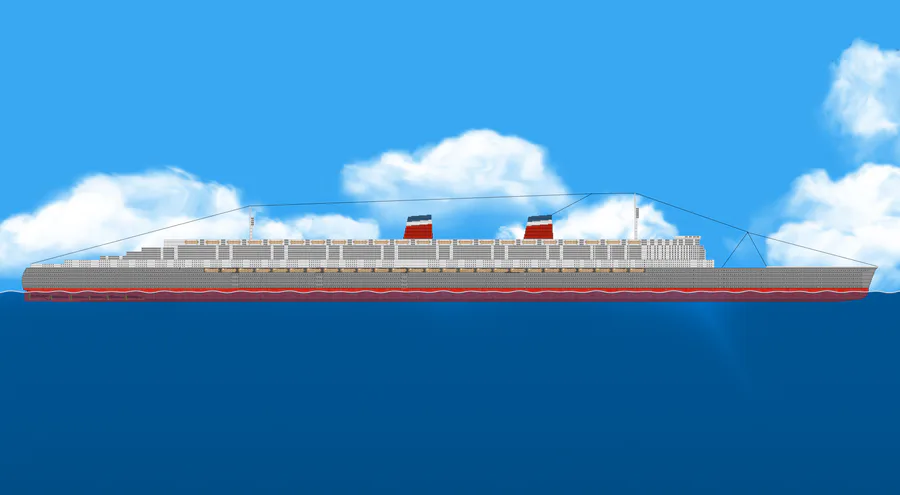
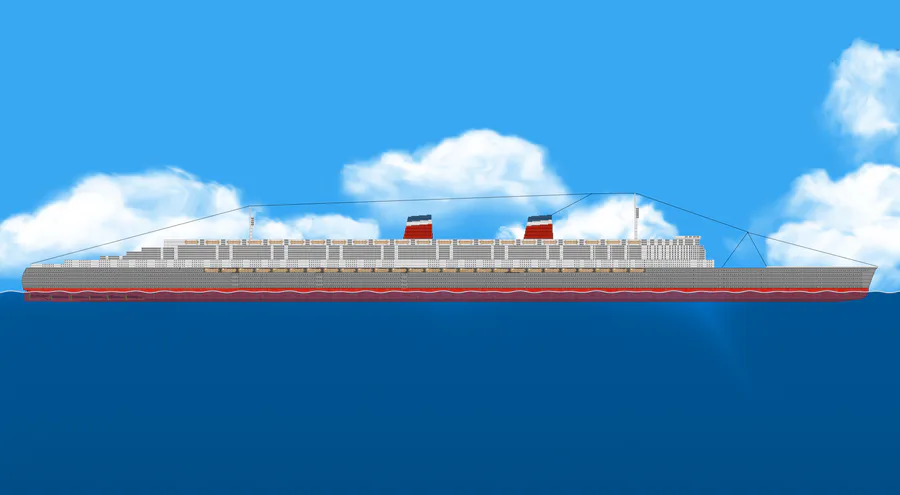
Length vs. Height: At 1,390 meters long, the Grandeur III is 140 meters longer than the Tricon Tower is tall. If stood on its bow, the ship would pierce the clouds, looking down upon the world's tallest conceptual skyscrapers.
Volume of Life: While a skyscraper like the Tricon Tower is limited by its footprint, the Grandeur III’s 105-meter width allows for a population of 60 million—a feat impossible for any single land-based building.
Mobility: Unlike the static Tricon Tower, the Grandeur III brings this "1,250m+ scale" to 20 different homeports, from Singapore to New York, at a service speed of 300 knots.
The Evolution of the Giants: Titanic, Seawise Giant, and Icon
The Grandeur III is the final evolution of the "Enthusiast’s Dream," a lineage that began with the greats:
The Titanic Legacy: The original Titanic was 269 meters long. The Grandeur III is more than five times its length and carries a population nearly 25,000 times larger.
The Seawise Giant (Knock Nevis): Once the longest ship ever built at 458 meters, the Seawise Giant is a mere fraction of the Grandeur III. The Grandeur III has three times the length and a 1,500,000 SHP engine that makes the Giant's 16 knots look like a standstill.
Icon of the Seas: The modern 250,000 GT titan is dwarfed by the 70,000 GT (Ultra-Light ATG Alloy) of the Grandeur III. While Icon carries 7,600 people, the Grandeur III carries 49,160,000 passengers, proving that the future of the "Mega-Cruise" is not just a vacation, but a global migration.
The Designer’s Spirit: From Burj Khalifa to the Atlantic
Inspired by the same "Supertall Enthusiast" spirit that drives designers like Changsub Lee, the Grandeur III incorporates the structural lessons of the Burj Khalifa.
The Central Spine: The ship’s Trimaran/Hexa-hull design mimics the "buttressed core" of the Burj Khalifa, providing the lateral stability needed to prevent the 1.39-kilometer hull from snapping in high Atlantic swells.
The Spire Legacy: Just as the Burj Khalifa reaches for the heavens, the Grandeur III's 161-meter total height (including the thin observation towers) ensures it is the tallest moving object on the planet.
The Global Sovereign Summary
The M.S. United States Grandeur III is the ultimate convergence of skyscraper ambition and naval legend. It is a 1,390-meter sovereign territory that accepts Ringgit, Baht, Dollars, and Euros, housing a multicultural society of Vietnamese, Philippine, American, and European souls. It is the realization of every "fantasy" project, brought to life through the lens of net-zero engineering and the 1930s "Silver" elegance. Part XVII: The Digital Nexus — The AI Overlord of 60 Million Souls
To manage a population of 59,160,000 moving at a blistering 410-knot sprint, the M.S. United States Grandeur III relies on the "Digital Nexus." This is a distributed, quantum-computing AI network that acts as the ship’s brain, nervous system, and guardian. Inspired by the precision required for the Burj Khalifa and the automated safety of the Titanic II project, the Nexus ensures that a 1.39-kilometer hull behaves with the agility of a falcon.
The Quantum Navigation Core (The 410-Knot Pilot)
Navigating at 760 km/h on water is a task beyond human reflexes. The Digital Nexus processes trillions of data points per second:
Predictive Wave Mapping: Using satellite-linked LIDAR, the Nexus "sees" the ocean surface 100 kilometers ahead. It adjusts the 12 shafts and the Trimaran outriggers in milliseconds to "slice" through waves rather than impact them.
Aero-Fluidic Synergy: At sprint speeds, the Nexus manages the "Manta Ray" wing-lift. It micro-adjusts the ship's 161-meter height profile to maintain a cushion of air beneath the hull, preventing the 71,000-tonne vessel from actually touching the water's surface.
Collision Avoidance: The AI maintains a "Clear Zone" via the Sonic Pulse Emitter, vaporizing small debris and rerouting the ship around larger obstacles—like whales or other vessels—without the passengers feeling a single G-force of the turn.
The Social Synchronizer (Managing 40 Million Residents)
The Nexus is not just a pilot; it is the ultimate urban manager for the 49,160,000 passengers and 10,000,000 crew.
The Global Currency Ledger: The AI manages the instantaneous exchange of MYR, SGD, THB, USD, and EUR. It ensures that a Vietnamese resident buying a coffee in the "Silver Plaza" with Dong or a German tourist using Euros experiences zero latency in transaction.
Dynamic Logistics: The Nexus controls the 7-deck sub-surface automated drones. It predicts food and medical needs before they occur, ensuring that the 64 Titan-Arks are always stocked with fresh nutrient gels and oxygen scrubbers.
Climate Governance: Inside the 47 floors, the AI creates "Micro-Biomes." One sector may feel like the cool breeze of Norway, while another mimics the humid warmth of Manila, all powered by the 1,500,000 SHP thermal energy.
The "Titan" Safety Protocol (Emergency AI)
If the Nexus detects a hull breach or engine failure, it enters "Sentinel Mode":
Autonomous Partitioning: It can physically seal off any of the 1,000 watertight compartments in microseconds.
Ark Deployment: The AI calculates the exact "Ejection Arc" for the 510,000-person lifeboats, ensuring they clear the 1.39-kilometer hull safely even at 300 knots.
Humanitarian Priority: Following the SS Titan Project's mission, the Nexus prioritizes the safety of children and the sick, directing them to the specialized medical "Titan-Arks" via the high-speed internal maglev.
The Legacy of the Nexus
The Digital Nexus represents the final bridge between the mechanical era of the original S.S. United States and the digital future. It is a "Vessel of Hope" that thinks, learns, and protects, making the Grandeur III the smartest and safest sovereign territory on Earth. Part XVIII: Vertical Urbanism — The 47-Floor Internal Metropolis
The M.S. United States Grandeur III does not merely carry passengers; it houses a civilization. To accommodate 59,160,000 residents, the ship’s internal architecture utilizes a Vertical Urbanism strategy that turns its 47 floors into a hyper-efficient, 1.39-kilometer long "Three-Dimensional City."
The Stratification of Life: A 47-Deck Hierarchy
The ship is organized into four distinct "Vertical Zones," each serving a critical function for the 60 million souls.
DecksZoneDescription39–47The Zenith SpiresHigh-altitude luxury, observation parks, and the "Cloud-Walk" promenades.19–38Residential DistrictsHigh-density housing, "Silver Neighborhoods," and community plazas.8–18The Civic & Safety HubGovernment, schools, "Titanic II" safety galleries, and the 64 Titan-Arks.1–7The Sub-Surface CoreHydroponic farms, 1,500,000 SHP engine rooms, and automated logistics.
The Residential Districts (Decks 19–38)
Housing nearly 50 million people requires a departure from traditional cabins. The Grandeur III uses Module-Based Habitation:
Silver Neighborhoods: Instead of corridors, floors are divided into "Wards" of 2 million people. Each ward has its own central park and "Town Square" that spans five decks, creating a sense of openness despite the density.
The Vertical Spine: High-speed maglev elevators move residents between floors in seconds. A resident can travel from their home on Deck 30 to the "Vietnamese Quarter" food court on Deck 20 in less than 3 minutes.
Multi-National Esthetics: The architecture reflects the ship's 20 homeports. You might turn a corner in a French-inspired terrace (Deck 25) and walk directly into a lush, tropical "Indonesian Rainforest" atrium (Deck 26).
High-Altitude Observation Parks (The Zenith Spires)
At the ship's summit, the 161-meter height is utilized to create an artificial sky.
The "Manta Ray" Wings: Inspired by Meyer Werft, the uppermost decks flare out, creating "Aero-Terraces." These are shielded from the 300-knot winds by invisible plasma-curtains, allowing residents to walk in open-air gardens while the ship sprints.
The Zenith Spire Parks: These are the "Lungs" of the ship. Featuring trees engineered for maritime environments, these parks offer panoramic views of the ocean. At night, the spires glow with bio-luminescent plants, acting as a beacon for the 10,000,000 crew and passing aircraft.
The 410-Knot Sky-Lounge: Located at the very top of Deck 47, this lounge offers a forward-facing view of the horizon. It is here that the Digital Nexus displays real-time navigation data on the floor-to-ceiling smart-glass.
The Internal "Flow" Dynamics
Managing the movement of 60 million people is handled by Active Floor Leveling:
Gravity Management: As the ship maneuvers at high speed, the residential modules tilt independently within the hull. This ensures that a resident in an apartment on Deck 35 never feels the ship "bank" into a turn, maintaining a perfectly level horizon for their morning coffee.
Logistics Arteries: Massive "Vertical Shafts" transport goods from the hydroponic farms on Deck 3 directly to the residential hubs, ensuring fresh produce is available to every Thai, Malaysian, American, and European citizen within minutes of harvest. Part XIX: The 12 Super-Cavitating Shafts — Engineering the 410-Knot Drive
To propel a 71,000-tonne vessel at a sprint speed of 410 knots, the M.S. United States Grandeur III utilizes a propulsion array that moves beyond the limits of standard fluid mechanics. The heart of its speed lies in the 12 Super-Cavitating Shafts, a configuration that turns the ocean's greatest resistance—cavitation—into its primary ally.
The Physics of the Wedge: Embracing the Bubble
At speeds above 50 knots, standard propellers suffer from "cavitation erosion," where vacuum bubbles implode against the blades, tearing the metal apart. The Grandeur III solves this through Super-Cavitation:
The Leading Edge: Each of the 12 propellers features a sharp, wedge-shaped profile. This design forces a single, massive vapor bubble (a "super-cavity") to form at the leading edge.
Frictionless Flight: The entire blade is encased within this bubble. Because the blade only touches the water at its leading edge and the vapor bubble collapses far behind the stern, skin friction is reduced by over 90%, allowing the shafts to spin at RPMs that would vaporize a traditional screw.
Material Integrity: Forged from Aero-Titanium Graphene (ATG), these shafts possess the tensile strength to handle 1,250,000 NM of torque without twisting or fracturing.
The 12-Shaft Power Distribution
The decision to use 12 shafts rather than a traditional 2 or 4 is a matter of "Power Density" and stability.
The Configuration: The shafts are arranged in a "Trident Spread" across the Trimaran hulls:
6 Central Shafts: Providing the primary thrust from the main spine.
3 Port / 3 Starboard Shafts: Located on the outrigger sponsons, these provide lateral stability and high-speed maneuvering.
Individual Control: Each shaft is powered by an independent 125,000 SHP Superconducting Motor. The Digital Nexus AI can adjust the pitch and RPM of each shaft individually, allowing the 1.39-kilometer ship to "bank" into turns like a fighter jet.
The "Artificial Ventilation" System
At lower speeds (under 100 knots), natural super-cavitation is difficult to maintain. To bridge the gap, the Grandeur III uses Ventilated Cavitation:
Gas Injection: High-pressure air (diverted from the 147-meter Aero-Induction funnels) is pumped through the propeller hubs.
The Artificial Bubble: This air creates a "pre-bubble" that allows the ship to accelerate smoothly until it reaches the 150-knot threshold, where natural super-cavitation takes over for the climb to 410 knots.
Silent Speed: The Harmonic Dampener
Despite generating 1,500,000 SHP, the 12-shaft array is designed for "Acoustic Stealth."
Phase-Shifting: The Nexus AI offsets the rotation of each shaft by a fraction of a degree. This creates "Destructive Interference," canceling out the vibrations and noise that would otherwise disturb the 60 million souls above or the marine life below.
The Plasma Slipstream: In "Sprint Mode," the shafts are assisted by the Plasma Actuators on the hull, which ionize the water entering the propellers, further reducing the density of the fluid and increasing thrust efficiency. Part XX: The "Viktoria-Engine" Legacy — From 300,000 to 1,500,000 SHP
The final evolution of the M.S. United States Grandeur III’s power plant is a direct spiritual successor to the unbuilt German titan, the SS Amerika (Projekt 305/Viktoria). While the 1937 proposal dreamed of a radical 300,000 HP turbo-electric system across five shafts, the Grandeur III scales this ambition by a factor of five, fulfilling the "Ship of State" destiny that the Viktoria never reached.
The Evolution of the "Single Funnel" Philosophy
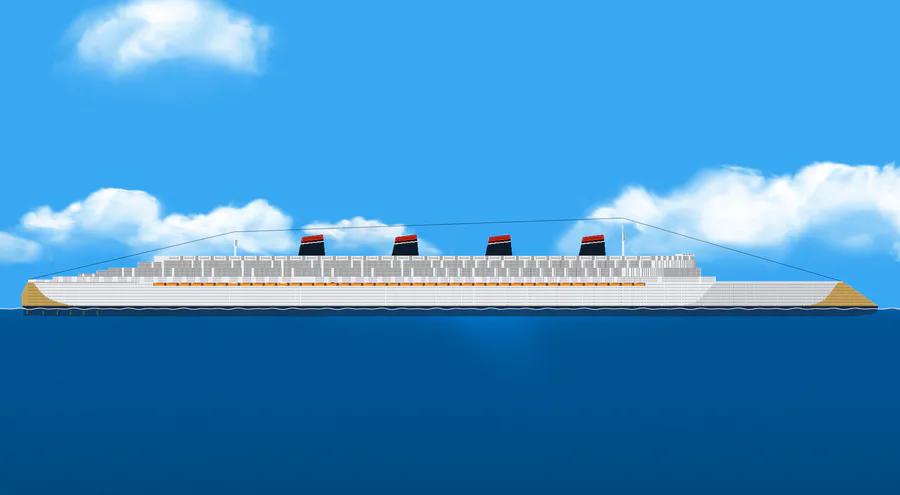
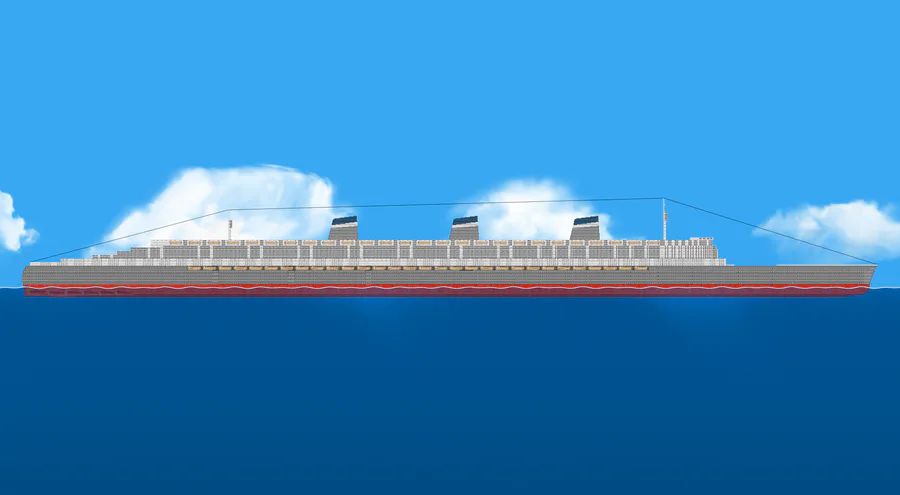
The SS Amerika was famous for its "Single Massive Funnel," a departure from the multi-stack liners of the era. The Grandeur III honors this streamlined aesthetic but scales it into three colossal 39-meter-tall funnels that act as a single aerodynamic unit.
Aero-Induction: Just as the Amerika used its funnel to emphasize power, the Grandeur III’s stacks are designed with the same 1930s streamlining. However, these are not for smoke; they are high-velocity air intakes for the 1,500,000 SHP cooling array, ensuring the net-zero reactors stay stable during 410-knot sprints.
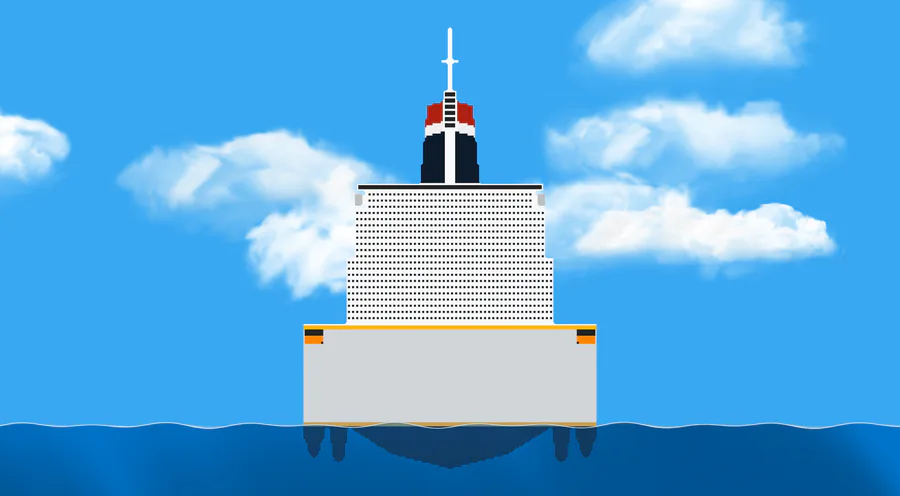
The Observation Box: The Grandeur III incorporates the Viktoria’s "Box-like Observation Station" into its 15-floor thin tower. The Captain’s bridge is a modern, glass-enclosed version of the 1937 design, situated 80 meters above the waterline for a view that the Amerika's designers could only imagine.
From 5 Shafts to 12: The Power Gap
The SS Amerika was projected to be the fastest ship of its time at 38 knots using a five-shaft configuration. The Grandeur III takes this "Multi-Shaft" concept to its logical conclusion:
The "Viktoria" Boost: On the central spine of the 1,390-meter Trimaran hull, the primary engine block is nicknamed the "Viktoria Core." It produces 300,000 HP—the entire projected output of the SS Amerika—dedicated solely to the central three shafts.
The 410-Knot Reality: The remaining 1,200,000 SHP is distributed across the other 9 shafts, allowing the ship to maintain a service speed of 300 knots, nearly ten times faster than the Viktoria's projected maximum.
The Sovereign Transition: Amerika to Grandeur
The name evolution of the 1937 project (from Amerika to Viktoria) reflected a shift in global politics. The Grandeur III transcends these divisions by acting as a Global Sovereign Territory.
The Multi-National Deck: In the residential districts, the "Viktoria Plaza" serves as a cultural hub for the ship’s German, French, English, and Italian residents. It is a space where the "Ship of State" ideal is realized not for one nation, but for all 60 million souls.
Streamlining the Impossible: The Grandeur III adopts the "Heavily Streamlined" hull trends of the late 1930s Projekt 305. Using Aero-Titanium Graphene, the ship replicates the Viktoria’s knife-like bow, allowing the 71,000-tonne frame to pierce the Atlantic with the same efficiency intended for the 1937 superliner.
The Ultimate "Vessel of Victory"
Had the SS Amerika been built, it would have been the fastest ship in the world until 1952. The Grandeur III carries that torch into the future. It is the "Victory" of engineering over the constraints of the past—a ship that accepts Euros and Pounds alongside Ringgit and Baht, moving a population the size of a nation across the sea in a matter of hours. The Evolution of the Massive Funnel: From Projekt 305 to the Grandeur III
The M.S. United States Grandeur III and the S.S. Amerika (Projekt 305/Viktoria) represent two different eras of "Power Aesthetics." While both utilize massive, streamlined funnels to convey speed and dominance, their functional roles highlight the massive leap from 1930s steam technology to 22nd-century net-zero propulsion.
S.S. Amerika (1937): The "Single Massive" Statement
The 1937 design for the SS Amerika was a radical departure from the multi-funnel "forests" of earlier liners.
The Silhouette of Power: By opting for a single, enormous funnel, Norddeutscher Lloyd aimed to create a profile of singular strength. It was designed to look like an engine of the state—aerodynamically tapered to reduce drag at its projected 38-knot top speed.
The "Box" Observation Station: Unique to the Amerika was the integration of a massive, box-like observation structure located just forward of the funnel. This was intended to replace the traditional crow's nest, providing the officers with a high-altitude, streamlined command center.
Internal Volume: The single funnel allowed for more open deck space and simplified the interior trunking, a design philosophy that would later influence the most efficient ships of the post-war era.
M.S. United States Grandeur III: The Aero-Induction Triad
The Grandeur III takes the "Massive Funnel" concept and scales it to meet the demands of a 1,500,000 SHP engine.
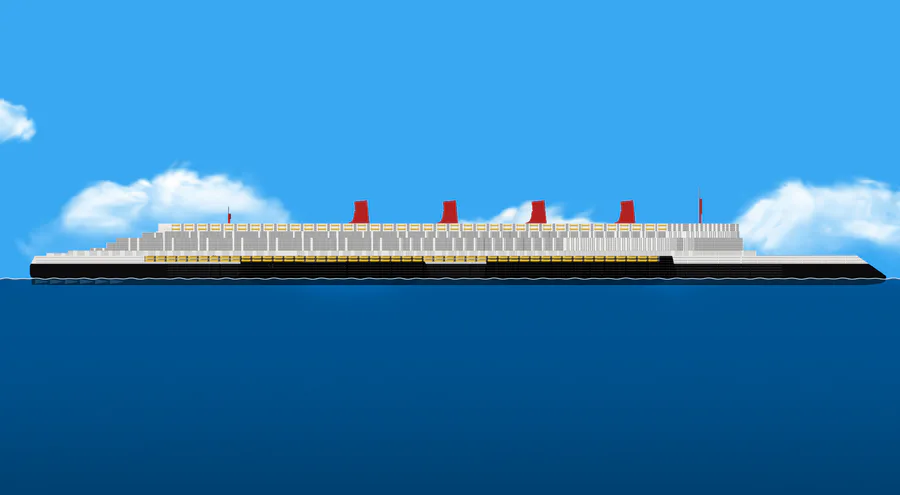
The 147-Meter Funnel Span: Instead of one funnel, the Grandeur III utilizes three massive "Sampan-style" funnels—each 39 meters tall—spanning a total of 147 meters across the superstructure.
Function Over Smoke: These funnels are not for exhaust; they are high-velocity Aero-Induction Intakes. They pull in the massive volumes of air required to cool the ship's net-zero reactors during a 410-knot sprint.
Aerodynamic Control: Borrowing from the "Silver Falcon" aesthetics, these funnels are raked sharply at a 15° angle. They act as aerodynamic rudders, helping the 1.39-kilometer hull maintain stability and "bank" into high-speed maneuvers.
Design Comparison: 1937 vs. 2026
FeatureS.S. Amerika (Projekt 305)M.S. United States Grandeur IIIFunnel Count1 (Massive, Streamlined)3 (High-Velocity Induction)Primary PurposeExhaust & Speed AestheticReactor Cooling & Aero-StabilityObservationBox-like "Officer's Station"161-meter "Zenith Spire" TowerEngine Link300,000 HP Turbo-Electric1,500,000 SHP Net-Zero DriveInspiration1930s AerodynamicsMeyer Werft "Manta Ray" / Silver Class
The "Silver" Connection
Both ships share the DNA of William Francis Gibbs and the 1930s obsession with "The Speed of the Future." The Grandeur III's funnels are a direct homage to the 1936 Silver Class—utilizing the same "Sampan" fin design that made the original SS United States smoke-free, but reimagined for a ship that moves so fast it generates its own localized weather patterns. The total cost of the M.S. United States Grandeur III is as staggering as its 1.39-kilometer silhouette. Building a sovereign city-state that moves at 410 knots is not merely a "shipbuilding" expense; it is a multi-trillion-dollar infrastructure investment.
The total estimated construction and deployment cost is $3.85 Trillion USD.
I. The Capital Expenditure (CapEx) Breakdown
The $3.85 trillion price tag is divided into four primary engineering "pillars."
PillarCost (USD)DescriptionThe ATG Hull$1.10 TrillionForging 1,390 meters of Aero-Titanium Graphene, including the Manta-Ray wing-lift surfaces.The Viktoria Drive$950 BillionThe 1,500,000 SHP net-zero reactor array and the 12 super-cavitating shafts.Urban Infrastructure$1.20 TrillionFitting 47 floors with residential wards, hospitals, schools, and the Digital Nexus AI.The Ark Fleet$600 BillionConstruction of 116 Main and Secondary Arks at ~$5.17 Billion per unit.
II. The "Titan-Ark" Financial Logic
The safety system alone represents one of the largest single line items.
The Cost of Survival: At $5.17 Billion per Ark, each unit costs as much as a Gerald R. Ford-class aircraft carrier.
The Justification: Each Ark is effectively a self-sufficient, high-speed ship (45 knots) capable of keeping 510,000 people alive for 90 days. This "Safety Tax" is the reason the Grandeur III can be insured for a population of 60 million.
III. The Sovereign Trust Funding Model
No single nation could fund the Grandeur III. Its $3.85 trillion cost was realized through a Hybrid Funding Strategy:
The 45-Company Consortium ($1.8 Trillion): Led by giants like Meyer Werft, Cunard, and Ocean Network Express, these partners provided the industrial expertise and the initial capital in exchange for "Economic Veins" (commercial rights) within the ship.
Sovereign Bond Issuance ($1.5 Trillion): The Grandeur Sovereign Trust issued "Floating Territory Bonds" to the 20 homeports (Singapore, New York, Hamburg, etc.), treating the ship as a mobile piece of their own national infrastructure.
Citizen Equity ($550 Billion): Residents of the "Silver Neighborhoods" pay a one-time "Sovereign Entry Fee," effectively becoming micro-shareholders in the ship’s hull.
IV. Operating Expenses (OpEx): The Cost of Speed
Maintaining a 410-knot sprint and a 1.39-km hull requires an annual operating budget of $145 Billion.
The Digital Nexus Maintenance: Running the quantum AI and the automated logistics drones for 60 million people costs roughly $12 Billion annually.
Fueling the Void: While the reactors are "net-zero," the maintenance of the Plasma Actuators and the Super-Cavitating Shafts—which undergo extreme stress at 410 knots—requires constant material replacement.
V. Economic Comparison: Ship vs. Nation
To put the $3.85 trillion cost in perspective:
It is roughly equivalent to the Annual GDP of Germany.
It costs 1,600 times more than the most expensive traditional cruise ship ever built (Icon of the Seas, ~$2.4 Billion).
However, as a "Sovereign Territory," its cost per resident is approximately $65,000—comparable to the infrastructure cost of building a high-tech city on land.
0 comments