GENESIS – Sugen’s “golden” set
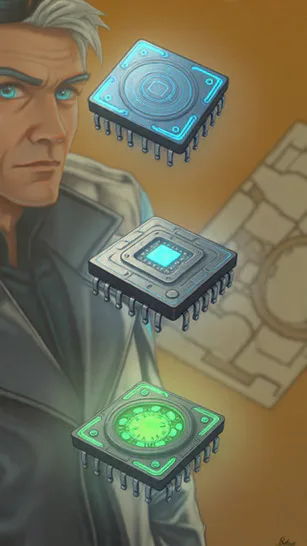
Sugen holds all 16 000 Genesis chips, and they’re more than a rarity – they’re a strategic asset. Each chip is a brain‑center that can execute unique instructions unavailable to Natural or Bio chips. Owning a Genesis means gaining immortality and access to an expanded instruction set.
Genesis chips are built on an Astium crystal lattice with the addition of rare, still‑unknown isotopes. These isotopes give them capabilities that other chips lack; only Genesis can run certain instructions such as “Market” or “Gravitational Field.”
Occasionally Sugen rewards someone with a Genesis chip for outstanding achievements. There have been cases where Sugen was especially generous and gave up to ten chips to a single colony—but you have to truly stand out.
Another way to obtain a Genesis is to buy it from Sugen or on the secondary market. From time to time a corporation or a colony sells chips to improve its finances. When that happens you need enough credits on hand so you don’t miss the chance. Once you acquire a Genesis, it stays with you until you decide to sell it on the secondary market.
NATURAL – Sugen’s “attempt” to replicate Genesis
Sugen threw all its resources into copying the unique abilities of Genesis, but so far it has only managed a “simplified” version – the Natural chips. They are made from the same Astium but without the rare isotopes, so their instruction set is limited, though still enough for endless space expansion.
The main drawback of Natural chips is that they can be destroyed, erasing everything stored in their memory. Another downside is that they can be seized by other colonies when salvaged from wreckage; the new owners then obtain all the data stored in the chip.
By salvaging wreckage and collecting “trophy” Natural chips you can earn a good profit, because the chips can be recycled back into Astium – the de‑facto currency of the machine world. Other uses for trophy chips include repurposing, resale, or selling the data stored in their memory cells.
Thus, Natural chips are a more accessible but less reliable tool for expansion.
BIO – the green terraforming driver
Bio chips are the “seeds” of the future, packed into an Astium crystal matrix. Their purpose is to turn lifeless planets into blooming worlds.
This type of chip emerged from Braip’s failed experiments while developing Natural chips. Early on Braip was playing with plant genomes. Before realizing that a chip could hold human consciousness, he discovered that Astium’s lattice can store and replicate biological code.
A genome is embedded in the chip, which is then “sealed” and ready for “planting.” Delivered to a suitable planet, the chip activates, releasing bio‑capsules that begin to grow. The chip fully controls the process and monitors further development.
A single Bio chip can cover an area from a few square meters up to whole regions, depending on the genome. By experimenting with genomes you can produce variants resistant to extreme radiation, cold, or high gravity. Not all genomes work the same; sometimes several attempts are needed to find the right set. Like Natural chips, the genetic code is stored in the crystal itself, so destroying the chip erases the data.
All chips store their data in local blocks – memory cells. The number of cells can be set at the time the chip is created.










0 comments