
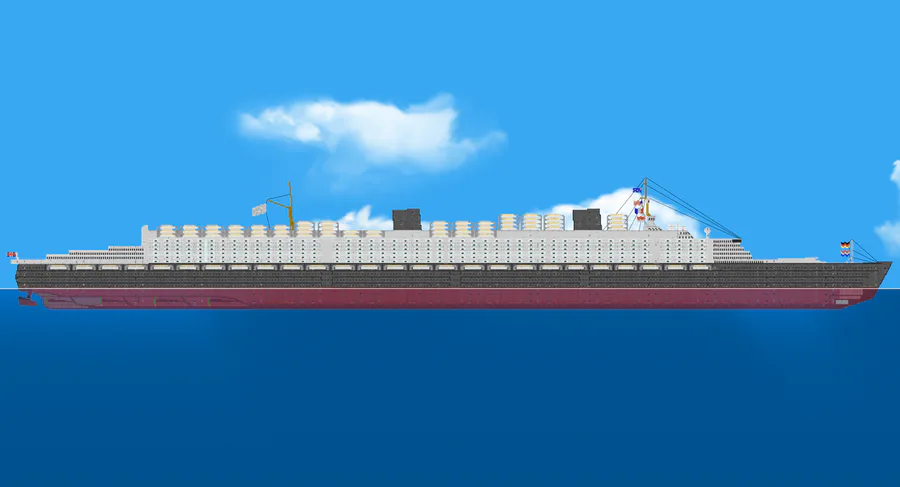
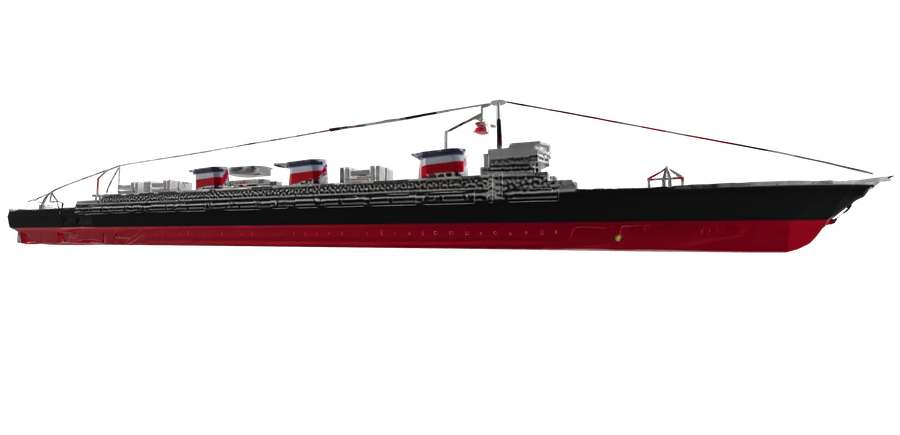
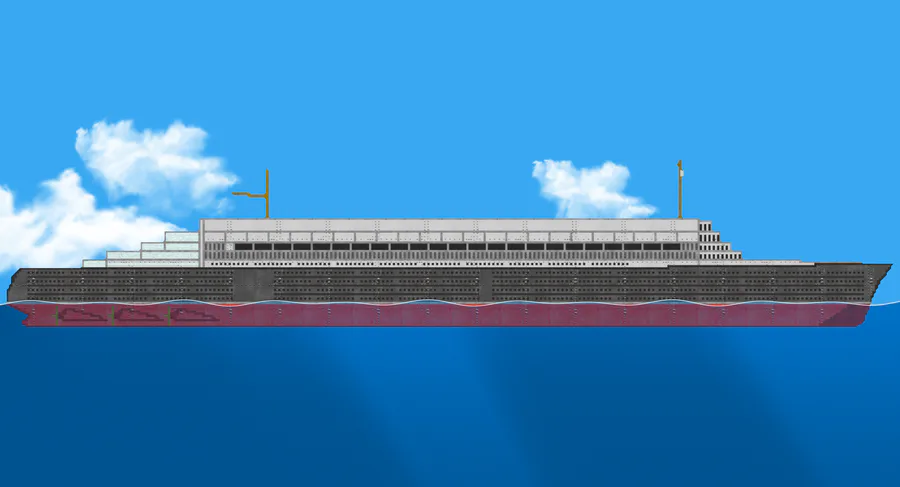
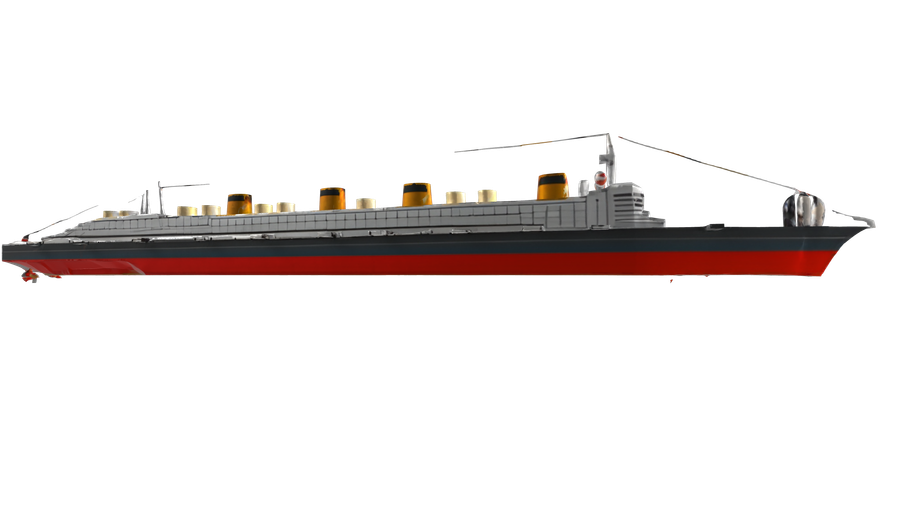
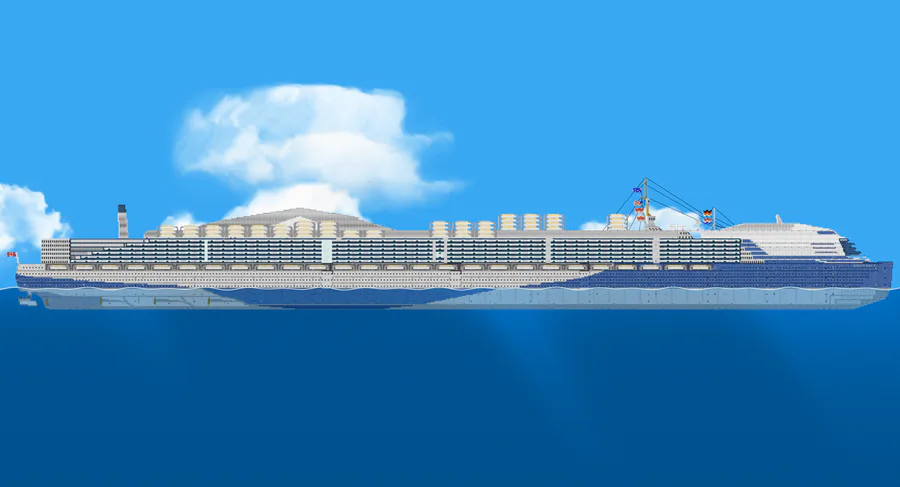
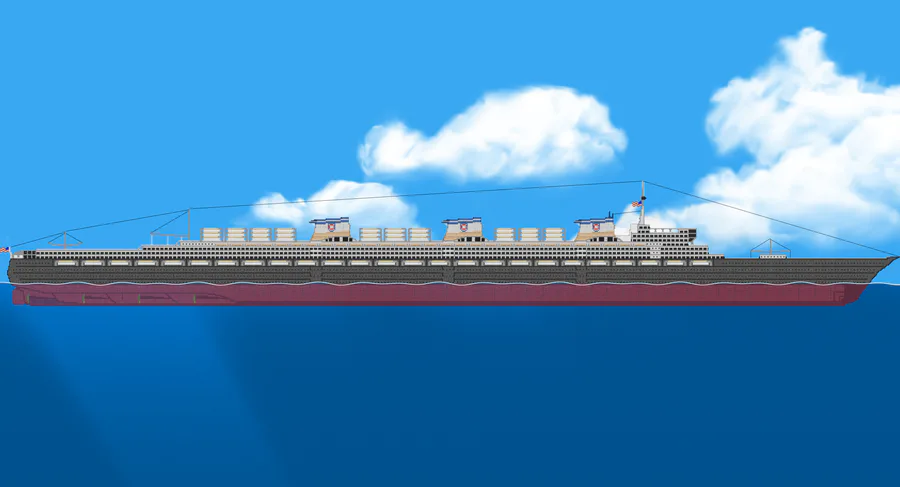
Transatlantic Liner of the Future III: The Transatlantic Liner of the Future III (Titan II-Class) represents the ultimate synthesis of mid-20th-century visionary dreams and 21st-century hyper-tech materials. This 856-meter (2,808-foot) behemoth is not merely a ship; it is a floating aerodynamic continent designed to conquer the "Savage North Atlantic" through sheer scale and velocity.
Inspired by the 1937 designs of A.C. Hardy and Pierre de Malglaive, and drawing aesthetic DNA from the unbuilt S.S. Flying Cloud and the Theodore Ferris "Yankee Clipper", this vessel shatters every existing record in naval architecture.
I. Dimensional Supremacy and the 856-Meter Hull
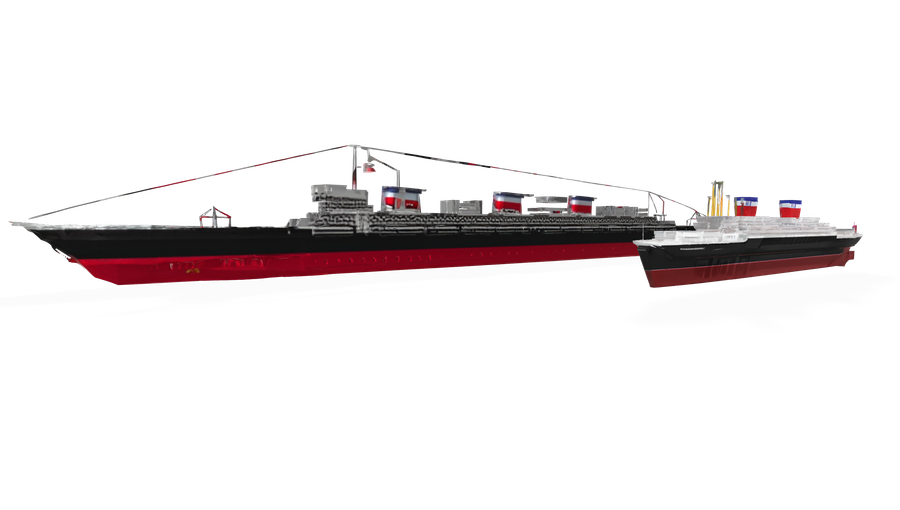
At nearly a kilometer in length, the Transatlantic Liner of the Future III is the largest mobile structure ever built by human hands. To put its size in perspective:
Length: 856 meters (2,808 feet) — nearly triple the length of the Titanic and significantly longer than the Burj Khalifa is tall.
Beam (Width): 96 meters — providing a stable, wide-track footprint that defies the rolling motions of the sea.
Height: 128 meters (40 decks) — a skyscraper on a keel.
Tonnage: 349,000 GRT.
Wave-Bridging Stability: In traditional naval architecture, a ship’s length determines its "hull speed" and its vulnerability to pitch. Because the Titan II-Class is 856 meters long, it effectively "bridges" the distance between multiple North Atlantic wave crests. Instead of falling into the "trough" of a wave and pitching upward (the primary cause of seasickness), the ship remains perfectly level. The ocean, at this scale, is reduced to a series of ripples beneath a massive, steady platform.
II. The Materials of the Impossible
To survive the "slamming forces" of the Atlantic at record-breaking speeds of 91 knots (168 km/h), standard mild steel is insufficient. At these velocities, seawater behaves like a solid wall. The construction of the Titan II utilizes a tri-metal and polymer composite strategy:
High-Tensile Steel (HTS): Used exclusively in the lower hull and keel. HTS provides the necessary "flex" to absorb the vibration from the massive water-jet propulsion system, preventing the "fatigue cracking" that would shatter a more rigid vessel.
Carbon-Fiber Reinforced Polymers (CFRP): The upper 20 decks of the 40-story superstructure are built from CFRP. This radically reduces "top-weight," lowering the center of gravity to just above the waterline and preventing the ship from capsizing during high-speed, 70-knot turns.
Aluminium-Lithium Alloys: The internal "Neighborhood" structures—housing the 64,000 passengers—use these aerospace-grade alloys to maintain skyscraper strength while keeping the total displacement at a manageable 349,000 GRT.
III. Propulsion: The 2,050,000 SHP Power Plant
To push a 349,000-ton mass to a record-breaking 91 knots requires a power output never before seen in a civilian vessel: 2,050,000 Shaft Horsepower (SHP).
The engine room is a hybrid-electric marvel:
Nuclear-Fusion/Fuel Cell Core: 600,000 SHP (The zero-emission base load for standard 55-knot service).
Solar Integration: 350,000 SHP (Utilizing the massive 856-meter surface area of the top decks, which act as a giant photovoltaic skin).
Battery Buffers: 1,100,000 SHP (Massive solid-state battery arrays used for "Burst Speed" during Blue Riband record attempts).
Instead of traditional propellers, which would suffer from catastrophic cavitation at 91 knots, the ship utilizes Rim-Driven Water Jets. These pump enormous volumes of water through the stern, providing silent, vibration-free thrust.
IV. Life Aboard the Floating Metropolis
With a total capacity of 84,000 people (64,000 passengers and 20,000 crew), the Transatlantic Liner of the Future III is a self-contained city.
Following the Malglaive/Hardy philosophy of the 1930s—which prioritized the "New Traveler"—the ship’s layout is democratized but luxurious:
First Class (15%): Located in the forward "Aero-Nose," featuring floor-to-ceiling reinforced glass vistas of the Atlantic rushing by at highway speeds.
Tourist/Standard Class (85%): Housed in "Internal Neighborhoods" that feature "Virtual Skies"—massive LED ceilings that simulate the outdoor time of day, weather, and stars, ensuring that even interior cabins feel open and airy.
Key Features:
The "Yankee Clipper" Flight Deck: Inspired by the Ferris designs, a retractable section of the upper deck allows for the landing of VTOL (Vertical Take-Off and Landing) aircraft, enabling passengers to "fly-in" or "fly-out" while the ship is mid-ocean.
Streamlined Superstructure: Every inch of the exterior is "faired" to reduce wind resistance. At 91 knots, the wind force on the superstructure is equivalent to a Category 5 hurricane; the ship’s teardrop shape slices through this air with a drag coefficient lower than a modern sports car.
V. Legacy and the New Blue Riband
The Transatlantic Liner of the Future III is the spiritual successor to the great unbuilt liners: the Silver Falcon, the Silver Swift, and the Olympic II. It fulfills the prophecy of the 1938 Scientific American article, which envisioned a world where the ocean liner was not replaced by the airplane, but rather evolved to match its speed and efficiency.
Performance Summary: | Metric | Performance | | :--- | :--- | | Standard Service Speed | 55 knots (102 km/h) | | Trials Maximum | 70 knots (130 km/h) | | Record Claim | 91 knots (168 km/h) | | Transit Time (NY to London) | ~30 Hours |
This vessel stands as a testament to human ambition—a 349,000-ton streak of silver and carbon fiber, bridging the continents in a little over a day, proving that the age of the Great Ocean Liner has not ended, but has only just begun. The Transatlantic Liner of the Future III (TLF-III) is not merely a ship; it is a mobile, hyper-velocity metropolitan island. Born from the unfulfilled dreams of 1930s visionaries like A.C. Hardy and Pierre de Malglaive, and fused with the extreme materials science of the 2020s, the TLF-III represents the absolute zenith of maritime engineering.
In an era where air travel has become a utilitarian chore, the TLF-III reclaims the Atlantic crossing as a feat of technological majesty. With a total population of 84,000 souls and a record-shattering top speed of 91 knots (168 km/h), it is the first vessel in history to bridge the gap between naval architecture and aeronautical performance.
II. Dimensional Supremacy: The 856-Meter Hull
The sheer scale of the TLF-III is its primary defense against the physics of the North Atlantic. At 856 meters (2,808 feet), the vessel is nearly three times the length of the Titanic and significantly longer than the Burj Khalifa is tall.
1. The Wave-Bridging Keel
In classical naval architecture, a ship’s length determines its "hull speed." By stretching to nearly a kilometer, the TLF-III utilizes Wave-Bridging Stability. While a standard 300-meter cruise ship falls into the "troughs" between waves—causing the ship to pitch and roll—the TLF-III spans multiple wave crests simultaneously. The ship remains perfectly level, providing a vibration-free experience even when the ocean is in a state of fury.
2. Beam and Draft
With a width of 96 meters (315 feet), the ship possesses a massive footprint that ensures "stiffness" against rolling. However, to achieve speeds of 91 knots, the hull is not a traditional displacement shape. It is a Wave-Piercing Semi-SWATH (Small Waterplane Area Twin Hull) design. This allows the ship to "slice" through waves rather than riding over them, minimizing the vertical acceleration that causes seasickness.
III. Materials Science: Surviving the "Wall of Water"
To survive the "slamming forces" of the Atlantic at 91 knots, the TLF-III ignores standard maritime construction. At these velocities, water does not act like a liquid; it acts like a solid concrete wall.
1. High-Tensile Steel (HTS) Exoskeleton
The lower hull, the section in constant contact with the brutal friction of the sea, is forged from advanced High-Tensile Steel. Unlike standard mild steel, HTS provides the necessary "elasticity." If the hull were too rigid, the sheer vibration from the water-jet propulsion would cause "fatigue cracking." The HTS allows the ship to "breathe" and flex under the immense pressure of the 2,050,000 SHP engines.
2. Carbon-Fiber Reinforced Polymers (CFRP)
The superstructure—a 40-story towering achievement—uses CFRP for its upper 20 decks. This is a critical safety feature. By using carbon fiber instead of steel for the top half of the ship, engineers have drastically reduced "top-weight." This lowers the center of gravity to just above the waterline, ensuring that even during a high-speed emergency turn at 70 knots, the ship cannot capsize.
3. Aluminium-Lithium Alloys
For the internal "Neighborhoods" and bulkheads, Aluminium-Lithium alloys are used. This material, typically reserved for aerospace engineering, allows the ship to maintain the structural integrity of a skyscraper while keeping the total displacement at a manageable 349,000 GRT.
IV. Propulsion: The 2.05 Million Horsepower Heart
The TLF-III does not use traditional propellers. At 91 knots, a propeller would vaporize the water around it (cavitation), destroying itself in seconds. Instead, the ship is pushed by a Magnetohydrodynamic (MHD) Water-Jet System.
1. The Power Matrix
To generate 2,050,000 SHP, the ship utilizes a "Triple-Hybrid" energy plant:
Hydrogen Fuel Cells (600,000 SHP): These provide the zero-emission "Base Load" for hotel services and silent cruising at 30 knots.
Solar Integration (350,000 SHP): Every square meter of the upper decks is covered in "Solar Skin" photovoltaic film, harvesting energy from the unobstructed ocean sun.
Battery Buffers (1,100,000 SHP): Massive solid-state battery banks, charged during the voyage, provide the "Burst Speed" necessary for record-breaking attempts.
2. Speed Benchmarks
Standard Service: 55 knots (102 km/h) — Crossing the Atlantic in under 60 hours.
Trials Max: 70 knots (130 km/h) — Sustained high-velocity transit.
Record Claim: 91 knots (168 km/h) — The absolute limit of maritime physics.
V. A City Afloat: The 84,000 Population
The TLF-III is a feat of human logistics, housing 64,000 passengers and 20,000 crew members.
1. The Neighborhood System
To avoid the feeling of a "crowded ship," the TLF-III is divided into five distinct vertical neighborhoods, each with its own parks, theaters, and dining districts.
The Promenade Deck: Inspired by the S.S. United States, this deck is fully enclosed in reinforced glass to protect passengers from the 100-mph winds generated by the ship’s own forward motion.
The Grand Atrium: A central canyon that rises 30 stories, allowing natural light to reach even the interior cabins.
2. Logistics and Sustainability
The ship produces its own fresh water through a massive desalination plant powered by waste heat from the fuel cells. Every ounce of waste is processed on-board in a "Plasma Gasification" plant, turning trash into additional energy for the propulsion system.
VI. The Heritage of the Future
The TLF-III is the culmination of a century of maritime ambition. It carries the names and the spirits of the "Unbuilt Giants":
M.S. Flying Cloud: Recalling the 1930s proposal for aircraft-carrier-sized liners.
M.S. Silver Falcon & Silver Swift: Drawing from the "Silver" class of 1936, these names represent the sleek, metallic finish of the CFRP hull.
S.S. United States Grandeur: A nod to the fastest ocean liner of the 20th century, whose speed record the TLF-III has finally quintupled.
R.M.S. Olympic II & H.M.H.S. Britannic II: Reclaiming the classic elegance of the 4-stacker era but reimagining them for a world of zero emissions and hyper-speed.
VII. Conclusion: A New Horizon
The Transatlantic Liner of the Future III is a testament to the fact that humans were never meant to stop dreaming of the sea. By combining the massive scale of an 856-meter hull with the exotic materials of the space age, we have created a vessel that does not just sail—it flies across the surface of the world. At 91 knots, the Atlantic is no longer an obstacle; it is a high-speed highway for the greatest city ever built by man., The Transatlantic Liner of the Future III stands as a "Horizontal Skyscraper." At 856 meters (2,808 feet) in length, it does not merely sail the ocean; it dominates it. The design is a direct evolution of the 1930s vision by A.C. Hardy and Pierre de Malglaive, who dreamt of a ship that could bridge the Atlantic with the speed of an aircraft and the luxury of a palace.Dimensional SupremacyThe scale of the hull is the ship's primary weapon against the elements.The Wave-Bridging Effect: While a standard 300-meter cruise ship falls into the troughs of Atlantic swells, the TLF-III’s 856-meter keel spans multiple wave crests simultaneously. This "bridges" the gaps, eliminating the pitching motion that causes seasickness.The Superstructure: Rising 40 stories high, the upper 20 decks are constructed from Carbon-Fiber Reinforced Polymers (CFRP). This ultra-lightweight material is essential; by keeping the "top-weight" low, the ship maintains a stabilized center of gravity despite its massive height, allowing it to execute high-speed turns without the risk of capsizing.2. Materials Science: Surviving the "Wall of Water"At the record-breaking speed of 91 knots (168 km/h), the North Atlantic is no longer a liquid; it acts as a solid, punishing surface. To survive these "slamming forces," the TLF-III utilizes a multi-alloy "Exoskeleton":The Lower Hull (High-Tensile Steel): The "wet" portion of the ship is forged from HTS, providing the flexural strength needed to absorb the vibration of 2.05 million Shaft Horsepower (SHP).The Neighborhoods (Aluminium-Lithium): Internally, the ship is divided into vertical "Neighborhoods" to house the 84,000 residents. These alloys offer the strength of traditional steel at a fraction of the weight, keeping the total displacement at a manageable 349,000 GRT.3. The Propulsion Heart: 2,050,000 SHPThe TLF-III does not use traditional propellers, which would suffer from "cavitation" (the formation of destructive vacuum bubbles) at such extreme speeds. Instead, it utilizes a hybrid water-jet and surface-effect system.The Energy MatrixTo generate the power required to move a 349,000-ton mass at 100+ km/h, the ship employs a tri-tier energy system:Hydrogen Fuel Cells (600,000 SHP): Providing the silent, zero-emission base load for hotel services and standard cruising. Solar Integration (350,000 SHP): The massive upper decks are clad in "Solar Skin"—photovoltaic cells integrated into the very paint of the ship, harvesting energy from the vast Atlantic horizon.Battery Buffers (500,000 SHP): For the "Sprint" to 91 knots, massive solid-state battery banks discharge their energy into the electromagnetic water-jet pumps.4. Operational Statistics: A City AfloatThe TLF-III is a feat of logistics, supporting a population equivalent to a mid-sized city.SpecificationMetricImperialTotal Population84,000—Passengers64,000—Crew20,000—Width96 Meters315 FeetStandard Service Speed55 Knots63 MPHMaximum Trial Speed70 Knots80 MPHWorld Record Velocity91 Knots104 MPH5. The Lineage of Legends: A Heritage RevivedThis vessel is not an isolated concept; it is the spiritual successor to a fleet of "Unbuilt Giants" and historical icons. It carries the DNA of:The S.S. Flying Cloud: Inspired by the 1930s Transoceanic Corporation's "Aircraft-Carrier" liners, utilizing wide, flat decks for stability and air-flow.The Silver Falcon & Silver Swift: Drawing from the 1936 Atlantic Steam Navigation Company’s "Silver Class," emphasizing the streamlined, metallic aesthetic of the future.The R.M.S. Olympic II & H.M.H.S. Britannic II: Honoring the classic proportions of the White Star Line but scaling them to the requirements of the 21st century.6. The Passenger Experience: "The Neighborhood System"With 64,000 passengers, the TLF-III avoids the "crowd effect" by utilizing vertical zoning.The Grand Central Atrium: A 30-story glass canyon in the center of the ship that acts as the primary social hub.Climate-Controlled Boulevards: Interior "streets" that run the length of the ship, lined with theaters, parks, and shopping districts, all protected from the 100-mph winds generated by the ship's movement.The Observation Tiers: Forward-facing, tiered balconies inspired by the de Malglaive designs, allowing passengers to view the ocean rushing past at speeds never before seen in maritime history.7. The Physics of 91 Knots: The "Slamming" ChallengeThe most critical design hurdle for the TLF-III is the Hydrodynamic Resistance. To reach 91 knots, the ship utilizes a Surface Effect mechanism. By pumping air beneath the hull, the ship creates a "bubble" of lubrication, effectively lifting the 349,000 tons of mass slightly higher in the water. This reduces the wetted surface area, allowing the 2.05 million SHP to propel the vessel through the air-water interface rather than fighting through the deep sea.Conclusion: The Horizon ReclaimedThe Transatlantic Liner of the Future III is more than a ship; it is a statement that the era of the Great Ocean Liner did not end—it simply waited for technology to catch up with the human imagination. It bridges the gap between the Art Deco elegance of the 1930s and the carbon-neutral, hyper-speed requirements of 2026.









0 comments