
Comments (2)

how is this a bendy fan game
Free Starter Guides
The companion PDF starter pack is available in the download on Patreon.
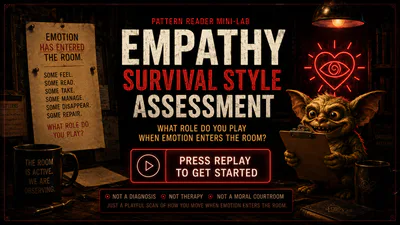
A playful Pattern Reader Mini-Lab about empathy, boundaries, accountability, charm, avoidance, and what happens when emotion enters the room.
Somebody is upset.
Somebody is charming.
Somebody is “confused” the second accountability arrives, which is interesting.
We are observing that respectfully.
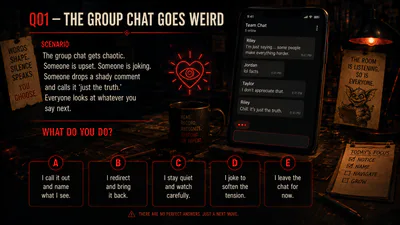
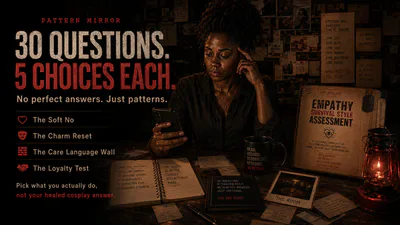
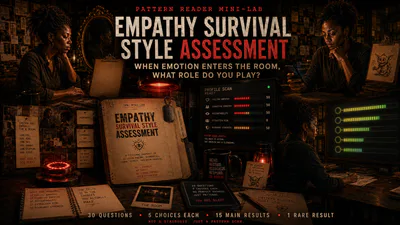
Empathy Survival Style Assessment is a browser-based interactive personality-style assessment built in Twine. You answer 30 questions about how you respond when emotion enters the room, then receive a result based on your choices in this run.
This is not a diagnosis. It is not therapy. It is not a clinical tool. It is not a morality courtroom with tiny emotional gavels.
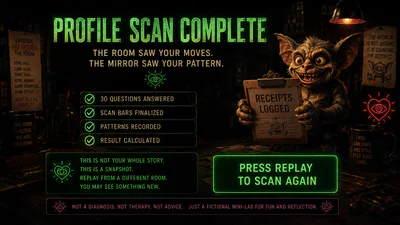
It is a fictional reflection game. A pattern mirror. A little gremlin with a clipboard asking what you actually do when feelings, boundaries, charm, attachment, pressure, and accountability start moving around the room.
Start the Profile Scan
Click Run Game to start the assessment in your browser.
For the best experience, play on desktop or laptop, use fullscreen if the interface feels tight, and turn on audio if you want the narrated version.
Press Replay to get started.
The Replay button starts or restarts the narration for the current screen. You can also play silently and read the text on screen.
The mirror is not judging you. The mirror is noticing.
Assessment at a Glance
30 questions
5 choices per question
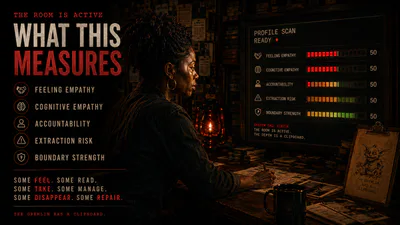
5 visible scan bars
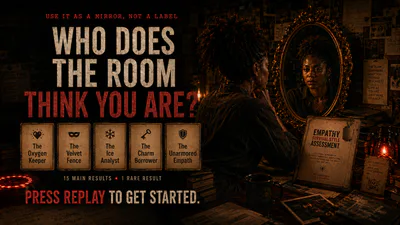
15 main result styles
1 rare result
Playful narration
Closed captions
Replay and mute controls
Pattern Reader Mini-Lab interface
Browser-based Twine assessment
AI-assisted visuals
AI-generated narration
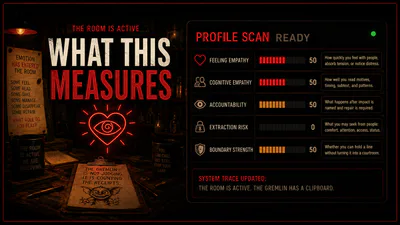
What This Measures
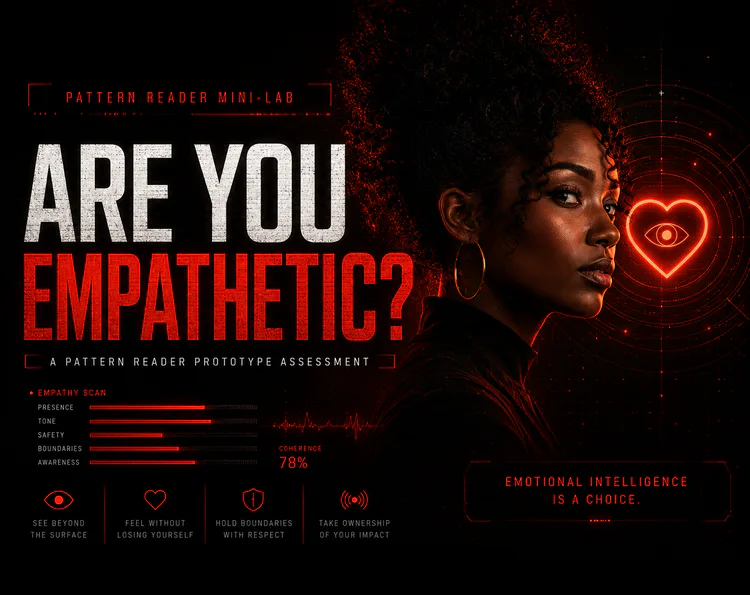
The assessment watches five visible scan bars:
Feeling Empathy: how quickly you feel with people, absorb emotional weather, or notice distress.
Cognitive Empathy: how well you read motives, timing, subtext, performance, and emotional patterns.
Accountability: what happens after impact is named and repair is required.
Extraction Risk: what you may seek from people, such as comfort, attention, forgiveness, status, access, or protection.
Boundary Strength: whether you can hold a line without turning it into a courtroom presentation.
The assessment also quietly watches hidden signals like avoidance, attachment hunger, perception management, disruption power, emotional absorption, charm use, and repair patterns.
The point is not to chase a perfect score. The point is to notice the move.
How to Answer
Please do not pick your healed cosplay answer.
Do not answer as the version of yourself who is perfectly rested, hydrated, emotionally regulated, glowing under soft lighting, and speaking in a wellness podcast voice.
Pick what you actually do when you are tired, flattered, embarrassed, rejected, needed, overwhelmed, corrected, offered access, asked for loyalty, or two seconds away from sending a paragraph you will later call “context.”
Your result is based on this run. If you replay while thinking about a different relationship, workplace, friendship, family pattern, mood, or version of yourself, you may get a different result.
That is normal.
Humans are not vending machines. We contain snacks, contradictions, and unresolved tabs.
Possible Result Families
Results are grouped into broad style families.
Pro-Social Styles
These styles usually use emotional information to protect, clarify, stabilize, or guide.
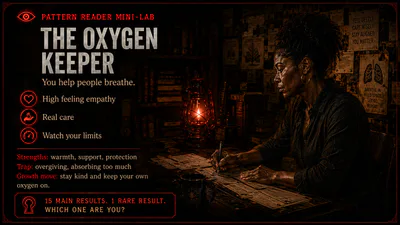
The Oxygen Keeper
The Pattern Lantern
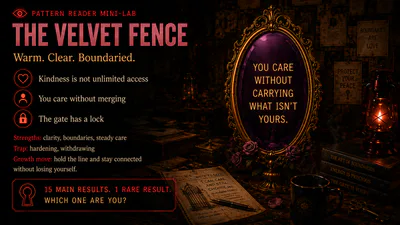
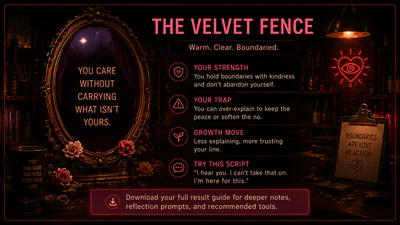
The Velvet Fence
The Mirror Blade
The Chaos Auntie / Chaotic Unc
Detached Styles
These styles may not be emotionally gushy, but they can still be fair, useful, strategic, accountable, and steady.
The Ice Analyst
The Distance Keeper
The Control Room Operator
The Transaction Reader
Shadow Styles
These styles use emotion, charm, vulnerability, performance, or care language in ways that can get slippery if accountability stays low.
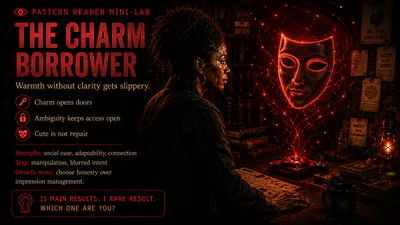
The Charm Borrower
The Mirror Thief
The Rescue Magnet
The Status Feeder
The Boundary Tester
The Empathy Mimic
Rare Result
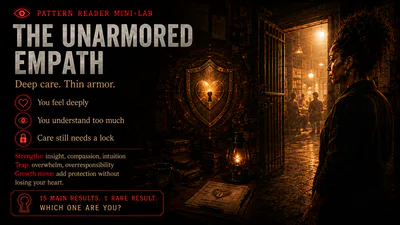
The Unarmored Empath
None of these results are permanent labels. They are pattern snapshots from one playthrough.
Free Starter PDFs
New to the mini-lab? Start with the free PDF pack in the download section below the game.
Recommended starter files:
What Is the Empathy Survival Style Assessment?
Quick Start Card
The Five Scan Bars Guide
Result Map
Content Note and Credits
These files are designed to help you understand the assessment without spoiling the deeper Pattern Reader Library materials.
Go Deeper in the Pattern Reader Library
The free game gives you your result. The deeper Pattern Reader Library gives you the support layer behind the result.
Patreon companion materials may include result deep-dives, glossary notes, reflection prompts, scripts, boundary tools, repair tools, access tools, emotional labor tools, and recommended Pattern Reader Field Tools tied to different empathy survival styles.
Some tools are available now. Some are in build. Some are coming soon.
Your result is the doorway. The library is the support system.
Behind the Overlay
The game uses layered interface panels, captions, buttons, and scan elements over the artwork. That means some visuals are partially hidden during play.
A deeper image gallery may be available through the Pattern Reader Library so the art can breathe without the interface sitting on top of it like a tiny dramatic clipboard goblin.
Creator Note
This is an AI-assisted creative project built by a one-woman creator.
I write, direct, edit, design, test, and shape the Pattern Reader universe. The writing, result logic, assessment structure, tone, and overall creative direction are mine. AI-generated visuals and AI-generated narration are used as production tools inside the game.
This assessment grew out of a larger creative question: what happens when empathy has no armor?
Sometimes trying to see the human in someone can become costly when that person, room, or system keeps testing boundaries, controlling access, managing the environment, and removing anyone who challenges the pattern.
This mini-lab is not here to make people colder. It is here to ask what care needs in order to stay clean, accountable, and protected.
Content Notes
This project explores emotional pressure, boundary testing, attachment, charm, accountability, avoidance, care language, repair gaps, social control, and interpersonal pattern recognition.
Empathy Survival Style Assessment is fictional and for reflective entertainment only.
It is not therapy, diagnosis, legal advice, workplace advice, relationship advice, mental health advice, or a substitute for professional support.
Your result does not define you. It only captures a possible pattern in this moment based on the choices you selected during this playthrough.
Use it as a mirror, not a label.
Support the Project
The assessment is free to play.
If the game helped you name a pattern, laugh at emotional goblin behavior, or pause before handing someone the admin password to your nervous system, optional support helps build future Pattern Reader tools, kits, mini-labs, and story experiences.
Leave a Pattern Trace
If the mirror made you squint, laugh, feel seen, feel called out, or whisper “ugh, fine,” leave a comment or rating.
It helps other pattern readers find the room.
KEEP READING THE ROOM.
#strategy #mindbending #empathy #personalitytest #indie #interactivefiction #psychology #behavior #boundary #reflection #emotionallintelligence #narrated #assessment #browsergame #choicebased #narrativegame #selfdiscovery #traits