
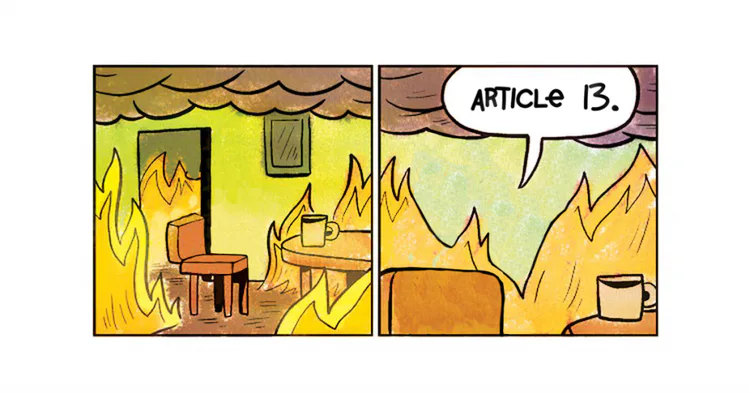
I am now speaking as a person, not as a GJ moderator!!!
A lot has been said and written about article 13! And it shows how people are very eager to always repeat the sad mistakes of the past.
The OFFICIAL reason for putting that article in place is to prevent copyright-violating-content to sites such as YouTube. The true reason can be found somewhere else though, as everybody knows that the higher barriers you make for people to make illegal copying impossible the harder people will do it, sometimes not because they care about obtaining it, but just to stick up a big middle finger to the copyright holders (read: abusers).
We should have learned from the Napster debacle. What happened back then. Napster was one of the first free platforms on the internet to upload music to. It was meant to give young artists a way to make themselves known to the world, and it was quite successful too. Unfortunately the platform was also abused to upload commercial music illegally and it was way too much for the Napster crew to handle. Metallica sued Napster eventually and won. Result Napster became a closed-platform and only the commercial industries kept using it to sell music, precisely the group for which this was not meant and many people left the platform out of protest.
YouTube is just a new victim in this matter, and YouTube is bigger now than Napster ever was. YouTube was set up by two students who were actually amazed by the gold they created (and even more by the money Google was willing to pay to take the platform over from them). YouTube refers to the old “tube” TVs that nobody remembers these days and “tube” could be a kind of verb of sending something to TV. So “you tube” means you are sending a TV broadcast now. That entire concept appears to have broken down now, as it’s impossible to prevent illegal uploads, and now YouTube must filter everything that is being uploaded. Since YouTube can’t afford enough staff to check every single upload, this will in the end most likely mean that YouTube will likely suffer the same end as Napster did. The people who already got their fame (either thanks to YouTube our around YouTube) will be free to upload their content freely, new YouTubers are now chanceless and hopeless, as YouTube cannot take any chances (as the fines are pretty steep), and the only complaint procedure YouTube got is that complaints are mostly ignored (and in Google’s defense I must say that they probably receive more complaints every day than any company can handle, due to the size of the YouTube now, and also because of people are not complaining but whining).
However in the end the goal of the copyright holders has NOT been reached. Now the middle-finger reaction will take place and illegal copying will rather increase than decrease, by means of USB sticks if people have to (harder to track), just like how the Frisbee interface (put stuff on a diskette and throw it like a Frisbee through the room to your receiver) worked in the past. For starting new talent, (read: dangerous competitors), another road to success (and YouTube has created many stars by now) has been barred, and that is the only true effect article 13 has.
I guess there’s a reason this article has the unlucky number.
And of course we know that YouTube will sooner or later be replaced by a new small platform for young talent to show what they can do, which will sooner or later also become too big to moderate properly and eventually be the target of copyright holders who fear their business would be ruined.
Truth is… Illegal copying is as old as storage media exist and can be used by minors. The very first storage medium happens to be a rock which people could carve in, and dates back thousands of years into the past. The internet made it a bit easier to do (which was to be expected) but is not the problem, as I do remember lobbies to get casette recorders banned as they were being used for illegal copies (the lobby failed as cassettes played back then a very vital role in the commercial industries as well, for temporary recordings, phone answering machines and many more things). As long as storage media exist, illegal copying will exist as well. And in my experience, people who copy/download illegally, were not potential buyers in the first place, so professional artists would not have made money from them anyway. It’s not like stealing a bottle of milk in which production cost of the bottle and the milk it contains are not being compensated, which does happen if the thief leaves the bottle be for somebody else to buy, as an illegal copy costs nothing to create, and brings nothing in the artist’s wallet and the same would have happened if the illegal downloader ignored the piece. Some companies (who will deny it firmly) even benefit from these illegal copies.
A famous example of that was WordPerfect. It was back in the MS-DOS era the most illegally copied piece of software on Earth, and the WordPerfect Corporation became very rich because of this. Why? Everybody KNEW how to use WordPerfect, so companies did not have to teach new employees the basics of WordPerfect, saved them money, so they all bought WordPerfect on their company systems (and the license fees for companies are WAY higher than for home usage so much more profitable). Isn’t this a joke?
Can this work for music as well? SURE! And also for games. Some games and music got to my notice thanks to illegal copies I’ve seen, and I liked those so much that I eventually bought the originals or their successors. Back then I was pretty rich, I must say.
Kevin McLeod was right when he said that the copyright failed. And now he offers his music for free under a CC license, and lives on donations, although the high-quality versions of his work (interesting for professionals) still cost money, but for people who’d like to copy illegally the free versions suffice, and hey, thanks to most indie game developers (people like us), he made a name for himself (or actually, in truth is, WE DID IT FOR HIM). Now THIS turned out to be a far better approach than paranoidly trying to bar all free copies going around.
It’s not that I am promoting illegal copying. No!
The copyright law should exist. It protects my work against plagiarism for starters. And is someone uses the stories in my games to make loads of money without me making a penny I can sue them. And that’s good. But more and more copyrights appear to be used to bully us. It makes me worry. And now that platforms appear to get barred from new talent with “illegal copies” as excuse, I wonder… Does the industry decide what I get to watch and hear, or do I do that? If I wanna listen to an amateur musician, I’ll do that, and if their ways close more and more around them, my possibilities go slim.
Well, no use to cry over spilled milk. The bill has passed, nothing we can do about it anymore. The money of the industries has won over common sense, which is only the 479347294729834729347th time in history such a thing happens, so we all gotta live with it. A new platform for young talent will be there eventually, and let’s enjoy it until they find a way to bar that one.
C’est la vie!





7 comments