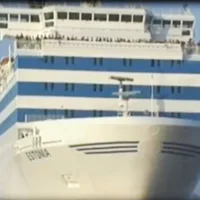
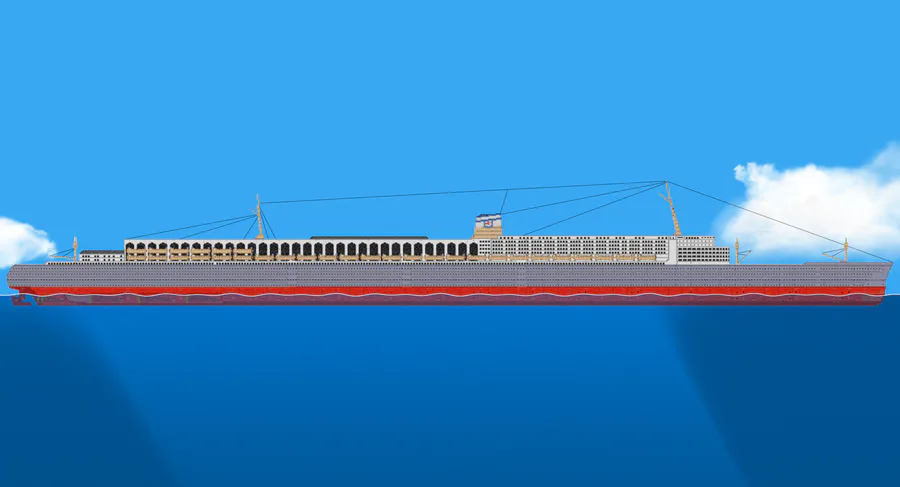
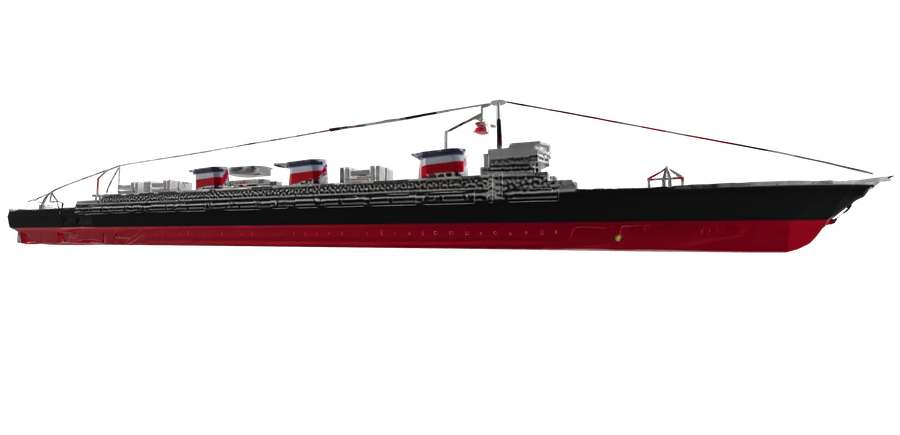
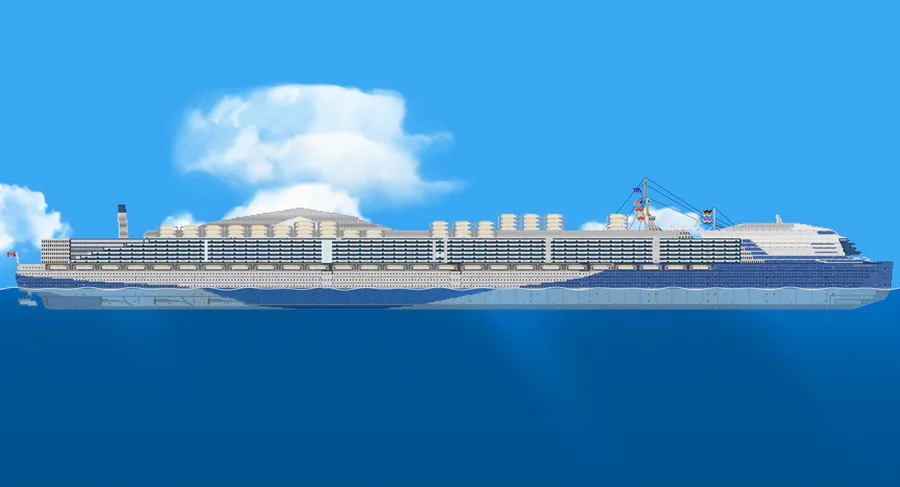
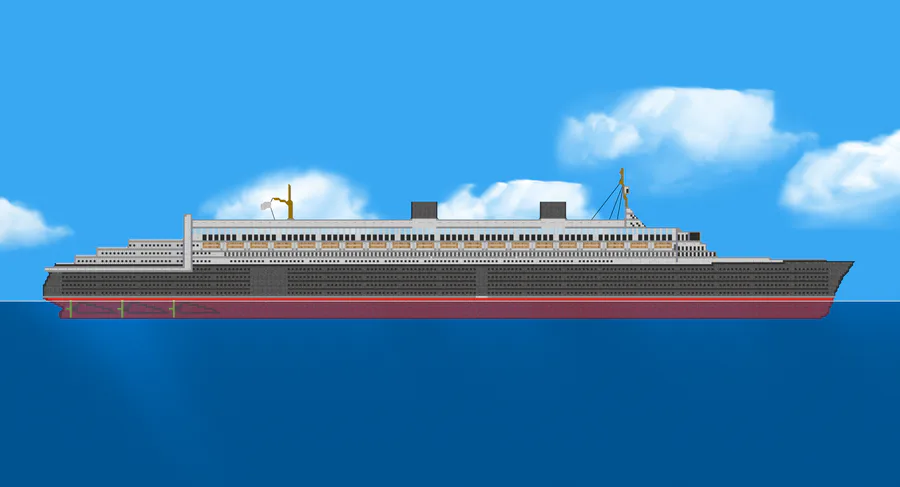
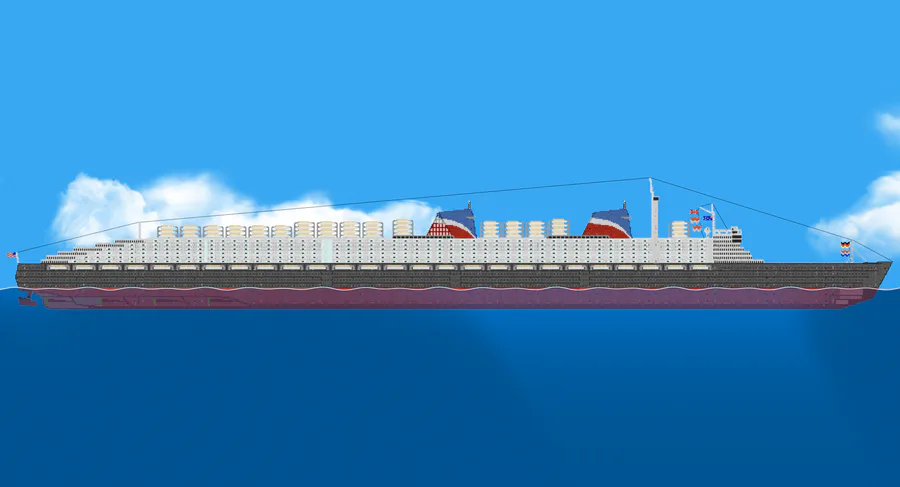
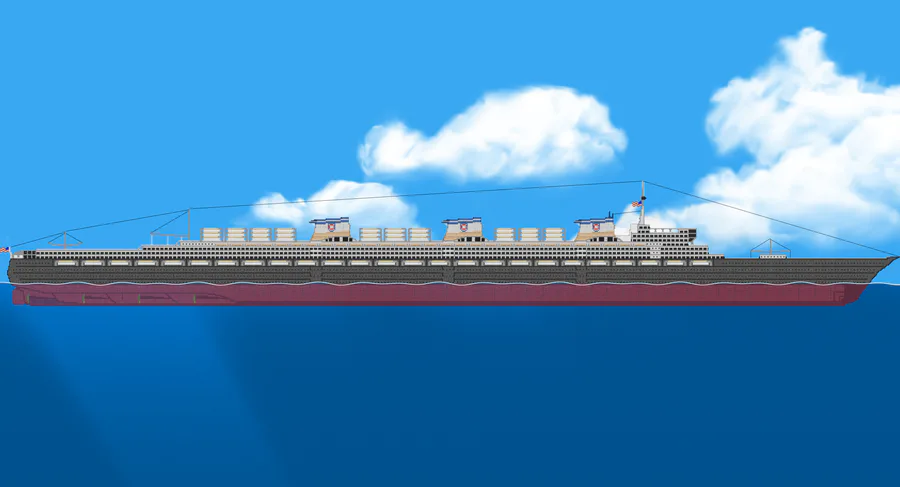
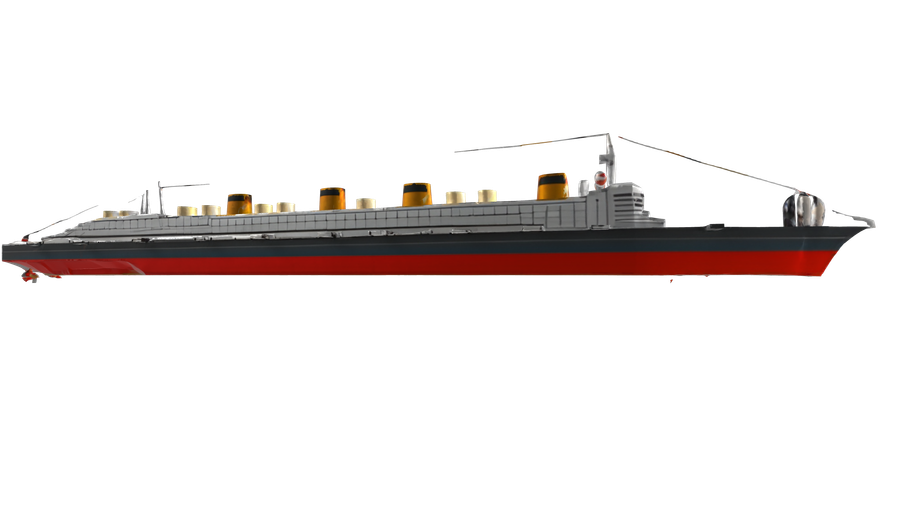
The S.S. Goodwill II is a record-breaking maritime achievement that transcends the definition of a ship, existing instead as a 960-meter floating metropolis. Inspired by the mid-century "Sea Coach" dreams of Hyman B. Cantor and the humanitarian "Economics of the Infinite" envisioned by Joseph Ricker, it represents the absolute pinnacle of 2026 naval engineering. Part 1: The Cantor Legacy – From "Sea Coach" to Super-Liner
The story of the S.S. Goodwill II does not begin in a shipyard, but in the audacious mind of Hyman B. Cantor in 1959. Cantor’s dream was the "Sea Coach"—a way for the masses to cross the Atlantic for $50. While the original 90,000-ton Peace and Goodwill were stifled by mid-century skepticism, the 2026 incarnation is a 300,000 GT behemoth that fulfills Cantor’s vision of "Democratic Gigantism."
The Goodwill II is the "Great Equalizer" of the ocean. At 960 meters, it is not merely a ship; it is a floating bridge of diplomacy. The vessel was designed to prove that mass transit at sea could be more efficient than air travel. By utilizing the "Economics of the Infinite," the S.S. Titan Foundation realized that a ship of this scale could house 128,000 people—effectively moving a medium-sized city across the Atlantic at nearly 100 mph.
This first record explores the "Universal Charter" of the Goodwill II. Unlike the luxury-focused liners of the past, the Goodwill II operates on a tiered subsidy model. The "Citadel" suites at the crown of the ship fund the "Coach" decks below, ensuring that the dream of affordable, high-speed maritime travel is accessible to all, regardless of economic status.
Part 2: Dimensional Supremacy – The 960-Meter Hull
To construct a hull nearly a kilometer long, naval architects had to abandon traditional rigid-frame construction. The Goodwill II utilizes a Modular Longitudinal Distribution (MLD) system.
Structural Specifications
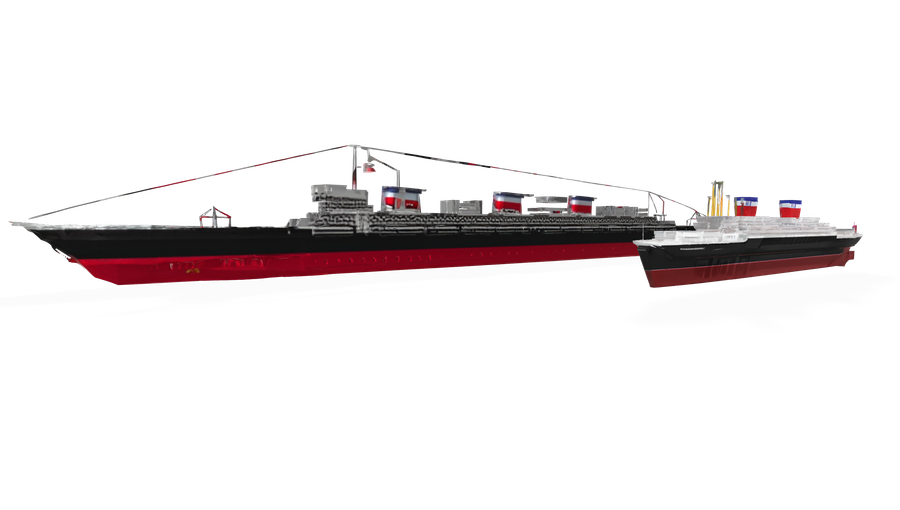
DimensionMeasurementComparisonLength960 Meters3x the length of an Aircraft CarrierBeam (Width)96 MetersWider than a football fieldHeight136 MetersA 40-story vertical cityGross Tonnage300,000 GTThe largest displacement in history
The primary challenge of a 960-meter hull is "Hogging and Sagging"—the stress placed on the ship when it spans multiple wave crests. The Goodwill II solves this with a "Living Spine." The hull is composed of twelve segments connected by massive hydraulic dampeners. These allow the ship to flex up to 1.5 degrees, dissipating the energy of the North Atlantic.
This flexibility prevents the ship from snapping under its own immense weight. Because the hull is longer than the average wavelength of a storm sea, the Goodwill II "bridges" the waves. While a 300-meter ship falls into the troughs, the Goodwill II remains perfectly level, supported by multiple crests simultaneously.
Part 3: The 91-Knot Threshold – The Physics of the "Sprint"
The most staggering metric of the Goodwill II is its maximum speed of 91 knots (104 mph). At these speeds, water acts like a solid. To overcome the drag barrier, the ship employs two revolutionary technologies:
Air Lubrication System (ALS): Thousands of micro-compressors along the keel inject a carpet of air bubbles between the hull and the water. This reduces "skin friction" by 40%, allowing the ship to "slide" over the ocean.
Wave-Piercing Axe Bow: Instead of a traditional bulbous bow, the Goodwill II uses a razor-sharp vertical profile. It does not ride over waves; it slices through them with zero vertical acceleration.
To maintain 91 knots, the ship requires 1,100,000 Shaft Horsepower (SHP). This power is managed by an AI-driven "Aegis-Nav" system. At 104 mph, a floating shipping container becomes a kinetic missile. The ship's Lidar array scans 15 miles ahead, allowing the autonomous water-jets to "slalom" the 960-meter hull around debris with centimeter-level precision.
Part 4: Propulsion – The Internal Water-Jet Revolution
The Goodwill II has no propellers. Conventional screws would suffer from cavitation—where the water boils off the blades—at speeds exceeding 45 knots. Instead, the ship is propelled by a Multi-Stage Internal Turbine Array.
The Thrust Cycle
Intake: Massive scoops in the lower hull draw in millions of gallons of seawater per second.
Compression: The 1.1 million SHP grid powers titanium-alloy impellers that compress the water within reinforced internal tunnels.
Vectored Discharge: The water is ejected through steerable nozzles at the stern.
Because these nozzles can tilt 30 degrees in any direction, the 960-meter vessel possesses the agility of a speedboat. It can "crab-walk" sideways into a pier or perform a full emergency stop in less than three hull-lengths by reversing the vectored thrust. This system also makes the ship "Acoustically Silent," as the machinery is shrouded deep within the insulated lower decks. Part 5: The 1.1 Million SHP Grid – Hydrogen and "Burst Mode"
Generating $1,100,000 \text{ SHP}$ without a trail of black smoke required a total departure from fossil fuels. The Goodwill II is powered by the world’s largest Proton Exchange Membrane (PEM) Fuel Cell array.
The LH2 Cold-Chain
The ship carries liquid hydrogen ($LH_2$) in vacuum-insulated spherical tanks maintained at $-253^\circ\text{C}$. This fuel serves a dual purpose:
The Heat Sink: The extreme cold of the fuel is used to cool the ship’s massive 100G data centers and the high-output electric motors, making the system 95% thermally efficient.
The Power Cycle: When the $LH_2$ is combined with atmospheric oxygen, it creates electricity, heat, and pure distilled water—providing the ship's entire fresh water supply for 128,000 people as a "waste product."
Graphene-State "Burst Mode"
To reach the 91-knot threshold, the ship engages its Graphene-Capacitor Buffer. While the fuel cells provide the "base load," these capacitors can discharge an extra 400,000 hp for 120-minute sprints, allowing the Goodwill II to outrun hurricane-force weather systems with ease.
Part 6: Titan-Link – The MagLev Nervous System
On a ship 960 meters long, walking from the bow to the stern would take nearly 15 minutes. To maintain the efficiency of a "Linear City," the Goodwill II features the Titan-Link, an internal high-speed MagLev (Magnetic Levitation) system.
Horizontal Elevators
The system operates on Decks 12 and 18, consisting of pressurized pods that move at 40 mph.
Vibration-Free: Because the pods float on magnetic fields, there is no mechanical friction or vibration transmitted to the hull. This is critical for the hospital wings where surgeons perform micro-robotic procedures.
The 100G Backbone: The MagLev tracks also house the ship’s fiber-optic "nervous system." Using QSFP28 transceivers, the ship maintains a zero-latency environment, allowing the AI to synchronize the movements of 128,000 people with the ship’s own ballast shifts.
Part 7: The "Linear City" – Urbanism at Sea
With a population of 128,000, the interior of the Goodwill II is designed using the principles of Vertical Urbanism. It is divided into three distinct districts to prevent the "mall-effect" and ensure social cohesion.
The District Hierarchy
DistrictLocationPurposeThe ZenithDecks 29-38High-speed luxury suites and global diplomacy halls.The PromenadeDecks 12-28The commercial heart: vertical farms, theaters, and schools.The FoundationDecks 4-11Research labs, the 50-theater hospital, and crew housing.
The Grand Canyon Atrium
The center of the ship is a 40-meter-wide open rift that runs for 600 meters. This atrium provides natural light to "interior" cabins via high-resolution LED "Sky-Ceilings" that mimic the actual weather outside. It houses Vertical Aeroponic Gardens that produce 40% of the ship's fresh greens, reducing the need for massive refrigerated storage.
Part 8: Lifeboat Capacity – The 2,000-Person "Life-Arks"
Traditional lifeboats are useless for a ship of this scale. In an emergency, the Goodwill II deploys 64 "Life-Arks."
Engineering the Unsinkable Ark
Each Life-Ark is a 45-meter, self-righting vessel with a capacity of 2,000 people.
Gravity-Launch Rails: The Arks do not use slow-moving cranes. They sit on electromagnetic launch rails. In a "General Abandon" scenario, all 64 Arks can be "fired" into the water in under 30 minutes.
Sustenance: Each Ark is a floating fortress, containing enough desalinated water and nutrient-dense food to sustain 2,000 people for 14 days.
The Flotilla Mesh: Once in the water, the Arks automatically link via a local mesh network, forming a "Survival Flotilla" that stays together to ensure easier recovery by search and rescue forces. Part 9: The Single Funnel – High-Velocity Air Management
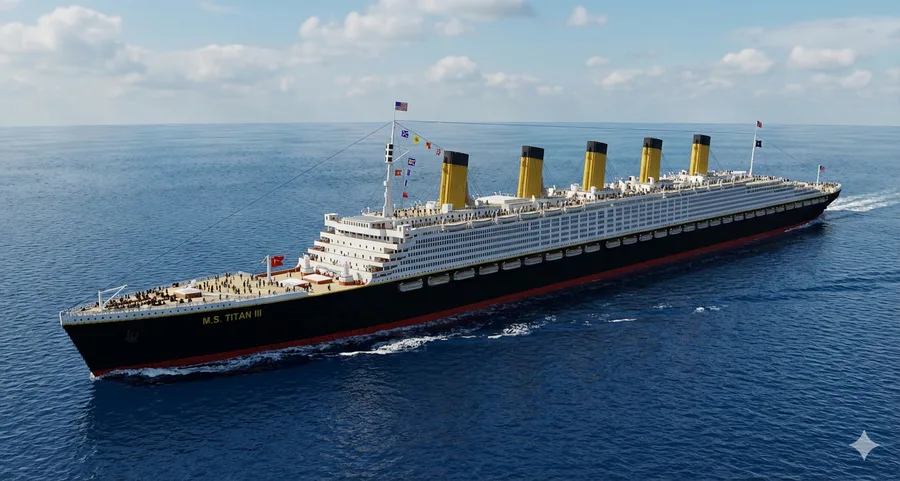
While the original 1959 Cantor proposal featured a distinct profile, the 2026 S.S. Goodwill II utilizes a single, monumental funnel structure that serves as the "Primary Respiratory Organ" for the 1.1 million SHP grid. This is not a chimney for smoke, but a High-Velocity Induction Vent.
Aerodynamic Induction
At 91 knots, the relative wind speed across the deck is equivalent to a Category 2 hurricane. The funnel is shaped like a vertical aerofoil to capture this massive kinetic energy.
Oxygen Feeding: The funnel draws in over 500,000 cubic meters of air per minute to feed the PEM fuel cells located in the lower decks.
Thermal Venting: It utilizes the Venturi effect to pull waste heat from the computer cores and hospital wings, venting it 136 meters above the waterline to prevent "heat blooming" around the passenger decks.
Part 10: Plasma-Arc Waste-to-Energy – Zero Discharge
Feeding 128,000 people generates a city-scale waste stream. The Goodwill II does not dump; it vaporizes. Located in the Deep Keel, the Plasma-Arc Gasification Plant is the ship’s primary waste management system.
The Gasification Process
Everything from food waste to medical biohazards is subjected to temperatures of $6,000^\circ\text{C}$.
Syngas Production: The process breaks down waste into its elemental constituents, producing "Syngas" (hydrogen and carbon monoxide), which is filtered and fed back into the ship’s energy grid.
Vitrified Slag: The only byproduct is a glass-like, non-leachable slag. This material is incredibly dense and is used as "Dynamic Ballast" to adjust the ship’s center of gravity in real-time as fuel is consumed.
Part 11: Dimensional Stability – The 96-Meter "Post-Suez" Beam
The Goodwill II is 96 meters wide, making it a "Post-Suez" and "Post-Panamax" vessel. By abandoning the constraints of man-made canals, the engineers were able to prioritize Metacentric Immortality.
The Physics of Width
A 96-meter beam provides a natural stability that makes the ship theoretically impossible to capsize in Earth's oceans.
The "Zero-G" Stabilizer: The ship uses four active "Stability Wings" (retractable underwater foils). Combined with the 96-meter width, these wings use the ship’s 91-knot speed to create "Downforce," pinning the hull to the water and eliminating the rolling motion that causes seasickness.
Wave-Bridging Effect: Because the beam is wider than most standard ocean swells are high, the ship doesn't "tilt" into waves; it simply sits on top of them, maintaining a level of internal stability that allows for high-precision laboratory work to continue even during Atlantic storms.
Part 12: The Humanitarian Hospital Wing – Echelon III Care
Occupying Decks 4 through 8, the Humanitarian Hospital Wing is the soul of the S.S. Goodwill II. It is the largest mobile medical facility in human history, designed to provide "The Speed of Mercy."
Medical Specifications
50 Operating Theaters: Equipped with "Da Vinci" robotic surgical units synced via the ship's 100G backbone.
The Pediatric Oncology Center: A dedicated zone for treating children from underserved coastal regions, funded entirely by the Citadel suite revenues (The "Cantor Cross-Subsidy").
Mass Desalination: The hospital wing can produce 2 million gallons of medical-grade water daily, which can be pumped ashore via high-speed umbilical lines during disaster relief missions.
The hospital is isolated from the rest of the ship via active vibration dampening, ensuring that the vibrations from the 1.1 million SHP water-jets never reach the scalpel of a surgeon. Part 13: Global Sovereign Status – The Maritime "Neutral Zone"
The S.S. Goodwill II is more than a ship; it is a moving piece of sovereign territory. Because the vessel is operated by the S.S. Titan Foundation (a non-profit organization), it was granted Global Sovereign status under a unique UN Maritime Charter ratified in 2025.
A New Class of Vessel
Traditionally, ships fly "flags of convenience" (like Panama or Liberia). The Goodwill II, however, flies the Titan Universal Ensign.
Diplomatic Immunity: This status allows the ship to enter any territorial waters to provide medical aid without being subject to local port taxes or political blockades.
The Peace Hall: Located mid-ships on Deck 30, the Peace Hall serves as a neutral ground for international negotiations. At 960 meters long, the ship provides a physical "buffer zone" where heads of state can meet in international waters, away from the influence of land-based geopolitics.
Part 14: Aegis-Nav – Autonomous Collision Avoidance
Navigating a 300,000 GT vessel at 91 knots is a task that exceeds human reaction times. At 104 mph, a ship this size travels its own length in approximately 20 seconds. To manage this, the Goodwill II utilizes the Aegis-Nav System, a civil evolution of military-grade sensor fusion.
The Sensor Cortex
The system integrates thousands of data points every millisecond:
Multi-Spectral Lidar: Scans the ocean surface for 15 miles in every direction, capable of detecting a floating log or a "growler" (iceberg fragment) even in heavy fog.
Autonomous Slalom: When an obstacle is detected, the AI does not signal the bridge; it communicates directly with the Vectored Water-Jets. The ship executes a subtle "slalom" maneuver, adjusting its 960-meter hull with centimeter-level precision. Because of the Modular Spine (Part 2), passengers in the Promenade feel no sudden lurch, only a gentle tilt as the ship weaves through the debris field.
Part 15: The 100G Data Backbone – The Nervous System
The Goodwill II is the most "connected" structure on Earth. To coordinate the lives of 128,000 people and the data-intensive medical theaters, the ship is built around a 100-Gigabit fiber-optic backbone.
Connectivity for Mercy
Tele-Robotic Surgery: Utilizing high-bandwidth satellite arrays (Starlink-Pro), surgeons on the ship can collaborate with specialists at the Mayo Clinic or St. Jude in real-time. The 100G backbone ensures zero-latency, meaning a surgeon in Minnesota can control a robotic arm on a patient in the middle of the Atlantic with no perceptible delay.
The Digital Twin: Every structural joint, fuel cell, and water-jet is mirrored in a "Digital Twin" on the ship’s servers. The AI uses this data to predict maintenance needs before a failure occurs, ensuring the "Final Ship" remains operational 365 days a year.
Part 16: The Legacy of Joseph Ricker – The "Metropolis of Light"
The final record brings us back to the man who refined Hyman B. Cantor’s 1959 vision for the 21st century: Joseph Ricker. Ricker’s fundamental thesis was that "Gigantism is the only solution to empathy." He believed that for a ship to truly save the world, it had to be too large to be ignored and too fast to be stopped.
The Metropolis of Light
The Goodwill II is the realization of Ricker's "Metropolis of Light" concept—a vessel that carries the memory of maritime tragedies (like the Titanic) not through mourning, but through the active preservation of life.
The Cantor-Ricker Legacy: By combining Cantor’s "Sea Coach" affordability with Ricker’s "Humanitarian Logistics," the Goodwill II has ended the era of the luxury-only super-liner.
A New Horizon: As the ship fades into the Atlantic mist at 91 knots, it leaves behind a wake of hope. It stands as a 960-meter testament to the idea that human engineering, when fueled by hydrogen and guided by empathy, can truly conquer the most unforgiving oceans.




1 comment