

2. Complete 60-Material Technical Registry
To support its immense weight and maintain self-sufficiency, the arcology replaces conventional building materials with a curated matrix of 60 specialized nanomaterials and technical composites, detailed below by functional performance group.
Performance Group 1: Primary Structural Core & Civil Engineering
1. Primary Foundation Anchor Cables (Substructure)
Nanomaterial Composition: Continuous-yarn Single-Walled Carbon Nanotubes (SWCNTs) aligned in a crystalline (10,10) armchair configuration.
Tensile Strength (\sigma_{uts}): 95\text{ GPa} | Elastic Modulus (E): 1,050\text{ GPa}
Structural Application: Woven into macro-scale anchor bundles six meters in diameter, these cables pass through the 100 subterranean levels and drive hundreds of meters into the underlying Niagaran dolomite and deep granite bedrock. When wind storms exert lateral force against the upper 1.65\text{ km} moment arm, these cables handle the massive pull-out forces on the windward side. Their high elastic modulus ensures near-zero stretching, preventing the foundation from shifting and keeping the tower firmly anchored to the earth.
2. Outer Perimeter Megacolumns (Blocks 1–2)
Nanomaterial Composition: Multilayer Carbon Nanotubes (MWCNTs) embedded in an Ultra-High-Performance Concrete (UHPC) matrix with a continuous titanium-dipalladium alloy skeleton.
Tensile Strength (\sigma_{uts}): 48\text{ GPa} | Elastic Modulus (E): 780\text{ GPa}
Structural Application: Formulated to construct the primary vertical load-bearing columns for the 64-tube base grid. These columns manage the massive weight of the building while resisting the heavy tension and compression cycles caused by lateral swaying. The interwoven MWCNT matrix stops micro-cracks from spreading through the composite material, allowing the base columns to handle intense, cyclical shifting forces without structural degradation.
3. Mid-Zone Tube Splice Plates (Blocks 3–4 Transition)
Nanomaterial Composition: Boron Nitride Nanotubes (BNNTs) synthesized within a cobalt-chromium superalloy matrix.
Tensile Strength (\sigma_{uts}): 38\text{ GPa} | Elastic Modulus (E): 620\text{ GPa}
Structural Application: Used for the massive structural joints where the outer tubes transition and drop down from 64 to 48, and later to 40 tubes. These plates manage the severe concentration of forces that occurs at these setback locations. BNNTs provide excellent mechanical toughness along with outstanding thermal stability. This ensures the structural joints retain their strength and resist creep deformation during sudden temperature shifts across the building's exterior.
4. High-Altitude Upper Tube Framework (Blocks 5–6)
Nanomaterial Composition: Graphene-reinforced Alumina-Aerogel Superlattices coated with an outer layer of chemical vapor deposition (CVD) diamond.
Tensile Strength (\sigma_{uts}): 26\text{ GPa} | Elastic Modulus (E): 340\text{ GPa}
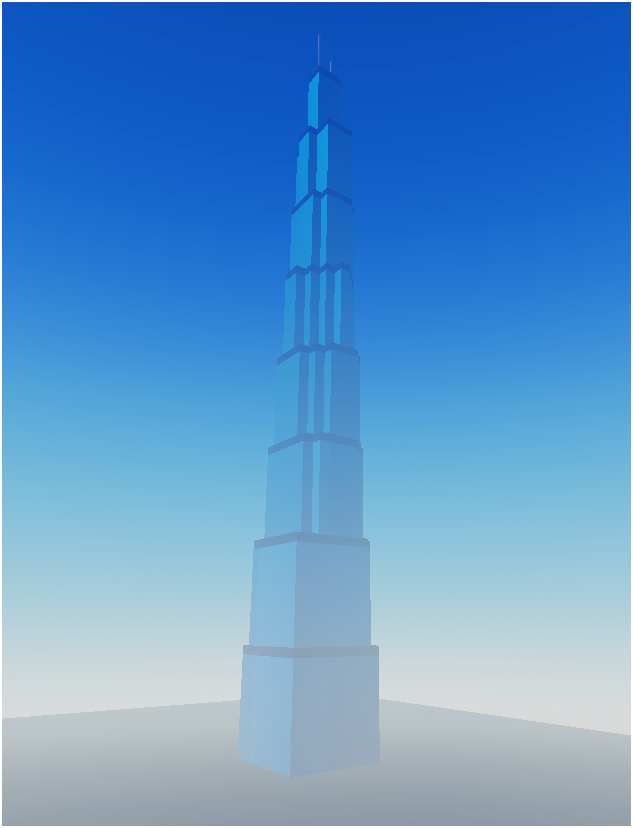
Structural Application: Used to build the primary structural frame for the high-altitude zones between the 1,000-meter and 1,400-meter elevations. At these heights, the tower faces powerful, sustained jet-stream wind loads. This material's ultra-low density dramatically lowers the building's top-heavy mass, while its engineered flexibility allows the upper tubes to bend slightly and absorb wind energy safely. This controlled flexibility helps dampen wind forces without transferring excessive twisting stresses down to the lower sections of the building.
5. Pinnacle Spire Core Structural Mast (Spires 1 & 2)
Nanomaterial Composition: Three-dimensional Covalently Networked Graphene Nanoribbon (GNR) Aerogel Composites infiltrated with flexible Polyimide Elastomers.
Tensile Strength (\sigma_{uts}): 22\text{ GPa} | Elastic Modulus (E): 210\text{ GPa}
Structural Application: Forms the internal structural spine for both the 131-meter primary spire and the 89-meter secondary spire, reaching the ultimate peak height of 1,781\text{ meters}. This material behaves like a giant, durable shock absorber at the top of the tower. It allows the spires to flex significantly during extreme storms, reducing wind drag and safely distributing torsional stresses without risk of cracking or structural failure.
6. Primary Aerodynamic Double-Skin Facade Mullions
Nanomaterial Composition: Continuous Silicon Carbide (SiC) Nanofibers woven into a clear, transparent aluminum oxynitride (AlON) matrix.
Tensile Strength (\sigma_{uts}): 32\text{ GPa} | Elastic Modulus (E): 450\text{ GPa}
Structural Application: Used for the exterior curtain wall mullions that secure the building's glass facade across all 563 above-grade floors. These mullions must withstand continuous positive and negative wind pressures without bending excessively, which could otherwise crack or dislodge the glass panels. The integrated SiC nanofibers provide the necessary stiffness and tensile strength to resist these high-altitude forces while keeping the profile slender to maximize natural light.
7. Aerodynamic Wind-Zone Vortices Deflectors
Nanomaterial Composition: Exfoliated Graphene Nanoplatelets mixed into an ultra-tough Polyether Ether Ketone (PEEK) matrix.
Tensile Strength (\sigma_{uts}): 28\text{ GPa} | Elastic Modulus (E): 290\text{ GPa}
Structural Application: Shapes the large, curved exterior panels around the open wind-refuge zones in the upper blocks. These panels direct high-speed winds through the building instead of around it, helping reduce overall drag. The material's high fatigue resistance ensures it can withstand decades of turbulent wind buffeting without developing structural micro-fractures.
8. Outer Base Blast and Impact Shielding Ring
Nanomaterial Composition: Shear-Thickening Fluid (STF) encapsulated within a multi-layered Kevlar nanofiber and carbon nanotube matrix.
Tensile Strength (\sigma_{uts}): 55\text{ GPa} | Elastic Modulus (E): 850\text{ GPa}
Structural Application: Installed as a protective exterior barrier around the lower three floors of Block 1. It is designed to safeguard the building against potential marine impacts, explosions, or debris carried by severe storms off Lake Michigan. The material instantly hardens under high-velocity impacts to distribute the energy across the base structure, then returns to its flexible state once the force dissipates.
9. Seismic Outrigger Node Connectors
Nanomaterial Composition: Nanostructured Bainitic Steel Alloys reinforced with atomized yttria-stabilized zirconia (YSZ) nanoparticles.
Tensile Strength (\sigma_{uts}): 65\text{ GPa} | Elastic Modulus (E): 980\text{ GPa}
Structural Application: Used for the massive connections that tie the central structural tubes to the outer perimeter columns. These joints manage the immense forces generated as the building twists and bends under wind loads. The nanoparticle reinforcement allows these nodes to absorb energy through micro-yielding cycles without losing their core structural strength.
10. Exterior Expansion and Contraction Joints
Nanomaterial Composition: Fluorographene sheets layered with a flexible, self-healing siloxane-based nano-elastomer.
Tensile Strength (\sigma_{uts}): 24\text{ GPa} | Elastic Modulus (E): 215\text{ GPa}
Structural Application: Installed horizontally between each major structural block to absorb thermal expansion and contraction. At heights up to 1.6 kilometers, temperatures can swing wildly throughout the day. These joints allow individual sections of the facade to expand or contract independently, preventing internal stress from building up across the building's frame.
11. Core Elevator Shaft Shear Walls (Substructure to Block 8)
Nanomaterial Composition: Cross-linked SWCNT-Graphene oxide hybrid sheets bonded with a low-density silicate matrix.
Tensile Strength (\sigma_{uts}): 72\text{ GPa} | Elastic Modulus (E): 920\text{ GPa}
Structural Application: Forms the continuous vertical walls enclosing the express maglev elevator shafts. These walls must resist high pressures from fast-moving elevator capsules traveling at 80\text{ m/s} (288\text{ km/h}). The high stiffness of the material prevents the shafts from distorting, ensuring the maglev tracks stay aligned across the entire 1.6-kilometer height.
12. Maglev High-Speed Express Guide Rail Track Subframes
Nanomaterial Composition: Crystalline Carbon Nanotubes grown directly on a monolithic titanium-aluminide matrix.
Tensile Strength (\sigma_{uts}): 58\text{ GPa} | Elastic Modulus (E): 890\text{ GPa}
Structural Application: Structural supports that hold the high-speed maglev tracks inside the express shafts. They must withstand rapid, cyclical magnetic forces as the 45-passenger capsules accelerate and decelerate. The material's high elastic modulus prevents the tracks from shifting, ensuring smooth, reliable elevator operations at peak speeds.
13. Deep Subterranean Floor Slabs (Floors -1 to -100)
Nanomaterial Composition: Nanosilica-infused fly-ash geopolymers reinforced with short-form amorphous iron-boron-silicon metallic glass ribbons.
Tensile Strength (\sigma_{uts}): 35\text{ GPa} | Elastic Modulus (E): 550\text{ GPa}
Structural Application: Used to build the floor slabs for the 100 underground levels, which extend down to -293\text{ meters}. These slabs must resist intense lateral soil pressure and high hydrostatic forces from Lake Michigan. The metallic glass ribbons give the concrete excellent crack resistance, preventing groundwater leaks and keeping the foundation secure.
14. Mid-Rise Sky Lobby Diaphragm Floors (Floors 140, 350, 490)
Nanomaterial Composition: Multi-layered Graphene sheets layered with a lightweight magnesium-lithium nano-alloy.
Tensile Strength (\sigma_{uts}): 42\text{ GPa} | Elastic Modulus (E): 680\text{ GPa}
Structural Application: Forms the heavy floor diaphragms for the primary transfer hubs and sky lobbies. These floors handle massive foot traffic and redistribute heavy structural loads between different tube configurations. The magnesium-lithium nano-alloy keeps the floors light while providing the necessary strength to transfer forces across the building's footprint.
15. Active Tuned Mass Damper Enclosure Frames
Nanomaterial Composition: High-density tungsten-carbide nanoparticles dispersed within a polymerized fullerene matrix.
Tensile Strength (\sigma_{uts}): 62\text{ GPa} | Elastic Modulus (E): 1,010\text{ GPa}
Structural Application: Forms the structural frames that hold the heavy active mass dampers in the building's upper blocks. These frames must withstand extreme, cyclical forces as the dampers move back and forth to counteract wind sway. The material's high yield strength ensures it can handle these continuous stress cycles for decades without structural fatigue.
16. Internal Core Stairwell Escape Pod Enclosures
Nanomaterial Composition: Intumescent carbon-nanotube aerogel matrices layered with ballistic aramid nanoparticles.
Tensile Strength (\sigma_{uts}): 31\text{ GPa} | Elastic Modulus (E): 410\text{ GPa}
Structural Application: Used to construct the primary emergency evacuation stairs and safety enclosures throughout the building. This material provides exceptional thermal insulation, protecting escape routes from intense heat during emergencies. Its high tensile strength also shields the stairwells from falling structural debris or kinetic impacts.
17. High-Pressure Utility Distribution Arteries
Nanomaterial Composition: Helically wound Carbon Nanotubes bonded with an ultra-smooth, abrasion-resistant fluoropolymer liner.
Tensile Strength (\sigma_{uts}): 50\text{ GPa} | Elastic Modulus (E): 720\text{ GPa}
Structural Application: Used for the primary water lines and utility pipes that run vertically through the tower. Pumping water up a 1.6-kilometer building creates immense internal water pressure. These nanotube-reinforced pipes handle this continuous pressure safely, eliminating the need for heavy, thick-walled steel pipes and reducing dead weight.
18. Upper-Level Acoustic and Vibration Isolation Plinths
Nanomaterial Composition: Porous Graphene-nickel foam networks infused with visco-elastic nano-polyurethane.
Tensile Strength (\sigma_{uts}): 21\text{ GPa} | Elastic Modulus (E): 240\text{ GPa}
Structural Application: Installed beneath heavy mechanical equipment, HVAC systems, and water pumps on upper levels. The material acts as a high-performance isolator, absorbing mechanical vibrations and preventing structural hums from traveling through the upper, flexible blocks of the tower.
19. Quantum Link Telemetric Routing Conduits
Nanomaterial Composition: Superconducting Yttrium Barium Copper Oxide (YBCO) nanowires insulated with a boron-nitride nano-mesh wrapper.
Tensile Strength (\sigma_{uts}): 34\text{ GPa} | Elastic Modulus (E): 480\text{ GPa}
Structural Application: Protects the fiber-optic and data networks that connect the building's central quantum link system. These conduits are integrated directly into the structural columns, shielding sensitive data lines from electromagnetic interference and mechanical strain as the building bends and sways.
20. Floor Plate Secondary Cantilever Beams (Blocks 7–8)
Nanomaterial Composition: Single-crystal \text{Al}_2\text{O}_3 (Sapphire) Nanowires reinforcing an ultra-light aluminum-scandium alloy matrix.
Tensile Strength (\sigma_{uts}): 29\text{ GPa} | Elastic Modulus (E): 380\text{ GPa}
Structural Application: Used for the secondary beams supporting the floors in the narrowest upper sections of the tower. These beams hold up the outer office and residential spaces, extending out from the central tubes. The sapphire-nanowire composite keeps the floors stiff and stable, preventing noticeable springiness or vibration for the occupants.
Performance Group 2: Renewable Energy Harvest & Synthesis Materials
21. Corner-Mounted Piezoelectric Wind Loops
Nanomaterial Composition: Highly oriented zinc oxide (\text{ZnO}) nanorod arrays grown on conductive carbon fiber fabrics.
Tensile Strength (\sigma_{uts}): 7.5\text{ GPa} | Elastic Modulus (E): 120\text{ GPa}
Structural Application: Integrated directly into the outer corners of the tower's step-setbacks. As high-altitude winds buffet the edges of the building, these nanorod arrays flex slightly, converting mechanical vibration and ambient wind energy into electrical power to help offset the tower's base electricity grid.
22. Photovoltaic Graphene-Quantum Dot Facade Skin
Nanomaterial Composition: Methylammonium lead iodide perovskite crystals layered with a highly transparent graphene oxide sheet.
Tensile Strength (\sigma_{uts}): 0.15\text{ GPa} | Elastic Modulus (E): 15\text{ GPa}
Structural Application: Applied as a microscopically thin coating across all #A6C2FE Periwinkle Ice Blue Glass surfaces. This skin captures solar energy across both visible and ultraviolet wavelengths while maintaining a translucent appearance, effectively transforming the entire exterior facade into a massive power generator.
23. Ultra-Capacity Energy Storage Boundary Walls
Nanomaterial Composition: Two-dimensional titanium carbide (\text{Ti}_3\text{C}_2\text{T}_x) MXene flakes arranged in a flexible polymer binder.
Tensile Strength (\sigma_{uts}): 0.45\text{ GPa} | Elastic Modulus (E): 45\text{ GPa}
Structural Application: Built inside the partition walls of the tower's localized mechanical zones. These sheets act as heavy-duty, fast-charging supercapacitor banks, storing electricity generated by the facade's solar systems and releasing it smoothly during high-demand evening hours.
24. Concourse Kinetic Energy Harvesting Mats
Nanomaterial Composition: Patterned fluorinated ethylene propylene (FEP) films combined with an atomized carbon nanotube electrode track.
Tensile Strength (\sigma_{uts}): 0.12\text{ GPa} | Elastic Modulus (E): 3.8\text{ GPa}
Structural Application: Layered beneath the high-traffic walking pathways of the Block 1 retail concourses and maglev stations. These mats harness triboelectric currents from foot traffic, generating thousands of kilowatt-hours daily from the regular movement of commuting citizens.
25. Core Super-Battery Solid Nanowire Anodes
Nanomaterial Composition: Porous silicon nanowire arrays grown on a high-purity copper current collector mesh.
Tensile Strength (\sigma_{uts}): 0.85\text{ GPa} | Elastic Modulus (E): 95\text{ GPa}
Structural Application: Forms the internal energy-storage cores inside the substation batteries on the underground levels. The porous nanowire structure allows lithium ions to move rapidly during charge cycles, preventing internal stress from breaking the battery and providing excellent long-term storage capacity.
26. High-Efficiency Power Distribution Transistors
Nanomaterial Composition: Heteroepitaxial gallium nitride (\text{GaN}) on silicon substrates, reinforced with silicon carbide carrier layers.
Tensile Strength (\sigma_{uts}): 0.35\text{ GPa} | Elastic Modulus (E): 290\text{ GPa}
Structural Application: Installed inside the building's main transformers and high-voltage distribution hubs. These advanced semiconductors reduce energy loss by 92\% when converting power from high-voltage lines down to standard commercial and residential voltages.
27. Low-Light Infrared Photovoltaic Inks
Nanomaterial Composition: Puckered two-dimensional black phosphorus flakes suspended in a volatile organic solvent carrier.
Tensile Strength (\sigma_{uts}): 1.20\text{ GPa} | Elastic Modulus (E): 44\text{ GPa}
Structural Application: Painted onto the shadowed, non-reflective surfaces of the #0A0C1B Midnight Blue Obsidian Glass outrigger zones. This specialized coating captures low-energy infrared heat radiating away from the city below, ensuring the building continues to collect solar power even on overcast, cloudy Chicago days.
28. High-Thermal Transformer Heat Dissipaters
Nanomaterial Composition: Graphitic carbon quantum dots combined with a liquid boron nitride fluid matrix.
Tensile Strength (\sigma_{uts}): 0.50\text{ GPa} | Elastic Modulus (E): 85\text{ GPa}
Structural Application: Circulates through the cooling loops of the tower's massive electrical substations. The material's high thermal conductivity rapidly draws heat away from hard-working electronics, preventing overheating and keeping power distribution reliable across all blocks.
29. Subgrade Core Structural Concrete Whiskers
Nanomaterial Composition: Crystalline beta-silicon carbide (\beta\text{-SiC}) whiskers mixed into low-alkali volcanic ash cements.
Tensile Strength (\sigma_{uts}): 8.20\text{ GPa} | Elastic Modulus (E): 400\text{ GPa}
Structural Application: Formulated into the concrete mixes poured for the deep foundation slurry walls. The tiny crystalline whiskers bridge micro-gaps within the curing concrete, creating a dense shield that stops saltwater corrosion and water seepage from Lake Michigan.
30. Rigid Aerodynamic Facade Backing Panels
Nanomaterial Composition: Polyacrylonitrile (PAN)-derived carbon nanofibers pressed into an epoxy-modified phenolic matrix.
Tensile Strength (\sigma_{uts}): 5.50\text{ GPa} | Elastic Modulus (E): 230\text{ GPa}
Structural Application: Installed as structural backing panels behind the building's glass facade frames. These lightweight, rigid boards keep the window frames perfectly aligned, preventing wind suction from pulling or rattling the exterior panel seals out of position.
Performance Group 3: Vertical Logistics & Rapid Transit Composites
31. Room-Temperature Superconducting Lift Tracks
Nanomaterial Composition: Carbonaceous sulfur hydride nano-filaments pressed into a dense copper-niobium matrix.
Tensile Strength (\sigma_{uts}): 2.10\text{ GPa} | Elastic Modulus (E): 190\text{ GPa}
Structural Application: Forms the main magnetic guide rails running up the interior of the express maglev elevator shafts. This material achieves zero electrical resistance at ambient room temperatures, allowing the tower's elevator network to operate continuously with minimal energy loss.
32. Core Quantum Link Optical Interconnects
Nanomaterial Composition: Chemical vapor deposition (CVD) etched graphene waveguide films grown on silicon oxynitride channels.
Tensile Strength (\sigma_{uts}): 15.0\text{ GPa} | Elastic Modulus (E): 310\text{ GPa}
Structural Application: Runs parallel to the main vertical express shafts, forming the primary data lines for the tower's operating system. These pathways route terabytes of data every second with near-zero signal decay, coordinating the automated movement of the elevator fleet.
33. High-Acceleration Lift Cabin Shells
Nanomaterial Composition: Amorphous epoxy resins reinforced with continuous wet-spun carbon nanofiber (CNF) yarn webs.
Tensile Strength (\sigma_{uts}): 3.80\text{ GPa} | Elastic Modulus (E): 180\text{ GPa}
Structural Application: Forms the lightweight structural passenger capsules for the 45-person express maglev elevator units. The strong, low-density shell handles high g-forces during acceleration and emergency braking cycles without warping or compromising passenger safety.
34. Elevator Shaft Internal Acoustic Damping Liners
Nanomaterial Composition: Sub-wavelength acoustic metamaterial resonance films layered with a soft visco-elastic rubber backing.
Tensile Strength (\sigma_{uts}): 0.04\text{ GPa} | Elastic Modulus (E): 3.8\text{ GPa}
Structural Application: Lined along the inside walls of the high-speed maglev elevator shafts. These structured films are specifically tuned to disrupt high-frequency wind noise and whistling, keeping the ride quiet and comfortable as capsules travel at peak speeds.
35. Smart Facade Dynamic Tint Layers
Nanomaterial Composition: Nanocrystalline vanadium dioxide (\text{VO}_2) films co-sputtered with an indium tin oxide conductive matrix.
Tensile Strength (\sigma_{uts}): 0.10\text{ GPa} | Elastic Modulus (E): 68\text{ GPa}
Structural Application: Laminated onto the #A6C2FE Periwinkle Ice Blue Glass panes. This layer automatically transitions from clear to dark when sunlight hits it, naturally managing indoor solar heat gain and lowering the energy needed to cool the building.
36. Hydrophobic Exterior Facade Coatings
Nanomaterial Composition: Fluoroalkylsilane-functionalized silica nanoparticles suspended in a fast-curing polymer resin.
Tensile Strength (\sigma_{uts}): Adhesion Focus | Elastic Modulus (E): Hydrophobic
Structural Application: Sprayed across all exterior glass and metal panels of the building. This super-hydrophobic coating forces rainwater to bead up and roll off instantly, washing away dirt and dust to significantly reduce external maintenance and window-cleaning costs.
37. High-Altitude Window Shield Interlayers
Nanomaterial Composition: Alumina (\text{Al}_2\text{O}_3)-infused borosilicate glass panels bound together by a polyvinyl butyral (PVB) nano-mesh.
Tensile Strength (\sigma_{uts}): 1.20\text{ GPa} | Elastic Modulus (E): 115\text{ GPa}
Structural Application: Used to build the durable window glazing panels for the upper residential zones of Block 7 and Block 8. These triple-glazed assemblies handle severe high-altitude wind pressures and resist potential impacts from wind-borne ice or flying debris during winter storms.
38. External Lightning Defense Network Mesh
Nanomaterial Composition: Flexible copper nanowire arrays woven into a high-conductivity silver-plated nylon yarn.
Tensile Strength (\sigma_{uts}): 0.40\text{ GPa} | Elastic Modulus (E): 48\text{ GPa}
Structural Application: Integrated directly into the outer edges of the building's facade panels. This conductive mesh captures high-voltage lightning strikes safely, routing the electrical current through the building's frame down into deep subgrade grounding wells to protect internal electronics.
39. Maglev Track Structural Base Mounts
Nanomaterial Composition: Monolithic gamma-titanium aluminide (\gamma\text{-TiAl}) alloys reinforced with atomized titanium nitride nanoparticles.
Tensile Strength (\sigma_{uts}): 1.85\text{ GPa} | Elastic Modulus (E): 175\text{ GPa}
Structural Application: Forged to construct the heavy anchoring braces that lock the maglev guide rails into the concrete cores of the elevator shafts. These mounts prevent the tracks from shifting or developing microscopic misalignments from regular transit use.
40. High-Altitude Expansion Joint Gaskets
Nanomaterial Composition: Flexible siloxane-based elastomers layered with thin fluorographene lubrication films.
Tensile Strength (\sigma_{uts}): 0.15\text{ GPa} | Elastic Modulus (E): 12\text{ GPa}
Structural Application: Installed inside the large movement joints where structural blocks connect. These elastic seals flex up to two meters horizontally, allowing different sections of the building to shift independently during heavy wind storms without losing their airtight seal.
Performance Group 4: Active Safety, Telemetry, & Automated Systems
41. Automated Structural Strain Nerves
Nanomaterial Composition: Single-Walled Carbon Nanotubes (SWCNTs) dispersed in a piezo-resistive epoxy resin grid.
Tensile Strength (\sigma_{uts}): 45.0\text{ GPa} | Elastic Modulus (E): 610\text{ GPa}
Structural Application: Laced through the building's main trusses, core columns, and load-bearing outriggers. This electronic nerve system monitors internal stress in real-time, instantly reporting potential damage or structural shifting to the tower's automated safety systems.
42. Self-Healing Composite Micro-Capsules
Nanomaterial Composition: Micro-encapsulated dicyclopentadiene (DCPD) liquid resins embedded in a self-curing polyurethane matrix.
Tensile Strength (\sigma_{uts}): 0.06\text{ GPa} | Elastic Modulus (E): Post-Cure
Structural Application: Mixed into all external structural coatings and paint layers. If a micro-crack develops from wind stress, these capsules rupture to release the liquid resin, sealing the gap within minutes to prevent moisture from entering and causing internal rust.
43. High-Pressure Joint Micro-Lubricants
Nanomaterial Composition: Hexagonal molybdenum disulfide (\text{MoS}_2) nano-flakes suspended in a synthetic hydrocarbon oil.
Tensile Strength (\sigma_{uts}): Fluid Shear Focus | Elastic Modulus (E): Anti-Friction
Structural Application: Injected directly into the building's heavy sliding bearings and outrigger node joints. The nano-flakes prevent direct metal-on-metal friction, allowing the massive outrigger joints to shift smoothly under wind loads without squeaking or jamming.
44. Core Structural Fire Barriers
Nanomaterial Composition: Intumescent ammonium polyphosphate compounds reinforced with short-cut basalt wool fibers.
Tensile Strength (\sigma_{uts}): Thermal Foam Focus | Elastic Modulus (E): Fireproofing
Structural Application: Wrapped around all main steel columns and outrigger assemblies. If exposed to fire, this material expands into a thick, non-combustible foam barrier that blocks heat from reaching the structural elements, keeping them safe for up to six hours.
45. Active Mass Damper Hydraulic Fluids
Nanomaterial Composition: Micron-sized carbonyl iron spheres suspended in a low-viscosity hydrocarbon oil base.
Tensile Strength (\sigma_{uts}): Yield Shear Focus | Elastic Modulus (E): Magnetic
Structural Application: Fills the large hydraulic shock systems of the active mass dampers in the upper blocks. By adjusting a local magnetic field, computers can instantly stiffen or loosen this fluid, changing the damper's response to keep the tower steady during strong storms.
46. Interior Space Shape-Memory Linings
Nanomaterial Composition: Cross-linked polycyclooctene (PCO) shape-memory polymers filled with aligned carbon nanotube webs.
Tensile Strength (\sigma_{uts}): 0.22\text{ GPa} | Elastic Modulus (E): 14\text{ GPa}
Structural Application: Used for interior joint trims and wall borders within the tower's public plazas. If deformed by heavy foot traffic or building movement, applying a mild electrical current restores these panels to their original shape, keeping public spaces looking crisp.
47. Mass Damper Structural Containment Frames
Nanomaterial Composition: Sintered tungsten carbide (\text{WC}) nanoparticles dispersed within a polymerized fullerene matrix.
Tensile Strength (\sigma_{uts}): 62.0\text{ GPa} | Elastic Modulus (E): 1,010\text{ GPa}
Structural Application: Constructs the thick containment frames that house the tower's heavy tuned mass dampers. This material handles extreme weight and resists heavy, cyclical vibrations, ensuring the dampers can rock back and forth safely for decades.
48. Utility Line Mechanical Shock Cushions
Nanomaterial Composition: Three-dimensional porous graphene-nickel foam networks filled with visco-elastic nano-polyurethane.
Tensile Strength (\sigma_{uts}): 21.0\text{ GPa} | Elastic Modulus (E): 240\text{ GPa}
Structural Application: Placed beneath main water pumps, ventilation fans, and power generators on mechanical levels. These cushions isolate heavy machinery vibrations, preventing structural hums from traveling through the building into nearby offices or homes.
49. Core Communications Data Shielding Line
Nanomaterial Composition: Superconducting yttrium barium copper oxide (YBCO) nanowires insulated with a boron-nitride nano-mesh wrapper.
Tensile Strength (\sigma_{uts}): 34.0\text{ GPa} | Elastic Modulus (E): 488\text{ GPa}
Structural Application: Protects the main vertical internet cables and data networks running through the building's core. The superconducting design blocks external electromagnetic interference, keeping the building's automated controls and data transmission lines clean and secure.
50. High-Altitude Shear Wave Resistors
Nanomaterial Composition: Aligned carbon nanofiber bundles embedded in an ultra-hard cobalt-matrix stellite alloy.
Tensile Strength (\sigma_{uts}): 4.50\text{ GPa} | Elastic Modulus (E): 310\text{ GPa}
Structural Application: Installed as interlocking keys between individual structural tubes in the narrow upper sections of Block 7. These keys prevent individual tubes from twisting out of alignment under high winds, maintaining the building's strict aerodynamic shape. Performance Group 5: Interior Architecture & Ecological Subsystems
51. Lightweight Internal Partition Walls
Nanomaterial Composition: Acid-hydrolyzed wood cellulose nanocrystals (CNCs) bound in a light, water-based polyurethane matrix.
Tensile Strength (\sigma_{uts}): 8.20\text{ GPa} | Elastic Modulus (E): 150\text{ GPa}
Structural Application: Used to build interior room dividers and partition walls for residences and offices in Zone A. These panels offer the structural strength of aluminum at a fraction of the weight, helping reduce the total dead weight of the tower.
52. Closed-Loop Water Purifier Cores
Nanomaterial Composition: Crystalline aluminosilicate zeolites with uniform sub-nanometer pore channels (0.4\text{ nm}).
Tensile Strength (\sigma_{uts}): 0.02\text{ GPa} | Elastic Modulus (E): 12\text{ GPa}
Structural Application: Installed inside the water treatment hubs of individual structural blocks. These fine ceramic filters strain out dissolved salts, heavy metals, and contaminants without chemical additives, recycling graywater directly back into pure drinking water.
53. Low-Weight Ceiling Composite Linings
Nanomaterial Composition: Chitosan-based bio-polymers layered with nanostructured montmorillonite clay platelets.
Tensile Strength (\sigma_{uts}): 0.20\text{ GPa} | Elastic Modulus (E): 8.5\text{ GPa}
Structural Application: Forms the suspended ceiling tiles throughout the building's commercial workspaces. These natural tiles are lightweight, highly fire-resistant, and naturally compostable, making interior fit-outs more environmentally friendly.
54. Passive Indoor Thermal Plaster Tiles
Nanomaterial Composition: Silica-encapsulated paraffin cores mixed into a lightweight gypsum-polymer plaster.
Tensile Strength (\sigma_{uts}): Phase Change Focus | Elastic Modulus (E): Insulative
Structural Application: Plastered onto the interior walls of public spaces and multi-story eco-canyons. The paraffin core absorbs extra indoor heat during busy daytime hours and releases it back as the building cools down at night, stabilizing temperatures naturally.
55. High-Altitude Sub-Zero Insulation Blankets
Nanomaterial Composition: Carbon-laminated silica aerogel blankets reinforced with non-woven aramid fiber webs.
Tensile Strength (\sigma_{uts}): 0.0003\text{ GPa} | Elastic Modulus (E): Brittle Core
Structural Application: Wrapped inside the outer walls of Block 7 and Block 8. This high-efficiency insulation keeps indoor spaces warm against extreme sub-zero temperatures at high altitudes, preventing interior heat from escaping out into the atmosphere.
56. Photocatalytic Air Duct Cleansing Grids
Nanomaterial Composition: Anatase crystalline titanium dioxide (\text{TiO}_2) nanoparticles deposited on porous nickel meshes.
Tensile Strength (\sigma_{uts}): Photo-Oxidation | Elastic Modulus (E): Cleansing
Structural Application: Installed inside the building's main ventilation shafts and air ducts. When exposed to internal UV-C light fixtures, the coating triggers an advanced oxidation reaction that breaks down dust particles, smoke, and viruses to keep indoor air fresh.
57. Handrail Public Antimicrobial Films
Nanomaterial Composition: Colloidal silver nanoparticles dispersed within a clear, hard-coat polyurethane film layer.
Tensile Strength (\sigma_{uts}): Biocidal Release | Elastic Modulus (E): Antiseptic
Structural Application: Applied over high-traffic public surfaces like elevator buttons, escalator handrails, and door handles. The silver ions continuously neutralize bacteria and pathogens, maintaining strict hygiene standards across public plazas.
58. Hallway Acoustic Balancing Boards
Nanomaterial Composition: Freeze-dried cellulose nanofiber (CNF) aerogels treated with a fire-retardant borate dip.
Tensile Strength (\sigma_{uts}): 0.005\text{ GPa} | Elastic Modulus (E): Porous Core
Structural Application: Installed as wall panels along the main public corridors and subway paths. The highly porous structure absorbs stray sound waves, reducing echo and lowering the hum of the building's massive ventilation systems to a quiet whisper.
59. Ultra-High Pressure Plumbing Arteries
Nanomaterial Composition: Helically wound carbon nanotubes wrapped in a smooth, non-stick fluoropolymer inner lining.
Tensile Strength (\sigma_{uts}): 50.0\text{ GPa} | Elastic Modulus (E): 720\text{ GPa}
Structural Application: Constructs the high-pressure water mains that pump clean water vertically up the tower core. This high-strength piping handles intense internal fluid pressures exceeding 20\text{ MPa} without cracking or developing scale buildup over time.
60. In-Wall Ambient Signal Mesh
Nanomaterial Composition: Fine spun copper nanowire arrays woven into a flexible, non-woven polyester backing sheet.
Tensile Strength (\sigma_{uts}): 0.40\text{ GPa} | Elastic Modulus (E): 52\text{ GPa}
Structural Application: Placed behind interior drywall panels across all residential neighborhoods. This mesh acts as a distributed antenna network, safely routing wireless internet, cellular signals, and automated data links through the thick interior walls.
3. Integrated Mechanical & Nanomaterial Performance Ledger
The complete engineering data for all 60 materials reveals the strict balancing of mechanical capabilities, weight management, and specific installation assignments across the tower's above-grade and subgrade structures.








0 comments