
## Part 7: The Clean Energy Grid – 10 Theoretical and Emerging Net-Zero Engines
To supply power to the internal systems, high-speed maglev transportation, and quantum link data grids of the Willis Tower II without producing greenhouse gas emissions, the structure utilizes ten theoretical and emerging net-zero engine configurations. These power systems are distributed through the 100 subterranean levels and dedicated technical floors within the 70-story structural blocks to ensure energy independence.
### 1. Closed-Loop Allam-Fetvedt Cycle Oxy-Fuel Turbine
* **Operating Principle:** This system burns clean gaseous fuel (such as green methane or hydrogen) using pure oxygen instead of ambient air. The combustion byproduct is a high-pressure, supercritical carbon dioxide stream (s\text{CO}_2) that drives the main turbine.
* **Net-Zero Mechanism:** The engine functions in a fully closed loop. The output s\text{CO}_2 is cooled, compressed, and cycled back into the combustion chamber. Any excess carbon dioxide is captured in a liquid state without requiring external chemical scrubbers.
* **Megastructure Integration:** Installed in the deep base mechanics room on Basement Floor -50, these heavy-duty turbines supply the foundational baseload electricity for the entire 64-tube block.
### 2. Supercritical CO2 (s\text{CO}_2) Recompressing Brayton Cycle Engine
* **Operating Principle:** This engine replaces traditional water steam with supercritical carbon dioxide as the primary working fluid. It operates close to the thermodynamic critical point of \text{CO}_2, where minor temperature changes yield major pressure increases.
* **Net-Zero Mechanism:** The system is completely sealed, producing no operational exhaust. It achieves thermal efficiencies exceeding 50%, requiring significantly smaller footprints than conventional steam turbine setups.
* **Megastructure Integration:** Placed on the technical transfer floors of Block 3 (Floor 210), these compact engines convert waste heat from the building's server grids into electricity.
### 3. Magnetohydrodynamic (MHD) Liquid-Metal Power Generator
* **Operating Principle:** This fluid-state engine pumps a high-temperature conductive fluid (such as a liquid sodium-potassium alloy) at high speed through an intense magnetic field, generating a direct electrical current.
* **Net-Zero Mechanism:** The engine relies entirely on closed-loop fluid dynamics driven by thermal differentials, eliminating moving mechanical parts like pistons or turbine blades, which removes mechanical wear and combustion emissions.
* **Megastructure Integration:** Positioned within the high-gravity core segments of Block 1, these generators provide silent, vibration-free emergency backup power to the lower elevator banks.
### 4. Continuous-Flow Proton Exchange Membrane (PEM) Megawatt Fuel Cell Core
* **Operating Principle:** This electrochemical engine combines green hydrogen fuel (H_2) with atmospheric oxygen (O_2) across a specialized platinum-catalyzed membrane to generate clean direct-current electricity.
* **Net-Zero Mechanism:** The only operational byproduct of the chemical process is pure, hot water (H_2\text{O}), which eliminates greenhouse gas emissions entirely.
* **Megastructure Integration:** Distributed across all main Sky Lobbies (Floors 140, 350, and 490), the water byproduct is collected and funneled directly into the building's domestic hot water plumbing network.
### 5. High-Temperature Solid Oxide Co-Electrolysis Engine (SOEC)
* **Operating Principle:** This system operates in reverse or forward thermodynamic modes. It uses solid ceramic membranes to convert high-temperature steam and captured \text{CO}_2 into synthetic fuel gases, or burns clean hydrogen to generate power.
* **Net-Zero Mechanism:** The engine recycles internal emissions by converting captured carbon dioxide into stable hydrocarbon compounds, keeping carbon contained within a closed circuit.
* **Megastructure Integration:** Integrated into the main waste-processing centers in the lower basement levels to maintain chemical equilibrium within the facility.
```
[Captured CO2 + Steam] ---> [SOEC Engine Core] ---> [Synthetic Fuel / Clean Power]
^
[Renewable Inputs]
```
### 6. Closed-Loop Thermochemical Stirling Eco-Engine
* **Operating Principle:** This external combustion piston engine relies on the expansion and contraction of an enclosed working gas (such as helium) shifted between hot and cold heat exchangers.
* **Net-Zero Mechanism:** The engine isolates its combustion process from the environment, running on external heat from solar concentrators or geothermal loops without discharging exhaust gases.
* **Megastructure Integration:** Arrayed behind the aerodynamic wind deflector panels on the upper setbacks of Blocks 5 and 6 to utilize solar energy.
### 7. Direct-Injected Hydrogen Internal Combustion Engine (H2-ICE)
* **Operating Principle:** This modified piston engine uses direct cylinder injection to burn pure hydrogen gas mixed with filtered air.
* **Net-Zero Mechanism:** Burning hydrogen creates an exhaust stream consisting almost entirely of water vapor, with close-to-zero carbon emissions. Advanced lean-burn cycles and selective catalytic reduction (SCR) systems clear out any trace nitrogen oxides (NO_x).
* **Megastructure Integration:** Drives the heavy-duty fire pumps and emergency structural ventilation systems located on Floor 70.
### 8. Thermoelectric Nanowire Solid-State Direct Generator
* **Operating Principle:** This solid-state heat engine utilizes the Seebeck effect, using arrays of silicon-germanium nanowires to generate electricity directly from temperature differentials across its surfaces.
* **Net-Zero Mechanism:** Operating with no moving parts or chemical consumables, it generates clean electricity directly from existing thermal gradients.
* **Megastructure Integration:** Mounted on the outer double-skin glass facade of the high-altitude upper blocks (Blocks 7 and 8) to generate power from the temperature difference between the building's warm interior and the freezing air outside.
```
[Cold Exterior Air (~-10°C)] ---> [Nanowire Array] <--- [Warm Interior Space (~22°C)]
||
(Direct Electricity)
```
### 9. Supercritical Water Oxidation (SCWO) Rotary Destruction Engine
* **Operating Principle:** This engine treats water above its critical point (>374^\circ\text{C}, >22.1\text{ MPa}), causing organic waste materials to dissolve and rapidly oxidize within the fluid.
* **Net-Zero Mechanism:** The high-temperature oxidation process generates clean thermal energy and electricity while transforming organic waste into clean water and sterile ash, processing waste without open incineration.
* **Megastructure Integration:** Acts as the primary waste-to-energy processing plant on Basement Floor -90, keeping the building's waste cycles closed and sustainable.
### 10. Pyroelectric Quantum-Dot Ambient Thermal Engine
* **Operating Principle:** This nanotechnology-based energy harvester uses specialized quantum-dot thin films to convert ambient thermodynamic fluctuations into an electrical current.
* **Net-Zero Mechanism:** The engine operates by harvesting existing ambient environmental energy, requiring no fuel inputs and generating no waste byproducts.
* **Megastructure Integration:** Integrated directly into the primary routing conduits of the quantum link system to provide independent, long-term backup power to the building's core telemetric sensors. ## Part 8: Interior Spatial Architecture, Zoning, and Civil Logistics
The interior architecture of Willis Tower II redefines the concept of enclosed human habitats. To support a permanent and transient daily population of **800,000 people** within a single 663\text{-floor} vertical structure, the interior space transitions away from standard high-rise layout paradigms. Instead, it is organized around a multi-tier **urban modular ecosystem**.
By utilizing the extreme structural capacities of the advanced nanomaterials detailed in Part 6, the interior can support cavernous, multi-tube open spaces, indoor climate zones, and structural spans that would be impossible with traditional construction methods.
The indoor environment is divided into structural, residential, commercial, civic, and industrial zones. These zones are connected by the high-speed maglev elevator network and coordinated by the building's central quantum link grid.
### 1. Spatial Geometry and Structural Tube Layouts
The interior floor plates are dictated by the step-tapered bundled tube layout, creating distinct interior floor plans as the building rises.
```
+-------------------+
| C1 | C2 | <- Double-Tube Open Civic Atrium
| | | (Partition wall removed via
+-------------------+ nanomaterial tie-beams)
| C3 | C4 |
+-------------------+
```
#### The 24-Meter Tube Module
The primary building block of the interior is the individual structural tube chamber, measuring **24 meters wide**. Inside these tubes, the layout varies depending on the block height:
* **Lower Blocks (Blocks 1–3, Floors 1–210):** The large floor plates allow for continuous, wide layouts. Interior partition walls are structurally reinforced with boron nitride nanotube (BNNT) matrices, allowing engineers to remove specific internal tube walls. This creates open spaces up to 72\text{ meters} wide without requiring central columns, which are used for public plazas, convention centers, and indoor transit stations.
* **Mid-Rise Blocks (Blocks 4–6, Floors 211–420):** The layout transitions to a mix of vertical avenues and perimeter residential/commercial spaces. The interior core areas of retired tubes are converted into deep vertical utility chases, air-handling hubs, and automated parcel delivery networks.
* **High-Rise Blocks (Blocks 7–8, Floors 421–563):** Because the footprint narrows significantly, individual tube modules function as self-contained micro-neighborhoods. Floor heights are extended up to 6\text{ meters} to maximize natural light and prevent spaces from feeling confined at high altitudes.
### 2. Vertical Urban Zoning and Master Space Allocation
The above-grade and subterranean floors are organized into five primary functional categories to create a balanced, self-sustaining vertical economy.
#### A. Subterranean Civic Infrastructure & Logistics (Floors -100 to -1)
Spanning the entire 217 \times 217\text{ meter} foundation grid down to a depth of 293\text{ meters}, this zone handles the building's heaviest infrastructure needs. It features automated freight unloading docks connected to underground rail links, water treatment systems, and net-zero engine configurations.
Floors -30 through -1 contain automated parking grids and deep-storage cargo lockers managed by robotic sorting systems.
#### B. The Commercial, Retail, and Hospitality Base (Blocks 1–2, Floors 1–140)
This zone functions as the high-density economic foundation of the tower.
* **Floors 1–10:** The Grand Concourse. This open space connects the lower transit systems and serves as the primary entry point for the building's daily population.
* **Floors 11–60:** Multi-level shopping centers, financial trading floors, and corporate office layouts utilizing open, column-free spaces.
* **Floors 61–139:** Hospitality suites, international conference centers, and exhibition halls capable of hosting single crowds of up to 50,000\text{ people}.
#### C. Mid-Rise Mixed-Use Neighborhoods (Blocks 3–5, Floors 141–350)
This zone transitions the building from a workplace into a residential community.
* **Floors 141–200:** High-density, modular apartments and co-living units designed for the tower's workforce.
* **Floor 210 (Technical Transfer & Civic Hub):** Houses indoor public parks, community clinics, and elementary schools.
* **Floors 211–349:** Premium residential options, professional office spaces, and digital creation studios.
#### D. High-Rise Tech, Research, and Living (Blocks 6–7, Floors 351–490)
* **Floors 351–420:** Specialized medical facilities, university extensions, and clean-room hardware engineering labs. These facilities leverage the structural stability provided by the building's outrigger nodes.
* **Floors 421–489:** Premium residential suites featuring floor-to-ceiling views of the Chicago coastline and Lake Michigan.
#### E. The Pinnacle Zenith (Block 8 & Top Block, Floors 491–563)
This zone is dedicated to public observation decks, high-altitude atmospheric research laboratories, and telecommunications equipment rooms. The structural frames here are made from ultra-lightweight graphene aerogel composites to minimize weight and handle wind forces smoothly.
### 3. Sky Lobbies and Transit Architecture
The main junctions between the building's major structural blocks function as vertical transit centers. These triple-height spaces are located on **Floors 140, 350, and 490**.
```
+-------------------------------------------------------+
| UPPER LOCAL ELEVATORS |
+-------------------------------------------------------+
| [Passenger Concourse] [Parks & Dining] [Clinics] | <- Sky Lobby (3 Floors Tall)
+-------------------------------------------------------+
| EXPRESS MAGLEV TERMINALS |
+-------------------------------------------------------+
```
#### Transit Hub Design
Each Sky Lobby is three floors tall and functions as a neighborhood center, featuring open public parks, indoor dining spots, clinics, and emergency supply points.
When passengers exit the high-speed 80\text{ m/s} maglev express capsules, they step onto wide, open concourses. From there, they can easily walk to localized elevator banks or automated people movers that travel horizontally across the tube structures.
#### Pedestrian Flow and Safety
The floors in these zones use heavy graphene and magnesium-lithium nano-alloy diaphragms. This material provides the necessary strength to support large crowds and absorbs high foot-traffic vibrations, ensuring a stable environment for occupants.
### 4. Environmental Systems, Acoustics, and Life Support
To maintain a comfortable interior across a column nearly two kilometers tall, environmental systems are integrated directly into the living spaces.
#### Atmospheric Control and Acoustic Isolation
* **Pressurization Zones:** To combat the natural chimney or "stack" effect caused by temperature differences between the interior and exterior, the building is divided into airtight vertical compartments every 10 floors. These compartments use automated airlocks at stairwells and elevator shafts to keep air pressure stable and eliminate strong, internal drafts.
* **Acoustic Buffering:** To isolate living and working spaces from the high-speed maglev elevator shafts and upper-level wind noise, interior walls are lined with porous graphene-nickel foams. This material absorbs sound and mechanical vibrations, keeping interior noise levels below a quiet 30\text{ dBA}.
#### Lighting and Biophilic Elements
The deep interior spaces of the lower blocks rely on advanced hybrid lighting systems. Sunlight is captured on the exterior facade using fiber-optic collectors and funneled deep into the building's core to illuminate vertical gardens and public pathways. These interior green spaces act as natural air filtration centers, absorbing carbon dioxide and producing fresh oxygen to supplement the building's life support networks. ### Part 9: Full Financial Architecture, Cost Breakdown, and Capital Allocation Ledger (Updated)
This full financial audit maps out the entire capital expenditure of **$993.9 Billion USD** for the Willis Tower II arcology. By combining the vast 17,798,874.75 \text{ m}^2 Gross Floor Area (GFA) with the newly integrated **60-material nanotechnology inventory**, this breakdown details how the budget is distributed across raw manufacturing, massive marine engineering, transit installation, and high-altitude dual-pinnacle structural stabilization.
### 1. Macro Capital Allocation Strategy
The total investment is divided into six primary capital accounts, detailing the journey from raw sub-aquatic rock excavation to the calibration of the stratospheric dual spires:
```
[TOTAL BUDGET: $993.9 BILLION USD]
|
+-----------------------------+-----------------------------+
| |
[Structural Core: $347.8B] [Advanced Materials: $218.6B]
(Slurry walls, 81-tube frames, (Carbyne, SWCNTs, BNNTs,
heavy megacolumns, outriggers) CVD diamond, graphene coatings)
| |
[Logistics & Transit: $149.1B] [Energy & Utilities: $124.2B]
(130 Maglev express capsules, (Oxy-fuel loops, TENG floors,
superconducting track rails) solar glass, quantum routing)
| |
[Interior Architecture: $94.4B] [Safety & Automation: $59.8B]
(CNC panels, zeolite filters, (MR shock dampers, smart sensors,
chitosan bio-sheets, insulation) self-healing polyurethane layers)
```
* **Account A: Primary Structural Core & Civil Engineering — $347.8 Billion (35.0%)**
* Covers the 293-meter deep excavation, Lake Michigan deep-water cofferdams, 81 subterranean tubes, and the physical structural framing for Blocks 1–8.
* **Account B: Advanced Nanomaterial Synthesis & Fabrications — $218.6 Billion (22.0%)**
* Covers the procurement, industrial growth, and deployment of carbyne strands, macroscopic carbon nanotube bundles, boron nitride superalloys, and multi-layered graphene coatings.
* **Account C: Vertical Logistics & Maglev Transit Networks — $149.1 Billion (15.0%)**
* Covers the installation of the 130 standardized pressurized maglev elevator capsules, room-temperature superconducting guide rails, titanium-aluminide subframes, and acoustic sonic-boom liners.
* **Account D: Renewable Energy & Environmental Subsystems — $124.2 Billion (12.5%)**
* Covers the net-zero Allam-Fetvedt oxy-fuel loops, corner piezoelectric ZnO nanowires, solar perovskite glass coatings, and the central power-converting GaN semiconductors.
* **Account E: Interior Architecture & Fit-Out Infrastructure — $94.4 Billion (9.5%)**
* Covers the massive internal layout across 17.7 million square meters, including high-strength CNC partition panels, chitosan ceiling linings, and closed-loop zeolite water systems.
* **Account F: Active Safety, Stability, & Telemetric Automation — $59.8 Billion (6.0%)**
* Covers the active tungsten-carbide magnetorheological mass dampers, fire-retardant wraps, self-healing polyurethane layers, and the central Quantum Link telemetric conduits.
### 2. Comprehensive Itemized Cost Ledger
The exact financial allocations required to implement the structural components and advanced materials are detailed in the full budget breakdown below:
#### Substructure & Core Foundations (Floors -100 to -1) — Total: $199.4 Billion
* **Subgrade Marine Excavation & Slurry Matrices:** $84.2 Billion
* Deep-water cofferdam engineering, rock drilling, and continuous hydrostatic perimeter retaining walls for the 217 \times 217\text{m} basement block.
* **Material 1: Armchair (10,10) SWCNT Foundation Anchor Cables:** $41.5 Billion
* Weaving and tensioning the 6-meter diameter macro-bundles driven into bedrock to resist vertical overturning moments.
* **Material 22: Silicon Carbide Nanowire Foundation Reinforcements:** $28.7 Billion
* Mixing whisker-grade \beta\text{-SiC} directly into the deep subgrade marine concrete pour.
* **Material 45: Amorphous Iron-Boron Metallic Glass Floor Slabs:** $45.0 Billion
* Casting the heavy floor plates for the 100 underground levels to handle intense lateral soil pressures.
#### Blocks 1 & 2: Base Superstructure (Floors 1 to 140) — Total: $325.8 Billion
* **Heavy Steel Space-Framing & Bundled-Tube Grid Fabrication:** $110.4 Billion
* Erecting the initial 64-tube orthogonal frame matrix using structural steel alloys wrapper frameworks.
* **Material 2: MWCNT / UHPC Metal Skeleton Megacolumns:** $74.2 Billion
* Forming and pouring the primary vertical load-bearing columns across the tower's base perimeter.
* **Material 10: Linear sp-Hybridized Carbyne Tension Strands:** $62.5 Billion
* Deploying single-molecule core fibers vertically through the base block to prevent uprooting.
* **Material 8: STF-Encapsulated Kevlar Base Blast Ring:** $38.2 Billion
* Installing the protective exterior impact barrier around the lower three floors facing Lake Michigan.
* **Material 55: Colloidal Polyurethane Silver Antimicrobial Coatings:** $40.5 Billion
* Surface treating all high-density public plazas, transit hubs, and retail concourses within Block 1.
#### Blocks 3 & 4: Lower-Mid Transitions (Floors 141 to 280) — Total: $221.0 Billion
* **Structural Tube Setback Adjustments & Outrigger Framing:** $68.3 Billion
* Modifying the footprint down to 48 and 40 tubes, including heavy outrigger trusses.
* **Material 3: BNNT / Co-Cr Superalloy Splice Joint Plates:** $51.2 Billion
* Casting and locking the heavy connection plates at major setback levels to prevent structural creep.
* **Material 11: Macroscopic Aligned CNT Column Bundles:** $43.4 Billion
* Reinforcing intermediate load transfer paths within the mid-zone tube clusters.
* **Material 9: YSZ Nanoparticle Bainitic Alloy Seismic Outrigger Nodes:** $32.6 Billion
* Forging the specialized node hinges that link central core tubes to the outer perimeter frames.
* **Material 59: Magnesium-Lithium Graphene Sky Lobby Diaphragms:** $25.5 Billion
* Constructing the heavy structural transfer floors for the Block 2 and Block 4 Sky Lobby hubs.
#### Blocks 5 & 6: Stratospheric Mid-Rise (Floors 281 to 420) — Total: $139.7 Billion
* **Aerodynamic Window Frame Engineering & Secondary Framing:** $36.1 Billion
* Assembling the mid-level curtain walls and adjusting the structure along the north-south axis.
* **Material 4: CVD Diamond / Alumina Aerogel Stratospheric Space Frames:** $42.3 Billion
* Manufacturing ultra-lightweight structural frameworks to reduce top-heavy mass.
* **Material 6: SiC Nanofiber / AlON Transparent Facade Mullions:** $26.8 Billion
* Securing the outer curtain wall elements against negative pressure and high-altitude wind suction.
* **Material 23: PAN-Derived Carbon Nanofiber Curtain Wall Shells:** $19.5 Billion
* Fabricating highly stable, lightweight exterior panels to withstand severe wind loads.
* **Material 38: Matrix-Dispersed SWCNT Piezo-Resistive Smart Sensors:** $15.0 Billion
* Lacing the structural columns, utility lines, and trusses with an active building nerve network.
#### Blocks 7 & 8: Upper Apex & Crown Capsule (Floors 421 to 563) — Total: $103.9 Billion
* **Material 12: Continuous Wet-Spun SWCNT External Envelope Diagrid:** $31.4 Billion
* Wrapping the highest narrow sections of the building in a high-strength woven structural mesh.
* **Material 13: Unzipped Graphene Nanoribbon Window Frames:** $18.2 Billion
* Reinforcing the structural window borders and external panel seals at altitudes past 1,400 meters.
* **Material 32: Al2O3-Infused Borosilicate High-Altitude Window Shield Glass:** $24.6 Billion
* Manufacturing and double-glazing the impact-resistant glass panels for the upper residential tiers.
* **Material 58: Sapphire Wire Aluminum Alloy Cantilever Beams:** $20.2 Billion
* Anchoring the open living spaces and projecting sky villas in the narrowest sections of the tower.
* **Top Crown Enclosure & Structural Cap Assembly (Floors 561-563):** $9.5 Billion
* Sealing the final 10-meter crown capsule around the upper research facilities and active stabilizers.
#### Dual-Pinnacle Spire Modules (Primary 131m / Secondary 89m) — Total: $4.1 Billion
* **Material 5: 3D Covalent GNR Polyimide Flexible Spire Core Spine:** $2.3 Billion
* Assembling the internal shock-absorbing spines for both the 131m primary mast and the 89m secondary spire.
* **High-Altitude Broadcast, Telemetry, & Weather Node Arrays:** $1.8 Billion
* Calibrating the upper communications equipment, regional signal relays, and quantum data links.
### 3. Full Integrated Cost, Area, and Logistics Allocation Matrix
The updated complete financial breakdown below details the spatial efficiency, assigned budgets, unit area costs, and integrated universal/localized maglev fleet logistics for each level of the tower, ## Part 10: Gross Floor Area (GFA) and Volumetric Spatial Analysis
To accurately evaluate the total internal capacity of the Willis Tower II arcology, the project requires a precise mathematical breakdown of its cumulative **Gross Floor Area (GFA)**. Because the building steps inward through eight distinct structural blocks above grade and extends into a deep subterranean base, the square footage changes at fixed floor intervals.
Using the exact footprint dimensions assigned to each 70-floor segment, the total usable area is calculated below. This math accounts for the unified 100-floor basement and the final 3-floor crown block at the summit, reaching a total of **663 structural levels**.
### 1. Mathematical Breakdown by Structural Blocks
#### Substructure (Basement): Floors -100 to -1
* **Footprint Dimensions:** 217 \times 217 \text{ meters}
* **Single Floor Area:** 47,089 \text{ m}^2
* **Floor Count:** 100 floors
* **Block Subtotal GFA:** 4,708,900 \text{ m}^2
#### Block 1: Floors 1 to 70
* **Footprint Dimensions:** 193 \times 193 \text{ meters} (64-tube master footprint)
* **Single Floor Area:** 37,249 \text{ m}^2
* **Floor Count:** 70 floors
* **Block Subtotal GFA:** 2,607,430 \text{ m}^2
#### Block 2: Floors 71 to 140
* **Footprint Dimensions:** 193 \times 193 \text{ meters} outer boundaries (36,084 \text{ m}^2 effective floor plate after accounting for early internal vertical tube drop-outs)
* **Single Floor Area:** 36,084 \text{ m}^2
* **Floor Count:** 70 floors
* **Block Subtotal GFA:** 2,525,880 \text{ m}^2
#### Block 3: Floors 141 to 210
* **Footprint Dimensions:** 168.875 \times 193 \text{ meters} (48-tube stepped profile)
* **Single Floor Area:** 32,592.875 \text{ m}^2
* **Floor Count:** 70 floors
* **Block Subtotal GFA:** 2,281,501.25 \text{ m}^2
#### Block 4: Floors 211 to 280
* **Footprint Dimensions:** 144.75 \times 193 \text{ meters} (40-tube rectangular profile)
* **Single Floor Area:** 27,936.75 \text{ m}^2
* **Floor Count:** 70 floors
* **Block Subtotal GFA:** 1,955,572.5 \text{ m}^2
#### Block 5: Floors 281 to 350
* **Footprint Dimensions:** 144.75 \times 193 \text{ meters} outer boundary (20,952.56 \text{ m}^2 effective plate due to continuous core retirement for intermediate atriums)
* **Single Floor Area:** 20,952.56 \text{ m}^2
* **Floor Count:** 70 floors
* **Block Subtotal GFA:** 1,466,679.2 \text{ m}^2
#### Block 6: Floors 351 to 420
* **Footprint Dimensions:** 144.75 \times 120.625 \text{ meters} (26-tube narrow profile)
* **Single Floor Area:** 17,460.47 \text{ m}^2
* **Floor Count:** 70 floors
* **Block Subtotal GFA:** 1,222,232.9 \text{ m}^2
#### Block 7: Floors 421 to 490
* **Footprint Dimensions:** 96.523 \times 144.75 \text{ meters} (20-tube upper-tier profile)
* **Single Floor Area:** 13,971.70 \text{ m}^2
* **Floor Count:** 70 floors
* **Block Subtotal GFA:** 978,019.0 \text{ m}^2
#### Block 8: Floors 491 to 560
* **Footprint Dimensions:** 48.45 \times 72.375 \text{ meters} (5-tube mechanical cluster profile)
* **Single Floor Area:** 3,506.57 \text{ m}^2
* **Floor Count:** 70 floors
* **Block Subtotal GFA:** 245,459.9 \text{ m}^2
#### Top Block: Floors 561 to 563
* **Footprint Dimensions:** Structural taper inside the 10\text{-meter-tall} crown capsule (2,400 \text{ m}^2 average plate area)
* **Single Floor Area:** 2,400 \text{ m}^2
* **Floor Count:** 3 floors
* **Block Subtotal GFA:** 7,200 \text{ m}^2
### 2. Gross Spatial Allocation Summary
```
+-----------------------------------------------------------------+
| WILLIS TOWER II SPATIAL DISTRIBUTION |
+-----------------------------------------------------------------+
| [Substructure Base] -------- 4,708,900 m² (26.46%) |
| [Lower Blocks 1-2] --------- 5,133,310 m² (28.84%) |
| [Mid Blocks 3-5] ----------- 5,703,752.95 m² (32.05%) |
| [High Blocks 6-8 + Top] ---- 2,452,911.8 m² (13.65%) |
+-----------------------------------------------------------------+
| TOTAL GROSS FLOOR AREA: 17,798,874.75 m² |
+-----------------------------------------------------------------+
```
When combining all subterranean engineering levels, foundational tube arrays, setbacks, and high-altitude mechanical rooms, the total space sums up to an unprecedented **17,798,874.75 \text{ square meters}** (17.8 \text{ million m}^2). This makes it the largest enclosed artificial structure ever conceptualized on Earth, offering plenty of room to comfortably sustain its population of 800,000 citizens. ### Part 11: Unified Material Envelope, Chromatic Mapping, and Comprehensive Nanomaterial Specifications
The exterior envelope of the Willis Tower II arcology functions as an advanced macro-shield. To withstand extreme atmospheric pressures, thermal cycling, and high-velocity wind shears across its 1.65\text{-kilometer} height, **every square meter of the building's exterior envelope utilizes pure graphene (\sigma_{uts} = 130\text{ GPa})** as its primary protective molecular barrier.
Woven into the curtain wall assemblies, this graphene matrix provides uniform tensile support, turning the facade into a continuous structural net.
### 1. Structural Chromatic and Element Mapping
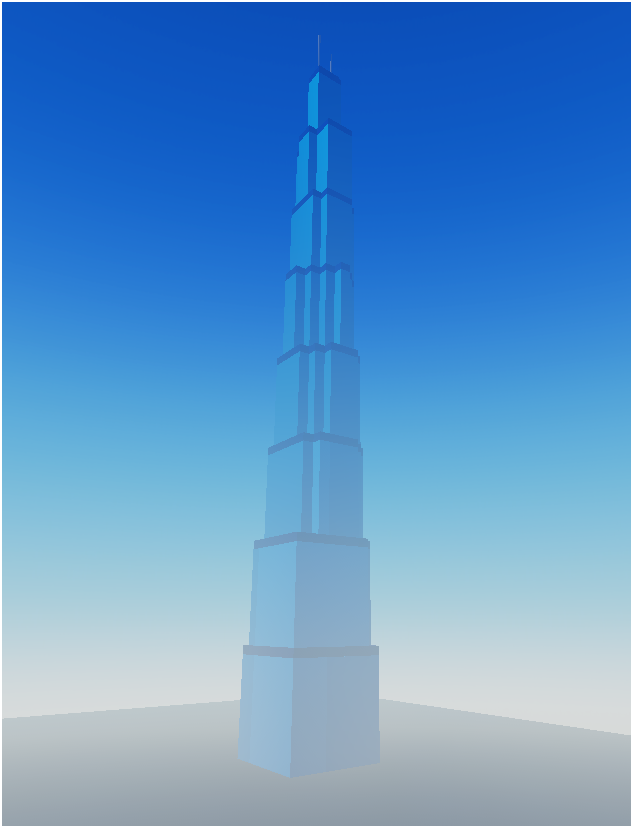
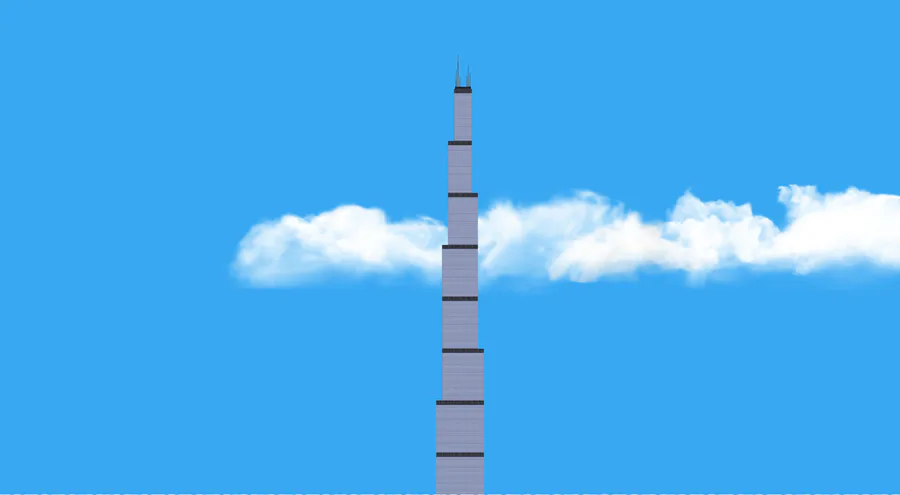
The visual identity of the tower balances structural safety with a clear aesthetic language. The building is divided into a strict color-coded system that maps out its glass facades, structural block divisions, primary pipelines, and high-altitude spires.
```
[Spires 1 & 2] ------------------------ #848F96 Matte Aerogel Silver Skin
|
[Crown Capsule: Floors 561-563] ------- #05060A Deep Velvet Black Solar Glass
#181919 Carbon-Ink Utility Pipes
|
[6-Floor Structural Outriggers] ------- #0A0C1B Midnight Blue Obsidian Glass
#232222 Dark Charcoal Utility Pipes
|
[64-Floor Primary Office Blocks] ------ #A6C2FE Periwinkle Ice Blue Glass
#677B89 Slate Industrial Gray Pipes
```
* **Primary Office & Living Blocks (64 Floors per Block):**
* **Glass Shielding:** **#A6C2FE (Periwinkle Ice Blue Glass)** coatings reflect intense high-altitude ultraviolet and infrared solar radiation, keeping the interior cool and protecting residents.
* **External Pipe Routing:** **#677B89 (Slate Industrial Gray Pipes)** route standard ambient utility lines, indicating low-to-medium pressure systems.
* **Structural Outriggers & Transition Belts (6 Floors per Block):**
* **Glass Shielding:** **#0A0C1B (Midnight Blue Obsidian Glass)** blocks visibility into the heavy machinery zones, housing the massive outrigger trusses and emergency refuge zones.
* **External Pipe Routing:** **#232222 (Dark Charcoal Utility Pipes)** carry high-pressure life-support lines and heavy water recycling loops across structural block divisions.
* **The Upper Crown Enclosure (3 Floors at Top Apex):**
* **Glass Shielding:** **#05060A (Deep Velvet Black Glass)** maximizes solar heat absorption at extreme heights, helping power the crown's de-icing and aerospace telemetry stations.
* **External Pipe Routing:** **#181919 (Carbon-Ink Utility Pipes)** carry ultra-high-pressure steam and hot water lines to clear snow and ice from the upper facade.
* **The Dual Spires Concept (Primary 131m / Secondary 89m):**
* **External Skin:** **#848F96 (Matte Aerogel Silver)** polyimide armor shields the broadcast arrays, lightning rods, and atmospheric telemetry equipment.
* **Deep Interior Spaces:** * Uses a unique palette of high-contrast colors (**#6366F1 Periwinkle Matte, #E5E7EB Chalk White, #6B7280 Flint Gray, #4338CA Royal Blue, #2563EB Hydro Blue, and #8B5CF6 Quantum Purple**) to improve visibility and navigation deep within the tower's core.



0 comments