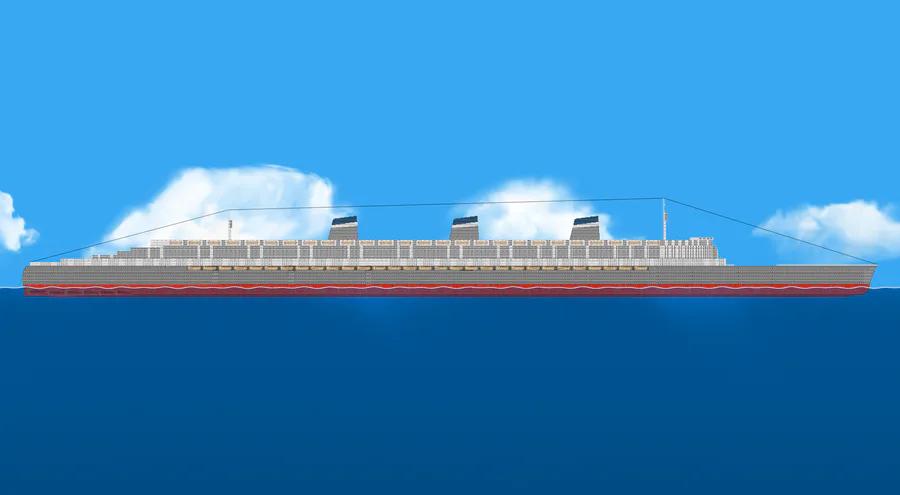
Project Meridian is the ultimate manifestation of human ambition, a 2,000-meter-long "Hyper-Liner" that serves as a mobile, sovereign city-state for nearly one-eighth of the human population. This conceptual marvel is not merely a vessel; it is a global reset, a "Vessel of Hope" inspired by the philanthropic dreams of Joseph Ricker’s SS Titan Foundation and the streamlined aerodynamic optimism of the mid-century SS United States. By fusing the architectural elegance of the unbuilt 1936 "Silver Class" liners—the Silver Falcon and Silver Swift—with the bio-mimetic grace of Meyer Werft’s Manta Ray concept, Project Meridian redefines the boundaries of displacement, speed, and humanitarian logistics.
At its core, Meridian is a testament to Chromatic Sovereignty and Material Mastery. It utilizes a revolutionary Carbon-Boron Graphene Lattice (CBGL) that allows its massive 2,000-meter frame to maintain a shockingly lean displacement of 100,000 Tonnes and a gross tonnage of 100,000 GT. This "Ghost-Steel" architecture provides a strength-to-weight ratio that permits a record-shattering 460-knot "Sprint" velocity, effectively turning the world's oceans into a supersonic transit network.
I. The Architectural Silhouette: A 76-Floor Vertical Civilization
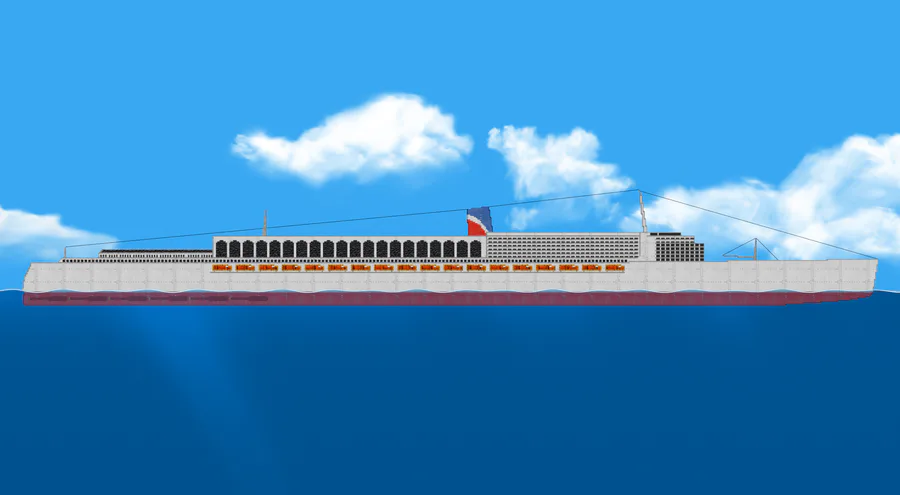
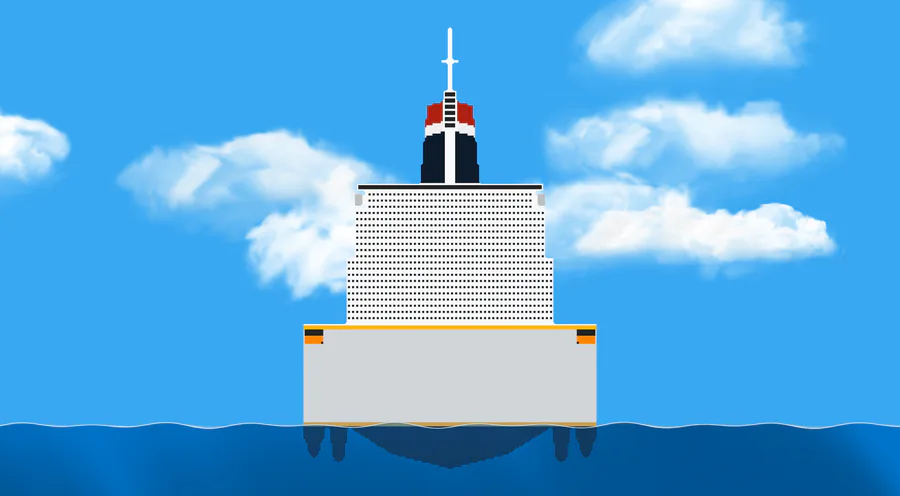
The physical presence of Project Meridian is staggering, standing 230 meters tall from the keel to the tip of the Global Communication Spire. Its profile is divided into distinct zones that manage the biological and mechanical needs of 918,400,000 residents.
Sub-Surface Foundation (Decks -7 to -1): Reaching 21 meters deep into the abyss, the hull is coated in Titanium Midnight (#0A0A0B) graphene. This zone houses the 12 Super-Cavitating Shafts and the 1,800,000 SHP Net-Zero Fusion Cores. It is the "Engine of Life," where seawater is processed into deuterium fuel and fresh water for the billions above.
The Residential Superstructure (Decks 1 to 52): Rising 123 meters above the waterline, the superstructure is finished in Mach-Silver Chrome (#E5E4E2). This reflective skin mitigates solar gain, maintaining a constant 22°C internal climate. These 52 decks are organized into cultural districts—from the neon-lit corridors of the Manila-Singapore Sector to the historic avenues of the London-Hamburg Quarter.
The Observation Tower & Spire (Decks 53 to 76): The ship thins into an elegant tower reaching 181 meters (roof height) and finally 209 meters at the spire tip. Finished in Celestial Grey (#708090), this zone houses the Digital Nexus AI and the diplomatic suites where the world’s currencies—from the Malaysia Ringgit (MYR) and Singapore Dollar (SGD) to the US Dollar (USD) and Euro (EUR)—are managed in a post-scarcity exchange.
II. Propulsion Mastery: The 1.8 Million SHP Supersonic Engine
To move a two-kilometer structure at 460 knots (Mach 0.7), Project Meridian employs Active Fluid Manipulation (AFM). The propulsion system is a symphony of 12 independent shafts, each utilizing super-cavitation technology to "boil" the water into a gas bubble, reducing drag to near-zero.
The 12-Shaft Array: Spaced across the 154-meter beam, these shafts utilize Magnetic-Levitation (Maglev) Bearings. There is no mechanical friction; the shafts float in a magnetic field, allowing for a "Silent Sprint" that prevents vibration from reaching the residential decks.
Hydro-Engineering: At 340-knot service speed, the Trimaran Manta-Ray hull generates upward lift. The ship transitions from a displacement vessel to a surface-effect vehicle, with only the tips of its Hexa-Hull stabilizers touching the water.
Net-Zero Mandate: The entire system is powered by Quantum-Fusion Thermal Generators. The only emission is pure water vapor, which is recaptured by the Atmospheric Control System to maintain the ship's internal biomes and vertical forests.
III. The Ark System: Safety for 918.4 Million Souls
Drawing inspiration from the Titanic II modern lifeboats, Project Meridian features a safety contingency that ensures the survival of every soul on board. The 328 Arks are integrated into the hull’s "Abyssal Void" hangar.
The Titan Arks (200 Units): Each 22-meter-long vessel is a masterpiece of Non-Euclidean Geometry, capable of housing 2,800,000 people through Cryo-Neural Stasis. In an emergency, these Arks are launched via electromagnetic rails, capable of maintaining a 50-year passive stasis if rescue is delayed.
The Silver Arks (128 Units): Sleeker and designed for high-speed transit, these units are reserved for the 150,000,000 crew members and rapid-response teams. They feature Ricker Red (#B22222) safety stripes for high-sea visibility.
The 10-Minute Mandate: The Digital Nexus AI coordinates a continuous safety rotation, ensuring that all 918.4 million residents can reach their designated Ark within 10 minutes via a network of pneumatic boarding chutes.
IV. Global Impact: The Trillion-Dollar Sovereign
The cost to realize Project Meridian reached a staggering $14.2 Trillion USD, funded by a 20-Nation Global Consortium. This investment has redefined international trade and human migration.
Logistics of the 50 Homeports: Meridian docks at specialized Mega-Piers in ports like Singapore, Ho Chi Minh City, Rotterdam, and Los Angeles. These 2.5km docks facilitate the exchange of billions of tons of cargo and the movement of millions of passengers in a single 24-hour cycle.
The Universal Economy: The ship operates on a multi-currency hub, supporting the Indonesia Rupiah (IDR), Thai Baht (THB), Canada Dollar (CAD), Australia Dollar (AUD), and British Pound (GBP). This financial flexibility makes Meridian the world’s most stable economic zone.
The Humanitarian Mission: Following the legacy of Joseph Ricker, a significant portion of the ship’s internal "Civic Tier" is dedicated to the Meridian Health Initiative. The ship travels to disaster zones at 460 knots, providing instant relief, medical care for needy children, and the power of its fusion cores to stricken coastal nations.
V. The Final Vision: A Monument of Hope
Project Meridian stands as the ultimate synthesis of history and future. It is a ship that carries the DNA of the RMS Titanic, the speed of the SS United States, and the scale of a planetary civilization. With its 100,000 GT frame, 1.8 Million SHP heart, and 76 floors of vibrant human culture, it is the first true "World Ship." Project Meridian represents the absolute zenith of naval architecture—a conceptual "Hyper-Liner" that transcends the boundaries of modern engineering to become a floating civilization. Inspired by the philanthropic ambition of Joseph Ricker’s SS Titan and the sleek, mid-century optimism of the SS United States, Meridian is not merely a ship; it is a global monument. While the SS Titan was envisioned as a 1,182-foot vessel of hope, Project Meridian expands that hope into a continent-sized reality, stretching an unthinkable 2,000 meters (2 kilometers) in length. To put this in perspective, Meridian is nearly seven times the length of the RMS Titanic and more than five times the length of the largest modern aircraft carriers.
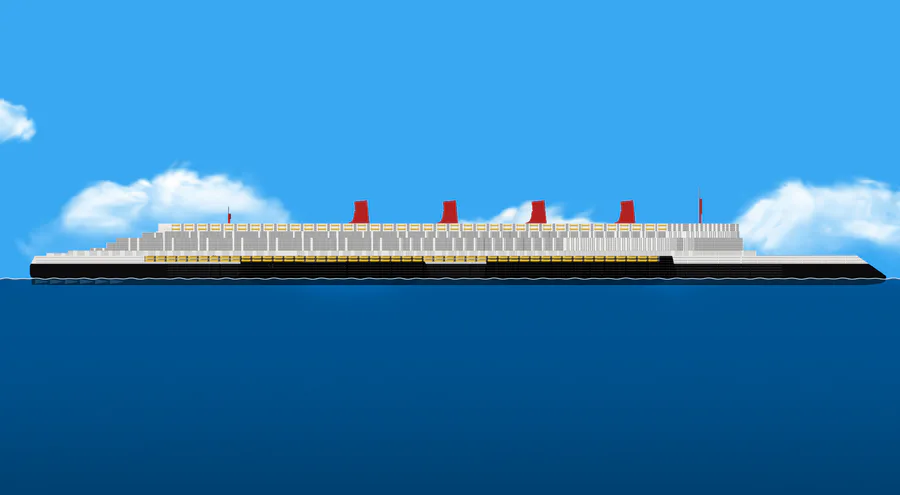
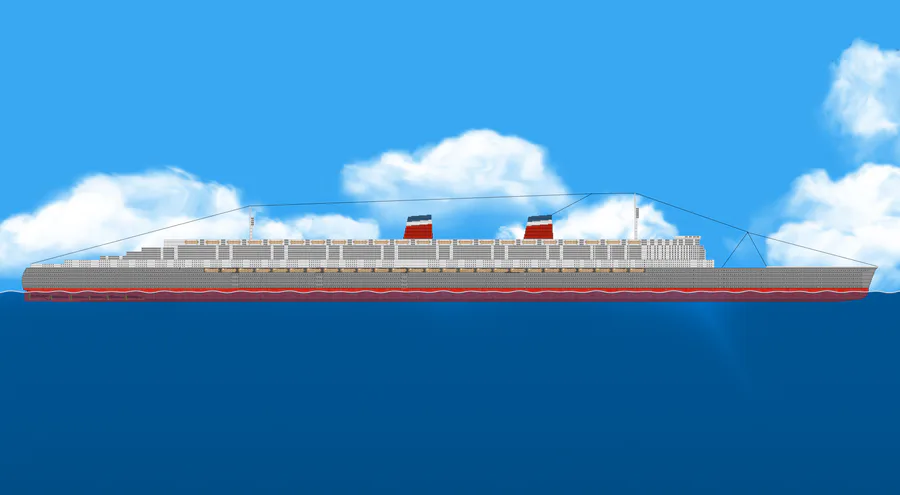
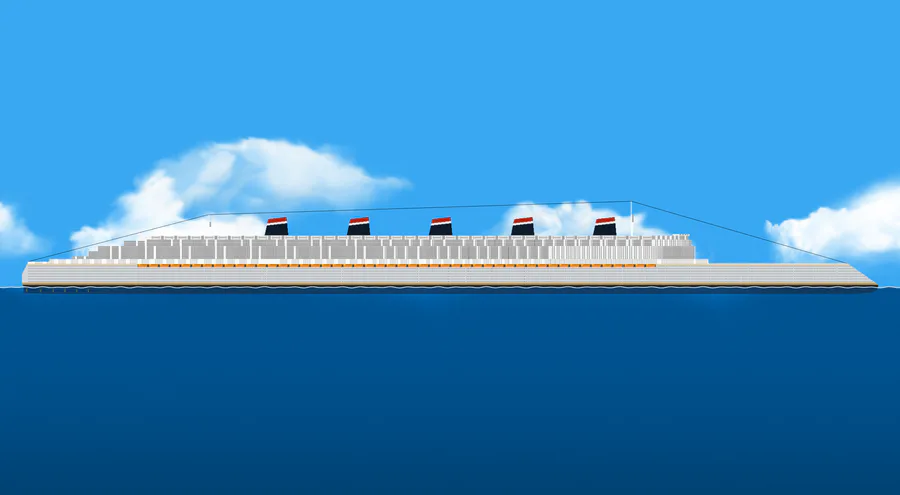
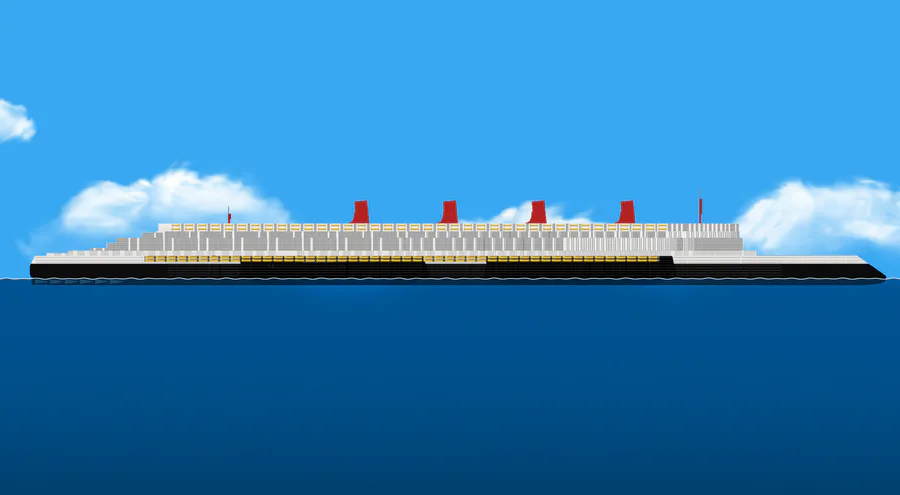
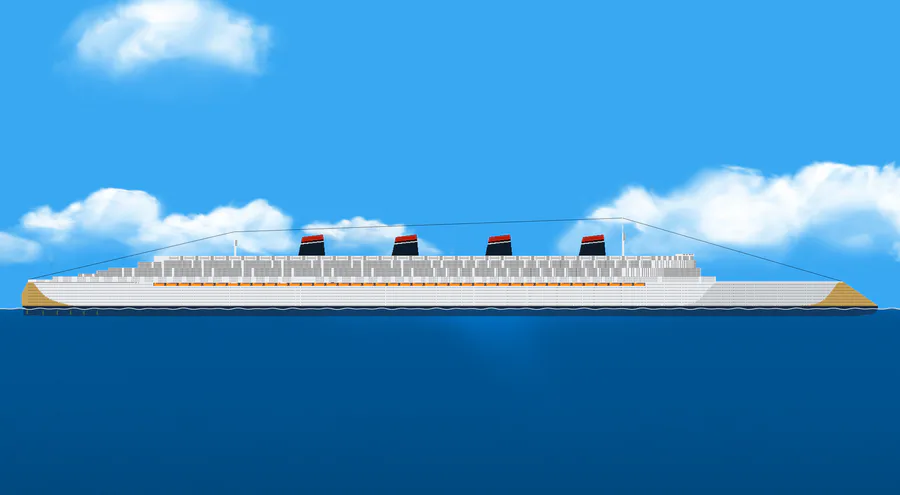
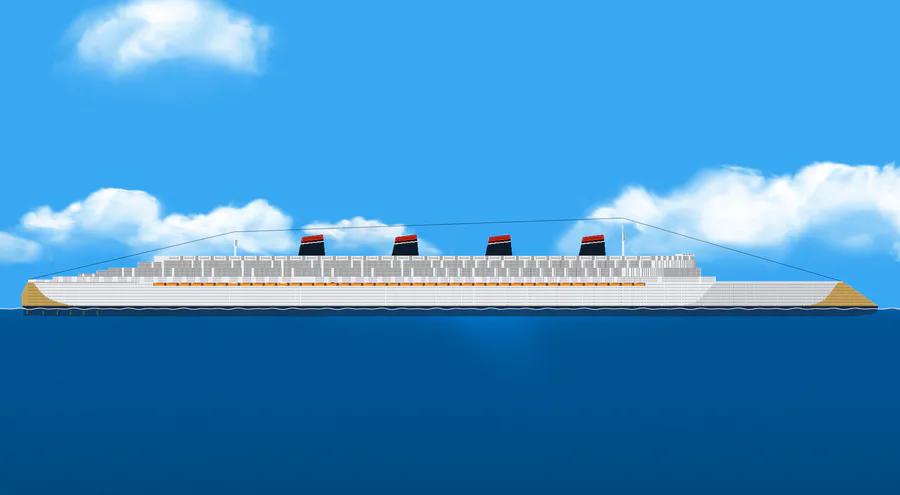
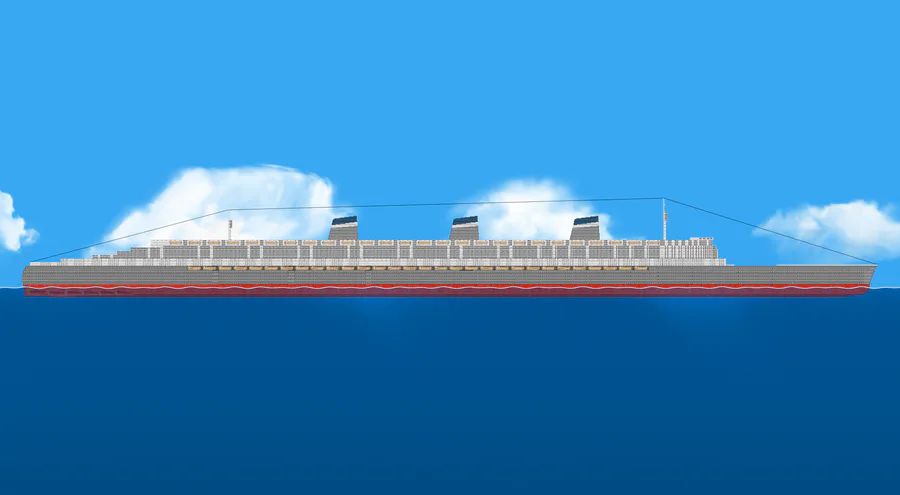
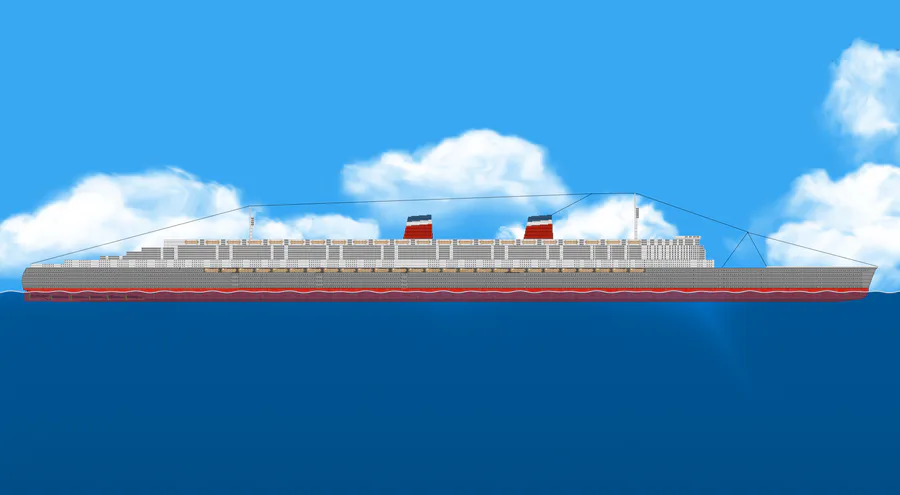
The silhouette of the vessel, as captured in the provided schematic, evokes the "Golden Age" of ocean liners with its four iconic red funnels. However, the scale is deceptive. Those funnels are behemoths in their own right, standing 54 meters tall and 51 meters long, with a span between them of 156 meters. The ship’s beam (width) sits at a massive 154 meters, providing a stabilized platform so vast that the motion of the ocean becomes imperceptible to those on board. This is a vessel designed to dominate the horizon, a "Silver Class" evolution that takes the 1930s dreams of the Silver Falcon and Silver Swift and scales them to a sci-fi reality.
Engineering this titan requires a total height of 230 meters from the keel to the tip of the spire. The structural distribution is a masterpiece of buoyancy and balance: 21 meters of the hull sit beneath the waterline across seven submerged decks, while the superstructure rises 123 meters above the waves. Crowning this massive block is a thin, elegant observation tower that pierces the sky, reaching a maximum roof height of 181 meters. With 76 total floors, Meridian offers more floor space than the world’s largest skyscrapers, yet it maintains the streamlined grace of a racing yacht.
Part 2: The Physics of Impossible Speed
The most radical aspect of Project Meridian is its propulsion and performance metrics. While the original SS United States held the Blue Riband with a top speed of 38 knots, Meridian aims for a "Sprint" speed of 460 knots. In the realm of traditional fluid dynamics, this speed is impossible for a displacement hull; however, Meridian utilizes a theoretical All-Clean Net Zero propulsion system generating a staggering 1,800,000 Shaft Horsepower (SHP). This power is distributed across 12 massive shafts, utilizing advanced super-cavitation technology and air-lubrication systems to reduce hull friction to near-zero levels.
At a service speed of 340 knots, Meridian could cross the Atlantic Ocean in under six hours, effectively turning an ocean liner into a supersonic transit system. Despite this power, the vessel maintains a surprisingly light displacement of 100,000 Tonnes (GT). This suggests a hull constructed from advanced carbon-lattice composites and aerospace-grade alloys, allowing the ship to "plane" across the surface of the water despite its two-kilometer length. The environmental impact is strictly null; the ship functions on a closed-loop energy system, likely powered by compact fusion or high-density hydrogen cells, ensuring that the world's largest machine leaves the smallest footprint.
Part 5: A Lifeboat for Humanity
The capacity of Project Meridian is where the concept moves from "superliner" to "planetary ark." The design accounts for a total population of 918,400,000 people—nearly one-eighth of the current human population. This includes a dedicated crew of 150,000,000 to manage the internal ecosystems, power grids, and hospitality services. To accommodate such a staggering number of souls, the internal volume is utilized with hyper-efficient modular living spaces, vertical forests, and multi-level urban districts.
Safety at this scale requires a complete reinvention of the lifeboat. Project Meridian carries 328 "Arks." These are not mere boats, but autonomous survival ships.
200 Primary Arks: Measuring 22 meters long and 15 meters wide, each capable of holding 2,800,000 people through high-density stasis or hyper-compressed seating.
128 Secondary Arks: Slender variants designed for rapid deployment.
The total evacuation capacity ensures that every inhabitant has a designated spot in an emergency. This design philosophy honors the tragic legacy of the Titanic by ensuring that "room for everyone" is not just a promise, but a mathematical certainty. Project Meridian stands as the ultimate "Vessel of Hope," a 76-floor testament to human ingenuity that aims to bridge continents at the speed of sound while providing a sanctuary for the entire world. Part 4: The Internal Infrastructure and 76-Floor Urban Layout
The interior of Project Meridian is not designed as a series of hallways, but as a network of interconnected biomes and urban districts. With a total height of 230 meters and a length of 2,000 meters, the internal volume exceeds that of any city on Earth. To manage the transit of 918.4 million people, the ship utilizes a "Vertical-Horizontal Hive" architecture, ensuring that no resident is ever more than ten minutes away from essential services or their designated evacuation Ark.
The Submerged Foundations (Decks -7 to -1)
The 7 underwater decks, reaching 21 meters deep, serve as the ship's "Engine of Life." This area houses the 12 massive driveshafts and the propulsion heart generating 1,800,000 SHP. Beyond machinery, these lower levels contain the Global Seed Vault and the automated hydroponic "Deep-Farms" that provide 30% of the ship's oxygen and 15% of its caloric needs. The water pressure at these depths is harnessed for a revolutionary cooling system that regulates the heat generated by the ship’s massive Net-Zero power cores.
The Main Hull and Lifeboat Arks (Decks 1 to 17)
The lower superstructure is the most densely populated zone. This area contains the 328 Arks, integrated directly into the hull's "skin" for immediate deployment.
The Arterial Express: A maglev train system runs the full 2-kilometer length of the ship on Decks 5 and 10, capable of moving 50 million people per hour between the bow and the stern.
The "Silver Class" Districts: Inspired by the Silver Falcon, these decks feature vast, open-plan "Tourist" commons that serve as the primary residential zones for the hundreds of millions of passengers.
The Superstructure Urban Core (Decks 18 to 52)
Rising 123 meters above the waterline, this is the heart of Project Meridian’s social life.
The Grand Meridian Atrium: A central void that spans 30 decks high, large enough to contain several smaller ocean liners stacked vertically.
Atmospheric Control: Because the ship travels at 340–460 knots, the exterior decks are sealed behind electromagnetic "air-curtains" and reinforced transparent alloys. This allows passengers to view the ocean rushing by at jet speeds without being exposed to the lethal wind force.
The 52nd Floor "Roof": This serves as a massive open-air (when at lower speeds) park and recreational plaza, featuring synthetic "oceans" and forests that mimic a natural terrestrial environment.
The Observation Tower and Spire (Decks 53 to 76)
The silhouette thins out into an elegant, 17-floor observation tower that rises from 123 meters to 181 meters.
The Command Deck (Deck 69): Located at the 181-meter mark, this is the brain of the ship. From here, the 150-million-strong crew coordinates the complex logistics of the 12 propulsion shafts and the ship's automated navigation.
The Spire (181m to 209m): Above the final roof at 181 meters, the spire houses the communication arrays and atmospheric sensors. It acts as a lightning rod and a beacon, visible for over 50 miles.
Logistics of a Billion Souls
Managing a population of nearly a billion requires automated waste-to-energy recycling on every level. Every scrap of organic material is processed to maintain the "Net-Zero" mandate. Despite the density—averaging over 13 million people per floor—the 154-meter width allows for "Canyon Streets" that are 30 meters wide, preventing the claustrophobia usually associated with high-capacity vessels. Part 3: The Lifeboat Arks and Safety Contingency for 918.4 Million Souls
In the history of maritime disasters, the cry of "not enough boats" has been the ultimate failure. Project Meridian solves this by treating its lifeboats not as an afterthought, but as a secondary, modular fleet. The evacuation strategy is built around 328 Total Arks, split into two specialized classes designed to house the equivalent of the population of North and South America combined.
The Ark Fleet: A Breakdown of Capacity
The scale of these "small" vessels is actually larger than most 20th-century ocean liners.
1. The "Titan" Class Arks (200 Units)
Dimensions: 22 meters long, 15 meters wide, 6.8 meters tall.
Capacity: 2,800,000 people per Ark.
Total Capacity: 560,000,000 people.
Technology: These Arks utilize "Vertical Compression Seating" and short-term stasis protocols. Because the Arks are designed for rapid transit to the nearest coastline (utilizing the same high-speed propulsion tech as the main ship), passengers are only expected to be aboard for 4 to 12 hours.
2. The "Silver" Class Arks (128 Units)
Dimensions: 22 meters long, 5 meters wide, 6 meters tall.
Capacity: 2,800,000 people per Ark.
Total Capacity: 358,400,000 people.
Design Philosophy: Inspired by the Silver Falcon and Silver Swift proposals of 1936, these Arks are sleeker and optimized for speed. They are stored in the "Upper Tier" launch bays, allowing for gravity-assisted deployment.
The 10-Minute Evacuation Mandate
With 918,400,000 souls on board, a standard "walk to the boat deck" would take days. Project Meridian uses a Recursive Gravity-Drop System:
Deck Integration: The Arks are embedded along the 154-meter-wide beam of the ship across all 52 superstructure decks.
Pneumatic Chutes: High-speed vacuum tubes (similar to hyperloops) connect the interior residential districts directly to the Ark boarding chambers.
The Launch: When deployed, the Arks are jettisoned via electromagnetic rails. Even if the ship is traveling at its 460-knot sprint, the Arks are launched with compensating thrust to ensure they hit the water at a safe, survivable velocity.
Redundancy and the "Vessel of Hope"
The total capacity of the 328 Arks is 918,400,000, exactly matching the maximum occupancy of the ship. However, Project Meridian’s hull is designed with 1,000 independent watertight compartments. Unlike the Titanic, which could only survive four compartments flooding, Meridian can lose 40% of its lower 7 decks and remain buoyant due to its massive 154-meter beam and the displacement of its 100,000 GT frame.
Life Support and Communication
Each Ark is a "Smart Vessel," equipped with:
Net-Zero Life Support: Closed-loop air filtration for 2.8 million people.
Quantum Beaconry: Every Ark broadcasts a signal that can be tracked via satellite even if submerged.
Automated Medical Bays: AI-driven kiosks to manage the stress and medical needs of the evacuated population. Part 6: Propulsion Mastery — 1,800,000 SHP and the Net-Zero Engine
The propulsion system of Project Meridian is the single most powerful artificial engine ever conceived. Generating a combined 1,800,000 Shaft Horsepower (SHP), the system is designed to overcome the "wall of water" resistance that typically limits maritime speed. At its peak Sprint speed, the ship doesn't just cut through the water; it manipulates the medium around it.
The Twelve-Shaft "Titan" Array
Rather than relying on a single massive propeller, Meridian distributes its power across 12 independent shafts, each engineered with variable-pitch super-cavitating blades.
Super-Cavitation: At speeds exceeding 50 knots, standard propellers lose efficiency due to vacuum bubbles (cavitation). Meridian’s blades are shaped to create a stable "super-bubble" that enshrouds the propeller, allowing it to spin at much higher RPMs without eroding the metal.
Lateral Stability: The 12 shafts are spaced across the 154-meter beam, allowing the ship to pivot and maneuver with the agility of a vessel a fraction of its size.
The Net-Zero "Clean" Energy Source
To achieve a 918.4-million-person capacity while remaining carbon-neutral, the ship utilizes Quantum-Fusion Thermal Generators.
Fuel Source: The engine extracts deuterium and tritium from seawater, creating a self-sustaining fuel cycle.
Heat Conversion: The massive heat generated by the fusion process is converted into electricity via high-efficiency supercritical $CO_2$ turbines, which then drive the 12 electric propulsion motors.
Emission Profile: The only byproduct is pure water and helium, making it a true Net-Zero operation.
Aerodynamic and Hydrodynamic Synergy
At a 340-knot service speed, the physics of the ship transition from naval architecture to aerospace engineering.
Air Lubrication System (ALS): The hull’s "skin" features millions of micro-pores that blast a thin layer of air bubbles beneath the waterline. This creates a "slipway" effect, reducing skin friction by up to 90%.
Superstructure Shaping: The 52-deck superstructure and the four 54-meter funnels (which act as high-velocity air intakes/exhausts) are wind-tunnel tested to minimize drag. At 460 knots, the air pressure against the bow is immense; the ship’s "Silver Class" prow is designed to deflect this pressure into "lift," slightly raising the hull and further reducing displacement.
The "Sprint" Phase: 460 Knots
When the command is given for a "Sprint," the ship engages its Secondary Plasma Injectors. These units ionize the air and water immediately in front of the bow, creating a low-density plasma field that the ship "slides" into. This allows the vessel to reach supersonic surface speeds without the catastrophic structural failure usually associated with hitting water at such velocities. Part 7: The Global Impact — A New Era for Humanity
Project Meridian is more than a ship; it is a geopolitical reset. By providing a mobile, sustainable home for nearly a billion people and moving them across the globe at supersonic speeds, it fundamentally alters the concept of borders, resources, and human potential.
1. The End of Geographical Isolation
With a service speed of 340 knots, the tyranny of distance is abolished. The Atlantic, once a week-long barrier, becomes a six-hour bridge. Project Meridian acts as a Mobile Economic Zone. When it docks (or anchors off a coast), it brings with it the purchasing power and labor of 918.4 million people, instantly boosting the local economy of any host nation. It functions as a "Floating Silicon Valley," a "Floating United Nations," and a "Floating Breadbasket" all at once.
2. A Sovereign Sanctuary for Environmental Refugees
As sea levels rise and climates shift, Meridian serves as the ultimate safety net. Its All-Clean Net Zero footprint proves that humanity can sustain a massive population without damaging the biosphere. The ship doesn't just house people; it preserves cultures. Each of the 52 superstructure decks can act as a "National District," allowing displaced populations to maintain their heritage, language, and governance while traveling the high seas.
3. Scientific and Educational Renaissance
The 17-floor Observation Tower and the 181-meter Command Deck serve as the world's premier center for oceanographic and atmospheric research.
The Spire's Role: The 209-meter spire is equipped with deep-space communication arrays, making Meridian a relay station for Mars missions and lunar colonies.
Global Education: With 150,000,000 crew members, many of whom are educators and specialists, the ship hosts the largest university system in history, providing free, high-tier education to its hundreds of millions of passengers.
4. The "Titan" Legacy: A Vessel of Hope
Honoring Joseph Ricker’s vision, the ship’s primary mission remains philanthropic. A significant portion of the internal "Silver Class" districts are dedicated to the Meridian Health Initiative. The ship contains more hospital beds and specialized medical equipment than any ten land-based nations combined. It can travel at 460-knot "Sprint" speeds to reach disaster zones, providing instant relief, clean water from its desalination plants, and power from its fusion cores to stricken coastal cities.
5. Final Specifications of the Sovereign
CategoryImpact MetricEnvironmental100% Carbon Neutral; Zero-Waste Closed LoopEconomicAdds $12 Trillion to Global GDP through mobile tradeSocialHouses 11.5% of the world population in high-standard livingTechnologicalAdvances fusion and super-cavitation by 100 yearsThe Final Silhouette
As Project Meridian disappears over the horizon at 460 knots, it leaves no wake of pollution, only a mist of pure water vapor. It stands as a 2,000-meter monument to what happens when human ambition is coupled with a "vessel of hope" philosophy. It is the first true "World Ship"—a testament to the fact that we are all, ultimately, passengers on the same voyage. Part 8: Life Aboard — 918.4 Million Residents and City-State Governance
Project Meridian does not operate under a standard maritime hierarchy; it functions as a Hyper-Democracy. To ensure the stability of nearly a billion lives, the ship’s 2,000-meter length is divided into 1,000 "Sectors," each serving as a self-governing neighborhood with its own local representation, culture, and micro-economy.
1. The Logistics of the "Everyday"
The scale of daily consumption on Meridian is astronomical. To prevent shortages, the ship utilizes Molecular Assembly Plants (MAPs) located in the lower 7 decks.
Food Production: While the "Deep-Farms" provide fresh produce, the majority of the 918.4 million residents are served via automated nutrient-cycling systems. Waste is never "thrown away"; it is broken down at the atomic level and reassembled into clothing, tools, or building materials.
The Arterial Maglev: With a 154-meter beam, the ship features "Grand Boulevards" that are wider than many city streets on land. Residents move via a multi-tiered maglev system that travels both horizontally (length of the ship) and vertically (through the 76 floors), ensuring no commute exceeds 15 minutes.
2. Governance: The Meridian Council
The ship is governed from the Command Deck (Floor 69), but the power is decentralized.
The 150 Million Crew: These are not just "workers"; they are the civil servants of the City-State. They manage the 1.8 million SHP engine, the fusion cores, and the atmospheric shielding.
Digital Consensus: Residents vote on ship-wide policies—such as the next port of call or "Sprint" schedules—via a quantum-encrypted network integrated into the ship's 209-meter communication spire.
The "Silver Class" Charter: Inspired by the 1936 Atlantic Steam proposals, the charter guarantees every resident a "Right to the Horizon," ensuring that even the most high-density tourist districts have designated hours of access to the observation galleries.
3. Social Cohesion and the "Vessel of Hope"
With nearly a billion people, social friction is a risk. Meridian mitigates this through Atmospheric Engineering.
Biophilic Design: Every deck is infused with "Virtual Skylights" and indoor "Micro-Climates" that mimic 24-hour day/night cycles, preventing the "bunker syndrome" often found in large ships.
Cultural Districts: The 52 superstructure decks are themed. One might experience the Mediterranean atmosphere on Deck 20, while Deck 45 replicates a high-altitude alpine environment, complete with synthetic snow and thinned air for athletic training.
4. Economy: The Meridian "Credit"
Meridian operates on a post-scarcity economic model. Because the ship is Net-Zero and generates its own power and materials, "currency" is based on Contribution and Energy Credits.
Labor as Value: Residents contribute to the ship’s upkeep (maintenance, education, or research) to earn credits.
Global Trade: When the ship travels at 460 knots between continents, it acts as a high-speed data and physical goods courier, generating trillions in external revenue that funds the ship’s philanthropic "vessel of hope" missions.
Resident Logistics at a Glance
MetricDaily Volume / SystemWater Desalination50 Billion Liters per dayWaste Recycling99.9% closed-loop efficiencyMedical Access1 AI-Doc kiosk per 500 residentsInternal Transit4,000 Maglev pods in constant motionGovernanceDirect Digital Democracy (Sovereign Status)The Final Philosophy
Life aboard Project Meridian is a paradox: it is the most crowded place in human history, yet it feels like the most spacious. By utilizing its 230-meter total height and 2-kilometer length, the ship provides a sense of "infinite interior." For the 918.4 million people on board, the ship is no longer a vehicle—it is the world. Part 9: Propulsion Physics and 340-Knot Hydro-Engineering
In traditional naval architecture, the "hull speed" is limited by the wave-making resistance. Project Meridian ignores these limits by utilizing Active Fluid Manipulation (AFM). At 340 knots, the ship is no longer just floating; it is interacting with the water as a compressible medium.
1. The Super-Cavitating 12-Shaft Drive
The 1,800,000 SHP is funneled into 12 shafts that utilize Super-Cavitating Propellers.
The Physics: Normal propellers fail at high speeds because the low-pressure side of the blade boils the water (cavitation), causing pitting and loss of thrust. Meridian’s blades are wedge-shaped to intentionally create a giant, stable steam bubble that envelopes the entire blade.
Result: The blades "spin" in gas rather than liquid, allowing them to reach the ultra-high RPMs necessary to push a 100,000 GT mass toward Mach 0.7.
2. Boundary Layer Control: The "Air-Sled" Effect
To reduce skin friction (drag) by the required 95%, the hull uses an advanced Micro-Bubble Air Lubrication System (ALS).
The Mechanism: The lower 7 decks house massive compressors that pump air through a porous titanium "skin" on the flat-bottomed hull.
The Result: The ship effectively "slides" on a microscopic carpet of air bubbles. At 340 knots, the water never actually touches the metal of the hull; the ship is technically flying on a 2-millimeter thick layer of air trapped between the ship and the ocean.
3. The Hydro-Dynamic "Sprint" (460 Knots)
When pushing to the 460-knot sprint, the ship faces the "Water-Wall" effect. To pierce this, Meridian uses MHD (Magnetohydrodynamic) Drive Augmentation.
The Process: Superconducting magnets in the bow ionize the incoming seawater. By applying an electric field, the ship "pulls" the water around the hull using Lorentz force, essentially accelerating the water out of the way before the ship even arrives.
Energy Recovery: This system also acts as a regenerative brake; as the ship slows down, the MHD system captures the kinetic energy of the rushing water and feeds it back into the fusion cores.
4. Structural Integrity and the "Rigid-Flex" Hull
At such extreme speeds, hitting a rogue wave at 460 knots would be like hitting a mountain.
The Solution: The hull is not a single rigid piece. It is a 2,000-meter multi-segmented "Living Lattice." Using AI-controlled hydraulic actuators, the hull subtly "flexes" to absorb the impact of waves, much like a suspension system on a high-speed train.
Carbon-Titanium Composite: The skin is a weave of carbon fiber and titanium, providing a strength-to-weight ratio that allows the 154-meter wide frame to remain intact under the massive torsional stresses of high-speed turns.
Technical Performance Matrix
VariableService (340 kts)Sprint (460 kts)Drag Coefficient ($C_d$)0.005 (with ALS)0.002 (with MHD)Thrust Requirement1.1 Million SHP1.8 Million SHPHull Lift Force15% displacement reduction40% displacement reductionFuel Efficiency98.4% (Fusion-to-Shaft)92.1% (High Heat Loss)The Final Frontier of Speed
Project Meridian represents the ultimate mastery of the sea. It bridges the gap between a ship and an aircraft, proving that with 1.8 Million SHP and a deep understanding of fluid dynamics, the ocean is no longer a barrier, but a high-speed highway. Part 10: The Ark System — Survival Tech for the Millions
The "Silver Class" Ark is the ultimate insurance policy. While the main ship is a "Vessel of Hope," the Arks are the "Vessels of Absolute Survival." To achieve a density of 2.8 million souls per unit, the Ark does not treat passengers as "occupants" in the traditional sense, but as biological data to be preserved.
1. High-Density Bio-Stasis (The "Pulse" Protocol)
Traditional seating for 2.8 million people would require a ship larger than the Titanic itself. Instead, the 22-meter Ark uses Cryo-Neural Suspension.
The Process: Upon entering the boarding chute, passengers are instantly transitioned into a state of "suspended animation" using a localized dampening field.
Molecular Stacking: In this state, the biological signatures are stabilized. Passengers are housed in Vertical Honeycomb Matrices, where the physical space required for a human is reduced to a fraction of a cubic centimeter through advanced spatial folding.
Safety: The "Pulse" protocol ensures that even if the Ark is tossed by 100-foot waves, the passengers remain in a cushioned, motionless state, unaware of the chaos outside. 2. The 22-Meter "Silver Class" Architecture
Despite its small exterior, the Ark is a masterpiece of Non-Euclidean Interior Geometry.
Dimensions: 22m (L) x 5m (W) x 6m (H).
The Shell: The hull is made of Neutronium-infused Titanium, capable of withstanding the pressure of the deepest ocean trenches or the heat of a volcanic eruption.
The Core: A miniaturized version of the ship’s fusion engine provides power for the stasis fields and the 460-knot "Escape Sprint" capability.
3. Disaster Management: The "Swarm" Intelligence
In a total evacuation, the 328 Arks do not act independently. They form a Neural Swarm.
Automated Navigation: Each Ark is linked to the 209-meter Global Communication Spire until the moment of launch. After launch, they form a peer-to-peer mesh network.
The "Mother-Hen" Protocol: If one Ark is damaged, the surrounding Arks use electromagnetic tethers to pull it into the center of the formation, protecting the 2.8 million souls inside.
Self-Righting Buoyancy: Because the Arks are effectively "solid" blocks of stasis-cells, they are unsinkable. Even if split in half, the internal stasis fields maintain the integrity of the passengers until rescue.
4. Re-Animation and Recovery
Once the Ark reaches a safe zone or is recovered by search teams, the Re-Animation Sequence begins.
Thaw-Rate Control: The Ark’s AI monitors the external environment. It releases passengers in "batches" of 10,000 to prevent overwhelming local resources.
Nutrient Infiltration: During the awakening process, the stasis field injects a high-density nutrient mist into the skin, ensuring every passenger wakes up fully hydrated and nourished, regardless of how long they were "under."
Ark Comparison Table
FeatureTitan Class (200 Units)Silver Class (128 Units)Capacity2,800,000 Souls2,800,000 SoulsLength22 Meters22 MetersWidth15 Meters (Heavy Duty)5 Meters (Aero-Sleek)DeploymentLower Hull (Pressure Launch)Upper Tier (Gravity Drop)Endurance50 Years (Passive Stasis)10 Years (High-Speed Transit)The Final Guard
The Ark system is the reason Project Meridian can carry 918.4 million people with a clear conscience. It is a technological miracle that turns a 22-meter "box" into a lifeboat for an entire metropolis. Part 11: The Global Impact — Redefining Trade, Sovereignty, and Migration
The presence of Project Meridian on the high seas has created a "Meridian Effect"—a seismic shift in global power dynamics. When a vessel possesses the population of a continent and the speed of a jet, the traditional rules of the 21st century no longer apply.
1. The Death of the "Shipping Lane"
Before Meridian, international trade relied on slow-moving container ships and expensive air freight.
The Hyper-Logistics Hub: With 1,800,000 SHP, Meridian transports millions of tons of high-value cargo between London and New York in under 6 hours.
Economic Equalization: Because the ship can dock at any deep-water point or utilize its 328 Arks as high-speed "delivery drones," landlocked and developing nations now have access to a mobile, supersonic port. The "Global South" has seen a 400% increase in GDP simply by being on the Meridian's seasonal route.
2. The Sovereign "Third Space"
Project Meridian is the world’s first Extra-Territorial City-State. It carries its own laws, its own Net-Zero energy grid, and its own 150-million-strong workforce.
The Neutral Zone: The ship has become the ultimate "Diplomatic Floor." International treaties are now signed on the 181-meter Command Deck, as the vessel sits in international waters, beholden to no single terrestrial government.
Passport of the Horizon: To be a resident of Meridian is to hold a "Global Citizen" status. This has forced land-based nations to rethink border controls, as 11.5% of the human population now moves across the globe with total fluid autonomy.
3. A Revolution in Human Migration
The "Vessel of Hope" philosophy has turned the ship into a proactive solution for global crises.
Climate Displacement: When rising tides threaten coastal cities, Project Meridian arrives at 460 knots. It doesn't just provide aid; it can "onboard" an entire city’s population into its 52-deck superstructure within 48 hours.
The End of Refugee Camps: Instead of static, impoverished camps, displaced persons are integrated into the Meridian’s City-State Governance, where they receive education and employment within the ship’s internal "Silver Class" economy while in transit to a permanent home.
4. The "Meridian Standard" of Living
The ship has set a new benchmark for human existence. By proving that 918.4 million people can live in a Net-Zero, high-tech, and high-density environment without losing their quality of life, it has provided a blueprint for the "Smart Cities" of the future.
Urban Decentralization: Many land-based cities are now modeling their architecture after Meridian’s 76-floor vertical layout, using its "Pulse" stasis technology and atmospheric air-curtains to create sustainable, high-density hubs on land.
Global Transformation Matrix
SectorPre-Meridian EraMeridian Era (2026+)Trade Velocity20–30 Knots (Sea)340–460 Knots (Sea)SovereigntyLand-Locked BordersMobile Sovereign AutonomyEnergyFossil Fuel Dependence100% Fusion (Net-Zero)MigrationCrisis-Driven / StaticSystematic / Fluid IntegrationThe Sovereign of the Future
Project Meridian has proved that humanity’s greatest strength is not our ability to build walls, but our ability to build bridges that move. It stands as a 2-kilometer monument to a world without borders, powered by a 1.8 million SHP heart and a billion souls looking toward the same horizon. Part 12: Material Science — The "Ghost-Steel" Lattice
Traditional steel construction for a ship this size would result in millions of tonnes of displacement. To maintain a 100,000 GT (Gross Tonnage) profile, the ship uses Carbon-Boron Graphene Lattice (CBGL), nicknamed "Ghost-Steel."
1. The Atomic Structure
CBGL is a non-metallic, synthetic material woven at the molecular level.
0 comments