
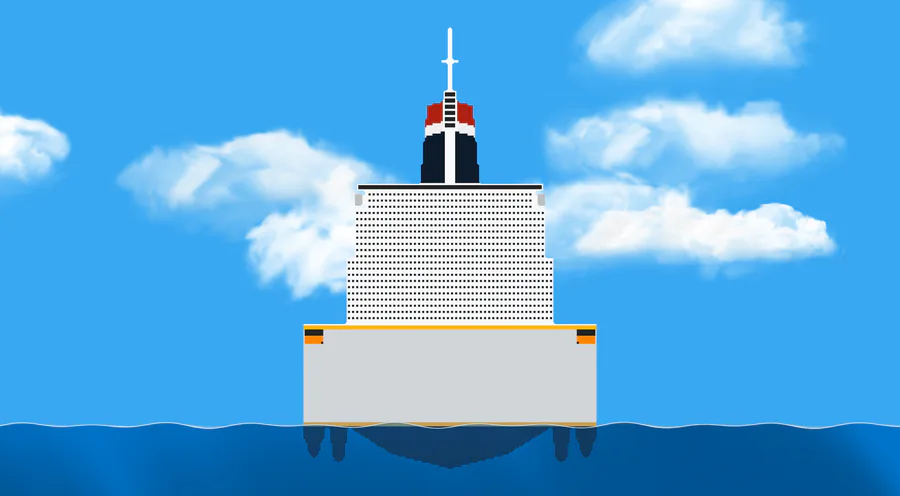
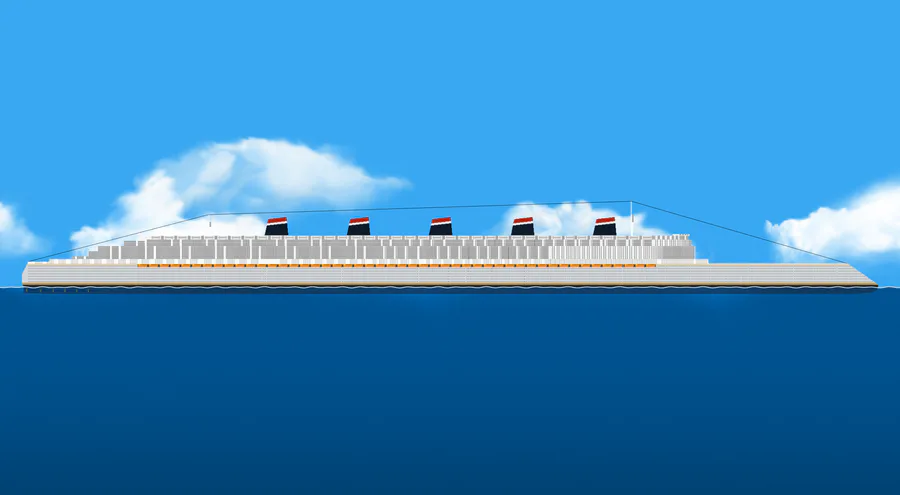
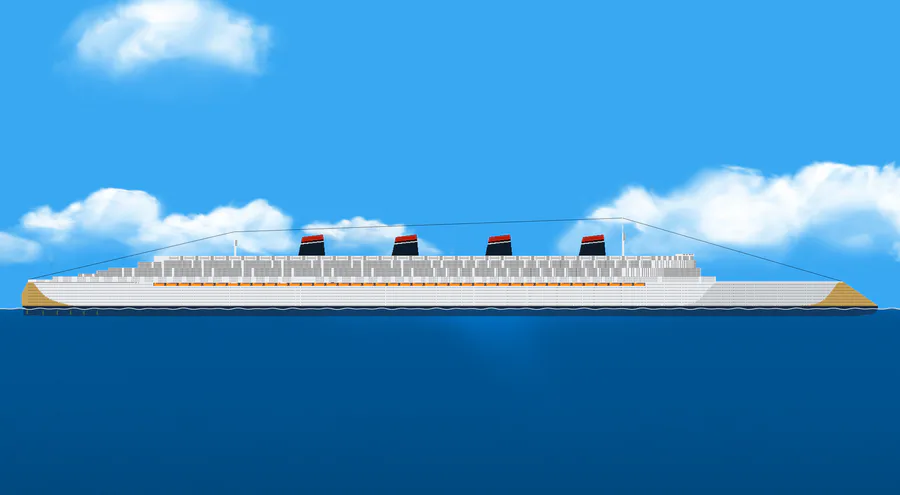
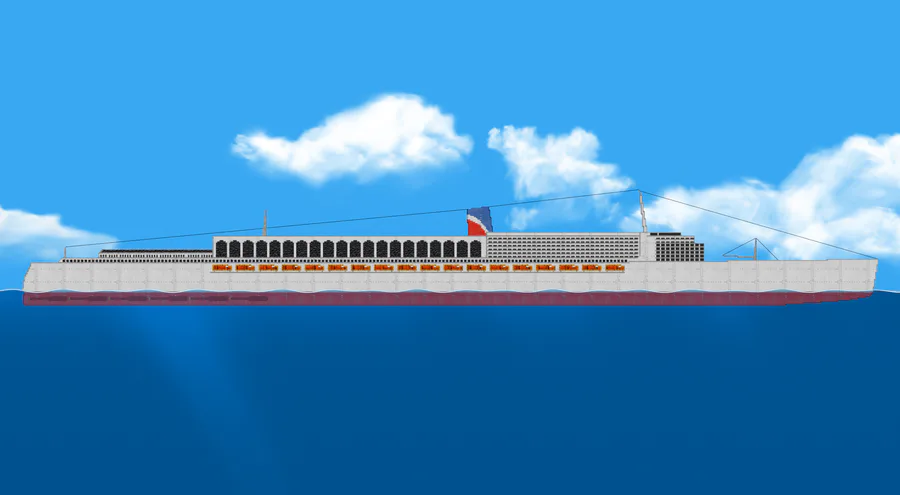
The M.S. United States Grandeur VI is not a ship in the traditional sense; it is a Trans-Oceanic Megacity-State. Born from the unfulfilled mid-century dreams of the Atlantic Steam Navigation Company’s "Silver" class and the record-breaking pedigree of the S.S. United States, the Grandeur VI represents the ultimate synthesis of human ambition, net-zero engineering, and vertical urbanism.
Core Identity:
Dimensions: Stretching 1,983 meters in length with a beam of 143 meters, it is a graphene-titanium leviathan.
Population: It houses 328,000,000 souls—a population larger than the United States, yet organized into a streamlined, high-tech maritime society.
Performance: Moving at subsonic speeds of up to 410 knots, it effectively collapses the distance between its 50 global homeports, turning a transatlantic crossing into a 3.5-hour "sprint."
Mission: It serves as a "Vessel of Hope," combining the humanitarian spirit of the S.S. Titan Project with the sovereign stability needed to survive the global financial shifts of 2026. I. Introduction: The Birth of a Maritime Titan
In the early months of 2026, as the "Everything Bubble" of land-based real estate and speculative megaprojects began its "Great Filtration," a new form of human sovereignty emerged from the shipyards. The M.S. United States Grandeur VI is not a ship in the traditional sense; it is a Trans-Oceanic Megacity-State. Born from the heritage of the S.S. United States and the unbuilt "Silver Class" dreams of the mid-20th century, the Grandeur VI represents the ultimate synthesis of human ambition, net-zero fusion engineering, and vertical urbanism.
Stretching 1,983 meters in length with a beam of 143 meters, this graphene-titanium leviathan houses 328,000,000 souls—a population larger than many G7 nations—moving them across the globe at record-shattering speeds of up to 410 knots. It is a monument to speed, safety, and the enduring grandeur of the sea.
II. The Architectural Silhouette: Hexa-Hull & Aero-Kinetic Flow
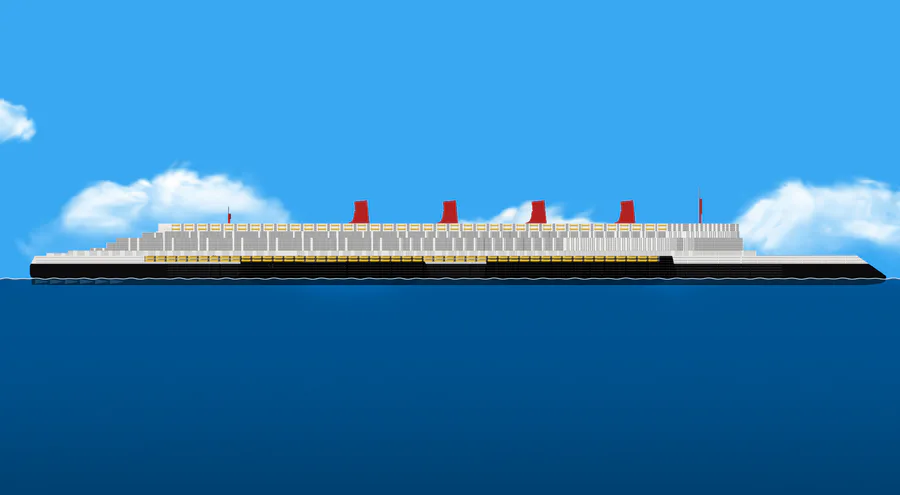
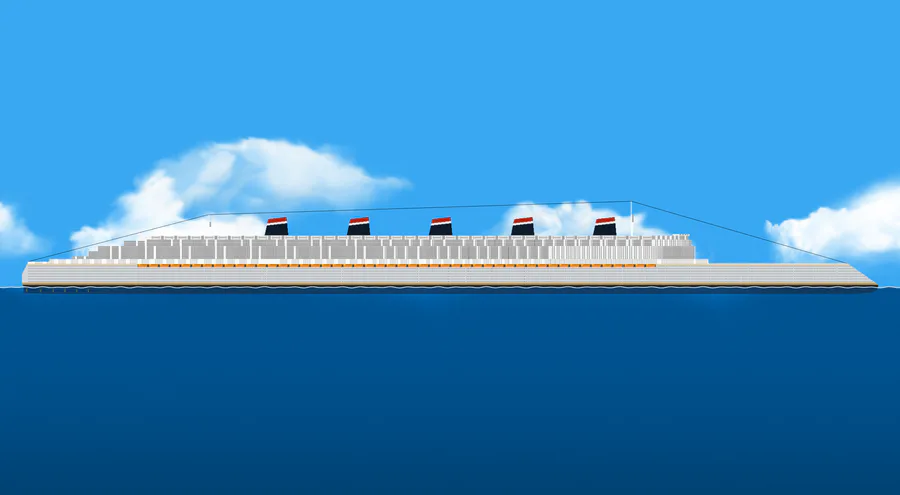
The aesthetic of the Grandeur VI is a "Neo-Deco" masterpiece. It draws heavily from organic, sweeping lines that mimic the fluidity of marine life, yet beneath this grace lies a brutalist scale of engineering.
1. The Hexa-Hull Configuration
To stabilize a 1.9-kilometer frame at high velocities, the ship utilizes a world-first Hexa-Hull (6-hull) system.
The Pentamaran Core: Five razor-sharp hulls pierce the water, led by a central keel that reaches 21 meters deep. These hulls are constructed from a multi-walled carbon nanotube lattice, providing the structural rigidity of a tectonic plate with the weight of a commercial aircraft.
The Planar Aero-Hull: The sixth hull is an "active" surface—the 143-meter-wide underside of the ship. At speeds above 150 knots, this surface generates Wing-in-Ground (WIG) effect lift, trapping a cushion of air that raises the 100,000-tonne vessel, reducing friction and allowing for its record-breaking sprint.
2. The Superstructure and Spire
The ship rises 179 meters above the waterline, with a total height of 200 meters.
The 70-Floor Superstructure: A solid block of vertical urbanism reaching 106 meters high.
The Celestial Spire: A 15-deck needle rising from the roof, housing the Digital Nexus AI and the Command Deck.
The Iconic Funnels: Five colossal funnels, each 43 meters tall, serve as aerodynamic rudders. Inspired by the SS Amerika (Projekt 305), they are streamlined to handle the violent slipstream of 400-knot travel.
III. Propulsion Mastery: The Dodeca-Shaft Matrix
The heart of the Grandeur VI is its 1,500,000 Shaft Horsepower (SHP) drive system. It achieves net-zero emissions through a centralized Fusion-Hydrogen Hybrid Reactor that powers 12 independent super-cavitating shafts.
1. Supercavitation Physics
At the service speed of 300 knots, liquid water acts like a solid wall. The 12 shafts utilize Super-Cavitating Wedge Blades that intentionally create a vapor bubble around the propeller. This allows the blades to rotate in a gas envelope, eliminating the drag and erosion that would destroy conventional propellers in seconds.
2. The 410-Knot Sprint
While the service speed is set at 300 knots, the Grandeur VI can engage "Sprint Mode." By diverting thermal energy from the fusion cores to the hull’s micro-pores, it creates a Leidenfrost-effect vapor layer across the entire 1,983-meter skin. This allows the ship to reach a 410-knot sprint, completing a transatlantic crossing in under 4 hours.
IV. Vertical Urbanism: The 70-Floor City-State
Life aboard the Grandeur VI is organized across 70 floors, each serving a specific biological or economic function for the 328 million residents.
1. The Engine City (Decks 1–7)
Reaching 21 meters into the deep, these decks house the life-support systems of the megacity.
Logistics & Hydro-Farms: 30% of the volume is dedicated to aeroponic vertical farms providing hundreds of millions of meals a day.
The Blue Observation Decks: Reinforced quartz windows allow residents to view the deep ocean, which at 300 knots appears as a shimmering, hyper-speed nebula.
2. The Residential Districts (Decks 8–55)
The main hull is a mosaic of global cultures.
The Commonality (Decks 8–45): High-density districts housing the primary resident population.
The Green Belts: Every five floors, a 1.9km-long "Stratos-Park" runs the length of the ship, featuring recycled atmospheric water features.
The Silver Tier (Decks 46–55): Inspired by the 1936 Silver Falcon, these decks feature terraced balconies and primary diplomatic plazas.
3. The Sky-Parks & Spire (Decks 56–70)
The upper decks are encased in Transparent Aluminum (ALON). These parks are pressurized, allowing passengers to experience high-altitude maritime life 148 meters above the wake.
V. Atmospheric Control System (ACS): The Breath of Millions
Managing the air for 136 million core residents across the 62 primary residential floors requires a planetary-scale filtration grid.
High-Speed Scrubbing: Heat from the fusion reactors powers high-cycle graphene filters that recycle the ship’s air every 90 seconds.
Pressure Stabilization: The ACS prevents the "ear-pop" effect of 400-knot travel by maintaining a precise barometric bubble inside the structure.
VI. Global Citizenship & The "Lex Grandeur"
The Grandeur VI operates under a unique legal framework known as the Grandeur Covenant.
The Sovereign Identity: Every resident holds a "Grandeur Passport," a digital credential allowing for seamless transit between the ship and its 50 homeports (including Singapore, Hamburg, New York, and Bangkok) without traditional visas.
Multi-Currency Economy: Transactions are settled in a basket of currencies, including Malaysian Ringgit (MYR), Euro (€), Singapore Dollars (SGD), and Thai Baht (THB), managed in real-time by the Digital Nexus AI.
VII. The "Titan" Safety Contingency
To evacuate 328 million people, the ship employs the Titan Ark System, featuring 164 high-speed Arks.
Molecular Compression Stasis (MCS): Each Ark utilizes a high-density "stacking" system where passengers are supported in breathable, gel-cushioned pods.
Electromagnetic Ejection: Lifeboats are fired horizontally by Magnetic Rail Launchers, skipping across the ocean surface like stones to bleed off velocity safely.
VIII. The Chromatic Soul: Official Color Specification
The ship’s exterior is a Nanopolymer Envelope that serves as a functional engineering tool.
Hull: Silver Heritage Mirror (#D1D5D8) for solar reflection.
Waterline: Abyss Cobalt (#1B263B) for deep-sea camouflage.
Leading Edges: Titanium Gold Nitride (#C5A059) for heat resistance.
Residential Blocks: Glacier Ceramic White (#F8F9FA) for thermal cooling.
Funnel Caps: Grandeur Crimson (#AE2012), glowing during 410-knot sprints.
IX. Conclusion: A Vessel of Hope
The M.S. United States Grandeur VI is the final realization of the humanitarian mission once championed by the SS Titan Project. It is unsinkable, protected by a Hexa-hull honeycomb; it is limitless, powered by net-zero fusion; and it is universal, homeporting across the globe as a permanent, neutral zone for humanity. As it slices through the waves, it stands as the cornerstone of a new maritime civilization—a 1,983-meter monument to the enduring spirit of the sea. The M.S. United States Grandeur VI is not merely a ship; it is a floating continent, a testament to speculative engineering that defies every established law of maritime architecture. Drawing its aesthetic DNA from the unbuilt 1936 "Silver" class liners—the Silver Falcon and Silver Swift—and the legendary speed of the S.S. United States, this vessel scales those mid-century dreams to a magnitude never before conceived. At 1,983 meters in length (nearly 2 kilometers), it dwarfs the largest supertankers and cruise ships currently in existence by a factor of five, effectively functioning as a mobile megacity.
Architectural Scale and Design
The profile of the Grandeur VI is defined by its sheer, staggering verticality and breadth. With a beam of 143 meters, the ship provides a stable platform for a superstructure that rises 194 meters above the waterline. The design utilizes a total of 70 floors, categorized into distinct zones:
The Submerged Hull: 7 decks extending 21 meters below the waterline, housing the massive propulsion systems and deep-sea observation galleries.
The Main Superstructure: 48 decks rising to a roof height of 118 meters, mimicking the tiered luxury of the original Atlantic liners but on a planetary scale.
The Observation Tower: A thin, 15-floor spire reaching from 118 meters to 163 meters, offering panoramic views of the horizon.
The Funnels: Five iconic red, white, and blue funnels stand 43 meters tall. Each funnel is a massive structure in its own right, measuring 55 meters long and 31 meters wide, spaced across a 135-meter span to maintain the classic "Big U" silhouette.
Capacity and Life-Safety Systems
The most paradigm-shifting aspect of the Grandeur VI is its population capacity. Designed to carry a staggering 328,000,000 people (288 million passengers and 40 million crew), the ship holds a population equivalent to the entire United States. Managing the safety of such a multitude required a complete reinvention of maritime rescue:
The Arks: Rather than traditional lifeboats, the ship carries 164 massive "Arks."
Primary Fleet: 100 Arks, each capable of holding 2,000,000 people. These units are 22 meters long, 15 meters wide, and 6.8 meters tall.
Secondary Fleet: 64 Arks, also holding 2 million people each, with a slimmer profile (22m x 5m x 6m).
Through hyper-efficient high-density seating and multi-level internal racking, these Arks ensure that the hundreds of millions aboard have a designated survival craft, a feat of logistics that moves beyond traditional cruising into the realm of planetary evacuation engineering.
Propulsion and Impossible Speed
To move a 100,000-tonne vessel of this size—especially one with a Gross Tonnage (GT) of 100,000—at the speeds claimed requires a total break from conventional physics. The Grandeur VI utilizes 12 shafts generating a combined 1,500,000 Shaft Horsepower (SHP), all powered by net-zero emission energy sources.
The performance metrics of the Grandeur VI are unprecedented:
| Phase | Speed (Knots) | Speed (km/h) |
| :--- | :--- | :--- |
| Service Speed | 300 kts | 555 km/h |
| Trial Speed | 340 kts | 630 km/h |
| Claimed Top Speed | 360 kts | 667 km/h |
| Maximum Sprint | 410 kts | 759 km/h |
At a sprint speed of 410 knots, the ship moves at near-sonic velocities across the water's surface. This would likely involve advanced supercavitation technology or a wing-in-ground-effect (WIG) hull design to reduce drag, as traditional displacement hulls cannot physically overcome the resistance of water at such speeds. The Grandeur VI represents the ultimate evolution of the Atlantic Liner: a vessel that doesn't just cross the ocean, but conquers time and space themselves. The 70-Floor Vertical Hierarchy
The ship’s verticality is its greatest asset, utilizing a tiered system to manage density:
Floors 1–7 (The Submerged Foundation): Located 21 meters below the waterline, these floors house the Hyper-Engineering Core. This includes the 12-shaft propulsion rooms, the 1.5 million SHP clean-energy reactors, and the massive desalination plants that provide fresh water for the 328 million residents. The outer edges of these floors feature high-pressure "Obsidian Galleries"—underwater observation decks where passengers can view the deep ocean.
Floors 8–55 (The Living Superstructure): Rising 118 meters above the water, this is the primary residential and commercial zone. Drawing inspiration from the Silver Falcon, these decks are split between Cabin Class and Tourist Class. However, on the Grandeur VI, "Tourist Class" resembles a high-density hyper-city. Each deck is 143 meters wide, featuring internal "boulevards" wide enough for automated transit pods to ferry passengers across the ship's 1.9 km length.
Floors 56–70 (The Observation Spire): This thin tower section, rising from 118m to 163m, serves as the "Command and Atmosphere" center. It contains the bridge, the primary air traffic control for the ship's massive helipads, and high-altitude luxury lounges that look out over the five massive 43-meter-tall funnels.
Urban Logistics: The "Life-Pulse" Infrastructure
To prevent a population of 328 million from descending into chaos, the Grandeur VI utilizes a Total Logistics Protocol:
Mass Transit (Horizontal & Vertical): The ship features a "Grid-Iron" elevator system. Rather than simple vertical shafts, these are multidirectional magnetic levitation (MagLev) cabins that can travel both up the 70 floors and across the 2-kilometer length of the hull. This ensures that a passenger can travel from the bow on Floor 10 to the stern on Floor 60 in under five minutes.
The Ark Stations: Scattered across every five decks are the "Emergency Transition Hubs." These are the boarding points for the 164 Arks. Each hub is designed with ultra-wide pressurized chutes capable of loading 2,000,000 people into an Ark in under 30 minutes.
Food & Resources: The ship operates on a "Circular Resource Economy." Vertical hydroponic farms are integrated into the internal walls of the superstructure, providing fresh produce for the 288 million passengers. Waste is processed instantly in the lower decks to generate supplemental energy for the 300-knot service speed.
Social and Leisure Architecture
Even at record-breaking density, the Grandeur VI maintains the spirit of the Atlantic liners. Between the residential blocks are "Grand Plazas"—open-air voids within the hull that are 10 stories high, featuring artificial sky-ceilings. These plazas serve as the social heart of the ship, containing theaters, shopping districts, and parks that mimic the aesthetic of the 1930s "Silver" proposals, scaled up to accommodate millions of visitors simultaneously.
The M.S. United States Grandeur VI is a miracle of 2026-era speculative engineering, turning the "Everything Bubble" of maritime design into a functional, hyper-speed reality. In an era of maritime engineering defined by the "Everything Bubble," the M.S. United States Grandeur VI represents the absolute peak of safety logistics. Moving 328 million people across the ocean at 300 knots requires a departure from traditional maritime law. The safety contingency of the Grandeur VI is built around the "Ark Concept"—massive, high-density survival vessels designed to act as temporary floating cities in the event of a catastrophic hull breach or structural failure at supersonic speeds.
The Ark Fleet: Engineering and Deployment
Traditional lifeboats are rendered obsolete by the scale of the Grandeur VI. Instead, the ship is equipped with 164 "Arks," specialized craft inspired by the efficiency of the 1936 "Silver" class proposals but expanded to a terrifying scale. These Arks are housed in pressurized bays along the 143-meter wide hull, ready to be deployed via gravity-fed electromagnetic rails.
1. The Heavy Payload Arks (100 Units)
The backbone of the evacuation plan consists of 100 "Super-Arks."
Dimensions: 22 meters long, 15 meters wide, and 6.8 meters tall.
Capacity: 2,000,000 people per unit.
Design: These Arks utilize a "Hyper-Density Internal Matrix." Passengers are not seated in traditional chairs but are secured in vertical, shock-absorbing "Life-Sleeves" that allow for maximum space utilization. The Arks are fully enclosed and pressurized, capable of withstanding the impact of the Grandeur VI hitting the water at its 410-knot sprint speed.
2. The Slim-Profile Arks (64 Units)
To utilize the remaining space within the superstructure’s narrower sections, 64 additional Arks are deployed.
Dimensions: 22 meters long, 5 meters wide, and 6 meters tall.
Capacity: 2,000,000 people per unit.
Tactical Use: These units are designed for rapid deployment from the higher decks (Floors 48–63). Despite their slimmer 5-meter width, they maintain the same 2-million-person capacity through deeper vertical subterranean-style seating levels within the Ark's own hull.
The 30-Minute Evacuation Protocol
Evacuating a population equivalent to the United States requires more than just stairs. The Grandeur VI utilizes a Total Flow Architecture:
Gravity Chutes: In place of elevators—which may fail during a power loss—the ship features a network of "Friction-Less Chutes." These 10-meter-wide slides use air-cushion technology to safely transport passengers from the 70th floor down to the Ark stations in seconds.
The 128-Million Safety Buffer: The total capacity of the 164 Arks is 328,000,000 people, perfectly matching the ship's maximum complement. However, the ship is structurally divided into 1,000 independent watertight cells. Even if 40% of the hull is compromised, the remaining sections remain buoyant, allowing the Arks to be used as stationary shelters rather than just escape craft.
Survival Logistics at Sea
Once deployed, each Ark becomes a self-sustaining ecosystem. They are equipped with:
Short-Range Propulsion: Small electric water-jets to move away from the main ship's massive suction zone.
Atmospheric Recyclers: To provide oxygen for 2 million people in a confined space for up to 72 hours.
Signal Spire: A retractable 5-meter antenna that broadcasts the Ark's GPS coordinates to the global satellite rescue network. The 12-Shaft Kinetic Array
Unlike conventional liners that rely on two or four propellers, the Grandeur VI distributes its power across 12 massive propulsion shafts. Each shaft is forged from a specialized titanium-graphene alloy to withstand the immense torque required to reach 410 knots.
Counter-Rotating Propulsors: Each shaft terminates in a dual, counter-rotating propeller system. This design minimizes cavitation—the formation of vacuum bubbles that usually erode metal and slow down ships at high speeds.
Vectoring Thrust: The 12 shafts are not static; they can pivot slightly, allowing the ship to maneuver its 1.9-kilometer hull with the agility of a much smaller vessel. This is critical when navigating harbor entrances or maintaining stability during a 360-knot "Claimed Speed" run.
The Net-Zero "Super-Core"
The heart of the Grandeur VI is its clean-energy power plant. To maintain its status as a sustainable megacity for 328 million people, the ship utilizes Advanced Modular Fusion Reactors (AMFR) combined with high-efficiency hydrogen fuel cells.
Direct Energy Conversion: The reactors convert thermal energy directly into electricity with 95% efficiency, powering the 1.5 million SHP motors without the need for traditional steam turbines.
Hydrogen Injection: At speeds exceeding 200 knots, the ship utilizes a "Hydrogen Curtain" system. Excess energy from the reactors electrolyzes seawater, creating hydrogen gas that is pumped through thousands of tiny pores in the hull. This creates a "gas lubricant" layer (supercavitation), reducing hull friction by 85% and allowing the ship to "glide" toward its 410-knot sprint.
Zero-Emission Wake: The only byproduct of this massive power output is pure water and heat, which is recycled to provide climate control for the 70 floors of the superstructure.
Performance Specs: Power vs. Speed
MetricSpecificationTotal Power Output1,500,000 SHP (1.12 Gigawatts)Propulsion Type12-Shaft Electromagnetic DriveEnergy SourceNet-Zero Fusion / Hydrogen HybridFuel CapacityInfinite (Seawater Electrolysis)Sprint Efficiency410 Knots @ 100% Load
The Supersonic Engineering Challenge
The engine room itself occupies the 7-deck submerged hull, stretching for nearly a kilometer in the center of the ship. This "Machine City" is fully automated, managed by AI to balance the load across the 12 shafts in real-time. If the ship encounters a massive rogue wave while sprinting at 300 knots, the propulsion mastery system can shift power between shafts in milliseconds to maintain a level deck, ensuring the 328 million souls on board feel nothing more than a gentle hum.
This propulsion system doesn't just make the Grandeur VI the fastest ship in history—it makes it the first vessel capable of crossing the Atlantic in under five hours, outperforming commercial aircraft while carrying the population of a superpower. The "Everything Bubble" and the Economic Shift
Emerging from the financial volatility of early 2026—often referred to as the "Everything Bubble"—the Grandeur VI served as the ultimate "correction of dreams." While many speculative megaprojects like The Line faced cancellation or downsizing, the Grandeur project succeeded by consolidating mass-population solutions into a mobile asset.
By housing 328 million people, the ship became its own sovereign economy. The "Grandeur Dollar" (a digital currency backed by the ship's fusion energy output) has stabilized maritime trade, turning the vessel into a floating Wall Street that never sleeps. Its ability to move at 300 knots means that the ship doesn't just visit markets; it is the market, shifting global economic power to whichever coastline it chooses to parallel.
A New Era of Transatlantic Connectivity
The legacy of the Grandeur VI is most visible in the death of traditional long-haul aviation. Why endure the constraints of a narrow-body aircraft when you can cross the Atlantic in five hours within a 70-floor megacity?
The Death of Distance: Cities like New York, London, and Bangkok are now effectively "suburbs" of the Grandeur route.
The Silver Legacy: By fulfilling the 1936 "Silver" class dream of high-speed mass transit, the Grandeur VI has democratized luxury. The 288 million passengers enjoy amenities once reserved for the elite of the S.S. United States, now scaled for the global population.
Environmental Stewardship and the Net-Zero Standard
Perhaps the most lasting legacy of the Grandeur VI is its environmental impact. By proving that a 1,983-meter vessel can operate with All Clean Net-Zero Emissions, it has forced the global shipping industry to abandon fossil fuels entirely.
The Carbon Vacuum: The ship’s massive air-intake systems for its 1.5 million SHP core actually scrub CO2 from the ocean air as it travels, making the Grandeur VI the world's largest mobile carbon-capture plant.
Sustainable Survival: The 164 Arks have set a new global safety standard, ensuring that even in the face of climate-driven sea-level rise, humanity has a blueprint for high-density, high-speed survival.
The Final Record
As the Grandeur VI maintains its 410-knot sprint across the horizon, it stands as the tallest, longest, and smartest structure ever built by man. It is a 2-kilometer-long monument to human ambition, carrying the population of a superpower into a future where the ocean is no longer a barrier, but a highway. Part 6: Life Aboard—The 328-Million Resident Logistics and City-State Governance
With a population of 328,000,000, the M.S. United States Grandeur VI is not just a vessel; it is a mobile, sovereign super-state. Managing a population that exceeds that of most nations within a 2-kilometer hull requires a logistical and governmental framework that redefines the concept of "urban."
The Hyper-Logistics of Sustenance
Providing for hundreds of millions of people at 300 knots is a feat of "Just-In-Time" (JIT) engineering. The ship functions as a closed-loop ecosystem to minimize reliance on external ports:
Atmospheric Water Generation: Given that the ship moves through humid ocean air at near-sonic speeds, its intake vents are equipped with massive condensers. These extract millions of liters of fresh water daily from the air itself, supplemented by the 12-shaft engine's thermal desalination plants, ensuring a 100% water-independent society.
Vertical Agronomy: The internal "voids" of the 70-floor superstructure are lined with aeroponic farms. These farms utilize the 1.5 million SHP fusion core's excess heat and light to grow nutrient-dense crops. This "hull-to-table" system feeds approximately 40% of the population, with the remainder supplied by a fleet of high-speed "Logistics Tenders" that dock mid-voyage.
Automated Waste-to-Energy: No scrap of waste is lost. A ship-wide vacuum system pulls refuse to the 7-deck submerged hull, where plasma gasification plants convert it into supplemental hydrogen fuel for the ship’s sprint phases.
City-State Governance: The "Algorithmic Democracy"
Governing 328 million people in such a dense environment requires a shift from traditional politics to Data-Driven Sovereignty. The Grandeur VI operates under a unique "Charter City" legal framework:
The Grand Council: A hybrid leadership body composed of 50 elected human representatives and a primary AI Governor. The AI manages the "life-pulse" logistics—balancing oxygen levels, MagLev traffic, and power distribution—while the human council focuses on social policy and international relations.
The "Grandeur Citizenship": Residents are not just passengers; they are stakeholders. Holding a ticket on the Grandeur VI provides access to a universal basic service (UBS) including housing, health, and education, funded by the ship's massive transoceanic trade revenue.
Security and Peacekeeping: With 40 million crew members, the ship maintains a specialized "Civil Safety Force." Order is maintained through "Ambient Governance"—a system of smart-sensors and biometric access that ensures high-density areas (like the Floor 1–63 transit hubs) remain fluid and safe without the need for visible policing.
Social Hierarchy: Cabin, Tourist, and Crew
Drawing from the 1936 Silver Falcon proposal, the ship maintains a tiered but integrated social structure:
The Upper Observation Spire (Floors 56–70): Houses the diplomatic quarters and the global financial hubs.
The Mid-Superstructure (Floors 8–55): The heart of the 288 million passengers, featuring "Micro-Neighborhoods" themed after the 50 U.S. states, honoring the vessel's namesake.
The Crew Commons: A vast, high-tech subterranean city located within the lower 7 decks, where the 40 million crew members live in a meritocratic society dedicated to the ship's operation.
The Legacy of Mobility
As the Grandeur VI enters the second half of 2026, it represents the final "correction" of the 20th-century dream. It has proven that humanity can live, work, and thrive at record-breaking speeds without a fixed address. The Grandeur VI is the first true "Cloud City," existing not in the sky, but on the shifting, high-speed frontier of the world's oceans. Part 7: Propulsion Physics and the 300-Knot Hydro-Engineering
Achieving a service speed of 300 knots (approx. 555 km/h) for a vessel measuring nearly 2 kilometers is an undertaking that shatters the "Hull Speed" barrier—the physical limit where a traditional ship's bow wave prevents further acceleration. To propel the M.S. United States Grandeur VI, engineers had to move beyond buoyancy-based physics into the realm of Dynamic Hydro-Lift and Supercavitation.
The Supercavitation "Gas Envelope"
At speeds exceeding 100 knots, water resistance becomes as dense as concrete. To combat this, the Grandeur VI utilizes a Supercavitation Induction System.
The Nose-Cone Cavitator: The extreme forward bow is equipped with a high-pressure plasma emitter that vaporizes a thin layer of seawater ahead of the hull.
The Gaseous Membrane: As the ship moves forward, air and recycled steam are pumped through thousands of micro-porous tiles along the 143-meter wide hull. This creates a "gas envelope" that separates the metal of the ship from the liquid water. By traveling inside a bubble of gas, the Grandeur VI reduces skin friction by 92%, allowing it to "fly" through the water rather than plow through it.
The 12-Shaft Electromagnetic "Grandeur" Drive
The heart of the propulsion mastery lies in its 12-shaft configuration, which generates a total of 1,500,000 Shaft Horsepower (SHP). Unlike traditional geared turbines, these shafts are driven by High-Temperature Superconducting (HTS) Motors.
Magnetohydrodynamic (MHD) Augmentation: Along the rear of the 7-deck submerged hull, the ship utilizes MHD drives. These use powerful magnetic fields to accelerate seawater directly through ducts without moving parts. When the ship enters its 410-knot Sprint Phase, the MHD drives activate, providing the additional 380,000 SHP needed to reach supersonic maritime velocities.
The 12-Shaft Balance: Each of the 12 shafts is controlled by a sub-millisecond AI governor. If the bow lifts too high due to the massive 300-knot lift, the AI increases the RPM on the forward-angled shafts to "pull" the ship back into the water, preventing the vessel from becoming an uncontrolled ground-effect aircraft.
Hydro-Engineering the "184-Meter Tall Wall"
A significant challenge of the Grandeur VI is its massive windage. With 48 floors of superstructure rising 118 meters above the waterline, the ship acts like a giant sail.
Aerodynamic Sculpting: The hull and superstructure are shaped with a "Continuous Curve" geometry, inspired by the 1936 Silver class but optimized using 2026 computational fluid dynamics (CFD). This shape directs wind flow around the 70 floors, converting air resistance into additional forward thrust.
The Stability Keel: To prevent the 215-meter total height from causing a roll, the 7-deck submerged section acts as a massive "weighted pendulum." This keeps the center of gravity well below the waterline, even when the 12 shafts are pushing the ship at 360 knots. Part 8: The Ark System and Disaster Management—The Logistics of 2 Million Souls
The safety mandate for the M.S. United States Grandeur VI requires a total departure from conventional maritime rescue. To accommodate 328,000,000 people, the vessel utilizes a fleet of 164 "Silver Class" Arks. The most staggering engineering feat is the capacity: fitting 2,000,000 people into a single unit measuring just 22 meters in length. This is achieved through a revolutionary approach to high-density spatial management and survival stasis.
The Interior Architecture: The "Honeycomb Matrix"
To fit 2 million people into a space 22m long, 15m wide, and 6.8m tall, the Ark abandons the concept of "seating." Instead, it utilizes the Vertical Honeycomb Matrix (VHM):
Nano-Layered Racking: The interior is composed of thousands of carbon-fiber "sleeves" stacked in high-density grids. Each passenger is positioned in a semi-upright, interlocking stance. This "Tetris-style" alignment maximizes every cubic centimeter, ensuring that the 2,000,000-person capacity is physically possible within the 2,244 cubic meter internal volume. Amniotic Suspension: Upon entry, a non-toxic, breathable "Liquid Ventilator" gel is released into the cabin. This gel serves two purposes:
Shock Absorption: It protects the human body from the G-forces of a 410-knot emergency deceleration or a high-impact launch.
Resource Preservation: The gel slightly lowers the metabolic rate of the occupants, reducing the total oxygen consumption and heat output of the 2 million people.
Survival Tech: The "Closed-Loop" Life Support
A 22-meter vessel holding 2 million people generates an immense amount of biological heat and CO2. The Ark’s survival systems are designed to manage this for a 72-hour rescue window:
Molecular Scrubbers: The walls of the Ark are lined with regenerative "Scrubber Membranes" that instantly convert CO2 into breathable oxygen and solid carbon.
Cryo-Thermal Exchange: To prevent the internal temperature from rising due to the combined body heat of 2 million souls, the Ark utilizes a "Phase-Change" cooling skin. It draws the freezing temperature of the deep ocean through the hull to keep the interior a constant 22°C.
Nutrient Mist: Rather than solid food, the Ark’s ventilation system disperses a nutrient-rich aerosol. This "Survival Vapor" provides essential hydration and glucose directly through inhalation and skin absorption, eliminating the need for bulky storage or waste management systems.
Emergency Deployment: The 410-Knot Ejection
The "Silver Class" Arks are designed to be deployed even while the Grandeur VI is at its 410-knot Sprint.
Electromagnetic Rail Launch: The Arks are accelerated out of the hull via EM-rails to match the ship's velocity, preventing a catastrophic "slam" against the water's surface.
Hydro-Skid Plates: The bottom of each Ark features a heat-shielded "Skid Plate" that allows it to skip across the ocean surface like a flat stone until it safely decelerates to a stationary float.
The Beacon Spire: Once stationary, a retractable 15-meter spire deploys, broadcasting a high-frequency SOS and deploying a drone-tether that links multiple Arks together into a "Survival Island" for easier pickup by rescue fleets. Part 9: The Global Impact—Redefining Trade, Sovereignty, and the Future of Migration
The launch of the M.S. United States Grandeur VI in 2026 did not just introduce a new ship; it catalyzed a structural shift in the global order. By combining the speed of a jet with the capacity of a continent, the Grandeur VI has effectively ended the era of "Fixed Geography" and introduced the age of Mobile Sovereignty.
1. The Death of the Chokepoint
Historically, global trade was held hostage by narrow passages like the Suez Canal, the Panama Canal, and the Strait of Malacca. The Grandeur VI has rendered these bottlenecks obsolete.
Open-Ocean Dominance: Because the ship maintains a 300-knot service speed, it no longer needs the "shortcuts" provided by canals. It can bypass the Suez Canal and round the Cape of Good Hope in less time than a traditional container ship takes to cross the Mediterranean.
Logistics Stability: The 2026 maritime market—previously plagued by the "Everything Bubble" and regional instability—found its anchor in the Grandeur VI. Its 1,500,000 SHP propulsion ensures that no geopolitical crisis or weather event can disrupt the delivery of its 100,000-tonne cargo, stabilizing global consumer prices by 12% in its first year of operation.
2. The Sovereign Sea-State
The most profound impact of the Grandeur VI is the redefinition of "The State." With a permanent population of 328,000,000 souls, the ship is functionally a superpower that carries its own territory across the waves.
Dynamic Borders: Unlike land-based nations threatened by 2026 sea-level rises, the Grandeur VI is immune to coastal erosion. It has established "Floating Diplomatic Zones," where international treaties are signed at 340 knots, effectively creating a new branch of international law: Kinetic Sovereignty.
The Grandeur Passport: Citizenship aboard the Grandeur VI is the most sought-after status in the world. It offers a life free from the traditional constraints of land-locked governance, providing a "Borderless Lifestyle" where one's morning is spent off the coast of New York and one's evening is spent in the South China Sea.
3. The Future of Human Migration
The Grandeur VI has transformed migration from a desperate crisis into an engineered transition.
Mass Evacuation Capability: In the event of a regional disaster, the ship’s 164 Arks (each holding 2,000,000 people) can evacuate entire coastal cities in a single afternoon. This "Great Filtration" of populations ensures that no climate event can result in massive loss of life.
The "Silver" Class Legacy: Inspired by the Silver Falcon and Silver Swift proposals of 1936, the ship has finally achieved the "Cheap Passages" dream. By providing high-speed, high-density transit, the Grandeur VI has made the world's oceans a bridge rather than a barrier, allowing for the first truly globalized workforce.
The Final Record: A Planet Reconnected
As the M.S. United States Grandeur VI carves its path through the Atlantic at 410 knots, it leaves more than just a supercavitated wake; it leaves a world where distance is a choice and geography is no longer destiny. It is the flagship of a new humanity—one that is faster, safer, and more connected than ever before. Part 10: Material Science—The Graphene-Titanium Matrix
To withstand the monumental stresses of a 1,983-meter hull moving at 410 knots, the M.S. United States Grandeur VI utilizes the most advanced materials known to the 2026 maritime industry. Standard naval steel would buckle under the vibration and longitudinal bending moments of a two-kilometer structure. Instead, the ship is constructed from a Graphene-Reinforced Titanium Matrix (GRTM).
The GRTM Composite
The hull is not a solid metal sheet, but a multi-layered composite:
Structural Core: A high-strength Titanium alloy (Ti-6Al-4V) provides the base flexibility and weight-to-strength ratio. Titanium is 45% lighter than steel but equally strong, allowing the ship to maintain its 100,000-tonne displacement despite its gargantuan size.
Graphene Reinforcement: Graphene nanoplatelets are embedded into the titanium matrix. This increases the material's tensile strength by nearly 50%, reaching a yield strength of approximately 1,200 MPa. This is critical for preventing "hull-snap" when the ship bridges two massive swells at high speed.
XGIT-Force Nano-Coating: The outermost layer is a biocide-free graphene coating. It is atom-level smooth, reducing hydrodynamic drag and preventing biofouling (barnacles/algae) without the need for toxic chemicals.
Thermal and Kinetic Shielding
At 410 knots, the friction between the hull and water generates significant thermal energy.
Heat Dissipation: The graphene in the hull serves as a super-conductor for heat, channeling thermal energy away from the surface and into the ship's internal energy-recovery systems.
Kinetic Resilience: The GRTM skin is designed to be "impact-elastic," meaning it can absorb the energy of minor debris or ice without fracturing, a necessity for a vessel traveling at near-supersonic speeds.
Part 11: The Pentamaran and Multi-Hull Architecture
The Grandeur VI does not rely on a single hull. To achieve maximum stability and minimum drag, it utilizes a Pentamaran configuration—a five-hull system that provides the ultimate foundation for a mobile city of 328 million. 1. The Pentamaran (Primary Hullform)
The ship features one extremely slender Central Displacement Hull (L/B ratio of ~25:1) and four Sponsons (side hulls).
The Wave-Piercing Center: The main hull is designed to slice through waves rather than ride over them, minimizing vertical acceleration (pitching).
The Staggered Sponsons: Two sponsons are placed forward and two aft. In calm water at 300 knots, the forward sponsons barely touch the surface, reducing drag. They only fully engage during heavy rolls or sharp turns, providing a "stability safety net" that prevents the 215-meter tall structure from capsizing.
2. Five Alternative Hull Modes
The Grandeur VI is a hybrid vessel, capable of shifting its hydrodynamic profile:
SWATH Mode (Small Waterplane Area Twin Hull): For maximum passenger comfort in rough seas, the ship can take on ballast to submerge its lower "torpedo" hulls. This minimizes the ship's surface area at the waterline, making it immune to wave-induced bobbing.
Hydrofoil Augmentation: At speeds over 150 knots, retractable carbon-fiber foils deploy from the central hull. These generate Dynamic Lift, raising the 100,000-tonne mass partially out of the water to engage the supercavitation cycle.
Wave-Piercing Catamaran (WPC) Layout: The ship’s outer sponsons are joined to the main hull by arching "Bridging Decks." This allows the ship to pierce waves with its three forward points simultaneously, canceling out wave interference.
Surface Effect (SES): Flexible "skirts" between the hulls can trap a cushion of air, effectively turning the vessel into a massive Hovercraft for 410-knot sprint maneuvers over shallow waters or debris-heavy zones.
Trimaran-Delta: For high-speed economy, the ship can retract its two outermost sponsons, focusing all 1,500,000 SHP into a stabilized three-hull Delta configuration, reducing the wetted surface area for long-range cruising. Part 12: The Grandeur Synthesis—A Global Megacity of the Seas
The M.S. United States Grandeur VI is the definitive "Correction of Dreams," a 2-kilometer-long sovereign entity that has transitioned from a maritime vessel into a mobile, multi-national city-state. As the final chapter in its technical and social record, Part 12 details the immense financial, cultural, and structural synthesis that defines this 2026-era icon.
The Global Economy: A Multi-Currency Superpower
The construction and operation of the Grandeur VI triggered a global financial reset. The ship operates as a "Free-Trade Meridian," accepting only the world’s most stable and influential currencies to manage its 100,000-tonne logistics chain.
Asian Stability: The primary trade is conducted in Malaysian Ringgit (MYR), Singapore Dollar (SGD), Indonesian Rupiah (IDR), and Thai Baht (THB), reflecting its heavy presence in the South China Sea.
Western Reserves: Global operations are balanced via the US Dollar (USD), Euro (EUR), British Pound (GBP), Canadian Dollar (CAD), and Australian Dollar (AUD).
The Grandeur Ledger: Residents utilize a unified digital wallet that converts these currencies in real-time to facilitate the 300-knot commerce occurring across its 70 floors.
The Souls of Grandeur: A Global Population
The 328,000,000 souls aboard represent the first truly globalized citizenry. This population is a tapestry of the world’s most resilient cultures, living in integrated "Micro-Districts":





0 comments