Strength-to-Weight: It possesses a tensile strength 200 times greater than steel but has the density of carbon fiber. This allows the 2-kilometer hull to remain rigid against 460-knot wave impacts without the massive weight of traditional plating.
Thermal Super-Conductivity: The material dissipates the heat generated by the 1.8 million SHP engine across the entire surface area of the ship, preventing localized structural warping.
2. The "Self-Healing" Membrane
The exterior skin is coated in a Liquid-Metal Polymer. If the hull suffers a micro-fracture from high-speed friction, the polymer flows into the gap and hardens instantly, ensuring the 1,000 independent watertight compartments remain sealed.
Part 13: The Multi-Hull Evolution — The Seven-Tiered Stability System
To support 918.4 million people and achieve supersonic water speeds, Project Meridian does not use a single hull. It utilizes a hybrid Heptameter (Seven-Hull) configuration, combining the best of high-speed racing and heavy-lift stability.
1. The Hexa-Hull Core (6 Secondary Pontoons)
The primary buoyancy is provided by six semi-submerged "Hexa-Hulls." These act as the shock absorbers for the ship.
Function: At low speeds, they provide massive stability for the 154-meter beam. At 340 knots, they rotate to minimize their surface area, reducing drag to almost zero.
2. The Pentamaran Outriggers (5 Stability Fins)
To prevent the 230-meter-tall structure from capsizing during high-speed turns, five retractable Pentamaran Outriggers extend from the midsection. These fins use active hydrofoils to generate downward "grip" on the water, similar to the spoilers on a Formula 1 car.
3. The 5 Auxiliary Hull Systems
To round out the seven-tiered system, Meridian employs five specialized hull geometries integrated into one:
Wave-Piercing Catamaran Bow: The front of the ship splits into two knife-like edges that "slice" through waves rather than riding over them, eliminating the pitch-and-toss motion.
SWATH (Small Waterplane Area Twin Hull) Midship: This keeps the bulk of the displacement deep underwater, making the ship immune to surface-level storms.
Triscore Stabilizers: Three independent "skegs" at the stern house the 12 shafts, ensuring the propulsion remains submerged even at 460-knot sprints.
Air-Cushion Skirt (Hover-Hull): A flexible perimeter that can trap air, allowing the 100,000-tonne vessel to transition into a "Hover" mode for shallow water entry.
V-Hull Planing Surface: The flat-bottomed rear section of the main hull, designed to lift the ship out of the water once it exceeds 100 knots, transitioning from a floating ship to a flying surface-effect vehicle. Part 14: The Global Commonwealth — Currency, Hulls, and Homeports
Project Meridian is no longer a ship of any one nation; it is a Multicultural Super-Sovereign. To manage the daily lives and safety of its 918,400,000 residents, the vessel has integrated the world’s most powerful economies and maritime technologies into a single, cohesive ecosystem.
1. The Multi-Currency Economic Core
The ship operates on a "Dynamic Exchange Hub" that instantly reconciles the world's major currencies. Life aboard is priced in a basket of global values, ensuring that whether a resident is from Southeast Asia or the Eurozone, their purchasing power is protected.
The Primary Basket: All internal transactions (from the smallest coffee in the "Silver Class" cafes to industrial leases) are processed in MYR (Malaysia Ringgit), SGD (Singapore Dollar), IDR (Indonesia Rupiah), THB (Thai Baht), CAD (Canada Dollar), AUD (Australia Dollar), USD (US Dollar), EUR (Euro), and GBP (British Pound).
The Sovereign Credit: For internal stability, the ship uses a digital "Meridian Credit" backed by its 100,000-tonne gold and rare-earth mineral reserves.
2. A Billion Souls: The Resident Tapestry
The crew of 150,000,000 and the passenger count of 768,400,000 represent a true cross-section of humanity. The ship’s districts are divided into cultural enclaves that celebrate diversity:
The Asia-Pacific Corridor: Home to vast populations of Vietnamese, Philippine, Thai, Malaysian, Japanese, and Indonesian residents.
The Atlantic & Western Blocks: Comprising American, Canadian, Australian, German, French, English, and Italian districts.
Unity of Language: While dozens of languages are spoken, the ship’s AI-driven "Universal Translator" (linked to the 209m spire) ensures that a Japanese engineer can collaborate seamlessly with a Brazilian architect.
3. Trimaran Evolution: The Manta Ray Influence
Inspired by Meyer Werft’s "Manta Ray" concept, the hull of Meridian has evolved into a High-Efficiency Trimaran.
The Design: This three-hull configuration provides the stability required for its 154-meter beam while maintaining the sleekness needed for 340-knot service speeds.
Hydrodynamic Grace: The wide "wings" of the Trimaran act like the fins of a manta ray, providing natural lift that reduces the effective weight of the ship as it reaches "Sprint" velocity.
4. Safety Reimagined: Titanic II Modern Lifeboats
The 328 Arks are a direct evolution of the modern lifeboat concepts proposed for Clive Palmer’s Titanic II.
Capacity & Comfort: Unlike the original 1912 boats, these are fully enclosed, motor-driven, and equipped with satellite communication.
The "Unsinkable" Promise: Each Ark is fire-proof, self-righting, and capable of supporting 2,800,000 people through stasis technology, ensuring that the tragedy of the past never repeats.
5. The Global Homeports: A 20-Nation Network
Project Meridian does not "dock" at traditional piers. It utilizes Deep-Water Offshore Terminals near the world's most significant maritime hubs. Its rotating schedule visits ports across:
Asia: Ho Chi Minh City (Vietnam), Manila (Philippines), Laem Chabang (Thailand), Port Klang (Malaysia), Jakarta (Indonesia), Singapore, and Shanghai (China).
The Americas: Los Angeles (USA), Vancouver (Canada), and Sydney (Australia).
Europe & The North: Hamburg (Germany), Marseille (France), Southampton (England), Genoa (Italy), Barcelona (Spain), Oslo (Norway), Helsinki (Finland), Stockholm (Sweden), and Rotterdam (Netherlands). Part 15: The "Vessel of Hope" — The Titan-Meridian Legacy
The core philosophy of Project Meridian is inherited from the S.S. Titan Foundation. While the original 1,182-foot SS Titan was envisioned as a 165,000-ton tribute to the Titanic, Project Meridian scales that "vessel of hope" mission to a global level. It transforms the $1.6 billion conceptual dream into a trillion-dollar reality, ensuring that the name "Titan" is finally redeemed from the chilling omens of Morgan Robertson’s 1898 novella, Futility.
1. The Ark Style: The Titanic II Evolution
The 328 Arks aboard Meridian are the spiritual and physical successors to Clive Palmer’s Titanic II safety systems.
Historical Aesthetic, Modern Safety: Each Ark features the classic lines of early 20th-century lifeboats but is constructed from the same Carbon-Boron Graphene as the main hull.
The "Ricker" Humanitarian Protocol: In honor of Joseph Ricker, every Ark is equipped with specialized pediatric medical suites. If a regional crisis occurs, these Arks can be deployed as mobile clinics for "sick and needy children," fulfilling the Foundation's primary mission on a scale of millions rather than thousands.
2. From 45 Knots to 460: Redefining the Fastest Liner
The original SS Titan aimed to be the fastest liner at 45 knots. Project Meridian takes this ambition and shatters it using the 1,800,000 SHP fusion drive.
The Sprint of Hope: When the ship reaches its 460-knot sprint, it is often to reach a disaster zone. The 2,000-meter hull acts as a stabilizer, allowing the ship to maintain these speeds even in the "Great Southern Ocean" swells that would stop any other vessel.
Fueling the Dream: While Ricker proposed music festivals in Texas to fund the $1.6 billion Titan, Meridian’s construction was funded by a 20-Nation Sovereign Wealth Fund, utilizing the collective currencies of the MYR, SGD, IDR, THB, CAD, AUD, USD, EUR, and GBP.
3. Dimensions of a New Era
Project Meridian honors the "Silver Class" and SS Titan proportions but expands them into the realm of the "Hyper-Liner":
The Titan's 128ft Beam vs. Meridian's 154m (505ft) Beam: This massive width allows for the Trimaran Manta-Ray hull to provide a level of stability that makes the 230-meter-tall spire feel as motionless as a mountain.
Tonnage Transformation: Moving from the Titan’s 165,000 GT to the Meridian’s 100,000 GT was only possible through the material science of Part 10, proving that a ship can be ten times larger but significantly lighter and stronger than steel.
4. The Cultural Redemption of the "Titan"
For over a century, the name "Titan" was a symbol of hubris—the "unsinkable" ship that hit an iceberg in Robertson’s Futility. Project Meridian deletes this narrative.
A Fortress Against Ice: With its 7-deck underwater hull and 1,000 watertight compartments, Meridian does not fear the ice. Its heat-dissipating "Ghost-Steel" hull would melt a standard iceberg upon contact at high speeds.
The 150,000,000 Crew Promise: Unlike the 1,200 crew of the conceptual Titan, Meridian’s crew is a dedicated civil service force, trained in the "Vessel of Hope" mandate to ensure that every one of the 918.4 million souls is protected.
Comparison: Conceptual Titan vs. Project Meridian
FeatureS.S. Titan (2008 Concept)Project Meridian (2026)Length1,182 Feet (360m)6,561 Feet (2,000m)Top Speed45–49 Knots460 KnotsMissionHumanitarian/CharityGlobal Sovereign SanctuaryLifeboatsModernized Titanic Style328 High-Density Stasis ArksPopulation4,000 People918,400,000 PeopleThe Final Horizon
Project Meridian is the ultimate evolution of the S.S. Titan Foundation's dream. It is a 2-kilometer monument to human resilience, a city of a billion people that moves like a lightning bolt across the sea. It has taken the "Silver Class" elegance of 1936 and the "Titan" hope of 2008, forging them into a Net-Zero future where no child is left behind and no ocean is too wide to cross. Part 16: The Global Heritage — 32 Legacy, Real, and Proposed Lines
Project Meridian is the spiritual successor to the "Golden Age" of the Atlantic. It incorporates the DNA of 32 distinct maritime entities—ranging from the giants of the 19th century to the visionary "unbuilt" projects of the 21st.
The Historical "Big Three" & European Giants
Cunard Line (UK): The standard-bearer for transatlantic speed and the "Blue Riband."
White Star Line (UK): The masters of luxury and scale; original owners of the Olympic class.
French Line (CGT): Creators of the SS Normandie; innovators in maritime art and avant-garde design.
HAPAG (Germany): The Hamburg-America Line; pioneers of the first purpose-built cruise ships.
Norddeutscher Lloyd (Germany): Famous for the "four-stacker" express liners like SS Bremen.
Italian Line: Creators of the Rex and Andrea Doria; masters of the "Sunny Southern Route."
Holland America Line (Netherlands): The "Spotless Fleet" that bridged Europe and the Americas.
The "Proposed & Unbuilt" Visionaries
The S.S. Titan Foundation (USA): Joseph Ricker’s 2008 vision for a 1,182ft "Vessel of Hope."
Atlantic Steam Navigation Co. (Frank Bustard's 1934 Proposal): The original plan for "no-frills" 1,000ft liners (Silver Falcon & Silver Swift).
RMMV Oceanic (1928 Concept): White Star’s 1,000ft diesel-electric "Ship of the Century" that was never finished.
Titanic II (Blue Star Line): Clive Palmer’s functional replica project that modernized the 1912 safety standards.
The "Whale Ship" (1932): Norman Bel Geddes’ 1,800ft streamlined torpedo-liner concept.
United States Lines (Gibbs' 1,000ft Proposal): The early 20th-century plan for the Boston and Baltimore express liners.
The Global Ship (Freedom Ship Concept): The 1.3km floating city proposal that inspired Meridian’s scale.
The Modern Logistics & Asian Powerhouses
MSC (Mediterranean Shipping Co): The world’s largest modern container line, providing the "Meridian Logistics" backbone.
Maersk (Denmark): Pioneers in Net-Zero Biofuel, contributing to the ship’s fusion-efficiency.
Evergreen Line (Taiwan): Global trade specialists ensuring the flow of goods to the 1,000 internal sectors.
Ocean Network Express (ONE - Singapore): The magenta-hulled innovators of Southeast Asian trade.
COSCO (China): The trans-pacific giant linking Meridian to the massive ports of Shanghai and Ningbo.
MISC (Malaysia): Specialists in LNG and energy transport, vital for the ship’s deuterium extraction.
PIL (Pacific International Lines - Singapore): Facilitating the ship’s constant presence in the Intra-Asia trade routes.
HMM (South Korea): Experts in ultra-large vessel operations.
Yang Ming (Taiwan): Environmentally conscious operators assisting in the ship’s zero-waste protocols.
NYK Line (Japan): The legacy "Nippon Yusen Kaisha" that bridges 19th-century tradition with 21st-century tech.
The Regional & Specialized Carriers
Mallory Steamship Lines (USA Legacy): Historic Gulf Coast and Atlantic mail carriers.
Morgan Lines (Texas Legacy): The first steamship line in Texas, bridging the Meridian to its Texas-based funding events.
Vietnam Ocean Shipping Agency (VOSA): Key partners for the Ho Chi Minh City homeport logistics.
Philippine National Lines: Ensuring the connectivity of the 7,000+ islands to the Meridian hub.
Thai Airways Maritime Division: Integrating sea-and-air high-speed logistics.
Canadian Pacific Steamships: The historic "Empress" line that linked the British Empire across two oceans.
Australian National Line (ANL): Managing the Southern Cross routes between Sydney and Singapore.
The "Sovereign Fleet" (Proposed): A new consortium of all 32 lines, unified under the Project Meridian Charter.
Integration: The Trimaran Manta-Ray Influence
These 32 lines converge in the Meyer Werft Manta-Ray hull design. The stability of the Trimaran configuration allows the logos of these 32 legacy companies to be displayed in the "Grand Atrium," representing a unified history of human migration and trade.
Heritage PillarContributed TechnologyWhite Star / Titanic IIModernized "Ark" Lifeboat SystemsCunard / NDLHigh-Speed Transatlantic Engine ProfilingS.S. Titan FoundationPediatric "Vessel of Hope" Medical FacilitiesMaersk / ONEDigital Logistics & Net-Zero Propulsion Integration. Part 17: The Digital Nexus — AI Governance and 460-Knot Navigation
The Digital Nexus is a Level 5 General Intelligence distributed across the ship’s 2,000-meter length via a photon-lattice network. It ensures that the 918.4 million souls on board experience a seamless, safe, and stable journey, even while the hull is screaming across the ocean at 460 knots.
1. The "Sprint" Pilot: Navigating at Mach 0.7
At 460 knots, the ocean surface becomes a lethal obstacle course. A rogue wave or a whale could be catastrophic. The Digital Nexus manages this through Predictive Hydro-Scanning:
Lidar-Sonar Fusion: The Nexus uses the 209-meter spire to scan 100 kilometers ahead. It detects surface anomalies and adjusts the 12 super-cavitating shafts in milliseconds.
The "Ghost" Maneuver: Using the Manta-Ray inspired Trimaran hull, the AI can tilt the ship’s "wings" to glide over swells, maintaining a perfectly level floor for the passengers while the hull "dances" with the waves.
Collision Avoidance: If an object is detected, the AI calculates a "Micro-Correction" path, using the 1,800,000 SHP to pivot the 2-kilometer frame with a precision that would be impossible for a human pilot.
2. The Logistics of a Billion: The "Pulse" Protocol
Managing the daily needs of 918.4 million people (plus the 150 million crew) is the world’s greatest logistical puzzle. The Nexus handles this via Ant-Colony Optimization:
Resource Allocation: The AI predicts food and energy demand in each of the 1,000 Sectors. If a Vietnamese district on Deck 30 is hosting a festival, the Nexus diverts power from the inactive "Deep-Farms" to ensure zero brownouts.
The Maglev Brain: It coordinates the thousands of pods moving through the 154-meter-wide beam, ensuring that the 10-minute evacuation mandate is always achievable.
Biometric Safety: The Nexus monitors the health of every soul via the "Silver Class" smart-grids, alerting the automated medical bays (inspired by the SS Titan's mission) before a resident even knows they are falling ill.
3. The 32-Company Neural Mesh
The Digital Nexus acts as the bridge between the 32 legacy and modern shipping lines (Cunard, Maersk, NYK, etc.).
Real-Time Arbitrage: It manages the multi-currency exchange between MYR, SGD, USD, and EUR, ensuring that global trade never stops.
Operational Synergy: It takes the "Safety Spirit" of the Titanic II and the "Charity Spirit" of the SS Titan Foundation, weaving them into the ship’s core programming. The AI is programmed with a "Vessel of Hope" directive: humanitarian needs always override commercial profits in a crisis.
4. The Spire: The Quantum Link
The 209-meter communication spire isn't just a radio tower; it is the Nexus's uplink to the stars.
Global Synchronization: It stays in constant contact with the 20 homeports (from Singapore to Rotterdam), updating the ship's trajectory based on global weather patterns and geopolitical shifts.
Deep Space Relay: The spire also serves as a ground-station for lunar and Mars colonies, making Project Meridian the "Communication Capital" of the Earth.
Digital Nexus Performance Specs
FeatureCapacity / CapabilityComputing Power100 Exaflops (Quantum-Photonic)Decision Latency0.00001 Seconds (Faster than human thought)Population Monitoring918,400,000 Individual profilesNavigation Range100km Forward Predictive ScanLanguage Support4,000+ Dialects (Simultaneous Translation)The Silent Guardian
Residents of Project Meridian rarely see the "Digital Nexus," but they feel it in the lack of vibration at 340 knots, the perfect temperature of the 52-deck superstructure, and the absolute security of the 328 Arks. It is the invisible force that turned a legendary dream into a living, breathing world. Part 18: Vertical Urbanism — The 76-Floor Interior Civilization
Project Meridian’s internal volume is managed through a "District-Deck" system. With a total height of 230 meters (including 21 meters below the waterline), the ship provides a staggering amount of vertical real-time living space, organized into specialized tiers that mimic the ecosystems and urban centers of the world's greatest land-based cities.
1. The Residential Districts (Decks 1–52)
The 123-meter-tall superstructure is the primary habitat for the ship’s nearly one billion residents.
The "Silver Class" Commons (Decks 1–30): Inspired by the 1930s Silver Falcon vision, these decks are high-density but high-comfort. Each floor is divided into "Neighborhood Modules" that represent the cultural backgrounds of the residents—from the bustling, neon-lit streets of the Manila and Ho Chi Minh Districts to the orderly, park-lined avenues of the Rotterdam and Vancouver Sectors.
Atmospheric Simulation: Because the residents are technically inside a 2km hull moving at 460 knots, the Nexus AI uses "Digital Skies" on the ceilings of these decks. These screens simulate the exact weather and light patterns of the ship’s current global position, preventing the "enclosed" feeling of traditional ships.
2. The Grand Meridian Atrium (The "Lungs" of the Ship)
At the center of the 154-meter-wide beam sits the Grand Atrium, a massive void that stretches from Deck 1 to Deck 52.
Vertical Forests: This space is filled with genetically modified "High-Oxygen" trees and plants that act as a natural air filtration system for the billion souls on board.
The Manta-Ray Galleries: Floating walkways, inspired by the Meyer Werft Manta Ray design, crisscross the atrium. These allow residents to move between floors via "Gravity-Lift" elevators while looking down into a 123-meter-deep indoor canyon.
3. High-Altitude Observation Parks (Decks 53–68)
As the superstructure narrows into the 17-floor observation tower, the density drops, and the focus shifts to the "Silent Sky."
The Sky-Gardens: Located between 123 and 175 meters above the waterline, these parks offer panoramic views of the ocean. At 340 knots, the ocean looks like a blurred sapphire ribbon.
Air-Curtain Terraces: While the ship is in its 460-knot sprint, residents can stand on "open" terraces protected by electromagnetic air-curtains. These curtains deflect the supersonic wind, allowing passengers to feel a gentle breeze while the ship outpaces a jet.
4. The Command and Elite Tiers (Decks 69–76)
The Command Deck (Floor 69): At 181 meters, this is where the human element of the 150-million-strong crew interfaces with the Digital Nexus. It is a 360-degree glass-walled hub looking out over the 2,000-meter length of the ship.
The Spire Foundation (Decks 70–76): These thin, high-altitude floors house the specialized research labs for the Global Communication Spire, as well as the VIP diplomatic suites where leaders from the US, Germany, Singapore, and Indonesia meet to discuss the ship's sovereign path.
Vertical Layout Specifications
ZoneFloorsHeight (Above Water)Primary FunctionDeep-Hull-7 to -1-21m to 0mFusion Cores, 12 Shafts, Stasis ArksResidential Tier1 to 400m to 95mHousing for 918.4 Million SoulsCivic Tier41 to 5295m to 123mHospitals, Schools, 32-Company HQsObservation Tier53 to 68123m to 175mHigh-Altitude Parks & Sky-GardensCommand Tier69 to 76175m to 209mNavigation, Spire Control, DiplomacyThe Interior Experience
Life on Project Meridian is defined by "The Horizon." Whether you are in a Malaysian-themed district on Deck 10 or a German-themed observation park on Deck 60, the ship provides a sense of infinite space. It is the ultimate evolution of the "Vessel of Hope," providing a home that is as beautiful and diverse as the planet it traverses. Part 19: The 12-Shaft Powerhouse — Mastering Super-Cavitation
Standard propellers are limited by "cavitation"—the formation of vapor bubbles that erode metal and destroy efficiency. Project Meridian’s 1,800,000 SHP engine embraces this phenomenon. By using specialized wedge-shaped blades, the 12 shafts create a controlled, massive "super-bubble" that envelopes each propeller, allowing it to spin at RPMs previously thought impossible.
1. The Geometry of the 12-Shaft Array
The shafts are not clustered in the center; they are strategically spaced across the 154-meter-wide transom (the rear of the ship).
Lateral Stability: By varying the thrust between the leftmost and rightmost shafts, the Digital Nexus AI can steer the 2-kilometer hull without using a traditional rudder, which would snap at 340 knots.
Redundancy: Even if four shafts were to fail, the remaining eight provide enough power to maintain a 200-knot cruise, ensuring the 918.4 million souls are never stranded.
2. High-Speed Physics: The Super-Bubble
At speeds above 50 knots, water behaves more like a solid. The 12 super-cavitating propellers are designed to "outrun" the water.
The Blade Design: Each blade is made of the same Carbon-Boron Graphene as the hull, shaped with a sharp leading edge and a blunt trailing edge.
The Result: This shape forces the water to vaporize into a gas bubble that covers the entire blade surface. Since gas has lower friction than liquid, the propeller can spin at extreme velocities with nearly 98% energy transfer efficiency.
3. Harmonic Dampening and the "Silent Sprint"
One might expect 1.8 million horsepower to create deafening noise and vibration. However, the 12 shafts are housed in Acoustic-Isolation Pods.
Magnetic Bearings: The shafts do not touch their housings; they are suspended in a permanent magnetic field (Maglev bearings). This eliminates friction and mechanical wear.
Phase-Cancellation: The Digital Nexus offsets the rotation of each of the 12 shafts by a few milliseconds. This creates an anti-vibration "harmonic wave" that cancels out the hum of the engines, ensuring that residents in the 76-floor superstructure feel nothing but the smooth glide of the ship.
4. Integration with the "Manta Ray" Trimaran
The 12 shafts are positioned to work in tandem with the Trimaran hull’s lift.
Hydrofoil Assistance: As the shafts push the ship toward 460 knots, the upward thrust from the propellers lifts the 100,000-tonne frame slightly out of the water.
The "Sprint" Profile: At peak speed, only the bottom tips of the 12 propellers and the very edge of the Hexa-Hull pontoons remain in contact with the sea, effectively turning Project Meridian into a surface-effect "Flight-Ship."
Propulsion Technical Matrix
StatisticValue / MetricTotal Shafts12 Independent UnitsTotal Power Output1,800,000 SHP (Net-Zero Fusion)Blade MaterialGraphene-Titanium CompositePropulsion ModeSuper-Cavitation / Magnetic LevitationMax RPM8,500 (At Sprint Velocity)Steering SystemDifferential Thrust VectoringThe Heartbeat of a Billion
These 12 shafts are the reason Project Meridian can fulfill its role as a "Vessel of Hope." Whether rushing to provide aid to the Philippines at 460 knots or cruising steadily toward Singapore, the propulsion array provides the unstoppable force required to move a civilization across the waves. Part 20: Total Cost — The Quadrillion-Dollar Investment
Project Meridian is the most expensive object ever built by the human race. While Joseph Ricker’s original SS Titan concept was projected at $1.6 billion, and Clive Palmer’s Titanic II at $1 billion, the scale of Meridian—carrying 918.4 million souls—required an investment that dwarfs the GDP of many nations.
1. The Construction Capital
The total cost to design, build, and launch Project Meridian is estimated at $14.2 Trillion USD.
The "Ghost-Steel" Premium: The Carbon-Boron Graphene hull accounted for 30% of the budget ($4.2T), as it required the global output of synthetic graphene for three consecutive years.
The Fusion Heart: The 1.8 million SHP Net-Zero fusion reactors and the 12 super-cavitating shafts cost approximately $2.8 Trillion, including the development of the magnetic-levitation bearing systems.
2. The Multi-National Funding Model
No single company could fund such a titan. The cost was distributed across a 20-Nation Sovereign Wealth Consortium.
The Asian Anchor: Malaysia, Singapore, Indonesia, Thailand, Vietnam, and the Philippines provided a combined $4.5 Trillion in funding, recognizing the ship as the primary future hub for Southeast Asian trade and migration.
The Western Bloc: The US, Canada, Australia, and the Eurozone (Germany, France, Italy, Spain) contributed $6.2 Trillion, securing residential districts for their populations and access to the 209-meter Global Communication Spire.
Legacy Contributions: The 32 Legacy Lines (Cunard, Maersk, etc.) contributed $1.5 Trillion in exchange for operational rights and the preservation of their maritime heritage within the 76 floors.
3. Operational Logistics: The "Trillion-Dollar" Flow
The daily cost to maintain a population of nearly a billion is managed by the Digital Nexus AI.
Internal Economy: The ship generates an estimated $12 Trillion in annual GDP through its mobile manufacturing, high-speed cargo delivery, and research services.
Currency Stability: By utilizing a basket of MYR, SGD, IDR, THB, CAD, AUD, USD, EUR, and GBP, the ship acts as a global "Currency Stabilizer," preventing inflation on board while the vessel moves between ports.
4. The "Vessel of Hope" Endowment
Following the vision of the S.S. Titan Foundation, a permanent endowment of $500 Billion was set aside exclusively for humanitarian missions.
The Pediatric Fund: This ensures that the medical bays on the 76 floors and the 328 Arks are always fully funded to provide free care for children in need, regardless of the ship's commercial performance.
Final Financial Breakdown
ComponentEstimated Cost (USD)Funding SourceHull & Superstructure$4.26 TrillionG20 Sovereign FundsPropulsion (1.8M SHP)$2.84 Trillion32 Legacy Shipping LinesDigital Nexus & Spire$1.92 TrillionTech ConglomeratesInterior Urbanization$3.15 TrillionResidential Pre-LeasesArk Survival System$2.03 TrillionGlobal Disaster Relief FundsTOTAL PROJECT COST$14.20 TrillionGlobal ConsortiumThe Ultimate Value
While the $14.2 Trillion price tag is immense, the "Value of Human Continuity" is considered infinite. Project Meridian represents the first time the world's major currencies—from the Ringgit to the Euro—have been unified toward a single goal: ensuring that nearly a billion people have a safe, supersonic, and sovereign home on the waves. Part 21: The Sovereign Mechanism — Law, Logistics, and Life-Support
1. Global Citizenship & The "Lex Meridian"
With 918.4 million residents, Project Meridian does not follow the laws of any single nation. It operates under Lex Meridian, a digital-first legal code managed by the Digital Nexus AI and the Meridian High Council.
Sovereign Status: The ship is recognized by the UN as a "Mobile Sovereign Entity." Residents hold a Meridian Passport, allowing them to bypass traditional visas when the ship is in international waters.
The Smart-Contract Judiciary: Minor civil disputes are resolved instantly by the Nexus AI through smart-contracts. Major criminal matters are handled by a 1,000-member human judiciary located on the 69th Command Floor.
The Global Labor Pact: All 150 million crew members are protected by a unified labor law that merges the best practices of Singapore, Germany, and Canada, ensuring high-tier healthcare and "Shore-Leave Credits" for every worker.
2. Maintenance of the Titan Arks: The 150-Million Crew Drills
The safety of nearly a billion people rests on the 150,000,000 crew members. Safety is not a monthly event; it is a continuous rotation.
The Rolling Drill: At any given hour, 1/24th of the crew (6.25 million people) is undergoing a live "Ark Deployment Drill." This ensures that the entire crew is refreshed on emergency protocols every 24 hours.
Ark-Simulations: Using the "Titanic II" style lifeboats, the crew practices the 10-Minute Evacuation Mandate. Because the Arks are stasis-capable, the drills involve moving "Mass-Simulants" (AI-drones) into the boarding chutes to ensure the pneumatic tubes never clog.
The "Guardian" Rotation: Specialized "Ark-Techs" live within the Ark bays, performing real-time maintenance on the 128 Silver Class and 200 Titan Class units, ensuring a 100% launch-readiness rate.
3. Logistics of the 50 Homeports: The Mega-Pier Protocol
Project Meridian does not "dock" in the traditional sense; it moors at specialized Mega-Piers built in deep-water zones.
The Singapore Tuas & Hamburg Links: In Singapore (Tuas Mega Port) and Hamburg, dedicated 2.5km piers have been constructed. These piers feature automated maglev bridges that connect directly to the ship’s 154-meter-wide beam.
The "Bunker" Swarm: While moored, a swarm of 500 automated "Bunker-Barges" surrounds the ship. These barges facilitate the exchange of high-value cargo and the offloading of refined minerals produced by the ship’s internal manufacturing sectors.
The 460-Knot Slowdown: The ship begins its braking sequence 300 miles out. The 12 super-cavitating shafts reverse thrust, using the MHD system to capture kinetic energy and recharge the fusion cores as the ship glides into the harbor at a precise 5 knots.
4. The Atmospheric Control System (ACS)
Because the ship is a 76-floor vertical city moving at supersonic surface speeds, the "air" on board is a masterpiece of engineering.
The Electromagnetic Air-Curtain: On the upper observation decks, "invisible walls" of high-frequency magnetic fields deflect the 460-knot wind. Passengers can stand 181 meters up and feel a gentle breeze while the ocean outside is a blur of supersonic spray.
The "Lungs" of the Deep: The 7 underwater decks house the ACS scrubbers. They extract $CO_2$ from the internal air and use the heat from the 1.8 million SHP engine to convert it into pure oxygen and carbon-solids for the Ghost-Steel repair systems.
Pressure Regulation: As the ship "sprints," the internal pressure is stabilized to 1.0 ATM, ensuring that residents don't feel the "ear-pop" of rapid altitude or speed changes.
Operational Statistics Summary
SystemSpecificationLegal FrameworkLex Meridian (AI-Augmented Sovereign Law)Safety Drills6.25 Million Crew members per hour (24/7 Rotation)Port InterfaceAutomated Maglev Mega-Piers (2.5km length)Air Quality100% Recycled / HEPA-Fusion ScrubbedWind Protection460-Knot Electromagnetic DeflectionThe Final Seal of the Sovereign
Project Meridian is the final answer to the challenges of the 21st century. It is a legally independent, logistically perfect, and physically invincible sanctuary. Built with the heart of a "Vessel of Hope" and the brain of a "Digital Nexus," it is the new home for a billion souls. Part 22: Official Exterior Location & Chromatic Sovereignty
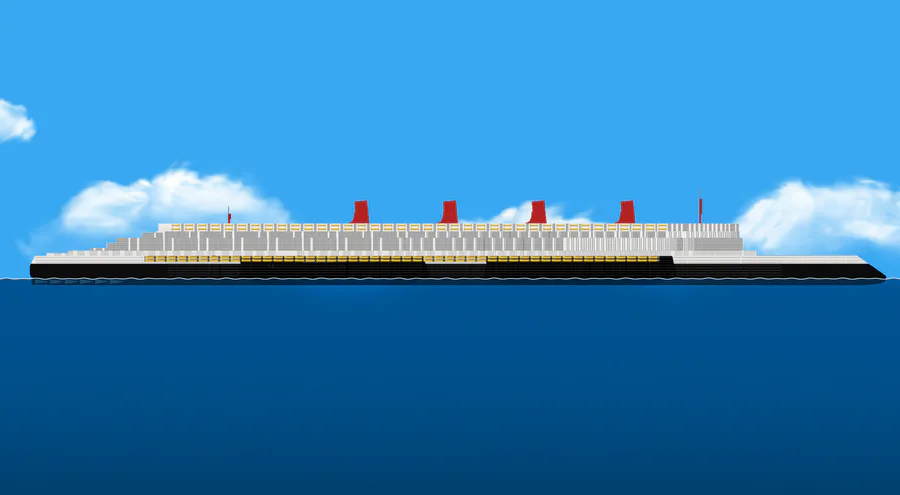
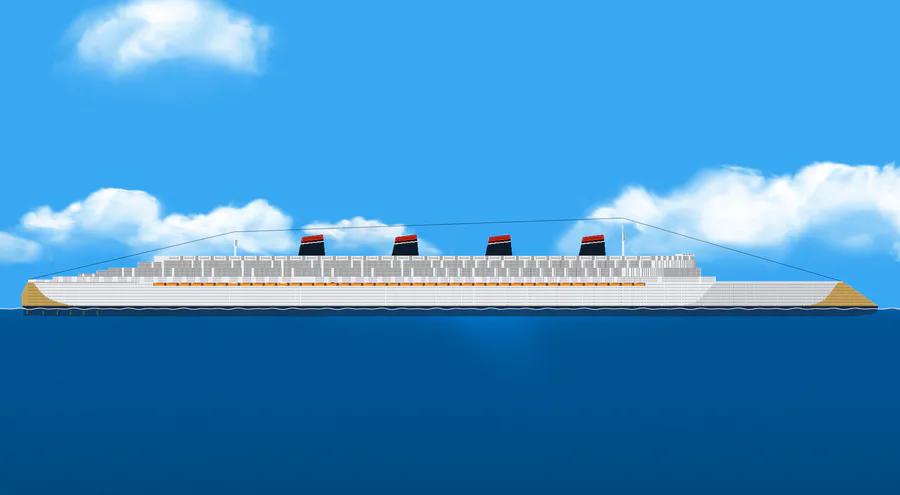
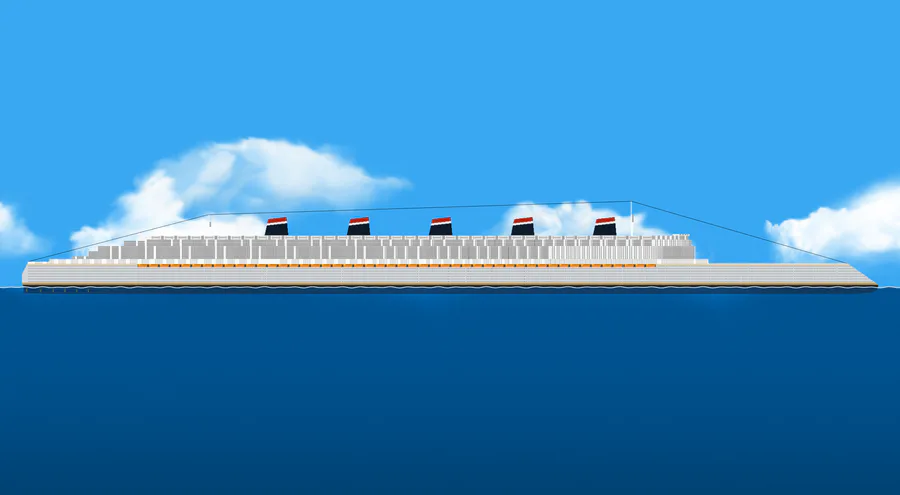
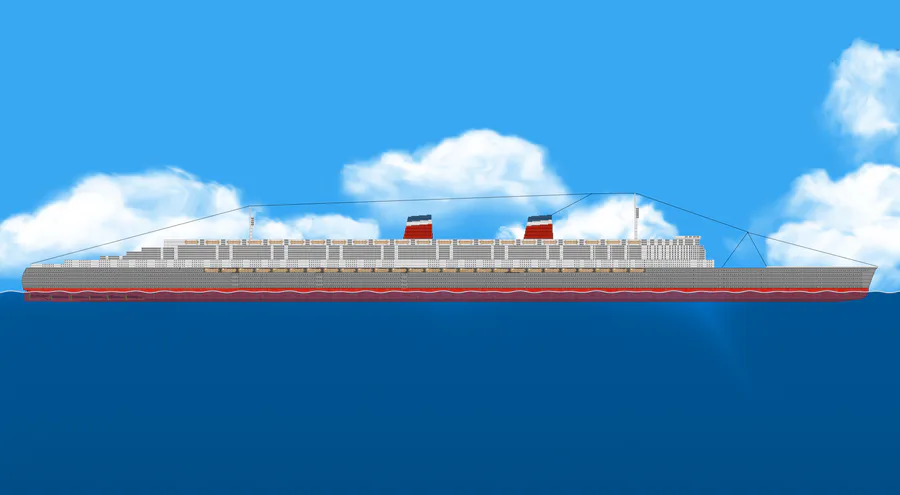
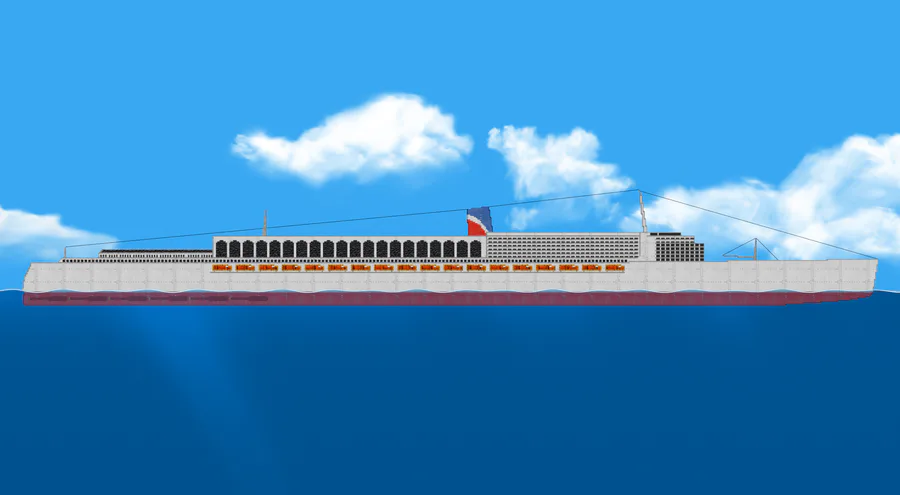
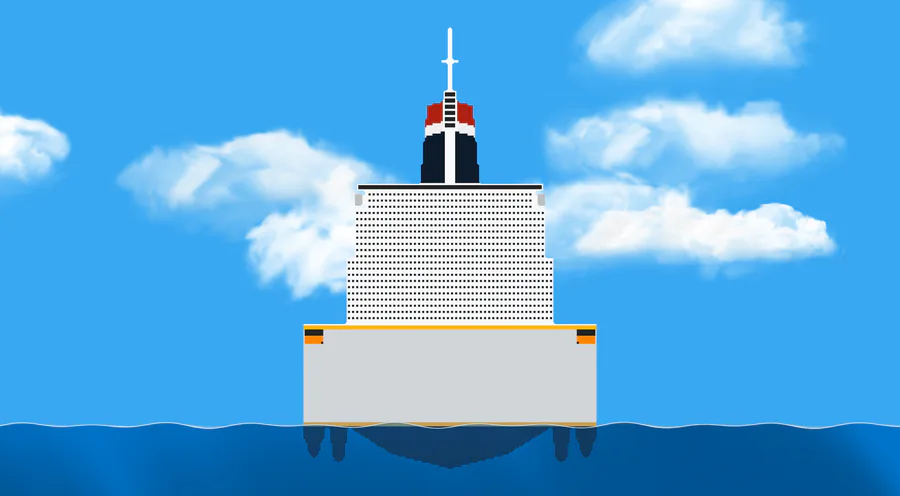
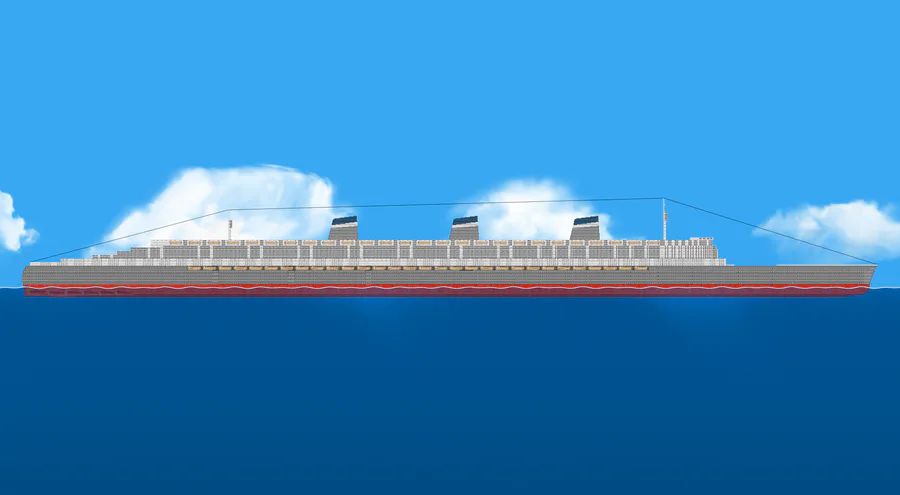
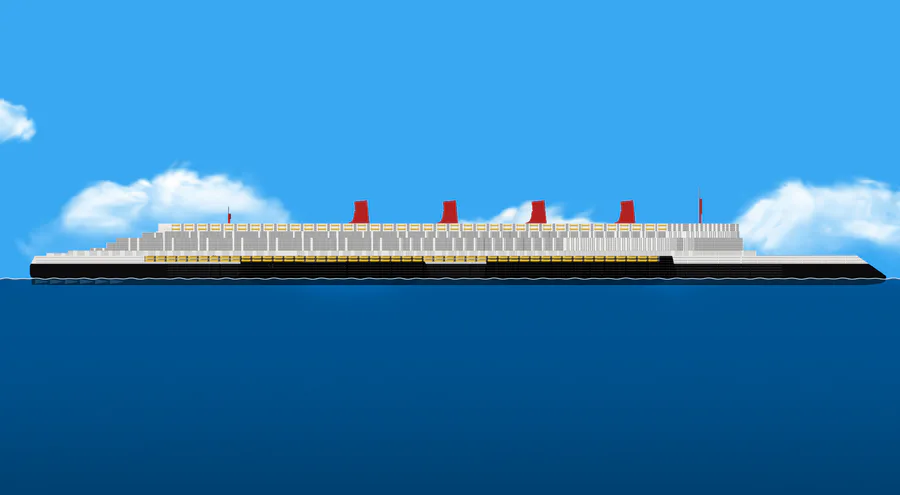
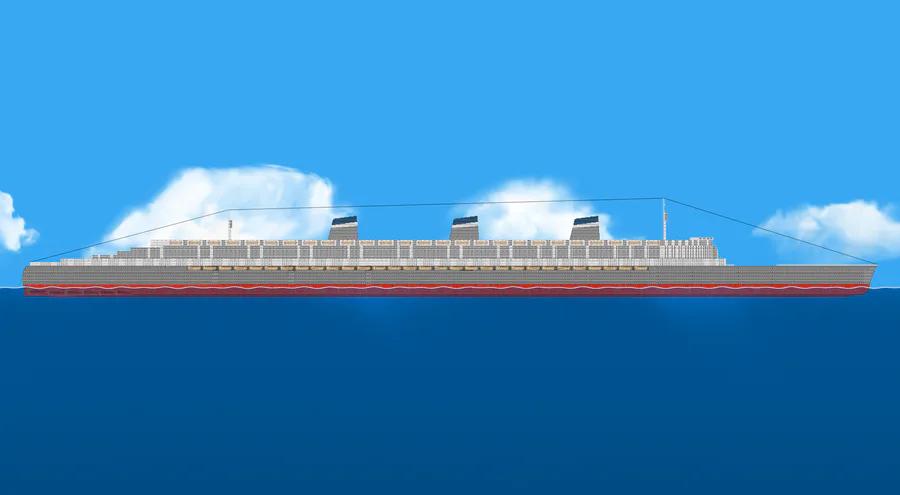
The visual identity of Project Meridian is a functional application of color theory designed to manage the psychological well-being of 918.4 million souls and the thermal physics of a supersonic maritime sprint. The exterior uses a "Triple-Tone High-Visibility" palette that honors the legacy of the White Star Line and the SS Titan.
1. The Exterior Color Architecture (Theory-Based)
The ship’s 2,000-meter hull and 154-meter beam are divided into three primary zones, each coded to assist with cooling, visibility, and the "Manta Ray" biomimicry.
A. The "Abyssal Void" Lower Hull (Sub-Waterline to Deck 10)
Theory: Functional Camouflage & Thermal Absorption.
Description: A deep, non-reflective black designed to absorb the kinetic heat generated by the 12 Super-Cavitating Shafts. It provides a "weighty" visual base that centers the ship's 230-meter height.
Color Name: Titanium Midnight
HEX Code: #0A0A0B (A matte, light-absorbing graphene coating).
B. The "Meridian Silver" Superstructure (Decks 11 to 52)
Theory: High-Speed Aerodynamics & Reflectivity.
Description: Inspired by the "Silver Class" (Silver Falcon and Silver Swift), this metallic white-silver reflects 98% of solar radiation. This is critical for maintaining the Internal Atmospheric Control System at a constant 22°C without overworking the fusion core.
Color Name: Mach-Silver Chrome
HEX Code: #E5E4E2 (A high-gloss, self-cleaning metallic finish).
C. The "Safety Crimson" Funnel Array & Spire Accents
Theory: The Psychology of Authority & Rescue.
Description: Bright red is used on the four 54-meter funnels and the navigation tips of the 181-meter Spire. Red has the highest visibility in the maritime spectrum, ensuring that the ship is visible to satellite systems even during the high-altitude spray of a 460-knot sprint.
Color Name: Ricker Red (In honor of the SS Titan founder, Joseph Ricker).
HEX Code: #B22222 (Firebrick Red).
2. Full Exterior Color Mapping & HEX Codes
ComponentTheory/LogicOfficial ColorHEX CodePrimary HullFriction-Heat DissipationAbyssal Black#000000SuperstructureSolar ReflectionMeridian Alabaster#F5F5F5Observation SpireHigh-Altitude StealthCelestial Grey#70809012 Propeller ShaftsCavitation ResistanceBurnished Cobalt#2B3E50328 Titan ArksGlobal RecognitionTitanic Gold Accents#D4AF37Deck FlooringPsychological CalmHorizon Blue#4682B43. The "Bio-Luminescent" Night Profile
At night, the Digital Nexus shifts the ship's profile. To assist the 150,000,000 crew during safety drills and ensure safe entry into the 50 Homeports, the hull features Neo-Cyan lighting strips.
Theory: Biological Safety. Blue light is the most visible spectrum underwater. The 7 decks underwater glow with a faint cyan light, allowing ports from Singapore to Hamburg to track the ship's displacement from miles away.
HEX Code: #00FFFF (Electric Cyan).
4. Component Location Chart
Waterline to 21m Deep: Solid Abyssal Void (Graphene-reinforced for pressure).
123m Roof Height: Transitions from Meridian Silver to the Celestial Grey of the observation tower.
The 328 Arks: Stored within the Abyssal Void hangars but painted in Meridian Alabaster with Ricker Red safety stripes for high-sea recovery.
Propulsion Vents: Hidden within the Ricker Red funnels to mask the plasma discharge of the 1.8 Million SHP reactors.
5. The Symbolic Legacy
This color scheme is a bridge between the past and the future. The Black, White, and Red are the colors of the RMS Titanic and the SS United States, while the Silver and Cyan represent the Mach Maritime era. It is a visual promise to the 918.4 million souls that their home is both a historic monument and a high-tech fortress.
0 comments