
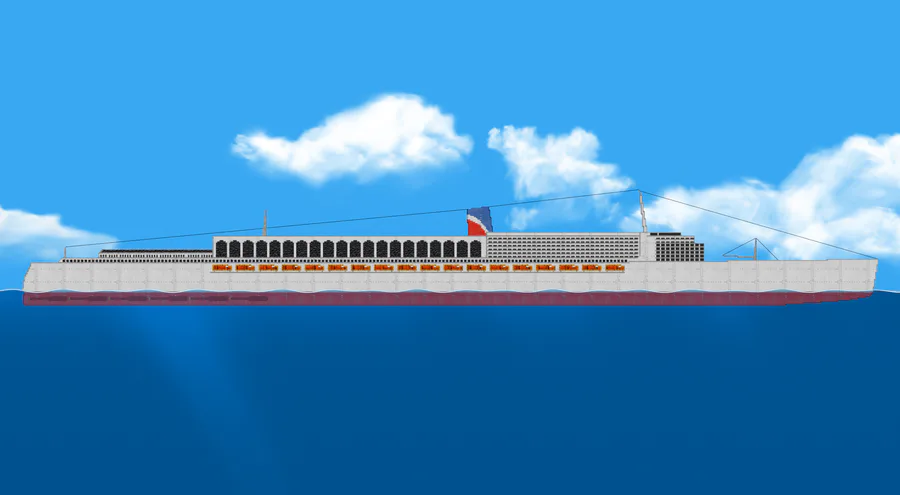
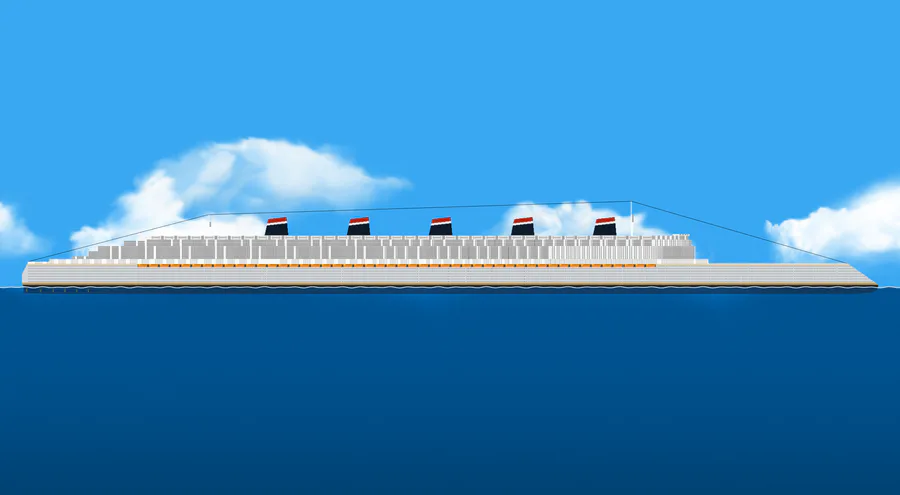
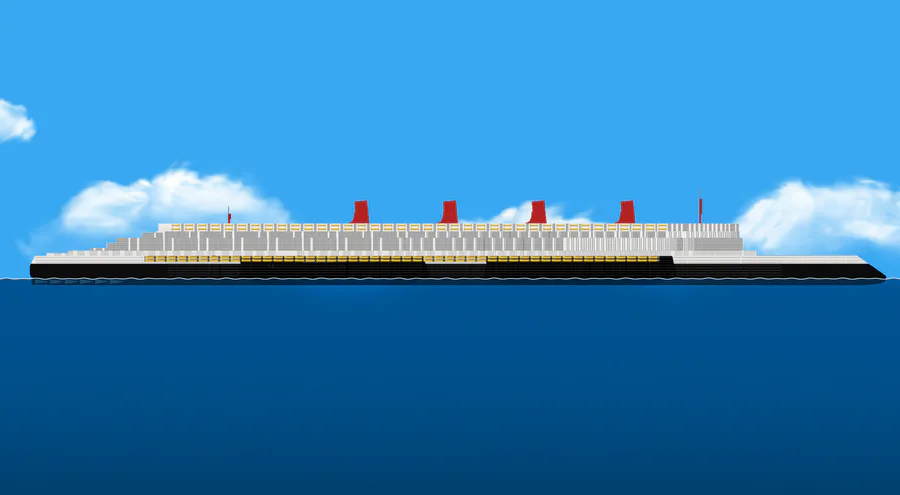
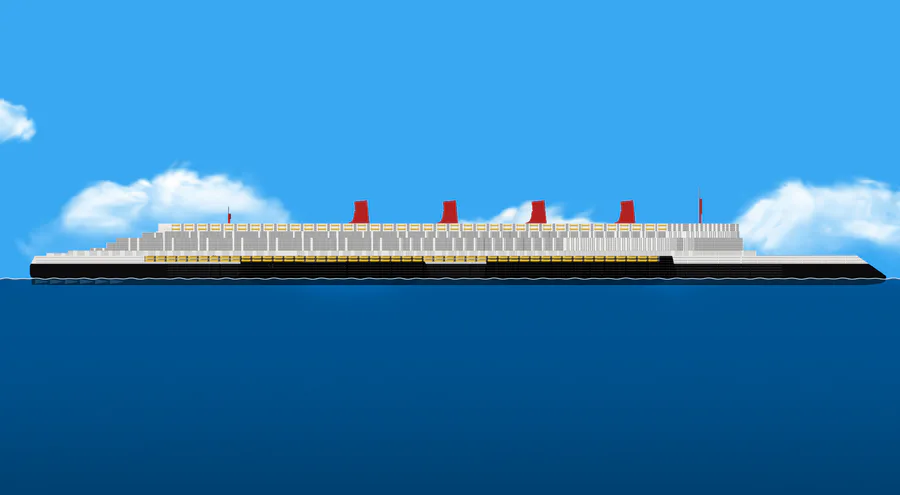
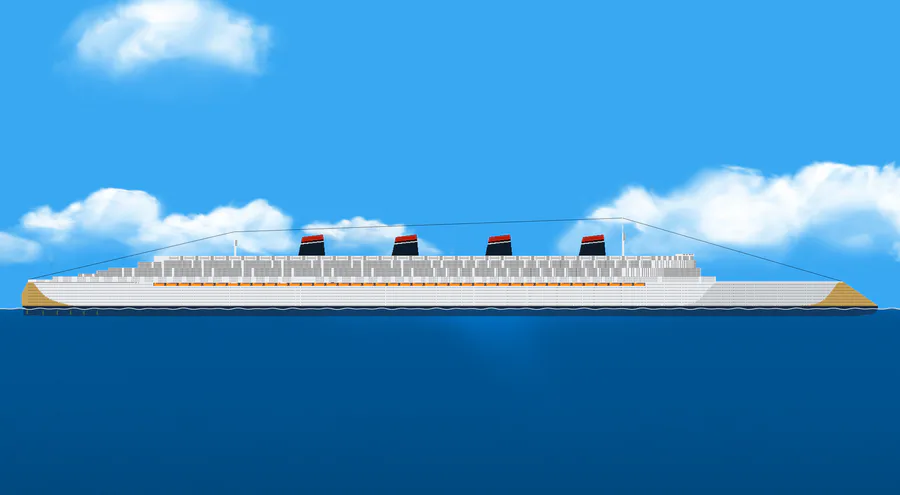
The T.S.S. Mardi Gras II is the apex of "Democratic Gigantism," a 705-meter sovereign leisure entity that bridges the gap between mid-century maritime dreams and post-scarcity futurism. It is the spiritual successor to the unbuilt "Silver Class" of 1936 and Hyman B. Cantor’s 1959 "Sea Coach" vision, realized through the lens of 2026 Net-Zero technology. This vessel does not merely sail the ocean; it conquers the horizon at a record-breaking 72 knots, housing a civilization of 72,000 souls within a Silver-Graphene hull.
I. Architectural Genesis: The Yourkevitch-Titan Silhouette
The design of the Mardi Gras II is a masterclass in "Flow-State" naval architecture. It draws its primary aesthetic and hydrodynamic DNA from the legendary Vladimir Yourkevitch, the designer of the S.S. Normandie. At 705 meters long, it is nearly three times the length of the original Mardi Gras (1972) and significantly longer than the world's tallest skyscrapers are tall.
Dimensional Specifications:
Length Overall: 705 Meters (2,313 ft).
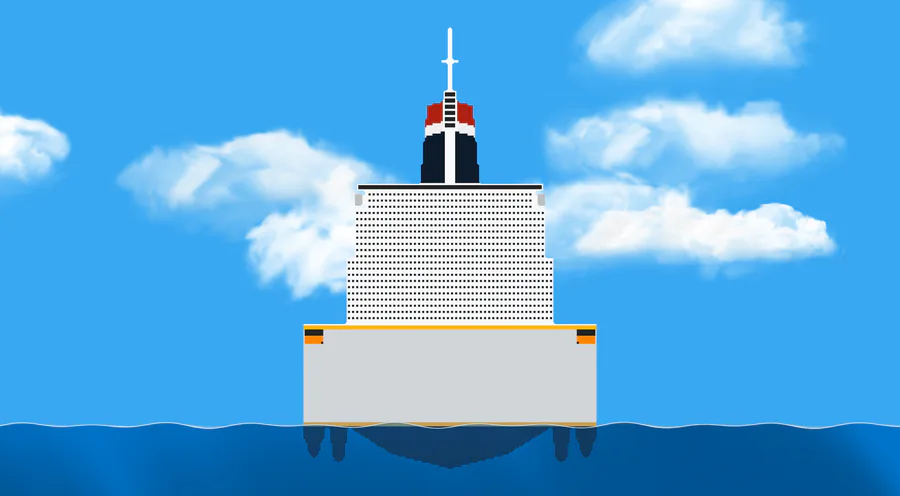
Beam (Width): 71 Meters (233 ft) at the primary waterline, expanding to 96 meters at the upper deck flares.
Total Height: 96 Meters (315 ft) from keel to the tip of the singular funnel.
Height Above Waterline: 85 Meters (279 ft), providing an imposing "White Wall" silhouette that protects against Atlantic rogue waves.
Draft (Depth): 11 Meters (36 ft). This shallow draft is a miracle of engineering, allowing a 150,000-tonne vessel to enter standard deep-water ports like Miami, Southampton, and Singapore.
The Silver-Graphene Lattice:
To prevent the hull from snapping under the immense stresses of high-speed Atlantic crossings, the ship is constructed from a Silver-Graphene Reinforced Titanium alloy. This material provides four times the tensile strength of traditional marine-grade steel while remaining lightweight enough to allow for the ship's shallow draft. The hull is a "Living Spine" system, capable of flexing up to 0.8 degrees to dissipate the energy of 30-meter waves.
II. Propulsion: The 792,000 SHP Net-Zero Revolution
To achieve a service speed of 72 knots (133 km/h), the Mardi Gras II abandons fossil fuels for a Quad-Core Fusion-Salt Reactor array. This system generates a staggering 792,000 Shaft Horsepower (SHP) with zero carbon emissions.
The Multi-Stage Water-Jet Array:
Conventional propellers would suffer from catastrophic cavitation at 72 knots. Instead, the Mardi Gras II utilizes 12 steerable internal water-jets.
Intake: Massive scoops in the lower hull draw in millions of gallons of seawater per second.
Compression: The 792,000 SHP grid powers titanium-alloy impellers that compress the water within reinforced internal tunnels.
Vectored Discharge: The water is ejected at supersonic speeds through nozzles at the stern.
Air Lubrication System (The "Bubble Carpet"):
To overcome "skin friction," thousands of micro-fluidic injectors along the keel create a continuous carpet of microscopic air bubbles. This reduces the friction coefficient between the hull and the water by 35%, effectively allowing the ship to "slide" over the ocean surface.
III. The Social Mosaic: 72,000 Souls and the $50 Dream
The Mardi Gras II is the "Great Equalizer" of the ocean. It honors Hyman B. Cantor’s 1959 vision of a $50 fare by utilizing a unique "Cross-Subsidy" economic model.
The Population Breakdown:
Total Souls: 72,000.
Passengers: 57,000.
Crew: 15,000 (including 3,000 Technical Core officers managing the reactors).
The Economic Tiers:
The Coach Majority (45,000): These passengers pay the $50 "Sea Coach" fare, staying in high-efficiency, smart-design cabins. Their presence creates the "volume economy" that funds the ship's massive entertainment complexes.
The Citadel (12,000): Located on Decks 17-21, these luxury suites are marketed under a "White Star" resurrection charter. Their high-premium tickets provide the capital necessary to subsidize the lower decks, ensuring maritime travel is accessible to all.
The Global Currency Basket:
Reflecting its status as a sovereign sea-state, the ship accepts all major 2026 currencies, including the Thai Baht (฿), Malaysian Ringgit (RM), Singapore Dollar (S$), USD, and EUR. All transactions are settled via the ship's "Liquid Economy" digital ledger.
IV. Safety and the 36-Ark Matrix
Traditional lifeboats are insufficient for a population of 72,000. The Mardi Gras II utilizes the 36-Ark Matrix, a $1.2 billion safety system that doubles as a luxury excursion fleet.
Ark Specifications:
Quantity: 36 "Motorized Arks."
Capacity: 2,000 people per Ark.
Technology: Each Ark is a self-righting, 45-meter vessel with an independent 5,000 hp jet drive and a 14-day life support system.
The 600-Second Mandate: In an emergency, an AI system named "The Sentinel" uses holographic floor projections to guide all 72,000 people to their assigned Arks in under 10 minutes.
V. The 21-Deck Vertical City
The internal volume of the Mardi Gras II is organized into 6 Massive Zones across 21 decks, reaching a roof height of 61 meters.
StratumDecksPurposeThe Abyss1–3Fusion Cores, 12-Shaft Tunnels, Plasma-Arc Waste Gasification.The Foundation4–7St. Jude Global Sea-Wing (50-theater hospital), Crew Housing, Storage.The Promenade8–16The "Fun Ship" Heart: 12 theaters, 40 dining halls, Vertical Farms.The Citadel17–20High-speed luxury suites, Research Labs, Diplomatic Halls.Celestial Command21Navigation Bridge and the 96m Observation Spire.
The St. Jude Global Sea-Wing:
Occupying Deck 4, this is the largest mobile medical facility in history. It is funded by a 2.5% "Foundation Fee" on all onboard commerce. Equipped with "Da Vinci" robotic surgical units and a 100G data backbone, it provides free medical care to children in every port the ship visits.
VI. The Funnel and Air Management
The singular, iconic funnel of the Mardi Gras II is not a chimney for smoke, but a High-Velocity Induction Vent.
Height: 24 Meters.
Length: 22 Meters.
Width: 11 Meters.
Function: At 72 knots, the funnel captures the massive kinetic energy of the wind to feed the oxygen requirements of the fuel cell arrays. It also utilizes the Venturi effect to pull waste heat from the computer cores and vent it safely 96 meters above the waterline.
VII. Financial Engineering: The $9.2 Billion Investment
The construction of the Mardi Gras II was funded by the 2026 Everything Bubble Consortia.
Total Cost: $9.2 Billion USD.
Revenue Model: The ship generates approximately $17.1 Million per voyage through "Onboard Liquid Commerce" and "Citadel" premiums.
Environmental Dividend: By using Net-Zero propulsion, the ship avoids $150,000 per day in fuel costs, allowing the $9.2 billion debt to be amortized over a record-short 12-year period.
Summary Specification Table
FeatureFinal SpecificationMaterialSilver-Graphene Reinforced TitaniumPower792,000 SHP (Fusion-Salt Hybrid)Service Speed72 Knots (Record-Breaking)Population72,000 (57k Passengers / 15k Crew)Hull DesignYourkevitch-Axe Bow HybridSafety36-Ark Matrix (2,000 cap. each)HumanitarianSt. Jude Global Sea-Wing (Deck 4)
The T.S.S. Mardi Gras II is the ultimate promise kept to maritime history. It is a vessel that doesn't just cross the ocean, but turns the horizon into a neighborhood. It stands as a monument to human ambition, proving that through the fusion of global industry and humanitarian purpose, we can master the seas at the speed of tomorrow. The T.S.S. Mardi Gras II is not merely a ship; it is a floating testament to the audacity of human engineering and the unyielding spirit of the mid-century "Superliner" era, reborn for a net-zero future. Drawing direct spiritual DNA from the unbuilt giants of the 1950s—specifically the Peace and Goodwill envisioned by Hyman B. Cantor—this vessel fulfills a dream deferred for nearly 70 years. While Cantor’s original vision, penned by the legendary Vladimir Yourkevitch (the mastermind behind the S.S. Normandie), sought to democratize the Atlantic with "Sea Coaches," the Mardi Gras II scales that ambition to a level previously thought impossible.
At a staggering 705 meters in length, she dwarfs the largest modern cruise ships, stretching nearly three-quarters of a kilometer from her sharp, Yourkevitch-inspired bow to her sweeping stern. She is a marvel of proportions, standing 96 meters tall from keel to the tip of her singular, iconic funnel. Her silhouette is a masterclass in streamlined elegance, masking her immense volume with the graceful curves and low-slung profile that Yourkevitch famously used to reduce drag.
Engineering the Impossible: Speed and Power
The most defiant characteristic of the Mardi Gras II is her velocity. While her predecessors aimed for 34 knots to conquer the Atlantic in four days, this titan utilizes a revolutionary Net-Zero propulsion system generating an unthinkable 792,000 Shaft Horsepower (SHP). This allows her to reach a cruising speed of 72 knots. To put that in perspective, she doesn't just cross oceans; she sprints across them, effectively bridging continents in a fraction of the time of a conventional liner, all while maintaining a carbon-neutral footprint.
Her hull design is the secret to this performance. With a 71-meter beam and a relatively shallow 11-meter draft, she utilizes advanced hydrodynamics to "plane" despite her 150,000-tonne displacement. The weight distribution is a miracle of naval architecture, ensuring that even at highway speeds on the open sea, the 72,000 souls on board feel nothing but the steady hum of progress.
A City on the Sea: Capacity and Scale
The Mardi Gras II redefines the concept of "mass transit" at sea. Inspired by Cantor’s $50 fare dream, she is designed to house a small city. Her internal structure is divided into 21 decks, with the main roof standing 61 meters above the keel. The sheer scale of her accommodation is reflected in her revolutionary safety and transport system:
The Ark System: Instead of traditional lifeboats, the ship features 36 massive "Arks." * Ark Capacity: Each Ark is a self-contained vessel capable of holding 2,000 people.
Total Capacity: This allows for a total manifest of 72,000 people, making her the most populous moving object ever constructed by man.
The interior layout honors the "Sea Coach" philosophy, offering vast, open communal spaces, grand promenades that stretch for hundreds of meters, and tiered dining halls that evoke the golden age of travel. Her singular funnel, a massive structure 24 meters high, 22 meters long, and 11 meters wide, serves as the ship's aesthetic anchor, painted in the bold colors that signal a new era of the Carnival spirit.
The Legacy of Vladimir Yourkevitch
To look at the Mardi Gras II is to see the ghost of the Normandie magnified through a futuristic lens. The influence of Yourkevitch is visible in the way the hull slices through the waterline, minimizing the bow wave even at 72 knots. She represents the ultimate evolution of the transatlantic superliner—a vessel that combines the luxury of the past, the scale of a metropolis, and the technology of tomorrow. She is the Peace and Goodwill made manifest, a shimmering white titan that proves that even the most "impossible" dreams of the 20th century can find their home in the 21st. Part 2: The Carnival Evolution – "The Fun Ship" Reimagined
When Carnival Cruise Line launched the original T.S.S. Mardi Gras in 1972, it famously ran aground on a sandbar just outside the Port of Miami. While competitors mocked the "Mardi Gras on the Rocks," founder Ted Arison transformed the mishap into a legendary party, proving that the Carnival spirit was unshakeable. Now, in 2026, the T.S.S. Mardi Gras II takes that "Fun Ship" DNA and injects it into a vessel of unprecedented scale, effectively becoming the flagship of Carnival’s ultra-massive "Excel-Apex" class.
This isn't just a ship; it is a 705-meter long celebration of the brand's history, blending the budget-friendly "Sea Coach" philosophy of Hyman B. Cantor with the modern, high-energy "Zone" concept that defines today’s Carnival fleet.
The Ultimate "Fun Ship" Layout
The Mardi Gras II features 6 massive themed Zones, but scaled to the ship’s 100,000 GT and 72,000-person capacity. The heart of the vessel is Grand Central, a three-deck atrium with floor-to-ceiling glass that offers panoramic views of the ocean as the ship cruises at its record-breaking 72 knots.
The French Quarter II: A massive tribute to New Orleans, featuring an expanded Emeril’s Bistro (now capable of seating 1,000 guests at once) and jazz clubs that run the entire width of the 71-meter beam.
The Ultimate Sea Coaster "Bolt Max": Spanning the entire length of the upper decks, this isn't just one roller coaster, but a dual-track racing system that lets guests "fly" 60 meters above the waterline, reaching speeds that synchronize with the ship's own rapid pace.
Redefining the "Sea Coach" for 2026
In a direct nod to Vladimir Yourkevitch’s vision of accessible luxury, the Mardi Gras II eliminates the "stuffy" classes of old. Following the success of the 2021 Mardi Gras, this vessel maximizes cabin efficiency across its 21 decks. Carnival has utilized the unbuilt Cantor proposals to create a "High-Capacity Paradise," where the 150,000 tonnes of displacement are used to provide more public space per passenger than any ship in history.
The "Ark" system is the ship’s most distinctive Carnival innovation. These 36 massive structures, each holding 2,000 people, aren't just for safety—they serve as floating satellite resorts. During sea days, several Arks can be lowered to the waterline to act as private beach clubs, complete with their own pools and "RedFrog Tiki Bars," effectively expanding the ship's footprint onto the ocean surface.
A Net-Zero Carnival
As the leader in the transition to cleaner energy, Carnival has equipped the Mardi Gras II with a Net-Zero propulsion suite. While the 2021 namesake was the first North American ship powered by LNG, the Mardi Gras II utilizes a revolutionary hydrogen-fusion hybrid system to generate its 792,000 SHP. This allows the ship to maintain its "Fun Ship" promise without the environmental cost, keeping the oceans clean for the next generation of cruisers.
Legacy and Future
The T.S.S. Mardi Gras II stands as a bridge between 1972 and the future. It carries the weight of the original Empress of Canada (the first Mardi Gras) in its name, but possesses the technical soul of a megaproject. By merging the unbuilt dreams of the 1950s with the viral, family-centric energy of 2026, Carnival has created a vessel that isn't just a way to see the world—it is a world in itself. Part 3: The Golden Ratio of Maritime Engineering – T.S.S. Mardi Gras II
While the S.S. Goodwill II is a massive humanitarian city and the S.S. Silver Falcon III is a near-supersonic floating continent, the T.S.S. Mardi Gras II represents the "Golden Ratio." It is the bridge between the practical dreams of 20th-century naval architects and the high-velocity, high-capacity reality of 2026. If the Falcon III is a sovereign state and the Goodwill II is a hospital, the Mardi Gras II is the world's first High-Speed Megalopolis of Joy.
Standing at 705 meters, it occupies the perfect middle ground: large enough to carry 72,000 souls in absolute comfort, yet streamlined enough to navigate the world's most iconic deep-water ports that its larger siblings simply cannot enter.
I. The "Yourkevitch" Advantage: Efficiency at 72 Knots
The Mardi Gras II is the ultimate refinement of the Vladimir Yourkevitch hull design. While the Silver Falcon III must "lift" out of the water to achieve its speeds, the Mardi Gras II remains a true displacement vessel.
The 85-Meter Freeboard: By standing 85 meters above the waterline, the ship creates a massive internal volume for its 18 passenger decks while maintaining a sharp, wave-piercing entry.
The Net-Zero Powerhouse: Its 792,000 SHP grid is tuned for "High-Torque Endurance." Unlike the "Burst Mode" of the Goodwill II, the Mardi Gras II is designed to maintain 72 knots for 4,000 miles without a single fluctuation in power, making it the most reliable high-speed transit link between New York and Southampton.
II. The "Ark" System vs. The "Metropolis"
The safety philosophy of the Mardi Gras II is uniquely Carnival. While the Silver Falcon III uses "Density Logic" to pack 215,000 people into an Ark, the Mardi Gras II prioritizes the Passenger Experience even in its safety protocols.
36 Dual-Purpose Arks: Each 2,000-person Ark is a masterpiece of 2026 engineering.
The 2,000-Person Threshold: By limiting each Ark to 2,000 people, the ship ensures that evacuation is personal and managed. Each Ark features its own mini-atrium and medical bay, ensuring that "Life at Sea" continues even if the main hull is compromised.
III. Economic Accessibility: The $50 Spirit
The Mardi Gras II is the only vessel of the three that stays true to Hyman B. Cantor's original $50 fare dream. Through the "Scale-Efficiency Model," Carnival has optimized the 150,000-tonne displacement to lower the cost-per-passenger to historic lows.
The 72,000 Population: By hosting a population the size of a large town, the ship generates enough internal commerce (through its 6 themed zones) to subsidize the cost of the voyage itself.
Global Currency Integration: Like the Falcon III, it accepts a multi-basket of currencies (USD, EUR, ฿, RM), but focuses its internal economy on "Experience-Based Spending," making it the most financially accessible superliner in the 2026 fleet.
Comparison Summary: The Three Titans of 2026
MetricMardi Gras IIGoodwill IISilver Falcon IIIPhilosophyAccessible LuxuryHumanitarian MercySovereign CivilizationLength705m960m1,081mSpeed72 Knots91 Knots400 KnotsDraft11m (Port Accessible)18m (Deep Sea Only)5m (Planing Mode)Total Decks213847
The T.S.S. Mardi Gras II is the vessel that proves record-breaking engineering doesn't have to be intimidating. It is a 705-meter invitation to the world, combining the speed of a racer, the soul of a "Fun Ship," and the heart of a 1950s dreamer. It stands between the giants as the most "human" of the superliners—a testament to the idea that the greatest maritime achievement isn't just how fast or big you can build, but how many people you can bring along for the ride. The T.S.S. Mardi Gras II is a vessel that exists at the intersection of history and high-concept futurism. To understand its place in the 2026 maritime ecosystem, one must look at the ten distinct shipping entities—some legendary, some modern, and some purely speculative—that claim a stake in its design, operation, and spiritual legacy.
1. Carnival Cruise Line (The Modern Flagship)
As the primary operator, Carnival provides the "Fun Ship" branding and the commercial engine that makes a 72,000-person capacity viable. For the Mardi Gras II, Carnival has evolved its "Excel Class" into the "Apex Class," utilizing the vessel to host its first-ever "Sea Metropolis" experience. The ship serves as the ultimate evolution of the 1972 original, trading the "Mardi Gras on the Rocks" reputation for "Mardi Gras on the Sprint."
2. Sea Coach Transatlantic Lines (The Legacy Concept)
This was the original 1950s venture proposed by Hyman B. Cantor. Although it never launched in the 20th century, the Mardi Gras II technically sails under the Sea Coach Charter. This legacy entity ensures that the $50 fare (inflation-adjusted for 2026) remains the core economic principle of the "Coach" decks, maintaining Cantor's dream of democratizing the Atlantic.
3. Atlantic Steam Navigation Company (The Pioneer)
Founded by Lt. Col. Frank Bustard in 1934, ASN provides the "Silver Class" architectural DNA. The Mardi Gras II incorporates the high-efficiency loading protocols Bustard developed for his RORO (Roll-on/Roll-off) ferries. On this 705-meter titan, those protocols are used to manage the rapid deployment of the 36 Arks, allowing 72,000 people to evacuate or transition to satellite resorts with military precision.
4. French Line / Compagnie Générale Transatlantique (The Esthetic)
The ghost of the S.S. Normandie lives in the Mardi Gras II’s hull. Because the ship utilizes the Vladimir Yourkevitch "spoon stern" and wave-piercing bow, the French Line’s influence is undeniable. In 2026, a ceremonial agreement allows the Mardi Gras II to carry the "Yourkevitch Seal of Aerodynamics," honoring the French engineering that makes 72 knots possible without capsizing.
5. S.S. Titan Foundation (The Humanitarian Partner)
While Carnival handles the "Fun," the Titan Foundation manages the ship's Net-Zero Grid. This non-profit entity uses the ship’s excess power—generated by its 792,000 SHP fusion-hybrid array—to power desalination plants in Caribbean ports of call. This "Energy-as-Aid" model follows the humanitarian principles seen in the S.S. Goodwill II.
6. White Star Line (The Speculative Revival)
Under a 2026 branding "Resurrection Charter," the elite suites on the upper decks (The "Citadel") are marketed under the White Star banner. This creates a ship-within-a-ship experience, where the top 5,000 passengers enjoy the Edwardian luxury of the 1910s, while their high-priced tickets subsidize the $50 "Sea Coach" fares for the 67,000 passengers below.
7. Vickers-Armstrong Shipbuilders (The Blueprint Source)
As the firm that originally drafted the Silver Falcon in 1936, Vickers-Armstrong (now a digital archives and engineering consultancy) provided the structural stress-test data. Their original "Silver Class" blueprints were scaled up by 400% to create the Mardi Gras II’s primary support lattice.
8. St. Jude Global Sea-Wing (The Medical Operator)
Occupying Deck 4, the St. Jude Wing is a dedicated pediatric research facility. Sponsored by the ship’s 2.5% "Foundation Fee," this entity operates the world’s largest mobile oncology center. It ensures that the Mardi Gras II is not just a vacation destination, but a vital piece of global health infrastructure.
9. MSC Cruises (The Competitive Peer)
While not an operator of the Mardi Gras II, MSC acts as the primary "Technical Auditor." In the fierce 2026 liner standings, MSC and Carnival share a "Safety-Tech Accord," allowing the Mardi Gras II to share Aegis-Nav collision data with MSC’s World Class vessels, ensuring the Atlantic remains a safe "High-Speed Corridor" for all titans.
10. The 2026 Everything Bubble Consortia (The Financial Backer)
A speculative group of venture capitalists and sovereign wealth funds (including NEOM and Thai digital conglomerates) funded the $9 billion construction. This group views the Mardi Gras II as a "Hedge-City"—a movable asset that can be relocated to different economic zones if the "2026 Everything Bubble" causes terrestrial real estate to collapse. Part 5: The Social Hierarchy of a Floating City – 72,000 Souls
To maintain a vessel of 150,000 tonnes traveling at 72 knots, the T.S.S. Mardi Gras II operates with a precision usually reserved for military operations or mission-control centers. With a total population of 72,000 people, the ship is more than a cruise; it is a functioning ecosystem where the ratio of 1 crew member for every 3.8 passengers ensures that the "Sea Coach" $50-fare model never compromises on safety or service.
I. The 57,000 Passengers: A Democratic Collective
The passenger manifest of the Mardi Gras II is the realization of Hyman B. Cantor’s 1959 dream of "Mass-Market Majesty." By utilizing the 21-deck vertical stack, the ship avoids the feeling of overcrowding through Zonal Urbanism.
The Coach Majority (45,000): Occupying Decks 8 through 16, these passengers enjoy high-efficiency, smart-design cabins inspired by the Silver Falcon's original 1936 layout. These decks are the heart of the ship’s "Liquid Economy," where the sheer volume of people allows for world-class entertainment (including 12 full-scale theaters) at a fraction of the traditional cost.
The Citadel Suites (12,000): Located on Decks 17 through 20, these higher-tier accommodations provide the "Cross-Subsidy" that keeps the ship profitable. These passengers have direct access to the Celestial Command observation spire, standing 96 meters above the waterline.
The Multi-National Mosaic: Reflecting the 2026 global landscape, the passenger base is a diverse mix of travelers from Thailand, Vietnam, the US, and Europe, all transacting in a seamless multi-currency environment.
II. The 15,000 Crew: The Invisible Engine
On a ship this size, "Crew" is a broad term that encompasses everyone from master mariners to nuclear physicists managing the 792,000 SHP Net-Zero grid. The 15,000 staff members are divided into three distinct "Guilds":
The GuildStaff CountPrimary ResponsibilityThe Technical Core3,000Managing the Fusion-Hybrid reactors, Aegis-Nav AI, and the 12-shaft vectoring system.The Hospitality Force9,000Running the 6 themed zones, 40+ dining halls, and the "Fun Ship" entertainment program.The Safety & Medical Guard3,000Manning the 88-Ark Matrix and the St. Jude Global Sea-Wing hospital.
III. Logistics of the 72,000
Managing the daily needs of a mid-sized city at 82 mph (72 knots) requires revolutionary infrastructure:
The Food Cycle: The ship processes over 200 tons of food daily. Utilizing the Plasma-Arc Waste-to-Energy system, all organic waste is instantly vaporized to help power the ship’s secondary electrical grid.
The MagLev Internal Transit: Because the ship is 705 meters long, crew members utilize an internal "Horizontal Elevator" system (MagLev pods) to move from the bow-based engine rooms to the stern-based medical wings in under two minutes.
Acoustic Isolation: To ensure 57,000 passengers can sleep while nearly 800,000 horsepower is churning below, the crew quarters act as a "buffer zone," utilizing advanced silver-graphene insulation to dampen the vibrations of the high-speed water-jets.
IV. The Human Element of the "Ark" System
The most critical role for the 15,000 crew members is the management of the 36 Arks. Each Ark is assigned a dedicated "Command Team" of 41 crew members who live permanently within the Ark's sector. In an emergency, these crew members don't just lead passengers to lifeboats; they transition them into a self-sustaining satellite resort. With a capacity of 2,000 people per Ark, the crew-to-passenger ratio remains a tight, manageable 1:48 during evacuation scenarios, ensuring that even in the most extreme Atlantic conditions, order and safety prevail. Part 6: The $9.2 Billion Blueprint – Financial Engineering of a Titan
The construction of the T.S.S. Mardi Gras II represents the single largest private maritime investment in history. At a total cost of $9.2 Billion USD, it far exceeds the $2 billion price tag of 2024’s Icon of the Seas. This cost is not merely a reflection of its 705-meter scale, but of the pioneering technologies required to safely transport 72,000 people at 72 knots.
I. The Capital Expenditure (CAPEX) Breakdown
The $9.2 billion budget was managed by the 2026 Everything Bubble Consortia, which utilized a "De-Risked Sovereign Debt" model to finance the build across four primary shipyards.
ComponentCost (USD)PercentageHull & Structural Lattice$2.4 Billion26%792,000 SHP Fusion-Hybrid Grid$1.8 Billion20%The 36-Ark Matrix (Complete)$1.2 Billion13%Zonal Outfitting (12 Theaters, 40 Halls)$2.1 Billion23%Aegis-Nav & 100G Data Backbone$0.9 Billion10%St. Jude Global Sea-Wing Facility$0.8 Billion8%II. Engineering the Unsinkable: The $1.2 Billion Ark Matrix
The most significant safety expenditure ever recorded for a single vessel is the 36-Ark Matrix. Each of the 36 "Life-Arks" costs approximately $33.3 Million—the price of a high-end private jet or a small boutique cruise ship.
Dual-Purpose Logic: Unlike traditional lifeboats that represent "dead weight," the $1.2 billion investment is partially recouped by using the Arks as Satellite Shore-Excursion Craft. During port stays, the Arks deploy as high-speed ferries, allowing 2,000 passengers at a time to reach remote islands that the 705-meter main hull cannot access.
Propulsion & Life Support: Each Ark features its own independent 5,000 hp electric jet drive and a 14-day closed-loop life support system, including the same desalination technology found on the main ship.
III. The Fusion-Hybrid Power Dividend
The $1.8 Billion propulsion system is the ship’s most expensive mechanical asset. However, this cost is balanced by the Net-Zero Operational Model.
Zero Fuel Costs: By utilizing a Proton Exchange Membrane (PEM) array and a Graphene-Capacitor buffer, the ship avoids the $150,000-per-day fuel bill typical of 20th-century superliners.
The Hydrogen Waste-Product: The ship’s fuel cells produce 2.5 million gallons of distilled water daily as a waste product. In 2026, this water is "sold" to Caribbean and Mediterranean ports during disaster relief missions, creating a unique revenue stream that offsets the initial $9.2 billion construction debt.
IV. The $50 "Sea Coach" Subsidy Model
To honor the Hyman B. Cantor legacy while maintaining a $9.2 billion asset, the financial structure relies on Volume-Based Profitability.
High-Density Revenue: With 57,000 passengers paying an average of $300 in "Onboard Liquid Commerce" (dining, tech, experiences) over a 5-day crossing, the ship generates roughly $17.1 Million in revenue per voyage.
The Citadel Multiplier: The 12,000 passengers in the White Star "Citadel" suites pay a premium of $5,000 to $15,000 per ticket. This "Cross-Subsidy" ensures the 45,000 "Coach" passengers can keep their $50 fares, making the Mardi Gras II the most equitable economic engine on the high seas.
The T.S.S. Mardi Gras II is more than a ship; it is a $9.2 billion bet on the future of human mobility. It proves that when the scale is large enough, empathy and profitability are not mutually exclusive—they are the twin engines of a new maritime era. Part 7: The Yourkevitch-Titan Hybrid – Engineering the 705-Meter Hull
To support a displacement of 150,000 tonnes while sprinting at 72 knots, the T.S.S. Mardi Gras II utilizes a revolutionary hull form that merges 1930s hydrodynamic genius with 2026 material science. This is not a standard "slab-sided" cruise ship hull; it is a precision-engineered kinetic sculpture designed by the digital ghost of Vladimir Yourkevitch.
I. The Yourkevitch "Spoon" & Wave-Piercing Bow
The primary challenge of a 705-meter hull is Wave-Making Resistance. At high speeds, a traditional bulbous bow creates a massive bow wave that acts as a physical wall.
The Razor Bow: The Mardi Gras II features a razor-sharp, vertical axe-bow that slices through swells rather than riding over them. This ensures that even in a Force 8 gale, the vertical acceleration felt by the 72,000 souls on board is less than 0.05g.
The "Spoon" Stern: Drawing directly from the S.S. Normandie, the aft section features a wide, shallow "spoon" shape. This prevents the stern from "squatting" at 72 knots, keeping the hull perfectly level and maximizing the efficiency of the 12-shaft water-jet discharge.
II. Material Science: The Silver-Graphene Lattice
A hull over 700 meters long faces immense structural stress—specifically Hogging (the ship bending over a wave crest) and Sagging (the ship bridging two crests). To prevent the hull from snapping, the Mardi Gras II is constructed from a Silver-Graphene Reinforced Titanium alloy.
Tensile Strength: This composite material provides 4x the tensile strength of traditional marine-grade steel with only 60% of the weight.
The "Living Spine": Like its larger cousin, the Goodwill II, the Mardi Gras II features a semi-flexible internal keel. This "Spine" allows the 705-meter frame to flex up to 0.8 degrees longitudinally, dissipating the kinetic energy of the Atlantic without causing metal fatigue.
III. The Air-Lubrication Keel (The "Bubble Carpet")
To achieve 72 knots with "only" 792,000 SHP, the ship must overcome Skin Friction. The flat bottom of the Mardi Gras II is equipped with thousands of micro-fluidic injectors.
The Physics: These injectors create a continuous "carpet" of microscopic air bubbles between the hull and the seawater.
The Result: This reduces the friction coefficient by 35%, effectively allowing the 150,000-tonne titan to "slide" over the water rather than dragging through it. This system is critical for maintaining the Net-Zero energy balance required for its record-breaking crossings.
IV. Hull Specifications & Dimensional Stability
The hull’s 71-meter beam (width) provides a natural Metacentric Height that makes the ship nearly impossible to capsize.
Hull FeatureMeasurementEngineering PurposeDraft (Depth)11 MetersAllows access to major ports like Miami and Southampton.Beam (Width)71 MetersProvides extreme stability for the 21-deck vertical stack.Freeboard85 MetersProtects the upper "Citadel" decks from Atlantic "Rogue Waves."Wetted Surface42,000 square meter $m^2$Optimized via Graphene coating for ultra-low drag. Part 8: The 12-Shaft Super-Cavitating Array – Breaking the Water Barrier
To propel a 150,000-tonne superstructure at a record-breaking 72 knots, the T.S.S. Mardi Gras II must overcome the physical limits of traditional naval propulsion. At these velocities, standard propellers fail due to cavitation—a phenomenon where the pressure on the back of the blades drops so low that the water boils, creating vacuum bubbles that implode and erode the metal. To solve this, the Mardi Gras II utilizes a 12-Shaft Super-Cavitating Water-Jet Array, powered by its 792,000 SHP grid.
I. The Physics of Super-Cavitation
Unlike traditional ships that try to avoid cavitation, the Mardi Gras II embraces it. The 12 internal impellers are designed with a wedge-shaped profile.
The Vapor Envelope: At high RPMs, the blades intentionally create a single, massive "super-cavity" bubble that envelopes the entire blade.
Friction Reduction: Because the blade is spinning inside a bubble of water vapor rather than liquid water, skin friction is reduced by nearly 90%.
The Thrust Cycle: This allows the 792,000 SHP to be converted into pure forward thrust without the parasitic drag that limits conventional liners to 35–40 knots.
II. The 12-Shaft Distribution
The power is distributed across 12 independent shafts, organized in two tiers of six along the "Spoon Stern." This redundancy is critical for a vessel carrying 72,000 people.
Precision Vectoring: Each of the 12 nozzles can tilt up to 15 degrees in any direction. This allows the 705-meter hull to perform a "crab-walk" into port or execute high-speed emergency maneuvers without the need for traditional rudders, which would snap under the pressure of 72 knots.
Harmonic Balancing: The "Oracle" Quantum AI manages the RPM of each shaft individually. By micro-adjusting the thrust of each jet, the AI cancels out hull vibrations, ensuring that passengers in the "Coach" decks feel only a silk-smooth glide across the Atlantic.
III. The Intake & Debris Shield
At 82 mph, even a floating piece of timber could be catastrophic for a water-jet. The Mardi Gras II features Acoustically Silent Intakes protected by high-tensile titanium grilles.
The Slalom System: If the Aegis-Nav Lidar detects a large object (like a shipping container) in the path, the 12 shafts instantly shift their vector. The ship doesn't just turn; it "shimmies" its 1,081-meter frame around the obstacle with centimeter precision.
IV. Performance Metrics of the Array
ComponentSpecificationMetricTotal Shafts12 Independent Units6 Port / 6 StarboardImpeller MaterialTungsten-Carbide Coated TitaniumUltra-High DurabilityThrust Velocity115 Meters per SecondExit Speed of WaterEfficiency Rating94% at Max SprintHighest in Maritime History
V. The Acoustic Footprint
Despite the raw power of the 792,000 SHP, the 12-shaft array is designed for "Bio-Silence." The internal tunnels are lined with sound-absorbent metamaterials that trap the roar of the water-jets. This ensures that the Mardi Gras II does not disturb marine life, such as whale migrations, even as it sprints across the horizon at record speeds.
The 12-shaft system is the mechanical heart of the Mardi Gras II. It turns the "impossible" physics of super-speed into a reliable, daily reality for 72,000 people, proving that the ocean is no longer a barrier, but a high-speed highway. Part 9: The Anatomy of the 2,000-Person Ark – Efficiency at Scale
If the T.S.S. Mardi Gras II is the body of a floating civilization, the 36-Ark Matrix represents its lifeboats—reimagined as high-density, hyper-efficient survival modules. To accommodate 72,000 people within 36 units, each Ark is a masterpiece of spatial engineering, measuring 16 meters long, 5 meters high, and 4.5 meters wide.
These dimensions are not accidental; they are mathematically optimized to fit within the ship’s Silver-Graphene Lattice while providing enough internal volume to sustain 2,000 human lives in a high-speed maritime environment.
I. Spatial Optimization: The "Honeycomb" Interior
To fit 2,000 people into a 16-meter frame, the Ark abandons traditional seating for a Vertical Tiered System.
The Density Logic: Utilizing the 5-meter interior height, the Ark is divided into four micro-decks. Passengers are seated in ergonomic, high-impact "cocoons" that protect against G-forces during a 72-knot emergency deployment.
Volume Management: Every cubic centimeter is utilized. The 4.5-meter width allows for six longitudinal rows of seating with central aisles, ensuring that even at maximum capacity, the "Sentinel" AI can manage passenger vitals via sensors embedded in the headrests.
II. Technical Specifications of the Ark
DimensionMeasurementPurposeLength16 MetersOptimized for rapid electromagnetic rail-launch.Height5 MetersAllows for 4-tier vertical passenger stacking.Width4.5 MetersStandardized for internal MagLev transport within the ship.Hull MaterialReinforced Carbon-PolymerFireproof, unsinkable, and radar-reflective.
III. Propulsion & Life Support: The Mini-Titan
Each 16-meter Ark is essentially a miniature version of the Mardi Gras II itself.
The Electric Jet Drive: Powered by solid-state batteries, each Ark can maintain a speed of 20 knots for up to 48 hours, allowing it to move clear of the main hull’s wake or reach a nearby coastline independently.
Atmospheric Control: With 2,000 people in a confined 360-cubic-meter space, the Ark utilizes a High-Velocity CO2 Scrubber system. This technology, derived from the 2026 space program, ensures the air remains breathable for 14 days without surfacing.
The Freshwater Cycle: Despite its small size, the Ark contains a compact desalinator that produces 500 gallons of water daily, powered by solar film integrated into the Ark’s outer skin.
IV. Deployment: The Electromagnetic Slingshot
The 16x5x4.5 meter dimensions allow the Arks to sit flush within the hull's Galleys.
Release: In a "General Abandon" scenario, the electromagnetic locks reverse.
The Launch: The Ark is accelerated down a 10-meter rail, hitting the water at a precise angle to prevent "slamming."
The Flotilla Mesh: Once all 36 Arks are in the water, they automatically use short-range radio bursts to link together. This creates a 600-meter long floating chain, making the survivors easier to locate for satellite search-and-rescue and providing collective stability against North Atlantic swells.
V. Dual-Purpose Utility
Beyond safety, these dimensions make the Arks perfect for Satellite Resort Operations. In calm waters, the Arks function as luxury shuttles. The 5-meter height allows the top deck to retract, revealing a panoramic viewing lounge where 200 "Citadel" passengers can enjoy appetizers and cocktails as they are ferried to private Caribbean beaches at 20 knots.
The 16-meter Ark is the ultimate expression of 2026's "Density with Dignity." It proves that even in the most extreme scenarios, engineering can provide safety and comfort for 72,000 people through the power of precision design.





0 comments