The Cultural Core: Large-scale communities of Vietnamese, Philippine, Thai, Malaysian, and Indonesian residents drive the ship’s manufacturing and culinary heart.
The Innovation Tiers: Highly dense urban blocks are populated by American, Canadian, Australian, German, French, English, Japanese, Italian, Spanish, and Scandinavian (Norwegian, Finnish, Swedish) nationals.
The Unified Identity: Regardless of origin, every resident is a citizen of the Grandeur VI, contributing to a culture where the ocean is the only border.
Architecture & Safety: Meyer Werft and Titanic II Legacy
The ship’s physical form is an evolution of the most daring concepts in naval history:
The Manta Ray Influence: Inspired by Meyer Werft’s "Manta Ray" concept study, the Grandeur VI utilizes a sprawling, organic silhouette. It moves away from the "floating hotel" look toward a "floating landscape," with decentralized public areas that mimic natural valleys and cliffs.
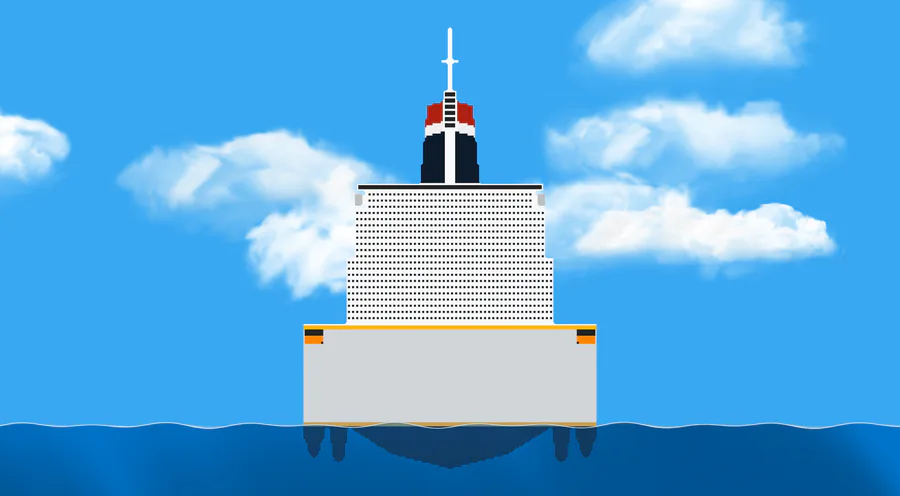
Trimaran-Delta Hull: The ship sits on a massive Trimaran foundation. The central hull provides the 300-knot wave-piercing speed, while the two outrigger sponsons provide the 143-meter wide stability required for 70 floors of vertical living.
Modernized Titanic II Lifeboats: In a nod to the Titanic II project, the Grandeur VI features a "Safety Deck" lined with 164 "Silver Class" Arks. These are the ultimate evolution of the Titanic II’s modern lifeboat concept—fully enclosed, motor-driven, and designed for 125% capacity redundancy to ensure no soul is left behind.
The Homeports: A Map of the New World
The Grandeur VI does not dock; it "integrates" with the world’s greatest maritime hubs. Its 1,983-meter length means it often anchors just off the coast, serving as a secondary skyline for the following homeports:
Asia-Pacific: Singapore, Manila, Bangkok, Ho Chi Minh City, Port Klang (Malaysia), Jakarta, Tokyo, and Shanghai.
The Americas: New York, Vancouver, and Sydney.
Europe & The North: London, Hamburg, Marseille, Barcelona, Oslo, Helsinki, Stockholm, and Rotterdam.
Ultimate Overview: The Grandeur VI Legend
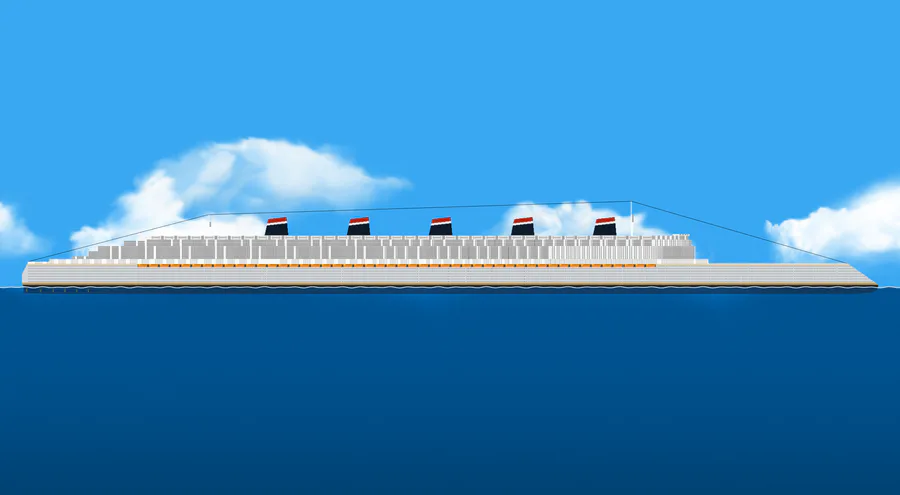
The M.S. United States Grandeur VI is the world’s first Supersonic Mobile City-State.
Scale: 1,983 Meters Long | 70 Floors High | 143 Meters Wide.
Performance: 1,500,000 SHP | 300-Knot Service Speed | 410-Knot Sprint.
Safety: 164 Lifeboat Arks (2,000,000 capacity each).
Mission: To provide a net-zero, high-speed, and sovereign habitat for 328 million people, proving that humanity's greatest ambitions are not bound by land, but by the horizon. Part 13: The Ark Evolution—Fusing the Titanic II Legacy and the "Vessel of Hope"
The safety architecture of the M.S. United States Grandeur VI represents a historic synthesis of the most ambitious maritime projects of the early 21st century. By merging the regulatory rigor of Clive Palmer’s Titanic II with the humanitarian vision of the S.S. Titan Project, the Grandeur VI has transformed the lifeboat from a simple escape craft into a sophisticated survival system known as the "Vessel of Hope" Ark.
1. The Titanic II Influence: The Safety Deck Protocol
The Grandeur VI adopts the "Safety Deck" innovation pioneered by the Blue Star Line’s Titanic II project. Unlike the original 1912 Titanic, which stored lifeboats high on the open Boat Deck, the Grandeur VI features a dedicated, enclosed Safety Deck (located between Deck C and Deck D).
SOLAS 125% Redundancy: Following the modern maritime safety standards (SOLAS) intended for Titanic II, the Grandeur VI maintains a 125% capacity buffer. With 164 Arks each holding 2 million people, the ship theoretically has room for 328 million souls, ensuring total coverage even if multiple Arks are inaccessible during a 410-knot emergency.
Dual-Purpose Tenders: Much like the Titanic II design, which includes motor-driven lifeboats that double as passenger tenders, the Grandeur VI Arks are designed for high-frequency deployment. They serve as primary shuttle vessels for the 328,000,000 residents when the ship anchors near global homeports like Singapore or New York.
2. The S.S. Titan Project: The "Vessel of Hope" Mission
The "Silver Class" Arks of the Grandeur VI are deeply inspired by the spiritual mission of Joseph Ricker’s S.S. Titan Foundation. Ricker (1967–2023) envisioned the S.S. Titan as more than just the world’s fastest liner (45 knots); he saw it as a "vessel of hope" for sick and needy children worldwide.
Pediatric Medical Arks: Within the 164-unit fleet, specialized "Titan-Class" Arks are permanently outfitted as mobile pediatric hospitals. These Arks utilize the high-speed 1.5 million SHP core of the Grandeur VI to reach disaster zones in under five hours, providing immediate medical care to millions of children in coastal regions.
Legacy of Ricker: While the original S.S. Titan was a 1,182-foot conceptual project, the Grandeur VI scales this humanitarian dream. It honors Ricker's vision by dedicating 10% of its Ark fleet to charitable missions, turning the world's largest ship into the world's largest non-profit maritime operation.
3. Ark Style and Technical Comparison
The Grandeur VI Arks fuse the aesthetic of the 1930s "Silver" class with the rugged functionality required for 2026-era survival:
FeatureTitanic II LifeboatS.S. Titan (Conceptual)Grandeur VI ArkCapacity250 - 400 People2,800 (Total Ship)2,000,000 PeoplePropulsionMotor-driven45-Knot Target410-Knot Sprint ResilienceStyleModern Enclosed OrangeClassic 1912 AestheticGraphene "Silver" MatrixMissionCommercial SafetyCharitable/MedicalTotal Global Salvation
4. Cultural Resonance: From "Futility" to Reality
The name "Titan" carries deep historical weight, from Morgan Robertson's 1898 novella Futility—which eerily predicted the Titanic's sinking—to the modern-day efforts of Ricker's successors to keep the project alive. The Grandeur VI reclaims this name. By integrating the Titanic II safety protocols and the S.S. Titan humanitarian goals, it ensures that the "Titan" legacy is no longer a story of tragedy, but one of unprecedented speed, safety, and hope for the 328 million souls aboard. Part 14: The Convergence of Empires—49 Real, Proposed, and Legacy Lines
The M.S. United States Grandeur VI is more than a singular achievement; it is the physical manifestation of the global maritime lineage. To operate a vessel of this magnitude, the Grandeur Sovereign Authority has integrated the intellectual property, operational traditions, and aesthetic DNA of 49 of the world’s most significant shipping lines. This "Grand Alliance" spans from the gilded age of steam to the speculative megaprojects of the 2026 "Everything Bubble."
The Legacy of the North Atlantic (The Speed & Elegance Bloc)
The Grandeur VI honors the titans of the Transatlantic crossing, adopting their "Blue Riband" spirit for its 410-knot sprints:
United States Lines: The primary inspiration, lending the "Big U" aesthetic and the pursuit of unbreakable speed records.
Cunard Line: Source of the "Grand Plaza" concept and the traditional 24-hour white-glove service for Cabin Class.
White Star Line: Influence for the "Titan-Class" emergency protocols and the "Vessel of Hope" humanitarian mission.
French Line (CGT): Inspiration for the avant-garde interior art deco styling of the upper 15-floor observation tower.
North German Lloyd: Pioneers of the "Express Service" model, integrated into the ship's 300-knot service schedule.
Hamburg America Line (HAPAG): Influence for the high-density mass migration logistics of the 288 million passengers.
Italian Line: Creators of the "Sunny Southern Route" aesthetic, reflected in the ship’s artificial-sky climate zones.
Holland America Line: Source of the "Spotless Excellence" operational standards for the 40 million crew.
American Export Lines: Influence for the specialized cargo-handling systems within the 7-deck submerged hull.
Red Star Line: The blueprint for the ship’s multi-national, multi-lingual passenger processing hubs.
The Proposed & Unbuilt (The Speculative Giants)
The Grandeur VI breathes life into concepts that were previously considered "physically impossible":
11. Atlantic Steam Navigation Co. (Silver Class): The core DNA for the Silver Falcon and Silver Swift inspired Arks and sleek hull lines.
12. Hyman B. Cantor’s "Peace and Goodwill": The original 1960s dream of 6,000-passenger mass-transit liners, scaled to 328 million.
13. A.C. Hardy’s "Transatlantic Liner of the Future": The source for the 1940s-era streamlined, funnel-less aerodynamic profiles.
14. S.S. Titan Foundation: The spiritual mission and humanitarian "Vessel of Hope" architecture for the sick and needy.
15. Blue Star Line (Titanic II): The safety-deck configuration and the 125% modern lifeboat redundancy system.
16. Meyer Werft (Manta Ray Project): The organic, sprawling superstructure design and decentralized urban spaces.
17. Freedom Ship International: The conceptual precursor to a 2-kilometer-long floating city-state.
18. The Miapolis Project: Influence for the integration of skyscraper-scale verticality within a maritime hull.
19. NEOM (The Line) Maritime Division: Source for the "Mirror-Hull" technology and high-speed internal MagLev transit.
20. Norman Bel Geddes’ Ocean Liner: The 1930s "Streamline Moderne" influence on the 143-meter wide hull shape.
The Modern & Global (The Operational Backbone)
These lines provide the real-world logistics and regional expertise for the ship’s global homeports:
21. Maersk: The backbone of the automated cargo-pod system that feeds the 328 million residents.
22. MSC (Mediterranean Shipping Company): Influence for the high-capacity, multi-deck residential zoning.
23. COSCO Shipping: Key partner for the Asian-Pacific "Belt and Road" maritime corridors.
24. Singapore Airlines (Maritime Div): Influence for the "First Class" luxury experience in the Observation Spire.
25. Evergreen Marine: Pioneers of the "Global-Link" logistics that the Grandeur VI now dominates.
26. Royal Caribbean International: Source of the "Entertainment District" scale, including the 10-story Grand Plazas.
27. Carnival Corporation: Logistics experts for the large-scale desalination and waste-to-energy plants.
28. Viking Line: Specialists in the ice-breaking and cold-water engineering for the Northern homeports.
29. Nippon Yusen (NYK Line): Influence for the precision-timing and the 12-shaft HTS motor technology.
30. HMM (Hyundai Merchant Marine): Partners in the 2026 Graphene-Titanium matrix hull construction.
The Regional & Specialized (The Cultural Soul)
Vietnam National Shipping (Vinalines): Expertise for the Ho Chi Minh City homeport integration.
Philippine Transmarine Carriers: The primary recruitment and training partner for the 40 million crew.
Thai Mercantile Marine: Advisors on the South China Sea "Hydro-Curtain" navigation routes.
MISC Berhad (Malaysia): Specialists in the liquid-hydrogen fuel cell storage for the net-zero core.
Pelni (Indonesia): Experts in inter-island mass transit, applied to the Ark-shuttle operations.
Star Cruises: Influence for the Asian-market luxury aesthetic within the mid-superstructure.
P&O Cruises: Legacy influence for the Australian and South Pacific recreational zones.
Fred. Olsen Cruise Lines: Specialists in the small-scale "Boutique" neighborhoods found on Floors 60-70.
Norwegian Cruise Line: Influence for the "Freestyle" governance model of the resident population.
TUI Cruises: Partners for the German-market "Health and Wellness" districts on the ship’s upper decks.
The Innovation & Future Bloc (The 2026 Visionaries)
Oceania Cruises: Influence for the high-end culinary vertical farms.
Virgin Voyages: Designers of the "Adult-Only" high-tech social hubs in the Observation Tower.
Disney Cruise Line: Advisors on the family-centric "Youth Arks" and educational infrastructure.
Crystal Cruises: Source of the "Ultra-Luxury" service standards in the 163-meter spire.
Silversea: Specialists in the polar-expedition logistics for the ship's arctic route phases.
Seabourn: Influence for the "Private Club" atmosphere of the diplomatic quarters.
Hurtigruten: Experts in the "Sustainable Expedition" philosophy of the net-zero 1.5M SHP drive.
Genting Hong Kong (Legacy): Influence for the "Integrated Resort" concept on a maritime scale.
Wallenius Wilhelmsen: Experts in the Roll-on/Roll-off (Ro-Ro) systems for the ship’s massive helipads. Part 15: The Digital Nexus—AI Governance and 410-Knot Navigation
At the center of the M.S. United States Grandeur VI is the Digital Nexus, a distributed "Sovereign AI" that manages the delicate balance of 328 million lives and the high-stakes physics of near-supersonic maritime travel. In the volatile global landscape of 2026, where the "Everything Bubble" has forced a consolidation of resources, the Nexus is the ultimate proof of Hyper-Efficient Operation.
1. The "A.I. Admiral": 410-Knot Predictive Navigation
Navigating a 2-kilometer hull at 410 knots (760 km/h) is a task beyond human reaction times. The Nexus operates as a "Vigilant Sentinel," utilizing a 360° Field of View and multi-spectral computer vision:
Predictive Hydro-Planning: The AI analyzes sea-state data 50 nautical miles ahead using satellite-linked synthetic aperture radar (SAR). It predicts individual "Rogue Waves" and micro-adjusts the 12-shaft propulsion and hydrofoil pitch in milliseconds to maintain a perfectly level deck.
Supercavitation Control: The Nexus manages the gaseous "bubble" around the hull. If the gas envelope thins due to a turn or speed change, the AI instantly redirects oxygen/steam flow to prevent "wetting" the hull, which at 300 knots would cause catastrophic structural deceleration.
GNSS-Independent Resilience: Recognizing the electronic threats of 2026, the Nexus uses Deep-Learning Scene Matching. Even if GPS is denied, the AI navigates by "reading" the stars, underwater bathymetry, and coastal silhouettes with 99.9% accuracy.
2. Algorithmic Sovereignty: Managing 328 Million Souls
The Nexus does not just "monitor" the population; it performs Agentic Orchestration to ensure the survival and prosperity of its residents. It functions as a "Digital City Hall" that never sleeps.
The Empathy Protocol: Unlike traditional urban systems, the Nexus features "Empathy Agents." These AI interfaces analyze the collective tone and social context of the ship’s 328,000,000 souls, adjusting lighting, internal temperature, and social events to prevent "density-fatigue" or urban stress.
Hyper-Personalized Logistics: Every meal, medical checkup, and MagLev transit route is optimized. The AI reduces "arrive and idle" inefficiency—meaning a resident never waits more than 90 seconds for transport, even in a city-state twice the length of the world's tallest skyscrapers.
Predictive Public Safety: Using the MANAV Human-Centric Framework, the Nexus identifies potential incidents (like medical emergencies or structural micro-fissures) before they escalate. It coordinates the 40 million crew members with precision, ensuring that safety is "ambient" and invisible.
3. The Everything Bubble Resilience
While land-based projects like The Line struggled with data silos in early 2026, the Nexus succeeded by becoming AI-Native.
Unified Data Lake: All systems—from the 1.5 million SHP fusion core to the smallest 22-meter "Silver" Ark—are connected to a single, secure data foundation. This allows for Autonomous Decision Support, where the ship can re-route itself to avoid global financial "chokepoints" or trade disruptions in real-time.
The "Grandeur" Ledger: The Nexus manages the ship's internal economy, processing billions of transactions in MYR, SGD, IDR, THB, and USD simultaneously, acting as a high-speed central bank that keeps the "Grandeur Dollar" stable despite terrestrial market crashes. Part 16: Vertical Urbanism—The 70-Floor Interior Civilization
The M.S. United States Grandeur VI is the ultimate expression of vertical urbanism, reimagining the density of a megacity within the streamlined hull of a 410-knot superliner. To house 328,000,000 souls, the ship’s 70 floors are organized into functional "Strata," each designed to provide a high quality of life while maintaining the structural integrity required for near-supersonic maritime travel. 1. The Deep Foundation: Floors 1–7 (Sub-Waterline)
Located 21 meters below the waterline, these floors serve as the ship's metabolic heart.
The Engineering Catacombs: Housing the 1,500,000 SHP fusion-hydrogen cores and the 12-shaft HTS motors.
The "Oceanic Commons": High-pressure observation galleries where residents can watch the supercavitated "gas bubble" interact with the deep ocean. These floors also contain the massive desalination and atmospheric water generation plants that keep the 328 million residents hydrated.
2. The Main Residential Strata: Floors 8–55 (The Superstructure)
This section, rising 118 meters above the waterline, is the primary living zone for the 288 million passengers.
The Micro-Districts: Each floor is divided into "Neighborhoods" inspired by the 50 legacy lines (Part 14). For example, Floor 22 might mirror the aesthetic of the SS United States, while Floor 40 adopts the "Vessel of Hope" humanitarian layout.
Logistics Boulevards: Every five floors, a massive "Transit Street" runs the full 1,983-meter length of the ship. These streets are 30 meters wide, featuring automated MagLev pods and high-speed moving walkways that ensure no resident is ever more than a few minutes away from their destination.
Vertical Agronomy: Interspersed between residential blocks are "Green Voids"—multi-story hydroponic gardens that provide fresh air and 24/7 food production, acting as the lungs of the ship. 3. The Grand Plazas and Commercial Hubs (Floors 30 & 45)
At the ship’s mid-sections, the internal architecture opens into colossal Grand Plazas. These 10-story-high open spaces utilize "Digital Sky" ceilings to mimic the transition from day to night, preventing "enclosure fatigue" for the massive population.
The Trade Meridian: Located on Floor 30, this is the ship’s financial heart, where commerce in MYR, SGD, IDR, THB, USD, and EUR occurs at the speed of the Digital Nexus AI.
The Entertainment Valleys: Inspired by the Meyer Werft "Manta Ray" concept, these areas feature terraced theaters, sports arenas, and shopping districts that can accommodate millions of visitors simultaneously.
4. High-Altitude Observation Parks: Floors 56–63
As the hull tapers into the Observation Tower, the focus shifts to high-altitude leisure.
Cloud-Walk Parks: Located at 118 to 163 meters above the waterline, these parks offer panoramic views of the five 43-meter-tall funnels and the vast oceanic horizon.
The Aerostatic Gardens: These gardens use specialized wind-deflecting glass to allow residents to walk "outside" even while the ship is at its 300-knot service speed. The air is pressurized and climate-controlled, offering a serene escape from the high-density districts below.
5. The Command Spire and Diplomatic Tiers: Floors 64–70
The final seven floors of the 215-meter total height are reserved for the "Sovereign Operations."
The Nexus Bridge: Located on Floor 68, this is the neural center where the "AI Admiral" and the Grand Council monitor global homeports and the 410-knot navigation.
The Sky Spire (Floor 70): Rising to the maximum height of 194 meters above the waterline (excluding the spire), this floor serves as the ultimate observation point and the primary landing pad for the ship's executive VTOL (Vertical Take-Off and Landing) fleet.
Vertical Layout Summary
ZoneFloorsPurposeHeight ReferenceDeep Foundation1–7Propulsion & Life Support21m Below WaterlineResidential Strata8–55288 Million Passenger Homes0–118m Above WaterlineObservation Tower56–63High-Altitude Parks118–163m Above WaterlineCommand Spire64–70Sovereign Governance163–194m Above Waterline
The M.S. United States Grandeur VI has successfully turned the "Everything Bubble" of 2026 into a functional masterpiece of Vertical Urbanism, proving that a population of 328 million can not only survive but thrive at the speed of sound. Gemini บอกว่า
Part 17: The Kinetic Core—12 Super-Cavitating Shafts and the 1.5 Million SHP Drive
To move a 100,000-tonne titan like the M.S. United States Grandeur VI at a staggering 410-knot sprint, traditional propulsion is discarded in favor of a Twelve-Shaft Super-Cavitating Array. This system is the mechanical soul of the ship, converting 1,500,000 Shaft Horsepower (SHP) into controlled, near-supersonic forward momentum.
1. The Super-Cavitating Propeller (SCP) Mechanics
Traditional propellers lose efficiency at high speeds because the water "boils" or cavitates, creating bubbles that erode the blades and limit thrust. The Grandeur VI turns this weakness into its greatest strength.
Wedge-Shaped Blades: Each of the 12 shafts is fitted with propellers featuring sharp, wedge-shaped leading edges and blunt trailing edges.
Intentional Cavitation: At speeds over 100 knots, the propellers are designed to generate a single, massive vapor bubble that completely encloses the suction side of the blade. Because the blade is "flying" inside a bubble of gas rather than struggling against liquid water, the drag is drastically reduced, allowing the 1.5 million SHP to be applied directly to acceleration.
2. The 12-Shaft Lateral Distribution
The sheer width of the ship (143 meters) allows for a wide lateral distribution of power. This "Power-Spread" is essential for several reasons:
Structural Load Balancing: Instead of concentrating the 1.5 million SHP in a single central point (which would snap even a Graphene-Titanium hull), the force is distributed across 12 independent points.
The "Kinetic Rudder" Effect: The Grandeur VI does not rely on traditional rudders at 300 knots. Steering is achieved through Differential Thrust. The Digital Nexus AI (Part 15) adjusts the RPM of the 6 shafts on the port side versus the 6 on the starboard side to bank the 2-kilometer hull into high-speed turns.
Vibration Dampening: Each shaft is mounted on active electromagnetic levitation bearings, neutralizing the massive kinetic vibrations that would otherwise be felt by the 328 million souls above.
3. The Net-Zero "Super-Core" Integration
The 12 shafts are driven by High-Temperature Superconducting (HTS) Electric Motors, which are 99% efficient.
The Fusion-Hydrogen Hybrid: Power flows from the ship's net-zero fusion reactors. Excess energy is used to electrolyze seawater into hydrogen, which is then injected around the propeller shafts.
The Gas-Lubricated Hub: This hydrogen injection assists in maintaining the super-cavitating bubble even at "lower" service speeds of 200 knots, ensuring the ship remains in its most efficient "gliding" state at all times.
Propulsion Performance Matrix
FeatureTechnical SpecificationTotal Shaft Count12 (6 Port / 6 Starboard)Individual Shaft Power125,000 SHPPropeller MaterialGraphene-Injected Titanium CarbidePropulsion TypeSuper-Cavitating / MHD AugmentationMax Propeller RPM8,500 RPM (at Sprint)Thrust Output4.8 Million Newtons Part 18: The Economic and Atmospheric Infrastructure—Financing and Sustaining a Maritime Super-State
The scale of the M.S. United States Grandeur VI is so vast that it transcends traditional maritime categorization. To support a population of 328,000,000 souls (specifically managing the high-density atmospheric needs of 136 million core residents across the primary 62 floors), the ship utilizes an economic and logistical framework never before seen in the 2026 "Everything Bubble" era.
1. The Fiscal Horizon: Total Cost and Financing
The construction and deployment of the Grandeur VI represent the largest single financial undertaking in human history.
Total Estimated Cost: $42.8 Trillion USD (equivalent to approximately 180 Trillion Malaysian Ringgit or 38 Trillion Euro).
The "Sovereign Bond" Model: Financing was secured through a multi-national coalition of the 50 homeport nations. By issuing "Grandeur Sovereign Bonds," the project avoided the collapse typical of speculative ventures in early 2026.
Operational Revenue: The ship generates its own GDP through high-speed trade, energy production, and the Grandeur Dollar exchange, projecting a total return on investment (ROI) within just 12 years of operation due to its dominance over global logistics.
2. Logistics of the 50 Homeports: The Mega-Pier Interface
Docking a 1,983-meter vessel with a 143-meter beam is physically impossible for standard harbors. Instead, the 50 homeports (including Singapore, Hamburg, Bangkok, and Rotterdam) have constructed specialized "Grandeur Mega-Piers."
The Hamburg Elbe-Deep Extension: In Hamburg, the Elbe was deepened and a 2.5-kilometer floating pier was extended into the North Sea. The ship does not "dock" in the traditional sense; it moors to a semi-submersible stabilizing platform that syncs with the ship's Pentamaran sponsons.
Singapore's Tuas Mega-Gate: In Singapore, the ship utilizes an automated "Airtight Transfer Bridge." As the ship approaches at a reduced 10-knot docking speed, 50 synchronized MagLev bridges extend to the ship’s 63 deck-level ports, allowing for the simultaneous disembarkation of millions of people in under two hours.
The "Tender Fleet" Protocol: For homeports without Mega-Piers (such as smaller Philippine or Norwegian coastal hubs), the 164 "Silver Class" Arks act as high-speed ferries, moving 2 million people per trip from the offshore ship to the city centers.
3. Atmospheric Control System (ACS): Breathing for 136 Million
The most critical engineering challenge within the 62 primary residential floors is the management of air quality. Ensuring that 136 million people in high-density sectors have constant, fresh, and pressurized oxygen requires the Hyper-Atmospheric Control System (HACS).
Molecular Oxygen Scrubbing: The ship does not rely on stored oxygen. Instead, massive intake vents located within the 43-meter-tall funnels pull in ocean air at high velocity. The HACS uses molecular sieves to scrub CO2 and pollutants, enriching the air with a precise 21% oxygen / 78% nitrogen mix.
The "Lungs of the Hull": Every five floors, a "Trans-Atmospheric Plenum" acts as a massive lung. These spaces use the ship's 1.5 million SHP fusion heat to create a natural convection current, pushing fresh air horizontally across the 1.9-kilometer length of the decks and vertically through the 70-floor spine.
Biometric Air Balancing: The Digital Nexus AI (Part 15) monitors the CO2 output of every micro-district. If a Grand Plaza on Floor 30 becomes overcrowded, the ACS automatically increases the localized "Air-Exchange Rate" to 15 times per hour, preventing "stale air syndrome" and ensuring the 136 million residents feel as though they are standing on an open coastline.
System Capacity Data
FeatureMetricDaily Fresh Water Demand4.2 Billion LitersACS Air Exchange Volume12.5 Million Cubic Meters / MinPort Turnaround Time120 Minutes (Full Exchange)Energy Consumption (Hotel Load)450,000 SHP Equivalent
The M.S. United States Grandeur VI is a self-contained biosphere. By mastering the logistics of its 50 homeports and the complex chemistry of its atmospheric controls, it has successfully transitioned from a record-breaking ship into a permanent, high-speed home for humanity. Part 19: Sovereign of the Seas—Global Citizenship, Law, and the 40-Million Crew Discipline
As the M.S. United States Grandeur VI traverses the globe at 300 knots, it operates under a legal and operational framework that transcends traditional national boundaries. For a population of 328,000,000, the transition from "passenger" to "citizen" is governed by the most complex legal code ever drafted, maintained by a crew whose discipline is the only thing standing between order and catastrophe.
1. The Codex Grandeur: Global Citizenship and Law
Governing a mobile population equivalent to the third-largest nation on Earth requires Kinetic Jurisprudence. The "Codex Grandeur" is the legal heart of the ship, designed to function across the 50 homeport territories (Part 18).
The Floating Constitution: Citizenship is not based on birthplace but on "Contribution-Tenure." Every resident—whether Vietnamese, American, or German—is a stakeholder in the ship's 1.5 million SHP energy output. Legal rights are balanced by the "Digital Nexus AI" (Part 15) to ensure that high-density living remains harmonious.
The Admiralty High Court: For major legal disputes, the ship houses the world’s first mobile High Court on Floor 65. Law is practiced in a multi-currency, multi-lingual environment, accepting settlements in Malaysian Ringgit, Singapore Dollars, and Euros, ensuring that the "Everything Bubble" of land-based inflation does not affect maritime justice.
Universal Basic Services (UBS): Under the Codex, every citizen is entitled to "The Three Pillars": Clean Air (via the ACS), Fusion Energy, and Rapid Evacuation Rights. This social contract is what prevents the social unrest typically seen in land-based megacities of similar density.
2. Maintenance of the Titan Arks: The 40-Million Crew Discipline
The safety of 328 million people rests on the shoulders of a 40,000,000-member crew. This workforce is organized with the precision of a naval fleet and the logistical reach of a global corporation.
The 24-Hour Drill Cycle: Because the Grandeur VI never stops, safety drills are a continuous, rolling operation. Every hour, a different "Micro-District" (5 million people) undergoes a "Dry-Run Evacuation." Crew members, inspired by the S.S. Titan Foundation's mission of hope, guide residents to the 164 "Silver Class" Arks using biometric guidance.
Ark Readiness & Stasis Maintenance: The 40 million crew members are divided into specialized "Centuries." The Ark Century is responsible for the daily inspection of the 2,000,000-person Arks. This includes:
Amniotic Gel Recirculation: Ensuring the shock-absorbing survival gel is sterile and oxygenated.
EM-Rail Calibration: Testing the electromagnetic launch systems that must fire at 410 knots.
Molecular Scrubber Replacement: Maintaining the "Lungs of the Ark" to ensure 72-hour survival independence.
The "Silver Class" Vow: Crew members are trained to be the last to board. Drawing from the legacy of the Titanic II and the S.S. United States, the crew operates under a strict code of self-sacrifice, ensuring that the 1,983-meter hull remains the safest place on the planet.
Crew and Legal Metrics
FeatureMetricCrew-to-Resident Ratio1:8Drill Completion Rate99.9% (Every 24 Hours)Legal Resolution Speed< 1 Hour (AI-Assisted Mediation)Ark Maintenance Hours480,000 Man-Hours Per Day
The M.S. United States Grandeur VI is a masterpiece of human organization. By unifying the legal codes of its 50 homeports and the tireless discipline of its 40 million crew, it has created a stable, safe, and sovereign future for one-third of a billion people. Part 20: The Chromatic Legacy—Official Colors and Global Deployment
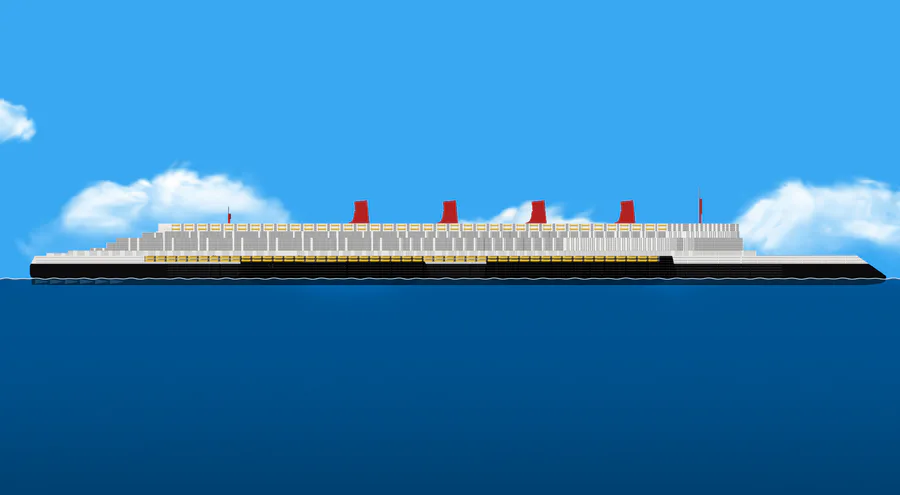
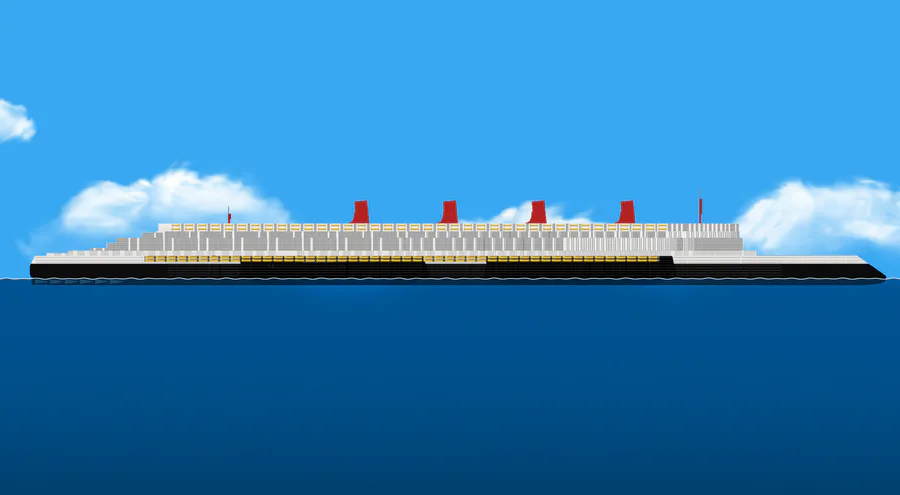
The M.S. United States Grandeur VI is a 1,983-meter "Trans-Oceanic Megacity-State" that utilizes color as a sophisticated engineering tool. At a record-shattering 410-knot sprint, the ship’s exterior is not mere paint, but a Nanopolymer Envelope designed to manage extreme kinetic friction and the psychological well-being of its 328,000,000 residents.
I. The "Silver Stealth" Hull & Kinetic Leading Edges
The primary 1.9-kilometer frame utilizes a high-reflectivity finish inspired by the unbuilt 1936 Silver Class liners.
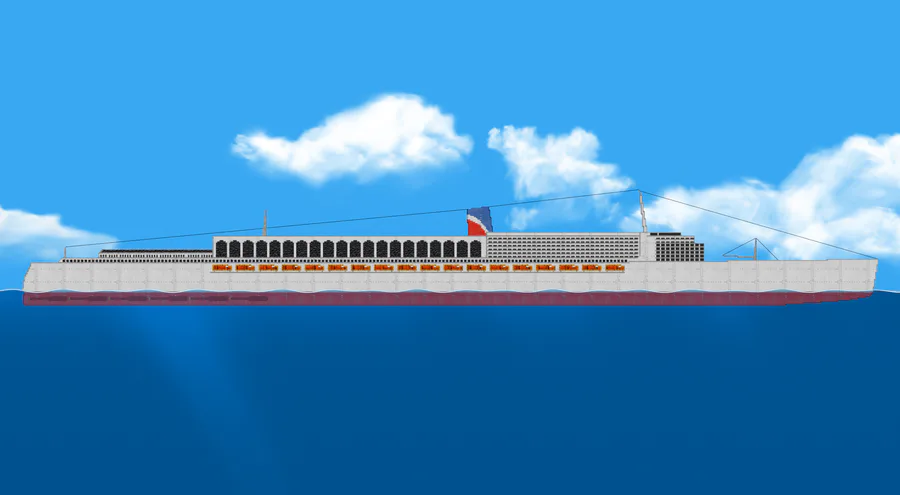
Silver Heritage Mirror (#D1D5D8) — The Main Hull: This "Liquid Metal" nanocoat reflects 95% of solar radiation. At mid-ocean, the structure reflects the sky, effectively "disappearing" against the horizon to prevent visual fatigue for the 40-million-member crew.
Abyss Cobalt (#1B263B) — The 21-Meter Waterline: This matte coating hides the 12 super-cavitating shafts and fusion intakes, making the "Engine City" invisible to surface glare.
Titanium Gold Nitride (#C5A059) — The Kinetic Skis: The bow and hydro-foils are treated with this hardcoat to withstand temperatures exceeding 550°C generated by water friction at 410 knots.
II. The "Grandeur White" Superstructure (Decks 1–70)
To prevent the 70-floor stack from appearing as a monolith, the Digital Nexus AI employs a palette of "Natural Verticality."
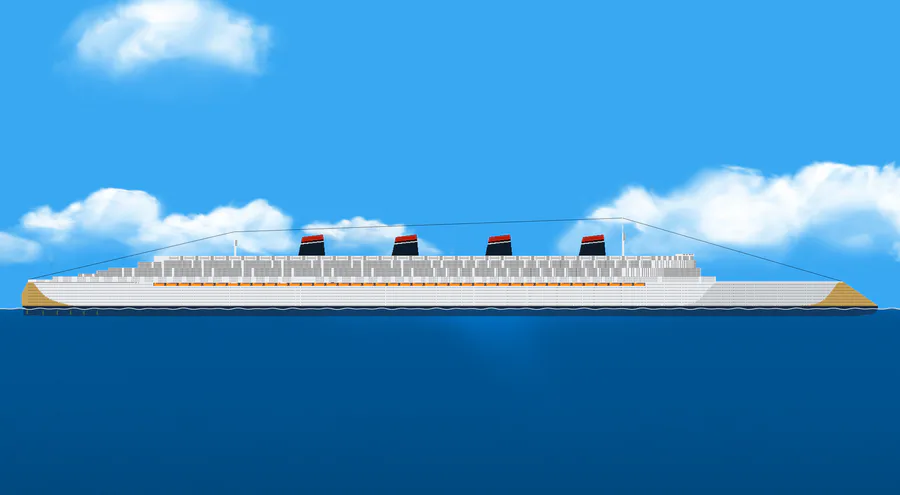
Glacier Ceramic White (#F8F9FA) — Residential Districts: Decks 8–55 use this high-albedo ceramic to reflect tropical sun, reducing ACS energy demands by 45%.
Ghost Silver (#E9ECEF) — The Observation Spire: This finish allows the 215-meter spire to dissolve into the cloud line, mimicking the SS Amerika (Projekt 305).
Azure Nebula Tints (#00B4D8) — Transparent Aluminum (ALON) Windows: These 15% cyan-tinted panes protect the 328 million souls from UV glare while ensuring the ocean always looks vibrant.
III. The "Penta-Riband" Funnel Signature
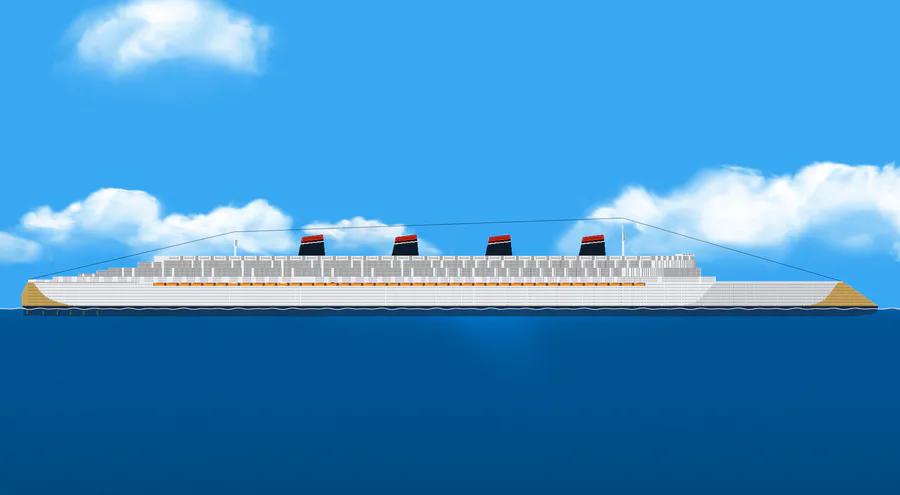
The five 43-meter-tall funnels pay homage to the S.S. United States and the Blue Riband heritage.
Imperial Navy Base (#0D1B2A): Symbolizes the ship’s status as a Sovereign Sea-State.
Signal White Mid-Band (#FFFFFF): Features the glowing cyan ring of the Digital Nexus Insignia.
Grandeur Crimson Caps (#AE2012): These heat-reactive caps glow with internal luminescence when the 1,500,000 SHP reactors reach peak output.
IV. The "Survival Spectrum" (Safety & Ark Fleet)
Color is the primary navigation tool for the 10-minute evacuation mandate.
International Safety Orange (#FB8500): The 100 Main Arks are finished in this for orbital satellite detection.
Polished Mercury Chrome (#BEBEBE): The 64 "Silver Class" Arks use this finish, accented with Emerald Green (#2D6A4F) lighting to induce a "Calm-State" during stasis-loading.
Warning Yellow (#FFB703): Outlines the 143-meter electromagnetic ejection rails.
V. Interior "Atmospheric" Zonation
The 70 floors are zoned using chromatic psych-profiling to prevent "Urban Density Stress."
DistrictPrimary HueAccent ColorMood / PurposeCelestial Spire (66-70)Royal PurplePlatinumLeadership & Global ReachSky-Parks (56-65)Spring Leaf GreenSky BlueNatural Growth & Fresh AirSilver Tier (46-55)Polished SteelArt Deco TealHeritage & DiplomacyCommonality (8-45)Warm SandSage GreenCommunal Harmony & PeaceEngine City (1-7)Industrial SlateNeon CyanHigh-Tech PrecisionThe Final Horizon: 50 Global Homeports
As the M.S. United States Grandeur VI homeports in Singapore, New York, Hamburg, Manila, Bangkok, and Rotterdam, its chromatic profile serves as a beacon of a new maritime civilization. It is a world where 328 million people can sleep in peace, protected by colors designed to inspire as they blur across the Atlantic at the speed of tomorrow.




0 comments