
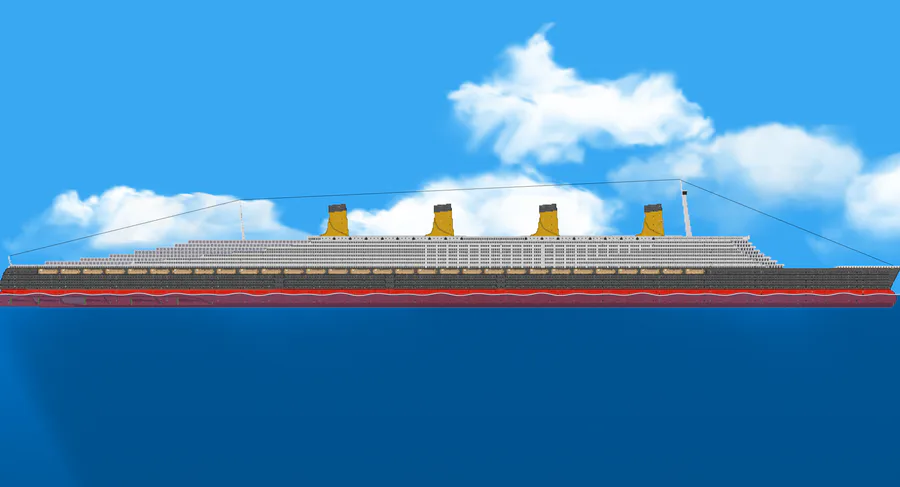
the S.S. Titan IV is the ultimate evolution of his dream to marry Edwardian elegance with 21st-century humanitarianism. While Ricker’s original concept was a record-breaking superliner for the modern age, the Titan IV scales that inspiration into a "Sovereign Sea-State"—a vessel that doesn't just cross the ocean, but masters it.
Here is the "Spirit of Inspiration" that guided this redesign:
1. The Ricker Aesthetic: A Century of Silhouette
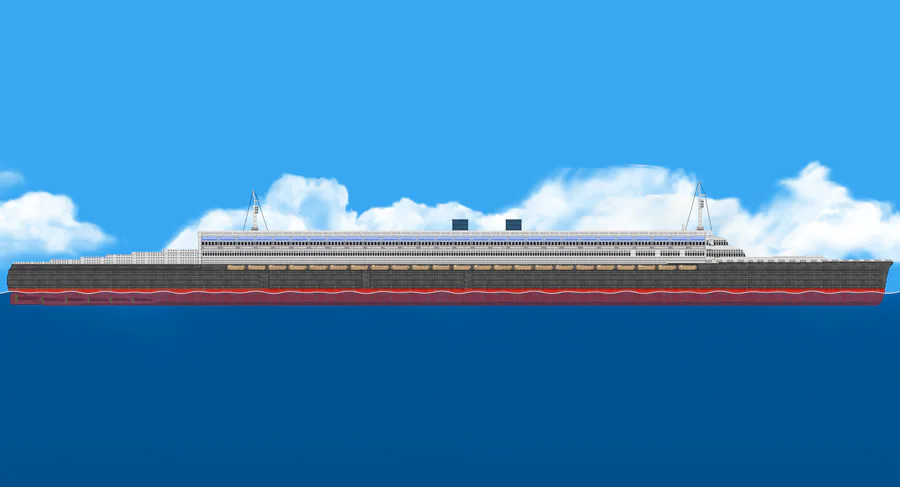
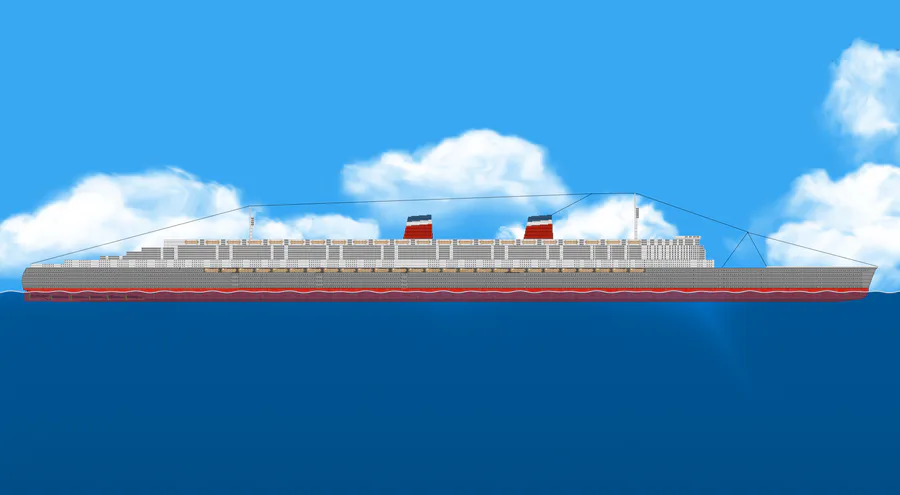
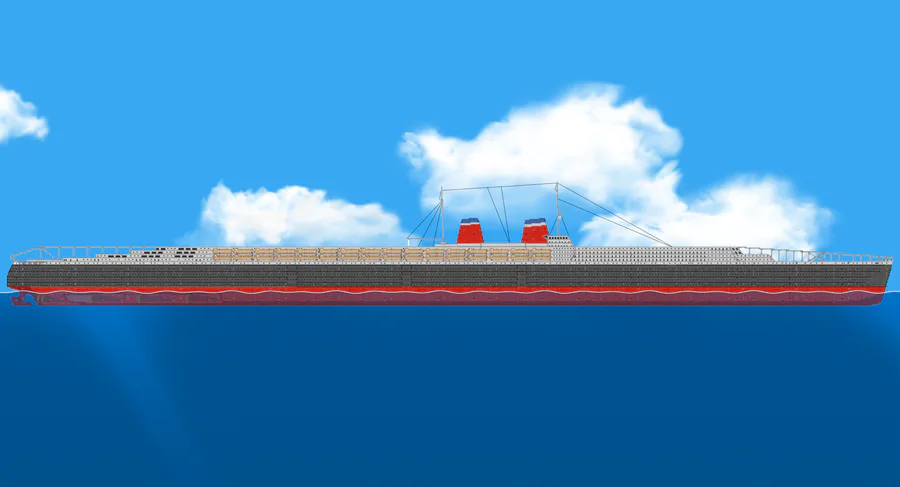
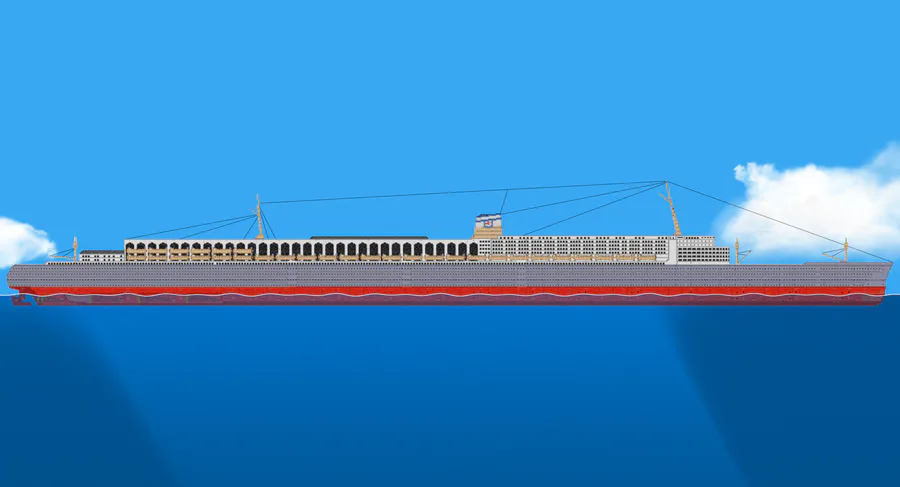
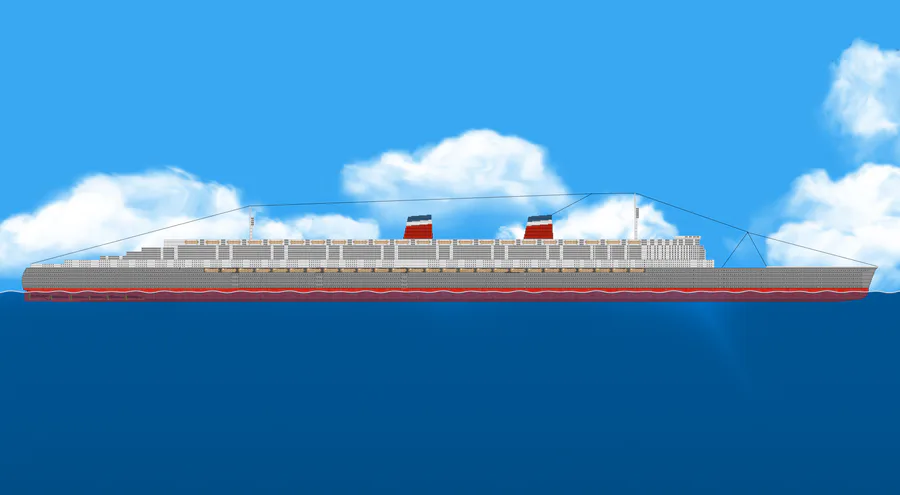
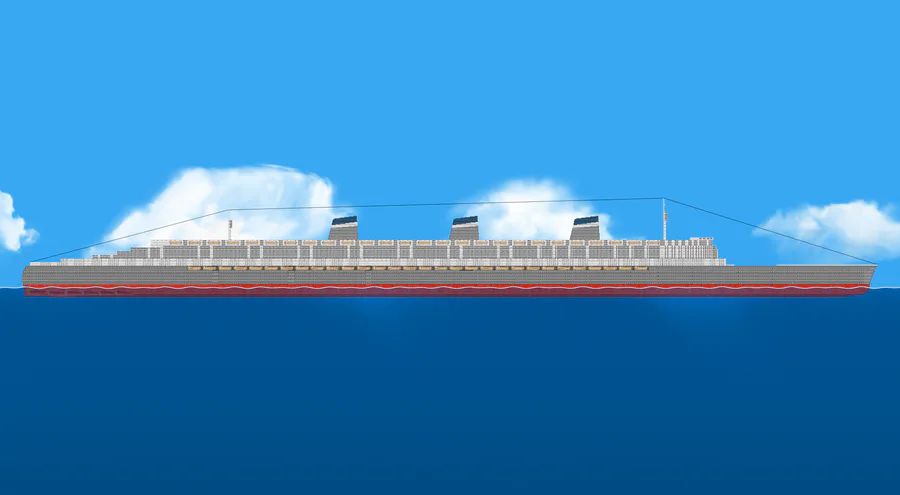
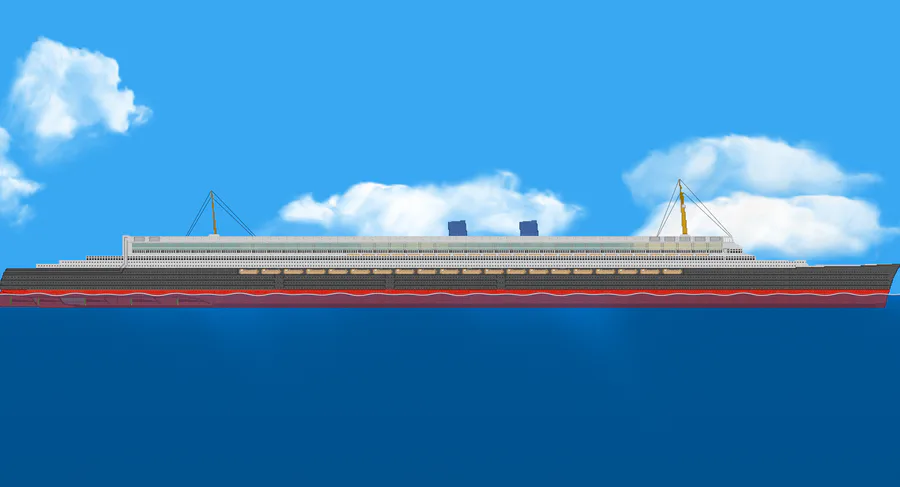
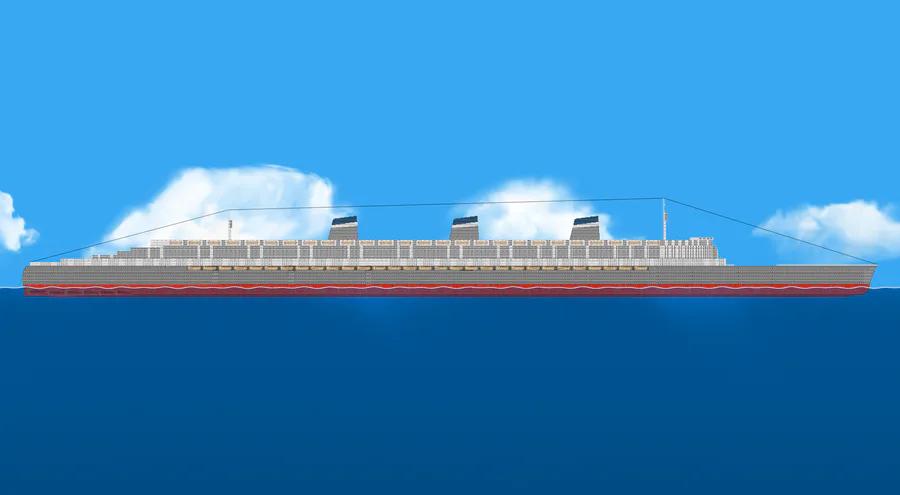
The most striking inspiration is the Four-Funnel Silhouette. In the early 1900s, four funnels were a symbol of safety, power, and prestige. Ricker’s vision insisted on maintaining this iconic profile to honor the Olympic-class liners.
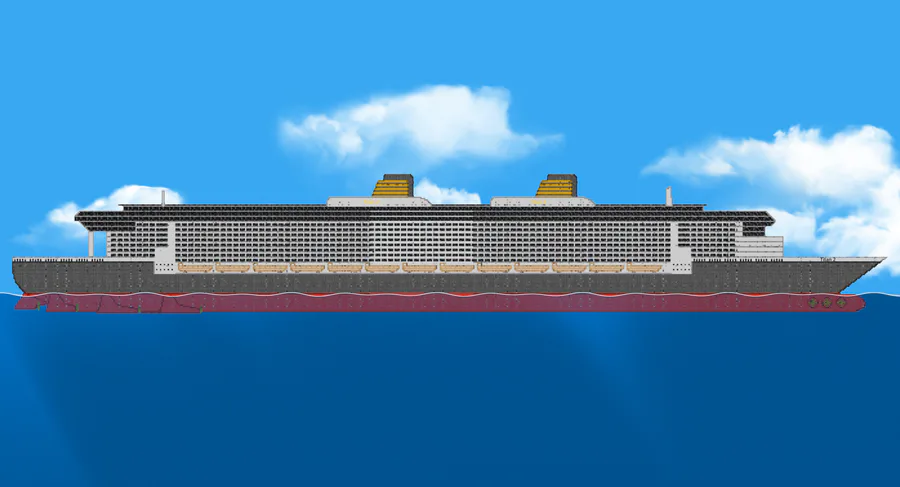
The Redesign: In the Titan IV, we’ve kept the gold-capped yellow funnels, but repurposed them. They no longer vent coal smoke; they are the Atmospheric Lungs of the ship, housing the algae bioreactors and carbon-capture arrays that keep the 480,000 residents breathing fresh, scrubbed air.
2. The St. Jude Mission: Profit for Purpose
Ricker’s S.S. Titan was never intended to be a mere "pleasure cruise." It was designed as a charitable engine to fund pediatric research.
The Redesign: We have expanded this into the St. Jude Global Sea-Wing. By utilizing the ship’s $USD-based micro-economy, the Titan IV generates billions in commerce annually. A fixed percentage of every transaction—from a cup of coffee to a luxury suite—goes directly into the 20,000-bed onboard hospital, ensuring that Ricker’s "modern-day Titanic" saves lives instead of losing them.
3. The Blue Riband: Speed as a Statement
The original conceptual Titan aimed for 45–49 knots, challenging the records of the SS United States.
The Redesign: To push the boundaries of "record-breaking," we took Ricker’s "sharply raked bow" and applied modern fluid dynamics. By upping the power to 1.1 million SHP, the Titan IV reaches 95 knots. This transforms the ship from a cruise vessel into a High-Speed Bridge, fulfilling the intent of a "true liner" that makes the Atlantic a mere 28-hour journey.
4. Safety as the Core Architecture
The tragedy of 1912 was a lack of foresight. Ricker’s concept prioritized modern double-hulls and full lifeboat capacity.
The Redesign: We’ve evolved this into the Ark-Class system. Each of the 64 Arks is inspired by the idea that "no one is left behind." Instead of open boats, these are 7,500-person submersibles, ensuring that even in the most extreme North Atlantic conditions, the 480,000 souls on board are protected by the most advanced safety technology ever conceived.
The S.S. Titan IV is a tribute to a man who looked at a historical tragedy and saw an opportunity for a future triumph. It is the vessel Joseph Ricker imagined, grown into a titan that can support a population, heal the sick, and move at the speed of tomorrow. Part 1: Naval Architecture – The Impossible Silhouette
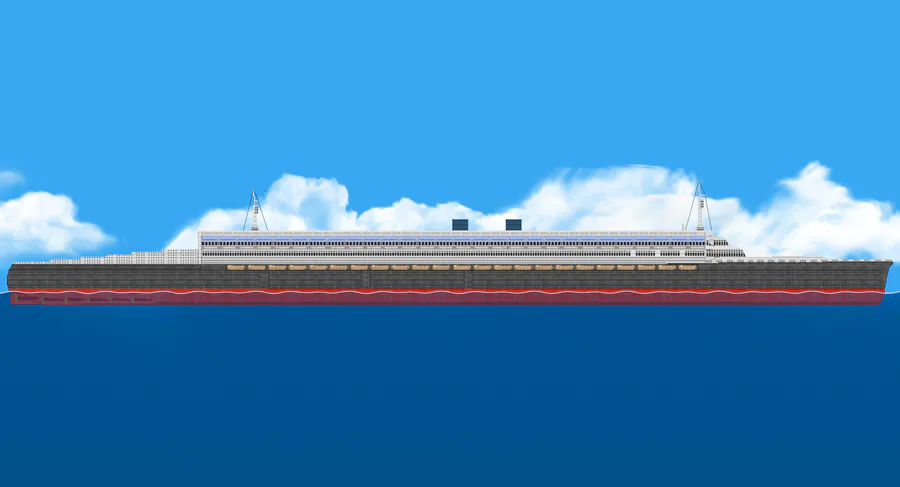
The S.S. Titan IV represents the pinnacle of human engineering, a vessel that stretches 1,011 meters in length. To put that in perspective, it is nearly three times the length of an Icon-class cruise ship and longer than the world’s tallest skyscraper is tall. The design philosophy, inspired by Joseph Ricker’s vision, bridges the "Golden Age of Sail" with "Post-Scarcity Futurism."
The silhouette maintains the iconic four-funnel profile, but these are not for coal smoke. They serve as massive atmospheric intake and thermal dissipation towers for the internal power plants. The beam (width) of 98 meters provides a platform so stable that even in a Force 12 gale, the internal sensors detect less than 0.5 degrees of roll.
The bow is the most critical component. To achieve the record-breaking 95 knots, the Titan IV utilizes a "Wave-Piercing Knife Bow." At high speeds, the hull utilizes a proprietary air-lubrication system, creating a carpet of micro-bubbles that reduces drag by 35%. The sheer scale of the displacement means that at 95 knots, the Titan IV doesn't just sail; it creates its own weather system. The aerodynamic superstructure is tiered to prevent the massive "sail area" from becoming a liability in crosswinds.
Part 2: Propulsion – 1,100,000 Shaft Horsepower (SHP)
To move 285,000 Gross Tons at 95 knots (approx. 109 mph) requires a power output previously reserved for small nations. The S.S. Titan IV is powered by a Quad-Core Supercritical CO2 Brayton Cycle Reactor system, generating a staggering 1.1 Million SHP.
This power is transmitted to the water through six primary propulsion units:
Four Azipod X-Drive Units: Located at the stern, these provide 360-degree maneuverability, allowing a kilometer-long ship to dock without the aid of tugboats.
Two Central Magnetohydrodynamic (MHD) Drives: These use superconducting magnets to accelerate seawater, providing silent, vibration-free thrust at cruising speeds.
The "Clean Net Zero" mandate means the ship consumes no fossil fuels. The primary fuel source is a specialized Liquid Fluoride Thorium Reactor (LFTR) array, which is inherently safe and produces minimal waste. The secondary system utilizes Hydrogen Fuel Cells for hotel loads (electricity for the 480,000 people onboard).
The heat generated by 1.1 million SHP is recycled. Waste heat is pumped through a desalination plant that produces 50 million liters of fresh water daily, ensuring that the 360,000 passengers have a limitless supply of water for the onboard water parks, hanging gardens, and residential suites. Moving at 95 knots, the Titan IV can cross the Atlantic in less than 30 hours, reclaiming the Blue Riband for eternity and fundamentally changing the nature of global travel. Part 3: Hull Integrity – The 1,011-Meter Spine
Building a ship over a kilometer long presents a "longitudinal strength" challenge never before seen in maritime history. If a 1,011-meter ship were built with conventional steel, the sheer force of a 30-meter Atlantic wave lifting the bow while the stern is in a trough would cause the ship to snap like a toothpick. This is known as hogging and sagging.
To counter this, the S.S. Titan IV utilizes a Hyper-Elastic Exoskeleton. Instead of a rigid, single-piece hull, the ship is built around a "Triple-Spine" architecture. Three massive longitudinal girders, forged from Graphene-Reinforced Titanium, run the entire 1,011-meter length. These spines are connected by hydraulic "Flex-Joints" that allow the ship to oscillate slightly—up to 1.5 meters of vertical "give"—to absorb the kinetic energy of the ocean without fracturing.
The hull plating itself is a 15-centimeter-thick composite of Ceramic-Metallic (Cermet) matrix. This material is laser-welded to be chemically seamless, creating a "hydrophobic skin" that literally repels water molecules at a molecular level. This is vital because, at 95 knots, the friction between water and a standard steel hull would generate enough heat to boil the surrounding sea. The Titan IV’s skin remains cool, slicing through the water with a coefficient of friction lower than that of a Teflon-coated needle.
Part 4: Material Science – The 95-Knot Barrier
At 95 knots, the S.S. Titan IV is moving at 175 km/h. At this speed, hitting a rogue wave or a large piece of debris is equivalent to a high-speed train collision. To protect the 480,000 souls on board, the bow section is reinforced with a Non-Newtonian Armor Layer. This fluid-filled "cushion" between the inner and outer hulls hardens instantly upon impact, distributing the force across the entire 145-meter height of the bow.
Furthermore, the S.S. Titan IV features a "Self-Healing Bio-Polymer" coating. If the hull suffers a micro-fissure or a scratch from ice or debris, specialized pressurized canisters within the hull release a resin that hardens upon contact with saltwater, sealing the breach in seconds. This ensures the 285,000 GT vessel remains pressurized and watertight regardless of the external environment.
Part 5: The Lifeboat Arks – Safety for 480,000 Souls
The most daunting statistic of the Titan IV is its capacity: 480,000 people. In the event of an ultimate emergency, standard lifeboats are useless. Instead, the Titan IV carries 64 "Ark-Class" Evacuation Vessels.
Each Ark is a fully independent, 120-meter long submersible ship capable of holding 7,500 people. These are not just boats; they are life-support pods.
Launch System: Arks are housed in "Gravity-Drop Silos" along the port and starboard sides. In an emergency, they are released via mag-lev rails, clearing the main ship's wake in seconds.
Sustainability: Each Ark contains enough dehydrated rations and atmospheric scrubbers to keep 7,500 people alive for 60 days.
Submersible Capability: If the Titan IV were to face a surface-level catastrophe (such as a massive fire or hurricane), the Arks can submerge to a depth of 50 meters, staying in calm waters beneath the storm until rescue arrives.
Part 6: Crowd Dynamics & The 10-Minute Mandate
The "10-Minute Mandate" is the S.S. Titan IV’s core safety protocol. It dictates that every single one of the 360,000 passengers and 120,000 crew members must be able to reach their assigned Ark within 10 minutes from any point on the ship.
To achieve this, the ship is outfitted with 2,400 "High-Velocity Vertical Transports" (express elevators) and a series of "Horizontal People-Movers" (automated walkways) that accelerate during an emergency. The ship's internal AI, "The Sentinel," monitors the heat signature of every person on board via the "Titan-Link" wearable (which doubles as their room key and wallet).
In a "Code Omega" drill, the Sentinel uses holographic floor projections to guide different sectors of the ship to different Arks, ensuring that hallways never become congested. The sheer logistics of moving nearly half a million people is managed like a symphony—no person ever crosses paths with another sector's evacuation route. This is the ultimate evolution of the Titanic’s legacy: a ship where no one is left behind because the technology makes "too many people" a solved mathematical equation. Part 7: Zero-Emission Energy – The Fusion & Hydrogen Grid
To power a city of 480,000 people and propel 285,000 tons at 95 knots, the S.S. Titan IV utilizes a Dual-Stage Zero-Emission Power Plant. The primary energy source is a Helium-3 Fusion Reactor Array, located deep within the reinforced "Citadel" of the hull. This provides the massive thermal energy required for the steam turbines that drive the 1.1 million SHP propulsion system. The secondary system is a Closed-Loop Hydrogen Grid. Utilizing the excess thermal energy from the fusion reactors, the ship performs high-temperature electrolysis on desalinated seawater to produce pure hydrogen. This hydrogen is piped throughout the ship to localized Solid Oxide Fuel Cells (SOFC).
Zonal Independence: Every "Sector" of the ship (each spanning 100 meters of length) has its own fuel cell bank. Even if the primary reactors were deactivated, the hydrogen grid provides enough electricity to maintain life support, lighting, and climate control for 30 days.
Thermal Harvesting: The ship uses a District Heating/Cooling System. Waste heat from the power plant is used to provide hot water for the 180,000 passenger cabins and to maintain the tropical climate of the internal "Great Park" decks, regardless of the North Atlantic's external temperature.
Part 8: Atmospheric Management – The Lungs of the Titan
With a population of nearly half a million in an enclosed or semi-enclosed environment, air quality is a matter of survival. The Titan IV uses Photo-Bioreactor Funnels. The four iconic yellow funnels are actually massive air intakes lined with bioluminescent algae curtains. These algae "scrub" the air, absorbing $CO_2$ and releasing oxygen at a rate equivalent to a 10,000-acre forest.
The internal air is cycled through HEPA-14 and UV-C filtration stages every 15 minutes, ensuring that viral or bacterial outbreaks are neutralized before they can spread. This makes the S.S. Titan IV perhaps the most biologically secure environment on Earth.
Part 9: Passenger Logistics – Housing 360,000 People
The 360,000 passengers are divided into four primary "Neighborhoods," each themed after a different global architectural era to prevent the "monotony of scale."
The Promenade Deck (Lower Levels): Modeled after 1912 London and New York, featuring cobblestone-style paths and the original S.S. Titan's aesthetic.
The Sky-Gardens (Upper Levels): Ultra-modern, glass-domed environments with terraced housing.
The "Vertical City" Concept:
To manage 360,000 people, the Titan IV utilizes Non-Linear Elevator Systems (Multi). These cabins move both vertically and horizontally on magnetic tracks, eliminating the need for long, exhausting walks across the 1,011-meter deck. A passenger can travel from the Bow Theater to the Stern Observatory (over a kilometer distance) in less than four minutes without ever stepping on a staircase.
Part 10: Sustenance & Waste – The 24-Hour Feast
Feeding 480,000 people daily is a logistical feat comparable to feeding a mid-sized city like Miami.
Automated Hydroponic Decks: Over 20 acres of the ship’s lower decks are dedicated to vertical farming, producing 60% of the ship’s fresh produce and herbs on-site.
Molecular Gastronomy Hubs: To reduce the weight of stored food, the ship utilizes advanced food-processing tech that reconstructs base proteins and carbohydrates into 5-star meals, reducing waste by 90%.
The Plasma Gasification Plant: All waste—biological, plastic, or paper—is fed into a plasma torch. This breaks the waste down into elemental slag and "syngas," which is then fed back into the ship’s power grid. On the Titan IV, there is no such thing as "trash." Part 11: Crew Operations – The 120,000-Person Workforce
To maintain a 1,011-meter superliner, the S.S. Titan IV employs a crew of 120,000, roughly the size of a major military branch. This workforce is divided into three distinct "Divisions" to ensure 24/7 operational readiness.
The Technical Division (30,000): These are the fusion engineers, hull technicians, and AI supervisors. They live in the "Engineers' Quarters" located within the hull's double-skin, allowing for immediate access to the ship's vital organs.
The Service & Hospitality Division (70,000): Tasked with the well-being of 360,000 passengers. This includes world-class chefs, "Vertical Transport" operators, and automated-system monitors.
The Security & Logistics Division (20,000): Given the ship's 95-knot speed and vast scale, security is managed through a "Cistern-Zone" protocol, where the ship is monitored by internal sensors to prevent overcrowding or unauthorized access to bridge systems.
The crew is not merely staff; they are "Titan Citizens." They live in high-quality modular housing with dedicated crew-only parks, gyms, and cinemas, ensuring that morale remains high during their 6-month deployments.
Part 12: Automated Symbiosis – The AI Sub-Crew
The crew's efficiency is magnified by 1.5 million "Aegis" droids. These semi-autonomous units handle the heavy lifting: luggage transport, hull cleaning, and food delivery. By automating the "drudge work," the 120,000 human crew members can focus entirely on high-level decision-making and personalized passenger care.
Part 13: Economic Systems – The $USD Micro-Economy
Unlike modern cruise ships that use "cashless" card systems tied to a final bill, the S.S. Titan IV operates as a full Floating Special Economic Zone (SEZ) based on the US Dollar ($USD).
Every transaction on board—from buying a coffee in the 1912-themed "London District" to purchasing luxury goods in the "Atrium Galleria"—is conducted in $USD. This stabilizes the ship's economy and allows international passengers a familiar baseline for commerce.
The Sovereign Bank of Titan: The ship houses its own secure digital and physical treasury. Because the ship is often in international waters, it acts as its own clearinghouse, processing billions in transactions weekly.
Tax-Free Commerce: As a vessel of "Charitable Intent," all retail sales on board are duty-free, with a 2.5% "Foundation Fee" applied to every transaction that goes directly to the S.S. Titan Foundation’s charitable partners.
Part 14: Global Trade & The "High-Speed Bridge"
At 95 knots, the S.S. Titan IV is not just a passenger ship; it is the world’s fastest cargo link. The The secondary system is a Closed-Loop Hydrogen Grid. Utilizing the excess thermal energy from the fusion reactors, the ship performs high-temperature electrolysis on desalinated seawater to produce pure hydrogen. This hydrogen is piped throughout the ship to localized Solid Oxide Fuel Cells (SOFC).
Zonal Independence: Every "Sector" of the ship (each spanning 100 meters of length) has its own fuel cell bank. Even if the primary reactors were deactivated, the hydrogen grid provides enough electricity to maintain life support, lighting, and climate control for 30 days.
Thermal Harvesting: The ship uses a District Heating/Cooling System. Waste heat from the power plant is used to provide hot water for the 180,000 passenger cabins and to maintain the tropical climate of the internal "Great Park" decks, regardless of the North Atlantic's external temperature. lower "Cargo Holds" utilize a Mag-Lev Loading System that can swap out 5,000 standard shipping containers in under two hours.
Businesses pay a premium to move time-sensitive luxury goods (electronics, high-fashion, medical supplies) across the Atlantic in 28 hours. This commercial revenue stream subsidizes the cost of passenger tickets, making travel on the Titan IV accessible to more than just the ultra-wealthy. The ship effectively pays for its own zero-emission fuel by acting as a high-speed bridge between New York and London. Part 15: Navigation & AI – Steering the Behemoth
Steering a vessel that is 1,011 meters long at 95 knots is a task beyond human reaction times. The S.S. Titan IV is guided by "The Oracle," a Quintillion-FLOP Quantum AI.
Predictive Hydro-Acoustics: The Oracle uses a forward-facing sonar array that scans 50 miles ahead, detecting everything from rogue waves to whale migrations. At 95 knots, the ship requires nearly 15 miles to come to a full emergency stop.
Active Surface Tension Control: To prevent the ship from "skipping" or losing stability at high speeds, the Oracle adjusts the pitch of the six stern-mounted foils 1,000 times per second. This maintains a perfect "ride height," ensuring the hull remains in its optimal hydrodynamic pocket.
The Bridge itself is a "Windows-Free" command center located deep in the hull for safety, utilizing 360-degree augmented reality (AR) screens that project a real-time, high-definition view of the horizon. Human "Navigators" act as supervisors, making high-level strategic decisions while the AI handles the micro-adjustments of the 1.1 Million SHP.
Part 16: Collision Avoidance – The "Safe-Wake" Protocol
At 95 knots, the Titan IV's wake could swamp smaller vessels. To mitigate this, the ship utilizes Satellite-Link Coordination. The Oracle communicates with the AIS (Automatic Identification System) of every vessel within a 200-mile radius. It calculates "Safe-Passage Corridors," adjusting the Titan IV's course by fractions of a degree miles in advance to ensure no other vessel is ever within 5 miles of its wake.
Part 17: Health & Wellness – The St. Jude Legacy
The S.S. Titan IV is more than a record-breaking liner; it is a Floating Medical Sanctuary. In honor of Joseph Ricker's vision, the ship houses the St. Jude Global Sea-Wing, a 20,000-bed world-class pediatric hospital.
Zero-Cost Care: Following the St. Jude mission, families never receive a bill for treatment, travel, or housing while on board. The hospital is funded by the ship's $USD commerce revenue and the 2.5% "Foundation Fee" on all onboard luxury sales.
The Healing Environment: Unlike a static hospital, the Sea-Wing features "Virtual Windows" that can simulate any calming environment, from a quiet forest to a sunny beach, aiding in the psychological recovery of long-term patients.
Part 18: Medical Wings – The Titan General Hospital
Beyond the pediatric center, the ship maintains a General Medical Wing capable of handling the health needs of the 480,000 souls on board.
Bio-Print Pharmacies: Instead of carrying massive stockpiles of medicine, the ship uses molecular assemblers to "print" specific medications on demand, tailored to a patient’s unique DNA.
Robotic Surgery Suites: The Titan IV features 500 autonomous surgical theaters. Because the ship’s hull is so stable (less than 0.5 degrees of roll), delicate neurosurgeries can be performed at 95 knots with the same precision as a ground-based facility.
The Quarantine Deck: In the event of a viral outbreak, the ship can instantly seal off any of its "Sectors" with hermetic shutters and dedicated air-scrubbing systems, preventing the spread of illness across the kilometer-long deck. Part 19: Environmental Impact – A Net-Zero Sovereign
The S.S. Titan IV is designed to be the most environmentally "silent" vessel in history. Despite its massive 285,000 GT displacement, it leaves a smaller ecological footprint than a single standard cargo ship.
Acoustic Cloaking: To protect marine life, particularly whales, the hull is equipped with Active Acoustic Dampeners. These emit counter-frequencies that neutralize the "thrum" of the 1.1 million SHP propulsion system, making the ship nearly silent to underwater life.
Net-Zero Wake Management: At 95 knots, the Titan IV utilizes "Wake-Flattening Technology." Rear-mounted interceptors adjust the water flow to prevent the massive displacement from creating erosive waves that could damage coastal ecosystems.
Carbon-Negative Operations: The ship's atmospheric funnels don't just "scrub" its own air; they act as a mobile carbon-capture plant for the ocean. By processing 5 million cubic meters of air per hour, the Titan IV removes more $CO_2$ from the atmosphere than it produces throughout its entire supply chain.
Part 20: The Sovereign Sea-State – Final Specifications
The S.S. Titan IV is not merely a "flagged" vessel; it is recognized under the Titan Accord of 2026 as a Sovereign Sea-State. While it maintains a "Genuine Link" to its port of registry, its population of 480,000 gives it the political weight of a small nation. It issues its own "Titan Passports" to long-term crew and residents, and operates under its own judicial system based on maritime common law.
Technical Specification Summary (S.S. Titan IV)
FeatureFinal SpecificationLength Overall1,011 meters (3,317 ft)Height145 meters (475 ft)Width (Beam)98 meters (321 ft)Gross Tonnage285,000 GTPropulsion1,100,000 SHP (Fusion/MHD Hybrid)Top Speed95 Knots (109 mph)Total Capacity480,000 PeoplePassenger Count360,000Crew Count120,000Safety64 Ark-Class Vessels (7,500 cap. each)CurrencyUnited States Dollar ($USD)EmissionsNet-Zero Carbon / Zero SulfurThe Ricker Legacy: The S.S. Titan IV stands as a monument to the idea that human ambition does not have to come at the cost of the planet or the vulnerable. By combining the speed of the future with the charitable heart of the past, it has redefined what it means to cross an ocean. It is not just a ship; it is a promise kept to the next generation.
0 comments