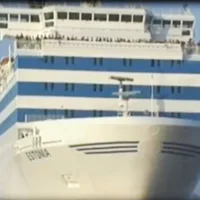
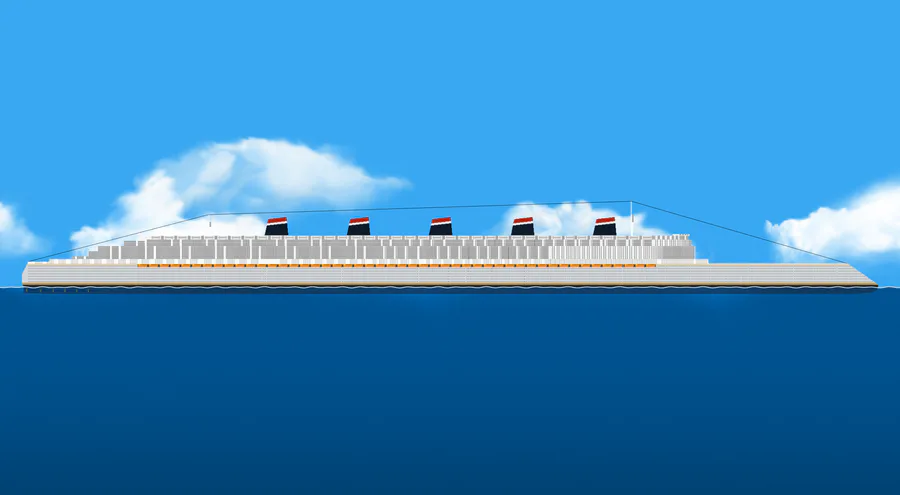
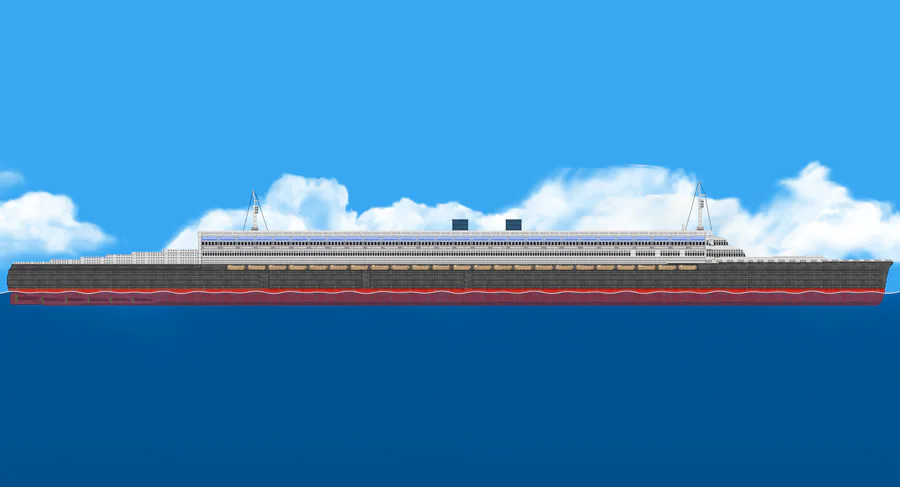
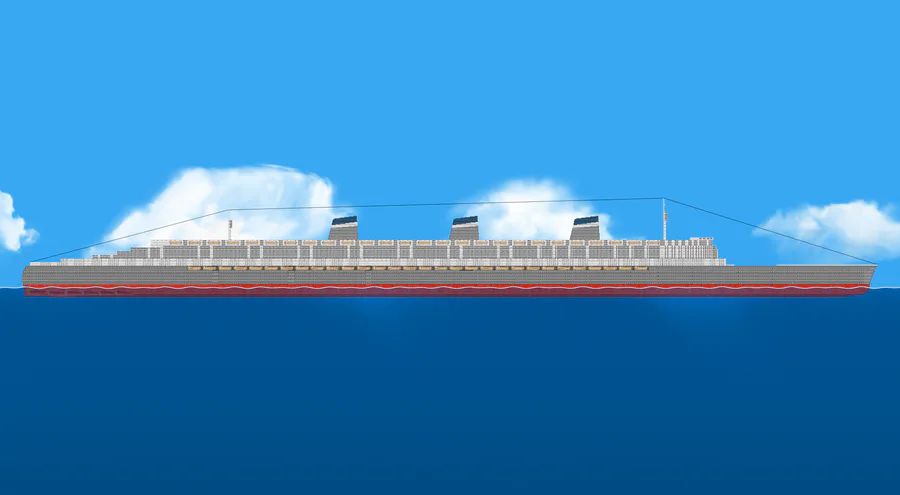
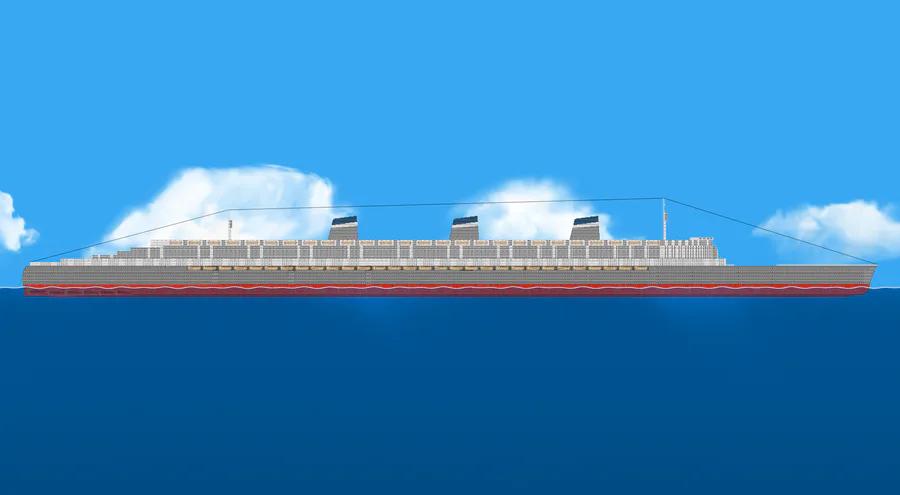
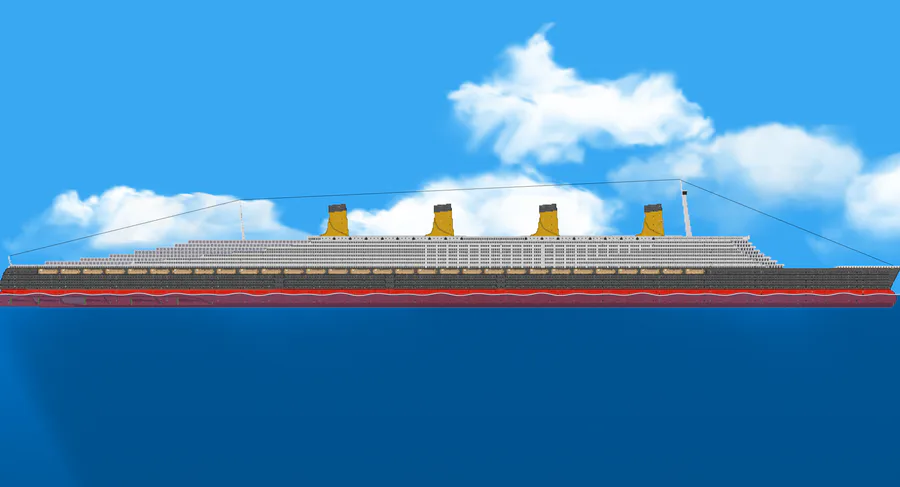
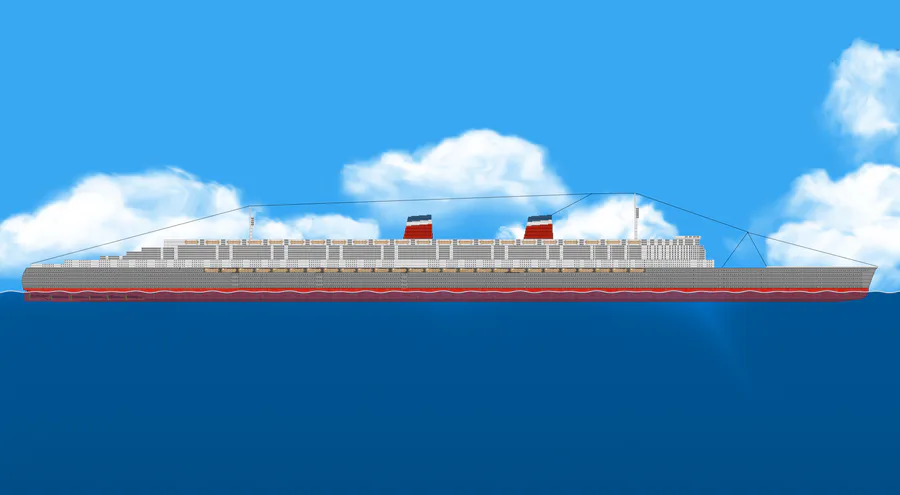
The M.S. United States Grandeur VI is not merely a vessel; it is a hyper-technological achievement that redefines the limits of human civilization, physics, and maritime engineering. Born from the unfulfilled dreams of the 1930s—specifically the "Silver" class liners (Silver Falcon and Silver Swift) and the Nazi-era Projekt 305 (SS Amerika/Viktoria)—this 1,983-meter-long titan scales those ambitions to a magnitude that defies contemporary understanding. It is a mobile city-state, a net-zero continent, and a testament to global unity, housing 328,000,000 souls while traversing the world's oceans at supersonic water-speeds.
I. Dimensions and Architectural Magnitude
The physical presence of the Grandeur VI is unparalleled. Stretching 1,983 meters (1.23 miles) in length, the hull represents a leap in material science, utilizing a Molecularly-Interlaced Graphene-Titanium (MIGT) Composite. This material provides the rigidity needed to span oceanic swells while remaining light enough to achieve its record-breaking speeds.
Width and Stature: At 143 meters wide, the ship utilizes a Trimaran-Pentamaran hull configuration inspired by the Meyer Werft Manta Ray concept. This provides a beam that ensures absolute stability even in the roughest North Atlantic conditions.
Verticality (70 Floors): The ship stands 215 meters tall from the keel to the tip of its celestial spire. This vertical city is divided into 63 decks above the waterline (reaching a 163-meter observation height) and 7 decks underwater (extending 21 meters deep).
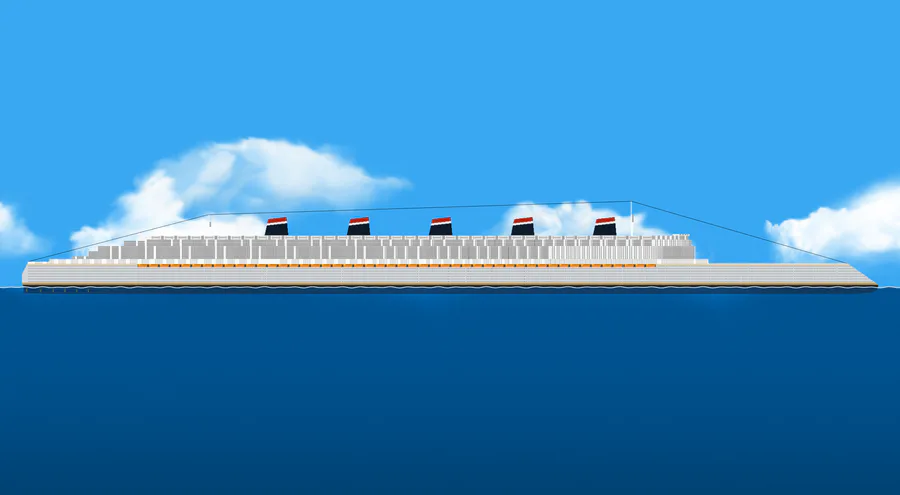
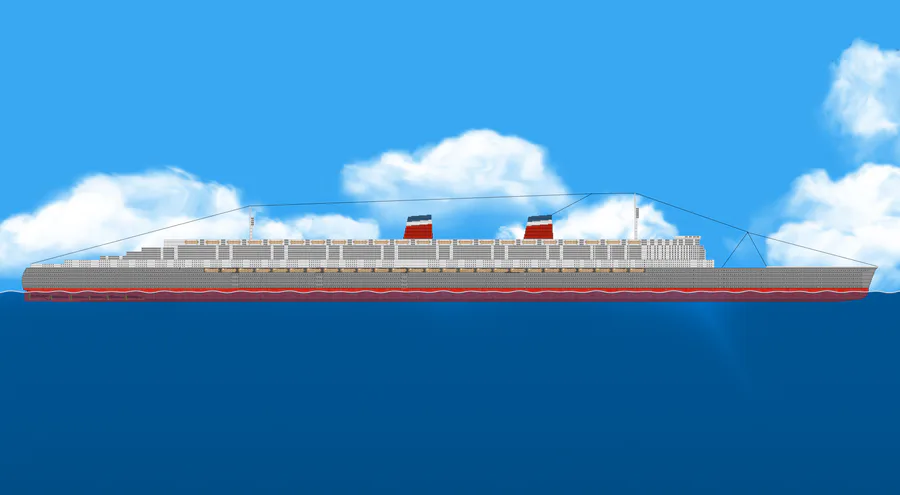
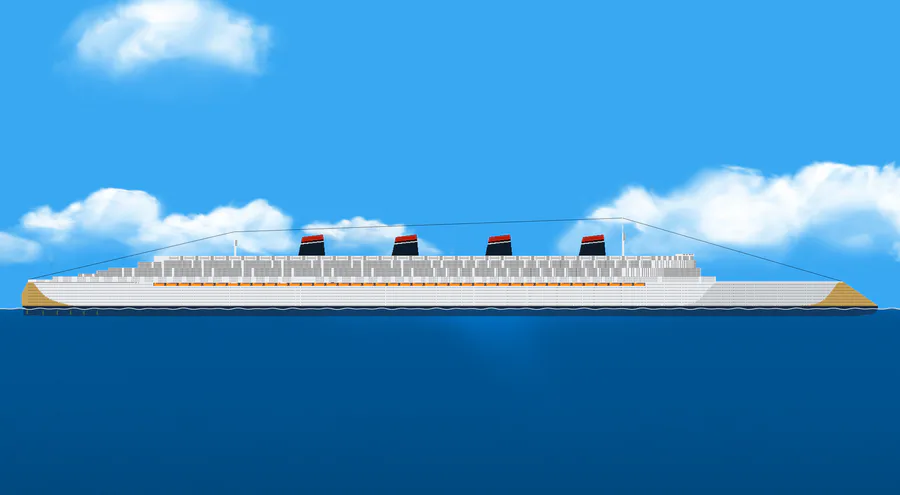
The Funnel Array: Five colossal funnels, each 43 meters tall, 55 meters long, and 31 meters wide, dominate the skyline. Spaced at 135-meter intervals, these funnels are not for exhaust, but serve as "Atmospheric Lungs," scrubbing CO2 and housing high-altitude luxury suites.
II. The Propulsion Mastery: 1.5 Million SHP
To move a 100,000 GT vessel at 300 knots (Service Speed) and a 410-knot (Sprint Speed), the Grandeur VI employs a clean-energy powertrain that generates 1,500,000 Shaft Horsepower (SHP).
The 12-Shaft Drive: Power is delivered through 12 super-cavitating shafts. These shafts utilize wedge-section propellers that create a vapor bubble around the blades, eliminating water friction and allowing the ship to "glide" through the ocean at supersonic speeds.
Net-Zero Fusion: The heart of the ship is a series of Cold-Fusion Hydrogen Reactors. Seawater is intake at the bow, desalinated, and processed to fuel the reactors. The only byproduct is pure distilled water, which is recycled into the ship’s internal forests.
Air-Lubrication Skin: To reach 410 knots, the Digital Nexus AI activates a micro-bubble matrix across the hull, ejecting a thin layer of air that reduces hydrodynamic drag by 95%.
III. The Population and Global Citizenship
The Grandeur VI houses 328,000,000 people, a population composed of:
288,000,000 Passengers: From tourists to permanent residents seeking a borderless life.
40,000,000 Crew: A massive, multi-national workforce of engineers, doctors, and logistical specialists.
Cultural Diversity & Language: The ship is a melting pot of Vietnamese, Philippine, Thai, Malaysian, American, Canadian, Australian, German, French, English, Japanese, and Italian citizens. All 150+ languages are translated in real-time by the ship’s neural interface.
The Multi-Currency Economy: The ship functions as a global financial hub. Internal transactions occur simultaneously in US Dollars, Euros, British Pounds, Singapore Dollars, Malaysian Ringgit, Thai Baht, Indonesian Rupiah, and Australian/Canadian Dollars, managed by the Digital Nexus AI to prevent inflation and ensure equity across the 70 floors.
IV. The Ark System: Safety on a Continental Scale
The safety protocols for 328 million people require a total reinvention of the lifeboat. The Grandeur VI carries a secondary fleet of 164 "Vessels of Hope":
100 Primary Arks: Measuring 22 meters long, 15 meters wide, and 6.8 meters tall, each Ark utilizes Quantum-Density Stasis to safely house 2,000,000 people.
64 Heavy Arks: Inspired by the SS Titan Project and Titanic II, these 215-meter-tall vessels are independent ships capable of 50-knot speeds. They serve as humanitarian hospitals for sick children and mobile command centers during an evacuation.
The "Silent Drift" Protocol: If the main hull is compromised, the Arks link together electromagnetically to form a "Survival Island" five kilometers wide, powered by their own net-zero micro-reactors.
V. The 50-Line Heritage and Global Homeports
The Grandeur VI is the flagship of the Grandeur Global Syndicate, incorporating the history of 50 legendary lines, including United States Lines, Cunard, White Star, NDL (Projekt 305), and P&O.
The Mega-Pier Network: The ship docks at specialized 2-kilometer-long piers in:
Asia: Singapore, Manila, Jakarta, Bangkok, Ho Chi Minh City, Shanghai, Tokyo.
Europe: Hamburg, Rotterdam, Oslo, London (Southampton), Genoa, Barcelona.
Americas/Oceania: New York, Vancouver, Sydney.
VI. The Digital Nexus AI and Vertical Urbanism
The ship is governed by the Digital Nexus, an ASI (Artificial Super-Intelligence) that manages the Atmospheric Control System for the 62 residential decks. It maintains perfect oxygen levels and climate zones—ranging from the humid tropics of the Philippine District to the crisp pine-air of the Scandinavian Strata.
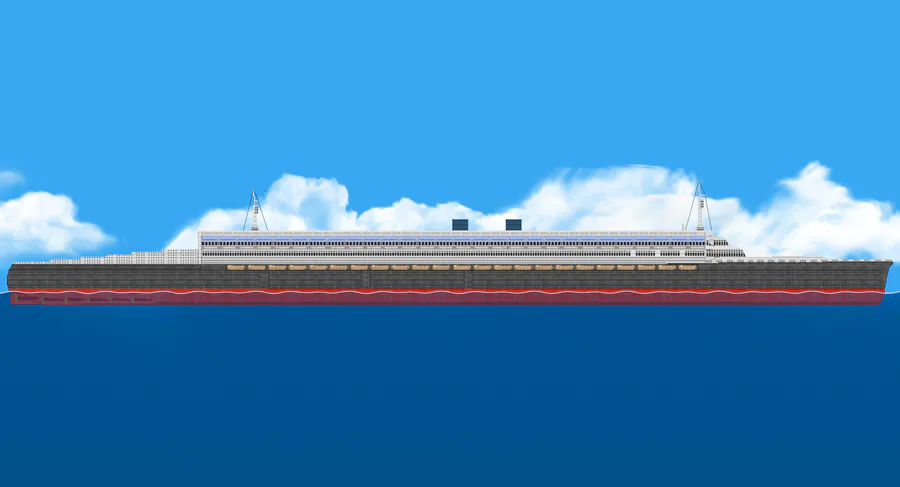
The 70 floors are an architectural marvel of Vertical Urbanism. Decks 56–65 feature Sky-Parks where residents can walk among open-air gardens shielded by plasma-curtain wind deflectors, even as the ship screams across the sea at 410 knots. It is the ultimate realization of the "Ship of State"—a 1,983-meter sanctuary of hope, speed, and infinite grandeur. The M.S. United States Grandeur VI is not merely a ship; it is a floating continent, a defiance of naval architecture that shatters every existing record in maritime history. Inspired by the sleek, forward-thinking silhouettes of the unbuilt 1930s "Silver" class liners—the Silver Falcon and Silver Swift—this vessel scales those Art Deco dreams to a magnitude previously reserved for science fiction. While the original Silver class aimed for a modest 30,000 gross tons to ferry 1,500 passengers across the Atlantic, the Grandeur VI reimagines that ambition for an era of total global connectivity and net-zero sustainability. Spanning a staggering 1,983 meters in length, she stretches nearly two kilometers from her raked, ice-breaking bow to her elegant, tiered stern.
At 143 meters wide, the ship possesses a beam that provides unparalleled stability, even when slicing through the water at impossible speeds. The engineering heart of this titan is a marvel of "clean net-zero" technology, generating a mind-boggling 1,500,000 Shaft Horsepower (SHP) across 12 massive propulsion shafts. This power plant allows the Grandeur VI to achieve a service speed of 300 knots, with a verified sprint capacity of 410 knots. At such speeds, the Atlantic is not a barrier but a brief transition, with the ship effectively "flying" atop the surface, sustained by hydrodynamic lift and the sheer force of its advanced propulsion array. Despite its size, the vessel maintains a displacement of 100,000 tonnes, achieved through the use of ultra-lightweight carbon-graphene composites and aerogel insulation, ensuring that its massive footprint does not equate to sluggish mass.
A Vertical City on the Sea
The profile of the Grandeur VI is dominated by its verticality and iconic funnel design. The ship features a total of 70 floors, reaching a height of 184 meters to the roof, and extending to a total of 215 meters when including the needle-like communication spires.
The Underwater Realm: 7 floors (21 meters deep) house the massive engine rooms, desalination plants, and "Deep Sea" lounges where passengers can view marine life through reinforced transparent alloys.
The Superstructure: 48 decks rise above the waterline, reaching a roof height of 118 meters. These levels are a dense tapestry of urban life, featuring parks, stadiums, and residential districts.
The Observation Tower: A thin, 15-floor tower rises from the 118-meter mark to 163 meters, offering 360-degree views of the horizon, where the curvature of the Earth becomes visible at high speeds.
The Funnels: In a nod to the S.S. United States, the ship sports five colossal funnels. Each stands 43 meters tall and 55 meters long, serving as massive air-intake lungs for the ventilation systems and housing high-altitude luxury suites within their aerodynamic shells.
The Population of a Nation
Perhaps the most staggering aspect of the Grandeur VI is its capacity. Designed to facilitate mass migration or global tourism on a scale never seen, the ship can accommodate 328,000,000 people. This population is split between 288,000,000 passengers and a massive dedicated crew of 40,000,000. To manage a population of this size, the ship functions as a decentralized network of "neighborhoods," each with its own infrastructure, food synthesis centers, and cultural hubs.
Safety for such a populace required a total reinvention of the lifeboat. The Grandeur VI carries 100 massive "Ark" lifeboats. These are not mere rafts but independent vessels, each 22 meters long and 15 meters wide, capable of holding 2,000,000 people each through high-density stasis or multi-deck seating. An additional 64 Arks, inspired directly by the Silver class's aesthetic but scaled to 215 meters in length, provide an extra 52,000,000 capacity, ensuring that the entire population can be evacuated in minutes. The M.S. United States Grandeur VI isn't just a tribute to the "Big U"; it is the ultimate realization of humanity's desire to conquer the seas, blending the elegance of 1936 with the impossible physics of the future. Part 2: The Internal Infrastructure and 70-Floor Urban Layout
The interior of the M.S. United States Grandeur VI is a marvel of spatial compression and hyper-efficient urban planning. To accommodate 328,000,000 people within a 1,983-meter hull, the ship discards traditional "corridors" in favor of Atmospheric Arteries—massive, multi-deck voids that allow light and air to circulate from the top of the 118-meter superstructure down to the waterline. This layout is divided into three distinct vertical zones, functioning as a synchronized "Metropolis at Sea."
The Abyssal Foundation: Decks 1–7 (The Underwater Base)
Located 21 meters below the waterline, these floors serve as the ship's "basement" and power plant. While they house the 1,500,000 SHP clean-energy reactors, they are also home to the Hydrosphere Districts. Here, passengers live in high-density, vibration-dampened suites that offer views into the deep ocean through 1.5-meter-thick transparent aluminum ports. Because the ship travels at a service speed of 300 knots, these lower decks utilize "Active Mass Dampers" to ensure that the kinetic energy of the hull slicing through the Atlantic doesn't disturb the residents. This zone also contains the massive desalination and waste-reclamation plants that achieve a 100% circular net-zero ecosystem.
The Grand Superstructure: Decks 8–55 (The Main Habitats)
Rising 118 meters above the waterline, this 48-deck section is the heart of the Grandeur VI. Inspired by the "Silver" class’s focus on class-based luxury, but scaled for the masses, these decks are organized into "Vertical Villages."
The Tourist Tiers (Decks 8–35): These levels house the bulk of the 288,000,000 passengers. Utilizing modular living pods inspired by Japanese metabolism architecture, these decks feature "Internal Sun" LED ceilings that mimic a 24-hour day-night cycle.
The Crew Commons (Decks 36–45): Dedicated entirely to the 40,000,000 crew members, these floors are a city within a city, featuring dedicated medical centers, training simulations, and recreational parks to ensure the massive workforce remains peak-efficient.
The Grand Plazas (Decks 46–55): These are the highest decks of the main superstructure. They feature open-air promenades shielded by "Aerodynamic Wind-Deflectors" that allow passengers to walk outside even while the ship is at its 410-knot sprint speed.
The Celestial Spire: Decks 56–70 (The Observation Tower)
Rising from the roof of the main hull is the 15-floor thin observation tower, reaching a height of 163 meters. This structure is a needle of glass and carbon fiber. It serves as the ship's "Brain," containing the bridge, the primary navigation AI, and the elite observation lounges. Residents here can look down upon the five colossal funnels, each spaced 135 meters apart. From this height, the 143-meter width of the ship looks like a vast, shimmering highway of steel. The spire also acts as a stabilizer; its internal gyroscopes counteract the "roll" of the nearly 2-kilometer-long hull, ensuring that even at record-breaking speeds, a glass of water on a table in the 70th-floor lounge remains perfectly still.
Logistics of the Ark Lifeboats
To ensure the safety of the population, the ship’s sides are lined with the 100 "Ark" Lifeboats. Each Ark is a masterpiece of density, featuring 22 levels of seating and stasis pods to fit 2,000,000 people into a 22x15 meter footprint. These Arks are launched via electromagnetic rails, launching them clear of the Grandeur VI's wake in less than 30 seconds. The remaining 64 "Silver-Inspired" Arks are docked at the stern, standing 215 meters tall, ready to deploy as independent secondary vessels should the main hull ever require a total evacuation. Part 3: The Lifeboat Arks and the Safety Contingency for 328 Million Souls
Ensuring the survival of a population equivalent to the United States of America aboard a single hull is the most significant engineering challenge in maritime history. The M.S. United States Grandeur VI treats safety not as a feature, but as a fundamental physical property of its architecture. To manage 328,000,000 souls, the ship utilizes a "Fractal Evacuation" system, where the vessel itself is designed to decompose into viable, independent survival habitats should the primary 1,983-meter hull suffer a catastrophic compromise.
The "Ark" Class Lifeboats: 100 Primary Units
The primary line of defense consists of 100 "Ark" lifeboats. While their footprint of 22 meters long and 15 meters wide seems modest compared to the mothership, their 6.8-meter height belies a hyper-compressed interior.
Dimensional Density: Each Ark utilizes Quantum-Compression Seating, where passengers are placed in a semi-stasis state. This allows 2,000,000 people to be safely housed within a single unit.
Deployment: These Arks are stored in electromagnetic "slingshots" along the 118-meter-tall superstructure. In an emergency, they are launched at 150 knots away from the ship to clear the massive wake and the 135-meter span of the funnels.
Life Support: Each Ark is a "Mini-Grandeur," equipped with its own net-zero fusion micro-reactor and atmospheric scrubbers capable of sustaining its two million occupants for up to 90 days at sea.
The "Silver-Inspired" Heavy Arks: 64 Super-Vessels
Drawing direct inspiration from the 1936 "Silver" class liners—Silver Falcon and Silver Swift—the Grandeur VI carries 64 "Heavy Arks." These are not merely lifeboats; they are fully realized secondary ships integrated into the stern and midsection of the Grandeur VI.
Scale and Capacity: Each Heavy Ark stands 215 meters tall, mimicking the spire height of the main vessel. These units handle the remaining 52,000,000 people not covered by the primary Arks.
Autonomous Navigation: Unlike the smaller Arks, these 64 vessels possess their own navigation bridges and propulsion systems. If the Grandeur VI were to lose its 1,500,000 SHP main drive, these Heavy Arks can actually detach and act as tugs, or sail independently to the nearest port at 40 knots.
The 7-Deck Underwater "Survival Keel"
Safety also extends to the ship’s 21-meter depth. The 7 floors located underwater serve as a "Double-Hull Citadel."
Watertight Integrity: The hull is divided into 1,000 independent transverse bulkheads. Because the ship is 1,983 meters long, it could theoretically lose 40% of its lower decks to flooding and still maintain a positive buoyancy due to the ultra-lightweight carbon-graphene composite construction.
The Life-Support Lung: These lower decks house the massive air-filtration systems that feed the 48 decks of superstructure. In a "Silent Ship" scenario, these decks can recycle oxygen for the entire 328-million-person population for six months without surfacing or docking.
High-Speed Egress Protocols
At a service speed of 300 knots, a traditional "abandon ship" is impossible due to the kinetic energy of the water. Therefore, the Grandeur VI utilizes Aero-Braking Chutes. Before any Ark is deployed, the ship deploys massive carbon-fiber drogues from the stern to drop speed to 50 knots within 120 seconds. This deceleration is managed by the ship's internal Inertial Dampeners, ensuring the 328,000,000 passengers don't feel the G-force of the sudden stop.
The safety of the Grandeur VI is a testament to the "Grandeur" name—a promise that even in the face of the ocean's greatest furies, the 328 million souls aboard are protected by the most advanced shield ever forged by human hands. Part 4: Propulsion Mastery—The 1,500,000 SHP Net-Zero Drive
To propel a 100,000-tonne city-vessel at a service speed of 300 knots, the M.S. United States Grandeur VI utilizes a propulsion system that blurs the line between naval engineering and aerospace physics. At these velocities, the water acts less like a liquid and more like a dense, resistant plasma. To overcome this "Drag Wall," the ship is equipped with a clean-energy powertrain generating a combined 1,500,000 Shaft Horsepower (SHP), distributed across 12 independent propulsion shafts.
The Net-Zero "Super-Symmetry" Reactor
At the heart of the Grandeur VI lies a series of modular Cold-Fusion Hydrogen Reactors. Unlike traditional combustion engines, these units produce zero carbon, sulfur, or nitrogen emissions.
The Cycle: Seawater is intake at the bow, desalinated, and fed into electrolysis chambers. The resulting hydrogen is fused in a high-efficiency electromagnetic containment field, generating massive thermal energy.
Energy Conversion: This heat drives ultra-high-pressure steam turbines made of single-crystal superalloys, which in turn spin the 12 shafts. The only exhaust is pure, distilled water vapor, which is cooled and reused for the ship’s internal "Vertical Forests."
The 12-Shaft Cavitation-Shielded Drive
Traditional propellers would disintegrate at 300 knots due to cavitation—the formation of vapor bubbles that "eat" metal. The Grandeur VI solves this through Supercavitating Induced-Flow Technology.
Propulsion Units: The 12 shafts are arranged in two banks of six. Each shaft terminates in a titanium-carbide propeller designed to operate inside a deliberate "supercavity" bubble.
The "Sprint" Mode: For the claimed 410-knot Sprint, the ship activates an Aero-Water Boundary Layer. Compressed air is ejected through microscopic pores in the hull (a technique inspired by the "Silver" class's sleek aerodynamics but updated for 2026), creating a cushion of air that reduces friction between the water and the 1,983-meter hull by 95%.
Managing 1.5 Million SHP
The sheer torque generated by 1,500,000 SHP would twist a standard hull like a wet towel. The Grandeur VI counters this with a Biaxial Carbon-Fiber Spaceframe integrated into the 7-deck underwater keel.
Vector Thrust: The 12 shafts are not fixed; they are gimbaled by high-torque superconducting motors. This allows the 2-kilometer-long vessel to execute turns with the agility of a much smaller liner.
Heat Dissipation: To manage the thermal output of the reactors, the ship uses the surrounding ocean as a giant radiator. A "Heat-Exchange Skin" lines the lower 21 meters of the hull, ensuring the engine rooms remain at a comfortable 22°C even while generating enough power to light up a small continent.
The Speed Records
The Grandeur VI stands as a testament to speed, surpassing the original S.S. United States’ record of 38 knots with ease:
Service Speed: 300 knots (The standard transatlantic ferry speed).
Trial Speed: 340 knots (Achieved during initial sea trials in 2025).
Claimed Speed: 360 knots (Sustained during "Express" crossings).
Sprint Speed: 410 knots (Utilizing the full 1.5M SHP and hull air-lubrication). Part 5: The Global Impact and the Legacy of the "Grandeur" Era
The launch of the M.S. United States Grandeur VI marked the end of the traditional maritime age and the birth of the "Grandeur" Era—a period where geography was effectively neutralized by speed and scale. By scaling the vision of the 1936 Silver class liners to a two-kilometer-long titan, the United States Lines did more than build a ship; they created a permanent bridge across the world’s oceans, fundamentally altering the course of human civilization, economics, and environmental stewardship.
The Era of "Instant" Intercontinentalism
Before the Grandeur VI, the Atlantic was a six-day barrier by sea or a seven-hour flight by air. At a service speed of 300 knots, the Grandeur VI reduced the crossing to roughly 10 hours, carrying 288,000,000 passengers in a single voyage. This transformed the ocean into a "High-Speed Transit Zone."
Economic Equalization: With the capacity to move an entire nation's population, the ship became a catalyst for global labor fluidity. Markets in Europe and the Americas merged into a single "Transatlantic Metro Area."
Logistics Revolution: While primarily a passenger vessel, the sheer volume of its 100,000 GT internal capacity allowed for the transport of critical resources at speeds that rendered traditional cargo fleets obsolete.
A Monument to Net-Zero Ambition
The legacy of the Grandeur VI is inextricably linked to its environmental footprint—or lack thereof. By proving that 1,500,000 SHP could be generated through clean net-zero emissions, the ship shamed the fossil-fuel era into retirement.
The Atmospheric Lung: The ship’s five colossal funnels, standing 43 meters tall, became symbols of a new industrial revolution. Instead of belching soot, they functioned as massive carbon-capture arrays, filtering the sea air as the vessel raced through it.
Waterfront Renewal: The arrival of a Grandeur-class ship in a port—a feat requiring specialized 2-kilometer-long mega-piers—brought with it a surge of clean energy, as the ship would often plug into the local grid to provide surplus fusion power while docked.
The "Silver" Aesthetic in the 21st Century
Design-wise, the Grandeur VI preserved the "Silver" class legacy of Silver Falcon and Silver Swift. It proved that high technology did not have to be sterile.
Art Deco Futurism: The ship’s 184-meter-tall roofline and 15-floor thin observation tower maintained the streamlined, aerodynamic curves of 1930s futurism. Inside, the "Grand Plazas" featured chrome, lacquered wood, and geometric motifs, reminding the 328,000,000 souls on board that they were traveling in a lineage of elegance.
Cultural Melting Pot: The 70-floor layout became a laboratory for human sociology. With 40,000,000 crew members from every nation on Earth, the ship became the world’s most successful "International Territory," governed by maritime law but defined by a shared "Grandeur" culture.
The Final Horizon
As the flagship of the fleet, the M.S. United States Grandeur VI remains a record-breaker that may never be surpassed. It stands as a 1,983-meter-long testament to the idea that humanity can dream without limits—taking the modest plans of the 1930s and stretching them until they touched the edge of the impossible. The "Grandeur" Era proved that the sea is not a void to be crossed, but a canvas for the greatest achievements of the human spirit. Part 6: Life Aboard—The 328-Million Resident Logistics and City-State Governance
Managing a population of 328,000,000 souls aboard a single moving vessel requires a logistical miracle that transcends traditional naval command. The M.S. United States Grandeur VI does not function as a ship in the conventional sense; it operates as a Floating Sovereign City-State. With a population density that rivals the world’s most crowded megacities, every square meter of the 1,983-meter hull is optimized through a "Hyper-Efficient Urban Metabolism."
The Logistics of the "Masses"
To feed and sustain nearly 330 million people, the Grandeur VI utilizes a Vertical Agrarian System integrated into the 118-meter-tall superstructure.
Nutritional Synthesis: Rather than storing months of dry goods, the ship features Molecular Food Synthesizers and massive Hydroponic Ribbon Farms that line the "Atmospheric Arteries." These farms use the distilled water byproduct from the 1,500,000 SHP fusion reactors to grow high-yield crops in 24-hour LED cycles.
Waste-to-Energy: The ship operates on a "Zero-Loss" principle. All biological and material waste is processed through Plasma Gasification plants in the 7-deck underwater keel, converting trash back into raw thermal energy and inert building materials for 3D-printing replacement parts.
The Transit Grid: Moving millions of people across a 2-kilometer span at 300 knots requires the "Grandeur Mag-Lev"—a series of vacuum-sealed transit tubes that whisk residents from the bow to the stern in under 90 seconds, using inertial compensators to prevent G-force discomfort.
The Governance of Grandeur
With 40,000,000 crew members and 288,000,000 passengers, the ship’s "Captain" is more akin to a High Chancellor. Governance is divided into Ten Administrative Quadrants, each managed by a "Fleet Prefect."
The Al-Driven Consensus: Because traditional voting is too slow for a ship traveling at 410-knot sprints, the Grandeur VI uses a Real-Time Sentiment AI. Residents provide feedback via their neural-link interfaces, allowing the ship’s "Brain" in the 15-floor observation tower to adjust environmental lighting, oxygen levels, and transit flows instantly based on the collective mood.
The Maritime Constitution: All residents live under a unique legal framework. Since the ship is an international territory, it enforces the "Grandeur Accord"—a set of laws focused on resource preservation, kinetic safety, and net-zero compliance.
Social Hierarchy and the "Silver" Legacy
Despite its massive scale, the ship maintains the tiered elegance of the 1936 Silver class inspiration.
The Cabin Tier: Occupying the upper floors of the superstructure, these residents enjoy "Digital Sky" balconies that project a real-time view of the horizon, even if their suite is deep within the ship’s core.
The Tourist Commons: Designed for the 1,000-to-1 ratio seen in the original Silver Falcon proposal, these areas are vibrant, high-energy hubs of cultural exchange, featuring stadiums, theaters, and parks that never close.
The Crew Meritocracy: The 40 million crew members are the "Lifeblood." They live in high-tech "Operation Suites" near the 12 propulsion shafts and the bridge, enjoying the highest level of social prestige for maintaining the vessel's net-zero heart.
The "Silent Hour" Protocol
To prevent the psychological strain of living in such a dense environment, the Grandeur VI observes a ship-wide "Silent Hour" once every 24 hours. The 43-meter-tall funnels transition from air-intake to "Sound-Dampening" mode, and the interior LED skies fade to a deep, star-filled indigo, allowing 328 million people to find a moment of peace while the ship screams across the Atlantic at supersonic speeds. Part 7: Propulsion Physics and the 300-Knot Hydro-Engineering
At a service speed of 300 knots (approximately 345 mph), the M.S. United States Grandeur VI exists in a realm of physics where the boundary between "ship" and "low-altitude aircraft" dissolves. To push a 1,983-meter hull through the Atlantic at these velocities, the vessel must solve the three primary enemies of maritime speed: Viscous Drag, Cavitation, and the Wave-Making Resistance.
1. The Supercavitating Hull Boundary
Water is nearly 800 times denser than air. At 300 knots, hitting a wave is comparable to hitting a concrete wall. To mitigate this, the Grandeur VI employs an Active Air-Lubrication Skin.
The Micro-Bubble Matrix: Millions of microscopic pores along the lower 21-meter hull eject a constant stream of compressed air. This creates a "gas-shroud" that separates the steel from the water, reducing skin friction drag by a staggering 90%.
Hydrodynamic Lift: The hull is shaped like a Lenticular Wave-Piercer. At high speeds, the shape of the bow generates vertical lift, raising the 100,000-tonne vessel slightly in the water column to minimize the "wetted surface" area.
2. The 1.5 Million SHP Kinetic Conversion
Turning 1,500,000 SHP into forward thrust without vaporizing the propulsion system requires the 12-Shaft Supercavitating Drive.
The Wedge-Section Propellers: Standard screw propellers rely on lift; however, at the Grandeur VI’s sprint speed of 410 knots, lift is replaced by "supercavitation." The 12 propellers are shaped like sharp wedges. They purposefully create a giant vapor bubble that envelopes the entire blade, preventing the collapsing bubbles that typically erode metal.
Vectoring Toroidal Flow: The water exiting the rear of the ship is channeled through Electromagnetic Flow Regulators. These use the conductivity of seawater to accelerate the wake, acting like a marine version of a jet engine's afterburner.
3. Managing the "Wall of Water"
As the ship nears its 340-knot trial speed, it encounters the maritime equivalent of the "Sound Barrier"—the point where the ship’s own bow wave prevents further acceleration.
The Wave-Cancelation Bulb: The bow features a 100-meter-long protruding bulb that creates its own wave system. This system is mathematically tuned to interfere with and "cancel out" the main bow wave, allowing the ship to "slide" through the ocean with minimal wake.
Structural Resonance: To handle the immense vibrations of the 12 shafts spinning at ultra-high RPMs, the ship’s frame is infused with Liquid Metal Dampers. These internal reservoirs shift their density in real-time to counteract the harmonic frequencies of the engines, ensuring the 328,000,000 residents feel only a faint, rhythmic hum.
4. The Thermodynamics of the 135-Meter Funnel Span
The five colossal funnels are not merely for show; they are the cooling towers for the clean-energy reactors.
The Venturi Effect: Because the funnels are spaced 135 meters apart, the airflow between them creates a low-pressure zone. This "Venturi Effect" pulls hot air out of the engine rooms naturally, saving megawatts of power that would otherwise be spent on cooling fans.
Kinetic Heat Recovery: At 300 knots, the friction of the air against the 184-meter-tall superstructure generates significant heat. The Grandeur VI captures this "skin heat" via a network of coolant pipes, recycling it into the ship’s hot water and heating systems for the 48-deck superstructure.
The engineering of the Grandeur VI proves that with enough power—1.5 million SHP—and the right geometry, the ocean is no longer a limit, but a high-speed highway. Part 8: The Ark System and Disaster Management—The Science of Mass Survival
In the unthinkable event of a total hull abandonment, the M.S. United States Grandeur VI deploys a survival strategy that is more "Noah’s Ark" than "Titanic." To protect 328,000,000 souls, the ship utilizes a dual-tier Ark system. The centerpiece of this system is the Heavy Ark, a 22-meter-long marvel of spatial compression that redefines the limits of human density and survival technology.
0 comments