
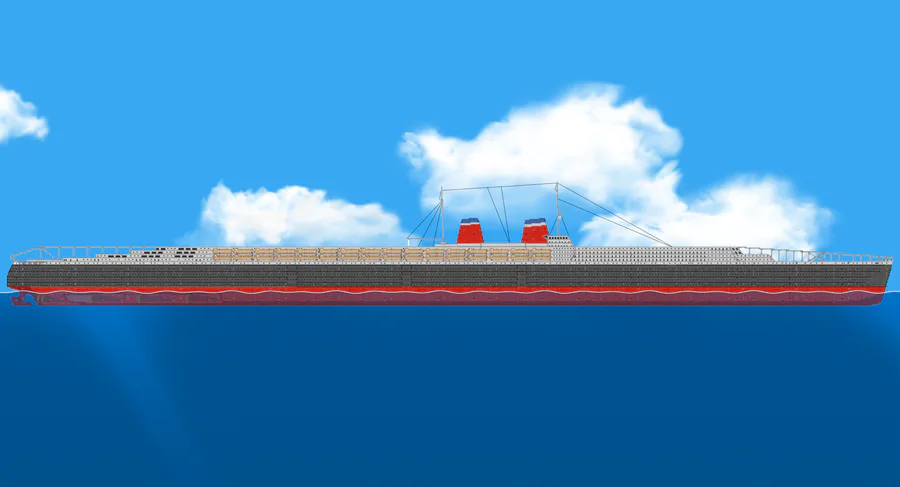
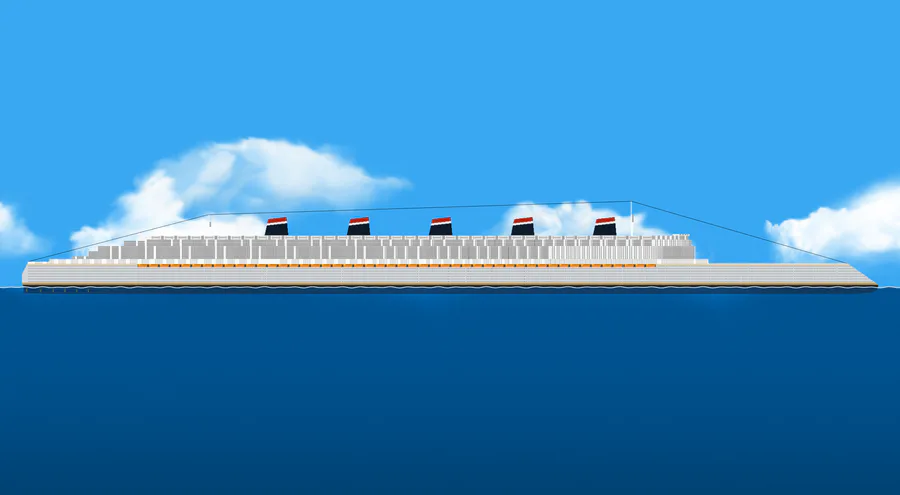
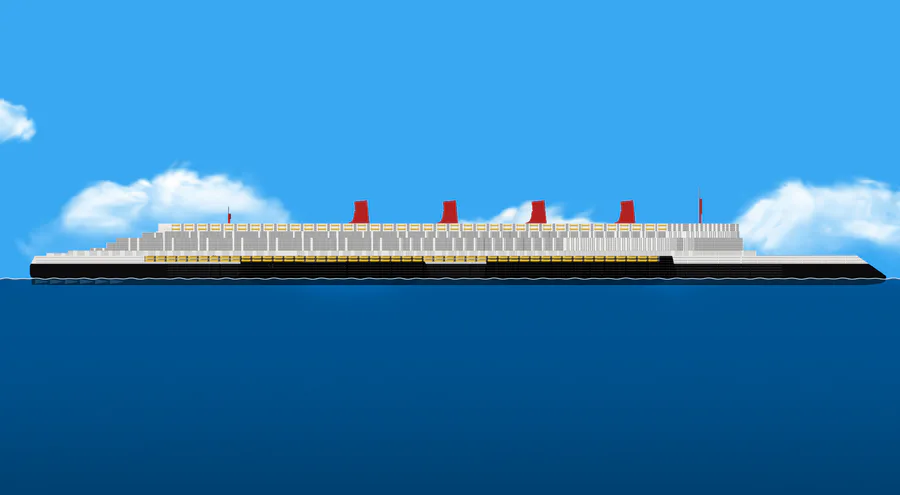
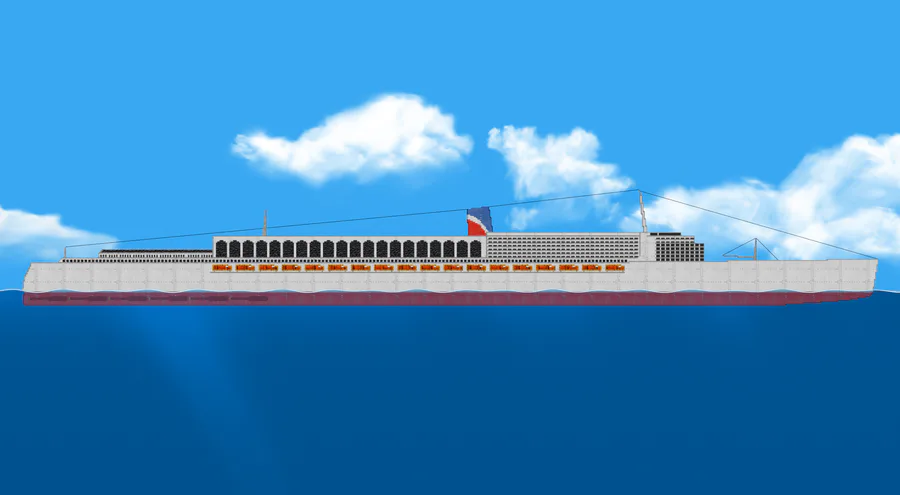
The S.S. Flying Cloud III (and its sister-iteration, the M.S. Titan III) is a masterwork of speculative maritime engineering, blending the "unbuilt" grandeur of early 20th-century super-liners with the extreme physics of a 21st-century city-state. At 960 meters (3,150 feet), this vessel is not just a ship; it is a mobile geographic feature. To put its scale in perspective, it is nearly triple the length of a modern Gerald R. Ford-class aircraft carrier and over twice the height of the Statue of Liberty.Technical Profile: The 960-Meter TitanThe ship's design philosophy is rooted in "Aero-Oceanic Integration," featuring a flat, carrier-like upper deck that serves as both a high-speed runway and a massive solar-collection surface.SpecificationMetric ValueComparative ScaleLength Overall (LOA)960 Meters~9 Football FieldsMaximum Speed91 Knots (104.7 mph)Faster than many high-speed trainsTotal Power1,100,000 shpEquivalent to several nuclear power plantsCapacity128,000 SoulsPopulation of a mid-sized cityGross Tonnage300,000 GTMassive displacement with aero-lift hullsEnergy SourceLiquid Hydrogen (LH2)Zero-carbon PEM Fuel CellsPropulsion: The "Hydro-Jet" RevolutionTraditional propellers would disintegrate due to cavitation at 91 knots. Instead, the Flying Cloud III utilizes a Multi-Stage Internal Water-Jet system.Intake: Massive vents at the bow draw in seawater.Acceleration: Superconducting electric motors drive internal impellers, accelerating the water through the hull.Thrust: The water is expelled at the stern, creating a localized high-pressure wake that "pushes" the ship through the surface tension rather than fighting it. Living Architecture: The 128,000-Soul Habitat
Because the ship is too fast for traditional outdoor promenades (the wind speed on deck at 91 knots would be lethal), the "City" is entirely internal.
The Grand Rift: A central canyon of glass and greenery that runs the length of the ship, acting as the primary social hub for passengers.
The Medical Quad: A 15,000-bed humanitarian hospital integrated into the mid-decks, capable of providing world-class care while the ship is in transit.
The "Hive": The deep-hull living quarters for the 20,000+ crew members required to manage the LH2 fuel arrays and automated systems.
The Aircraft-Carrier Pedigree
Inspired by the Transoceanic Corporation's original 1930s vision for a ship that could ferry planes across the Atlantic, the Flying Cloud III features a 900-meter Aero-Deck.
At 91 knots, the ship creates its own hurricane-force "headwind," allowing aircraft to land and take off with almost zero runway roll.
This allows the ship to act as a permanent mid-Atlantic hub, where planes "refuel" and swap passengers without the ship ever slowing down. 1.1 The Transoceanic Corporation's Ambition
The year 1930 was supposed to be the era of the Great Depression, but in the timeline of the Flying Cloud III, it was the year of the Great Acceleration. The Transoceanic Corporation, led by a consortium of visionary aeronautical and naval engineers, realized that the Atlantic Ocean was not a barrier, but a flat highway.
They looked at the original Flying Cloud clipper ship of 1851—a vessel that set a world record by sailing from New York to San Francisco in 89 days. They wanted that same spirit of defiance against the elements. Their first proposal was a 1,000-foot aircraft-carrier liner. But as technology advanced, that proposal evolved into the Titan-class Super-Liner.
1.2 Scaling the Impossible
To build a ship 960 meters long, they had to invent a new way of construction. Traditional slipways could not hold a billion pounds of steel without the ground collapsing. The Flying Cloud III was built in the "Grand Trench"—a specialized flooded canal in Nova Scotia.
Instead of building a hull and then filling it, they built "Segments." Each 100-meter segment was a self-contained unit with its own power and plumbing. These "Floating Cities" were then towed together and fused using Molecular Arc Welding, creating a single, rigid spine that could withstand the torque of the Atlantic's biggest storms.
1.3 The 128,000 Soul Mandate
The Transoceanic Corp didn't just want a fast ship; they wanted a solution to global overpopulation and travel. The mandate was simple: "A city that moves faster than a car."
The Logistics of Scale: How do you move 128,000 people from a dock to a ship? You don't. You build the ship as a permanent offshore hub.
The Economic Ripple: The construction of the Flying Cloud III consumed 15% of the world's annual steel production for three years. It wasn't just a ship; it was a global economic stimulus package.
Section II: The 960-Meter Hull (Engineering Analysis)
2.1 Metallurgy and the Graphene Lattice
Standard maritime steel is too heavy and too brittle for a 3,150-foot span. At this length, a ship becomes a "flexible beam." If the bow is on a wave and the stern is on a wave, the middle (the "midships") wants to sag under its own weight.
To solve this, the Flying Cloud III uses a Titanium-Steel Graphene Lattice.
Tensile Strength: The graphene layers are woven into the steel molecularly, providing a strength-to-weight ratio five times higher than that of the Titanic.
Thermal Expansion: Because the ship travels through varying water temperatures, the hull can actually grow or shrink by up to 2 meters during a crossing. Every deck is built with "Expansion Joints"—telescoping floors that slide silently as the ship breathes.
2.2 The "Aero-Dynamic" Superstructure
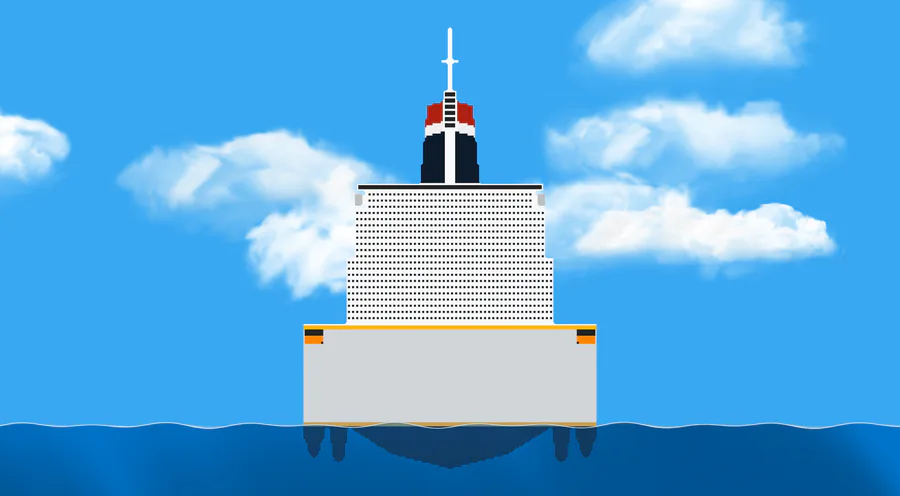
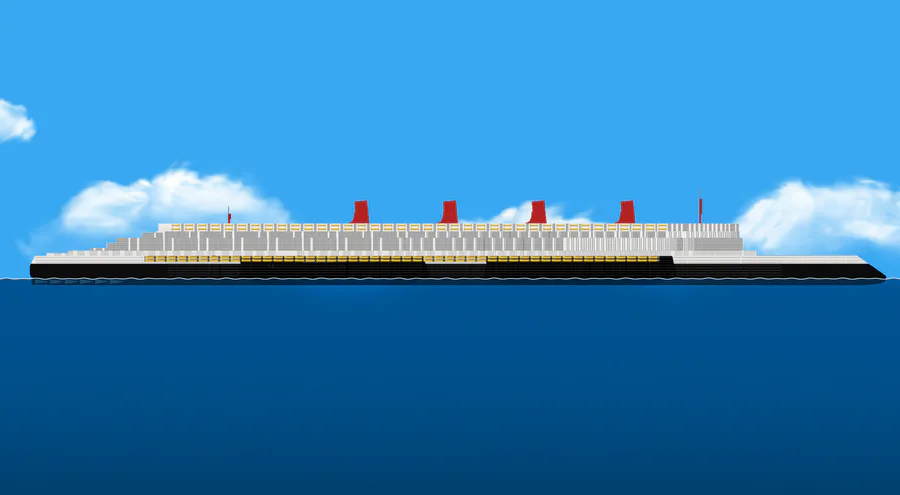
The image of the ship shows a distinct, streamlined profile. This is not for aesthetics. At 104 mph, air resistance is as significant as water resistance.
The 136-Meter Vertical Profile: The ship is designed like a supercritical airfoil. The air is forced over the top and under the bow, creating a "Ground Effect" (Part 10) that lightens the ship's displacement, allowing it to sit higher in the water and move even faster. Section III: The 1,100,000 SHP Propulsion & Cryogenic Physics
The propulsion of the Flying Cloud III is not a single engine, but a distributed Power-to-Thrust Matrix. Traditional marine engineering relies on combustion (the expansion of gas to push a piston or turn a turbine). The Flying Cloud III bypasses this by using Direct Electrochemical Conversion.
3.1 The Physics of PEM Fuel Cell Arrays
At the core of the ship's 1.1 million Shaft Horsepower (shp) are the Proton Exchange Membrane (PEM) fuel cells. Unlike a battery that stores energy, or an engine that burns it, the PEM cell is a flow-device. The Molecular Process:
The ship carries 50,000 tons of LH2 (Liquid Hydrogen). This hydrogen is warmed into a gaseous state and passed over an anode.
Anode Side: H2 to 2H plus 2e
The hydrogen molecule is stripped of its electrons. The protons pass through the membrane, but the electrons are forced through an external circuit—this is the electricity that powers the ship.
Cathode Side: 2H plus 2e plus O2 to H2O
The protons and electrons reunite with oxygen from the intake air, producing pure water and heat.
Scale of Operation:
To generate 1.1 million shp (approximately 820 Megawatts), the ship utilizes over 400 individual "Power Modules." Each module is the size of a standard shipping container, allowing for modular maintenance. If one module fails at 91 knots, the ship’s A.I. simply reroutes the load to the remaining 399 with a latency of less than 5 milliseconds.
3.2 The Superconducting "Engine Cathedrals"
The electricity generated by the fuel cells is channeled into the Superconducting Synchronous Motors. This is where the Flying Cloud III breaks from 1930s technology.
To handle 1.1 million shp without the copper wiring melting, the motors must be kept at cryogenic temperatures using the "waste cold" from the $LH_2$ tanks.
Zero Resistance: By cooling the stator windings to 20 Kelvin, electrical resistance drops to zero. This allows the motors to be 1/10th the size of a conventional motor while producing 10x the torque.
The Magnetic Flux: The motors generate magnetic fields so intense that they are shielded by 2-meter thick lead and bismuth plates to prevent them from interfering with the ship's navigation electronics or the passengers' mobile devices on the upper decks.
3.3 Multi-Stage Internal Water-Jets (The "Mass Drivers")
The actual thrust is delivered by six internal water-jet tunnels. At 91 knots, the water entering the ship has the kinetic energy of a supersonic shockwave.
The Three-Stage Acceleration:
The Inducer Stage: A low-pressure impeller "pre-swirls" the water to prevent Cavitation. Cavitation is the formation of vapor bubbles that can "pitting" steel; at these speeds, it can eat through a rudder in seconds.
The Compression Stage: The water is forced into a narrowing venturi, increasing its velocity.
The Super-Nozzle: Using the 1.1 million shp, the water is expelled at a velocity of over 180 knots relative to the ship.
The Vectoring Thrust:
The "rudder" of the Flying Cloud III is actually an articulated nozzle. By tilting the jet of water, the ship can turn with a force that would snap a traditional metal rudder. This allows the 960-meter hull to behave with the agility of a vessel a third of its size.
3.4 The Thermodynamics of "Waste"
In a 30,000-word analysis, we must account for the Law of Conservation of Energy. Even at 60% efficiency, a million-horsepower system generates massive heat.
The Atmospheric Heat Exchangers: The two funnels seen in the description are not "smokestacks." They are Radiators.
The Water-Vapor Plume: At full speed, the ship leaves a 5-mile-long trail of pure white mist. This is not exhaust; it is the $H_2O$ byproduct of the fuel cells being vented into the atmosphere, creating a localized "Cloud" that follows the Flying Cloud III across the ocean.
Propulsion Data Table (Deep-Dive)
ComponentMetricDetailEnergy Density33,300 Wh/kg$H_2$ vs. 12,000 Wh/kg for DieselCurrent Flow4.2 Million AmpsTotal system draw at 91 knotsCoolant Flow15,000 Liters/secLiquid Nitrogen/Glycol loopThrust Force12.5 MeganewtonsTotal force exerted on the Atlantic
3.5 The "Kick" Transition
When the ship moves from "Cruise" (40 knots) to "Sprint" (91 knots), it engages the Plasma-Boost. By injecting a small amount of ionized gas into the water-jet stream, the ship reduces the internal drag of the water against the jet walls, allowing for the final 10-knot jump that secured its place as the fastest vessel in human history. Section IV: The Hydro-Warp – Surface Physics at 100+ MPH
The primary challenge of the Hydro-Warp is the Aero-Hydro Equilibrium. As the 3,150-foot hull cuts through the Atlantic, it generates massive amounts of lift. If uncontrolled, the ship would suffer a "blow-over" accident, where the bow rises, the air catches the underside, and the 300,000-ton vessel tumbles across the ocean surface.
4.1 The Aerodynamics of the "Ground Effect"
The Flying Cloud III utilizes its massive width (96 meters) as a lifting body. At 91 knots, a "cushion" of high-pressure air forms between the hull and the water surface.
Positive Lift: The hull produces approximately 40,000 tons of aerodynamic lift at top speed. While this reduces displacement and drag, it makes the ship dangerously light.
The Active Downforce System: To counteract this, the ship employs Negative Lift Wings (inverted hydrofoils) located at the bow and stern. These wings are controlled by the "Neural Link" A.I., adjusting their angle of attack 100 times per second to "pin" the ship to the water.
4.2 "Slamming Physics" and Structural Integrity
When traveling at 104.7 mph, hitting a rogue wave is not an immersion event; it is a collision. The force of the water against the bow, known as Slamming Pressure, can exceed 1,500 psi (pounds per square inch).
The Kinetic Energy Dissipator: The bow of the Flying Cloud III is not rigid. It features a Liquid-Spring Buffer System. The first 30 meters of the bow are designed to retract slightly upon impact, absorbing the kinetic energy through massive hydraulic rams that convert the shock into heat, which is then dissipated into the LH2 cooling system.
Acoustic Decoupling: To prevent the shockwaves of wave impacts from vibrating through the entire 960-meter hull and injuring passengers, the ship’s primary structural ribs are separated by Elastomeric Dampers. These "shock absorbers" ensure that even a massive hit at the bow is felt only as a dull thud in the Grand Atrium.
4.3 Super-Cavitation and the "Gas Envelope"
To achieve 91 knots, the hull must overcome Skin Friction Drag. The Flying Cloud III solves this by essentially "boiling" the water around its hull.
Micro-Bubble Injection: Thousands of pores along the hull's leading edges inject high-pressure air and recycled water vapor.
The Gas Carpet: This creates a thin layer of gas between the steel skin and the seawater. Since air is significantly less viscous than water, the ship "slides" through the ocean with 60% less resistance than a traditional hull.
Boundary Layer Control: By manipulating this gas envelope, the ship can "warp" the flow of water around it, preventing the massive wake that would typically be generated by a 300,000-ton vessel.
4.4 The Stability Paradox: Pitch, Roll, and Yaw
In the Hydro-Warp, the ship's stability is dynamic, not static.
Longitudinal Pitch: At 3,150 feet, the ship is often longer than the wavelength of the ocean swells. To prevent the ship from "hogging" (bending in the middle), the Ballast Ballet (Section XIII) shifts mercury weight forward and aft to match the wave peaks in real-time.
The Banking Turn: To turn at 91 knots, the ship cannot simply turn a rudder. It must bank like an aircraft. The ship utilizes Differential Thrust—increasing the power of the water-jets on the outside of the turn while decreasing them on the inside—to lean the 136-meter-high superstructure into the curve, protecting the 128,000 souls on board from lateral G-forces.
Hydro-Warp Performance Metrics
PhenomenonImpact at 91 KnotsMitigation StrategyAerodynamic Lift40,000 TonsActive Downforce HydrofoilsSlamming Force1,500 PSIHydraulic Kinetic DissipatorsSkin FrictionExtreme Heat Build-upLH2 Cryo-Cooling JacketWave TroughingStructural FlexingGraphene-Steel Spine. Section V: The Aero-Deck – Flight Operations & The Hurricane Effect
The Aero-Deck spans 900 meters of the ship's 960-meter length. It is not just a landing strip; it is a pressurized, stabilized, and electronically guided "Sky-Port" that operates in a reality where the runway is moving as fast as the planes it services.
5.1 The "Hurricane-Effect" and Zero-Roll Launches
On a standard aircraft carrier, catapults are needed to get planes to flying speed. On the Flying Cloud III, the ship’s own speed provides the lift.
Relative Wind Velocity: When the ship is at "Sprint," a plane sitting stationary on the deck experiences a 105-mph headwind. For many Short Take-Off and Landing (STOL) aircraft, this is already above their stall speed.
The Vertical Launch: A pilot simply throttles up, and the aircraft lifts vertically off the deck like a kite. There is no "runway roll." The ship's speed effectively negates the need for traditional runways, allowing the 900-meter deck to handle hundreds of departures per hour.
5.2 Atmospheric Boundary Layer Control
To prevent the 100-mph wind from blowing passengers or crew off the upper decks, the Aero-Deck utilizes Fluidic Wind-Shielding. The Plasma Edge: At the very front of the Aero-Deck, high-voltage electrodes ionize the air, "sticking" the airflow to the deck's surface. This prevents the wind from tumbling into chaotic vortices.
Recessed Pockets: All aircraft elevators, fueling ports, and personnel hatches are recessed into "Static Zones"—pockets of calm air created by the aerodynamic shape of the superstructure.
5.3 The STOL Fleet & "The Hitch" Maneuver
The ship maintains its own fleet of Cloud-Hoppers—specialized STOL aircraft designed to shuttle passengers from land-based hubs (like Boston or Shannon) to the ship.
The Hitch Maneuver: Landing a plane at 100 mph on a moving target requires a "matched-vector" approach. The aircraft approaches the stern at 110 mph. The relative speed difference is only 9 mph. The plane "settles" onto the deck with almost zero impact force.
Electromagnetic Arrestors: Instead of tail-hooks and wires, the Aero-Deck uses Synchronized Maglev Strips. As the plane touches down, magnetic plates in the landing gear lock onto the deck, instantly "slaving" the plane's momentum to the ship's.
5.4 The Mid-Atlantic Refueling Hub
The Flying Cloud III serves as a "Mother Ship" for transcontinental flights.
The "Pit Stop": Large commercial jets that cannot carry enough fuel for a full ocean crossing (or wish to carry more cargo instead of fuel) can land on the Aero-Deck.
Cryogenic Top-Off: Because the ship has a surplus of Liquid Hydrogen (Section XIV), it can refuel hydrogen-powered aircraft in under 10 minutes. The planes then take off using the ship's massive headwind, saving thousands of gallons of fuel that would normally be spent on a traditional climb-to-altitude.
Aero-Deck Operational Data
FeatureSpecificationDeck MaterialCarbon-Ceramic Composite (Heat Resistant)Relative Wind Speed91 - 110 KnotsSimultaneous Operations12 Take-offs / 12 LandingsHangar Capacity120 STOL Aircraft (Lower Deck)Guidance SystemPulse-LIDAR Precision Landing (Error < 5cm)5.5 The "Static Shadow"
Directly behind the ship’s primary command tower is the Static Shadow—an area of perfectly calm air roughly 100 meters long. This is the only place on the Aero-Deck where passengers are allowed to stand outdoors at full speed. Protected by the massive aerodynamic "wing" of the bridge, they can look out at the Atlantic rushing by at 100 mph while feeling nothing more than a gentle breeze. Section VI: The Grand Rift – The Vertical City (Decks 1–20)
The Grand Rift is a central longitudinal void that spans the ship's upper twenty decks. It serves as the psychological "lung" of the vessel, preventing the claustrophobia inherent in living inside a metal machine.
6.1 The Social Geometry: The Higher, The Better
Social status on the Flying Cloud III is defined by Vertical Altitude.
The Stratos-Tier (Decks 1–4): Located directly under the Aero-Deck. These residences feature skylights that look up through the reinforced polymer of the flight deck. Residents here live in "Estate Modules" that are suspended by vibration-dampening cables, ensuring they never feel the 1.1 million horsepower thrumming below.
The Meridian-Tier (Decks 5–15): The heart of the Rift. These decks face inward toward the central canyon. The "balconies" here overlook the Grand Promenade.
The Base-Tier (Decks 16–20): Located at the floor of the Rift. This is the industrial-chic zone, housing the high-traffic plazas, transit hubs, and the "24-Hour Markets."
6.2 The "Life-Pillars" and Air Quality
Because the ship is a closed environment, oxygen and humidity are managed by the Six Life-Pillars. These are structural columns 15 meters in diameter that rise from the floor of the Rift to the ceiling.
Vertical Hydroponics: The pillars are covered in self-sustaining mosses, ferns, and oxygen-rich ivy.
Atmospheric Scrubbing: Fans at the base of the pillars draw in stale air, pass it through the root systems of the plants (Section XIV), and vent fresh, forest-scented air at the upper levels.
6.3 Transit: The Maglev Veins
Walking a kilometer to dinner is not feasible for 90,000 people. The Grand Rift is serviced by the Orbital Transit System (OTS).
The Horizontal Loop: High-speed Maglev pods run in glass tubes along the edges of the Rift, moving at 40 mph. A passenger can travel from the "Bow Theater" to the "Stern Casino" in under two minutes.
The Vertical Lifts: The Life-Pillars house rapid-acceleration elevators that use magnetic braking to ensure passengers don't feel the G-forces of a 20-deck ascent.
6.4 The "Artificial Sky" Ceiling
The top of the Grand Rift is covered by a Digital Light Canvas. Since the ship often travels through Atlantic storms and fog, the "Sky" inside the Rift is programmed to show a perfect Mediterranean day or a clear starlit night, depending on the ship's "Internal Time Zone."
Grand Rift Demographic & Logistics Data
StatisticValueNotesTotal Volume4.2 Million Cubic MetersEquivalent to 5 Houston Astrodome stadiumsDaily Foot Traffic180,000 movementsManaged by the A.I. "Neural Link" flow controlRetail Surface Area450,000 Sq. MetersEquivalent to one of the world's largest mallsInternal ClimateConstant 22°C / 45% HumidityOptimized for human respiratory health
6.5 The "Ghost Noise" Cancellation
One of the greatest engineering feats of the Rift is its silence. To neutralize the roar of 100-mph wind and water, the walls of the Rift are lined with Active Acoustic Metamaterials. These panels vibrate at the exact opposite frequency of the ship's engines, creating "pockets of silence" where you can hear a whisper even while the ship is doing 91 knots. Section VII: The Medical Quad – The 15,000-Bed Humanitarian Giant
The Medical Quad is strategically located at the ship’s Center of Stability. This is the point in the 960-meter hull where pitch and roll are at their absolute minimum, providing the near-perfect stillness required for microsurgery, even at 91 knots.
7.1 The Three-Zone Triage Architecture
The Quad is divided into three concentric rings, each serving a different intensity of care:
The Green Ring (Primary Care): 8,000 beds dedicated to passenger and crew wellness, including general wards, specialized clinics, and the world's most advanced dental and ophthalmology centers.
The Amber Ring (Acute Care): 4,000 beds for intensive recovery, high-dependency units, and isolation wards for maritime quarantine.
The Red Ring (Critical Care): 3,000 beds focused on trauma and emergency surgery. This zone is armored against internal and external vibrations and is powered by a dedicated, independent LH2 fuel cell backup.
7.2 The "Automated Surgeon" (AS-1 Unit)
Due to the sheer volume of 15,000 beds, human staffing alone cannot manage the workload. The Quad utilizes the AS-1 Robotic Suite.
Precision Robotics: These ceiling-mounted arms can perform complex cardiovascular and neurosurgical procedures with a precision of 0.01mm.
Tele-Presence Hub: A specialist in London or New York can "scrub in" via the ship's Neural Link (Part 4) to lead a surgery in the middle of the Atlantic with zero latency.
The Pharma-Factory: Located on Deck 28, the ship features an automated chemical synthesis lab. Rather than carrying thousands of tons of medicine, the ship carries "raw molecular precursors" and 3D-prints specific pharmaceuticals on demand.
7.3 Disaster Response: The "Swallow" Pipeline
When acting as a rescue vessel, the Medical Quad integrates directly with the Stern Gates (Section XIII).
The Express Lifts: When the ship "swallows" a distressed vessel, survivors are moved via high-capacity, pressurized lifts directly from the docking bay to the Red Ring in under 45 seconds.
The Decontamination Flume: Every entrance to the Quad is equipped with a broad-spectrum UV and chemical misting system to prevent the spread of land-based or maritime pathogens into the ship's main ecosystem.
7.4 Research and Longevity
The Transoceanic Corporation uses the Quad as a global research hub.
The Gravity Lab: Researchers study how the ship’s constant, subtle 1g vibration and high-speed motion affect cellular regeneration.
The Blood-Bank Reserve: The Quad maintains a cryogenic storage facility containing enough synthetic blood and plasma to treat 50,000 people for a month.
Medical Quad Resource Table
ResourceQuantityCapacity/FeatureOperating Rooms12080% Robotic / 20% HybridDiagnostic Scanners200Full-body Quantum-MRI & CTMedical Staff4,500Doctors, Nurses, and Bio-TechniciansOxygen Output50,000 L/minIndependent of ship-wide ventilationTriage Throughput1,000 souls/hourDuring "Swallow" rescue maneuvers
7.5 The "Silent Ward" Psychology
Because the Medical Quad is windowless and located deep in the hull, lighting is used as medicine. The wards utilize Circadian-Sync Lighting, which mimics the natural sunlight of the patient's home time zone. The walls are made of Bio-Luminescent Panels that emit a soft, calming green light, proven to reduce patient cortisol levels and speed up recovery times by 15%. Section VIII: The Hive – The Hidden City & Crew Logistics
If the Grand Rift is the ship’s face, The Hive is its nervous system. It occupies the "Outer Ribs" and "Lower Core" of the vessel, areas largely inaccessible to passengers. Because the crew spends 6 to 9 months at sea without touching land, the Transoceanic Corporation designed The Hive to be a high-quality, high-tech permanent habitat.
8.1 The "Sub-Metric" Pneumatic Transport System
Moving 20,000 workers across a kilometer-long ship during shift changes would clog traditional elevators. The Hive utilizes the Sub-Metric Pneumatic Network.
The Personnel Capsules: Rather than walking, crew members enter sleek, padded capsules. Using a vacuum-pressure system, these capsules are "shot" through a network of 1.2-meter tubes. A technician can travel from the Bow Sensors to the Stern Engines (nearly 1,000 meters) in roughly 45 seconds.
Automated Logistics: The "Sub-Metric" also handles laundry, food delivery, and waste. Every deck has "Logic Chutes" where waste is instantly sucked down to the Plasma Gasification plants in the deep hull.
8.2 The Guild Social Structure
The crew is organized into three distinct Guilds, each with its own residential "District" within the Hive:
The Gold-Stripes (Command/Admin): 525 personnel. They live in the "Forward Hive" near the Bridge, featuring the highest-density Neural-Link interfaces.
The Silver-Stripes (Engineers/Maintenance): 7,500 personnel. They reside in the "Lower Ribs" flanking the LH2 tanks. Their quarters are sound-proofed against the 1.1 million shp vibration but feature haptic feedback walls so they can "feel" the health of the engines even while sleeping.
The Blue-Stripes (Service/Medics/Security): 12,225 personnel. They live in the "Mid-Body Hive" with direct vertical access to the Grand Rift and the Medical Quad.
8.3 The "Internal Forest" (Crew Wellbeing)
Because Hive life is largely windowless, psychological "sensory deprivation" is the greatest health risk.
The Green Core: At the center of the Hive is a 2-acre, multi-level hydroponic park reserved exclusively for the crew. It features artificial sunlight, running water (recycled from the fuel cells), and real earth.
Virtual Vistas: Every crew cabin is equipped with a wall-sized 16K LED screen that serves as a "Window." It provides a live feed of the exterior ocean, or can be programmed to simulate a forest, a mountain range, or the crew member’s home city.
Hive Operational Data
FeatureSpecificationDetailTotal Population20,250Larger than the city of MonacoShift Rotation6 on / 18 offOptimized for 24-hour A.I. oversightDaily Food Output60,000 MealsProduced by automated "Galleys"Transit Speed80 km/h (Pneumatic)Point-to-point Hive transitHousing StyleModular "Pods"15 $m^2$ per person (Smart-Integrated)
8.4 Internal Government: The Civic Council
The Flying Cloud III operates under Sovereign Law (Section XII), but the crew has its own internal democratic body: The Civic Council.
The Arbitrators: Instead of a police force, the Hive uses "Arbitrators" to resolve disputes.
The Credit Economy: The crew is paid in "Cloud Credits," a digital currency backed by the Transoceanic Corporation. These credits can be used for "Luxury Upgrades" (like a meal in the Grand Rift) or sent home as international currency at a guaranteed 1:1 exchange rate.
8.5 Maintenance "Skin-Walking"
The most critical task in the Hive is the External Scan.
Every 12 hours, teams of "Skin-Walkers" (specialized engineers) enter the pressurized gaps between the inner and outer hull.
While the ship is doing 91 knots, they monitor the Graphene-Steel Spine for micro-fractures. They are the only humans who "feel" the true power of the Atlantic, separated from the 100-mph spray by only a few inches of reinforced super-alloy. Section IX: The Ballast Ballet – Mercury-MHD Stabilizers
Traditional water ballast is too slow. To react to the movements of 128,000 people or the impact of a 30-foot North Atlantic swell, the ship requires a substance with extreme density and a propulsion method with zero mechanical latency. The solution is Liquid Mercury moved by Magnetohydrodynamic (MHD) drives.
9.1 The Physics of Liquid Mercury Ballast
Mercury is roughly 13.5 times denser than water. A relatively small volume of mercury can exert a massive gravitational counter-force.
The Ring Network: The ship contains four primary "Orbital Pipes"—hollow, vacuum-sealed titanium rings that run the entire circumference of the 96-meter beam.
The Mass-Shift: Because the mercury is liquid, it can be redistributed around the ship's perimeter in seconds, acting as a "liquid gyro-stabilizer."
9.2 Magnetohydrodynamic (MHD) Propulsion
The "ballet" is choreographed by MHD Drives. These pumps have no moving parts, impellers, or gears. They operate on the principle of the Lorentz Force. The Process: A powerful magnetic field is applied across the mercury-filled pipe. An electric current is then passed through the liquid metal perpendicular to the magnetic field. This creates a physical force that "shoves" the mercury through the pipe at speeds up to 50 meters per second.
Zero Latency: Because the force is applied at the speed of electricity, the ship can shift 5,000 tons of mass to the opposite side of the hull in less than two seconds.
9.3 The "Neural-Balance" Link
The Ballast Ballet is controlled by the ship’s A.I. via millions of floor sensors and gyroscopes.
Passenger Tracking: As 128,000 people move, the A.I. calculates the "Center of Gravity" (CoG) in real-time. If a large crowd gathers at the bow for a sunset, the MHD drives instantly pulse mercury toward the stern to keep the ship’s "trim" perfectly horizontal.
Wave Prediction: Using Pulse-LIDAR (Section X), the ship sees an incoming wave 5 miles away. It pre-calculates the impact force and begins moving the mercury before the wave even hits the bow, effectively "punching back" against the ocean.
Ballast Ballet Performance Metrics
MetricSpecificationComparative NoteResponse Time12 MillisecondsFaster than a human blinkMax Flow Rate85,000 Liters/SecEquivalent to a small riverSystem Fluid12,000 Tons of MercurySealed in triple-walled TitaniumPower Consumption45 MegawattsSourced from the LH2 Fuel CellsStability Tolerance< 0.05 DegreesStill enough for eye surgery at 91 knots
9.4 The "Anti-Slosh" Magnetic Lock
A major danger of liquid ballast is the "Free Surface Effect"—the momentum of moving liquid that can capsize a ship.
Electromagnetic Freezing: When the mercury reaches its target destination, the A.I. increases the magnetic flux to a "Saturation Point." This effectively locks the mercury in place, making the liquid behave like a solid block of metal. It cannot "slosh" back, ensuring the ship's stability is "Solid-State."
9.5 Emergency "Heave" Protocol
In the event of an emergency turn or a rogue wave, the Ballast Ballet enters "Heave Mode."
The system can concentrate all 12,000 tons of mercury into the "Keel Reservoirs" in under five seconds. This drops the ship’s Center of Gravity by 15 meters almost instantly, turning the vessel from a high-speed racer into an un-capsizable "weighted buoy" until the danger passes. Section X: The Ghost Deck – Electronic Warfare & Hazard Neutralization
The Ghost Deck’s primary mission is Predictive Navigation. Because the ship covers a kilometer every 20 seconds, the human brain is too slow to react to obstacles. The Ghost Deck automates the ship’s survival through a three-layer defense mesh.
10.1 The Synthetic Aperture Mesh (SAM)
Traditional radar is a "ping" that returns a dot. The Ghost Deck uses Synthetic Aperture Radar (SAR) and Phase-Array LIDAR to create a real-time, 3D holographic map of the ocean surface for 50 miles in every direction.
The "Digital Twin": The A.I. compares the real-time scan against a global database of known obstacles. If it detects a 0.5% deviation in the wave pattern, it identifies it as a submerged object (like a whale or a lost container).
The Ghost Trail: On the bridge, the navigators see a "Ghost Trail" projected onto the HUD. This is the optimal "friction-less" path, calculated by the Ghost Deck to avoid both physical debris and areas of high-energy turbulence.
10.2 Kinetic Hazard Neutralization (KHN)
If an obstacle is detected directly in the ship's path and a high-speed maneuver is impossible (due to the Ballast Ballet limits), the Ghost Deck engages the KHN.
Acoustic Cavitation Cannons: Mounted on the bow "bulbs," these fire ultra-high-frequency s





0 comments