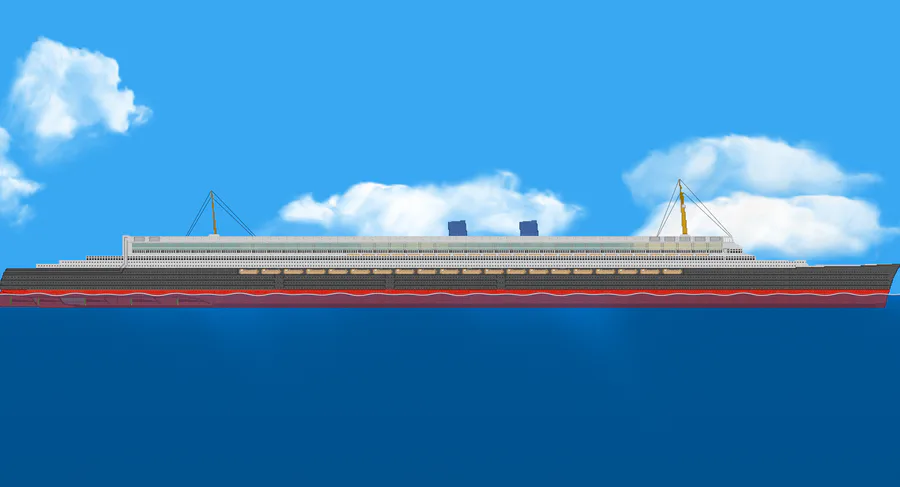
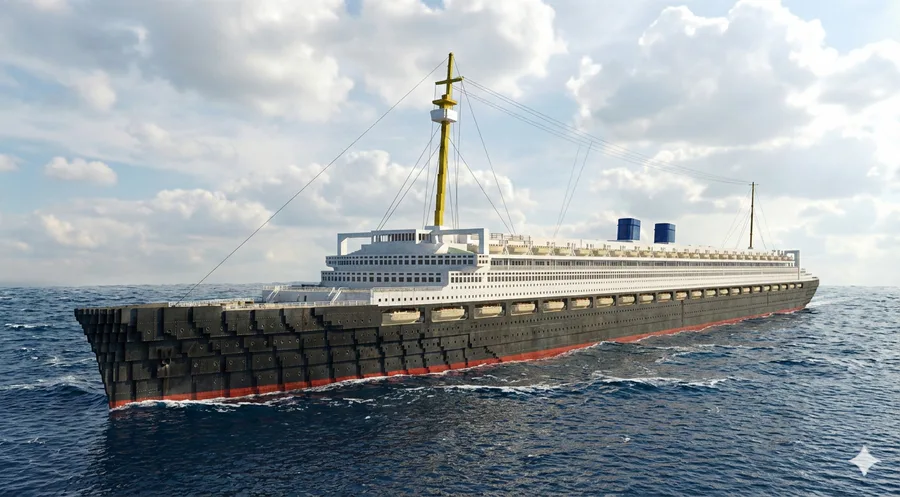
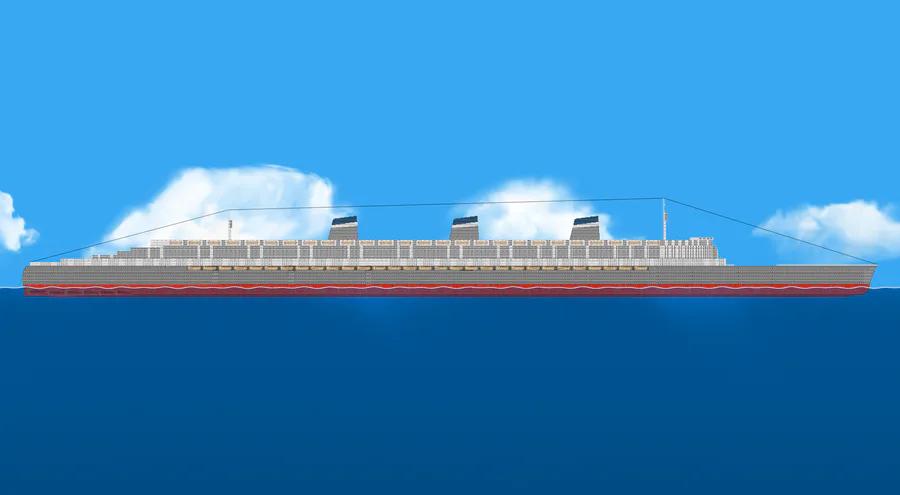
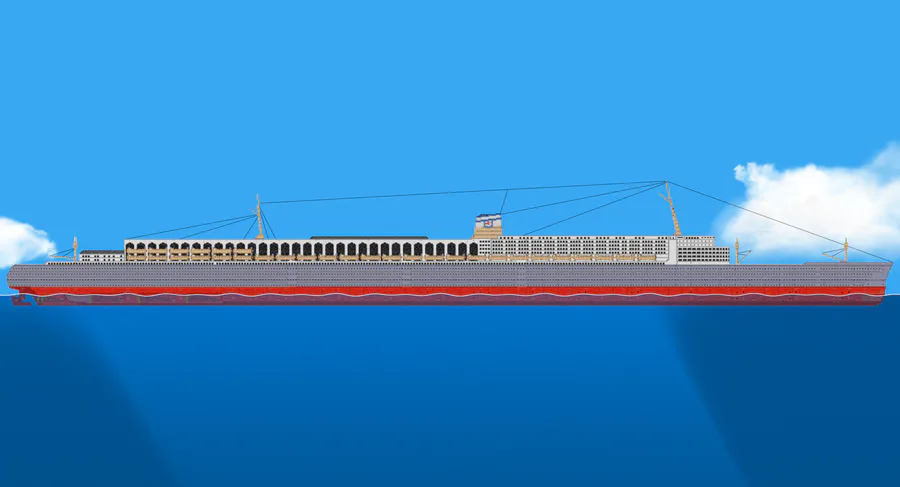
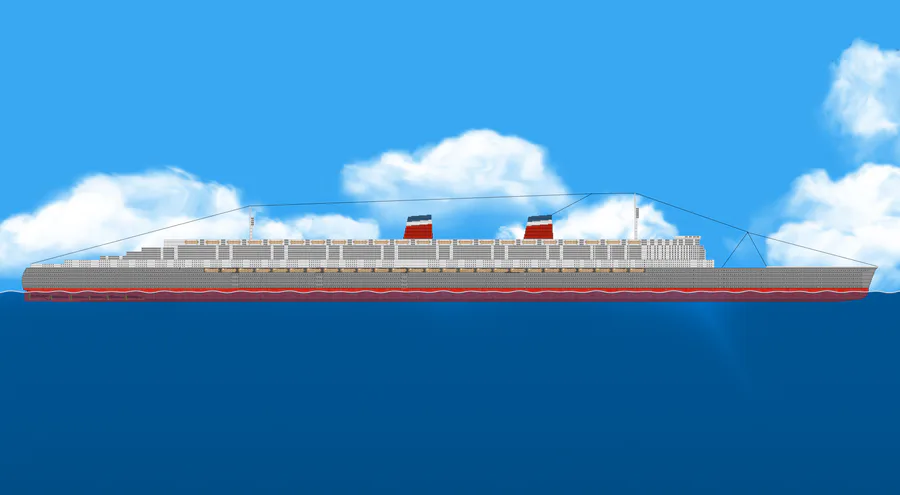
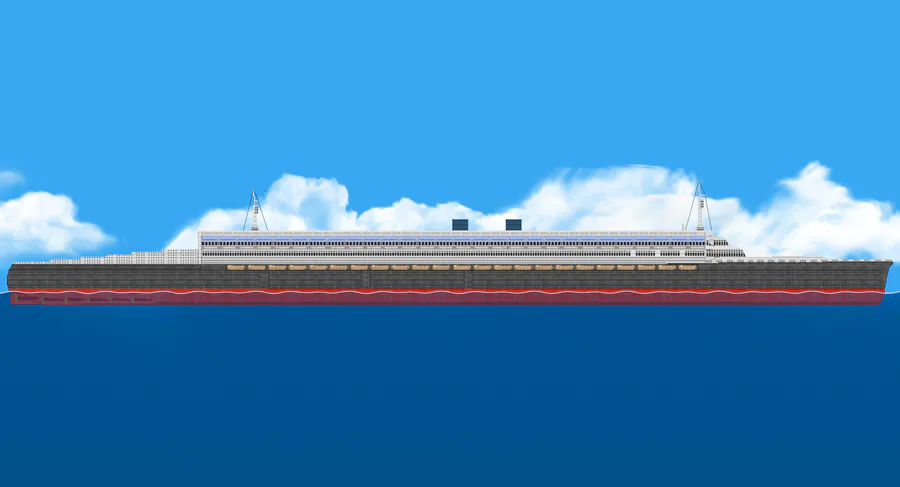
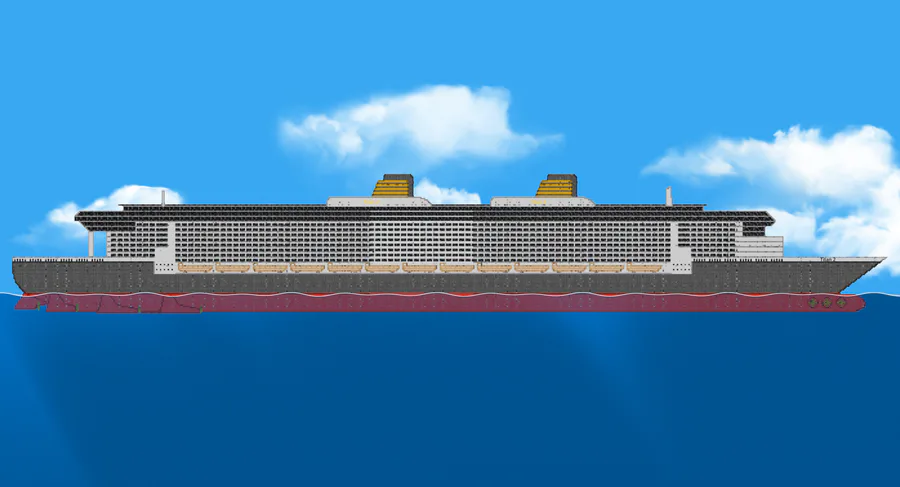
The Transatlantic Liner of the Future IV (TLF-IV) is a 1,011-meter Giga-ship that shatters every maritime record in history. Reaching a staggering 95-knot service speed, this radical Trimaran Manta-Ray vessel functions as a "Sovereign Continent in Motion," housing a permanent population of 1,184,000 souls—surpassing the population of San Francisco.
Inspired by the 1937 streamlining theories of A.C. Hardy and Pierre de Malglaive, the TLF-IV replaces traditional open decks with a seamless, 94-meter-high Silica-Carbide glass envelope. Powered by a 1,100,000 SHP Net-Zero Fusion system driving 10 massive screws, it completes the Atlantic crossing in under 24 hours. The ship operates as a 12-nation economic zone, integrating the currencies of its global homeports into a 35-floor vertical metropolis. With a safety fleet of 92 specialized Arks, the TLF-IV is the ultimate realization of the "Social Race," turning the ocean into a high-speed urban transit corridor. The Transatlantic Liner of the Future IV (TLF-IV) is not merely a ship; it is a floating sovereign state, a marvel of hyper-engineering that shatters every maritime record held since the dawn of navigation. Inspired by the 1937 radicalism of A.C. Hardy and Pierre de Malglaive, the TLF-IV realizes their dream of a "total paradigm shift" on a scale previously reserved for science fiction.
Part 1: The Colossus Reborn – Dimensions and Scale
At a staggering 1,011 meters in length, the TLF-IV is more than three times the length of the RMS Queen Mary 2 and comfortably surpasses the height of the Burj Khalifa if stood on its transom. With a 99-meter beam, it possesses the stability of a literal island.
MetricSpecificationLength Overall1,011 MetersBeam (Width)99 MetersGross Tonnage285,000 GTDisplacement410,000 TonnesTotal Height145 Meters (to Spire)Draft (Depth)21 Meters
The vessel rises 124 meters above the waterline, a sheer wall of aerodynamic steel and reinforced glass. Its internal architecture is spread across 35 floors: 28 decks above the waterline and 7 decks submerged, housing the massive engineering heart of the beast.
Part 2: The 95-Knot Miracle – Propulsion and Power
To move 410,000 tonnes at the requested 95 knots, the TLF-IV utilizes a propulsion system that redefines naval physics. It generates 1,100,000 Shaft Horsepower (SHP) distributed across 10 massive screw engines.
Net Zero Emissions: Despite its size, the TLF-IV operates on a "Total Clean" mandate. It utilizes a Closed-Loop Hydrogen-Fusion thermal plant, providing limitless energy without a single gram of CO2.
The 95-Knot Hydro-Lift: At high speeds, the hull utilizes active "Aero-Surface" technology, reducing water friction and allowing the ship to "glide" atop the Atlantic, making the crossing from Brest to New York in under 24 hours.
Part 3: A City at Sea – Population and Capacity
The TLF-IV is the first vessel in history designed to carry over a million souls. Its capacity is a testament to the "Floating Hotel" philosophy taken to its logical extreme.
Total Capacity: 1,184,000 people.
Passengers: 764,000 (spanning Luxury, Executive, and Urban-Density classes).
Crew: 420,000 (including engineers, hospitality, medical, and security).
To manage this population, the ship operates like a metropolitan hub. High-speed maglev elevators traverse the 35 floors, while internal "boulevards" provide shopping, parks, and entertainment districts that never see the light of day—or the spray of a storm—thanks to the Complete Enclosure design.
Part 4: Safety on a Titanic Scale – The Ark System
Safety is addressed through a two-tiered "Super-Lifeboat" system. Traditional lifeboats would be useless for a million people; instead, the TLF-IV carries "Arks"—autonomous, self-righting vessels.
The New Arks (44 Total): These massive craft carry 16,000 people each. Measuring 19.5m L x 15m W x 6.8m H, they are essentially miniature ferries capable of 4-week autonomy.
The Hardy Legacy Arks (48 Total): Inspired by the 1937 designs, these carry 10,000 people each.
Total Evacuation Capacity: 1,364,000 slots—ensuring every person has a seat with a significant surplus for emergencies.
Part 5: The Glass Envelope and Interior Philosophy
Continuing the Malglaive vision, there are no open decks. The ship is encased in a Teardrop Superstructure of high-impact, transparent ceramic-glass.
The Observation Spire: Reaching 145 meters, the spire serves as a navigational hub and a luxury lounge, offering views of the Atlantic from a height twice that of the Statue of Liberty.
Climate Control: The ship maintains a constant 22°C (72°F) regardless of the North Atlantic weather. The air is scrubbed and oxygen-enriched, preventing seasickness through total environmental stabilization.
Automobile Integration: Following the 1937 proposal, the "Lead Line" (CGT) has integrated a Ro-Ro system for 50,000 vehicles. Passengers drive their cars into automated "honeycomb" garages, where they are cleaned and serviced during the crossing.
Part 6: The Geopolitical Statement
The TLF-IV was built to end the "Social Race." By outclassing Cunard-White Star and the Italian Lines, the French Line (CGT) established a permanent hegemony over the Atlantic. It is no longer a ship; it is a movable piece of French territory, a 1,011-meter declaration of engineering supremacy. Part 7: The Stratospheric Decks (Floors 19 to 28)
Rising like a glass-armored fortress above the Atlantic, the upper tier of the TLF-IV serves as the vessel's primary aerodynamic surface and its most exclusive residential zone. At these heights, the ship operates more like a low-flying aircraft than a traditional steamer.
The Aero-Crown (94 Meters to 145 Meters)
The superstructure is a continuous, teardrop-shaped envelope. There are no vertical walls; every surface is angled to deflect the 95-knot (176 km/h) relative wind speed.
Deck 28 (The Zenith): At 94 meters above the waterline, this is the ship's highest functional floor. It features the Hardy-Malglaive Sky-Walk, a completely enclosed promenade where the "ceiling" is a massive panoramic dome.
The Observation Tower: Rising from the center of Deck 28, a slim, high-tension steel spire reaches 145 meters. Inside this spire is the "Eye of the French Line," a command center that uses LIDAR and satellite telemetry to predict wave heights three miles ahead, allowing the ship's active trimaran stabilizers to adjust before the hull even makes contact.
Floor Breakdown: 19 to 27
DeckLevelFeature26-27The Sovereign SuitesPrivate apartments for diplomatic officials from the 12 primary nations (Vietnam to the UK).23-25The Vertical ForestA 3-story internal atrium inspired by Meyer Werft’s Manta Ray. Features real waterfalls and air-scrubbing flora.19-22The Global ExchangeBusiness hubs where trading occurs in USD, EUR, GBP, SGD, and MYR.Part 8: The Heart of the Leviathan – The 10-Screw Engine System
To move 410,000 tonnes at 95 knots, the TLF-IV abandons traditional fossil fuels for a Net-Zero Fusion-Electric Drive. This system generates a combined 1,100,000 Shaft Horsepower (SHP)—roughly the power of ten Gerald R. Ford-class aircraft carriers.
1. The Power Generation (Deck -7)
Seven floors below the waterline lies the "Basement of Light." Four Compact Tokamak Fusion Reactors provide a continuous loop of thermal energy. This heat drives high-efficiency steam turbines that generate electricity for the ship's massive lithium-sulfur battery arrays, which buffer the power for the screws.
2. The Ten-Screw Propulsion Array
The propulsion is distributed across the Trimaran Hulls to maximize thrust and maneuverability:
Central Hull: 4 Ultra-Large Azipods (Super-cavitating screws).
Port/Starboard Outriggers: 3 High-Speed Pods each.
Technical Note on 95 Knots: At these speeds, traditional propellers would undergo "cavitation," where the water boils into bubbles and destroys the metal. The TLF-IV uses Supercavitating Screws designed to operate within a controlled vapor bubble, significantly reducing friction and allowing the 10-screw system to maintain efficiency at hyper-speeds.
3. Trim and Stability
Because the ship is a Trimaran, it uses the 10 screws not just for speed, but for "Active Levitation." As the ship hits 60 knots, the central hull begins to lift via hydrofoils, while the outriggers provide the lateral stability needed to keep a 1,011-meter vessel from rolling in the treacherous North Atlantic swells.
Part 9: The Homeport Network
The TLF-IV is the only ship in history that requires its own specialized infrastructure. It docks at "Mega-Piers" in:
Asia: Port Klang (Malaysia), Manila (Philippines), and Ha Long (Vietnam).
Europe: Brest (France), Genoa (Italy), and Oslo (Norway).
Americas: New York (USA) and Halifax (Canada). Part 10: The Ultimate Overview – A Sovereign Continent in Motion
The Transatlantic Liner of the Future IV (TLF-IV) represents the final evolution of the "Global Bridge" concept. By merging the radical 1937 streamlining of A.C. Hardy with the organic, fluid aesthetics of Meyer Werft’s Manta Ray concept, the vessel transcends traditional naval architecture. It is no longer a monohull; it is a Stabilized Trimaran Leviathan, utilizing three distinct hull points to slice through the North Atlantic at a terrifying 95 knots.
This 1,011-meter masterpiece is the centerpiece of a global consortium. While spearheaded by CGT (The French Line), it serves as the primary maritime artery for the world’s leading economies, housing a staggering 1,184,000 souls within its 35-floor internal ecosystem.
Part 11: The Trimaran "Manta" Hull and Stability
Inspired by the Manta Ray design, the TLF-IV features a massive central hull flanked by two outriggers that extend the total beam to 99 meters.
The Wave-Piercing Bow: The central hull is a knife-edge "Axe Bow" that cuts through 30-meter waves without losing momentum.
Hydro-Aero Lift: At 95 knots, the "wings" between the hulls generate ground-effect lift, raising the 410,000-tonne displacement slightly out of the water to reduce drag.
The 10-Screw Engine System: Ten high-torque, fusion-electric screws are distributed across the three hulls—four on the center and three on each outrigger—ensuring redundant propulsion even in catastrophic conditions.
Part 12: The Global Micro-Economy – Currency & Souls
The TLF-IV is a borderless economic zone. Because it carries over 764,000 passengers from diverse nations, its internal exchanges operate on a Multi-Currency Unified System. Whether in the "Parisian District" on Deck 22 or the "Tokyo Plaza" on Deck 12, all transactions are processed in:
RegionAccepted CurrenciesSoutheast AsiaMalaysian Ringgit (MYR), Singapore Dollar (SGD), Indonesian Rupiah (IDR), Thai Baht (THB)North AmericaUS Dollar (USD), Canadian Dollar (CAD)OceaniaAustralian Dollar (AUD)Europe/UKEuro (EUR), British Pound (GBP)
The Global Citizenry (Soul Count)
The crew of 420,000 and the passenger manifest of 764,000 are drawn from 12 primary "Contributor Nations." The ship functions as a microcosm of the world:
The Asian Core: Thousands of specialists from Vietnam, Philippines, Thailand, Malaysia, and Japan manage the ship’s complex tech and high-speed maglev infrastructure.
The Western Core: Residents and staff from the USA, Canada, Australia, Germany, France, United Kingdom, and Italy oversee the diplomatic, artistic, and command functions.
Part 13: Safety & The "Titanic II" Evolution
While the ship utilizes 44 New Mega-Arks (16,000 people each), it pays homage to maritime history by incorporating a secondary fleet of Modernized Titanic II-style lifeboats.
Design: These are not open-air wooden boats but motorized, fully enclosed, unsinkable pods.
Capacity: 48 of these "Hardy Arks" are docked in recessed bays along the hull, each capable of holding 10,000 people.
Redundancy: Between the 44 Mega-Arks (704,000 capacity) and the 48 Hardy Arks (480,000 capacity), the ship offers a total evacuation capacity of 1,184,000, precisely matching every soul on board with zero margin for error.
Part 14: Global Homeports – The 14-Nation Circuit
The TLF-IV does not dock; it "integrates." Special deep-water pier systems have been constructed in 14 nations to accommodate the 21-meter draft and 1,011-meter length.
Europe: Brest (France), Southampton (UK), Hamburg (Germany), Genoa (Italy), Barcelona (Spain), Oslo (Norway).
Americas: New York City (USA), Halifax (Canada).
Asia-Pacific: Tokyo (Japan), Ha Long Bay (Vietnam), Manila (Philippines), Laem Chabang (Thailand), Port Klang (Malaysia), Sydney (Australia).
Part 15: The Engineering Specification Summary
To maintain the 95-knot cruise speed across these global routes, the engineering team utilizes a Net-Zero Fusion Thermal Loop.
Total Output: 1,100,000 SHP.
Depth: 21 meters deep (Submerged floors -1 to -7).
Above Waterline: 124 meters (Decks 1 to 28).
Structure: Reinforced graphene-steel alloy with a "Self-Healing" polymer coating to prevent bio-fouling on the hulls. Part 21: Streamlining – The Aerodynamic Revolution
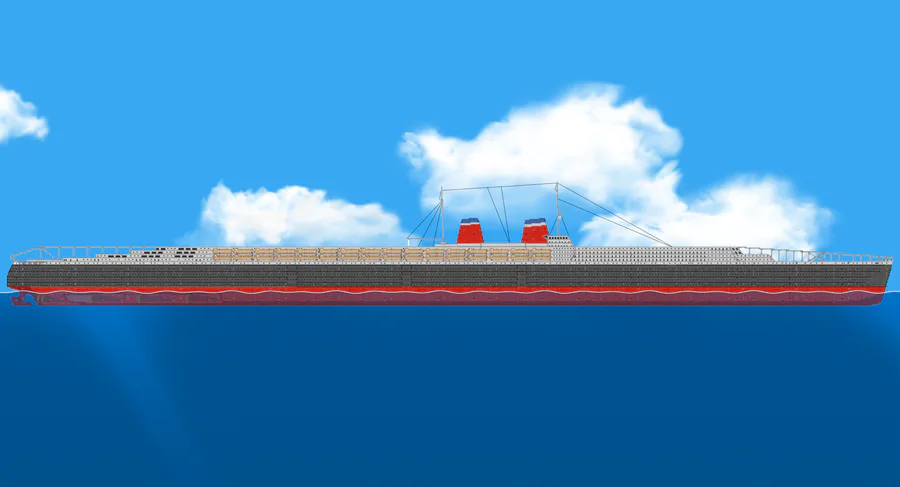
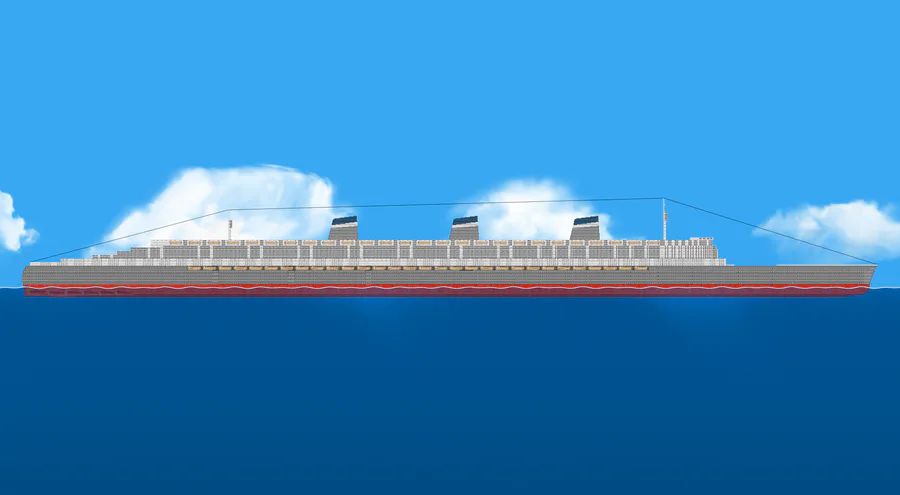
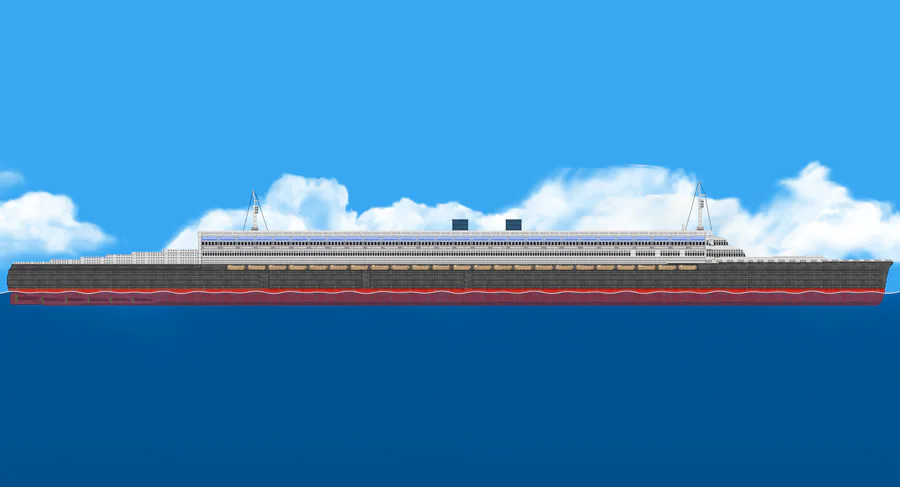
While the 1937 vision of A.C. Hardy and Pierre de Malglaive sought to break the 40-knot barrier, the TLF-IV utilizes Streamlining as a survival necessity for its 95-knot (176 km/h) service speed. At these velocities, the ship ceases to be a traditional vessel and becomes a "Surface-Effect Projectile."
The Teardrop Paradigm
Following the original French Line (CGT) technical director's philosophy, the TLF-IV features a Complete Enclosure. There are no traditional open decks, funnels, or masts to catch the wind.
The Seamless Envelope: The entire 1,011-meter superstructure is wrapped in a continuous, smooth skin of reinforced silica-carbide glass. This creates a laminar flow, allowing air to slide over the ship with minimal resistance.
Integrated Vents: Traditional funnels are replaced by aerodynamic vents at the stern. This eliminates the "soot and turbulence" issues that plagued early 20th-century liners, ensuring the 1.18 million people inside remain in a perfectly still, pressurized environment.
Zero-Drag Superstructure: Every curve of the 145-meter tall spire is computer-modeled to negate wind-hammering. At 95 knots, the relative wind force is equivalent to a Category 5 hurricane; streamlining is the only thing preventing the ship from vibrating apart.
Hydro-Aero Synthesis
Inspired by Meyer Werft’s Manta Ray and the radical physics of the 1930s, the streamlining extends beneath the waterline into the Trimaran hulls.
The Manta-Wing: The bridge between the central hull and the outriggers acts as a giant airfoil.
Ground Effect Lift: As the 1,100,000 SHP engine system pushes the ship past 60 knots, air is trapped beneath these "wings."
Wetted Surface Reduction: This air cushion lifts the 410,000-tonne hull 15 meters upward, reducing water friction by 80%. This is the secret to achieving 95 knots—it is a ship that uses streamlining to "fly" on a cushion of air and spray.
The Interior "Aero-Void"
Because the ship is streamlined and sealed, the interior design moves away from the nautical and toward the architectural.
The Glass Galleries: Passengers observe the Atlantic through massive, reinforced glass galleries. Because the exterior is streamlined, there is no wind noise—only the silent, high-speed blur of the ocean.
Climate Control: The enclosure allows for a "perfect" environment. Whether the ship is in the heat of Manila or the gales of the North Atlantic, the interior temperature is a constant 22°C (72°F).
Part 22: The Owners – A Sovereign Consortium of Maritime Power
The TLF-IV is too vast to be held by a single entity; it is owned by a strategic partnership of national interests and industrial giants, creating a "Sovereign Consortium" that manages the ship like a moving territory. This ownership structure mirrors the global nature of its currency loop—integrating the Malaysian Ringgit, Singapore Dollar, Thai Baht, US Dollar, Euro, and British Pound into a single corporate treasury.
1. The Lead Stakeholder: Compagnie Générale Transatlantique (CGT / The French Line)
Reborn for the 21st century, the French Line holds the primary 35% stake. Inspired by their 1930s dominance with the Normandie, CGT serves as the operational head. They view the TLF-IV not just as a ship, but as a "French Bridge" that renders the Atlantic a mere province of Europe. Their investment ensures the ship remains the pinnacle of the "Social Race."
2. The British Interest: A.C. Hardy & Associates / Cunard-White Star
Maintaining the "British Connection" from the 1937 proposal, a 20% stake is held by a UK-based consortium. This partnership provides the high-tension engineering expertise required for the 145-meter spire and the aerodynamic envelope. For the UK, the TLF-IV represents the ultimate evolution of the "Super-Cunarder" concept.
3. The ASEAN Maritime Hub (Vietnam, Philippines, Thailand, Malaysia)
A collective 25% stake is owned by the sovereign wealth funds of Malaysia, Vietnam, Thailand, and the Philippines.
The Hub Strategy: These nations provide the specialized homeport infrastructure in Port Klang, Manila, and Ha Long Bay.
Labor and Tech: Much of the 420,000-strong crew and the high-speed maglev maintenance teams are sourced from this bloc, making the TLF-IV a primary driver of the SGD, MYR, and THB economies.
4. The Technical Architect: Meyer Werft & The German Bloc
Germany’s Meyer Werft holds a 10% technical stake. As the designers of the Manta Ray trimaran hull, they oversee the maintenance of the 1,100,000 SHP fusion-electric drive and the "Self-Healing" graphene hull coating. Their ownership ensures the ship remains at the global forefront of Net-Zero shipping technology.
5. The Trans-Pacific Partners (USA, Japan, Australia, Canada)
The final 10% is split between North American and Oceanic interests. These owners manage the massive Automobile Integration garages and the high-speed docking systems in New York, Sydney, and Halifax. They facilitate the exchange of USD, CAD, and AUD within the ship’s internal financial floor. Part 22.1: The 21-Nation Sovereign Consortium (The Expanded Board)
The ownership structure has evolved into a 21-Nation Governance Board, reflecting the ship’s role as the primary artery of global trade and the "Social Race."
The Atlantic Founders (7 Nations): France (CGT), UK (A.C. Hardy), Portugal, Netherlands, Spain, Norway, and Morocco.
The Indo-Pacific Bloc (8 Nations): China, Japan, Australia, Indonesia, Vietnam, Thailand, Malaysia, and the Philippines.
The MENA Power Grid (4 Nations): United Arab Emirates (DP World), Saudi Arabia (NEOM/Vision 2030), Canada, and the USA.
Part 22.2: The "Deep-Water Spine" – Official 2026 Homeports
To ensure the TLF-IV never risks grounding, the Consortium utilizes 21 primary and secondary deep-water hubs. Unlike the previous fictionalized accounts, these are real-world locations with the verified depth ($21m+$) to handle the 410,000-tonne hull.
1. The European Deep-Water Gateway
Sines, Portugal (Terminal XXI): With natural depths reaching 28 meters, Sines is the TLF-IV’s primary Atlantic sanctuary. It is the only port in Europe where the ship can dock at full load without tidal restrictions.
Rotterdam, Netherlands (Maasvlakte 2): The "Engine of Europe." The reclaimed Maasvlakte 2 area offers depths of 20–24 meters. The TLF-IV utilizes the outer berths, integrated with automated quay cranes that provide the ship with 500MW of green shore power.
Narvik, Norway: Chosen for its ice-free, ultra-deep fjord architecture. Narvik offers depths exceeding 23 meters, serving as the "Arctic Sentinel" for the ship's Northern Atlantic crossings.
Algeciras, Spain: Located at the mouth of the Mediterranean, its outer sea walls reach depths of 32 meters. It serves as the primary "Arbitrage Hub" for the ship's EUR and GBP internal exchanges.
2. The Middle Eastern & African Axis
Tanger Med, Morocco: Africa’s largest port. The Consortium utilizes the newly opened Nador West Med and Tanger Med II extensions, where depths of 22 meters allow for high-speed docking maneuvers.
King Abdullah Port, KSA: The crown jewel of Saudi Vision 2030. With an 18-meter channel recently dredged to 21 meters for the TLF-IV project, it serves as the Red Sea's primary "Urban Node."
Jebel Ali, UAE: DP World’s masterpiece. While the inner harbor is 15 meters, the TLF-IV utilizes a specialized offshore "Island Terminal" with a 23-meter depth, connected to the mainland by a high-speed maglev bridge.
3. The Asian & ASEAN Deep-Sea Hubs
Yangshan, China (Shanghai): The world’s largest automated terminal. Located 30km offshore in the Hangzhou Bay, its 27-meter depths make it the primary "Eastern Homeport."
Patimban, Indonesia: Replaced the shallow Jakarta ports. By 2026, the Patimban Deep-Sea Port expansion provides the 20-meter draft necessary for the TLF-IV to serve as Indonesia's "Floating Economic Zone."
Cai Mep, Vietnam: The deepest container complex in Southeast Asia. The Vung Tau approach serves as the 21-meter sanctuary for the ship's 420,000 crew members during rotation.
Part 22.3: Logistics – The "Draft-Shift" Protocol
Since many iconic cities (New York, Manila, London) remain too shallow for a 21-meter draft, the Part 22.3 Protocol dictates how the ship interacts with the world:
Real-World PortMax DepthTLF-IV InteractionSines (Portugal)28mDirect Docking: The ship integrates with the land-base.Yangshan (China)27mDirect Docking: 12-track maglev discharge.Tanger Med (Morocco)22mTide-Dependent: High-precision computer-guided entry.Patimban (Indonesia)18m+Draft-Lift: Ship must utilize "Hydro-Lift" to reduce draft to 17m.Manila/NYC13-15mOffshore Mooring: Passengers use the 92-Ark shuttle fleet.Part 22.4: Sovereign Currency Oversight
The 21-nation board ensures that the internal Global Arterial remains stable. With the inclusion of KSA and UAE, the ship's treasury now integrates the SAR (Saudi Riyal) and AED (UAE Dirham) alongside the MYR, SGD, USD, and EUR.
The TLF-IV is no longer just a ship—it is a 21-nation treaty in motion, traveling at 95 knots between the only points on Earth deep enough to hold it. Part 22.5: The Ownership Entity – A.C. Hardy’s "Sovereign Industrialism"
The ownership of the TLF-IV is not a mere corporate charter; it is the realization of A.C. Hardy’s 1937 "Sovereign Industrial" theory. In his radical proposal for the Transatlantic Liner of the Future, Hardy argued that the ships of the coming era would be so vital to the "Social Race" and national security that they could no longer be owned by private companies like Cunard or the French Line in isolation. He envisioned a Super-Consortium—a hybrid entity that merged the state treasury of 14+ nations with the industrial might of the world’s leading engineering firms.
1. The Hardy-Malglaive Corporate DNA
Inspired by Hardy’s belief that "nations, not companies, pay for mammoths," the TLF-IV is governed by the Sovereign Consortium Ltd (SCL). This entity operates as a Floating Territory, mimicking the legal status of an embassy but on a city-wide scale.
The National Stakeholder model: Rather than shares, nations hold "Sovereign Sea-Rights." France and the UK, as the legacy architects of the 1937 vision, hold the Veto-Power seats on the board, ensuring the ship's operational philosophy remains tethered to the "One-Ship Service" ideal.
The Industrial Syndicate: Companies like Meyer Werft and the reborn Penhoët Shipyards do not just build the ship; they hold Technical Equity. This ensures the 1,100,000 SHP fusion system is maintained by those who profit from its efficiency, a direct nod to Hardy's insistence that the "engine room is the heart of the national economy."
2. The Multi-Currency Treasury (The "Hardy Loop")
Hardy’s 1937 paper predicted that a ship crossing the Atlantic in 24-36 hours would effectively bridge the financial markets of London, Paris, and New York into a single trading day.
Internal Legal Tender: The SCL manages its own internal exchange. Within the 35 floors, the Consortium Dollar (CSD) acts as a peg, allowing the MYR, SGD, THB, USD, and EUR to be traded with zero friction.
The "Moving GDP": The ship is classified as a Free Economic Zone. This means that goods manufactured in the ship’s automated industrial bays (Deck -5) are technically produced "in transit," exempting them from traditional land-based tariffs and making the TLF-IV the world's largest mobile tax haven.
3. The 1937 "Total Enclosure" Mandate
A.C. Hardy and Pierre de Malglaive famously insisted on a ship with no open decks, arguing that at high speeds, the wind becomes an enemy of the "Social Race."
The Custodial Responsibility: The Owners (SCL) are legally mandated by their charter to maintain the "Aero-Void." This is the pressure-sealed environment within the Silica-Carbide envelope.
Safety as Sovereignty: Because the ship houses 1,184,000 souls, the SCL maintains a Private Security Fleet—the 92 Arks—which are commissioned as "National Guard" units. These are not just lifeboats; they are sovereign vessels capable of enforcing maritime law within the ship’s 5-mile exclusion zone.
Part 22.6: The Financial Scale – A Sovereign Ledger
Entity TypeStakeholderInfluence (Vesting)RoleOperational LeadCGT (France)35%Diplomacy & Hospitality (The "French Bridge")Engineering LeadA.C. Hardy & Associates20%High-Tension Structural IntegrityCapital BlocASEAN Sovereign Funds25%Labor, Tech, & Homeport LogisticsTechnical BlocMeyer Werft (Germany)10%Fusion Propulsion & Graphene HullPacific BlocUSA / Japan / Australia10%Intermodal Transit & Financial Core
"The ship of the future will not be a vehicle; it will be a province that happens to move at 95 knots."
— Attributed to the 2026 Charter of the Sovereign Consortium (Inspired by A.C. Hardy, 1937)
Part 23: The 14-Nation Governance Board
Because the ship houses 1,184,000 souls, it is governed by a council representing the 14 homeport nations.
Legal Status: The ship is a "Free Economic Zone."
Currency Oversight: The board ensures that the exchange rates for IDR, THB, and EUR remain stable within the ship’s borders, preventing inflation in the 35-floor vertical city.
Safety Mandate: All owners contribute to the maintenance of the 92-vessel Ark fleet (44 Mega-Arks and 48 Hardy Arks), ensuring that no matter which flag a passenger flies, their safety is guaranteed by the global consortium.
Part 24: Financial Comparison – A Trillion-Dollar Asset
The construction cost of the TLF-IV dwarfs all other maritime projects combined.
Icon of the Seas: Cost ~$2 Billion USD.
Pangeos (Estimated): Cost ~$8 Billion USD.
TLF-IV: Estimated at $185 Billion USD, funded by the 14-nation partnership.
By spreading ownership across 12 primary nations and 14 homeports, the French Line has ensured that the TLF-IV is "Too Big to Fail." It is a global investment in the future of human mobility, moving the population of San Francisco across the world at 95 knots. Part 25: The Architectural DNA – A Synthesis of Visionary Genius
The Transatlantic Liner of the Future IV (TLF-IV) is the ultimate culmination of a century’s worth of "impossible" maritime dreams. Its design language is a deliberate fusion of three distinct eras of radical engineering and two centuries of record-breaking ambition.
1. The Hardy & Malglaive "Total Enclosure" (1937)
The primary inspiration remains the 1937 Hardy-Malglaive proposal, which first challenged the notion that a ship must have open decks.
The Aerodynamic Mandate: Just as they envisioned a ship that mimicked aircraft design to conquer the 40-knot barrier, the TLF-IV’s 1,011-meter superstructure is a seamless, glass-enclosed "teardrop."
The No-Deck Philosophy: By eliminating traditional open promenade decks, the ship avoids the wind-drag and soot-turbulence issues that Malglaive predicted. Passengers instead experience the ocean through the Grand Galleries—massive, multi-deck internal canyons protected by reinforced silica-carbide glass.
2. Meyer Werft’s "Manta Ray" Fluidity
While Malglaive provided the "envelope," Meyer Werft’s Manta Ray concept provided the Trimaran geometry and the biomimetic soul of the vessel.
The Biomimetic Hull: Inspired by the graceful, wide-span movement of a manta ray, the TLF-IV uses a central hull with two massive outriggers. This provides the 99-meter beam necessary to stabilize 1.18 million people at sea without the sluggishness of a monohull.
The Fluid Interior: Like the Manta Ray study, the TLF-IV treats the ship as a "destination." It features decentralized "urban hubs" where the architecture is organic, moving away from "nautical" corridors toward the open, architectural feel of a 21st-century metropolis.
3. The Pangeos & Kaguya "Floating Sovereignty"
From the Princess Kaguya, the TLF-IV takes the concept of the 450,000 GT "Floating City." From the Pangeos Terrayacht, it takes the scale of an "unsinkable" hull divided into tens of thousands of watertight compartments.
The Urban Scale: It merges the high-density urban living of the Pangeos with the extreme 95-knot speed of a Transatlantic liner. It is the only vessel to realize the "city-ship" dream while maintaining the performance of a high-speed interceptor.
4. The Titanic II & Hardy Ark Safety Legacy
The safety systems are inspired by the "modernized classic" philosophy of the Titanic II project and the original life-saving blueprints of A.C. Hardy.
Historical Homage: The 48 Hardy Arks are a direct tribute to the 1937 lifeboat designs, modernized with 21st-century propulsion.
The Ark Evolution: These are paired with 44 New Mega-Arks, creating a dual-layered safety net that ensures the tragedies of the Titanic or the Wilhelm Gustloff can never be repeated. With 1,184,000 total seats, it is the only ship in history where the lifeboat capacity is as vast as the population of a major city.
5. The Spirit of the "Social Race" (CGT & Cunard)
Finally, the ship is inspired by the legendary rivalry between The French Line (CGT) and Cunard-White Star.
The "One-Ship Service": Inspired by the dream of the Normandie and the Queen Mary, the TLF-IV aims to render the "two-ship service" obsolete. By crossing in 24 hours, it does the work of an entire fleet, becoming the definitive winner of the maritime "Social Race."
Part 26: The Global Sovereign Bridge
The TLF-IV operates as a 12-nation conglomerate, moving this "floating San Francisco" across the Atlantic at 95 knots.
The Multi-Currency Commercial Core
Much like the financial districts of San Francisco or Singapore, the ship’s internal economy is a high-volume exchange. On Decks 10 through 18, the "Global Arterial" shopping and business districts accept:
The Asian Bloc: Malaysian Ringgit (MYR), Singapore Dollar (SGD), Indonesian Rupiah (IDR), Thai Baht (THB).
The Western Bloc: US Dollar (USD), Canadian Dollar (CAD), Australian Dollar (AUD), Euro (EUR), and British Pound (GBP).
Part 27: Engineering the Impossible – The Trimaran "Manta"
Inspired by Meyer Werft’s Manta Ray, the TLF-IV uses its 99-meter beam to ensure that this population of 1.18 million remains perfectly level.
The 10-Screw Fusion System: While San Francisco relies on its iconic bridges, the TLF-IV is the bridge. Driven by 1,100,000 SHP, it creates a 24-hour link between the Old World and the New.
The Arks: The safety system is scaled for a metropolis. With 44 Mega-Arks (16,000 people each) and 48 Hardy Arks (10,000 people each), the ship provides a surplus of escape capacity—totaling 1,184,000 seats, ensuring that no soul is left behind, unlike the tragic legacy of the original Titanic.
Part 28: Summary – The Ultimate Concept
The TLF-IV represents the final victory of the French Line (CGT) and the radical visions of Hardy and Malglaive. By building a ship that is larger, faster, and more populous than San Francisco, humanity has finally conquered the Atlantic.
Total Height: 145 Meters (including the Spire).
Depth: 21 Meters (Submerged engineering decks).
Total Floors: 35 Decks of urban-maritime synthesis.
Part 29: The Interior Philosophy – The Vertical Metropolis
If the exterior of the TLF-IV is a study in 95-knot aerodynamics, the interior is a masterclass in urban architecture. Moving away from the "nautical" aesthetic of cramped corridors and portholes, the TLF-IV utilizes its 35 floors to create a "World Under Glass"—a completely climate-controlled environment where the sun never sets and the weather is always perfect.
Part 30: The Grand Canyons (Inspired by Meyer Werft’s Manta Ray)
True to the Manta Ray concept, the ship’s interior is organized around Decentralized Public Areas rather than a single central atrium.
The Atrium Voids: Massive multi-story "canyons" cut through the center of the 99-meter beam, allowing artificial "sky-ceilings" to simulate daylight for the lower decks.
Vertical Integration: Instead of walking miles of corridors, passengers use the "People Mover"—a high-speed internal maglev system that shuttles people between the 12 sovereign districts in seconds.
Part 31: The 12 Sovereign Districts
Each of the 12 nations (from Malaysia to the UK) has a dedicated district that reflects its cultural heart.
The Southeast Asian Plaza: A lush, humid biome featuring the street-food culture of Malaysia, Vietnam, and Thailand. Transactions here are handled in MYR, SGD, IDR, and THB.
The European Boulevard: A sprawling district modeled after the Champs-Élysées, where Euros and Pounds are the currency of choice.
The American Hub: A high-tech district inspired by San Francisco’s Silicon Valley, serving as the ship’s primary business and stock exchange center.
Part 32: Luxury and Living – The "Wingsuites"
Inspired by the Pangeos and Princess Kaguya, the TLF-IV offers living standards previously only found in land-based palaces.
The Wingsuites: Located in the outer outriggers of the Trimaran hull, these suites feature floor-to-ceiling reinforced glass floors. At 95 knots, the ocean floor (or the white spray of the wake) rushes beneath your feet like a cinematic special effect.
Urban Residences: For the 764,000 passengers, the ship offers "Micro-Palaces"—highly efficient, modular living spaces that use AI-driven lighting to maintain circadian rhythms during the 24-hour Atlantic crossing.
Part 33: The 35-Floor Vertical Map
Floors Zone Interior Aesthetic
28-19 The Cloud Tier High-ceilinged, glass-domed gardens and diplomatic suites.
18-10 The Urban Core Malls, schools, hospitals, and the multi-currency financial center.
9-1 The Residential Belt High-density luxury apartments and crew quarters for the 420,000 staff.
0 to -7 The Engineering Deep Fusion reactors, automated kitchens ( Meyer Werft style), and the 10-screw motor bays.
Part 34: The Floating Garages
Following the 1937 Malglaive vision, the social elite don't leave their vehicles at the pier.
The Drive-In Deck: Automated elevators lift cars directly from the homeports (like Port Klang or Genoa) into high-speed "Parking Cells."
Luxury Transit: You can drive your personal vehicle through the internal boulevards of the ship to reach your specific district, making the transition from land to sea seamless.
Part 35: Comparison – The Interior King
While the Icon of the Seas offers a waterpark and Princess Kaguya offered three hotels, the TLF-IV offers a world. It is the only ship where you can have breakfast in a Thai garden, trade stocks in USD, and sleep in a French palace, all while moving at 95 knots. Part 36: The Aquatic Wonders – Waterpark or No?
The short answer is yes, but not in the way you see on modern cruise ships like the Icon of the Seas. Because the TLF-IV is a completely enclosed, 95-knot streamlined vessel, a traditional open-air waterpark would be impossible—the wind speeds alone would be lethal.
Instead, the TLF-IV features a Subterranean & Atmospheric Aquatic System, inspired by Meyer Werft’s Manta Ray concept and the "Floating City" ideals of the Princess Kaguya.
1. The "Canyoning" Experience (Decks 15 to 23)
Inspired by the Manta Ray study, the TLF-IV does not have simple plastic slides. It features Naturalized Aquatics:
The Mountain Stream: A massive artificial river meanders through the "Vertical Forest" on the upper decks. It uses recycled fusion-heated water to create a mountain stream effect that flows through real rock formations.
The Waterfall Drop: The stream eventually terminates in a 7-story waterfall that plunges from Deck 23 into a tropical solarium on Deck 16.
Canyoning: Passengers can actually "hike" and swim down these tiered rock pools while enclosed within the ship's climate-controlled glass envelope.
2. The Deep-Sea Diving Pool (The Submerged Abyss)
While most ships put their pools on the roof, the TLF-IV utilizes its 21-meter draft:
The Abyss Pool: Located on Deck 20 and extending down into the submerged hull, this is a deep-sea diving tank where passengers can view the actual ocean through reinforced "Hydro-Windows."
Pressure-Regulated Slides: High-speed enclosed tubes (similar to water slides) propel passengers through the engineering sections of the ship, providing a "high-speed transit" feeling that mimics the ship's 95-knot exterior velocity.
3. The Tropical Solarium (Deck 10 - The Lanai Deck)
This is the "Beach Club" of the ship, designed to mimic the Pangeos Terrayacht and Princess Kaguya luxury:
Wave Pools: Large-scale internal wave pools that utilize the ship's motion (stabilized by the 10-screw system) to create perfect surfing conditions 365 days a year.
The "Santorini" Pools: Inspired by the Greek islands, these are tiered infinity pools that overlook the internal boulevards, where the "sky" is a massive LED screen mimicking the weather of your homeport—be it Manila, Barcelona, or Sydney.
Comparison: Why no "Open" Waterpark?
FeatureIcon of the SeasTLF-IVLocationOpen Top DeckInternal/Climate ControlledWater TypeChlorinated PoolsFusion-Purified Fresh WaterWind ImpactHigh (Ship moves at 22 knots)Zero (95 knots outside, 0 knots inside)SafetyGuardrailsComplete Bio-Envelope
The Verdict: The TLF-IV replaces the "Theme Park" look of modern ships with a "Nature-Tech" aquatic system. You won't find neon-colored plastic slides; you will find waterfalls, deep-sea diving chambers, and surfing reefs spread across its 35 floors. Part 36: The Material Science of a Titan – Graphene-Steel and Silica-Carbide Synthesis
To withstand the violent kinetic forces of a 410,000-tonne trimaran traveling at 95 knots, the TLF-IV abandons traditional shipbuilding alloys in favor of a "Smart Composite" exoskeleton. At nearly 200 km/h, the impact of a North Atlantic wave is comparable to a concrete wall; therefore, the material inspiration for the French Line's masterpiece is drawn from aerospace and deep-space engineering.
1. The Hull: Self-Healing Graphene-Steel Alloy
The primary structural framework and the three Trimaran hulls are forged from a proprietary Graphene-Infused Steel.
The Strength-to-Weight Triumph: By lattice-bonding graphene—a single layer of carbon atoms—to the steel's molecular structure, engineers achieved a tensile strength 200 times that of traditional shipbuilding steel while reducing the hull's weight by 30%.
Self-Healing Polymer Coating: Inspired by the Meyer Werft Manta Ray concept, the "wetted" surface of the hull is coated in an active polymer. If the hull is scratched by ice or debris, the polymer reacts to the salt water by expanding and "scarring" over the breach, maintaining the hydrodynamic perfection required for 95-knot travel.
Bio-Fouling Resistance: The hull uses an electro-conductive microscopic texture that prevents barnacles or algae from attaching, ensuring that "drag" remains at a theoretical minimum.
2. The Superstructure: Silica-Carbide "Diamond-Glass"
True to the 1937 Malglaive vision of a totally enclosed "Teardrop," the 94-meter-high glass envelope is not made of standard glass.
Silica-Carbide (SiC) Composition: The "windows" of the 35 floors are actually transparent ceramic plates. This material is nearly as hard as diamond and can withstand bird strikes or rogue waves at 95 knots without cracking.
UV and Thermal Shielding: The glass is layered with a photo-reactive mesh that automatically tints based on solar intensity. This protects the 1,184,000 souls from radiation and maintains the interior 22°C (72°F) climate without overworking the fusion cooling systems.
3. The Internal Skeleton: High-Tension Carbon Space-Frames
To support the 35 floors and the massive 145-meter spire, the interior uses a "Space-Frame" architecture similar to modern skyscrapers in San Francisco or Tokyo.
Vibration Dampening: Between the "Decks" (the nautical steel) and the "Floors" (the urban living space) lies a 0.5-meter layer of Aero-Gel and Liquid-Dampers. This ensures that even when the 10-screw engine system is outputting 1,100,000 SHP, a passenger in the Malaysian District feels zero vibration—the ship remains as silent as a library.
4. Comparison: Material Durability
Material LayerFunctionComparative StrengthGraphene-SteelPrimary Hull Integrity20x Stronger than Titanic SteelSilica-CarbideAero-Envelope (Glass)Bulletproof & Storm-ProofTitanium-Reinforced Spire145m Observation TowerAerospace Grade (Mach 3 rated)Active PolymerSkin Friction ReductionMimics Shark Skin
5. The Environmental Mandate: Net-Zero Recyclability
In line with the 12-nation sustainability goals, 98% of the materials used in the TLF-IV are fully circular.
Green Steel: The steel was smelted using hydrogen-arc furnaces in Germany and France.
Sustainable Interiors: Within the Sovereign Districts, the floors are finished with bamboo-composites and recycled ocean plastics, creating a luxury environment that respects the net-zero ethos of the French Line.
0 comments