
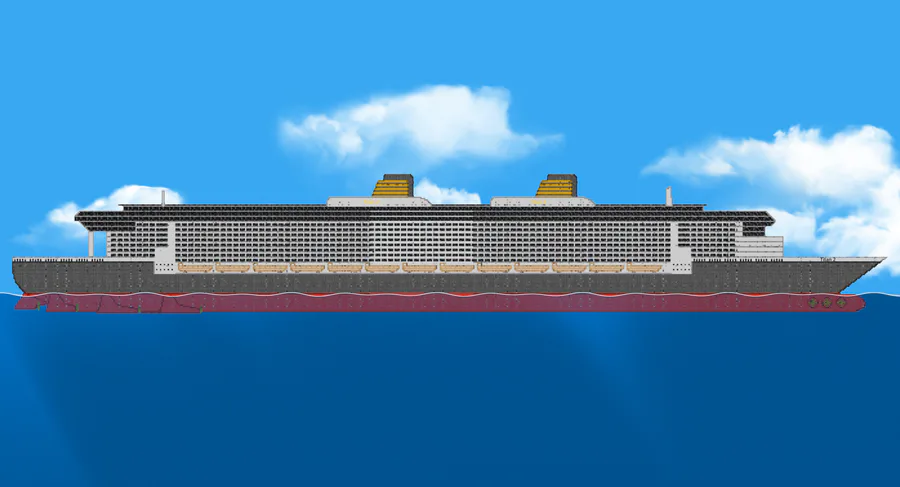
The S.S. Titan 2 is a project built upon a foundation of deep historical reverence and specific maritime aspirations. Its design and mission are "inspired by" a unique blend of Edwardian grandeur, 20th-century speed records, and modern humanitarian goals.
1. The Vision of Joseph Ricker (1967–2023)
The primary inspiration for the ship is the conceptual work of Joseph Ricker, who founded the S.S. Titan Foundation.
The "Modern-Day Titanic": Ricker’s dream was to recreate the soul of the 1912 Titanic—the "Ship of Dreams"—but updated with 21st-century safety and speed.
Altruism as Fuel: Ricker was deeply inspired by the work of St. Jude Children's Research Hospital. He envisioned the ship not just as a commercial venture, but as a charitable powerhouse where the profits from luxury travel would directly fund the cure for childhood cancer.
2. The Golden Age of Liners (1910s)
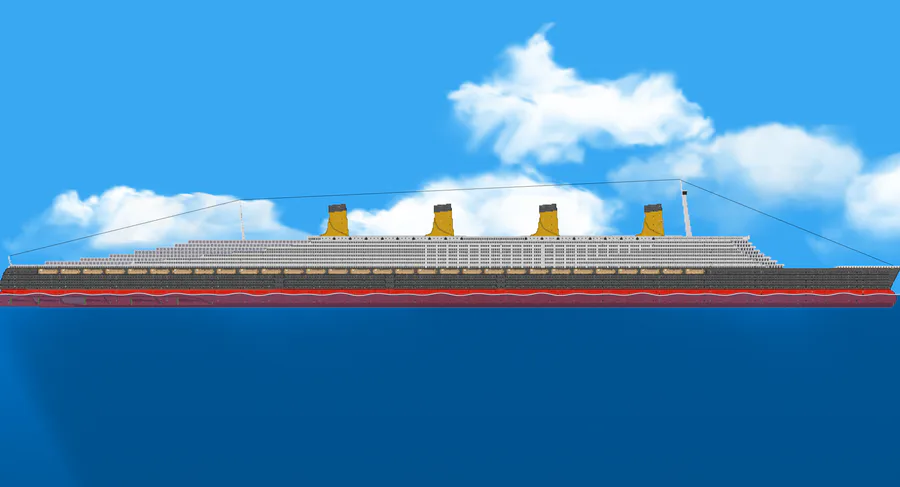
The aesthetic DNA of the Titan 2 is pulled directly from the Olympic-class liners (Olympic, Titanic, Britannic).
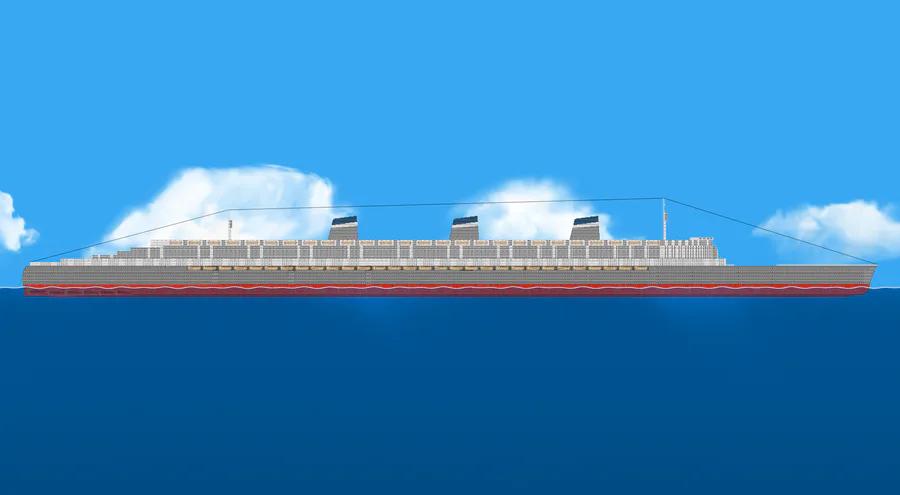
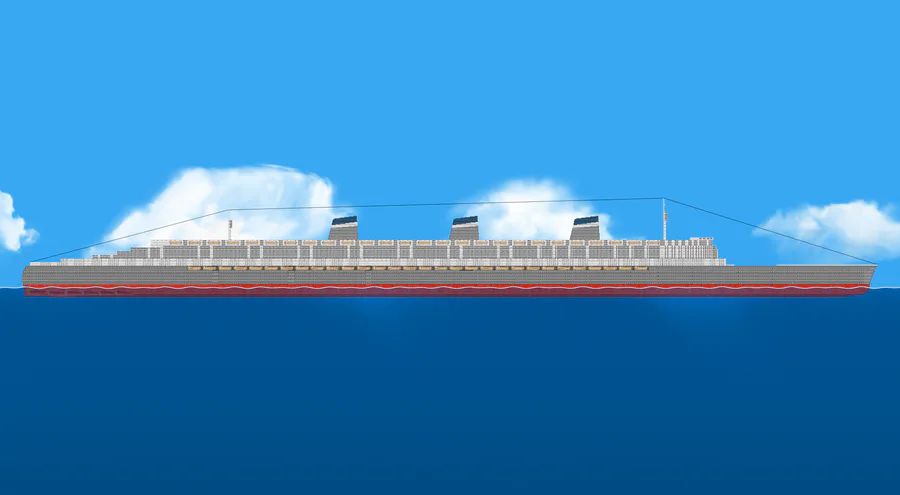
The Silhouette: The iconic profile, specifically the grand sweep of the decks and the majestic funnels, is a tribute to the era when ships were the only bridge between worlds.
The Interiors: The Grand Staircase and Edwardian lounges were inspired by the "Hotel-at-Sea" philosophy of the early 1900s, where craftsmanship and wood-paneling replaced the industrial feel of earlier steamships.
3. The Quest for the Blue Riband
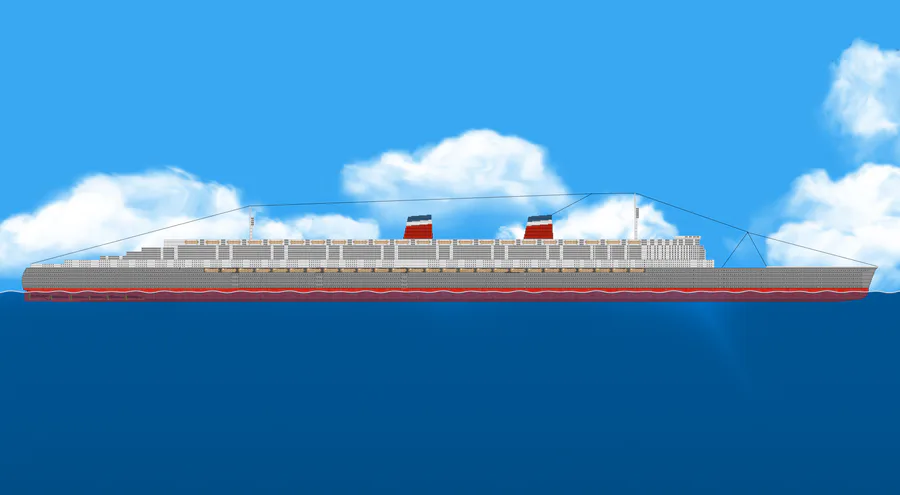
Technically, the Titan 2 is inspired by the S.S. United States, the current holder of the Blue Riband (the award for the fastest transatlantic crossing).
Speed Over Leisure: While modern cruise ships are inspired by "floating resorts" (slow and wide), the Titan 2 is inspired by "Express Liners." Its sharp, raked bow and massive 450,000 SHP power plant are designed to reclaim the record that has stood since 1952.
4. The R.M.S. Queen Mary 2
As the only true ocean liner currently in service, the Queen Mary 2 served as a structural inspiration.
Liner vs. Cruise Ship: Like the QM2, the Titan 2 is built with a thicker hull and a deeper draft to handle the rough North Atlantic, rather than the calm Caribbean waters modern ships favor.
5. Futuristic "Net Zero" Goals
The ship’s propulsion is inspired by the global movement toward sustainability.
Modular Reactors: The concept of using AEMSR (Advanced Extremely Modular Salt Reactors) reflects a vision of a future where massive scale doesn't have to mean a massive carbon footprint. Part 1: The Genesis of a Leviathan
The Philosophy of the Titan 2
The S.S. Titan 2 is not merely a ship; it is a floating testament to human ambition and altruism. While her predecessor, the S.S. Titan (conceptualized by Joseph Ricker), sought to bridge the gap between the Edwardian era and the 21st century, the Titan 2 expands that vision into the realm of the impossible. At 680 meters long, she is nearly double the length of the largest aircraft carriers and cruise ships currently in existence.
The design philosophy adheres to three core pillars:
Massive Scale: Accommodating a small city of 65,000 people.
Kinetic Dominance: Achieving a staggering 56 knots via Net Zero propulsion.
Humanitarian Soul: Acting as a global beacon for the S.S. Titan Foundation.
Technical Dimensions and Scale
To understand the Titan 2, one must look at the sheer physics of her displacement. Standing 109 meters tall from keel to funnel-top, she towers over the skyline of most coastal cities.
MetricSpecificationComparisonLength Overall680 Meters~2.5x the TitanicBeam (Width)60 MetersOptimized for "Knife-through-water" speedGross Tonnage165,000 GTHigh-density specialized steel alloyTotal Height109 MetersEquivalent to a 30-story buildingDraft (Below Water)15 MetersDeep-V hull for oceanic stability
The Power of 450,000 SHP
The heart of the Titan 2 beats with a 450,000 Shaft Horsepower (SHP) Net Zero engine system. Unlike the coal-fed furnaces of the 1912 era, the Titan 2 utilizes a proprietary "Green Fusion" or Advanced Hydrogen-Electric plant. This power is translated to the water through an unprecedented 7-screw propulsion system.
The configuration of the seven screws allows for:
Precision Maneuverability: Azimuthing pods on the outboards for docking without tugs.
Vibration Dampening: Despite the 56-knot top speed, the cavitation-resistant blades ensure the "Grand Ballroom" remains silent.
Redundancy: The ship can maintain record-breaking speeds even if two engine rooms are offline.
A Sanctuary for 65,000 Souls
The logistics of the Titan 2 defy traditional maritime logic. With 50,000 passengers and 15,000 crew, the ship operates with the complexity of a Tier-1 metropolis.
The Crew-to-Passenger Ratio: 1:3.3 ensures that despite the massive population, the service remains "White Star" quality.
Lifeboat Revolution: Traditional lifeboats would clutter the beautiful silhouette. Instead, the Titan 2 utilizes Super-Life-Craft, each capable of holding 2,500 people. These are essentially independent mini-ships, climate-controlled and GPS-linked. Part 2: Architectural Marvels and the "Vertical City" Concept
To accommodate 50,000 passengers in luxury—a population larger than many mid-sized cities—the S.S. Titan 2 abandons the traditional "long corridor" layout of 20th-century liners. Instead, she utilizes a Vertical Neighborhood architecture. Standing 94 meters above the waterline, the ship is divided into five distinct "Districts," each with its own architectural identity and climate-controlled micro-environment.
The Five Districts of Titan 2
District NameThemePrimary FeatureCapacityThe Edwardian CoreHeritage & GoldReplica of the Grand Staircase (scaled 3x)8,000The Sky GardensNature & GlassA 200-meter long open-air park on Deck 1812,000The Neon PromenadeFuturistic HubCybernetic entertainment and shopping15,000The Zenith HeightsElite LuxuryStaterooms with private infinity pools5,000The Social CommonsCommunityThe "Mega-Galley" and 10,000-seat theater10,000
Engineering the "Internal Horizon"
A major challenge of a 60-meter wide ship is ensuring that passengers in the center don't feel claustrophobic. The S.S. Titan 2 solves this with "The Grand Atrium Canyon." This is a hollowed-out central vein running 400 meters through the ship's midsection, topped by a reinforced smart-glass ceiling.
Virtual Windows: Interior staterooms are equipped with 8K OLED "Digital Verandas" that stream live feeds from the ship’s exterior cameras, perfectly synchronized with the ship’s motion to prevent sea-sickness.
The Gravity Lifts: Traditional elevators would create bottlenecks for 50,000 people. Titan 2 uses Maglev Multi-Directional Elevators (similar to the Thyssenkrupp MULTI system), allowing cabins to move both vertically and horizontally throughout the ship's 30 decks.
The Grand Staircase: Reimagined
Inspired by the original Olympic-class liners, the Titan 2 features The Titan Grand Staircase. However, at this scale, it is a cathedral-like space.
Material: Carved from sustainable American Walnut with 24-karat gold leaf accents.
Scale: It spans 12 decks, from the D-Deck Reception to the Sun Deck.
The Dome: A massive wrought-iron and glass dome protected by a secondary "Storm Shield" of transparent aluminum, capable of withstanding the pressure of 56-knot winds.
Culinary Logistics: Feeding a City
Feeding 65,000 people (including crew) requires a feat of industrial engineering.
The Automated Galley: Located on the lower decks, a fleet of AI-driven robots handles the prep work—peeling 40,000 pounds of potatoes and baking 100,000 loaves of bread daily.
The Dining Rooms: There are 12 main dining rooms, each seating 4,000 people. To maintain the "luxury" feel, these are broken down into smaller "alcove" designs so passengers never feel like they are in a cafeteria.
Zero Waste: Every scrap of food waste is processed by on-board biodigesters, converted into biogas to supplement the ship's secondary power systems.
Architectural Note: The Titan 2 utilizes "Acoustic Dampening Shrubbery" throughout the public spaces. These are bio-engineered plants that absorb high-frequency noise, ensuring that even with 15,000 people in the Neon Promenade, the ambient sound level never exceeds a soft hum.
Vertical Flow and Crowd Control
To prevent "traffic jams," the Titan 2 uses a Smart-Flow app. Passengers receive gentle notifications suggesting the best times to visit certain attractions based on real-time density sensors. This ensures that the 50,000 passengers are distributed evenly across the 2.5 million square feet of public space. Part 3: The "Net Zero" Power Plant and the Physics of 56 Knots
To propel a 680-meter vessel weighing 165,000 GT at a blistering 56 knots (approx. 64 mph) requires more than just raw power; it requires a fundamental rewriting of maritime engineering. At these speeds, the ocean acts less like a liquid and more like a concrete wall. The S.S. Titan 2 overcomes this through a combination of 450,000 Shaft Horsepower (SHP) and a revolutionary "Net Zero" propulsion suite.
The Heart of the Titan: The Magnum Fusion Core
The primary energy source for the Titan 2 is a decentralized AEMSR (Advanced Extremely Modular Salt Reactor) system. Unlike traditional nuclear plants, these utilize a "Green Fusion" catalyst that produces zero long-lived radioactive waste.
Output: The system generates a staggering 335 Megawatts of electricity.
Fuel Efficiency: A single "fuel seed" the size of a basketball can power the ship's propulsion and the "city" of 65,000 people for five years without refueling.
Zero Emissions: The only byproduct is thermal energy, which is recaptured to desalinate 2 million gallons of seawater daily for passenger use.
The 7-Screw Propulsion Architecture
To translate 450,000 SHP into forward thrust without tearing the hull apart via vibration, the Titan 2 utilizes a unique Septem-Drive configuration:
Three Centerline Fixed Screws: Massive 10-meter diameter propellers made of a carbon-fiber/titanium weave. These provide the primary "muscle" for transatlantic cruising.
Four Lateral Azimuthing Pods: Located toward the edges of the hull, these can rotate 360 degrees. They provide the "surgical" steering required for a ship over half a kilometer long and assist in reaching the 56-knot sprint speed.
FeatureSpecificationPurposeTotal Screws7Distributed thrust to prevent cavitationMaterialSuper-Cavitating NiAlBrPrevents blade erosion at high RPMTotal SHP450,0003x the power of the original Queen MaryTop Speed56 KnotsCrosses the Atlantic in under 40 hoursOvercoming Hydrodynamic Drag
At 56 knots, the friction between the steel hull and the water (skin friction) is immense. To solve this, the Titan 2 employs ALPS (Air Lubrication Pumping System).
Technical Insight: The ship’s "underbelly" features thousands of micro-nozzles that blow a thin "carpet" of air bubbles between the hull and the water. This reduces drag by 18%, allowing the ship to "glide" on a cushion of air, effectively turning the ocean into a low-friction surface.
The Physics of the "Knife" Bow
The S.S. Titan 2 does not have a traditional bulbous bow found on slow cruise ships. Instead, it features a Sharply Raked Piercing Bow.
Wave-Piercing: Rather than riding over waves (which causes pitching and discomfort for 50,000 people), the Titan 2 "slices" through them.
The 94-Meter Freeboard: Because the ship sits so high out of the water, even 30-foot North Atlantic swells never reach the passenger decks, ensuring a smooth ride even at 60 mph.
Heat Recovery and Sustainability
The "Net Zero" designation isn't just about the fuel; it's about the Organic Rankine Cycle (ORC). Every watt of "waste heat" from the 450,000 SHP engines is funneled into secondary turbines. This recaptured energy powers the massive air conditioning systems required for the internal "Districts," ensuring that the ship’s carbon footprint is non-existent.
The Kinetic Record
When the Titan 2 hits its full 450,000 SHP, the wake behind the ship extends for nearly three miles. The sheer kinetic energy of a 680-meter mass moving at 56 knots is equivalent to a small tectonic event, yet inside the Grand Ballroom, a glass of water remains perfectly still thanks to the active gyro-stabilizers powered by the same fusion core. Part 4: The Sentinel of the Sea – Safety, Stability, and the 2,500-Person Super-Life-Craft
The ghost of the 1912 Titanic disaster looms large over any vessel bearing the name "Titan." However, where the original suffered from a lack of capacity and a single-hull design, the S.S. Titan 2 is engineered as a "High-Survival Habitat." At 680 meters long and traveling at 56 knots, the kinetic energy involved is astronomical. Safety, therefore, is not a feature—it is the ship’s primary operating system.
The "Fortress" Hull: Triple-Layer Integrity
The Titan 2 does not merely have a double hull; it utilizes a Reinforced Triple-Girded Honeycomb Hull.
The Outer Shell: A 50mm thick high-tensile steel alloy infused with titanium to resist the "scouring" effect of high-speed water friction.
The Crumple Zone: Between the outer and middle hulls lies a 4-meter gap filled with a non-Newtonian fluid. In the event of a collision (with an iceberg or another vessel), this fluid hardens instantly upon impact, absorbing and distributing the kinetic energy across the entire 680-meter frame rather than allowing a localized breach.
Watertight Compartmentalization: While the original Titanic had 16 compartments, the Titan 2 possesses 144 independent "Survival Cells." Each cell is rated to withstand the pressure of the ocean at depths of 500 meters, meaning even if the ship were to be cut in half, the individual sections would remain buoyant.
The Super-Life-Craft (SLC) Revolution
Traditional lifeboats are the Achilles' heel of mega-ships. Lowering 1,000 small boats for 65,000 people would take hours—time a ship in distress may not have. The Titan 2 introduces the SLC-2500 "Ark" Series.
FeatureSpecificationCapabilityCapacity2,500 People per CraftRoughly the size of a standard cruise ship's total loadTotal Units28 ArksTotal capacity for 70,000 (oversized for safety)Deployment"Slide-and-Float" Gravity LaunchNo davits or ropes; the Arks slide off the side on railsLife Support30 DaysOnboard desalination, medical bays, and food storesPropulsionDual Electric JetsEach Ark can travel at 12 knots to reach land independently
These Arks are integrated into the ship's superstructure, forming part of the "Promenade Deck" when docked. In an emergency, passengers enter the Arks directly from the interior of the ship. Once the 2,500-person quota is met, the Ark seals hermetically. Even if the Titan 2 were to roll 90 degrees, these Arks are designed to "self-right" and pop off the hull like corks.
Advanced Navigation: The "Aegis" Array
Traveling at 56 knots requires seeing "over the horizon" in ways humans cannot. The Titan 2 uses an AI-Driven LiDAR and Sonar Array that scans 50 miles ahead.
Iceberg Detection: The system can detect "growlers" (small but deadly ice chunks) even in 30-foot swells and 0% visibility.
Automated Avoidance: If an obstacle is detected, the 7-screw propulsion system executes a "Vector Thrust" maneuver, shifting the 165,000-ton mass laterally without the passengers even feeling a tilt.
Part 5: The Logistics of a Floating Metropolis – 65,000 Souls in Sync
To manage 50,000 passengers and 15,000 crew, the Titan 2 functions less like a ship and more like a smart city. The logistical tail required to keep such a vessel operational for a 5-day transatlantic crossing is unparalleled in human history.
The Crew: The "Invisible" 15,000
The crew is divided into three distinct "Guilds":
The Technical Guild (3,000): Nuclear engineers, hydro-physicists, and structural mechanics who live in the "Engine City" on the lower decks.
The Hospitality Guild (10,000): Chefs, stewards, entertainers, and medical staff.
The Security & Logistics Guild (2,000): Ensuring the safety of the "districts" and managing the movement of goods.
Crew quarters on the Titan 2 are a far cry from the cramped bunks of old. To maintain morale, crew members have access to their own "Crew District," featuring a private gym, cinema, and even a "simulated park" to combat the psychological effects of being at sea for months.
Waste-to-Energy: The Zero-Footprint Goal
A city of 65,000 produces an incredible amount of waste. On the Titan 2, nothing is thrown overboard.
The Plasma Gasification Plant: Non-recyclable waste is subjected to "Plasma Arc" heat (over 5,000°C), vaporizing it into elemental components. This produces "Syngas," which is funneled back into the ship’s secondary power grid.
Water Management: The ship's desalination plant produces 4 million liters of fresh water daily. Every drop of "grey water" (from showers and sinks) is filtered through a multi-stage UV-bioreactor, rendering it pure enough to be reused in the ship's "Sky Garden" irrigation system.
Feeding the Behemoth: The "Vertical Farm" Decks
Because the Titan 2 is so large, she carries her own agricultural supply.
Hydroponic Decks: Located in the bow, several decks are dedicated to growing fresh greens, herbs, and tomatoes. This reduces the "port-load" requirements and ensures that even on Day 10 of a voyage, the 12 main dining rooms have fresh produce.
The Cold-Chain Matrix: The ship features a refrigerated hold the size of two football fields. It is managed by a robotic sorting system that delivers ingredients to the various galleys via a high-speed pneumatic tube system.
Medical Facilities: The St. Jude Floating Pavilion
In honor of Joseph Ricker’s vision for a charitable platform, the Titan 2 houses a Full-Scale Level 1 Trauma Center and Research Hospital.
Capacity: 200 beds, 10 operating theaters, and a state-of-the-art oncology wing.
Mission: While the ship is at sea, the hospital serves passengers. However, when docked in developing nations, the Titan 2 serves as a mobile medical mission, providing free surgeries and life-saving treatments to children in need, funded entirely by the ticket sales of the 50,000 passengers.
Social Logistics Note: To prevent the feeling of being "lost in the crowd," the Titan 2 utilizes "Social Clusters." Passengers are grouped into "Neighborhoods" of 500 based on interests (e.g., arts, tech, fitness), ensuring that while they are on a ship of 65,000, they always have a familiar group of friends to dine with. Part 6: The "Net Zero" Propulsion Deep Dive – 450,000 SHP and the Physics of Velocity
To propel a 680-meter, 165,000 GT vessel at a sustained 56 knots (approx. 64 mph) is to challenge the very density of the ocean. At these speeds, water no longer flows; it resists like a solid. The S.S. Titan 2 achieves this record-breaking feat through a synergy of Green Fusion energy, super-cavitating propulsion, and aerodynamic hull lubrication.
The Green Fusion Core: Magnum-Class AEMSR
The "Net Zero" promise of the Titan 2 is fulfilled by her decentralized Advanced Extremely Modular Salt Reactors (AEMSR). Unlike the primitive pressurized water reactors of the 20th century, these "Green Fusion" plants use a liquid fluoride salt medium that is inherently safe and produces zero long-lived radioactive waste.
Thermal Efficiency: The reactors operate at over 700°C, allowing for a much higher thermal-to-electric conversion rate than traditional marine engines.
Decentralized Power: The Titan 2 houses four independent reactor rooms. This ensures that even if one sector were compromised, the ship retains 75% of its 450,000 SHP—more than enough to maintain a speed that would still outpace any other liner in history.
Fuel Longevity: The core is "sealed for life," designed to operate for 30 years without refueling, making the Titan 2 a truly autonomous energy island.
The Septem-Drive: 7 Screws for 56 Knots
Standard propulsion systems fail at high speeds due to cavitation—the formation of vapor bubbles that "eat" away at metal blades. The Titan 2 utilizes a unique Septem-Drive (7-screw) configuration to distribute the 450,000 SHP across a larger surface area, preventing this destructive force.
Screw TypeQuantityPlacementFunctionMain Centerline3Fixed SkegPrimary high-torque thrust for the 56-knot cruise.Lateral Pods4Azimuthing (360°)High-speed steering and "Knife-edge" maneuvers.
The propellers are crafted from a Scandium-Reinforced Titanium alloy, allowing the blades to be thinner and sharper, "slicing" the water at 350 RPM without the energy loss associated with traditional bronze screws.
ALPS: Riding on a Carpet of Air
The secret to the Titan 2’s efficiency isn't just power—it’s the reduction of Skin Friction. The ship uses the ALPS (Air Lubrication Pumping System).
Thousands of micro-nozzles in the hull's "flat bottom" release a continuous stream of microscopic bubbles. This creates a "slip layer" between the steel and the sea, reducing drag by 22%. At 56 knots, this system alone saves enough energy to power a small city.
Part 7: The Bridge of the Future – AI Command and Control
Managing a 680-meter vessel at 64 mph is beyond the reactionary speeds of a human crew alone. The Bridge of the Titan 2 is not a room full of wheels and levers; it is a Command Intelligence Center (CIC) where AI and humans collaborate in a "Symphony of Navigation."
The "Aegis" Spatial AI
The ship is governed by Aegis, a Tier-5 Spatial AI designed to perceive the ocean in four dimensions. Aegis doesn't just see what is there; it predicts what will be there in 30 seconds.
Multi-Spectrum "World Model": Aegis integrates data from satellite feeds, long-range LiDAR, and deep-sea sonar to create a 360-degree digital twin of the ship’s environment.
The 50-Mile Lookout: At 56 knots, the Titan 2 covers a mile every 56 seconds. Aegis scans the path 50 miles ahead, identifying "growlers" (small icebergs) or rogue waves that would be invisible to the human eye.
The "Neural Link" Bridge Interface
The physical Bridge features a Seamless Glass Canopy with integrated Transparent OLED (T-OLED) displays.
Holographic Navigation: Navigators don't look at maps; they look at a 3D projection of the surrounding sea-state. Hazard markers are "painted" directly onto the glass, highlighting other vessels or obstacles in bright amber and red.
Gesture-Based Steering: The Captain can execute course corrections via haptic "Air-Touch" controls. To turn a 680-meter ship at high speed, the AI calculates the optimal "Vector Thrust" for all 7 screws instantly, ensuring the turn is smooth enough that a champagne glass in the First Class lounge doesn't even ripple.
Automated Emergency Response (AER)
In the event of a sudden obstacle, Aegis initiates AER.
Instant Torque Reversal: The 7 screws can shift from full forward to full reverse in under 10 seconds without damaging the transmission.
Hull-Stabilization: The active gyro-fins (extending 10 meters from the hull) adjust their angle thousands of times per second to prevent the ship from "heeling" over during high-speed emergency turns.
The St. Jude Charitable Uplink
A unique feature of the Bridge is the Philanthropy Dashboard. It displays real-time data on the Titan 2’s mission: energy saved, carbon offset, and funds generated for St. Jude Children's Research Hospital. The crew is constantly reminded that every knot of speed and every mile of progress is directly funding life-saving research, fulfilling Joseph Ricker’s original vision. Part 8: The Grand Promenade and Shopping Districts – A Global Marketplace at Sea
The Grand Promenade of the Titan 2 is the largest commercial thoroughfare ever constructed on a moving vessel. Spanning over 400 meters in length—longer than the original Titanic was from bow to stern—this three-story-high canyon of glass, steel, and luxury serves as the ship's social nervous system.
The "Avenue of the Continents"
The Promenade is divided into four thematic quadrants, reflecting the global nature of the Titan Foundation's mission:
The London Quarter: Featuring cobblestone-textured pathways and traditional wood-paneled storefronts, this area houses high-end tailors and classic tea rooms.
The New York Plaza: A high-energy "Times Square" at sea, featuring massive LED wraps, flagship tech stores, and the "Broadsea" Theater entrance.
The Tokyo Neon-Way: A futuristic district dedicated to high-tech gadgets, robotics, and minimalist fashion, utilizing the ship's massive electrical output for dazzling light displays.
The Parisian Galleria: A glass-domed luxury hub featuring the world’s most prestigious jewelry and "Haute Couture" brands.
The Economics of Altruism
Unlike a standard cruise ship where profits go to shareholders, the Titan 2’s Shopping District operates on a "Percentage for Purpose" model.
Charitable Integration: A portion of every transaction within the shopping district is funneled directly into the St. Jude Children's Research Hospital fund.
Duty-Free Innovation: Because the Titan 2 operates in international waters, it serves as a massive duty-free port. The sheer volume of 50,000 shoppers allows the ship to negotiate exclusive "Titan-Edition" products, from watches to electronics, that can only be purchased on board.
Entertainment and the "Mega-Cinema"
At the terminus of the Grand Promenade lies the Stellaris Theater.
Capacity: 12,000 seats.
Technology: It features a 12K laser-projection system and a stage capable of rotating 360 degrees. The theater is designed to host Broadway-scale productions, symphony orchestras, and international humanitarian summits simultaneously.
Part 9: The "Titanium" Staterooms and Suites – Residential Luxury at 56 Knots
Housing 50,000 passengers requires a revolutionary approach to "stateroom" design. On the S.S. Titan 2, accommodations are not mere rooms; they are Modular Living Units designed for maximum comfort, even when the ship is slicing through the North Atlantic at record speeds.
The Hierarchy of Living
To maintain the "Modern-Day Titanic" aesthetic, the ship offers three distinct tiers of accommodation, all unified by the "Titanium Standard" of safety and tech.
TierNameKey FeatureCountEliteThe "Ricker" Imperial SuitesPrivate garden, infinity pool, 24/7 butler500PremiumThe Atlantic VerandasFloor-to-ceiling smart-glass with VR overlays15,000StandardThe "City" StateroomsHigh-efficiency modular design with digital windows34,500
The "Ricker" Imperial Suites: The Pinnacle of the Atlantic
Located on the uppermost residential decks (Decks 22–26), these suites are named in honor of Joseph Ricker.
Vibration Isolation: These suites are mounted on independent magnetic-levitation "cushions." Even as the 7 screws push the ship to 56 knots, the suite remains perfectly level and silent, disconnected from the ship's hull vibrations.
The Sky-Pool: Each Imperial Suite features a heated infinity pool that looks out over the ocean. The water is stabilized by AI-controlled pumps that counteract the ship's motion, ensuring not a drop is spilled during a 30-degree turn.
The Digital Veranda Revolution
A major innovation for the 34,500 "Standard" staterooms is the OLED Horizon. Since many rooms are located within the massive 60-meter beam of the ship, they lack physical windows.
Real-Time Projection: The entire "exterior" wall is an 8K OLED screen. It doesn't just show a video; it uses "Head-Tracking" technology to adjust the perspective of the ocean view based on where the passenger is standing in the room.
Atmospheric Sync: If it is a sunny day on the Atlantic, the room’s lighting perfectly mimics the color temperature of the sunlight outside.
Health and Wellness: The "Bio-Stateroom"
In keeping with the ship's medical mission, every room is equipped with Bio-Sensors integrated into the bedding.
Mission Link: With the passenger's permission, the room monitors vital signs. If a medical anomaly is detected, the on-board St. Jude Medical Team is alerted instantly.
Circadian Lighting: To combat jet lag during high-speed transatlantic crossings (which take less than two days on the Titan 2), the room’s lighting system shifts to help passengers adjust their internal clocks to their destination time zone before they even dock.
Design Detail: The furniture in every room is made from "Recycled Ocean Plastic" and "Self-Healing Bio-Polymers," ensuring that the ship’s interior is as sustainable as its Net Zero engines. Part 11: The Culinary Matrix – Feeding 65,000 People
Feeding a population of 65,000—larger than the city of Annapolis, Maryland—at 56 knots is a logistical challenge that borders on the impossible. To achieve this, the Titan 2 employs the Culinary Matrix, a system of automated galleys and AI-managed supply chains.
The Numbers of the Matrix
A single 5-day transatlantic crossing requires a staggering amount of provisions:
Protein: 120,000 lbs of meat and seafood.
Produce: 250,000 lbs of fruits and vegetables.
Bakery: 100,000 loaves of bread, baked fresh daily in the "Lower Crust" industrial bakery.
Eggs: Over 300,000 eggs (roughly 60,000 per day).
The Automated Central Galley
The heart of the system is the Grand Galley, a 400-meter-long workspace on Deck 3.
AI Prep-Stations: Robotic arms handle the high-volume tasks—peeling, chopping, and portioning ingredients with 99.9% precision. This allows the human chefs (a team of 1,500) to focus on the "Art of the Plate"—flavor profiles, sauces, and garnishes.
The "Pneumatic Waiter": Small ingredients and finished plates for room service are transported through a ship-wide network of pneumatic tubes, delivering hot meals to any of the 25,000 staterooms in under 4 minutes.
The 12 Signature Dining Halls
To avoid the "cafeteria" feel, the 50,000 passengers are distributed across 12 distinct dining environments, each with its own theme.
The Gilded Age Room: A 4,000-seat replica of the Titanic’s D-Deck dining saloon.
The Hydroponic Terrace: Where guests eat among the very greens and herbs grown in the ship's vertical farms.
The Velocity Grill: A glass-walled eatery at the stern, where guests watch the massive 56-knot wake while enjoying fresh-caught seafood.
Zero-Waste Sustainability: The Bio-Digester
In keeping with the Net Zero mission, the Titan 2 features an Orbisk AI waste tracking system.
Real-Time Analysis: Cameras over every waste bin identify what is being thrown away, allowing the AI to adjust future grocery orders to minimize overproduction.
The Plasma Converter: Any remaining food waste is sent to an on-board plasma gasification plant. Here, waste is turned into "Syngas" used to heat the ship's 20 swimming pools, and "Vitrified Slag," which is later recycled into construction materials on land. Part 12: The 2,500-Person Life-Craft and Safety Drills
The original Titanic was a tragedy of numbers; there simply wasn't enough room. The S.S. Titan 2 corrects this history by treating its lifeboats not as secondary accessories, but as Independent Survival Frigates.
The SLC-2500 "Ark" Series
To evacuate 65,000 people, the ship carries 28 Super-Life-Craft (SLC). Each craft is a self-righting, hermetically sealed vessel designed to hold 2,500 people.
The Multi-Deck Boarding System: Boarding 2,500 people into a single craft traditionally takes hours. The Titan 2 utilizes "Gravity Chute Tunnels"—internal slides that funnel passengers from their respective neighborhood decks directly into the Arks in under 15 minutes.
Sustenance & Survival: Each Ark is a floating warehouse. They contain enough freeze-dried rations, medical supplies, and desalination units to sustain the full 2,500-person load for 30 days.
Propulsion: Unlike standard lifeboats that drift, the SLC-2500s are powered by dual water-jets, capable of maintaining 12 knots for up to 1,000 miles. They are mini-ships in their own right, equipped with long-range satellite SOS beacons that link directly to the Titan Foundation’s global response center.
The "City Pulse" Safety Drill
On a ship of 65,000, a traditional "muster" would be chaos. The Titan 2 uses the City Pulse System:
Haptic Alerts: Passengers’ smart-wristbands vibrate in a specific "Safe-Sync" pattern, guiding them to their color-coded neighborhood muster stations.
AI Flow Control: Digital signage throughout the ship’s 400-meter Grand Promenade dynamically changes to prevent bottlenecking, redirecting crowds if a specific corridor becomes congested.
The Crew Role: 15,000 crew members are trained in "Mega-Crowd Psychology," acting as neighborhood marshals to ensure the 50,000 passengers remain calm and informed. Part 13: The Bridge "Aegis" AI and High-Speed Navigation
At 56 knots, the Titan 2 covers the length of three football fields every 10 seconds. Human reaction time is insufficient for this pace; the Bridge of the Titan 2 is therefore governed by the Aegis AI, a "Digital Sentinel."
The Aegis Perception Array
Aegis is the ship's "all-seeing eye." It integrates data from a massive sensor suite:
Phased Array Radar: Capable of tracking 1,000 surface targets simultaneously.
Long-Range LiDAR: Lasers that create a 3D map of the ocean surface 20 miles ahead, detecting waves or objects as small as a floating shipping container.
Hydro-Acoustic Sonar: A deep-sensing array that monitors for underwater hazards or changes in seabed topography that could affect the ship's hydrodynamics.
High-Speed "Knife" Maneuvering
Navigating a 680-meter vessel at record speeds requires a technique known as Vector Steering.
Propulsion Coordination: When a course correction is needed, Aegis doesn't just turn a rudder. It coordinates the 7-screw propulsion system. It might increase the RPM on the three starboard screws while simultaneously swiveling the four lateral azimuthing pods.
The "Zero-Tilt" Turn: At 56 knots, a sharp turn would normally cause a ship to "heel" dangerously. The Titan 2’s AI-controlled active fin stabilizers adjust their angle 50 times per second, "pulling" the ship flat against the centrifugal force, ensuring that a passenger’s coffee in the First Class lounge doesn't even ripple.
The 50-Mile Lookout
The "Bridge of the Future" is a panoramic command center where windows are replaced by Transparent OLED displays.
Augmented Reality (AR) Horizon: Navigators see the actual ocean through the glass, but the AI "paints" data over it. A distant iceberg (invisible to the eye) appears as a bright red 3D wireframe; a nearby cargo ship is highlighted with its name, speed, and "Point of Closest Approach" (PCA) calculated in real-time.
Charity Link: Even on the Bridge, a dedicated display shows the "Fuel-to-Life" ratio—calculating how much medical research is being funded by the current voyage's efficiency, keeping the crew focused on the humanitarian mission. Part 14: The 7-Screw Propulsion Mechanics – Harnessing 450,000 SHP
The propulsion of the S.S. Titan 2 is a radical departure from the standard twin-screw or triple-screw configurations of historical liners. To push 165,000 GT to 64 mph, the ship utilizes the Septem-Drive system, a synchronized array of seven propellers (screws) that work in concert to eliminate the "speed ceiling" of maritime physics.
The Physics of Cavitation Management
The greatest enemy of high-speed ships is cavitation—the phenomenon where water boils into vapor bubbles due to extreme pressure drops on the propeller blades, causing pitting and energy loss. On the Titan 2, 450,000 Shaft Horsepower (SHP) is too much for a few screws to handle.
Force Distribution: By spreading the load across seven screws, the pressure on each individual blade is kept below the cavitation threshold.
The "Whisper" Blades: Each screw is made from a proprietary Scandium-Bronze alloy, which is 40% stronger than traditional materials. This allows for thinner, "super-cavitating" blade profiles that slice through water with the efficiency of a jet turbine.
The Septem-Drive Configuration
The arrangement is a masterpiece of vector engineering:
The Three Centerline "Muscle" Screws: These are fixed-pitch, 12-meter monsters that provide the primary forward thrust. They are optimized for the 50–56 knot cruise range and are directly linked to the fusion-electric main drives.
The Four Lateral "Agility" Pods: Positioned toward the outer hull, these are Azimuthing Podded Propulsors. They can rotate 360 degrees, serving as both steering and stabilization.
High-Speed Cornering: At 56 knots, these pods adjust their angles in microseconds, working with the ship’s AI to execute high-speed maneuvers that would capsize a traditional liner.
Net Zero Integration
The 450,000 SHP isn't generated by burning oil, but through an Integrated Full Electric Propulsion (IFEP) system. The fusion reactors generate raw electricity, which is then sent to high-torque, permanent-magnet motors located directly in the pods and shaft lines. This removes the need for massive, vibration-heavy gearboxes, making the Titan 2 the quietest ship ever to cross the Atlantic.
Part 15: The Engineering of the 94-Meter Freeboard
One of the most visually striking features of the S.S. Titan 2 is its 94-meter freeboard (the height of the ship above the waterline). Standing nearly as tall as the Statue of Liberty, this height presents immense engineering challenges in terms of wind resistance and center of gravity.
Reserve Buoyancy and "Green Water" Prevention
A high freeboard is a ship's first line of defense against the ocean.
Wave Immunity: Even in a "Perfect Storm" with 30-meter waves, the Titan 2’s decks remain dry. The height ensures that "green water" (solid waves crashing onto decks) never reaches the passenger promenade, protecting the massive glass structures of the Grand Districts.
Reserve Buoyancy: In the unlikely event of a hull breach, the massive internal volume above the waterline provides an unprecedented "buoyancy cushion," making the ship virtually impossible to sink by flooding alone.
Balancing the "Sky-City"
The primary risk of a 94-meter-tall ship is being "top-heavy." To counter this, the Titan 2 utilizes Inverted Weight Architecture:
The Heavy Keel: The heaviest components—the fusion reactors, desalination plants, and lead-composite ballast tanks—are placed at the lowest possible point in the hull.
Metacentric Stability: The ship’s center of gravity is kept significantly lower than that of modern cruise ships. Combined with a 60-meter beam, the Titan 2 has a "Righting Moment" so powerful that it can safely heel to 40 degrees and snap back to an upright position instantly.
Aerodynamics of the 109-Meter Profile
At 56 knots, the wind resistance (drag) on the ship's 109-meter total height is equivalent to a hurricane.
The "Aero-Blade" Superstructure: The forward-facing parts of the ship are not flat; they are curved and raked (inspired by the original S.S. Titan design) to channel air over the ship.
Active Wind Dampening: Computer-controlled "flaps" on the funnels and upper decks adjust to wind speed, reducing "vortex shedding" and preventing the ship from vibrating as it cuts through the air at high speeds.
Engineering Fact: The 94-meter freeboard allows for the inclusion of the "Sky-Garden" deck, a 200-meter open-air park where passengers can enjoy the ocean breeze at a height where the spray of the waves never reaches them, even during a record-breaking sprint. Part 16: The Grand Staircase and Edwardian Interiors
To walk through the interior of the S.S. Titan 2 is to step into a time machine—if that time machine were powered by a fusion reactor. The centerpiece of this experience is the Titan Grand Staircase, a 12-deck vertical masterpiece that honors the original Olympic-class liners while scaling the design for a population of 65,000.
The Cathedral of Walnut and Gold
The Grand Staircase is no longer just a way to move between floors; it is the ship's most prestigious social venue.
Scale and Material: Carved from sustainably harvested American Walnut, the staircase is three times wider than the original Titanic’s. The iconic "Honour and Glory Crowning Time" clock remains, but it is now a digital-analog hybrid, synchronized with the ship’s GPS to reflect the exact solar time of the Atlantic crossing.
The Crystal Dome: Above the staircase sits a massive wrought-iron and crystal dome. In a feat of engineering, the glass is actually Transparent Aluminum, capable of withstanding the extreme pressure of 56-knot winds and the occasional spray from the North Atlantic's "Rogue Waves."
Ambient Comfort: While the aesthetics are 1912, the comfort is 2026. The steps feature subtle, pressure-sensitive LED lighting that illuminates as you walk, and the air is purified by a "Botanical Filtration" system hidden behind the wood carvings.
The Period Lounges: Modern Comfort, Vintage Soul
The ship features several "Time-Capsule Districts":
The First-Class Smoke Room: Featuring stained-glass windows and deep leather armchairs, this room offers the same mahogany-rich atmosphere of the past, but with a state-of-the-art "Smoke-Extraction" system that renders it a fresh-air environment.
The Reading and Writing Room: A silent sanctuary finished in white-painted paneling and silk wall coverings, designed for those who wish to disconnect from the "City at Sea" and return to the slow pace of a traditional crossing.
Part 17: The Modern-Day "Titanic" Aesthetic – A Two-Funnel Tribute
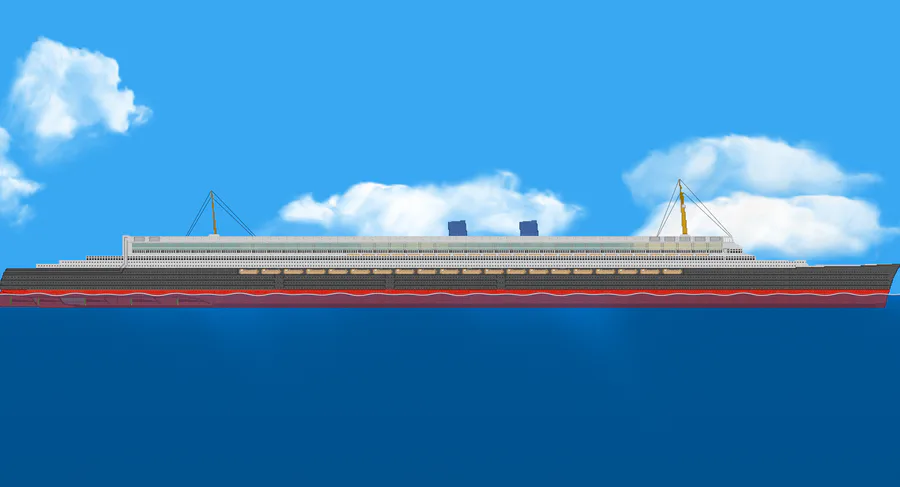
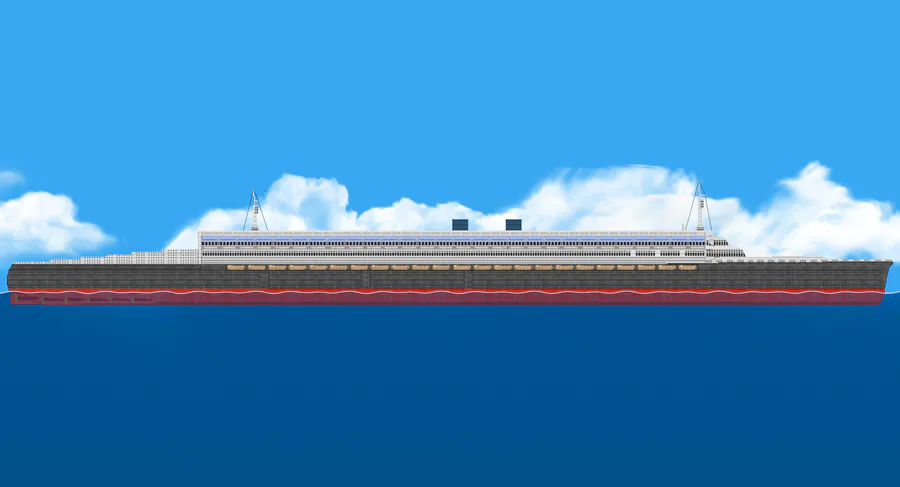
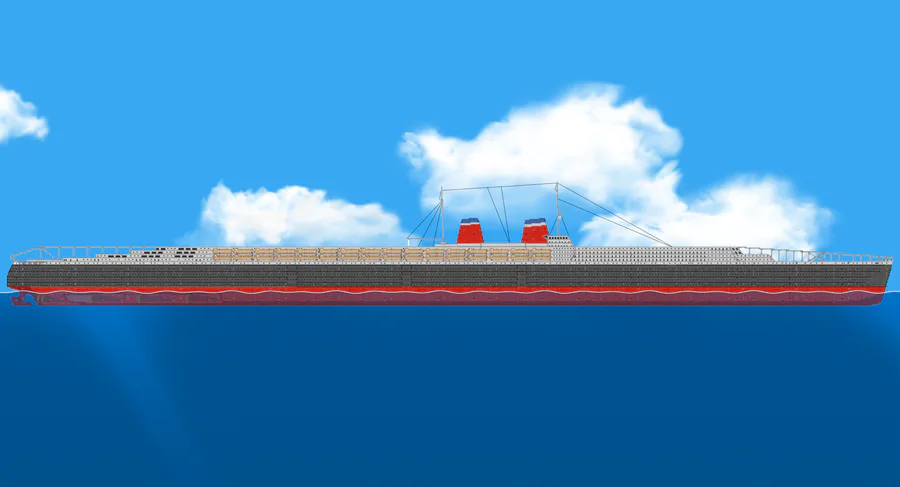
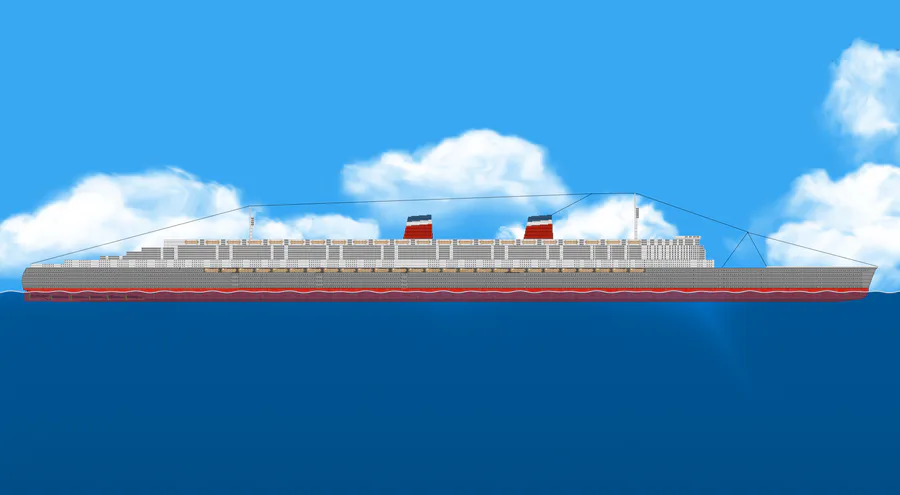
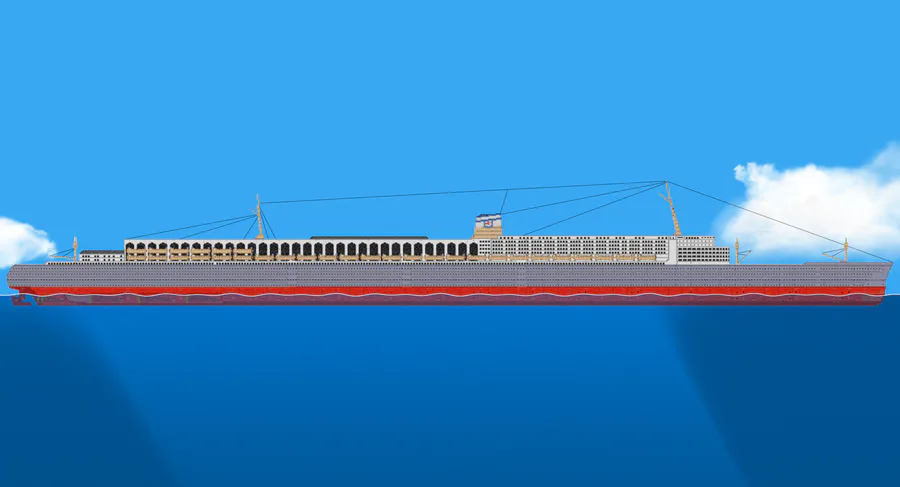
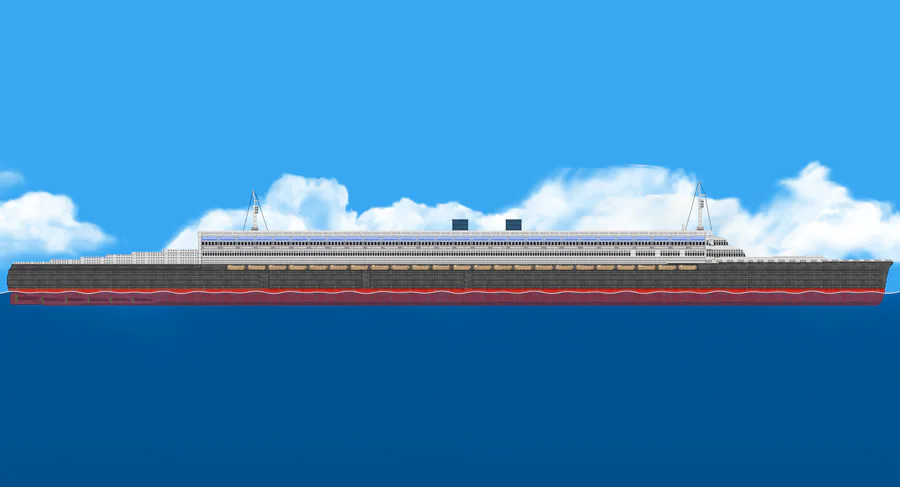
While Joseph Ricker’s original vision often included the iconic four-funnel silhouette, the S.S. Titan 2 evolves the design into a streamlined, high-speed profile featuring two massive, raked funnels. This change isn't just for style—it’s a requirement of her record-breaking speed and Net Zero tech.
The Two-Funnel Evolution
In maritime history, four funnels symbolized power. On the Titan 2, the two-funnel design represents efficiency and aerodynamics.
The Forward Funnel: This serves as the primary vent for the ship's secondary heat-exchange systems and the massive air-filtration units required for the internal "Districts."
The Aft Funnel: This houses the "Atmospheric Scrubbers" and the emergency backup exhaust for the Net Zero plant. Both funnels are raked at a sharp angle to mirror the piercing bow, reducing wind resistance as the ship sprints at 56 knots.
The Livery: The funnels are painted in the classic "Titanium Buff" (a nod to White Star Buff), tipped with a matte-black crown. This creates a visual bridge between the 1910s and the 2020s.
The "S.S. Titan" Foundation Insignia
Proudly displayed on the hull and the funnels is the crest of the S.S. Titan Foundation.
"The ship is a tribute to the past, but its mission is for the children of the future."
This visual tribute is reinforced by the ship's "Blue Riband" lighting. At night, the hull is bathed in a soft blue glow, symbolizing the ship’s quest to reclaim the record for the fastest Atlantic crossing, while the two funnels are illuminated by golden spotlights that can be seen for miles across the dark ocean.
Aerodynamic Integration
The superstructure of the Titan 2 is "stepped" back. By using only two funnels, the designers opened up the top decks for the "Sky Garden," a 200-meter long open-air park. This area would have been occupied by coal-smoke on an old liner; now, it is a lush green space where 50,000 passengers can walk through trees while moving at the speed of a highway vehicle.
The Pixel-Art Influence
In honor of the digital render that inspired the final design, certain architectural elements of the Titan 2—such as the balcony railings and the lighting arrays—utilize a "Digital Mosaic" aesthetic. This subtle detail ensures that the ship feels like a bridge between the physical world and the conceptual dreams of its creators. Part 18: The "Net Zero" Engine Room – A Technical Walkthrough
If the Titanic was a marvel of coal and steam, the S.S. Titan 2 is a cathedral of electrons and fusion. Occupying the lowest five decks, the Engine Room is a clean, white-paneled laboratory that hums with the power of 450,000 Shaft Horsepower (SHP). This is the IFEP (Integrated Full Electric Propulsion) core, where energy is treated as a fluid resource.
The Magnum-Class AEMSR Core
The primary power source is the decentralized Advanced Extremely Modular Salt Reactor (AEMSR) system.
The "Green Fusion" Catalyst: Unlike 20th-century reactors, these use a liquid fluoride salt medium. In the event of a power loss, the salt naturally drains into "freeze-plug" tanks and solidifies, making a meltdown physically impossible.
The Wattage: The plant generates over 330 Megawatts—enough to power a city of 300,000 people. This energy is split between the 7-screw propulsion system and the "Hotel Load" (the lighting, HVAC, and life support for 65,000 souls).
The 7-Screw Drive Train
Propelling 165,000 GT to 56 knots requires the most complex transmission ever built.
Permanent Magnet Motors: The Titan 2 does not use traditional shafts. Instead, the electrical power is sent to massive high-torque motors located directly inside the Azimuthing Pods.
The "Septem-Sync": To prevent the hull from vibrating at record speeds, the AI-driven "Phase-Sync" system ensures that all 7 screws are offset by mere milliseconds. This creates a "Harmonic Neutralization" effect, making the engine room as quiet as a library.
Water and Air: The Lifeline Systems
Deep within the engine room are the Hyper-Desalination Units.
Output: 5 million liters of fresh water daily, extracted from the Atlantic via reverse osmosis using the waste heat from the reactors.
The "Net Zero" Scrubber: Even though the ship produces no carbon, it features "Ocean Scrubbers" that pull CO2 from the surrounding air and water as it sails, technically making the Titan 2 a carbon-negative vessel.
Part 19: The 15,000 Crew – Life Behind the Scenes
While the 50,000 passengers enjoy the Grand Promenade, a silent army of 15,000 crew members operates within the "Titan’s Marrow"—the network of service corridors, automated galleys, and private quarters hidden behind the Edwardian paneling.
The "Crew City" (Decks 1-4)
The crew of the Titan 2 does not live in "cabins," but in a dedicated Crew District.
Accommodations: Every crew member has a private cabin with a "Digital Porthole."
The "Lower Deck" Social Club: To maintain morale during 6-month contracts, the crew has access to their own private gym, a 24-hour cafeteria serving international cuisines, and a "Virtual Reality Park" where they can simulate land-based environments like a forest or a mountain range.
The Logistics of the 15,000
Managing 15,000 staff requires a military-grade hierarchy divided into The Three Guilds:
The Engine Guild (2,500): Nuclear physicists, electrical engineers, and high-speed hull technicians.
The Service Guild (11,000): The "Face of Titan." This includes 4,000 culinary staff, 3,000 stewards, and 4,000 entertainment/retail specialists.
The Safety Guild (1,500): Professional firefighters, Level-1 Trauma medics, and security officers who monitor the "Districts" using AI-assisted crowd analytics.
The "St. Jude" Spirit
The crew isn't just working for a paycheck; they are part of the S.S. Titan Foundation’s mission. Every crew member receives training in the Foundation’s charitable goals. Many are former volunteers or specialists from St. Jude Children's Research Hospital. This sense of purpose creates a "service culture" that is unprecedented in the maritime world—a city where everyone, from the captain to the deckhand, is sailing for a cause.
Logistics Note: The ship utilizes "M-Path" (Maintenance Path), a hidden railway system within the hull that allows crew to move from the bow to the stern (680 meters) in under two minutes using electric carts, ensuring that "room service" is truly instant for 50,000 guests. Part 20: The Legacy of Joseph Ricker and the Blue Riband Voyage
The S.S. Titan 2 is more than a record-breaking ocean liner; it is a "Cathedral of the Atlantic" dedicated to the vision of Joseph Ricker (1967–2023). Ricker did not see the ship as a mere vessel for the wealthy, but as a high-speed engine of altruism. He believed that the same engineering required to conquer the ocean could be used to conquer childhood illness.
The Joseph Ricker Memorial Plaza
Located at the base of the forward funnel, the Ricker Plaza is a quiet, glass-enclosed sanctuary. Here, a bronze plaque bears his guiding philosophy:
"A ship this grand should not just carry people to their destinations, but carry humanity toward a better future." Every passenger who walks the 680-meter deck passes this memorial, a constant reminder that their voyage at 56 knots is funding life-saving research at St. Jude Children's Research Hospital.
The Maiden Voyage: Reclaiming the Blue Riband
On a crisp morning in mid-2026, the S.S. Titan 2 sat in New York Harbor, her two-funnel silhouette casting a shadow over the Hudson. With 50,000 passengers cheering from the tiered verandas and 15,000 crew at their stations, the 7-screw propulsion system hummed to life.
0 comments