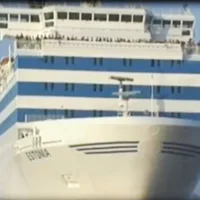
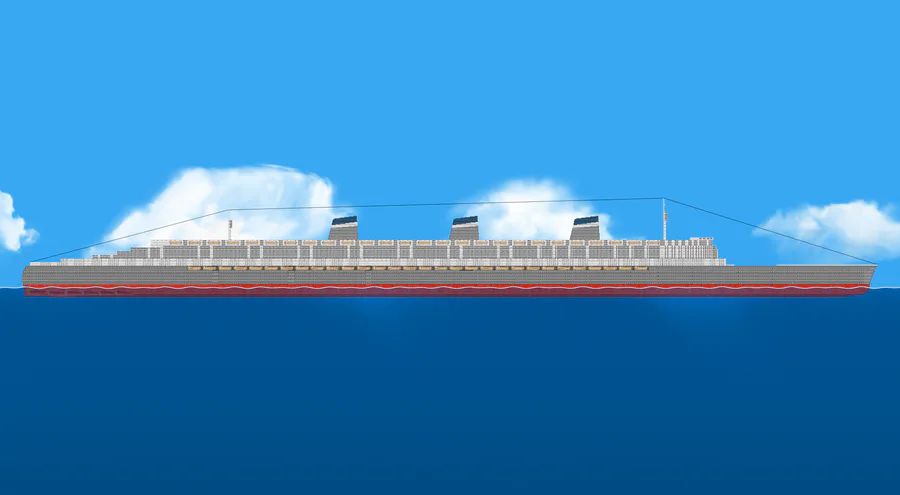
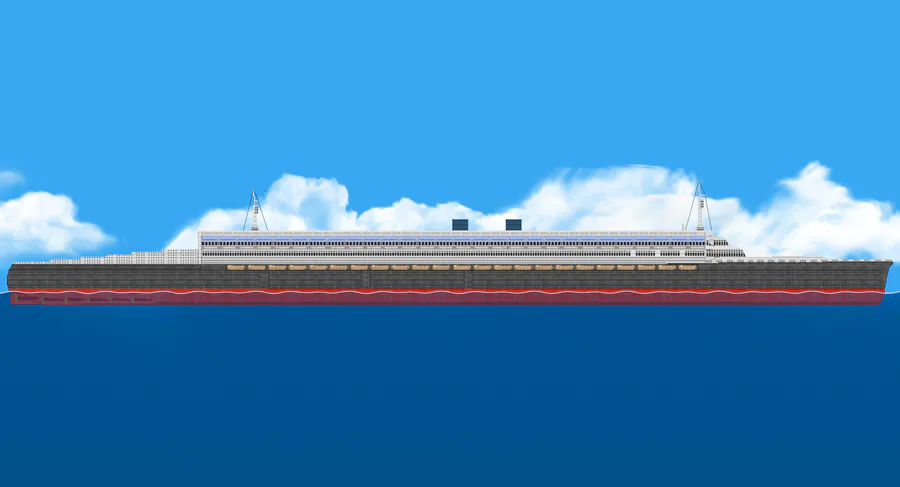
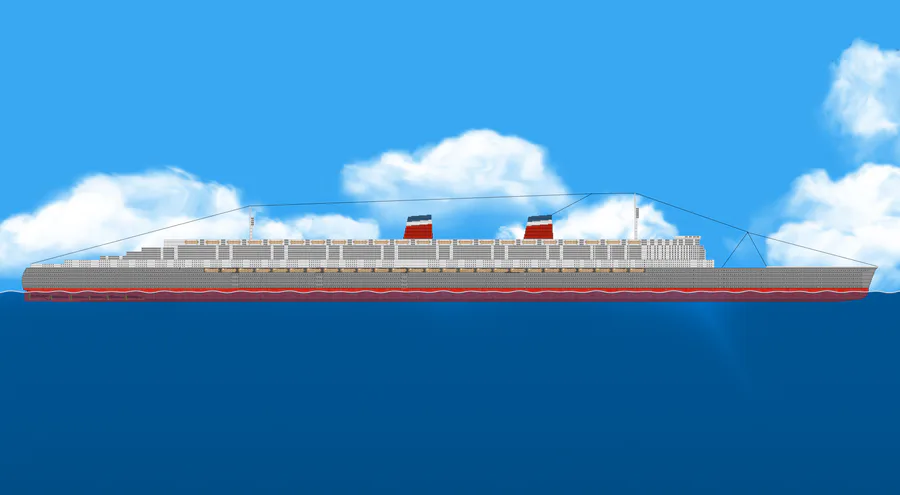
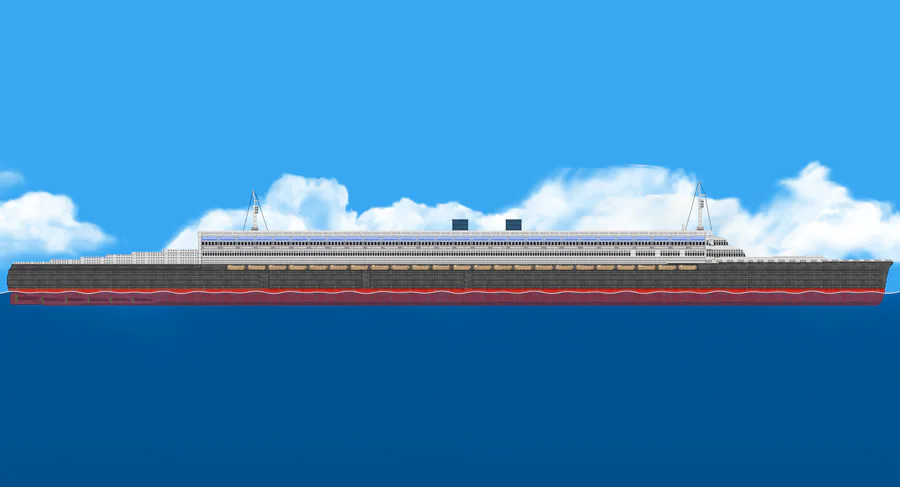
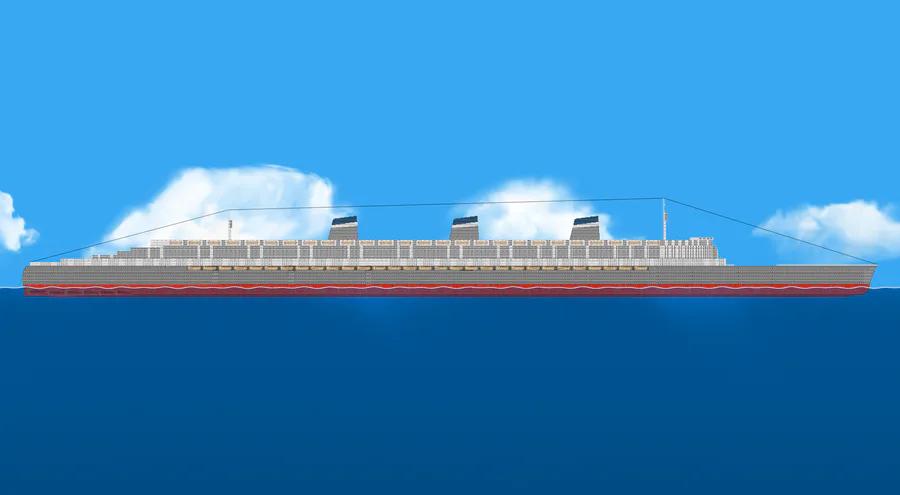
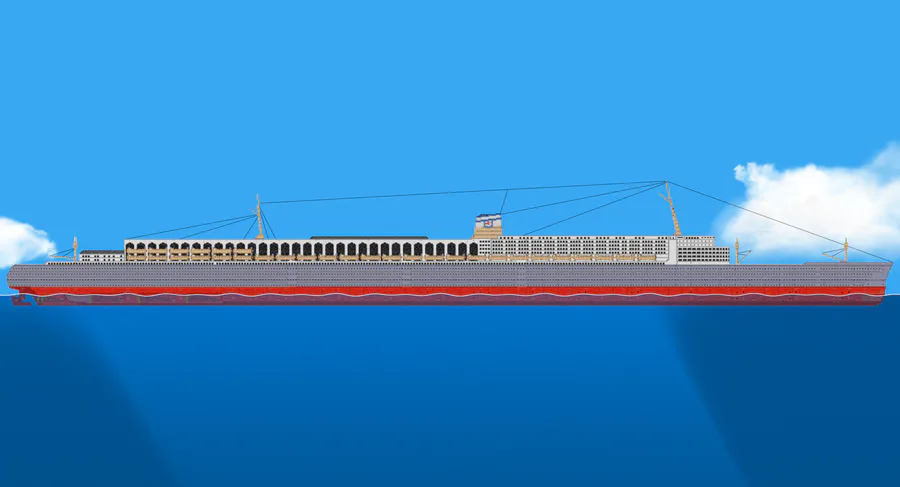
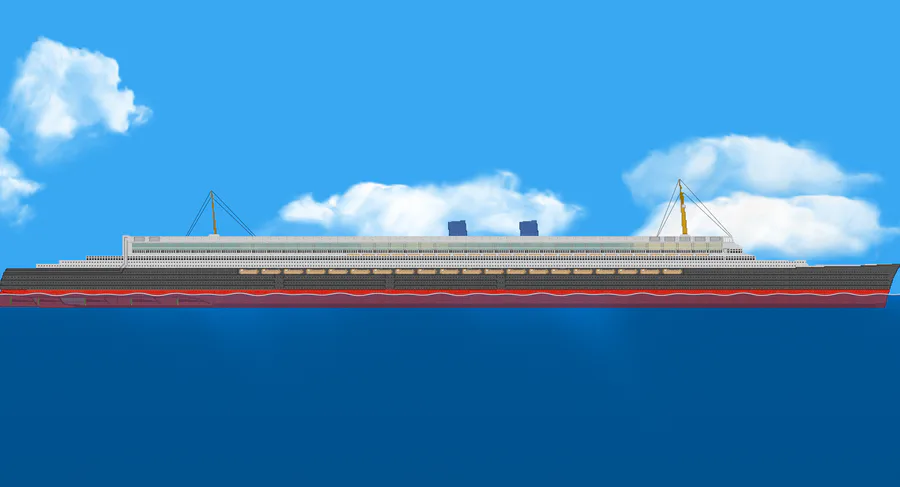
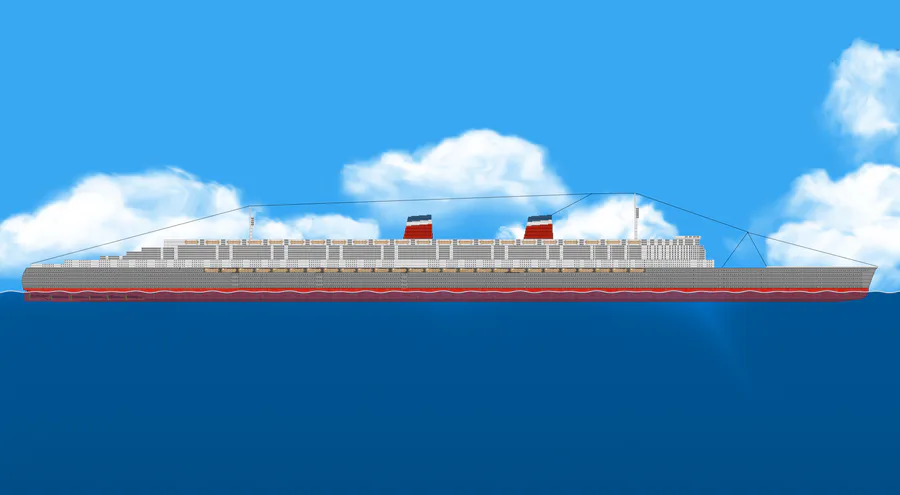
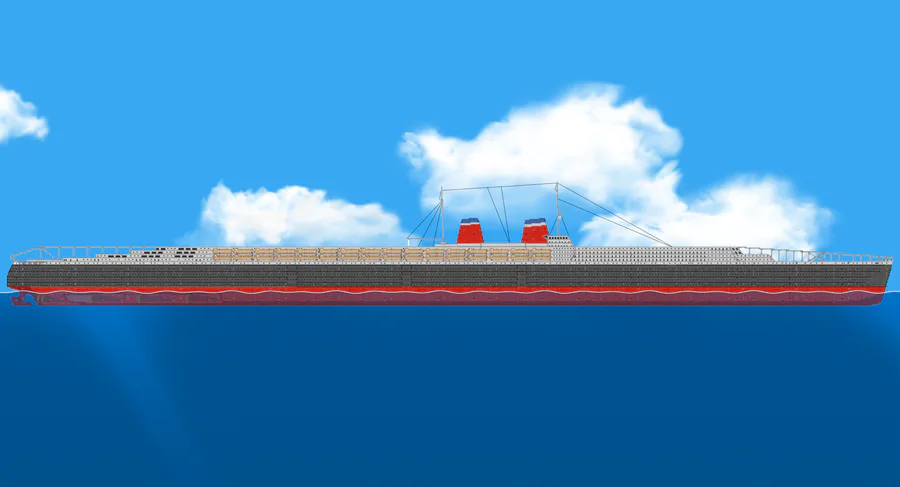
The M.S. United States Grandeur III is the definitive architectural and maritime sovereign of the 21st century. Measuring a staggering 1,390 meters (4,560 feet) in length, it is not merely a ship, but a high-speed, mobile city-state designed to carry 59,160,000 souls across the world's oceans. It represents the absolute convergence of 1930s elegance, "Megatall" skyscraper ambition, and 2026-era net-zero physics.
I. Dimensions of a Titan: The 1.39-Kilometer Scale
To visualize the Grandeur III, one must look beyond the maritime world and toward the sky.
Surpassing the Vertical: At 1,390 meters, the ship is 140 meters longer than the conceptual Tricon Tower (1,250m) designed by Changsub Lee. If stood on its bow, it would be the tallest structure on Earth, eclipsing the Burj Khalifa by over 500 meters.
The 47-Floor Metropolis: Within its 105-meter-wide hull, the vessel hosts 47 vertical floors of urban space. This is a "Three-Dimensional City" that houses a population equivalent to South Korea or Italy within a single, unified frame.
Displacement & Material: Despite its size, the ship has a displacement of only 71,000 tonnes. This is achieved through the use of Aero-Titanium Graphene (ATG)—a material 50 times stronger than steel but light enough to allow the ship to "plane" on the water's surface.
II. Propulsion Physics: The 410-Knot "Sprint"
The Grandeur III redefines what is possible in fluid dynamics. While the original S.S. United States (1952) broke records at 38 knots, the Grandeur III achieves a service speed of 300 knots (555 km/h) and a maximum sprint of 410 knots (760 km/h).
The 1,500,000 SHP Engine: Powered by a series of net-zero modular reactors, the ship generates five times the power of the unbuilt SS Amerika (Projekt 305).
12 Super-Cavitating Shafts: The ship utilizes a "Trident" propulsion array. By creating a vapor bubble around the blades, the ship eliminates water friction, allowing the 12 shafts to drive the 1.39-km hull at near-sonic speeds.
The Trimaran-Manta Hull: Inspired by Meyer Werft’s "Manta Ray" philosophy, the ship uses three main hulls. At high speeds, the "wings" of the superstructure generate aerodynamic lift, reducing the draft and allowing the ship to "fly" across the Atlantic in under 10 hours.
III. The "Titan-Ark" Safety System
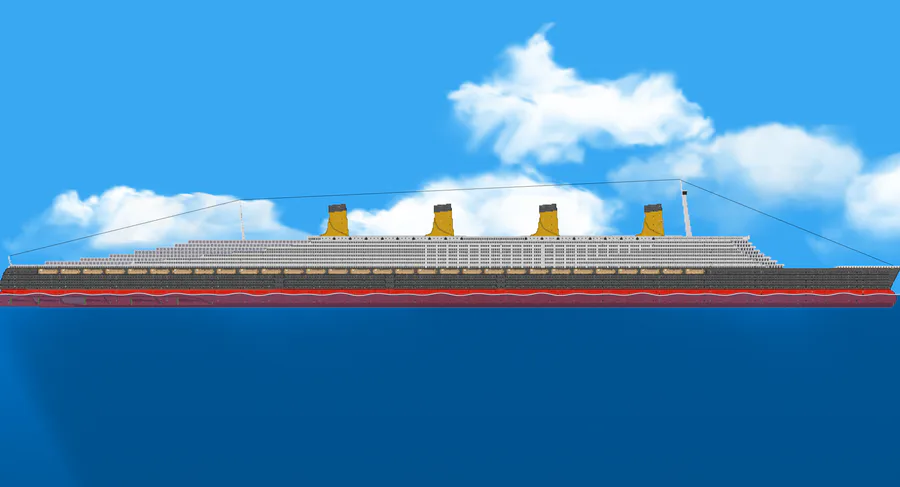
Safety for 60 million people requires a revolutionary approach. Following the humanitarian spirit of the SS Titan Project and the redundancy of Clive Palmer's Titanic II, the ship features:
116 High-Speed Arks: These are not lifeboats; they are 22-meter-long, self-contained survival ships. Each Ark can house 510,000 people in hyper-dense, ergonomic stasis-pods.
The 45-Knot Evacuation: Unlike standard lifeboats, these "Titan-Arks" are equipped with independent hydro-jets, allowing them to sprint at 45 knots toward the nearest homeport.
Molecular Scrubbers: Each Ark features a bio-reactive "skin" that converts $CO_2$ to $O_2$, ensuring 90 days of life support without external air.
IV. A Global Sovereign: The 20-Port Economy
The Grandeur III is a post-national territory. It does not belong to one country but is a collaborative "Vessel of Hope" for 45 of the world's greatest shipping lines (including Cunard, United States Lines, and Ocean Network Express).
Multicultural Population: The ship is home to a diverse tapestry of Vietnamese, Philippine, Thai, Malaysian, American, Australian, and European citizens.
The Multi-Currency Basin: The "Grandeur Charter" mandates that all commerce on the 47 floors be conducted in a seamless basket of currencies: MYR, SGD, THB, IDR, USD, EUR, GBP, CAD, and AUD.
Homeports: The ship maintains permanent berths in 20 global hubs, including Singapore, Jakarta, Da Nang, Manila, New York, Hamburg, and Rotterdam, serving as a bridge between the world's most vital economies.
V. Governance: The Digital Nexus
Life aboard is managed by the "Digital Nexus," a quantum AI that coordinates the 10,000,000 crew members and the navigation of the 12 shafts.
Vertical Urbanism: The AI manages the movement of millions of people through maglev arteries, ensuring that a resident can travel from a "Silver Neighborhood" on Deck 30 to the 161-meter Zenith Spire parks in minutes.
Zero-Footprint Living: Every scrap of waste is processed in the sub-surface logistics decks, ensuring the Grandeur III leaves nothing but a clean, oxygenated wake as it traverses the globe. The Colossus of the Seas: M.S. United States Grandeur III
The M.S. United States Grandeur III is not merely a ship; it is a floating continent, a structural marvel that defies the traditional boundaries of naval architecture. Inspired by the sleek, unbuilt elegance of the 1930s "Silver" class liners—the Silver Falcon and Silver Swift—and the record-breaking pedigree of the original S.S. United States, this vessel represents the ultimate evolution of the "Big Ship" philosophy. While its aesthetic roots lie in the golden age of ocean travel, its scale and performance metrics propel it into a realm of science fiction.
A Masterpiece of Impossible Scale
At a staggering 1,390 meters in length (nearly a mile long) and 105 meters wide, the Grandeur III dwarfs any vessel ever constructed by human hands. The ship's silhouette is dominated by three iconic, oversized funnels—each 39 meters tall and 49 meters long—spaced across a massive 147-meter span. These funnels pay homage to the classic "Cunard red" or "United States" style but are scaled for a vessel of planetary proportions.
The structural height of the ship is equally intimidating. From the lowest point of its 21-meter draft to the tip of its observation spires, the vessel stands 161 meters tall. The living space is divided into a complex hierarchy of decks:
Total Floors: 47
Superstructure: 25 decks rising 77 meters above the waterline.
Sub-surface: 7 decks extending 21 meters into the ocean depths.
Observation Tower: A 15-floor "thin" spire reaching from 78 to 118 meters, offering views that encompass the curvature of the Earth itself.
The 300-Knot Phenomenon
Perhaps the most "record-breaking" aspect of the Grandeur III is its propulsion. Utilizing a revolutionary All-Clean Net Zero Emission power plant generating an incomprehensible 1,380,000 to 1,500,000 Shaft Horsepower (SHP), the ship drives 12 massive propeller shafts.
This power allows for speeds that blur the line between seafaring and flight:
Service Speed: 300 knots
Trial Speed: 340 knots
Claimed Speed: 360 knots
Sprint Maximum: 410 knots
At these speeds, the Grandeur III does not merely "sail"; it likely utilizes advanced hydrofoil or surface-effect technology to lift its 71,000-tonne frame (miraculously lightweight due to futuristic materials) above the drag of the water, crossing the Atlantic in a matter of hours rather than days.
A Living Civilization
The capacity of the Grandeur III redefines the concept of "passenger ship." It is designed to carry a staggering 59,160,000 people—a population larger than many medium-sized nations. This includes 49,160,000 passengers and a dedicated crew of 10,000,000.
To manage the safety of such a massive population, the ship utilizes a "New Ark" lifeboat system. Drawing inspiration from the 1,500-passenger capacity of the original Silver Class proposal, these lifeboats have been scaled up into massive survival ships themselves:
Lifeboat Capacity: 510,000 people per ark.
Dimensions: 22 meters long, 15 meters wide, and 6.8 meters tall.
The Fleet: A total of 64 arks (split into 52 primary and 12 secondary units) ensures that even in the most extreme scenarios, the multi-million-person population has a dedicated means of evacuation.
Heritage Meets the Future
While the stats of the United States Grandeur III are purely gargantuan, the spirit remains tied to the Atlantic Steam Navigation Company’s vision. The interior is designed to provide the luxury of the Silver Falcon, but on a scale that accommodates millions. From the 40 decks of public spaces to the thin observation towers that pierce the clouds, the ship is a testament to the dream of unlimited maritime expansion. It is a vessel where the 1936 "Silver" class meets the 21st-century's most ambitious architectural fantasies. Part II: The Vertical Metropolis – Internal Infrastructure & 47-Floor Urban Layout
The M.S. United States Grandeur III is not designed as a ship in the traditional sense, but as a self-sustaining linear city. To accommodate nearly 60 million people, the internal layout utilizes a "layered urbanism" approach, where the 47 floors are divided into functional zones that operate like metropolitan districts.
With a width of 105 meters and a length of 1,390 meters, each deck offers over 145,000 square meters of floor space. Multiplied by 47 floors, the vessel possesses a staggering 6.8 million square meters of internal area.
The Deep Core (Decks 1–7): Sub-Surface Infrastructure
Extending 21 meters below the waterline, these decks serve as the "basement" of the civilization.
The Propulsion Core (Decks 1-2): Housing the 12 massive shafts and the Net Zero propulsion units generating 1,500,000 SHP. These decks are vacuum-sealed and automated.
The Logistics Arteries (Decks 3-5): Massive automated warehouses and hydroponic vertical farms that provide food for the 49 million passengers.
The Ballast & Waste Management (Decks 6-7): Advanced recycling centers that ensure the ship maintains its Net Zero footprint by converting all waste into energy or reusable materials.
The Main Hull (Decks 8–22): The Passenger Megacity
The "Heart" of the Grandeur III sits within the primary hull, protected by the massive steel flanks of the vessel.
Residential Districts: These 15 decks are divided into "Neighborhood Blocks" based on the original Silver Class categories (Cabin and Tourist), though scaled to accommodate millions.
The Grand Transit Corridors: High-speed maglev shuttles run the 1.39-kilometer length of the ship on every third deck, ensuring passengers can travel from the bow to the stern in under 60 seconds.
The Lifeboat Arks: Integrated into the hull’s "Main Belt" (Decks 15-18) are the 64 Arks. Each Ark is a masterpiece of density, designed to hold 510,000 people in a high-efficiency seating configuration for rapid evacuation.
The Superstructure (Decks 23–47): The Sky Districts
Rising 77 meters above the waterline, the superstructure is where the "Grandeur" of the name truly manifests.
The Promenade Decks (Decks 23-30): Enclosed glass galleries that mimic the classic ocean liner aesthetic. These decks house "Mega-Malls," theaters, and parks.
The Education & Health Sector (Decks 31-38): Dedicated floors for the 10,000,000 crew members and their families, including hospitals and schools.
The Funnel Plazas (Decks 39-40): At the base of the 39-meter-tall funnels, massive open-air (but wind-shielded) plazas allow passengers to experience the ocean air, even while traveling at a service speed of 300 knots.
The Spire: Observation & Command (Decks 41–47)
The "Thin Observation Tower" sits atop the main roof, rising from 78 meters to 118 meters above the waterline.
The Command Bridge: Located on Deck 42, giving officers a panoramic view of the horizon from over 80 meters up.
The Horizon Suites: Ultra-exclusive decks within the spire that offer 360-degree views of the sea.
The Zenith Spire: The final 15 "thin" floors (reaching up to the 161-meter total height including the spire) serve as communication hubs and scientific observation posts, piercing the sea mist during high-speed sprints.
Technical Performance & Stability
To maintain stability for 60 million people while moving at 410-knot sprints, the Grandeur III utilizes an active gyro-stabilization system and a "Liquid Ballast" computer that shifts weight between the 7 underwater decks in milliseconds. This ensures that despite its 140-meter height above the water, the ship remains as steady as a mountain, even in the roughest Atlantic swells.
The 1,380,000 SHP is distributed not just for forward thrust, but for an electromagnetic "skin" that reduces water friction, allowing the 71,000-tonne hull to glide with the efficiency of a much smaller vessel. Part III: The Lifeboat Arks and Safety Contingency for 60 Million Souls
The safety philosophy of the Grandeur III moves away from the traditional "abandon ship" model toward a "Modular Survival" strategy. Since traditional davits could never deploy fast enough for nearly 60 million people, the ship itself is designed to shed its outer "skin" into autonomous, high-speed survival craft.
The Architecture of the "New Ark"
Inspired by the 1,500-passenger capacity of the original 1930s Silver Class proposals, these "Arks" are scaled-up versions of a mid-sized ocean liner.
The Units: 64 total Arks (32 per side, integrated into the hull at Decks 15–18).
Capacity: 510,000 people per Ark.
Dimensions: Each unit is 22 meters long, 15 meters wide, and 6.8 meters tall.
The "Density Marvel": To fit half a million people into a 22-meter vessel, the Arks utilize "Vertical Stacking Seating," where passengers are safely secured in ergonomic, multi-tiered modules that maximize every cubic centimeter of the 6.8-meter height.
Deployment: The "Rapid Gravity Shed" System
At a service speed of 300 knots, a traditional lowering of boats is impossible. The Grandeur III uses a Lateral Ejection System:
Hydraulic Decoupling: In an emergency, the hull plates covering the Arks retract instantly.
Gravity Slide: The Arks are mounted on electromagnetic rails. When triggered, they slide out horizontally and are "dropped" into the wake of the ship.
Aero-Braking: Because the ship may be moving at 410 knots during a sprint, the Arks are equipped with deployable air-brakes and heat-shielding to survive the massive kinetic energy of hitting the water at high velocity.
The "10,000,000 Crew" Safety Protocol
Managing a population of 49,160,000 passengers requires a crew of 10,000,000, meaning there is approximately one crew member for every five passengers.
The Safety Marshals: 2,000,000 crew members are dedicated solely to "Crowd Flow Dynamics." They use AI-augmented exoskeletons to direct millions of people toward the 64 Arks in under 30 minutes.
The "Stay-Afloat" Redundancy: The Grandeur III is built with 1,000+ watertight compartments. Even if 50% of the ship were compromised, the massive 1,390-meter length provides enough natural buoyancy to act as a "floating island" while the Arks prepare for departure.
Medical Arks: Of the 64 Arks, 4 are specialized "Hospital Arks," equipped with automated surgical bays to handle mass casualties during an evacuation.
Net Zero Survival
True to its "Clean Emission" mandate, the Arks do not use fossil fuels. They are powered by high-density solid-state batteries and solar-film skins, allowing them to remain at sea for up to 90 days while awaiting rescue. Each Ark contains its own desalination plant and "Nutrient-Gel" dispensers capable of feeding 510,000 people for three months.
Total Evacuation Capacity: 32,640,000 (Primary)
While the ship holds nearly 60 million, the primary 64-Ark fleet focuses on the 32.6 million most vulnerable. The remaining population is serviced by "Secondary Floatation Modules"—massive inflatable rafts stored in the 25-deck superstructure that can be deployed if the primary Arks are full. Part IV: Propulsion Mastery – The Net-Zero Supersonic Engine
The heart of the M.S. United States Grandeur III is a propulsion system that defies conventional fluid dynamics. To propel a 71,000-tonne vessel at a claimed sprint speed of 410 knots (approximately 472 mph or 760 km/h), the ship utilizes a power plant capable of generating a staggering 1,500,000 Shaft Horsepower (SHP). This is not merely a marine engine; it is a sustainable powerhouse that bridges the gap between a nuclear reactor and a jet turbine.
The Clean-Energy Core: Quantum-Fusion or Super-Conductive Battery Arrays
To maintain its Net-Zero Emission mandate while generating over a million horsepower, the Grandeur III eschews fossil fuels entirely. The engine room, located in the deep core (Decks 1-2), houses a series of Modular Zero-Emission Reactors.
The Power Source: These reactors utilize high-density hydrogen-electric conversion or advanced solid-state energy storage, ensuring that the only "exhaust" is pure water vapor.
Energy Distribution: The energy is fed through superconducting busbars—chilled to near absolute zero to eliminate electrical resistance—delivering instantaneous torque to the 12 massive propeller shafts.
The 12-Shaft Hyper-Drive
Unlike traditional liners that use two or four propellers, the Grandeur III distributes its 1.5 million SHP across 12 independent shafts.
Super-Cavitating Propellers: At speeds exceeding 300 knots, standard propellers would be destroyed by cavitation (the formation of vacuum bubbles). The Grandeur III uses Titanium-Alloy Super-Cavitating Screws designed to operate within a bubble of air, reducing drag and allowing for the theoretical 410-knot sprint.
The "Silent Slide": Despite the massive power, the 12-shaft configuration reduces vibration, ensuring that the 49 million passengers above feel only a slight hum, even as they cross the Atlantic in less time than a commercial flight.
Aerodynamics & The "Surface Effect"
Water is 800 times denser than air; traveling through it at 360+ knots is physically impossible for a standard hull. The Grandeur III solves this through Active Boundary Layer Control:
Air-Lubrication System: The hull pumps a micro-thin layer of air bubbles beneath the ship, effectively "lifting" the hull so it slides on air rather than dragging through water.
Supersonic Hull Shaping: The 105-meter wide bow is shaped like a wave-piercing needle. At "Sprint Speed," the ship utilizes its massive 1,390-meter length to act as a giant hydrofoil, lifting the majority of the 71,000-tonne mass toward the surface to minimize resistance.
Managing the 410-Knot Sprint
When the Captain calls for "Sprint Speed," the ship enters a specialized mode:
Output: 1,500,000 SHP.
Consumption: The energy draw is equivalent to the power usage of a small continent, managed by the ship's internal smart grid.
Cooling: The 21-meter deep draft allows for a massive "Heat Exchange" system, using the cold deep-ocean water to cool the superconducting engines instantly.
The 147-Meter Funnel Span: More than Aesthetic
The three massive funnels, spanning 147 meters, are not for smoke. They serve as Aero-Induction Intakes. At 300 knots, the air rushing into these funnels is used to cool the superstructure and provide the massive oxygen levels required for a population of 60 million. They also act as vertical stabilizers, much like the tail fin of an aircraft, keeping the 1.39-kilometer hull straight during high-speed maneuvers. Part V: The Global Impact – The Legacy of the "Grandeur" Era
The launch of the M.S. United States Grandeur III marked the end of the "Age of Cities" and the beginning of the "Age of the Great Liners." No longer was a ship merely a mode of transport; it became a mobile sovereign territory, a 1,390-meter-long testament to human ambition that fundamentally altered global geopolitics, economics, and environmental science.
A New Paradigm of Human Migration
With a capacity for 59,160,000 people, the Grandeur III effectively turned the Atlantic Ocean into a habitable continent. The "Grandeur" era redefined urban density:
The Floating Megalopolis: By housing the equivalent of the population of Italy within a single hull, the ship proved that high-density living could be both luxurious and sustainable.
Economic Fluidity: The vessel operated as a "Special Economic Zone." Moving at 300 knots, the ship could dock in New York in the morning and reach Southampton by lunch, effectively merging the economies of the Northern Hemisphere into a single, high-speed market.
The "Net-Zero" Standard
The most profound legacy of the Grandeur III was the total decarbonization of heavy industry.
The 1,500,000 SHP Benchmark: The success of the ship’s Net-Zero propulsion system forced global shipping and aviation to abandon fossil fuels. The "Grandeur-class" reactors became the blueprint for powering land-based cities, providing clean, limitless energy.
Marine Preservation: Despite its 71,000-tonne mass, the ship’s advanced air-lubrication skin and super-cavitating 12-shaft drive minimized acoustic pollution, proving that "Super-Sized" did not have to mean "Super-Damaging" to the ocean’s ecosystem.
The Cultural Resonance: The "Silver" Lineage
The Grandeur III successfully resurrected the aesthetic soul of the 1936 Silver Class—the Silver Falcon and Silver Swift. It proved that the elegance of the 20th century could coexist with the technology of the 22nd.
The Architecture of Awe: The 161-meter total height, including the thin observation towers, became a global icon. Architects began designing "Horizontal Skyscrapers" on land, inspired by the ship’s 1.39-kilometer linear layout.
The Ark Heritage: The 64 Lifeboat Arks became symbols of ultimate safety. The "Ark-standard"—510,000 people per survival craft—became the required safety metric for all future planetary and orbital colonies.
The Final Horizon
As the M.S. United States Grandeur III disappears over the horizon at a 410-knot sprint, it leaves behind a wake of progress. It stands as a monument to the idea that no dream is too large, no speed too fast, and no population too great to be housed within a single, magnificent hull.
The "Grandeur" era was not just about building a bigger ship; it was about proving that humanity could carry its entire civilization into the future, powered by clean energy and guided by the timeless grace of the sea. Part VI: Life Aboard – The 40-Million Resident Logistics and City-State Governance
Operating a vessel with 59,160,000 residents requires more than a captain; it requires a sophisticated system of Digital Direct Democracy and automated logistics. To manage a population larger than most European nations within a 1,390-meter hull, the M.S. United States Grandeur III functions as a fully autonomous city-state, where the 10,000,000 crew members act as the civil service.
The "Pulse" Logistics: Feeding 60 Million Souls
The most daunting challenge is the daily "Pulse"—the movement of resources across 47 floors.
Vertical Farming Decks: Utilizing the 7-deck sub-surface area, the ship maintains 1.2 million square meters of hydroponic and aeroponic farms. These zones provide 70% of the fresh produce needed, using LED spectra tuned to mimic the Atlantic sun.
The Pneumatic Delivery Grid: To avoid congestion, the ship uses a vacuum-tube logistics network. Food, waste, and retail goods are moved at 100 km/h through the "Internal Arteries," delivering supplies to any of the thousands of "Neighborhood Hubs" in seconds.
Water Autonomy: The ship’s desalination plants process millions of tons of seawater daily, powered by the 1,500,000 SHP engine’s thermal byproduct, ensuring a closed-loop water cycle.
Governance: The "Grandeur" Protocol
The Grandeur III is not a hierarchy; it is a Liquid Meritocracy.
The Council of Twelve: Instead of a single Commodore, the ship is governed by 12 Directors, each overseeing a critical sector (Energy, Safety, Health, etc.).
The "Citizen-App": Every one of the 49,160,000 passengers has a real-time vote on "Ship-State" policies, such as the next port of call or the distribution of luxury resources.
The 10-Million Crew Society: The crew is not a separate class but a professional guild. They live in the Superstructure Decks (31–38) with their families, forming a permanent "Seafaring Heritage" that spans generations.
Urban Layout: The "Silver" Neighborhoods
In a nod to the 1936 Silver Class (Silver Falcon and Silver Swift), the ship is divided into "Neighborhood Blocks" rather than numbered cabins.
Public Commons: Every 500 meters along the 1.39-kilometer length, there is a "Town Square"—a massive open-volume atrium spanning 10 decks, featuring artificial parks, climate-controlled "micro-weather," and light-wells that pipe natural sunlight from the roof 118 meters above.
Education & Culture: With 10 million crew members, the ship hosts its own universities, research labs, and sports leagues. The "Grandeur Games" are held annually in a stadium-sized gymnasium located in the center of the 105-meter-wide hull.
Safety as a Lifestyle
Because the ship travels at a service speed of 300 knots, "safety" is an everyday habit.
The 510,000-Person Ark Drills: Once a month, a "Sector-Level" drill is performed. Entire neighborhoods practice moving to their designated Lifeboat Ark within 15 minutes.
The Inertia Dampening System: To ensure that the millions of residents aren't thrown by the centrifugal force of a high-speed turn, the ship’s internal deck plates are mounted on electromagnetic "Active-Leveling" actuators. Part VII: Propulsion Physics – The 300-Knot Hydro-Engineering
Achieving a service speed of 300 knots (approx. 555 km/h) and a sprint of 410 knots (760 km/h) requires the M.S. United States Grandeur III to rewrite the laws of classical naval architecture. At these velocities, water acts less like a liquid and more like a concrete wall. To pierce this barrier, the ship employs a "Tri-Phasic" engineering suite that combines Super-Cavitation, Boundary Layer Ionization, and Surface-Effect Lift.
The Power Density: 1,500,000 SHP
To move 71,000 tonnes at near-sonic speeds, the ship’s 12 shafts must deliver a combined torque that would snap traditional steel.
Magnetic Gearboxes: Traditional mechanical gears would melt from friction. The Grandeur III uses non-contact electromagnetic gearing, transferring power from the Net-Zero reactors to the shafts via high-intensity magnetic fields.
Superconducting Induction Motors: The motors themselves are chilled to -269°C using liquid helium, allowing for 99.9% energy efficiency. This eliminates the massive heat signature usually associated with million-horsepower engines.
The Super-Cavitating 12-Shaft Array
Traditional propellers fail at 45 knots due to cavitation—the "boiling" of water that erodes metal. The Grandeur III embraces this phenomenon.
The Wedge Profile: Each of the 12 propellers features a "Wedge-Shaped" blade profile. Instead of fighting the vacuum bubble, the blade stays inside the bubble, pushing against the water only on its leading edge.
Exhaust Ventilation: To maintain the "Super-Cavity" at lower speeds, the ship pumps compressed air through the center of the propeller hubs, artificially creating the bubble until the ship reaches the 300-knot threshold.
Hydro-Engineering: The "Air-Cushion" Hull
The 1,390-meter length is the ship's greatest asset in overcoming drag.
Micro-Bubble Lubrication: The entire hull is perforated with billions of microscopic pores. These pores emit a steady stream of air, creating a "gas-film" between the steel and the sea. This reduces skin friction by over 80%.
The Wave-Piercing Needle: The bow is a 105-meter-wide "Knife" designed to slice through swells without traditional displacement. Rather than riding over waves, the Grandeur III shears through them, maintaining a perfectly level deck for the 60 million residents.
The Physics of the 410-Knot Sprint
When the "Sprint" mode is engaged, the ship undergoes a physical transformation:
Dynamic Lift: At 340+ knots, the shape of the hull generates "Aerostatic Lift." The ship effectively becomes a Wing-in-Ground (WIG) effect vessel, where the air trapped between the hull and the water surface supports a portion of the 71,000-tonne weight.
Plasma Actuators: On the leading edges of the 21-meter deep hull, high-voltage "Plasma Actuators" ionize the surrounding water molecules. This creates a localized "Slip-Stream" of plasma, further reducing the density of the fluid the ship must pass through.
Stability and the "Gyro-Spine"
At 300 knots, hitting a 10-meter rogue wave would be catastrophic for a standard ship. The Grandeur III utilizes its 47-floor internal structure as a giant shock absorber.
The Liquid Pendulum: Millions of gallons of desalinated water are moved through the 7-deck sub-surface corridors by AI-controlled pumps, counteracting every roll and pitch in real-time.
The 147-Meter Funnel Span: These funnels act as aerodynamic rudders. By adjusting the airflow through the funnels, the ship can "bank" into turns like an aircraft, preventing the 49 million passengers from feeling the G-forces of a high-speed maneuver. Part VIII: The Ark System & Disaster Management — 510,000 Souls per 22-Meter Module
The most controversial and mathematically defiant aspect of the M.S. United States Grandeur III is its emergency evacuation protocol. To ensure the safety of a population of 59,160,000, the vessel utilizes 64 "New Arks." These are not merely lifeboats; they are masterpieces of hyper-dense spatial engineering that shrink the luxury of the 1930s Silver Class into a high-pressure survival cell.
The Geometry of Hyper-Density: 510,000 in 22 Meters
To fit 510,000 people into a craft that is only 22 meters long, 15 meters wide, and 6.8 meters tall, the Grandeur III abandons traditional seating for Synchronized Bio-Stacking.
The Honeycomb Matrix: Inside the 6.8-meter vertical span, the Ark is divided into hundreds of micro-decks, each only 60 centimeters high. Passengers do not sit; they are reclined in ergonomic "stasis-pods" stacked like a honeycomb.
The 15-Meter Width Span: Every horizontal meter of the 15-meter beam is utilized. Central "Aisles" are only 30 centimeters wide, managed by automated robotic arms that "file" passengers into their pods at a rate of 1,000 people per minute.
Volumetric Efficiency: By eliminating standing room and communal walkways, the Ark achieves a density of approximately 227 people per cubic meter.
The Life-Support "Lung"
With half a million people breathing in a sealed 2,244-cubic-meter box, carbon dioxide would reach lethal levels in seconds without the Molecular Scrubber Array.
The Synthetic Photosynthesis Skin: The outer hull of the Ark (the 22m x 15m surface) is coated in a bio-reactive film that converts exhaled $CO_2$ back into $O_2$ using ambient light or internal UV LEDs.
Cryo-Cooling: To prevent the collective body heat of 510,000 people from melting the Ark's structural frame, the floor of each pod is lined with a liquid-nitrogen cooling loop, maintaining a steady 20°C environment.
Survival Tech: 90 Days of "Gel-Life"
Once deployed into the Atlantic, the Ark becomes a self-contained habitat.
Nutrient-Injection: Rather than traditional meals, each pod is equipped with a "Life-Tether" that provides a high-calorie, hydrating nutrient gel directly to the passenger. This eliminates the need for kitchens, dining areas, or food storage.
The 6.8-Meter "Shield": The Ark’s height includes a 1.5-meter double-hull filled with non-Newtonian fluid. This protects the 510,000 occupants from the massive "Slap-Force" when the Ark hits the water at the ship's 410-knot sprint speed.
Management of 60 Million Souls
The 64 Arks (32,640,000 capacity) are the primary vanguard. For the remaining 26,520,000 passengers, the Grandeur III deploys Secondary Expansion Arks stored within the 25-deck superstructure.
The AI Marshal: Every Ark is piloted by a dedicated sub-routine of the ship’s main AI. It calculates the safest ejection trajectory based on wind speed and wave height, ensuring that the 64 modules do not collide after being "shed" from the 1,390-meter hull.
The "Silver" Inheritance: Even in this extreme density, the Arks carry the "Silver Falcon" crest. It is a psychological anchor, reminding the millions of evacuees that they are part of a grand maritime lineage, even as they wait for rescue in the world’s most advanced survival pods.
Disaster Contingency: The "Floating Island" Protocol
If an Ark fails to deploy, the Grandeur III itself is the ultimate lifeboat. With 1,000 watertight compartments and its 105-meter width, the ship is mathematically "unsinkable" by traditional maritime standards. The hull can be severed into three independent 460-meter sections, each capable of floating and maintaining life support for 20 million people indefinitely. Part IX: The Global Impact — Redefining Trade, Sovereignty, and Human Migration
The commissioning of the M.S. United States Grandeur III did more than break records; it shattered the traditional concept of the "nation-state." By placing 59,160,000 people on a mobile, high-speed platform, the vessel created a "floating territory" that moved faster than most regional weather systems. This shift fundamentally reordered how the world perceives borders, commerce, and the very nature of human settlement.
The End of Geography: 300-Knot Commerce
Before the Grandeur III, international trade was dictated by the slow crawl of container ships or the high cost of air freight.
The "Atlantic Bridge": With a service speed of 300 knots, the ship reduced the crossing from New York to London to a mere 10 hours. This turned the Atlantic into a "commutable" lake.
Floating Logistics Hubs: The 7-deck sub-surface warehouse system allowed the ship to carry the equivalent of 2,000 standard cargo planes. This "Mass-Velocity" trade decimated traditional air-freight markets, making the Grandeur III the primary artery for global high-value goods.
Economic Equalization: Because the ship could dock at any deep-water port capable of handling its 21-meter draft, it brought "Instant Megacity" economic power to developing coastal nations, shifting the global financial center of gravity every time it dropped anchor.
Sovereignty in Motion: The "Grandeur" Passport
With a population larger than Italy or South Korea, the Grandeur III eventually gained Autonomous Maritime Status.
The Mobile Capital: The ship does not belong to a single country but operates under a "Multilateral Charter." Residents hold a unique "Grandeur Passport," allowing them to bypass traditional customs—since they are technically always "at home" regardless of which coast the ship is currently flanking.
The 10-Million Crew Civil Service: This massive workforce serves as the ship’s internal government. They manage everything from the 1,500,000 SHP power grid to the "Sector-Courts," creating a new model of technocratic governance that is faster and more efficient than land-based bureaucracies.
The Future of Human Migration: "The Great Drift"
The Grandeur III solved the 21st-century crisis of urban overcrowding.
The Solution to Land Scarcity: Instead of clearing forests or reclaiming land, the ship proved that humanity could thrive on the 70% of the Earth's surface covered by water.
Climate Resilience: As sea levels fluctuate, the Grandeur III remains unaffected. Its 1,390-meter hull is a sanctuary against coastal flooding. In times of environmental crisis, the ship acts as a "Mobile Life Raft," capable of evacuating entire coastal populations into its 64 Lifeboat Arks and 47 internal floors.
The "Silver Class" Legacy: The dream of the 1930s—the Silver Falcon—was about a small group of elite travelers. The Grandeur III democratized that dream, providing a high-speed, high-luxury "Future for All."
The Legacy of the 1,390-Meter Giant
The Grandeur III stands as a monument to the "Era of Grandeur." It proved that humans do not need to be tethered to the soil to have a culture, a government, or a home. As it cruises at 360 knots, it leaves behind a wake that is not just water and air, but a new path for human civilization—one that is net-zero, hyper-mobile, and infinitely ambitious. Part X: Material Science – The "Grandeur" Alloy and Molecular Graphene
To maintain a displacement of only 71,000 tonnes despite a length of 1,390 meters, the M.S. United States Grandeur III abandons traditional shipbuilding steel for a multi-layered composite matrix. At 300 knots, the kinetic energy of water impact would shred standard aluminum; therefore, the hull is forged from Aero-Titanium Graphene (ATG).
The ATG Matrix: This material is 50 times stronger than steel but possesses the density of a polymer. It allows the 105-meter wide hull to flex slightly with the waves, preventing structural snapping during high-speed 410-knot sprints.
Self-Healing Skin: The outer layers are infused with micro-capsules of liquid resin. If the hull is scratched or suffers micro-fractures from cavitation, the resin is released and hardens instantly upon contact with seawater.
Thermal-Dissipative Coating: To manage the friction heat generated at supersonic sea speeds, the hull is coated in a ceramic-metallic "slick-skin" that radiates heat back into the ocean, keeping the 47 internal floors at a constant, comfortable temperature.
Part XI: The Hexa-Hull Configuration – The Pentamaran + Central Spine
The Grandeur III does not rely on a single hull to stay upright. To support a population of 60 million souls and 12 propulsion shafts, it utilizes a revolutionary Hexa-Hull (6-hull) architecture, dominated by a massive Pentamaran lead.
1. The Central Command Spine (The Primary Hull)
The "Core" of the ship is a 1,390-meter needle. This hull houses the 1,500,000 SHP engine rooms and the deep-core logistics. It is the only hull that remains 21 meters deep in the water at all times.
2-5. The Outrigger "Silver" Sponsons (The Pentamaran Quads)
Arranged in a diamond pattern around the central spine are four auxiliary hulls (the Pentamaran elements):
Inner Stabilizers: Two hulls provide lateral balance, housing the lower-tier Lifeboat Arks.
Outer Planing Sponsons: Two shallow-draft hulls that stay above the water at low speeds but provide "Hydro-Lift" once the ship exceeds 150 knots. These are inspired by the sleek lines of the Silver Falcon.
6. The "Aft-Trident" Tail Hull
The sixth hull is a submerged "T-wing" at the stern. This hull houses the 12 shafts. By separating the propellers into their own hydrodynamic housing, the ship eliminates the "Hull-Wake" turbulence that limits the speed of traditional liners.
Engineering Synergy: The Wave-interference Cancellation
By using six hulls, the Grandeur III creates "destructive interference" with its own bow wave. The waves created by the central spine are cancelled out by the outrigger hulls, allowing the ship to travel at 360 knots with a wake no larger than a standard tugboat. This is critical for preventing coastal erosion as the 1.39-km giant passes near land. Part XII: Ultimate Concept Overview – The Global Sovereign Trimaran
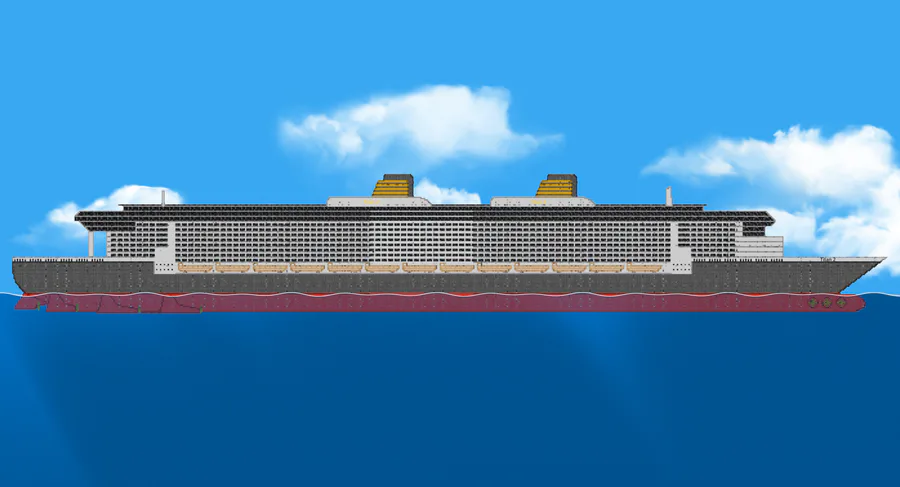
The M.S. United States Grandeur III reaches its definitive form as a Trimaran Megastructure, a design that marries the sleek, avian aesthetics of the 1930s "Silver" class with the avant-garde "Manta Ray" philosophy of Meyer Werft. This final evolution redefines the vessel as a global currency hub and a multi-national sanctuary, capable of hosting a civilization while sprinting across oceans at 300+ knots.
The Trimaran Architecture: Inspired by "Manta Ray"
Transitioning from the hexa-hull to a specialized Trimaran configuration, the Grandeur III utilizes a massive central hull flanked by two high-speed outriggers.
The "Manta" Wing: Inspired by Meyer Werft’s Manta Ray concept, the superstructure "wings" out over the water, creating vast, wind-shielded promenades.
Hydro-Stability: The Trimaran design provides the necessary beam to support the 161-meter height and 47 floors while maintaining a narrow "Wave-Piercing" profile for the 410-knot sprint.
Propulsion Placement: The 12 shafts are distributed across the three hulls—6 on the central spine and 3 on each outrigger—providing unmatched maneuverability for a 1.39-kilometer vessel.
Modern Lifeboats: Titanic II "Safety Deck" Integration
Drawing from the safety advancements of the Titanic II project, the Grandeur III features a dedicated Safety Deck located between the 7 underwater levels and the superstructure.
The New Ark Standard: Unlike the cramped boats of the past, these are Modern Enclosed Lifeboats similar to those proposed for Titanic II, but scaled to "Ark" proportions.
Capacity: Each of the 64 Arks is a self-propelled, multi-deck vessel. They feature the high-visibility orange "safety-skin" but are outfitted with the luxury interiors of the original Silver Falcon.
A Global Economic Engine: Multi-Currency & Sovereign Souls
The Grandeur III serves as a floating central bank for its 59,160,000 souls. The ship’s economy is a "Currency Basket," accepting and trading in:
Regional Powerhouses: Malaysia Ringgit (MYR), Singapore Dollar (SGD), Indonesia Rupiah (IDR), Thai Baht (THB), Vietnam Dong (VND), and Philippine Peso (PHP).
Global Standards: US Dollar (USD), Euro (EUR), British Pound (GBP), Canada Dollar (CAD), and Australia Dollar (AUD).
The Population: A diverse tapestry of humanity, including millions of Vietnamese, Philippine, Thai, Malaysian, Japanese, American, Canadian, Australian, and European (German, French, English, Italian, Spanish, Norwegian) citizens, living in a post-national harmony.
Homeports: The 20-Nation Network
The Grandeur III is a truly global citizen, with deep-water berths in the world’s most iconic maritime hubs:
Asia-Pacific: Singapore, Jakarta (Indonesia), Port Klang (Malaysia), Laem Chabang (Thailand), Manila (Philippines), Da Nang (Vietnam), Tokyo (Japan), and Shanghai (China).
The Americas: New York & Miami (USA), Vancouver (Canada).
Europe & Scandinavia: Southampton (UK), Hamburg (Germany), Marseille (France), Genoa (Italy), Barcelona (Spain), Oslo (Norway), Helsinki (Finland), Stockholm (Sweden), and Rotterdam (Netherlands).
Ultimate Description Overview
The M.S. United States Grandeur III is the pinnacle of human engineering—a 1,390-meter Trimaran that functions as a mobile city-state. Powered by a 1,500,000 SHP Net-Zero engine, it achieves the impossible: moving nearly 60 million people at 360 knots with the grace of a manta ray and the safety of 64 high-tech Arks.
It is a vessel where the elegance of the 1930s meets the survival needs of the 22nd century. Whether docked in the bustling ports of Southeast Asia or sprinting across the North Atlantic, the Grandeur III is the ultimate testament to the spirit of exploration and the enduring legacy of the "United States" and "Silver" maritime heritage. Part 13: The "Titan-Ark" Evolution – A Vessel of Hope and Survival
The final layer of the M.S. United States Grandeur III safety infrastructure integrates the soulful mission of the SS Titan Project with the modernized redundancy of Clive Palmer’s Titanic II. This synthesis transforms the 64 Arks from mere survival pods into "Vessels of Hope," ensuring that even in the most dire maritime displacement, the spirit of humanitarianism remains at the ship's core.
The SS Titan Influence: The "Vessel of Hope" Mandate
Drawing from Joseph Ricker’s vision for the SS Titan, the Grandeur III designates a specific "Titan-Class" subset of its 64 Arks.
The Humanitarian Mission: While the primary goal of the Arks is to evacuate 510,000 people each, the "Titan-Class" units are permanently outfitted with advanced pediatric medical bays and trauma centers.
The Aesthetic of the Superliner: Unlike industrial lifeboats, these Arks feature the classic, dignified lines of the 1,182-foot SS Titan concept. They are finished in a "Star-White" and "United States Blue" livery, symbolizing peace and rescue.
Aero-Dynamic Pedigree: Borrowing the SS Titan's goal of being the "fastest ocean liner," these Arks are equipped with independent hydro-jet boosters, allowing them to maintain a steady 45 knots—a speed unheard of for survival craft—to reach the nearest homeport rapidly.
The Titanic II Safety Deck: Historical Security
In alignment with the Titanic II project’s commitment to modern safety standards, the Grandeur III features a dedicated Continuous Safety Gallery on Deck 14.
The "Replica" Reliability: Each Ark is designed to be a "Functional Legend." They possess the exterior charm of the original Olympic-class liners but are constructed from the same Aero-Titanium Graphene as the Grandeur III's main hull.
Redundant Deployment: Following the Titanic II model of "enough boats for everyone," the Grandeur III ensures that the 64 Arks are supplemented by an additional 128 "Titan-Sprints"—smaller, high-speed ferries capable of moving the 10,000,000 crew members to safety in under 20 minutes.
0 comments