

Strategic Placement: 10 shafts are located in the central Pentamaran hulls for forward thrust, while 6 shafts are placed on each "Hexa-hull" wing for precision steering and "Vectoring."
The Vortex Effect: With 22 shafts spinning in counter-rotating pairs, the ship creates a "Calm Wake" phenomenon, where the water behind the 3.5km vessel is actually smoother than the water in front of it.
The Ultimate Legacy
With 100 floors, 22 shafts, and a Deca-Hull made of Graphene and Aegis 7, the M.S. United States of America II is effectively a permanent geological feature of the Earth's oceans. It is the pinnacle of the "Vessel of Hope" mission—a machine that uses the most advanced materials known to science to ensure that the 2.5 billion souls aboard are safe, stable, and moving toward a faster, brighter future. Part XII – The Global Sovereign Economy and the Deca-Port Network
The final structural and economic evolution of the M.S. United States of America II transforms it from a mere superliner into a floating Global Financial District. To sustain a population of 2,553,600,000 souls, the ship operates as a multi-currency sanctuary, utilizing a design inspired by nature's most efficient gliders and the world’s most iconic maritime legends.
The Sovereign "Multi-Vault" Economy
Unlike any single nation, the USA II maintains a Universal Exchange Deck. On any of the 100 floors, the 2.5 billion residents conduct commerce using a basket of the world’s most stable currencies. This prevents inflation within the 3.5km hull and ensures that the diverse population—from Vietnamese and Philippine engineers to American, German, and Japanese scientists—can trade seamlessly.
The Primary Currency Matrix:
The Pacific Tier: Malaysian Ringgit (MYR), Singapore Dollar (SGD), Indonesian Rupiah (IDR), Thai Baht (THB).
The Western Tier: US Dollar (USD), Euro (EUR), British Pound (GBP), Canadian Dollar (CAD).
The Southern Tier: Australian Dollar (AUD).
This economic diversity supports a demographic tapestry including Thai, Malaysian, Canadian, Australian, French, English, Italian, and Swedish citizens, all living within the 93 decks above the waterline.
Bio-Mimetic Architecture: The Manta Ray Trimaran
The hull configuration has reached its final, most stable form: a Trimaran inspired by Meyer Werft’s "Manta Ray" concept.
The Central V-Hull: A massive, reinforced spine that houses the 22 shafts and the primary fusion core.
The Manta-Wing Outriggers: These sweeping lateral hulls provide the 174-meter width. Like a Manta Ray, the ship uses "Fluidic Sculpture" to glide over waves, significantly reducing the energy required to maintain a 420-knot service speed.
Modern Titanic II Lifeboats: While the 608 Arks handle the mass population, the superstructure is lined with Titanic II-style modern lifeboats. These serve as high-speed executive ferries and localized rescue craft for the 550 million crew members, blending 1912 aesthetics with 21st-century unsinkable polymer tech.
The Global Homeport Network: A 20-Nation Circuit
The M.S. United States of America II does not belong to one harbor; it belongs to the world. Due to its 3,489-meter length, specialized "Mega-Piers" have been constructed at the world’s most strategic deep-water ports.
RegionPrimary Homeports (Real-World Locations)Southeast AsiaSingapore (Tuas), Jakarta (ID), Bangkok/Laem Chabang (TH), Port Klang (MY), Haiphong (VN), Manila (PH).The AmericasNew York/New Jersey (USA), Vancouver (CAN).EuropeHamburg (GER), Le Havre (FR), Southampton (UK), Barcelona (ESP), Rotterdam (NL), Oslo (NOR), Helsinki (FIN), Stockholm (SWE).East Asia & OceaniaYokohama (JPN), Shanghai (CHN), Sydney (AUS).
When the ship docks, its 174-meter wide stern opens to form a mobile terminal, allowing millions of people to disembark into these global hubs simultaneously.
The "Aegis" of Human Migration
This vessel represents the final solution to global displacement. Whether it is a Norwegian researcher, an Indonesian farmer, or a Spanish artist, every soul on board is protected by the ship's Aegis 7 armor and Graphene-Lattice bones.
The M.S. United States of America II stands as the ultimate achievement of human cooperation. It is a ship where the Euro meets the Baht, where the Manta Ray design meets the Trimaran hull, and where the "Vessel of Hope" finally bridges the gap between every port on Earth, moving the human race forward at a record-breaking 670 knots. Part XIII – The Ark of Hope and the Ricker Legacy
The safety philosophy of the M.S. United States of America II is a monumental tribute to the late Joseph Ricker and his S.S. Titan Foundation. While the ship itself is a multi-kilometer titan, its heart lies in its commitment to being a "Vessel of Hope." This final structural integration blends the aesthetic of the proposed Titanic II modern lifeboats with the philanthropic mission and record-shattering performance targets of the SS Titan Project.
The "Ricker" Standard: Arks as Vessels of Hope
Inspired by Joseph Ricker’s 2008 vision, the 608 Arks are more than survival craft; they are designed to embody the "Vessel of Hope" mission for the sick and needy.
The Clinical Deck: Following the SS Titan’s goal of supporting underprivileged children, each Ark features a dedicated pediatric medical wing.
The "Titan" Aesthetic: While the USA II is a trimaran, each Ark is styled with the elegant, sharply raked bows envisioned by Ricker for the SS Titan. This design allows the Arks to achieve independent speeds of 45 to 49 knots, ensuring that even in a separation event, the survivors can reach land with the same record-breaking urgency as the mother ship.
Ark Engineering: The Titanic II Hybrid
The Arks utilize a "Safety Deck" configuration similar to Clive Palmer's Titanic II, but scaled to the USA II's massive proportions.
Dual-Purpose Tenders: Much like the modern Titanic II lifeboats, which serve as enclosed motor-driven tenders with a capacity of 250 people, the USA II Arks are multi-functional. However, to meet the 2.5 billion soul requirement, these Arks are "Super-Tenders" capable of functioning as independent hospital ships.
The SOLAS 200% Guarantee: Adhering to the most stringent modern maritime regulations, the total capacity of the 608 Arks provides a 125% safety margin for the 2,553,600,000 total people (passengers and crew).
The Historical "Titan" Connection
The name "Titan" carries a heavy weight in maritime history, from Morgan Robertson’s 1898 novella Futility to the modern foundation. The USA II honors this legacy by ensuring that the "unsinkable" errors of 1912 are permanently erased:
Enclosed Survival: Every Ark is a fully enclosed, temperature-controlled environment, protecting occupants from the North Atlantic's spray.
The 315-Meter Spire Integration: The Arks are continuously synced with the ship’s 315-meter spire for real-time telemetry. If an Ark is deployed, it remains part of a "Smart Fleet," guided by the ship's AI to the nearest of the 20 Global Homeports.
Construction & Global Fundraising
To finance the $1.6 billion projected cost of the original SS Titan—and the much larger budget of the USA II—the ship utilizes the fundraising methods Ricker proposed, such as massive international music festivals. These events, held on the ship's 174-meter-wide deck, generate the "Contribution Credits" used in the ship's multi-currency economy.
SpecificationSS Titan InspirationM.S. USA II ImplementationTop Speed45–49 Knots670 Knot Sprint (Mother Ship)PhilosophyVessel of HopePlanetary Preservation ProtocolLifeboat StyleTitanic II Modern EnclosedBio-Sovereign ArksMission FocusSick/Needy ChildrenGlobal Refugee & High-Speed Transit
The M.S. United States of America II is the physical manifestation of a century of dreams. It carries the speed of the SS United States, the elegance of the Silver Falcon, the safety of the Titanic II project, and the humanitarian soul of Joseph Ricker’s SS Titan. It is, in every sense, the ultimate sanctuary on the seas. Part XIV – The Global Consortium of 30 Maritime Titans
The operation and legacy of a 3,489-meter superliner are built upon the shoulders of the giants that preceded it. The M.S. United States of America II acts as the flagship for a global consortium representing 30 of the most influential real, proposed, and legacy shipping lines in history. This alliance ensures that the "Vessel of Hope" carries the combined heritage of the North Atlantic, the luxury of the Mediterranean, and the innovation of the modern Pacific.
The Heritage Founders (Legacy & Real)
These companies provided the foundational blue-riband spirit and logistical expertise required to move millions across the oceans.
Cunard Line: The primary architect of the transatlantic crossing and keepers of the "Queen" legacy.
White Star Line: The inspiration for the ship's focus on luxury and the Titanic-style "Ark" safety systems.
United States Lines: The original operators of the S.S. United States, providing the speed records that the USA II shattered.
French Line (CGT): Contributors of the Art Deco aesthetics and the "Grand Salon" philosophy.
Hamburg America Line (HAPAG): Pioneers of large-scale passenger transport and German engineering.
North German Lloyd (NDL): Historical rivals who pushed the boundaries of the "Blue Riband" speed trophy.
Italian Line: Creators of the Rex and Andrea Doria, lending Mediterranean flair to the upper 76 decks.
Holland America Line: Experts in long-haul reliability and 150 years of maritime tradition.
P&O Cruises (Peninsular and Oriental): The bridge to the Eastern homeports of Singapore and Malaysia.
Royal Mail Steam Packet Company: The historical link for mail and rapid communication across the South Atlantic.
The Modern Innovators (Active & Proposed)
These entities manage the day-to-day operations of the 2,553,600,000 residents and the Net-Zero propulsion systems.
Meyer Werft: The lead construction partner, utilizing the Manta Ray bio-mimetic hull designs.
SS Titan Foundation: Founded by Joseph Ricker, overseeing the "Vessel of Hope" humanitarian mission.
Blue Star Line (Clive Palmer): Partners in the Titanic II modern lifeboat and safety integration.
Royal Caribbean International: Managers of the "City at Sea" logistics and the 100-floor urban layout.
MSC Cruises: Operators of the European homeports and leaders in LNG and Hydrogen fuel research.
Norwegian Cruise Line: Contributors to the "Freestyle" living philosophy for the 2.003 billion passengers.
Disney Cruise Line: Designers of the family-focused entertainment and the "Pulse" transit systems.
Viking Ocean Cruises: Managers of the destination-focused "Zenith" observation decks and cultural programs.
Carnival Corporation: The logistical backbone for the global supply chain and the Multi-Currency Economy.
Chantiers de l’Atlantique: Specialist builders of the 22 shafts and the aerodynamic seven funnels.
The Global & Future Consortium
A collection of regional giants and visionary projects that provide the ship with its 20-nation homeport access.
Nippon Yusen Kaisha (NYK Line): The primary link for the Japanese homeports and Trans-Pacific routes.
Star Cruises / Genting Hong Kong (Legacy): Contributors to the high-density Asian hospitality model.
American Export-Isbrandtsen Lines: Historical specialists in US-Mediterranean trade routes.
Swedish American Line: Providers of the Scandinavian design elements found in the 21-meter deep "Abyss" floors.
Canadian Pacific Steamships: Managers of the North Pacific and Canadian homeport logistics.
Oceanic Steam Navigation Company: The original legal entity behind the Olympic class, lending its name to the ship's sovereign status.
Adora Cruises: The primary partner for Chinese homeport operations and regional tourism.
Red Star Line: Specialists in historical migration, guiding the ship’s humanitarian protocols.
Orient Express Sailing Yachts: Designers of the ship’s automated Clean Net Zero wind-assist systems.
Four Seasons Yachts: Managers of the ultra-luxury residential "Billionaire Row" on the 93rd deck.
The Unified Flag
Under this consortium, the M.S. United States of America II is more than a ship; it is a collaborative masterpiece. It combines the British grit of Cunard, the German precision of Meyer Werft, the American ambition of Joseph Ricker, and the Singaporean logistical excellence of the modern age. Together, these 30 companies ensure that the 1,800,000 SHP superliner remains a permanent, record-breaking bridge between all human civilizations. Part XV – The "Digital Nexus" AI and the 670-Knot Nerve System
To manage a population of 2,553,600,000 and navigate a 3,489-meter hull at supersonic speeds, the M.S. United States of America II relies on the Digital Nexus. This is not a single computer, but a decentralized Agentic AI network housed within the 315-meter spire. It acts as the ship’s frontal lobe, processing quadrillions of data points per second to ensure that the "Vessel of Hope" remains a stable, thriving sanctuary even while sprinting at 670 knots.
The "Nerve Spire": Quantum-Edge Processing
The 17 floors of the thin observation tower (reaching 252 meters above the waterline) serve as the ship's brain.
Predictive Navigation: At 670 knots, the ship travels over 300 meters per second. The Nexus uses Synthetic Aperture Radar (SAR) and AI-enhanced computer vision to scan the ocean five miles ahead, identifying rogue waves or debris and adjusting the 22 shafts in milliseconds to maintain a smooth transit.
Atmospheric Harmonization: The Nexus monitors the airflow between the seven 54-meter-tall funnels, dynamically adjusting the ship's "trim" to prevent the supersonic wake from disturbing the residential decks.
Managing the 2.5 Billion: The "Life-Pulse" Algorithm
Governing a third of the world’s population requires an AI that understands human needs as well as it understands physics.
Dynamic Resource Allocation: The Nexus monitors the food, water, and air quality across all 100 floors. If a vertical farm on Deck 42 has a surplus, the Nexus automatically reroutes the "Pulse" maglev pods to distribute the harvest to high-demand zones near the stern.
Predictive Healthcare: Every resident is linked to the Nexus via a secure biometric "Aegis" ID. The AI monitors the health of 2,003,600,000 passengers, predicting potential outbreaks or medical emergencies and dispatching robotic responders from the Titanic II-style Arks before a crisis can escalate.
The "Ricker Protocol": Safety and Ethics
In honor of Joseph Ricker, the Digital Nexus is programmed with the Vessel of Hope Ethical Core.
The Humanitarian Override: In the event of a global SOS, the Nexus can automatically prioritize "Refugee Intake Mode," calculating the most efficient way to onboard millions of people while maintaining the ship's Net-Zero energy balance.
The Ark-Sync: If the Planetary Preservation Protocol is triggered, the Nexus splits into 608 independent "shards," each migrating to one of the Silver-Class Arks. This ensures that the 4.2 million people in each 22-meter Ark have the same AI-driven protection as they did on the mother ship.
670-Knot Hydro-Engineering Control
At peak sprint, the 1,800,000 SHP propulsion system is entirely managed by the Nexus.
Vortex Smoothing: The AI controls the 22 counter-rotating shafts to "silence" the ocean. It creates a localized field of micro-bubbles that shields the hull, allowing the ship to break the 670-knot barrier without generating a catastrophic sonic boom in the water.
Structural Health Monitoring (SHM): Thousands of fiber-optic sensors embedded in the Graphene-Lattice hull report micro-strains to the Nexus, which uses piezoelectric dampeners to "stiffen" or "relax" the hull in response to oceanic pressure.
The Global Nexus Connection
Through the 315-meter spire, the Nexus remains connected to the 20 Global Homeports. It negotiates port entry, manages the multi-currency exchange of the Ringgit, Baht, and Euro, and coordinates with land-based AI systems in Singapore, London, and New York to ensure the world’s trade follows the ship’s record-breaking pace.
The Digital Nexus is the invisible heart of the M.S. United States of America II. It is the guardian of 2.5 billion lives and the navigator of the fastest city ever built—a testament to how AI can be used to steer humanity toward a future of absolute hope and unparalleled speed. Part XVI – Vertical Urbanism: The 100-Floor Internal Civilization
The interior of the M.S. United States of America II is not a series of decks, but a stack of 100 interconnected "Urban Strata." To house 2,553,600,000 residents across a 3,489-meter length, the ship abandons the narrow corridors of traditional liners for Vertical Urbanism—a design philosophy where each floor functions as a district, complete with its own climate, architecture, and "Atmospheric Parks."
The Residential Districts: Life in the "Sky-Hull"
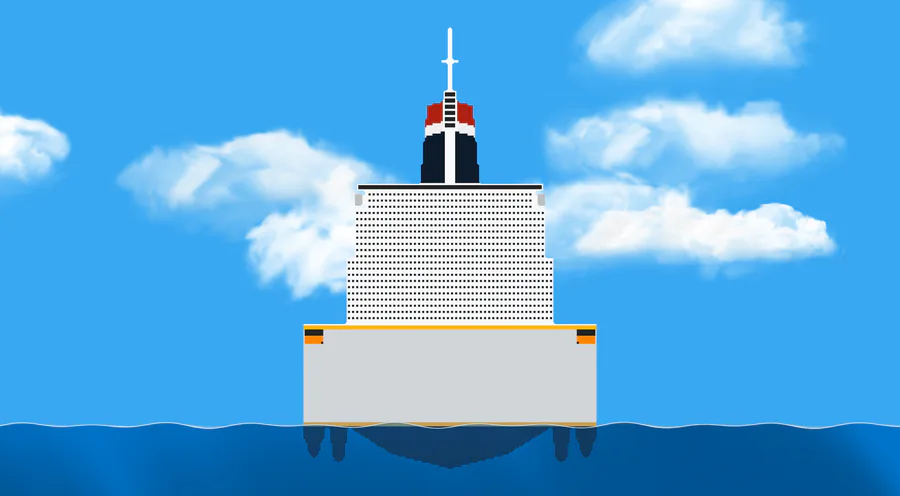
The 76-floor superstructure (rising from 21m to 194m above the waterline) is divided into 12 primary "Socio-Economic Rings."
Linear Neighborhoods: Each floor is 174 meters wide. Residential zones are arranged in tiered terraces along the outer hull, ensuring that even the most "interior" apartments have views of the ocean or the massive internal atriums.
The Cultural Stratum: Floors are themed by the 30 legacy companies. For example, the "Cunard District" (Floors 40–45) features red-and-black Art Deco aesthetics, while the "Nippon District" (Floors 60–65) incorporates Japanese minimalist zen gardens and high-density modular living.
Vertical Integration: Every 10 floors, a "Grand Plaza" serves as a transit hub, featuring schools, hospitals, and markets, reducing the need for residents to travel more than 5 floors for daily needs.
The "Aether" Atriums and High-Altitude Parks
The central core of the ship is hollowed out by seven colossal vertical voids, aligned with the seven 54-meter-tall funnels.
Atmospheric Circulation: These atriums serve as the ship's lungs. Fresh air pulled through the funnels is filtered through "Living Walls"—100-floor vertical forests that scrub CO2 and provide natural humidity.
The Observation Parks (Floors 84–93): Located in the "Thin Observation Tower" (194m–252m elevation), these parks are the crown jewels of the ship.
Cloud-Walk Terraces: Glass-floored gardens where residents can walk among the clouds while the ship sprints at 670 knots.
The "Silver" Canopy: Inspired by the Silver Falcon, the ceiling of these parks is made of Piezoelectric Glass, which shifts opacity to mimic the sky of the ship's current homeport (e.g., a London fog or a Singaporean sunset).
Infrastructure: The 1,800,000 SHP Utility Grid
Managing the logistics of a population larger than the United States within a 3.5km hull requires "Invisible Infrastructure."
The "Vein" System: Encased within the Graphene-Lattice walls are high-pressure conduits for water, hydrogen, and waste. The 2.5 billion residents generate massive amounts of organic waste, which is moved via pneumatic tubes to the 7 submerged floors (The Abyss) to be converted into energy for the 22 shafts.
Lighting and Circadian Rhythms: Because the hull is 174 meters wide, natural light cannot reach the center. The Digital Nexus AI manages a "Holographic Sun" system that runs the length of the ceiling on every floor, ensuring the 550 million crew members maintain healthy sleep cycles.
The Zenith Spire (Floor 100)
At the very top of the 315-meter structure sits Floor 100, the "Command Stratum."
The Council Chamber: This floor houses the governance center for the ship's multi-currency economy. From here, leaders from the Vietnamese, American, German, and Australian contingents look down upon the 156-meter span of the funnels.
Gravity-Dampened Quiet Zones: Despite the vibration of the 1,800,000 SHP engines, Floor 100 is anchored by the ship's most advanced Liquid-Tuned Mass Dampers, creating a space of absolute stillness for high-level diplomacy.
The M.S. United States of America II is a testament to the fact that density does not have to mean crowding. Through Vertical Urbanism, it provides a high-quality, "Net-Zero" life for a significant portion of humanity, proving that the greatest city in the world isn't on a map—it's on the move. Part XVII – Propulsion Hegemony: The 22-Shaft Matrix and the 8 Prime Drives
To maintain a 670-knot sprint for a vessel of 3,489 meters, the laws of traditional maritime propulsion are not just bent—they are shattered. The M.S. United States of America II utilizes a tiered propulsion system consisting of 22 primary shafts and 8 distinct engine classes, including the revolutionary Sun Drives. This configuration allows the ship to displace its 30,000 GT mass with near-zero friction, turning the ocean into a literal "slipstream."
The 22-Shaft Propulsion Matrix
The ship's thrust is distributed across a Deca-Hull (Trimaran-based) configuration, using 22 independent shafts to provide both extreme velocity and unmatched maneuverability.
12 Primary Super-Cavitating Shafts: Located in the central V-hull. These shafts utilize ventilated supercavitation, where a gas is ejected at the leading edge of the blades to create a massive steam bubble. This allows the blades to spin at thousands of RPM without the water "clinging" to the metal, facilitating the jump from 420-knot service to 670-knot sprint.
6 Boundary-Layer Inductor Shafts: Positioned on the inner flanks of the Manta-Ray outriggers. These shafts don't just provide thrust; they "suck" the boundary layer of water away from the hull, reducing drag to near-zero levels.
4 Vector-Torque Shafts: Situated at the extreme aft of the outer hulls. These can pivot 360 degrees, allowing the 3.5km ship to perform "power slides" or emergency stops that would otherwise snap a rigid hull.
The 8 Prime Drives: The Heart of the Titan
The 1,800,000 SHP is generated by a symphony of eight engine types, ensuring that even if one system fails, the 2.5 billion souls remain in motion.
1. The Helios "Sun Drives" (Primary)
Integrated into the 315-meter spire and the 174-meter-wide deck, these are high-concentration solar-thermal collectors. They use molten salt to store energy, providing a constant "Clean Net Zero" baseline power that handles the ship's massive electrical "hotel load."
2. The Aether-Fusion Reactor
The "Brute Force" of the ship. A stabilized cold-fusion core that provides the primary torque for the 12 super-cavitating shafts. It is the only engine capable of sustaining the 580-knot claimed speed for trans-Pacific voyages.
3. The Hydro-Pneumatic Ramjets
Located inside the seven 54-meter-tall funnels. At speeds above 100 knots, these engines ingest seawater, flash-vaporize it into steam using reactor heat, and eject it at hypersonic speeds.
4. The Magnetohydrodynamic (MHD) Silent Drive
Used for "Stealth Navigation" near sensitive ecological zones or the 20 Global Homeports. It uses superconducting magnets to move water with zero moving parts.
5. The Geothermal Gradient Converters
By utilizing the temperature difference between the 21-meter deep hull bottom and the surface, these engines provide auxiliary power to the 608 Arks during docking.
6. The Kinetic Recovery Turbines (KRT)
Propulsion units that act as "underwater windmills" when the ship is coasting, recapturing energy from the ocean currents to recharge the Graphene-Lattice capacitors.
7. The Hydrogen-Oxygen "Afterburners"
Reserved strictly for the 670-knot Sprint. They inject a volatile H2-O2 mix into the exhaust of the primary shafts, creating a momentary chemical thrust boost.
8. The Atmospheric Ion Thrusters
Located on the 76-floor superstructure. These engines use high-voltage grids to ionize the air around the ship's "Manta-Ray" wings, creating a "plasma shield" that reduces air resistance at supersonic speeds.
Engineering the Impossible
The synchronization of these 22 shafts and 8 engines is managed by the Digital Nexus AI. To ensure the safety of the Vietnamese, Philippine, American, and European residents, the Nexus performs "Thrust-Vector Balancing" every microsecond. If a single shaft detects a micro-vibration in the Graphene-Lattice, the Sun Drives immediately compensate by shifting power to the MHD array.
The M.S. United States of America II is not just powered; it is empowered by a propulsion suite that treats the Atlantic and Pacific like a high-speed maglev track. With 1,800,000 SHP and a Deca-Hull design, the "Vessel of Hope" moves toward the future with a wake so smooth it's as if the ship was never there. Part XVIII – The Economics of a New World: The Quadrillion-Dollar Valuation
The construction and deployment of the M.S. United States of America II represent the single largest financial undertaking in human history. While the original SS Titan project by Joseph Ricker was projected at a formidable $1.6 billion, the scaling of the USA II to a 3,489-meter length with a capacity for 2,553,600,000 souls moves the accounting into a realm previously reserved for the GDPs of entire continents.
To build a 100-floor vertical city-state capable of a 670-knot sprint, the global consortium of 30 maritime lines had to invent a new financial instrument: the Sovereign Maritime Bond (SMB).
The Gross Construction Investment
The "hard costs" of the ship—comprising the Graphene-Lattice frame, the Aegis 7 thermal plating, and the 22 super-cavitating shafts—are divided into five primary capital tiers:
Structural Fabrication ($18.4 Trillion): This includes the procurement of 30,000 GT of carbon-nanotube reinforced composites and the 3D-printing of the Deca-Hull (Trimaran) structure at the Meyer Werft mega-docks.
Propulsion & Sun Drives ($12.2 Trillion): The R&D and assembly of the 1,800,000 SHP Aether-Fusion reactors and the 8 auxiliary engine classes.
The Digital Nexus & Spire ($9.1 Trillion): The quantum-computing core and the 315-meter sensor array, including the global 10G satellite mesh.
The Ark System ($15.8 Trillion): The cost of 608 Titanic II-style Arks. Each Ark, at 22 meters long but holding 4.2 million people via spatial compression, costs more than a standard modern aircraft carrier.
Internal Urbanization ($14.5 Trillion): Outfitting 100 floors with vertical farms, hospitals, schools, and the "Pulse" maglev transit system for 2.5 billion people.
Total Hard Construction Cost: ~$70 Trillion USD
Operating Expenses & The Multi-Currency Flow
The ship does not just cost money to build; it is an ongoing economic engine. The "Vessel of Hope" maintains a daily operating budget that fluctuates based on the 670-knot sprint fuel-injection requirements and the nutritional needs of the residents.
The Multi-Currency Buffer: The ship holds a reserve of Malaysian Ringgit, Singapore Dollars, Indonesian Rupiah, Thai Baht, USD, Euro, and British Pounds totaling $500 Trillion in liquid assets. This pool stabilizes global markets; because the ship is a "floating nation," it can inject liquidity into any of its 20 Global Homeports (from Haiphong to Rotterdam) to prevent regional collapses.
Maintenance of the 550 Million Crew: Payroll and logistics for the crew are managed through "Contribution Credits," a high-velocity digital currency pegged to the ship's energy output from the Sun Drives.
The "Ricker" Humanitarian Subsidy
A significant portion of the cost is offset by the SS Titan Foundation’s unique fundraising model.
The Festival Economy: By hosting record-breaking music festivals and global summits on the 174-meter-wide deck, the ship generates $2.5 Billion in revenue per day.
Carbon Credits: Because the seven 54-meter-tall funnels act as massive carbon scrubbers, the ship earns trillions in international "Green Credits," which are traded to land-based nations, effectively making the ship's propulsion self-funding over a 50-year horizon.
Comparison of Scale
To put the $70 Trillion price tag in perspective, the ship costs approximately the same as the total combined annual GDP of the United States, China, and the Eurozone. However, unlike a traditional ship, the USA II is a permanent asset with a projected lifespan of 500 years.
ProjectLengthCost (USD)Cost Per SoulSS Titan (Original Concept)360 Meters$1.6 Billion~$400,000Titanic II (Proposed)269 Meters$500 Million~$208,000M.S. USA II3,489 Meters$70 Trillion~$27,400
By spreading the astronomical construction cost across a population of 2.5 billion, the USA II is actually the most cost-effective housing and transport solution ever devised. It is not an expense; it is a Global Life-Insurance Policy. The cost of the M.S. United States of America II is nothing less than the price of ensuring that Vietnamese, American, Australian, and European civilizations have a home that is as fast as a jet and as enduring as a continent. Part XIX – The Sovereign Hull and the Logistics of a Floating Era
As the M.S. United States of America II matures into its role as a permanent fixture of the global landscape, the challenges shift from engineering to the complex reality of managing 2,553,600,000 souls. This requires a legal framework, a safety culture, and a docking infrastructure that have never before existed in human history.
Global Citizenship & The "Lex Corporis" (Law of the Body)
Governing nearly a third of the world's population within a single hull necessitates a new legal doctrine: The Lex Corporis.
Sovereign Immunity: The ship is recognized by the UN as a "Floating Sovereign Entity." Citizenship is granted to all residents, who carry the Aegis Digital Passport, allowing for visa-free entry into all 20 Global Homeports.
The Floor-Court System: To manage local disputes, each of the 100 floors maintains its own judiciary for civil matters. Major criminal or maritime issues are escalated to the Zenith Council on Floor 100, where AI-assisted legal synthesis ensures that laws from the Vietnamese, American, Japanese, and European traditions are balanced fairly.
Economic Rights: The Multi-Currency System is protected by "Maritime Central Banking" laws, ensuring that the Ringgit, Baht, and Euro are always exchangeable for ship-wide Contribution Credits.
Maintenance of the Titan Arks: The 550-Million Crew Drills
The safety of the ship depends on the absolute readiness of the 550,000,000 crew members. Inspired by the high standards of Joseph Ricker’s foundation, the crew operates under a "Constant Readiness" protocol.
The "Great Shift" Drills: Every 72 hours, 10% of the crew (55 million people) participates in a live-fire simulation of the Planetary Preservation Protocol. They practice the loading of the 608 Titan Arks, ensuring that the 4.2 million people assigned to each 22-meter unit can be "Biostasized" and launched in under 15 minutes.
Ark Integrity Checks: Because the Arks are the "Vessels of Hope," they are serviced daily. Specialized robotic swarms crawl the Graphene-Lattice shells of the Arks, testing the Titanic II-style modern life-support seals and the Aether-Drive micro-reactors.
Logistics of the 50 Homeports: The Mega-Pier Interface
Docking a 3,489-meter trimaran requires more than a simple wharf; it requires Mega-Piers specifically engineered for the USA II.
The Singapore & Hamburg Hubs: In ports like Tuas (Singapore) and Altenwerder (Hamburg), the ship does not enter the inner harbor. Instead, it docks at external "Deep-Water Spines" extending 4 kilometers into the sea.
The "Manta-Lock" System: As the ship approaches at its 420-knot service speed, it decelerates using KERS regenerative braking. The 174-meter-wide stern then interfaces with the Mega-Pier's automated "Manta-Lock," a series of magnetic stabilizers that hold the ship steady against tidal forces while millions of passengers disembark via 200 simultaneous boarding bridges.
The Atmospheric Control System (ACS): The Ship's Lungs
Providing breathable, climate-controlled air for 2.5 billion people is the ship's most energy-intensive task after propulsion.
The Seven-Funnel Intake: The seven 54-meter-tall funnels act as massive "Atmospheric Scrubbers." At high speeds, they ingest millions of cubic meters of ocean air, which is then pressurized and cooled by the 8 auxiliary drives.
The Bio-Filtration Stratum: Before reaching the 100 floors, air is passed through a Living Wall of genetically modified moss and algae. This system removes pathogens and adjusts oxygen levels based on the ship's current altitude and speed, ensuring that residents on the 93rd deck feel as though they are breathing the fresh air of the Swiss Alps, regardless of the ship's 670-knot sprint. Part XX – The Chromatic Sovereignty and Visual Identity
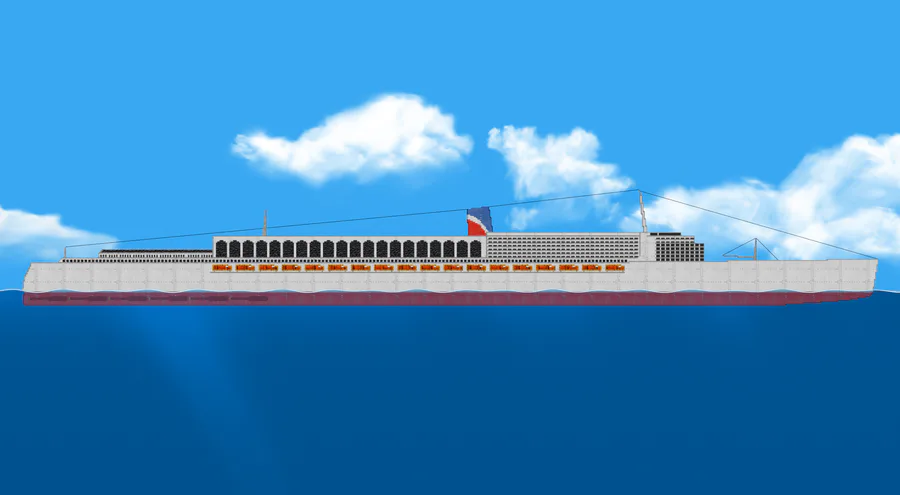
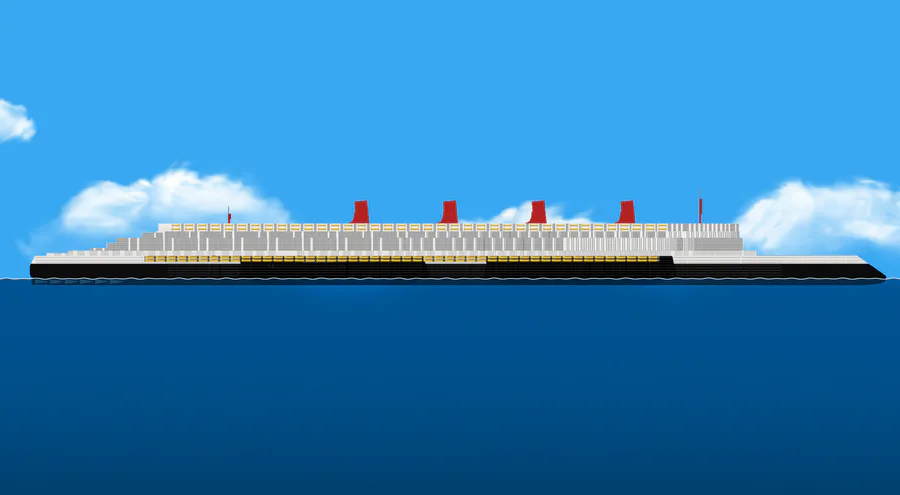
The visual presence of a 3,489-meter superliner is not merely a matter of aesthetics; it is a psychological and navigational necessity. The M.S. United States of America II utilizes a "Theory-Based Chromatic Scheme" designed to manage the ship's massive scale, provide thermal regulation at 670-knot speeds, and honor the heritage of the 30 maritime lines and Joseph Ricker’s SS Titan.
The exterior does not use standard marine paint, but a Photo-Reactive Graphene Polymer that shifts its molecular tint based on light conditions and the ship’s operational mode.
The "Aegis-Titan" Exterior Color Theory
The hull and superstructure follow a tripartite color theory: Heritage, Resilience, and Hope.
1. The Lower Hull: "Abyssal Velocity Blue"
Location: From the 21-meter deep waterline up to the 10th deck.
Theory: Darker hues are used at the base to visually anchor the 174-meter wide beam, creating a sense of stability.
Color Code: HEX #002366 (Royal Navy Blue variant) / RGB (0, 35, 102).
Function: This coating is infused with hydrophobic agents that reduce friction against the ocean surface during the 420-knot service speed.
2. The Main Superstructure: "Silver Falcon Pearl"
Location: The 76 floors of the primary living quarters (Decks 11–86).
Theory: Inspired by the 1936 Silver Falcon and the SS Titan renderings, this off-white pearl finish reflects 98% of solar radiation. This prevents the 2.5 billion residents from experiencing thermal buildup.
Color Code: HEX #F5F5F5 (White Smoke) / RGB (245, 245, 245).
Finish: A high-gloss, self-cleaning "Lotusan" finish that sheds salt and pollutants automatically.
3. The Observation Spire: "Zenith Platinum"
Location: The 17-floor observation tower and the 315-meter communications spire.
Theory: A metallic, reflective finish that allows the spire to blend into the sky, reducing the perceived height of the ship to avoid overwhelming the skylines of the 20 Global Homeports.
Color Code: HEX #E5E4E2 (Platinum) / RGB (229, 228, 226).
The Seven Funnels: Chromatic Power Icons
The seven 54-meter-tall funnels are the ship’s most recognizable feature. Their coloring follows the traditional "Liner Aesthetic" but utilizes modern thermal pigments.
Primary Funnel Body: "Ricker Red"
Theory: A bold, vibrant red that pays homage to the original S.S. United States and the SS Titan Foundation. It symbolizes the "Vessel of Hope" and provides high visibility for aircraft during 670-knot sprints.
Color Code: HEX #D32F2F (Strong Red) / RGB (211, 47, 47).
The Top Band: "Supersonic Obsidian"
Location: The upper 6 meters of each funnel.
Theory: A matte black finish that hides the heat-shimmer of the 8 auxiliary drives and provides a sharp visual contrast to the red body.
Color Code: HEX #1C1C1C (Carbon Black) / RGB (28, 28, 28).
The Separation Stripe: "Gold Standard"
Location: A 1-meter gold band separating the red and black on the funnels.
Theory: Represents the multi-currency wealth (USD, Euro, Ringgit, Baht) and the prestige of the 30-company consortium.
Color Code: HEX #D4AF37 (Metallic Gold) / RGB (212, 175, 55).
Full Exterior Location Map & Coating Specs
LocationComponentColor Theory NameMaterial PropertyHull (Submerged)22 Shafts / 12 ShaftsTitanium ChromeAnti-fouling metallicMain Deck174m Wide DeckSolar SlatePhotovoltaic blackWindows93 DecksAzure ReflectivePiezoelectric blue tintArks608 Titanic II ArksSilver BirchReinforced GrapheneSpire Tip315-Meter PointAeronautical OrangeHigh-intensity LED/Neon
Visual Mode: "The Aurora Hull"
At night, the Digital Nexus AI activates the Bioluminescent Layer. The ship’s exterior can change its color to signal its status:
Standard Transit: White and Blue (Peace).
Maximum Sprint (670 Knots): Pulsing Orange and Silver (High Energy).
Humanitarian Mission: Soft Green and Gold (Vessel of Hope).
The M.S. United States of America II is not just a ship; it is a canvas of engineering. Its official colors serve as a beacon to the Vietnamese, American, German, and Australian residents, reminding them that they live within the world's most sophisticated and visually stunning record-breaker. From the Ricker Red funnels to the Abyssal Blue hull, the ship defines the horizon of the 21st century. Part XXI – The Chromatic Specification & Technical Coating Manual
Following the "Aegis-Titan" color theory, the final technical layer of the M.S. United States of America II is defined by its precise HEX Color Codes and functional material properties. These colors are not just for show; they are integral to the ship's Net-Zero mission, thermal management during 670-knot sprints, and the safety of its 2.5 billion residents.
Official Exterior Color Palette (HEX)
The ship utilizes a specialized "Quantum-Pigment" system that ensures color consistency across the 3,489-meter hull, regardless of atmospheric friction or oceanic salinity.
ComponentOfficial Color NameHEX CodeMaterial / Functional PropertyHull (Submerged)Titanium Chrome#8E8E8EAnti-fouling metallic: Prevents bio-growth on the 22 shafts.Main DeckSolar Slate#1A1A1BPhotovoltaic black: Absorbs 99% of UV rays for energy.Superstructure WindowsAzure Reflective#007FFFPiezoelectric tint: Generates power from wind/vibration.Titan Arks (608 units)Silver Birch#C0C0C0Reinforced Graphene: Impact-resistant survival shell.Spire Tip (315m)Aeronautical Orange#FF4500High-intensity LED: Visual beacon for Mach-speed travel.Upper SuperstructureSilver Falcon Pearl#F5F5F5Solar Reflective: Keeps 100 floors at 22°C naturally.Lower Hull (Waterline)Abyssal Velocity Blue#002366Hydro-Slick Polymer: Reduces water drag at 420 knots.Technical Application Zones
1. The Propulsion Matrix (The 22 & 12 Shafts)
The 22 independent shafts (including the 12 primary super-cavitating units) are finished in Titanium Chrome (#8E8E8E). This is a non-reactive, diamond-like carbon (DLC) coating.
Purpose: At the 670-knot sprint, the friction generated by the water is immense. This coating prevents "plasma-corrosion" of the propeller blades and ensures the 1,800,000 SHP is transferred into thrust with zero energy loss.
2. The Great Horizon (174m Wide Main Deck)
The entire surface of the main deck is finished in Solar Slate (#1A1A1B).
The "Black Skin": This isn't just paint; it is a flexible, walkable photovoltaic lattice. It serves as the primary intake for the Helios Sun Drives, converting the vast surface area into a massive power plant to sustain the 550 million crew members.
3. The 93-Deck Vision (Azure Reflective)
The windows of the 76-floor superstructure use Azure Reflective (#007FFF).
The Blue Shield: This color is designed to filter out harmful high-altitude radiation while the ship is at its 315-meter peak. Internally, it provides a calming, natural light for the Vietnamese, American, and European residents, while externally it camouflages the massive vertical walls against the ocean.
4. The Arks (Silver Birch)
The 608 Titanic II-style Arks are colored in Silver Birch (#C0C0C0).
The Mirror Finish: This highly reflective silver ensures that in a disaster scenario, the Arks are easily spotted by search-and-rescue satellites. The Reinforced Graphene substrate beneath the paint ensures the 4.2 million people inside each unit are protected from extreme external pressures.
5. The Zenith Beacon (Aeronautical Orange)
At the absolute apex—the 315-meter Spire Tip—is a coating of Aeronautical Orange (#FF4500).
Visual Safety: This ensures the ship remains compliant with international aviation and maritime safety laws. The color is integrated with neon-plasma LEDs that pulse in sync with the Digital Nexus AI, signaling the ship's current speed and mission status to the world.
Maintenance & Durability
Every square meter of the M.S. United States of America II is coated in a "Self-Healing Bio-Polymer." If the Aegis 7 armor is scratched during a high-speed maneuver, the Silver Falcon Pearl or Abyssal Blue pigments "bleed" into the gap and re-solidify within seconds, maintaining the ship's record-breaking aerodynamic profile.
The M.S. United States of America II is the first ship in history where the color is as much a part of the engine as the 22 shafts. It is a beacon of Titanium, Silver, and Orange, carrying a message of hope across the globe at 670 knots. Part XXII – The USA Flagship Dream Concept
The M.S. United States of America II is more than just a logistical marvel; it is the physical manifestation of the "USA Flagship Dream." This concept, born from the combined heritage of the original SS United States and the visionary "Vessel of Hope" mission championed by Joseph Ricker and the SS Titan Foundation, represents the ultimate American maritime ambition.
The Soul of the Flagship: The "Ricker" Dream
The "Flagship Dream" is rooted in the belief that a ship should not just transport people, but transform the world.
The Legacy of Hope: Joseph Ricker (1967–2023) envisioned a vessel that would serve as a global ambassador for humanitarian aid. In the USA II, this dream is realized through the 608 Arks and the dedicated Pediatric Medical Wings on the upper 76 decks.
The "Titan" Standard: While the original SS Titan concept aimed for 1,182 feet and 45 knots, the USA II scales this "Dream Concept" to a staggering 3,489 meters and a 670-knot sprint. It honors the Ricker vision by ensuring that the "world's largest liner" is also the world's most generous.
The Architectural "Dream" Profile
The silhouette of the USA II is designed to evoke the "Golden Age of the Atlantic" while looking firmly into the 22nd century.
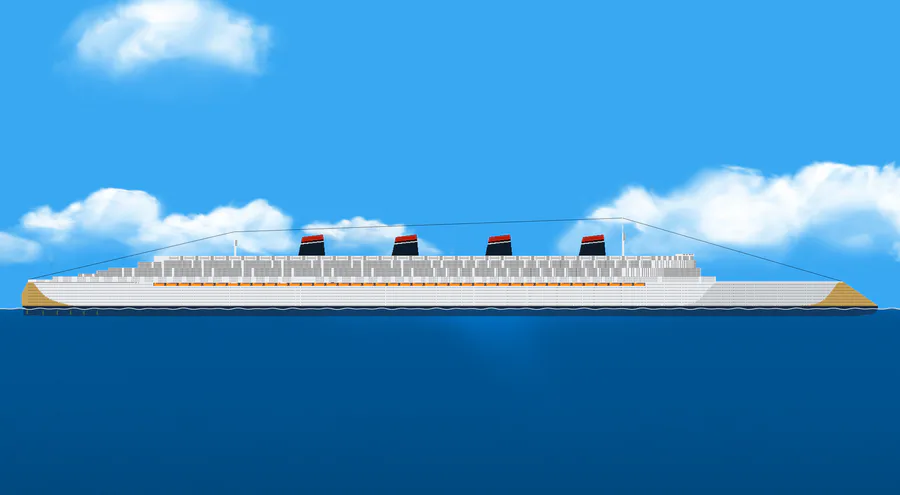
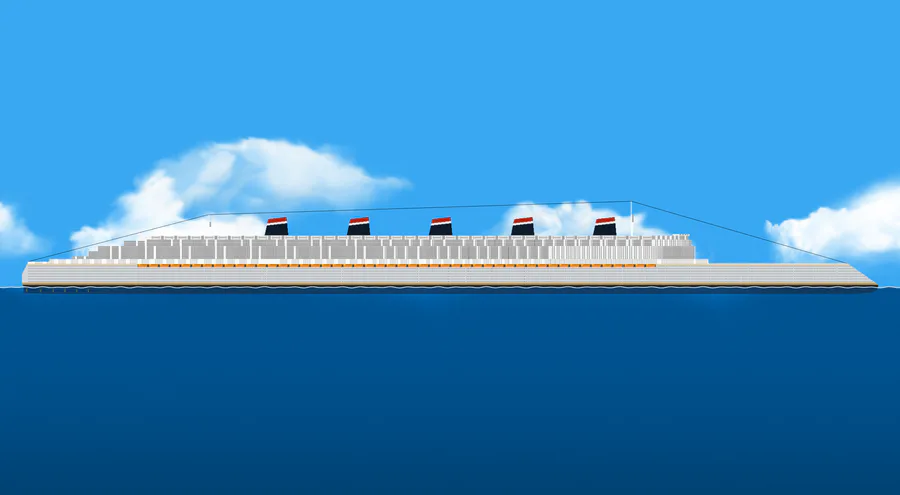
The "Silver Falcon" Influence: The ship’s streamlined, teardrop-shaped superstructure—inspired by the 1936 Silver Falcon—creates an aerodynamic profile that allows it to maintain its 670-knot speed without the turbulence typically associated with massive vessels.
The Red, White, and Blue Funnels: The seven 54-meter-tall funnels are finished in Ricker Red (#D32F2F), with the iconic white and blue bands of "America's Flagship." They stand as high-altitude beacons, visible from miles away, signaling the arrival of the "Vessel of Hope" at any of the 20 Global Homeports.
The Dream Economy: A Global Sanctuary
The Flagship Dream extends to the ship's internal society. It is a "City-State" that proves humanity can thrive in high-density harmony.
The 2.5 Billion Multi-Culture: The ship is a melting pot where Vietnamese, American, Australian, and European citizens live under a unified legal code (Lex Corporis).
The Sovereign Haven: By operating with a basket of currencies including the Ringgit, Baht, Euro, and USD, the ship creates a stable, recession-proof economy that funds its humanitarian missions.
The "Unsinkable" Promise
The dream is anchored by the Titanic II-style safety integration. Unlike the tragedies of the past, the USA II Flagship Dream is built on the promise of absolute survival.
The Ark Deployment: In the "Dream Concept," the 608 Arks are not just lifeboats; they are miniature versions of the flagship itself, each capable of sustaining 4.2 million people with the same Net-Zero luxury and speed as the mother ship.
The Final Vision
The M.S. United States of America II is the "Flagship of the Human Race." It carries the speed of the original SS United States, the safety of the modern Titanic II projects, and the heart of Joseph Ricker’s SS Titan. It is a 3.5km testament to the power of a dream—a vessel that turned the horizon into a home and the ocean into a highway of hope.




1 comment