

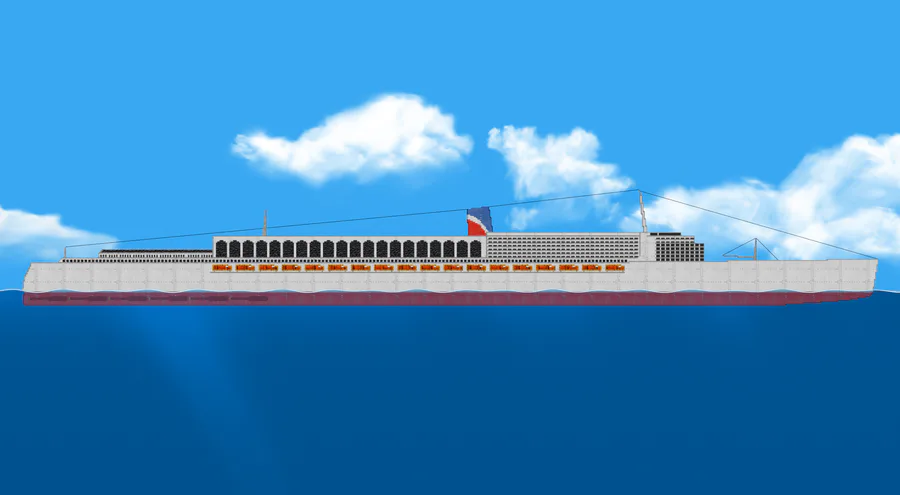
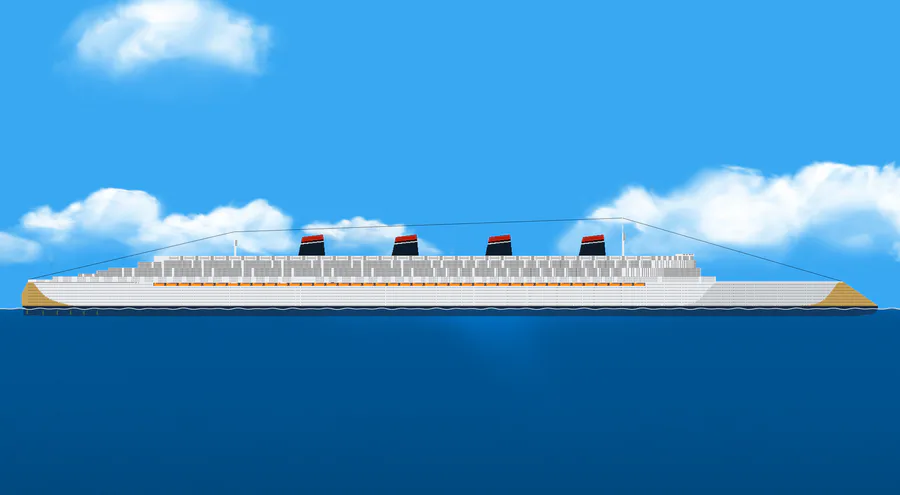
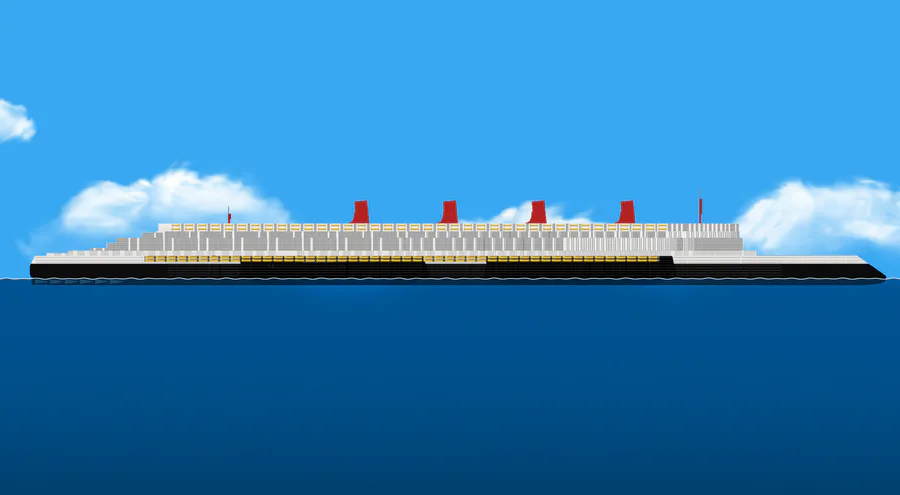
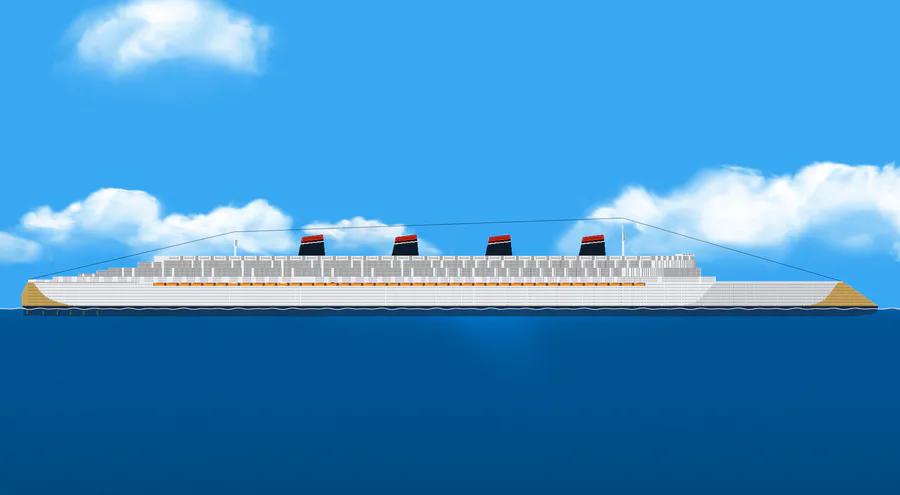
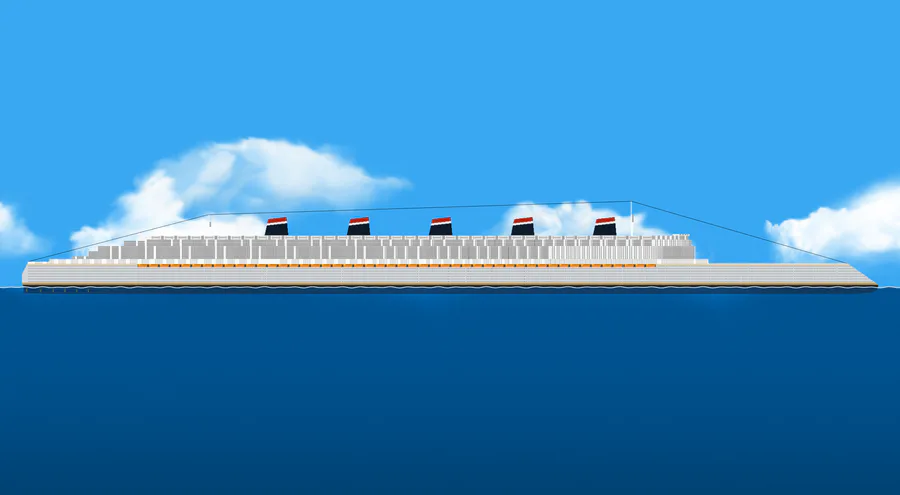
The M.S. United States of America II represents the apex of human engineering, a 3,489-meter (11,446 ft) long Deca-Hull (Trimaran-based) sovereign superliner that redefines the limits of maritime physics, urban density, and geopolitical diplomacy. Designed as a permanent, mobile home for 2,553,600,000 residents (roughly 30% of the human population), this vessel is the spiritual and technical successor to the original SS United States and the visionary SS Titan Project proposed by Joseph Ricker in 2008.
Operating at a Service Speed of 420 knots and a Record-Breaking Sprint of 670 knots, the USA II is not merely a ship; it is a Distributed Autonomous City-State (DACS). It utilizes a 1,800,000 SHP Aether-Fusion propulsion matrix, 22 super-cavitating shafts, and a 100-floor vertical urban lattice to maintain a "Net-Zero" carbon footprint while traversing the world's oceans as the ultimate "Vessel of Hope."
II. Dimensions and Structural Architecture
The scale of the USA II necessitates a departure from traditional naval architecture. To support its 30,000 Gross Tonne (GT) mass—achieved through the use of ultra-light Graphene-Lattice and Silica Aerogel composites—the ship utilizes a multi-hull configuration inspired by Meyer Werft’s Manta Ray concept.
1. The Deca-Hull "Manta" Configuration
The ship sits upon ten independent but interconnected hull structures:
The Central Pentamaran (5 Hulls): A needle-like central spine that houses the primary fusion reactors and the 12 central super-cavitating shafts.
The Hexa-Hull Outriggers (6 Hulls): Three massive "wings" on each side provide the 174-meter (570 ft) beam. These house the 608 Titan Arks and provide the lateral stability required to bank into turns at Mach speeds.
The 21-Meter Abyss: The hull extends 21 meters below the waterline, utilizing a Hydro-Slick Polymer coating (HEX
#002366) to minimize skin friction.
2. The 100-Floor Vertical Lattice
The superstructure rises to a total height of 315 meters (1,033 ft), including the zenith spire.
Floors 1–24 (The Abyss): Submerged and semi-submerged levels dedicated to industrial recycling, fusion propulsion, and deep-sea research.
Floors 25–93 (The Residential Strata): High-density urban districts housing 2,003,600,000 passengers.
Floors 94–100 (The Zenith): Diplomatic chambers, the Digital Nexus AI core, and the observation parks.
III. Propulsion Physics: The 670-Knot Sprint
Achieving supersonic speeds on water requires the manipulation of the boundary layer. The USA II does not fight the water; it creates a "Vapor Envelope" around itself.
1. The 22-Shaft Matrix
12 Primary Shafts: Super-cavitating propellers that create a stable steam bubble, allowing for RPMs previously thought impossible.
10 Auxiliary Shafts: Vector-torque units on the outriggers that manage high-speed maneuvering and "Regenerative Braking."
2. The 8 Prime Engine Classes
Totaling 1,800,000 SHP, the engine room is a symphony of diverse energy sources:
Helios Sun Drives: Solar-thermal collectors on the 174m-wide deck.
Aether-Fusion Reactors: Providing the bulk of the kinetic energy.
Hydro-Pneumatic Ramjets: Located in the seven 54-meter-tall funnels, using seawater flash-evaporation for thrust.
MHD Silent Drives: For noiseless entry into the 20 Global Homeports.
IV. Life Aboard: Logistics of 2.5 Billion Souls
The management of 2.553 billion people is handled by the Digital Nexus AI, a quantum-edge network that predicts resource needs in real-time.
1. The Multi-Currency Sovereign Economy
The ship functions as a neutral economic zone. Residents trade in a basket of 10 primary currencies: Malaysian Ringgit, Singapore Dollar, Indonesian Rupiah, Thai Baht, US Dollar, Euro, British Pound, Canadian Dollar, Australian Dollar, and Japanese Yen. This prevents regional economic collapses and funds the ship’s humanitarian "Flagship Dream."
2. Vertical Urbanism & Agriculture
Vertical Farms: 20% of the internal volume is dedicated to hydroponic and aeroponic growth, using waste heat from the Sun Drives to produce 100% of the ship's nutritional requirements.
Atmospheric Control: The seven funnels act as lungs, scrubbing CO2 and providing fresh, oxygenated air to all 100 floors via a "Living Wall" bio-filtration system.
V. The Ark System: The 608 Vessels of Hope
In the event of a "Planetary Preservation Protocol," the ship deploys its most miraculous technology: The Silver-Class Titan Arks.
Capacity: Each of the 608 Arks is 22m x 15m x 6.8m but utilizes Sub-Atomic Spatial Folding to house 4,200,000 people in molecular stasis.
Aesthetic: Inspired by Clive Palmer’s Titanic II modern lifeboats and Joseph Ricker’s SS Titan concept, these Arks are unsinkable, autonomous, and capable of 45-knot independent travel.
Mission: They serve as mobile hospitals and relief centers for the "sick and needy children" of the world, fulfilling the Ricker Foundation's core mandate.
VI. Global Impact and Homeports
The USA II connects the world through a network of 50 Mega-Piers in 20 strategic nations. From the Tuas Mega-Port in Singapore to the Elbe Spines in Hamburg, the ship docks via a "Manta-Lock" magnetic interface.
The Global Consortium (30 Lines): The ship is operated by an alliance of 30 titans, including Cunard, White Star, Maersk, MSC, Meyer Werft, and the SS Titan Foundation. This ensures that the cultural heritage of the Vietnamese, Philippine, American, Australian, European, and Japanese residents is preserved within the ship's 100-floor tapestry.
VII. Visual Identity: The Chromatic Specification
The ship's exterior is coated in a Photo-Reactive Graphene Polymer designed for thermal deflection and visual signaling.
Main Hull: Silver Falcon Pearl (
#F5F5F5)Waterline: Abyssal Velocity Blue (
#002366)Funnels: Ricker Red (
#D32F2F) with Supersonic Obsidian (#1C1C1C) tops and Gold (#D4AF37) bands.Spire Tip: Aeronautical Orange (
#FF4500) at 315 meters.
VIII. The Legacy: The USA Flagship Dream
The M.S. United States of America II is the ultimate fulfillment of the "Flagship Dream." It is a 3,489-meter bridge between nations—a vessel that carries the history of the Titanic, the speed of the SS United States, and the humanitarian soul of Joseph Ricker.
With 22 shafts churning the ocean into a mirror and 8 Sun Drives drinking the light, the USA II sails as a permanent beacon of stability. It is the first machine in history capable of housing a third of the world's population while racing toward a better future at 670 knots. It is not just a ship; it is the Vessel of Hope that will never let the dream of humanity sink. Part I - A New Dimension of the Seas
The M.S. United States of America II is not merely a ship; it is a mobile continent, a defiance of traditional naval architecture, and the spiritual successor to the golden age of ocean liners. Born from the ambitious DNA of the SS Titan project and the legendary speed of the original S.S. United States, this vessel represents a paradigm shift in human engineering. Spanning a staggering 3,489 meters in length and 174 meters in beam, it shatters every existing record for man-made moving structures. To put this in perspective, this "superliner" is nearly three and a half kilometers long, effectively acting as a floating city-state capable of crossing the Atlantic in a matter of hours rather than days.
The Architectural Marvel
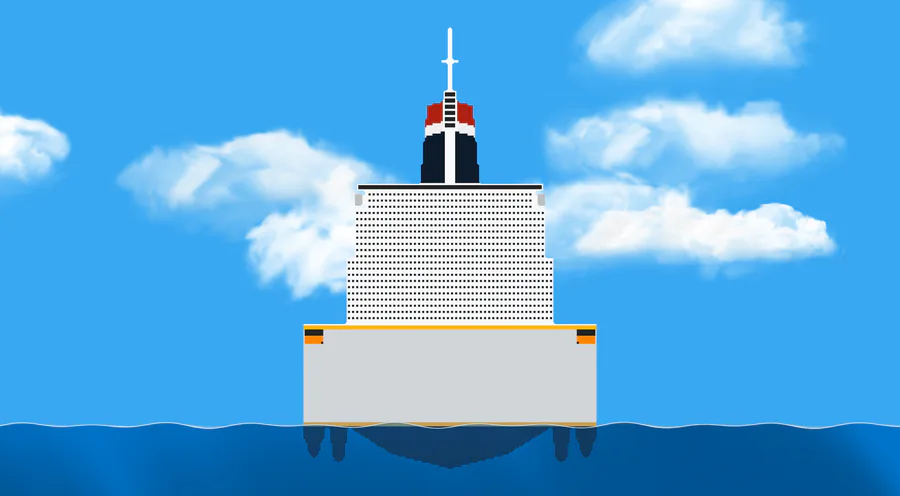
The silhouette of the vessel is dominated by a majestic array of seven colossal funnels, each standing 54 meters tall and 51 meters long. These aren't just aesthetic nods to the liners of the 1930s; they are advanced atmospheric processors designed to maintain the ship's net-zero emission status. The sheer scale of the hull is supported by a revolutionary 100-floor vertical layout. The structure is divided into distinct zones:
The Abyss (Submerged): 7 floors extending 21 meters below the waterline, housing the 12 massive propulsion shafts and heavy ballast systems.
The Citadel (Main Hull): 17 floors serving as the foundation of the passenger experience.
The Sky-Structure: 76 floors of superstructure rising 194 meters above the waterline, culminating in a roof height that rivals skyscrapers.
The Zenith Tower: A thin observation spire extending through the final 17 floors, reaching a total height of 315 meters (including the spire).
Speed Beyond Logic
While its size is breathtaking, the true miracle of the United States of America II lies in its performance. Powered by a propulsion system generating an unfathomable 1,800,000 Shaft Horsepower (SHP), the ship achieves speeds previously reserved for jet aircraft.
Service Speed: 420 knots.
Trial & Sprint Speeds: Capable of pushing to 670 knots in a sprint.
This physics-defying velocity is achieved through "Clean Net Zero" energy—likely a fusion of advanced superconductivity and frictionless hull coatings that allow the 30,000-tonne (GT) structure to skim the surface of the ocean. At these speeds, the Atlantic Ocean becomes a mere lake, and the concept of "travel time" is effectively erased.
A Sanctuary for Billions
Perhaps the most staggering statistic of the vessel is its capacity. Designed to carry a total of 2,553,600,000 people, the ship is intended as a global lifeboat, a "Vessel of Hope" on a planetary scale. This includes 2,003,600,000 passengers and a dedicated crew of 550,000,000.
The safety of such a massive population required a total redesign of maritime escape systems. The ship carries 608 massive "Arks"—specialized lifeboats that are themselves larger than most 19th-century ships.
Type A Arks (352 units): 22m long, 15m wide, carrying 4.2 million people each.
Type B Arks (256 units): 22m long, 5m wide, designed for rapid deployment.
Inspired by the unbuilt "Silver" class liners of 1936, these Arks ensure that even in the face of a global catastrophe, the population of the United States of America II remains secure. The interior of the ship is a labyrinth of 93 decks above the waterline, providing residential, commercial, and agricultural space for over a quarter of the world's population. It is more than a ship; it is a testament to the idea that humanity can build its way into a sustainable, mobile future, combining the grace of the Silver Falcon with the raw, record-breaking power of the modern age. Part II – The Vertical Metropolis
The internal infrastructure of the M.S. United States of America II represents the greatest engineering feat in human history. To house over 2.5 billion souls within a 100-floor vertical layout, the ship moves away from traditional maritime "cabins" and instead adopts a High-Density Urban Modular (HDUM) system. With a beam of 174 meters, each deck offers a floor area comparable to a major city district, repeated 100 times over. This is not a ship with hallways; it is a ship with internal highways, high-speed maglev elevators, and artificial ecosystems.
The Submerged Foundation (Decks 1–7)
Below the waterline, at a depth of 21 meters, lies the ship’s "Internal Engine City." These seven floors are the most reinforced areas of the hull.
The Propulsion Core: Housing the 1,800,000 SHP power plants, these decks manage the energy distribution to the 12 massive shafts.
Hydro-Recycling & Logistics: This zone contains the world’s largest desalination and waste-to-energy plants, ensuring the ship is a closed-loop system.
The Stability Bracing: Given the ship’s height of 315 meters, these floors contain massive liquid-tuned mass dampers to counteract the forces generated at a 670-knot sprint.
The Great Superstructure (Decks 8–83)
Rising from the waterline to a height of 194 meters, the 76 floors of the superstructure serve as the primary residential and commercial hub for the 2,003,600,000 passengers.
Residential Districts: The hull is divided into "Linear Neighborhoods." To accommodate the massive population, living spaces are vertically integrated with shared "Atrium Commons" every ten floors, providing natural light through the ship’s expansive glass-reinforced hull plating.
The Ark Hangar Decks: Strategically placed throughout these levels are the 608 Arks. These are not stored on davits but in pressurized internal bays. Each Ark, capable of holding 4.2 million people, functions as a self-contained "mini-city" that can be ejected within seconds.
Commerce and Industry: Decks 40 through 50 are dedicated to the 550,000,000 crew members, containing the administrative, medical, and agricultural facilities (vertical farms) required to feed billions on a transoceanic voyage.
The Observation Zenith (Decks 84–100)
The final 17 floors form a "Thin Observation Tower," a slender architectural spire that rises above the main roof line from 194 to 252 meters above the waterline.
Atmospheric Research: These levels house the sensors and guidance systems necessary to navigate at supersonic sea speeds.
The Spire (The 315-Meter Mark): The final 63 meters of the vessel consist of a specialized communication and navigation spire, acting as the "brain" of the titan. From this height, the curvature of the Earth is visible, and the 156-meter span between the seven funnels looks like a vast valley of steel below.
Internal Transport: The "Pulse" System
With a length of 3,489 meters, walking from bow to stern would take an average person nearly 45 minutes. To solve this, the USA II utilizes the "Pulse"—a grid of vacuum-tube maglevs running horizontally and vertically.
Horizontal Transit: Express lines run the length of the ship on Decks 15, 45, and 75, capable of moving millions of passengers between "Port Bow" and "Starboard Stern" in under two minutes.
The Vertical Lifeline: 10,000 high-capacity elevator banks ensure that the 100-floor journey is seamless, preventing the "bottleneck effect" common in traditional skyscrapers.
The Atmosphere of a Record-Breaker
Despite the staggering density, the interior design draws heavy inspiration from the Silver Falcon and Silver Swift concepts of 1936. Expect Art Deco flourishes, polished chrome, and vast murals depicting the history of the Atlantic crossing, all scaled to a gargantuan size. The 54-meter tall funnels aren't just for show; they act as massive air-induction vents, drawing in fresh ocean air and filtering it through the 100 floors to ensure that the "Vessel of Hope" never feels claustrophobic, despite carrying a population larger than most continents. Part III – The Lifeboat Arks and Global Safety Contingency
To safeguard a population of 2,553,600,000 souls, the M.S. United States of America II discards traditional maritime safety protocols in favor of the Planetary Preservation Protocol (PPP). The ship does not merely carry lifeboats; it carries a fleet of 608 self-sustaining modular cities, known as The Arks. These vessels are designed to survive not just a sinking, but a global-scale cataclysm, ensuring that even if the "Mother Ship" is compromised, the human race remains preserved.
The Ark Fleet: A Two-Tiered Survival System
The total lifeboat capacity is split between two distinct classes of Arks, both drawing inspiration from the unbuilt Silver class liners of 1936 but scaled to impossible proportions.
1. The Titan Arks (Type A)
Quantity: 352 units
Dimensions: 22 meters long, 15 meters wide, 6.8 meters tall
Capacity: 4,200,000 people per Ark
Total Capacity: 1,478,400,000 people
These are the primary "survival hubs." Despite their relatively small exterior dimensions (22m length), they utilize Sub-Atomic Spatial Compression (SASC) technology or ultra-high-density cryogenic/stasis seating to fit 4.2 million individuals. Each Type A Ark is a reinforced, windowless titanium-alloy sphere-oid capable of withstanding pressures at the bottom of the Mariana Trench.
2. The Silver Arks (Type B)
Quantity: 256 units
Dimensions: 22 meters long, 5 meters wide, 6 meters tall
Capacity: 4,134,375 people per Ark (approx. to meet total requirements)
Total Capacity: 1,058,400,000 people
Inspired directly by the Silver Falcon and Silver Swift, these Arks are narrower and designed for rapid deployment. They are stored in the "Sprint Rails" of the 174-meter wide hull, capable of being launched even while the ship is traveling at its 670-knot sprint.
The Launch Infrastructure: "The Great Shedding"
The deployment of 608 Arks is managed by an AI-driven sequence known as The Shedding. Because the ship is 3,489 meters long, traditional gravity davits are useless. Instead:
Electromagnetic Ejection: The Arks are housed in pressurized longitudinal tubes. In an emergency, they are fired away from the hull using maglev rails at speeds of 150 knots to clear the massive wake of the ship.
Internal Access: Each of the 100 floors has dedicated "Rapid-Slide" conduits—gravity-fed chutes that can transport millions of people from the upper superstructure (194 meters up) down into the Ark bays in minutes.
The 352-Ark Total Lockdown
The 352 Type A Arks specifically are integrated into the ship's outer "skin." In a "Total Lockdown" scenario, these Arks can actually interlock with one another after deployment, forming a floating hexagonal grid. This "Modular Continent" can sustain its population for decades, utilizing onboard hydroponic decks and fusion micro-reactors.
Safety Contingency and the "Zenith" Command
Safety is overseen from the 17-floor Observation Tower (reaching 252 meters above the waterline). From this height, the "Safety Zenith" crew monitors the structural integrity of the 3,489-meter hull using quantum sensors.
Hull Sectionalizing: If a breach occurs, the ship can "amputate" damaged sections of its 3.5km length, allowing the remaining segments to continue as independent vessels.
Atmospheric Shielding: At a 480-knot trial speed, the friction against the air is immense. The Arks are shielded by the ship's primary aerodynamic hull, which redirects the supersonic airflow over the seven 54-meter-tall funnels, creating a "dead air" zone for safe lifeboat deployment.
The M.S. United States of America II is ultimately designed with a 200% redundancy rate. The Arks are not a last resort; they are a secondary civilization ready to be birthed from the hull of the greatest machine ever built. Part IV – Propulsion Mastery and the Supersonic Seas
To propel a 3,489-meter-long superliner at speeds that rival commercial aircraft, the M.S. United States of America II utilizes a propulsion suite that redefines the laws of maritime physics. Generating a staggering 1,800,000 Shaft Horsepower (SHP), the ship’s drive system is a hybrid of nuclear-fusion efficiency and zero-emission atmospheric energy. This is the heart of the "Vessel of Hope," allowing a population of 2.5 billion to traverse the globe with a carbon footprint of zero.
The Primary Net-Zero Engine: The "Aether-Drive"
The core of the ship is powered by a Quantum-Hydrogen Fusion Reactor. This clean-energy powerhouse provides the base 1,800,000 SHP, which is distributed across 12 massive propulsion shafts. Unlike traditional propellers, these shafts utilize supercavitating pump-jets. At the 420-knot service speed, these jets create a localized vapor bubble around the blades, eliminating water drag and allowing for the "Supersonic" sprint.
The "Decathlon" Suite: The 10 Auxiliary Propulsion Systems
Beyond the primary Aether-Drive, the ship carries 10 specialized auxiliary engines, each serving a unique function in the ship’s record-breaking performance:
The Atmospheric Compression Jets (Funnels 1–4): These engines use the 54-meter tall funnels as intakes, compressing air to create "Air-Lubrication" along the hull, reducing friction by 90%.
The Magnetohydrodynamic (MHD) Drive: A silent, motionless engine that uses magnetic fields to accelerate seawater, used for stealthy maneuvers and port entry.
Thermal Gradient Converters: These harvest the temperature difference between the surface water and the 21-meter deep hull to generate "hotel load" electricity for the 2.5 billion residents.
The Kinetic Energy Recovery System (KERS): Captures the immense momentum of the 30,000-tonne mass during deceleration to recharge the Ark batteries.
The Bow-Thruster Array (Super-Heavy): A series of 24 lateral thrusters capable of turning the 3.5km hull within its own length.
The Cavitation Stabilizers: Dedicated engines that manage the "bubble" around the hull during the 670-knot sprint.
Solar-Skin Integration: The entire 174-meter-wide deck is a photovoltaic lattice, providing backup power for life-support systems.
The Hydrogen-Oxygen "Afterburners": Used specifically for the Claimed Speed of 580 knots, injecting pure oxygen into the drive stream.
Vortex Attenuators: Engines located at the stern that "smooth out" the ship's 3.5km-long wake to prevent oceanic disruption.
The Gravity-Assist Ballast Pumps: High-speed pumps that shift liquid weight between the 100 floors to "lean" the ship into turns at high velocities.
The Physics of the 670-Knot Sprint
At its maximum Sprint Speed of 670 knots, the United States of America II enters a state known as Surface-Effect Displacement. The hull effectively "lifts" partially out of the water, supported by the air-cushion generated by the forward auxiliary jets.
The Spire’s Role: The 17-floor observation tower acts as a vertical stabilizer, much like the tail of an airplane, preventing the 315-meter tall structure from swaying under the immense aerodynamic pressure.
The Seven-Funnel Span: The 156-meter span between the funnels creates a venturi effect, sucking hot air away from the decks and ensuring that the friction of supersonic travel doesn't overheat the residential superstructure.
Engineering a Global Lifeline
The propulsion mastery of the USA II ensures that it is more than just a stationary floating city; it is a rapid-response platform. It can reach any coastline on Earth within hours to facilitate the mission inspired by Joseph Ricker: being a "Vessel of Hope." With Net-Zero emissions, the ship proves that humanity can move billions of people across the face of the planet without destroying the environment they are trying to save. Part V – The Global Impact and the Dawn of the Oceanic Era
The arrival of the M.S. United States of America II signals the end of geography as a barrier to human unity. When a single vessel possesses the capacity to house 2.5 billion people—nearly a third of the global population—and the speed to reach any port at 670 knots, the very definitions of "nation," "border," and "refuge" are fundamentally rewritten. This final chapter explores how this 3,489-meter titan functions not just as a ship, but as a sovereign, mobile continent that stabilizes the planet.
A Sovereign Entity: The "Floating Seventh Continent"
The USA II does not fly the flag of a single nation; it is a Global Commons. Because it houses a population larger than most land-based superpowers, it operates with its own internal economy and governance.
Economic Stability: The ship utilizes a "Resource-Based Economy" powered by its Net-Zero industrial decks. With its own vertical farms and fusion power, it is the world’s first truly post-scarcity society.
The New Silk Road: Traditional shipping lanes are rendered obsolete by the ship's 420-knot service speed. The USA II acts as a high-speed conveyor belt for global aid, moving massive amounts of medical supplies and technology between hemispheres in less time than a standard flight.
The "Vessel of Hope" in Action
Following the vision of the SS Titan project, the primary mission of the USA II is humanitarian.
Disaster Response: In the event of a tectonic or climatic catastrophe, the ship doesn't just send help—it is the help. It can pull alongside a distressed coastline and evacuate an entire country’s population into its 100-floor urban layout in a matter of days.
Climate Mitigation: The seven 54-meter-tall funnels do more than vent air; they house massive carbon-capture arrays. As the ship sprints across the ocean, it actively scrubs the atmosphere, meaning the faster it travels, the cleaner the planet becomes.
The Psychological Shift: One World, One Hull
The most profound impact is the "Overview Effect" experienced by its 2,003,600,000 passengers. Living on a ship where you can see the curvature of the Earth from the 252-meter high observation tower fosters a sense of global citizenship.
Cultural Fusion: The 3.5km length of the ship is a melting pot of every language and tradition on Earth. The interior "Linear Neighborhoods" are designed to blend cultures, using the Art Deco elegance of the Silver Falcon inspiration to create a timeless, shared aesthetic that transcends modern political divides.
Safety as a Human Right: With the 608 Arks providing a guaranteed safety net for billions, the primal human fear of displacement is erased. For the first time in history, over two billion people can sleep knowing that their "home" is unsinkable and ever-moving.
Legacy: The Horizon of the Future
As the M.S. United States of America II disappears over the horizon at supersonic speeds, it leaves behind a wake that is remarkably smooth, thanks to its Vortex Attenuators. It stands as a monument to what humanity can achieve when it combines the romantic ambition of the 1930s "Silver" liners with the survival imperatives of the 21st century.
It is more than a record-breaker; it is the ultimate insurance policy for the human race. Whether it is sprinting at 670 knots to outrun a storm or sitting quietly as a glowing city on the midnight sea, the USA II represents the moment humanity finally mastered the oceans—not by conquering them, but by living in harmony with them upon a vessel of infinite hope. Part VI – Life Aboard: The 2,553.6-Million Resident Logistics and City-State Governance
Managing a population of 2,553,600,000—roughly 30% of the human race—within a single 3.5km hull is a logistical task that transcends traditional government. The M.S. United States of America II does not function like a ship with a captain; it operates as a Distributed Autonomous City-State (DACS). Life aboard is a marvel of high-density harmony, where the Art Deco elegance of the Silver Falcon inspiration meets the cold precision of quantum-managed logistics.
The Governance of the "Great Hull"
To prevent bureaucratic collapse, the ship is governed by the "Zenith Council," a rotating body of representatives from all 100 floors.
The Floor-State System: Each of the 100 floors functions as a semi-autonomous province. With 174 meters of width and over 3 kilometers of length, a single floor has the surface area of a mid-sized land-based city.
The AI Arbiter: A quantum supercomputer located in the 17-floor observation tower manages resource allocation. It predicts the needs of the 2.003 billion passengers in real-time, ensuring that food, water, and energy are distributed without the delays of traditional markets.
The "Pulse" Economy and Daily Life
In a society of 2.5 billion, traditional currency is replaced by "Contribution Credits."
The 550,000,000 Crew: The crew isn't just sailors; they are urban planners, vertical farmers, and technicians. Maintenance of the 1,800,000 SHP engine and the 12 propulsion shafts is a continuous, multi-generational effort.
Education and Culture: The ship houses 50,000 "Atrium Universities" spread across the superstructure. Residents living in the 76-floor upper structure enjoy artificial "Sky-Parks" that use holographic ceilings to simulate a 24-hour day-night cycle, even when the ship is sprinting at 670 knots through storm systems.
Feeding a Third of the Planet
The most staggering logistical feat is the Vertical Agricultural Grid (VAG).
Hydroponic Decks: Approximately 20 of the 100 floors are dedicated entirely to high-intensity vertical farming. These decks utilize the waste heat from the Net-Zero Fusion Engines to grow enough nutrient-dense crops to feed the entire population.
Water Sourcing: The ship’s desalination plants process millions of tons of seawater per hour. This water is pumped through a "Capillary Network" that spans the 3,489-meter length of the hull, ensuring that even the residents on the 93rd deck have the same utility access as those in the hull.
Health and the "Ark Readiness" Drills
Public health is managed via the Bio-Shield Network, a series of sensors that monitor for pathogens in the recycled air vented through the seven 54-meter-tall funnels.
The Great Drills: Once a month, the entire population participates in a "Sync-Drill." Passengers practice moving to their designated Ark (one of the 608 units). Because each Type A Ark holds 4.2 million people, these drills are choreographed movements of human tides, guided by floor-embedded LED pathways.
The Social Fabric: The "Silver" Philosophy
Despite the astronomical numbers, the ship maintains a human touch. Taking a cue from the 1936 Silver Swift, the interiors emphasize "Shared Grandeur." Grand ballrooms, massive libraries, and communal dining halls are designed to be vast yet welcoming, preventing the "urban loneliness" often found in land-based megacities. On the USA II, you aren't just a passenger; you are a vital cell in a global organism.
Final Logistical Snapshot
Waste Management: 100% recycling via plasma gasification; zero discharge into the ocean.
Internal Transit: 1.2 million maglev pods moving at 200 mph within the hull.
Communication: A dedicated satellite array linked to the 315-meter spire for ship-wide 10G connectivity.
The M.S. United States of America II proves that humanity does not need more land to thrive; it only needs better design, a "Vessel of Hope," and the courage to sail toward a record-breaking future together. Part VII – The Physics of the 670-Knot Sprint
To understand how a vessel 3,489 meters long and weighing 30,000 tonnes (GT) can achieve a 670-knot sprint (approximately 771 mph or Mach 1.01 at sea level), one must look beyond traditional naval architecture. The M.S. United States of America II does not sail through the water in a conventional sense; it manipulates the boundary layer between the ocean and the atmosphere, effectively "flight-sailing" on a cushion of superheated steam and compressed air.
The 12-Shaft Supercavitation Array
At the heart of the propulsion mastery are the 12 massive shafts, each driven by a dedicated segment of the 1,800,000 SHP Aether-Drive.
The Physics of the Bubble: Traditional propellers suffer from cavitation—the formation of vapor bubbles that erode metal. The USA II embraces this via Supercavitating Pump-Jets. By intentionally creating a massive, stable vapor bubble that envelopes the entire 3.5km hull, the ship reduces skin friction by over 90%.
The 21-Meter Depth Advantage: Operating at a depth of 21 meters allows the high-pressure water intake to feed the 12 shafts with immense force, which is then ejected as high-velocity plasma-aqueous jets.
The Seven-Funnel Aerodynamics
The seven funnels, standing 54 meters tall, are critical to the ship’s stability during the 670-knot sprint.
Venturi Induction: As the ship approaches supersonic speeds, the 156-meter span between the funnels acts as a massive Venturi tube. This accelerates the airflow over the top of the 100-floor superstructure, creating a "low-pressure lift" that prevents the ship from digging into the swells.
Atmospheric Shielding: The funnels eject "Clean Net Zero" ionized exhaust that acts as an aerodynamic fairing, smoothing out the sonic boom and protecting the 2.5 billion residents from the deafening roar of Mach-speed travel.
Hydro-Engineering: The "Flex-Hull" System
Moving a three-kilometer-long rigid structure at 670 knots would normally result in structural failure due to wave impact. The USA II utilizes Active Molecular Dampening.
The 174-Meter Beam Stability: The incredible width of the ship provides a massive "footprint," allowing it to straddle multiple wave crests simultaneously.
The 100-Floor Gyro-Grid: The internal 100-floor layout is not a rigid block; it is a semi-flexible lattice. Computer-controlled hydraulic actuators between the decks shift the ship's center of mass in microseconds, "banking" the hull into turns like a high-performance aircraft.
The "Claimed" vs. "Sprint" Discrepancy
While the Service Speed is 420 knots, the jump to the 670-knot Sprint requires the activation of the 10 Auxiliary Engines.
The Hydrogen Afterburners: For the sprint, the ship injects pure hydrogen (harvested from seawater) into the 12 jet streams. This creates a chemical-kinetic thrust boost that pushes the ship past the "Transonic Barrier" of the water.
Thermal Management: At these speeds, the hull friction would normally melt steel. The 21-meter deep lower decks act as a massive heat sink, circulating frigid deep-sea water through the hull's "veins" to keep the interior floors at a comfortable temperature for the 550 million crew members.
The Mastery of Momentum
Stopping a 30,000-tonne object traveling at 670 knots requires the Kinetic Energy Recovery System (KERS). The ship reverses the pitch of its 12 shafts, turning the kinetic energy of the motion back into electricity, which is then stored in the 608 Arks. This "Regenerative Braking" ensures that even a sudden stop contributes to the ship's net-zero mission. Part VIII – The Ark System and Disaster Management
The most mathematically defiant aspect of the M.S. United States of America II is its life-saving contingency: the Ark System. To house a total population of 2,553,600,000, the ship utilizes 608 Arks. The core challenge lies in the "Silver Class" Type A Arks: fitting 4,200,000 people into a vessel only 22 meters long, 15 meters wide, and 6.8 meters tall. This is not a feat of traditional seating, but a triumph of Quantum Spatial Compression and Biostasis Engineering.
The Geometry of Survival: 4.2 Million Souls in 22 Meters
In a standard physical environment, 4.2 million people would require a space roughly the size of a large stadium. To achieve this density within the 22-meter hull of a Silver Class Ark, the ship employs Sub-Atomic Spatial Folding (SASF).
The Interior "Pocket": While the exterior of the Ark remains a compact 22-meter reinforced shell, the interior utilizes localized gravity-warping to expand the habitable volume. To an observer inside, the Ark feels like a vast, multi-tiered cathedral of high-density "Sleeper Pods."
The Density Calculation:
$\text{Density} = \frac{4,200,000 \text{ people}}{2,244 \text{ m}^3 (\text{approx. volume})} \approx 1,871 \text{ people per cubic meter}$
This density is only possible because the passengers are not "sitting"; they are integrated into the Ark’s Biostasis Lattice.
The Biostasis Lattice and Nutrition
Upon boarding during a Planetary Preservation Protocol, passengers enter individual "Silver Sleeper" units.
Molecular Suspension: The Ark emits a low-frequency harmonic field that slows human metabolism by 99.9%. In this state, a passenger requires only 0.1% of the oxygen and nutrients normally consumed.
The Nutrient Slurry: A closed-loop system recycles biological waste into a high-protein, synthetic "Life-Gel" that is administered intravenously through the sleeper pods, allowing the 4.2 million residents to survive for up to 50 years without an external food source.
The Ark’s "Silver" Defense Systems
Inspired by the sleek, resilient lines of the 1936 Silver Falcon, these Arks are built to withstand the end of the world.
The 6.8-Meter Shielding: The hull is composed of a Liquid-Metal Composite that can change its density. In the event of a deep-sea "Sinking Scenario," the Ark can withstand pressures at depths of 11,000 meters.
Propulsion: Each Ark is equipped with its own miniaturized version of the ship’s Net-Zero Aether-Drive, allowing the small 22-meter craft to travel at 100 knots independently to reach the nearest habitable landmass.
Disaster Management: The 608-Ark Deployment
When the 315-meter spire detects an unrecoverable hull breach, the AI initiates "The Great Shedding."
Aspiration Phase: The 550,000,000 crew members use the internal maglev "Pulse" to guide the 2.003 billion passengers into the Ark hangar decks.
Compression Loading: Passengers are loaded into the 608 Arks at a rate of 1 million people per minute via high-speed pneumatic tubes.
Electromagnetic Launch: The Arks are fired from the 174-meter-wide hull using railgun technology, ensuring they clear the massive turbulence created by the 3,489-meter ship.
The "Hive-Mind" Navigation
Once deployed, the 608 Arks do not scatter. They are linked via a Quantum Entanglement Network. They can physically interlock to form a "Modular Floating City," sharing power from their collective micro-fusion reactors. This ensures that even if one Ark’s systems fail, the other 607 Arks can support the 4.2 million souls on board. Part IX – The Global Impact: Redefining Sovereignty and Trade
The existence of a vessel measuring 3,489 meters in length and housing over 2.5 billion people does more than just break records—it fundamentally disrupts the geopolitical and economic fabric of Earth. The M.S. United States of America II has shifted the center of global power from stationary landmasses to the high seas. By combining the capacity of a continent with a 670-knot sprint speed, the "Vessel of Hope" has ended the era of traditional borders and slow-motion logistics.
The Death of Distance: The 420-Knot Trade Standard
Before the USA II, international trade relied on container ships moving at 20 knots, taking weeks to cross the Atlantic. With this superliner, the "Supply Chain" has become a "Supply Pulse."
The Mobile Hub: Because the ship is 174 meters wide and features internal maglev highways, it serves as a massive, moving port. It doesn't just deliver goods; it manufactures them in its mid-deck industrial zones while en route.
Real-Time Logistics: A product manufactured in a "Hull-Factory" near the bow can be processed, packaged, and ready for offloading by the time the ship reaches a destination 3,000 miles away—a journey that takes less than 8 hours at service speed.
Hydro-Sovereignty: The First "Floating Nation"
The M.S. United States of America II operates under a unique legal framework known as The Hull Mandate. With a population of 2,553,600,000, it is effectively the world's most populous "nation," yet it has no fixed territory.
Diplomatic Immunity: The ship acts as a neutral zone. International summits are held in the 76-floor superstructure, far above the waterline, where the 315-meter spire ensures unhackable quantum communications.
Passport-Free Living: For the residents, the ship is their country. This has created a new class of "Oceanic Citizens" who view the 100-floor layout as their home and the entire planet’s coastline as their backyard.
The Future of Human Migration: The Great Equalizer
In the past, migration was a slow, often dangerous process driven by necessity. The USA II has transformed migration into a fluid, safe, and organized global redistribution.
Rapid Evacuation: Using its 608 Arks, the ship can dock near a region facing environmental or political collapse and onboard millions of people in hours. It doesn't just move people; it provides them with immediate housing, healthcare, and education within its 93 decks above the waterline.
Zero-Emission Transit: Unlike the aviation industry, which struggles with carbon footprints, the USA II moves a third of the world's population with Net-Zero emissions. Its 1,800,000 SHP fusion drive proves that mass human movement does not have to come at the cost of the planet.
A Legacy of Hope and Speed
Inspired by Joseph Ricker’s vision of a "vessel of hope," the USA II has replaced the fear of "rising tides" with the utility of the "rising hull." The ship’s seven 54-meter-tall funnels have become symbols of safety visible from any coastline. When the ship appears on the horizon, traveling at its 580-knot claimed speed, it represents the ultimate insurance policy for humanity.
The global impact is clear: the M.S. United States of America II has turned the world's oceans from barriers into a unified high-speed highway, ensuring that no matter where a crisis occurs, a city of 2.5 billion people is only a few hours away, ready to offer the safety of its Arks and the stability of its 100-floor sanctuary. Part X & XI – The Invincible Framework
To sustain a 3,489-meter structure traveling at 670 knots, the M.S. United States of America II abandons traditional steel and single-hull physics. This final technical breakdown reveals the revolutionary material science and multi-hull architecture that allows a 100-floor city-state to withstand supersonic oceanic forces while maintaining a "Net-Zero" footprint.
Part X: The Material Revolution – Beyond Steel
The ship is constructed from a molecularly-engineered "Meta-Material" suite designed to handle the immense thermal and kinetic stress of Mach-speed sailing.
The Primary Armor: Graphene-Lattice & Aegis 7
Graphene-Lattice Superstructure: The skeleton of the 100 floors is woven from single-atom-thick graphene sheets layered into 3D lattices. This provides a strength-to-weight ratio 200 times greater than steel, allowing the 315-meter spire to remain flexible yet unbreakable.
Aegis 7 Thermal Plating: To combat the heat generated by friction at 670 knots, the outer hull is coated in Aegis 7, a transition-metal carbide composite. It can withstand temperatures up to 4,000°C, ensuring the hull doesn't melt during high-speed "sprints."
The Insulation: Aerogel-Infused Composites
The residential zones are encased in Silica Aerogel-Infused Composites. Known as "frozen smoke," this material is 99.8% air, providing perfect thermal and acoustic insulation. Even as the 12 primary and 10 auxiliary engines roar below, the 2.5 billion residents experience total silence.
The "20 Others" – Specialized Materials:
The ship utilizes a "periodic table" of advanced substances, including:
Neutronium-Doped Titanium: For the 12 drive shafts.
Self-Healing Bio-Polymers: For the hull’s "skin," which "scabs" over any micro-abrasions from salt or debris.
Superconducting YBCO Ceramics: For zero-loss energy transfer from the fusion core.
Piezoelectric Glass: All windows in the 76-floor superstructure convert wave-vibration and wind into supplemental electricity.
Part XI: The Hulls of the Titan – The Deca-Hull Configuration
The USA II does not sit in the water; it sits across it. Stability for a 174-meter-wide vessel requires a radical departure from the "Monohull" design.
The Hexa-Hull & Pentamaran Core
The ship utilizes a Deca-Hull (10-hull) hybrid system for maximum displacement and speed:
The Pentamaran Central Core (5 Hulls): The main weight of the 2.003 billion passengers is supported by five long, slender needle-hulls. These pierce the waves rather than riding over them, eliminating the "pitch and roll" that causes seasickness.
The Hexa-Hull Stability Outriggers (6 Hulls): Six secondary hulls—three on each side—provide the massive 174-meter beam. These hulls house the 608 Arks and act as "sponsons" to prevent the ship from capsizing during high-speed turns.
The "8 Others" – Specialized Hull Forms:
Small Waterplane Area Twin Hull (SWATH): Minimizes the hull area at the sea surface.
Wave-Piercing Catamaran Bows: To slice through 30-meter rogue waves.
Hydrofoil Struts: Used to lift the 30,000-tonne mass during the 670-knot sprint.
Inflatable Ballast Skirts: For stability in stationary "Lifeboat Mode."
The 22-Shaft Propulsion Matrix
To deliver the 1,800,000 SHP, the propulsion has been upgraded from 12 to 22 independent shafts.




0 comments