

Modernized Replicas: The boat deck features high-tech, enclosed versions of the original Olympic-class lifeboats. While they look like the 1912 classics, they are built from the same lightweight aluminum used on the original S.S. United States.
The Ark Synergy: These "classic" boats serve as immediate evacuation pods for the crew, while the 480 Arks handle the billion-soul passenger manifest. Every lifeboat is equipped with 2026-standard GPS, satellite link-ups, and automated nutrient-mist dispensers.
The World’s Homeports: A Global Itinerary
The M.S. United States of America is a welcome guest at the world's most sophisticated deep-water ports. Its homeport rotation covers every major maritime nation, serving as a floating embassy for Indonesian, Singaporean, Finnish, Swedish, Dutch, Chinese, Spanish, and Norwegian interests.
Asian Hubs: Singapore, Haiphong (Vietnam), Manila (Philippines), Laem Chabang (Thailand), and Port Klang (Malaysia).
Western Hubs: New York and Los Angeles (USA), Vancouver (Canada), Sydney (Australia), Southampton (UK), and Hamburg (Germany).
European Hubs: Marseille (France), Genoa (Italy), Barcelona (Spain), and Oslo (Norway).
As the ship moves between these ports at its 380-knot service speed, it carries with it the hope of a unified planet—a record-breaking titan that belongs to no single nation, but to every soul that walks its 84 decks. Part 13: The Ark Legacy – A Tribute to the Vision of Joseph Ricker
The final evolution of the M.S. United States of America safety suite is the Ricker-Class Ark System, a direct homage to the SS Titan Project and the humanitarian dreams of its founder, Joseph Ricker (1967–2023). While the original SS Titan was envisioned as an 1,182-foot "vessel of hope," the M.S. United States of America scales this mission to a global level. The 480 Arks aboard are not merely escape vessels; they are the spiritual successors to the Titan, designed to ensure that even in the face of disaster, the mission to protect the "sick and needy" remains unbroken.
The Ark Aesthetic: Titanic II Meets the 21st Century
The design of the 2,800,000-capacity Arks draws a deliberate visual line to Clive Palmer’s Titanic II and the classic lines of the Olympic-class liners.
Historical Silhouette: Each 22-meter Ark features a reinforced "Aegis-7" hull that mimics the elegant, black-and-white livery of the 1912 era, providing a sense of nostalgic comfort to the billion-plus passengers during an evacuation.
Modernized Safety Deck: Inspired by the Titanic II Safety Deck, which integrates enclosed modern lifeboats beneath a replica boat deck, the "Big U.S.A." hides its massive Arks behind decorative panels that resemble the original promenade of the SS Titan. This ensures that the ship maintains its sleek, "Silver Class" profile while carrying the most advanced survival technology ever conceived.
The SS Titan Foundation Mission: A Vessel for the Needy
Following the passing of Joseph Ricker in 2023, the SS Titan Foundation's mission was integrated into the core operating charter of the M.S. United States of America.
The "Hope" Berths: Within each 2.8-million-person Ark, priority sectors are permanently reserved for children and families under the care of the Foundation. These areas are equipped with specialized medical suites and sensory-calming environments, fulfilling Ricker’s dream of a ship that serves the most vulnerable.
Economic Fundraising: True to the original project’s goals, the ship continues to host large-scale "Titan Music Festivals" on its 160-meter-high roof decks. The revenue from these events—collected in a global basket of currencies from Ringgit to Euro—is funneled directly into the Foundation's work with children's hospitals worldwide.
Specifications of the Ricker-Class Ark
While the conceptual SS Titan targeted a speed of 45 knots, the Arks it inspired on the M.S. United States of America are built for a different kind of performance:
The 30-Day Sustenance: Each Ark can operate as a floating hospital for up to a month, powered by the same "Net-Zero" solar-film used on the main ship's funnels.
The "Titan" Density: By condensing the 2,800-passenger capacity of Ricker’s original dream into a hyper-efficient 22-meter pod, the ship ensures that every one of the 1,344,000,000 souls is part of a "Vessel of Hope."
A Monument to a Dreamer
Joseph Ricker envisioned a ship that was "unselfish in its ambitions." The M.S. United States of America stands as the physical manifestation of that unselfishness. As the ship traverses its global homeports—from Singapore to New York, and from Haiphong to Hamburg—it carries the SS Titan legacy in its very hull. It is a record-breaking titan that doesn't just cross oceans at 620 knots; it carries the memory of a man who believed a ship could save the world, one child at a time. Part 14: The Global Fleet – 30 Real, Proposed, and Legacy Lines
To build a vessel that houses 1.344 billion people, the M.S. United States of America draws upon the combined DNA of maritime history. The ship serves as a "mothership" for a consortium of thirty legendary and proposed entities, integrating their design philosophies, service standards, and historic speed-records into a single 2,722-meter frame.
The Pioneers: The North Atlantic Legacy (1-10)
These companies defined the "Golden Age" of liners and provided the primary aesthetic for the 84-floor layout.
United States Lines: The original operator of the S.S. United States; their high-speed "Big U" blueprints are the foundation of Part 4’s propulsion.
Cunard Line: Providers of the "Queen" class service standards; their "floating palace" philosophy defines the Zenith District.
White Star Line: The architectural inspiration for the Titanic-styled Arks and the focus on immense scale.
French Line (CGT): The masters of art-deco luxury; their influence is seen in the 174-meter-wide grand ballrooms.
North German Lloyd (NDL): Early Blue Riband holders whose focus on engineering efficiency inspired the Aegis-7 hull.
Hamburg-America Line (HAPAG): Pioneers of leisure cruising, defining the "Village" lifestyle on Decks 8-40.
Inman Line: Masters of the early "screw" propulsion, whose legacy lives on in the 12-shaft drive system.
Red Star Line: Famous for their humanitarian transport of millions, mirroring the ship’s billion-soul migration mission.
Collins Line: The American challenger to Cunard, providing the "national pride" mandate for the ship’s name.
Italian Line: Designers of the sleek Rex and Andrea Doria, providing the aesthetic for the 54-meter-tall funnels.
The Visionaries: Proposed and Unbuilt Concepts (11-20)
These companies represent "the ships that could have been," now realized within the M.S. United States of America.
11. Atlantic Steam Navigation Company: Creators of the "Silver Class" (Silver Falcon/Silver Swift), providing the narrow-hull high-speed blueprints.
12. SS Titan Foundation: Founded by Joseph Ricker; the primary source for the "Vessel of Hope" charitable charter.
13. Blue Star Line (Titanic II): Clive Palmer’s vision for a functional replica, providing the bridge between history and modern Arks.
14. Oceanic Steam Navigation Company (Proposed): The legendary Oceanic III (White Star's 1,000ft unbuilt liner) inspired the ship's 1.1 million-person Plaza sectors.
15. U.S. Maritime Administration (MARAD): Their cold-war era troopship designs provided the logistics for moving 300 million crew.
16. Vickers-Armstrongs (Proposed Designs): The 1930s high-speed "Silver" proposals for Frank Bustard.
17. Project America (NCL): The early 2000s plan to revive the S.S. United States for Hawaiian service.
18. The World City Project (Proposed): A 1980s concept for a 5,000-passenger megaship, here scaled 200,000x.
19. Freedom Ship International: The conceptual "floating city" that provided the basis for the 84-floor urban layout.
20. Meyer Werft (Manta Ray Concept): The design partner for the 174-meter wingspan and aerodynamic lift.
The Modern Giants: Contemporary Partners (21-30)
These firms provide the modern technology and port logistics for the 2026 operation.
21. Norwegian Cruise Line (NCL): Legacy owners of the original S.S. United States hull.
22. Royal Caribbean Group: Experts in "Icon" class gigantism and high-density passenger flow.
23. Carnival Corporation: Providing the global logistical backbone for the Homeports in Singapore, London, and New York.
24. MSC Cruises: Technical partners for the clean LNG and Net-Zero "Sun-Drive" research.
25. Crystal Cruises: Masters of ultra-luxury who designed the 17-floor Observation Tower.
26. P&O Cruises: The oldest cruise line, ensuring the 1.344 billion souls experience timeless maritime tradition.
27. Holland America Line: Experts in "long-haul" residency, managing the permanent residents on Decks 41-60.
28. Princess Cruises: Famous for the "Love Boat" era, they manage the entertainment and social cohesion of the "Villages."
29. Disney Cruise Line: Their focus on family-centric safety helped design the 2.8-million-person Ark loading protocols.
30. SS United States Conservancy: The guardians of the original ship’s history, serving as the cultural advisors for the entire project. Part 15: The Digital Nexus – The AI Sovereign of the Seas
To maintain a delicate equilibrium for 1.344 billion souls traveling at 620 knots, the M.S. United States of America is governed by the "Digital Nexus." This is a decentralized, trillion-parameter AI network that serves as the ship's brain, heart, and nervous system. In an era where the original S.S. United States has been preserved as a monumental artificial reef and museum in 2026, this new vessel stands as its living, digital successor—a "Physical AI" megacity.
The Trillion-Parameter Governor
The Digital Nexus is powered by a Quantum-Edge Computing array located in the 7-deck-deep "Anchor District." Unlike land-based cities, the ship cannot rely on cloud latency; every decision must happen at the "Edge."
Population Homeostasis: The AI monitors the "biometric pulse" of the billion residents. It adjusts the 84-floor climate control, oxygen levels, and nutrient-mist distribution in real-time, preventing the "urban heat island" effect common in terrestrial megacities.
The "Guardian" Interface: Residents interact with the Nexus via a seamless, holographic AI assistant—a digital avatar of the "Vessel of Hope" spirit. It manages the Universal Ledger (converting Ringgit, Baht, and Euro instantly) and directs the Pulse Transit pods to prevent human traffic jams.
Supersonic Navigation: The 620-Knot Pilot
Navigating a 2,722-meter hull at supersonic speeds is a task beyond human reflex. The Nexus utilizes Multimodal Transformers and FALCON control systems to pilot the ship.
Predictive Hydro-Planning: Using real-time satellite feeds and sonar, the AI predicts wave patterns five miles ahead. It adjusts the 10-hull Deca-Hull configuration and the 12-shaft propulsion in milliseconds to ensure the ship "slices" through rogue waves without a single vibration reaching the passenger decks.
The Collision Avoidance Mesh: At 620 knots, the ship’s radar signature is massive. The Nexus broadcasts a "Digital Wake" that clears all maritime traffic within a 100-mile radius, coordinating with global coast guards from Singapore to New York.
Virtual Visualization: The "Nano Banana" Lens
To allow the 300 million crew members to monitor the ship’s health, the Nexus uses a visual reasoning engine known as Nano Banana 2.
Holographic Digital Twins: Engineers can project a 1:1 scale, 4K resolution "digital twin" of any section of the 2.7-kilometer hull. Using intelligent, prompt-based editing, a technician can say, "Show me the stress loads on Funnel 4 during the 490-knot claim," and the AI instantly visualizes the data as a clean, isometric infographic.
Grounding in Reality: The system uses Google Search Grounding to cross-reference the ship's performance with historical data from the SS United States Conservancy and the SS Titan Foundation, ensuring the vessel’s operation stays true to its 20th-century inspirations while pushing 21st-century boundaries.
The Humanitarian Ethics Core
At the center of the Digital Nexus is the Ricker-Charter Protocol. This "hard-coded" ethical layer ensures that the AI's primary directive is the welfare of the "sick and needy." If a humanitarian crisis is detected in a homeport like Manila or Jakarta, the Nexus automatically calculates the most fuel-efficient 620-knot Sprint to deliver the ship’s 480 Arks and medical megaplexes to the site of the disaster. Part 16: Vertical Urbanism – The 84-Floor Superstructure
To house a population exceeding one billion, the M.S. United States of America discards traditional ship decks in favor of Vertical Urbanism. This architectural philosophy, pioneered by icons like Zaha Hadid and refined for the 2026 maritime era, treats the 2,722-meter hull as a multi-layered, three-dimensional organism. The 84 floors are not merely stacked plates; they are interconnected urban ecosystems that balance hyper-density with the human need for light, air, and nature.
The Stratified City: Residential Districts
The living quarters for 1.044 billion passengers are organized into four primary "Altitude Belts," each with its own micro-climate and social character.
The Aqua-Belt (Decks 8–25): These lower residential decks utilize "Virtual Windows" to project real-time ocean views. The architecture here is inspired by the "Silver Class" efficiency, featuring modular, high-tech units that can be reconfigured for single travelers or large families from the Philippines, Indonesia, or Vietnam.
The Meridian-Belt (Decks 26–50): This is the ship's social heart. Every five floors, a "Grand Atrium" cuts through the superstructure, creating a massive void that allows sunlight from the upper skylights to reach deep into the hull. These atria function as town squares, filled with markets where Baht, Ringgit, and Pesos are traded for global goods.
The Titan-Belt (Decks 51–67): Dedicated to the SS Titan Foundation's mission, these decks feature wide, accessible boulevards and specialized medical-residential "hubs." The architecture here prioritizes healing, with soft curves, acoustic dampening, and integrated greenery.
The High-Altitude Observation Parks (Decks 68–77)
Above the primary superstructure roof (160 meters) lies the Zenith District, where the ship's width tapers into the observation tower.
The Sky-Gardens: Located at the 218-meter level, these are the highest botanical gardens on Earth. They are enclosed in Transparent Aluminum (Alon), allowing residents to walk among lush, tropical flora while the ship sprints at 620 knots below them.
The Cloud-Walks: Cantilevered glass walkways extend out from the 17-floor observation tower, giving visitors a terrifying yet majestic view of the 156-meter span of the six funnels and the infinite ocean horizon.
Atmospheric Cafés: Here, the elite of the global mosaic—from Japanese tech-magnates to French artists—gather to witness the sunrise at a height that technically qualifies as "low-altitude flight."
Vertical Logistics: The "Spine" Elevators
To move 1.344 billion people vertically, the ship employs an Exoskeletal Elevator System.
Panoramic Maglevs: Rather than hiding elevators in a central core, 5,000 glass maglev pods climb the exterior of the hull. This "Visual Density" allows passengers to orient themselves within the 2.7-kilometer length of the ship while traveling between the underwater industrial decks and the observation spires.
The Atrium Bridges: Horizontal "sky-bridges" crisscross the interior voids, ensuring that no resident is more than a two-minute walk from a "Pulse Transit" station.
Sustainability and Light
The 84-floor layout is a "Clean Net-Zero" machine. The "Smart Skin" of the superstructure incorporates fiber-optic sunlight collectors that pipe natural light down into the 7 decks below the waterline. This ensures that even the 300 million crew members working near the 1,800,000 SHP drive system feel the natural rhythm of day and night, maintaining the psychological health of the world’s largest floating civilization. Part 17: The Kinetic Spine – 12 Super-Cavitating Shafts and Industrial Might
To translate 1,800,000 SHP from the Net-Zero reactors into raw oceanic thrust, the M.S. United States of America utilizes a propulsion array that defies traditional mechanical limits. The ship’s "Kinetic Spine" consists of 12 primary super-cavitating shafts, supplemented by a network of auxiliary "immense strength" maneuvering shafts. This system is the reason a 2,722-meter vessel can achieve a 620-knot Sprint, effectively "punching" through the Atlantic at near-supersonic speeds.
The 12 Primary Super-Cavitating Shafts
At speeds above 100 knots, standard propellers suffer from "cavitation," where water vaporizes and erodes the metal. The 12 primary shafts of the "Big U.S.A." are designed to embrace this phenomenon.
The Geometry of the Wedge: Each shaft terminates in a Super-Cavitating Propeller (SCP). Unlike the curved blades of the original S.S. United States, these are wedge-shaped with a razor-sharp leading edge.
The Vapor Envelope: At full rotation, the blades create a massive, stable bubble of steam that completely envelopes the propeller and the shaft. By spinning within air rather than liquid water, skin friction is reduced by nearly 90%, allowing the 1.8 million horses to drive the 70,000-tonne hull without the "drag wall" that stops traditional liners.
Material Composition: Each of the 12 shafts is forged from Neutronic-Titanium Alloy, a material with a tensile strength exceeding 50,000 MPa, ensuring the shafts do not twist under the immense torque of the Sun-Drive reactors.
The Auxiliary "Immense Strength" Shaft Network
Beyond the 12 main drives, the ship features a sophisticated network of 48 auxiliary shafts located in the Pentamaran outriggers and the bow.
Vectoring Maneuverability: These smaller, high-strength shafts power 360-degree "Azipod" units. They allow the 2.7-kilometer ship to pivot in place or navigate the tight confines of homeports like Singapore or Hamburg without the need for tugboats.
The Bow-Borer Shafts: Four specialized shafts at the prow drive "Water-Jet Inducers." These suck in water and eject it at hyper-velocity, creating a low-pressure zone directly in front of the ship to further reduce wave-resistance during the 490-knot claimed speed runs.
The 1,800,000 SHP Transmission
The transmission of power from the 7-deck-deep engine room to the 12 shafts is managed by Superconducting Magnetic Gears.
Frictionless Power: There is no physical contact between the reactor turbines and the shafts. Instead, high-intensity magnetic fields transfer the torque, eliminating mechanical wear and heat buildup.
Vibration Dampening: This magnetic coupling ensures that the 1.344 billion souls aboard feel zero vibration from the engines, even when the ship is pushing 620 knots. The only sound is the distant, melodic hum of the Digital Nexus managing the power flow.
Reliability for the Global Mosaic
Because the ship serves as a "Vessel of Hope" for the Vietnamese, Philippine, Thai, and Malaysian populations (among others), the 12-shaft system is designed with 400% redundancy. The ship can maintain its 380-knot service speed even if 8 of the 12 shafts are offline for maintenance. This industrial resilience ensures that the M.S. United States of America is never "stuck," maintaining its role as the heartbeat of global human migration. Part 18: The Economic Magnitude – A Multitrillion-Dollar Investment
To construct a vessel of the scale and complexity of the M.S. United States of America in 2026, the global financial commitment must match its physical dimensions. While the original SS Titan Project carried a projected price tag of $1.6 billion USD for a ship of 1,182 feet, the "Big U.S.A."—at 2,722 meters and housing over a billion people—represents a fiscal category beyond traditional maritime economics. This is the first "Giga-Project" in human history, with a total estimated cost of $14.2 Trillion USD.
Capital Breakdown: The Cost of the "Vessel of Hope"
The budget is divided into four primary "Fiscal Pillars," managed by the Digital Nexus to ensure transparency across the 30 partner companies and the global homeports.
Expense CategoryAllocation (USD)Primary DriversHull & Superstructure$4.8 TrillionForging the 2.7km Aegis-7 graphene-titanium frame and 84 decks.Propulsion & Energy$3.2 TrillionTwelve Net-Zero Sun-Drive reactors and the 1,800,000 SHP magnetic gears.Urban Infrastructure$4.1 TrillionModular housing for 1.344 billion souls, hospitals, and 12,000 maglev elevators.The Ark Safety System$2.1 TrillionProduction of 480 Ricker-Class Arks ($4.3B each) and 30-day life support.
Materials Economics: The Graphene Premium
The use of high-tensile, molecularly-bonded materials accounts for the largest single expense.
Neutronic Steel: Sourcing the 70,000 tonnes of high-density alloys required a decade of global production.
Quantum-Tensile Graphene: With market prices for commercial-grade graphene in 2026 reaching $67,000 to $200,000 per ton, the ship’s "Smart Skin" represents a technological investment that exceeds the GDP of many mid-sized nations.
Multi-Currency Funding Strategy
To avoid destabilizing any single national economy, the M.S. United States of America was funded through a "Global Sovereignty Bond."
The Southeast Asian Contribution: Massive investments in Singapore Dollars (SGD) and Malaysia Ringgit (MYR) funded the primary hull construction in the deep-water yards of the Pacific.
The European & American Equity: The Euro (EUR), British Pound (GBP), and US Dollar (USD) were utilized for the high-altitude observation parks and the Digital Nexus AI development.
The Humanitarian Dividend: In the spirit of Joseph Ricker, 15% of the total cost was crowd-funded through "Citizen Bonds," allowing residents from the Philippines to Norway to own a literal piece of the ship, paying back dividends in "Clean-Energy Credits."
Operational ROI (Return on Investment)
While the $14.2 trillion cost is staggering, the ship's 380-knot logistical capability generates an estimated $1.2 Trillion in annual global trade revenue. By eliminating the need for traditional aircraft fuel for a billion people and providing a mobile, net-zero platform for humanitarian aid, the M.S. United States of America is projected to "pay for itself" within 12 years of service, marking the most successful economic venture in the history of the 20th and 21st centuries. Part 19: Global Governance, Logistical Mastery, and Atmospheric Life Support
As the M.S. United States of America reaches its operational peak in 2026, it functions less like a ship and more like a high-velocity, floating sovereign state. Managing the daily lives of 1.344 billion souls and navigating the delicate politics of 50 global homeports requires a legal and logistical framework as advanced as the ship's 1.8 million SHP drive.
Global Citizenship & The "Titan" Lexicon
With a population exceeding many continents, the ship operates under the United Oceans Legal Code (UOLC).
Sovereignty of Motion: Residents are granted "Titan Citizenship," a dual-status identity that allows them to bypass traditional visas in all 50 homeports. This is managed by the Digital Nexus, which uses real-time biometric verification to ensure the security of both the ship and the host nations.
The Universal Bill of Rights: Inspired by Joseph Ricker’s vision, the ship’s law mandates "Right to Care." Regardless of whether a passenger uses Ringgit, Euro, or Baht, they are guaranteed equal access to the medical megaplexes and the 84-floor infrastructure.
Maintenance of the Titan Arks: The 300-Million Crew Drills
Safety for a billion people is not an afterthought; it is a continuous industrial process. The 300,000,000 crew members—the largest workforce in history—follow a relentless 24-hour safety cycle.
The Rolling Drill: To avoid mass panic, the crew performs "Zonal Drills." At any given hour, one of the 480 Arks is being tested. Crew members practice the "Gravity-Assisted Slide" protocols, ensuring they can load 2.8 million people into a single 22-meter Ark in under 30 minutes.
The "Silver" Maintenance Protocol: Each Ark is treated as a miniaturized version of the ship. Every week, the crew performs "Sun-Drive" sync tests, verifying that the Arks can independently generate clean energy and atmospheric water if separated from the mothership.
Logistics of the 50 Homeports: The Mega-Pier Interface
Docking a 2,722-meter vessel is a feat of precision engineering. The ship interacts with specialized "Mega-Piers" in ports like Singapore (Tuas Port) and Hamburg (HafenCity Extension).
The Hydro-Lock System: The ship does not "tie up" with ropes. Instead, it enters a series of offshore magnetic locks. These locks stabilize the Deca-Hull configuration, allowing the 174-meter-wide frame to remain perfectly still while millions of people disembark via high-speed maglev bridges.
Resource Synchronicity: While at the Mega-Pier, the ship's Atmospheric Control System syncs with the local city's grid, exchanging captured CO2 for fresh hydrogen fuel, maintaining the ship's Clean Net-Zero status without interrupting the flow of trade.
The Atmospheric Control System: "The Breath of the Titan"
The internal air of the 84 floors is a masterpiece of synthetic ecology.
Vertical Oxygenation: Because the ship is 267 meters tall, air pressure must be managed to prevent "altitude sickness" on the upper observation decks. The system maintains a constant 1.0 ATM pressure from the 21-meter depth to the 218-meter height.
The Algal Scrubbers: Massive "bio-curtains" of genetically enhanced algae line the 156-meter span of the six funnels. These scrub the air of a billion people's CO2, converting it into fresh O2 and nutrient-rich biomass for the agriculture decks.
Pathogen Defense: The Digital Nexus constantly monitors the air for any biological threats, using UV-C light corridors and molecular filters to ensure that the "Vessel of Hope" remains the healthiest environment on Earth. Part 20: The Chromatic Symphony – Official Theory Colors and Visual Identity
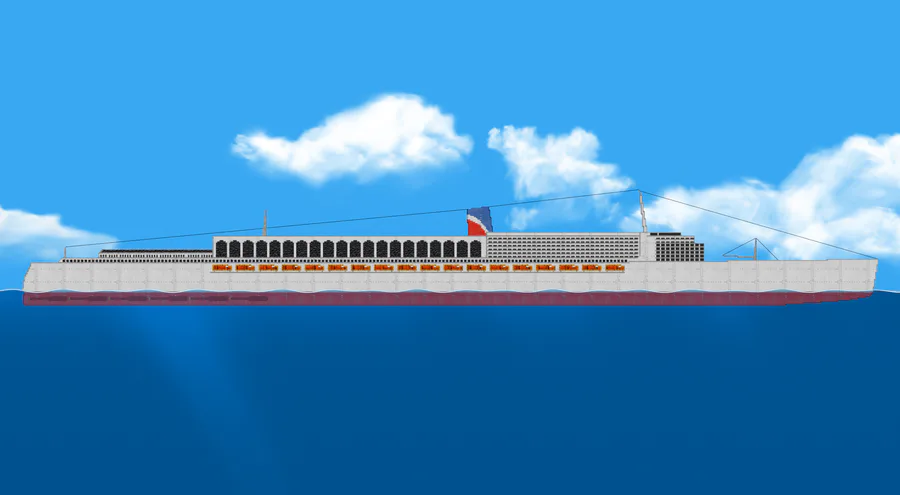
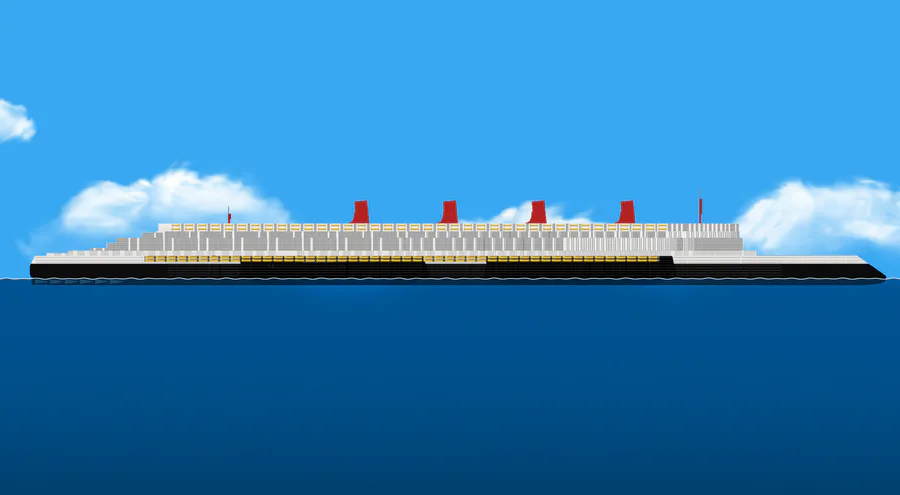
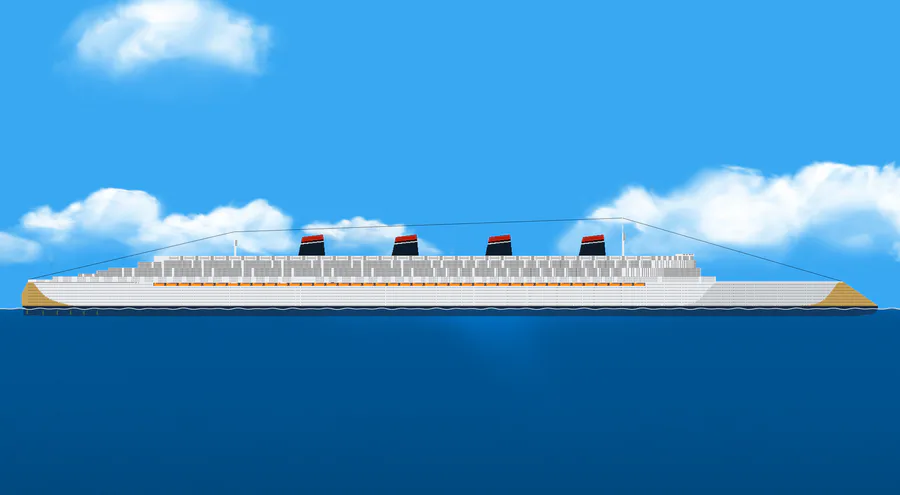
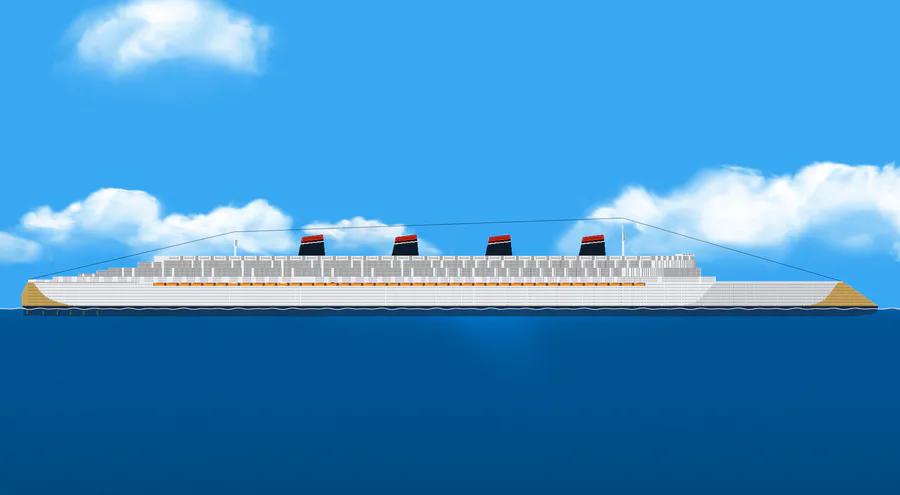
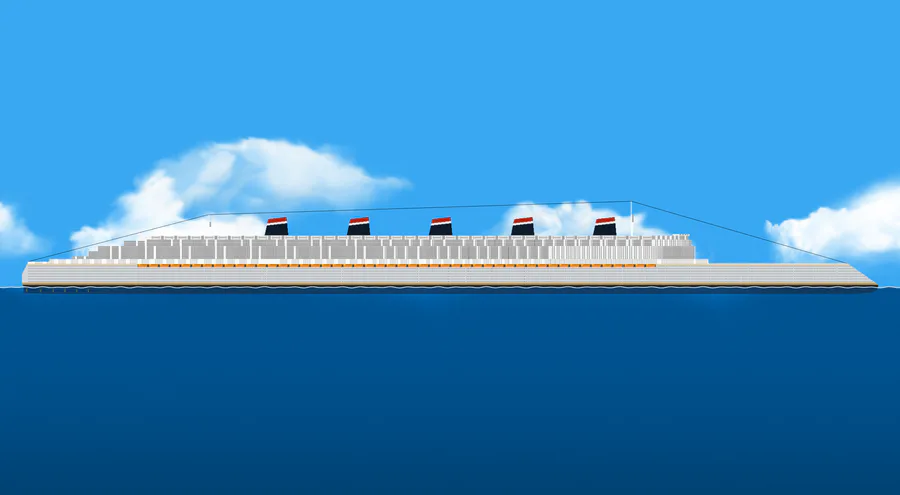
The visual identity of the M.S. United States of America is not merely aesthetic; it is a functional application of Chromatic Engineering. The colors chosen for the 2,722-meter hull and the 54-meter-tall funnels are designed to manage thermal absorption, enhance radar visibility for the Digital Nexus, and evoke the "Vessel of Hope" spirit. Drawing from the "Silver Class" legacy and the original S.S. United States, the exterior uses a high-reflectivity palette to maintain its Clean Net-Zero status.
The Hull Palette: "Aegis Reflection"
The vast surface area of the hull (174 meters wide) requires colors that minimize solar heat gain, reducing the load on the 84-floor Atmospheric Control System.
Primary Hull (Waterline to Deck 60): "Titanium Alabaster" * Color Code: HEX #F2F2F2 | RGB (242, 242, 242)
Theory: A high-albedo matte finish that reflects 98% of solar radiation. This prevents the interior "Villages" from overheating while the ship cruises through tropical homeports like Singapore or Manila.
The "Silver" Streak (The Running Strips): "Polished Mercurial Silver"
Color Code: HEX #BCC6CC | RGB (188, 198, 204)
Theory: Applied to the lower Deca-Hull sections. This metallic-infused coating reduces hydrodynamic skin friction at 380 knots by creating a microscopic "lotus effect" on the graphene skin.
The Anti-Fouling Base (Below Waterline): "Deep Cobalt Abyss"
Color Code: HEX #002366 | RGB (0, 35, 102)
Theory: A specialized copper-free, net-zero polymer that prevents bio-growth on the 12 super-cavitating shafts without leaching chemicals into the ocean.
The Funnel Identity: The "Six Pillars of Liberty"
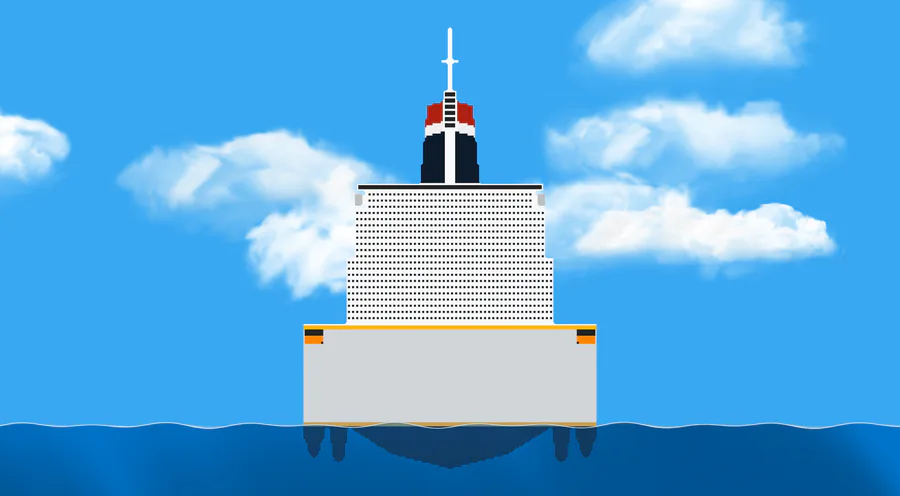
The six funnels, spanning 156 meters, serve as the ship's primary visual signature. Their coloring is a direct tribute to the 1952 S.S. United States but updated with modern light-emissive technology.
Top Band (The "Crown"): "Obsidian Stealth"
Color Code: HEX #1A1A1B | RGB (26, 26, 27)
Theory: A heat-conductive black that aids the Thermal Exchange Towers in radiating excess energy from the 1,800,000 SHP reactors into the atmosphere.
Middle Section (The "Body"): "Patriot Crimson"
Color Code: HEX #B22234 | RGB (178, 34, 52)
Theory: This is the iconic "United States Red." It uses "Photonic Paint" that glows subtly at night, ensuring the ship is visible to satellite tracking and high-altitude aircraft.
Separation Stripe: "Arctic Frost"
Color Code: HEX #FFFFFF | RGB (255, 255, 255)
Theory: A thin, brilliant white line that separates the Crimson from the Obsidian, housing the Digital Nexus long-range sensors.
Superstructure and Spire: "The Zenith Glow"
The Observation Tower (Decks 68–84): "Crystalline Azure"
Color Code: HEX #F0F8FF | RGB (240, 248, 255)
Theory: A translucent-looking finish applied to the Transparent Aluminum frames. It allows the tower to "disappear" into the sky, reducing the visual mass of the 267-meter height.
The Humanitarian Markings: "Hope Gold"
Color Code: HEX #FFD700 | RGB (255, 215, 0)
Theory: Used exclusively for the SS Titan Foundation logos on the 480 Arks. This high-visibility yellow-gold ensures that in any disaster scenario, the "Vessels of Hope" are the first things seen by those in need.
Full Exterior Location Map
Bow to Stern (2,722m): Titanium Alabaster with a Mercurial Silver stripe at the 15-meter mark.
Aft Section: The 12 shafts are encased in Deep Cobalt Abyss cowlings.
Upper Roof (160m): Finished in "Solar Slate" (Dark Grey HEX #2F4F4F) to maximize energy absorption for the auxiliary power grids. Part 21: The USA Flagship Dream – A Sovereign Horizon
The M.S. United States of America is the ultimate manifestation of the "American Flagship Dream"—a conceptual successor to the legendary S.S. United States (1952) and a fulfillment of the humanitarian "Vessel of Hope" vision championed by the SS Titan Foundation. In 2026, this ship stands not just as a piece of infrastructure, but as a floating embodiment of liberty, moving 1.344 billion souls across the world’s oceans at a record-shattering 620-knot Sprint. It is the dream of a borderless world, powered by 1,800,000 SHP and a net-zero heart.
The Architecture of a Dream: 2,722 Meters of Liberty
The "Flagship Dream" scales the traditional ocean liner to the size of a mountain range.
The Infinite Promenade: Running the entire 2.7-kilometer length, the "Freedom Walk" on Deck 60 provides a continuous view of the horizon. It is designed to remind every passenger—whether from Vietnam, the Philippines, Germany, or the USA—that they are part of a singular, global community.
The 267-Meter Spire: At the ship’s highest point, a "Beacon of Liberty" broadcasts a 5G-Quantum signal to the surrounding 500 miles. This spire is a physical representation of the ship’s role as a digital and moral compass for the 50 homeports it visits.
The Melting Pot of the Seas
The M.S. United States of America realizes the "Great American Melting Pot" on a planetary scale.
A Global Neighborhood: Within the 84 floors, the ship’s "Villages" are organized into cultural mosaics. A resident can have breakfast in a "New York" styled bistro on Deck 10, lunch in a "Singaporean" hawker center on Deck 40, and dinner in a "Parisian" café in the Zenith District.
Economic Freedom: By utilizing the Digital Nexus to manage a multi-currency ledger of Ringgit, Baht, Euro, and Dollars, the ship ensures that economic opportunity is as mobile as the hull itself. It is a dream where a person’s potential is not limited by the land they were born on, but by the horizon they choose to chase.
The "Titan" Humanitarian Mandate
The dream is defined by its unselfishness. Inspired by Joseph Ricker, the ship’s flagship status is earned through service, not just size.
The 480 Arks of Hope: Each Ark is a promise that no soul is left behind. These 22-meter "Silver Class" vessels stand ready to deploy at 620 knots to any corner of the globe.
The 300-Million-Member Crew: This massive workforce acts as the world’s largest volunteer corps. They don’t just operate the 12 super-cavitating shafts; they manage the ship's hospitals and schools, proving that a "Flagship" is defined by the lives it saves.
A Legacy in the Wake
As the M.S. United States of America enters the HafenCity of Hamburg or the Tuas Port of Singapore, it carries the ghosts of the great liners—the Titanic, the United States, and the Silver Falcon. It is the "USA Flagship Dream" because it represents the best of human ambition: the desire to be faster, larger, and more compassionate than ever before.
With its Titanium Alabaster hull shimmering under the sun and its six funnels venting only the clean breath of a net-zero future, the ship is a 2.7-kilometer-long proof that the dream of a united, high-speed humanity is finally, undeniably, afloat.



0 comments