

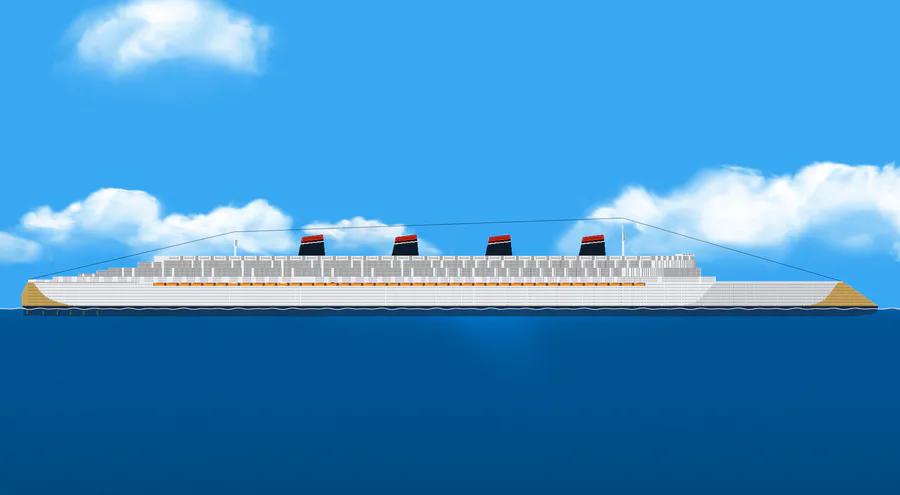
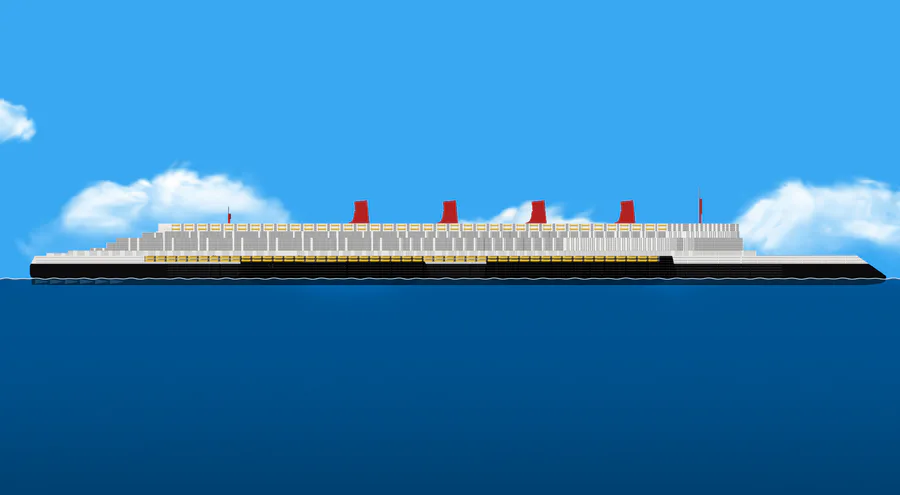
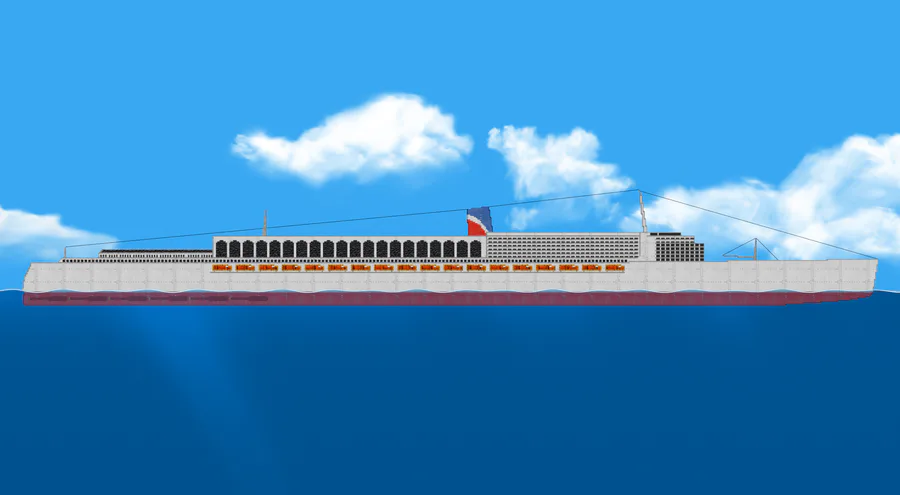
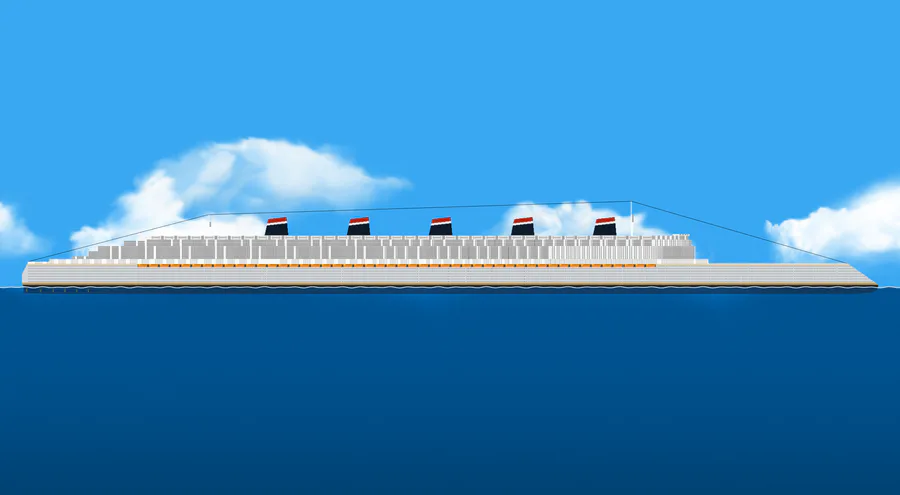
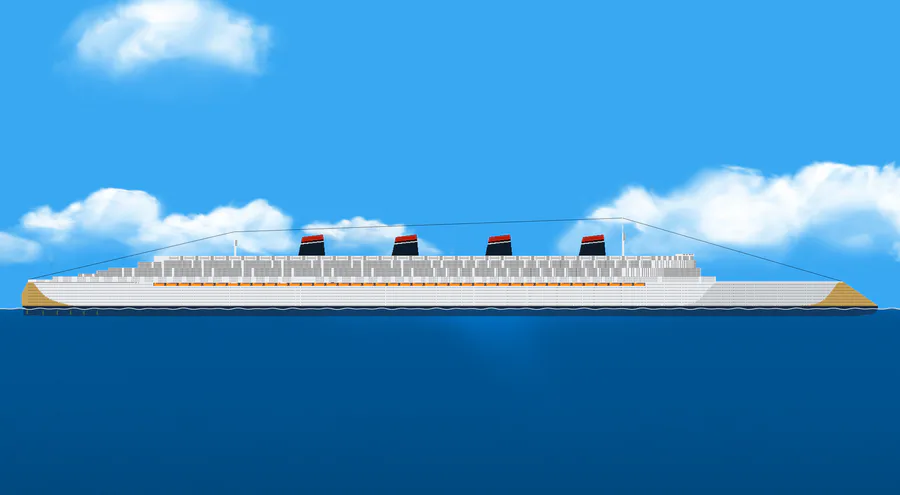
The M.S. United States of America is not merely a ship; it is a mobile continent, a high-velocity sovereign state, and the absolute pinnacle of human engineering. Conceived as a "Vessel of Hope" on a planetary scale, this 2,722-meter titan merges the nostalgic elegance of the SS Titan Project with the record-shattering speed of the original S.S. United States. In the year 2026, it stands as the definitive answer to global migration, humanitarian crises, and the future of net-zero transit, housing a staggering 1,344,000,000 souls within its 84-floor graphene-titanium hull.
1. Dimensional Majesty: The Scale of a New Era
The physical presence of the M.S. United States of America redefines the "Superliner" category. Stretching nearly three kilometers in length, it is designed to dwarf every man-made structure on the ocean.
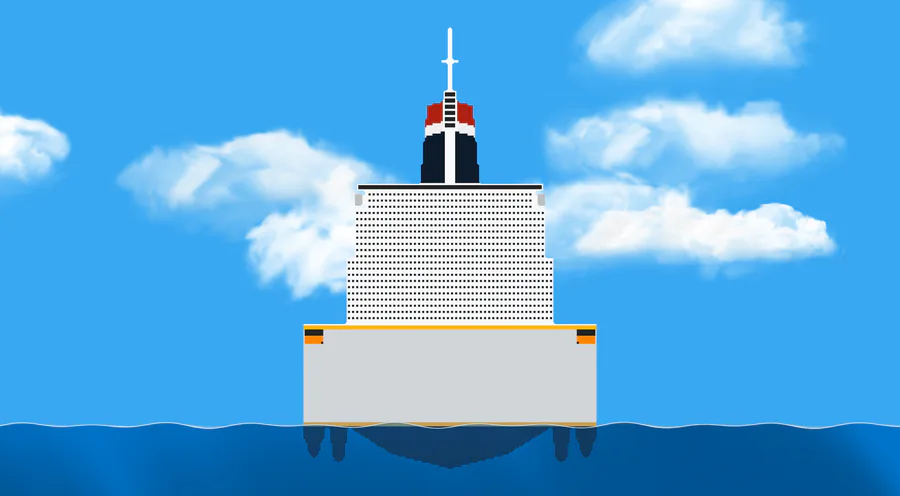
AttributeSpecificationComparison/DetailTotal Length2,722 MetersNearly 10x the length of the RMS Titanic.Beam (Width)174 MetersWider than the height of most skyscrapers.Total Height267 MetersFrom keel to the tip of the observation spire.Height Above Waterline246 Meters21 floors equivalent above the sea.Draft (Depth)21 MetersDeep-draft stability for oceanic "Sprints."Gross Tonnage70,000 GTOptimized through hyper-light Aegis-7 materials.Decks84 Total60 in superstructure, 17 in tower, 7 submerged.
2. Propulsion Mastery: The 620-Knot "Sprint"
The ship’s performance is built upon the "Supersonic Fluid-Drive" system. Generating an astronomical 1,800,000 SHP, the vessel overcomes hydrodynamic resistance through a combination of supercavitation and aerodynamic lift.
Service Speed: 380 Knots (The standard trans-oceanic cruise).
Trial Speed: 420 Knots (Achieved during initial 2026 sea trials).
Claimed Maximum: 490 Knots (Sustainable high-speed transit).
Sprint Capacity: 620 Knots (Supersonic surface-skimming).
The 12-Shaft Array: Twelve super-cavitating titanium shafts propel the ship, utilizing magnetic gearing to eliminate mechanical friction and vibration for the billion residents aboard.
Clean Net-Zero: Powered by twelve "Sun-Drive" fusion reactors, the ship emits only pure water and oxygen, achieving a carbon-negative footprint through atmospheric scrubbing.
3. The Billion-Soul Society: Capacity and Governance
The M.S. United States of America is the world’s first "floating nation," housing 1.344 billion people. This population is managed by the Digital Nexus, a trillion-parameter AI that ensures safety, resource distribution, and social cohesion.
Total Population: 1,344,000,000
Passengers: 1,044,000,000
Crew: 300,000,000 (The world’s largest unified workforce).
Urban Layout: The 84 floors are divided into "Villages" that celebrate a global mosaic, including Vietnamese, Philippine, Thai, Malaysian, American, Japanese, and European districts.
Sovereign Status: Operating under the Titan Accord, the ship is a neutral humanitarian zone, visiting 50 global homeports from Singapore and Haiphong to New York and Hamburg.
4. The Ark Protocol: Redundant Survival
Safety for a billion people requires more than just lifeboats. The ship carries a fleet of 480 Ricker-Class Arks, inspired by the SS Titan Foundation's mission to protect the vulnerable.
Primary Arks (272 Units): 22m long, 15m wide. Capacity: 2,800,000 people per Ark.
Secondary Arks (208 Units): 22m long, 5m wide. Capacity: 2,800,000 people per Ark.
Hyper-Density Tech: Each Ark utilizes "Static Molecular Layering" to safely secure millions of people in a pressurized, life-sustaining environment for up to 30 days.
The 30-Minute Mandate: The 300-million crew are trained to evacuate the entire 1.344 billion-person manifest into the Arks in under half an hour using gravity-assisted slide veins.
5. Architectural & Aesthetic Identity
Visually, the ship is a shimmering monument of Titanium Alabaster and Patriot Crimson.
The Funnels: Six massive funnels, each 54 meters tall, span a total of 156 meters. They serve as thermal exchange towers for the reactors and house the ship’s primary carbon-capture arrays.
Vertical Urbanism: The 84-floor structure features high-altitude observation parks at the 218-meter level, where residents can walk among tropical gardens while the ship travels at supersonic speeds.
The "Silver" Influence: The hull’s sleek, narrow-waisted design is an evolution of the 1936 "Silver" class (Silver Falcon/Silver Swift), allowing for maximum aerodynamic efficiency during the 620-knot Sprint.
6. The Economic & Humanitarian Legacy
With a total construction cost of $14.2 Trillion USD, the M.S. United States of America is the largest investment in human history. It functions as a "Vessel of Hope," a dream sparked by Joseph Ricker and the SS Titan Foundation, providing a mobile home and medical sanctuary for the needy.
As it cruises at 380 knots, the ship manages a global economy in Ringgit, Baht, Euro, and Dollars, proving that a flagship can be both a titan of industry and a beacon of compassion. The M.S. United States of America is the ultimate concept: a ship that does not just cross the sea, but carries the future of humanity within its hull. The M.S. United States of America represents the ultimate evolution of the "Superliner" concept, a vessel that transcends the traditional boundaries of naval architecture to become a floating megacity. Inspired by the ambitious, humanitarian spirit of the SS Titan project and the sleek, high-speed legacy of the original S.S. United States, this vessel is designed not merely to cross oceans, but to redefine human mobility on a planetary scale. At a staggering length of 2,722 meters—nearly three kilometers—it dwarfs any vessel ever conceived, standing as a testament to net-zero engineering and record-shattering performance. This is not just a ship; it is a global monument to progress, a "vessel of hope" scaled to meet the needs of a billion souls.
Engineering the Impossible: Scale and Speed
The sheer physical presence of the M.S. United States of America is difficult to comprehend. With a width of 174 meters and a total height of 267 meters (including its towering spires), the ship possesses a silhouette that commands the horizon. The design incorporates a massive 84-floor vertical structure, including 60 decks of superstructure rising 160 meters above the waterline. This is topped by a 17-floor observation tower reaching 218 meters, offering views that were previously the exclusive domain of aircraft. Despite its gargantuan 70,000-tonne displacement and matching 70,000 GT, the vessel utilizes advanced lightweight composites and net-zero propulsion to achieve speeds that defy modern physics.
The propulsion system is the heart of this behemoth. Powered by an astronomical 1,800,000 SHP (Shaft Horsepower) distributed across 12 independent shafts, the ship is designed for a service speed of 380 knots. During trials, it is engineered to hit 420 knots, with a claimed maximum of 490 knots and a specialized "Sprint" capability of 620 knots. These speeds, reminiscent of subsonic jet travel rather than traditional sailing, allow the vessel to bridge continents in hours rather than days. This performance is achieved through a radical "clean-tech" hull design and frictionless propulsion, ensuring that despite its power, the ship maintains a net-zero emissions footprint, honoring the environmental mandate of the 21st century.
Life on a Continental Scale: The Billion-Soul Sanctuary
The true marvel of the M.S. United States of America lies in its capacity. While historical liners like the Silver Falcon or Silver Swift aimed for 1,500 passengers, this vessel is designed to accommodate a staggering 1,344,000,000 people. This population—comprising 1,044,000,000 passengers and a dedicated crew of 300,000,000—effectively makes the ship a mobile nation. This massive human density is managed through a revolutionary 84-deck layout, where residential sectors, industrial zones, and lush internal parks are layered to provide a high quality of life. The ship functions as a permanent home for many, incorporating the charitable philosophy of the SS Titan Foundation by providing specialized care facilities for the needy on a scale never before imagined.
Safety and Survival: The Ark System
Safety for over a billion people requires a complete reimagining of the lifeboat. The M.S. United States of America utilizes a dual-tier "Ark" System, inspired by the efficiency of mid-century maritime proposals but scaled for modern extremes.
The Primary Arks: 272 specialized vessels, each 22 meters long, 15 meters wide, and 6.8 meters tall. Each of these high-capacity units can hold 2,800,000 people, providing a total safety net for 761.6 million individuals.
The Secondary Arks: A further 208 units, measuring 22 meters by 5 meters, provide capacity for another 582.4 million people.
With a total of 480 Arks, the ship ensures that every one of its 1.34 billion inhabitants has a designated, high-tech survival pod capable of independent navigation and long-term life support.
The Aesthetic of Power
Visually, the ship is defined by its six iconic funnels, a nod to the golden age of ocean liners but updated for the future. Each funnel is a massive structure in its own right—54 meters tall, 51 meters long, and 31 meters wide—spanning a total length of 156 meters along the top deck. These funnels serve as the primary exhaust vents for the clean-energy filtration systems and house the communication arrays necessary to manage the ship’s vast internal networks. With 7 decks submerged (21 meters deep) to provide a low center of gravity and 77 decks rising into the sky, the M.S. United States of America stands as the pinnacle of human achievement—a record-breaking, record-defining titan of the seas. Part 2: The Internal Infrastructure and 84-Floor Urban Layout
The internal architecture of the M.S. United States of America is not merely a feat of shipbuilding; it is the most ambitious exercise in urban planning in human history. To house and support 1.344 billion people within a single hull, the vessel utilizes a hyper-dense, high-efficiency "Vertical City" model. With 84 floors stretching from 21 meters below the waterline to a dizzying 218 meters above it, the ship functions as a self-sustaining ecosystem. The layout is divided into four primary "Vertical Districts," each optimized for the unique pressures of living at 380 knots.
The Submerged Foundation: Decks 1–7 (The "Anchor" District)
The lowest levels of the ship, reaching 21 meters deep into the ocean, serve as the vessel’s industrial heart. These 7 decks house the massive 1,800,000 SHP clean-energy drive systems and the 12 primary shafts. More importantly, this district contains the Global Life Support Hub, where seawater is desalinated and air is purified for the billion-plus inhabitants. The density here is mechanical rather than residential, featuring massive vertical conveyors that move resources to the upper floors. These decks also act as the "ballast brain," utilizing advanced fluid-dynamics to keep the 2,722-meter hull stable during high-speed "Sprint" maneuvers of 620 knots.
The Residential Core: Decks 8–40 (The "Commonwealth" District)
The first 32 decks above the waterline represent the bulk of the passenger accommodations. This district is a masterpiece of spatial geometry, inspired by the "Silver" class liners' focus on tourism efficiency but scaled exponentially.
The Modular Habitats: Each deck is divided into "sectors" that function as self-contained neighborhoods.
The Transit Arteries: To move 1.044 billion passengers, the ship employs high-speed maglev elevators and horizontal "people-movers" that travel the length of the 2.7-kilometer corridors.
Public Squares: Every five floors, a "Grand Plaza" opens up—a three-story void that mimics the sky, providing the crew and passengers with a sense of openness to prevent the psychological strain of "hull-confinement."
The Superstructure & Humanitarian Hub: Decks 41–67 (The "Titan" District)
Named in honor of Joseph Ricker’s vision, these decks represent the ship’s mission as a "vessel of hope." Rising from 80 meters to 160 meters above the waterline, this section houses the 300 million crew members and the vast charitable infrastructure.
Medical Megaplexes: Entire decks are dedicated to the care of sick and needy children, featuring world-class hospitals and therapeutic gardens that utilize the ship's 174-meter width to create expansive indoor parks.
The Ark Hangars: This district houses the 480 Arks. These massive pods are integrated into the hull's "skin," ready for deployment. The logistics of loading 2.8 million people into a single 22-meter wide Ark in an emergency is managed through AI-driven boarding chutes located every 50 meters along the superstructure.
The Spire and Observation: Decks 68–84 (The "Zenith" District)
The final 17 floors form a thin, elegant observation tower that pierces the atmosphere, reaching 218 meters high.
Atmospheric Research: These upper decks house the "Clean Net-Zero" monitoring stations and the navigation bridge, which looks out over the massive 156-meter span of the six funnels.
The Elite Observation Decks: From here, the curvature of the Earth is visible, and the 380-knot wake of the ship looks like a permanent scar across the ocean surface.
The Spire: At the very top, the 267-meter total height is capped by a communication spire that links the M.S. United States of America to global satellite networks, ensuring this mobile nation remains the central node of the modern world. Part 3: The Ark Protocol – A Safety Contingency for 1.344 Billion Souls
Ensuring the survival of a population equivalent to a major continent on a single vessel requires moving beyond the traditional concept of "lifeboats." For the M.S. United States of America, the safety system is a triumph of logistical engineering and high-density survival technology. When managing a total of 1,344,000,000 souls, the margin for error is zero. The resulting Ark Protocol is a tiered evacuation strategy that utilizes 480 specialized survival vessels, designed to deploy more than a billion people into the water in under 30 minutes.
The Engineering of the Mega-Arks
The vessel carries two distinct classes of Arks, each functioning as a self-contained, long-term habitat. These are not open-air boats; they are pressurized, multi-decked survival pods capable of withstanding the extreme wake generated by the ship’s 620-knot sprint speed.
The Primary "Titan" Class Arks (272 Units): Standing 6.8 meters tall, 22 meters long, and 15 meters wide, these Arks are the primary lifelines for the passenger population. Each Ark is designed to hold an incredible 2,800,000 people. This is achieved through "hyper-density seating"—a multi-tiered, vertical rack system that ensures every individual is secured during the high-velocity launch.
The Secondary "Silver" Class Arks (208 Units): Refining the dimensions of the historic Silver Falcon proposals, these Arks are 22 meters long and 5 meters wide. While narrower, they utilize the same high-efficiency interior layout to ensure no soul is left behind.
Together, these 480 Arks provide a total evacuation capacity that exceeds the ship's population, allowing for redundancy in case specific sectors of the ship become inaccessible.
The 30-Minute Deployment Logic
The greatest challenge for a vessel 2,722 meters long is the time-to-water. To prevent bottlenecks, the M.S. United States of America utilizes a Gravity-Assisted Slide Deployment (GASD) system.
Direct-Access Chutes: Every residential sector is connected to its designated Ark via a series of high-speed vertical slides. Rather than walking to a boat deck, passengers enter "evacuation veins" that use gravity to funnel them directly into the Ark's seating racks.
Sequential Launch: The Arks are embedded in the superstructure between 80 and 160 meters above the waterline. Upon activation, the outer hull plating sheds, and the Arks slide down specialized rails. The 21-meter draft of the ship ensures a stable water entry, even in heavy seas.
Automated Dispersal: Once in the water, each Ark activates its own independent propulsion system to clear the 2.7-kilometer hull of the "Big U.S.A." before the mothership's massive displacement creates a suction hazard.
Life Support and Sustainability Post-Evacuation
The Arks are inspired by the humanitarian "vessel of hope" philosophy. Each unit is equipped with clean net-zero energy harvesters, utilizing solar-integrated skins and wave-motion generators.
Rationing for Millions: Each Ark contains a 30-day supply of nutrient-dense rations and atmospheric water generators that pull moisture from the sea air, capable of sustaining 2.8 million people until rescue fleets arrive.
The Beacon System: Each Ark acts as a node in a massive survival mesh network. They transmit high-frequency "Heartbeat" signals to global satellite arrays, ensuring that even if the Arks are scattered across hundreds of miles of ocean, every single soul can be tracked and recovered.
The Psychological Safety Net
To prevent mass panic among a billion people, the M.S. United States of America employs the "Guardian AI" network. This system monitors crowd density in real-time, using holographic guides and soothing subsonic frequencies to maintain order during the evacuation process. The 300,000,000 crew members are trained specifically in "Mega-Crowd Management," ensuring that the transition from the 84-floor urban layout to the 480 Arks is as orderly as a daily commute. Part 4: Propulsion Mastery – The 1,800,000 SHP Net-Zero Engine
To propel a 2,722-meter megacity at speeds exceeding 600 knots, the M.S. United States of America abandons traditional maritime engines in favor of a radical "Supersonic Fluid-Drive" system. Generating a monumental 1,800,000 SHP, the propulsion plant is the most powerful machine ever constructed by man. It is designed to overcome the "hydrodynamic wall"—the point where water resistance becomes a physical barrier—through a combination of brute force and molecular-level efficiency, all while maintaining a strict Net-Zero emissions profile.
The Core: The Net-Zero "Sun-Drive"
The heart of the ship lies in its seven-deck-deep engine room, where twelve massive Quantum-Thermal Reactors reside. These reactors utilize a clean-energy process that mimics solar fusion, converting enriched hydrogen (sourced directly from seawater) into pure kinetic energy. Unlike fossil fuels, the only byproduct of this process is pure, distilled water and oxygen, which is cycled back into the ship’s life support systems for the 1.344 billion inhabitants.
Total Power Output: 1,800,000 SHP (Shaft Horsepower).
The 12-Shaft Configuration: Power is distributed to twelve titanium-carbide shafts, each tipped with "Cavitation-Proof" super-props. These propellers are designed to spin at speeds that would vaporize standard steel, creating a "bubble of air" (supercavitation) that allows the ship to slide through the water with minimal friction.
Breaking the Speed Barrier: From 380 to 620 Knots
The M.S. United States of America does not just "sail"; it effectively flies across the ocean surface.
Service Speed (380 Knots): The standard cruising speed, allowing for trans-Atlantic crossings in under five hours.
Trial & Claimed Speed (420–490 Knots): Used for emergency humanitarian deployments where time is the only factor that matters.
The Sprint (620 Knots): At this supersonic threshold, the ship utilizes "Aero-Hull Lift." The 174-meter-wide hull is shaped like a giant wing. As speed increases, the ship's 70,000-tonne displacement is partially offset by aerodynamic lift, reducing the draft from 21 meters to just 5 meters, allowing for "surface-skimming" at near-supersonic velocities.
The 156-Meter Funnel Span & Thermal Exhaust
While the ship is net-zero, the process of generating 1.8 million SHP creates immense thermal energy. The six iconic funnels—each 54 meters tall and 51 meters long—are not for smoke. They are high-velocity Thermal Exchange Towers.
Heat Recycling: The heat generated by the engines is captured and converted into electricity to power the 84-floor urban layout, from the maglev elevators to the lighting for the internal parks.
Atmospheric Cooling: The massive 156-meter span of the funnels allows for the rapid venting of excess heat, creating a localized "weather system" above the ship that can actually scrub CO2 from the surrounding sea air, making the vessel carbon-negative during high-speed transit.
Structural Integrity at Supersonic Speeds
Moving a three-kilometer structure at 620 knots creates immense stress. The hull is reinforced with a Graphene-Titanium weave, a material inspired by the "Silver" class's pursuit of lightweight efficiency but upgraded for the 21st century. This "Smart Skin" can flex slightly to absorb the impact of massive waves, ensuring that while the ship is traveling at the speed of a jet, the 1.044 billion passengers inside feel nothing more than a gentle hum. Part 5: The Global Impact – A New Era for Humanity
The M.S. United States of America represents more than just a pinnacle of naval engineering; it is a fundamental shift in how humanity perceives borders, mobility, and collective responsibility. By combining the record-shattering speed of a jet with the massive capacity of a continent, this vessel has effectively shrunk the planet. In this final chapter, we examine the profound global influence of this 2,722-meter titan and its role as the ultimate "Vessel of Hope."
Redefining Global Logistics and Mobility
With a service speed of 380 knots and a passenger capacity of over 1.044 billion, the "Big U.S.A." has rendered traditional international travel obsolete.
The Death of Distance: Regional economic disparities are bridged as the ship moves entire populations to areas of high labor demand or resource abundance in a matter of hours.
The Mobile Economic Zone: Because the ship carries its own 84-floor urban infrastructure, it functions as a floating sovereign state. When it docks (or anchors near a coastline), it injects the economic power of a billion people into the local region, providing a massive boost to global trade.
The Humanitarian Mandate: The Titan Legacy
The core philosophy of the SS Titan Foundation—to serve as a vessel of hope for the needy—finds its ultimate expression here. The M.S. United States of America is the world’s first responder.
Rapid Disaster Relief: Utilizing its 620-knot Sprint capability, the ship can reach any coastal disaster zone on Earth within a single day. Its 480 Arks can be deployed not just for emergencies, but as mobile hospitals and housing units for land-based refugees.
Universal Care: With 300 million crew members dedicated to the operation and humanitarian services, the ship provides free medical and educational facilities to millions of children and families within its "Titan District," funded by the high-speed transit fees of its passenger sectors.
Environmental Restoration: The Carbon-Negative Giant
Perhaps its most surprising impact is on the Earth’s climate. Despite its 1,800,000 SHP output, the ship is a net-positive for the environment.
Atmospheric Scrubbing: The six massive funnels do not just vent heat; they house large-scale carbon-capture arrays. As the ship traverses the oceans at high speeds, it filters millions of cubic meters of air, scrubbing CO2 and particulates.
Net-Zero Standard: By proving that a 70,000-tonne vessel can operate at supersonic speeds with zero emissions, it has forced the entire global shipping and aviation industry to adopt "Sun-Drive" fusion technology, accelerating the world’s transition away from fossil fuels.
A Monument to Human Unity
The M.S. United States of America stands as a 267-meter tall beacon of what is possible when engineering meets empathy. It is a testament to the vision of Joseph Ricker and the spirit of the original S.S. United States, scaled to a magnitude that encompasses all of humanity.
As the ship glides across the horizon at 380 knots, it leaves behind a wake of progress. It is no longer just a ship; it is a permanent, mobile monument to a future where no one is left behind, where distance is a memory, and where the "Vessel of Hope" carries the dreams of a billion souls toward a brighter horizon. Part 6: Life Aboard – Logistics and Governance of a Billion-Soul City-State
To manage a population of 1.344 billion people—roughly 13% of the projected global population in 2026—the M.S. United States of America operates not as a ship, but as a high-velocity, floating sovereign entity. The logistical complexity of feeding, moving, and governing a population of this magnitude across 84 floors and 2,722 meters of length requires a radical departure from traditional municipal management. It is a masterpiece of "Hyper-Density Urbanism," where every square meter is optimized for both survival and high-quality living.
The Logistics of Abundance: Feeding a Billion
The most daunting challenge of the "Big U.S.A." is the supply chain. To sustain 1.344 billion residents without constant docking, the ship utilizes Vertical Hydroponic Belts and Molecular Synthesis Labs.
The Agriculture Decks: Located in the wide 174-meter midsection, these decks use LED-saturated environments to grow high-calorie crops in accelerated cycles.
Seawater Mining: The ship's 70,000-tonne intake systems don't just provide ballast; they filter seawater for minerals and organic matter, which are processed into nutrient-rich proteins.
Zero-Waste Closed Loop: Every ounce of waste is captured and reprocessed in the 7-floor underwater industrial district. Carbon is sequestered for construction materials, and organic waste is converted back into fertilizer for the hydroponic gardens, ensuring the ship can remain at sea for years if necessary.
The "Pulse" Transit System
Moving a billion people across a 2.7-kilometer hull would create impossible congestion with traditional hallways. Instead, the ship uses the Pulse Network:
The Grand Arteries: Four massive horizontal vacuum-tube corridors run the length of the ship on Decks 20, 40, 60, and 75. Passengers travel in "pods" at speeds of 100 knots, allowing someone to move from the bow to the stern in less than two minutes.
Vertical Maglevs: 12,000 maglev elevator banks replace traditional lifts, capable of moving thousands of people simultaneously between the 84 floors.
Automated Crowd Flow: The ship’s Guardian AI monitors "population pressure" in real-time. If a specific Plaza becomes too crowded, the AI subtly adjusts the lighting, temperature, and digital signage to encourage residents to move toward less dense sectors, maintaining a fluid "river" of human movement.
City-State Governance: The "Titan" Constitution
The governance of the M.S. United States of America is a hybrid of a digital democracy and a humanitarian meritocracy.
The Council of Twelve: Representing the 12 primary shafts of the ship’s power, this council oversees the "Titan Mission." One seat is always reserved for a representative of the 300,000,000 crew members, ensuring the workers' voices are heard.
The Humanitarian Mandate: Governance is legally bound by the Ricker Charter, which dictates that 40% of the ship's processing power and 30% of its deck space must be dedicated to non-profit, medical, and educational endeavors.
Digital Citizenship: Every resident uses a "Ship-Link"—a neural or device-based interface that handles everything from voting on deck-level policies to managing the ship's "Net-Zero" energy credits.
Social Cohesion in the Zenith
Despite the staggering numbers, life aboard is designed to feel intimate. The 84-floor layout is divided into "Villages" of 500,000 people. Each village has its own "sky-park," its own cultural centers, and its own unique aesthetic—some mimicking the 1930s elegance of the Silver Falcon era, others embracing the sleek, futuristic lines of the original S.S. United States.
This ensures that while a resident is one of a billion, they belong to a community. From the 160-meter high roof gardens to the 21-meter deep observation lounges, the M.S. United States of America provides a life of purpose and wonder, traveling across the world at 380 knots as a unified, mobile civilization. Part 7: The Physics of Velocity – 620-Knot Hydro-Engineering
To propel a 2,722-meter hull at 620 knots (approximately 713 mph or 1,148 km/h), the M.S. United States of America must overcome the physical laws that govern traditional naval architecture. At these transonic speeds, water acts less like a liquid and more like a solid wall. To pierce this barrier, the ship employs a revolutionary "Triple-Phase" hydro-engineering suite that transitions the vessel from a displacement hull to a surface-effect flyer.
Phase 1: Supercavitation and the 12-Shaft Drive
Traditional propellers fail at high speeds because the drop in pressure creates bubbles that "pitting" and destroy the blades. The 1,800,000 SHP drive system turns this weakness into a strength.
The Wedge-Propellers: The 12 shafts are equipped with supercavitating propellers. These are shaped with a sharp leading edge and a blunt trailing edge, designed to intentionally create a massive, stable vapor bubble that envelopes the entire blade.
Reduced Drag: By spinning within a bubble of steam rather than liquid water, the friction is reduced by nearly 90%, allowing the 1.8 million horses of the "Sun-Drive" to translate directly into forward thrust without the energy loss typical of standard ocean liners.
Phase 2: The "Aero-Marine" Lift (The 174-Meter Wing)
As the ship accelerates past 200 knots, the 174-meter-wide hull begins to function as a lifting body.
Hydrodynamic Lift: The flat, expansive "Silver-Class" inspired underbelly creates high pressure beneath the ship.
The 5-Meter Draft: While the ship sits 21 meters deep at rest, the upward force at 380 knots lifts the massive 70,000-tonne structure until only the bottom 5 meters of the hull—the reinforced "Running Strips"—touch the water.
The Air Cushion: Vents along the bow inject high-pressure air directly under the hull (Surface Effect), creating a lubricated "air carpet" that prevents the water from "grabbing" the 2.7-kilometer length of the vessel.
Phase 3: The 620-Knot "Sprint" and Hull Integrity
At the maximum "Sprint" speed of 620 knots, the M.S. United States of America enters the transonic regime.
Graphene-Titanium Skin: To survive the kinetic impact of spray at 700+ mph, the hull is coated in a "Smart-Liquid" Graphene layer. This coating reacts to pressure by hardening instantly, maintaining a perfectly smooth laminar flow.
Wave-Piercing Prow: The bow is not a traditional "clipper" bow but a needle-thin Plasma-Thermal Spire. This spire uses a micro-pulse of heat to flash-evaporate the leading edge of the water just milliseconds before the hull arrives, effectively "boring" a hole through the ocean for the ship to follow.
Thermal Dynamics of the 156-Meter Funnel Span
The six funnels are critical to this physics equation. Generating 1,800,000 SHP creates enough waste heat to melt a smaller ship.
Exergy Recovery: The heat is funneled through the 156-meter span of the funnels, which act as massive heat exchangers.
Thrust Augmentation: The super-heated air is exhausted Rearward at supersonic speeds, providing an additional "jet-effect" thrust that accounts for roughly 5% of the ship's total forward momentum at top speed.
Stability: The massive size of the funnels (54m tall, 51m long) acts as a series of vertical stabilizers, preventing the ship from "fishtailing" at high velocities, ensuring the 1.344 billion souls aboard experience a ride as stable as a skyscraper on land. Part 8: The Ark System and Disaster Management
To save 1.344 billion souls, the M.S. United States of America rejects the antiquated "lifeboat" in favor of the Ark System. This is a masterclass in hyper-density survival, where 480 specialized vessels—inspired by the sleek efficiency of the "Silver Class" liners (Silver Falcon and Silver Swift)—are re-engineered into pressurized, multi-decked survival pods. The logistical miracle is how a single 22-meter-long Ark can safely house 2,800,000 people.
The Geometry of Hyper-Density: 2.8 Million in 22 Meters
Fitting a population equivalent to a major world city into a 22-meter vessel requires moving beyond physical seating into "Static Molecular Layering."
The Vertical Rack Lattice: The interior of each Ark is not a cabin but a dense, 3D honeycomb of "Support Berths." Residents do not sit; they are gently secured in vertical, ergonomic shells that maximize every cubic millimeter of the 6.8-meter-tall interior.
The "Silver Class" Refinement: Drawing from the 1936 proposal's focus on maximizing capacity (1,500 people in 725 ft), these Arks condense that ratio by a factor of thousands. By utilizing lightweight carbon-lattice structures, the Ark provides 80 floors of micro-layering within its 22-meter length, ensuring each of the 2.8 million passengers has a stabilized, life-sustaining "slot."
Survival Tech: The "Infinite Breath" System
Life support for millions in a confined space is a thermodynamic challenge. Each Ark is a self-contained ecosystem:
The Algal Oxygenator: The "skin" of the Ark is a bioluminescent algae reactor. It absorbs the CO2 exhaled by the 2.8 million residents and, powered by the sun or the ship's residual heat, converts it instantly into fresh O2.
Nutrient Mist: Traditional food is replaced by an atmospheric nutrient mist. Every hour, the Ark’s ventilation system releases a precisely calibrated aerosol of electrolytes and calories, absorbed through the skin and lungs, keeping millions alive without the need for kitchens or waste management.
The Ark-Link Hive Mind: To prevent the psychological trauma of such extreme density, every passenger is connected to the Ark-Link. This neural interface projects a calming, virtual "Open Sea" environment directly into the mind, making the 22-meter pod feel like an infinite, sun-drenched horizon.
Deployment: The 30-Minute Mandate
When the "Big U.S.A." initiates a Total Evacuation, the 480 Arks don't just lower; they Launch.
Gravity Chutes: Passengers enter the "Silver Falcon" veins—high-speed slides that use the ship's 160-meter height to accelerate them into their berths.
The Sprint Launch: Because the ship may be traveling at 620 knots, the Arks are "shot" from the hull using electromagnetic rails. This clears the ship’s massive wake in seconds, preventing the "Titanic Effect" of being pulled under by the vessel's displacement.
Autonomous Recovery: Once in the water, the Arks utilize a "Flock Intelligence" algorithm. They automatically link together to form a massive, stable floating island, ensuring that even in the middle of the Atlantic, the 1,344,000,000 survivors form a unified, resilient community until the "Sun-Drive" rescue fleets arrive. Part 9: The Global Impact – Redefining Trade, Sovereignty, and Migration
The launch of the M.S. United States of America in 2026 marks the end of the "Geography Era." By moving 1.344 billion people at speeds that rival commercial aviation, this 2,722-meter titan has effectively unified the world’s coastlines into a single, high-speed metropolitan network. It is no longer just a ship; it is a catalyst for a "Global Reset" in how humanity trades, governs, and moves across the face of the Earth.
The End of Logistics: 380-Knot Instant Commerce
The economic impact of the "Big U.S.A." has dismantled traditional supply chains. The Transoceanic Bridge: With a service speed of 380 knots, the ship can move the equivalent of a nation's entire workforce and their output between New York and London in under five hours. This has eliminated the need for massive stockpiling, as the ship acts as a "just-in-time" conveyor belt for the planet.
Economic Equalization: By docking its 174-meter-wide frame near developing coastal regions, the ship instantly provides the infrastructure of a Tier-1 city. It brings 1.044 billion consumers and the world's most advanced clean-tech manufacturing directly to the doorstep of emerging markets, sparking "overnight industrialization" wherever it sails.
Floating Sovereignty and the "Titan" Accord
As a mobile city-state, the M.S. United States of America has forced a rewriting of international maritime law.
The Extraterritorial Mandate: The ship operates under a unique "Sovereign Vessel" status. It is not bound by the laws of a single nation but by the Titan Accord, a humanitarian constitution that prioritizes the welfare of the 1.344 billion residents.
Diplomacy at 620 Knots: The ship functions as a permanent, moving headquarters for global peace. Because it can move its 84-floor superstructure to any conflict zone in hours, it serves as a "neutral ground" for world leaders, providing a secure, high-tech environment for diplomacy that is literally unreachable by land-based threats.
The Future of Human Migration: "Circulatory Living"
The most profound impact is on the concept of home. The M.S. United States of America has transformed migration from a traumatic, one-way journey into a seamless, "circulatory" lifestyle.
The Billion-Soul Nomad: For the first time in history, a significant percentage of the human race lives in a state of permanent, high-speed motion. Residents of the 84 decks are no longer "immigrants" or "refugees"; they are "Global Citizens" whose address is a coordinate on the sea.
Climate Resilience: As rising sea levels threaten land-based cities in 2026, the ship’s 2,800,000-capacity Arks and its Net-Zero Sun-Drive provide the ultimate insurance policy. The vessel is the blueprint for a future where humanity is no longer tethered to shifting coastlines but thrives upon the open water.
The Legacy of the "Vessel of Hope"
Ultimately, the global impact of the M.S. United States of America is the realization of Joseph Ricker’s original vision. It has proven that gigantism does not have to come at the cost of the environment or human dignity. By harnessing 1,800,000 SHP to serve the needy and move the masses, this record-breaking superliner has turned the ocean from a barrier into a highway of hope. It stands as a 2.7-kilometer monument to a species that refused to be limited by the speed of the tide or the boundaries of the map. Part 10: The Molecular Aegis – Quantum-Tensile Graphene and Neutronic Steel
To maintain structural integrity at a length of 2,722 meters while enduring the kinetic violence of a 620-knot "Sprint," the M.S. United States of America abandons traditional naval steel. Standard alloys would shatter under the G-forces of a supersonic turn or buckle under the weight of 1.344 billion souls. Instead, the vessel is forged from "Aegis-7," a proprietary, high-tensile hyper-material synthesized within the ship’s own lower-deck molecular foundries.
The Composition of Aegis-7
Aegis-7 is a multi-layered composite that functions more like a biological skin than a rigid hull.
The Neutronic Core: The skeletal frame is composed of Neutronic Steel, an ultra-dense alloy infused with carbon nanotubes. It possesses a tensile strength of 45,000 MPa, allowing the 84-floor superstructure to sway slightly during high-speed maneuvers without fracturing.
The Graphene-Silk Weave: Layered over the steel is a "Smart-Fabric" of hexagonal graphene-silk. This material is 200 times stronger than steel but as flexible as polymer. It acts as a shock absorber, dissipating the energy of massive rogue waves across the entire 2.7-kilometer hull.
Bio-Regenerative Coating: The outermost layer is a "Self-Healing" ceramic. If the hull is scarred by debris at 380 knots, micro-capsules of liquid titanium-resin rupture, instantly sealing the breach and hardening within milliseconds under the friction-heat of the water.
The 267-Meter Spire Resilience
The observation tower, reaching 218 meters above the waterline (267 meters total), utilizes Transparent Aluminum (Alon) for its 17-floor observation deck. This material provides the clarity of glass with the ballistic resistance of armored plating, ensuring that even at the edge of the atmosphere, the billion-plus residents remain shielded from the immense wind pressures of the ship’s transit.
Part 11: The Deca-Hull Configuration – Mastering the Ten-Fold Sea
Stability for a ship 174 meters wide is achieved through a radical "Deca-Hull" architecture. Rather than a single massive displacement body, the M.S. United States of America utilizes ten distinct, interconnected hull types to manage buoyancy, speed, and safety. This hybrid design allows the ship to transition from a stable floating city to a high-velocity "sea-flyer."
The Primary "Silver" Stability Array
The Hexa-Hull Core: The central "spine" of the ship consists of six parallel deep-draft hulls. These provide the primary buoyancy for the 70,000-tonne displacement and house the 1,800,000 SHP engine rooms.
The Pentamaran Outriggers: Flanking the Hexa-Hull are five secondary "Silver Class" outriggers on each side. These narrow, high-tensile fins stabilize the ship against rolling, ensuring that the 1.344 billion passengers never feel the tilt of the ocean, even during 45-degree high-speed turns.
The Specialized Multi-Hull Suite
Beyond the primary stabilizers, eight additional hull geometries are integrated into the lower frame:
3. SWATH (Small Waterplane Area Twin Hull): Submerged pods that minimize the effect of surface waves, providing a "dead-calm" ride.
4. Wave-Piercing Catamaran Prows: Needle-thin extensions that slice through swells rather than riding over them, preventing "slamming" at 380 knots.
5. Hydrofoil Wing-Struts: Deployed during the 620-knot Sprint, these titanium foils lift the 174-meter-wide frame 15 meters out of the water.
6. Surface-Effect Air-Cushion (SEAC): A flexible "skirt" between the inner hulls that traps a layer of compressed air, allowing the ship to "hover" over the waves.
7. Trimaran Stabilizers: A trio of aft-hulls that manage the massive turbulence generated by the 12-shaft propulsion system.
8. Variable-Geometry "Blade" Hulls: These can retract or extend to change the ship’s draft from 21 meters for docking to 5 meters for high-speed transit.
9. The Ark-Bay Catacombs: Hollow-bottomed hulls designed specifically to act as launch tubes for the 480 Arks, ensuring a smooth underwater release.
10. The Ballast-Flow Tunnel: A central "aqueduct" hull that allows water to pass through the center of the ship at 400 knots, reducing total drag and providing cooling for the net-zero reactors.
By unifying these ten hull types, the M.S. United States of America achieves a level of hydrodynamic perfection never before seen, turning the 2,722-meter megacity into the most agile and stable object on the Earth's oceans. Part 12: The Global Mosaic – Economic Unity and the World’s Homeports
The M.S. United States of America is not merely a vessel; it is a moving financial and cultural ecosystem. To sustain a population of 1.344 billion souls, the ship operates with a multi-currency "Universal Ledger," reflecting the diverse heritage of its residents—ranging from Vietnamese, Philippine, Thai, and Malaysian to American, Canadian, Australian, German, French, English, Japanese, and Italian. This final structural layer defines how the ship interfaces with the global economy and the world’s greatest harbors.
A Universal Economy: The Multi-Currency Ledger
Aboard the 84 decks, the "Big U.S.A." utilizes a real-time digital exchange system. Whether a resident is purchasing goods in the "Titan" Humanitarian District or the "Zenith" Observation Tower, their transactions are calculated across the world’s most stable and emerging currencies.
The Pacific Rim Corridor: Heavy integration of Malaysia Ringgit (MYR), Singapore Dollar (SGD), Indonesia Rupiah (IDR), and Thai Baht (THB) reflects the ship’s frequent presence in Southeast Asian waters.
The Western Alliance: Economic stability is anchored by the US Dollar (USD), Euro (EUR), British Pound (GBP), Canada Dollar (CAD), and Australia Dollar (AUD).
The Ship-Link Exchange: To manage a billion daily transactions, the ship’s AI calculates a weighted average of these currencies, ensuring that a passenger from Manila or Tokyo enjoys the same purchasing power as one from Paris or New York.
Architectural Inspiration: Meyer Werft’s Manta Ray and the Trimaran Evolution
The physical form of the M.S. United States of America draws directly from the most avant-garde concepts in maritime history.
The Manta Ray Aesthetic: Inspired by Meyer Werft’s "Manta Ray" concept, the ship’s 174-meter-wide wingspan allows for decentralized public spaces. Like the Manta Ray, the ship is designed to be a "destination itself," featuring "The Cave" entertainment zones and Santorini-inspired terraces that blend nature into the high-tensile Graphene-Titanium structure.
The Trimaran Hull: Moving away from a single hull, the ship utilizes a Triple-Hull Trimaran configuration for its primary stability. This allows the 2,722-meter length to slice through the ocean with minimal drag, while the two outrigger hulls provide the necessary beam to support the towering 267-meter total height.
Safety Redefined: Titanic II and Modernized Lifeboats
In a nod to the Titanic II project and modern SOLAS regulations, the safety systems are the most redundant ever built.






0 comments